Tag Archives: Suffolk Regiment

Major Alexander Leslie

Major Alexander Leslie

Alexander Augustus Maurice Leslie was born in France in 1852. One of five children, his parents were Government Secretary of State Francis Leslie and his French wife, Josephine.

Alexander’s mother died when he was 8 years old, by which point the family had moved back to Britain. Francis had set up home in Ealing, Middlesex, and they were living at 15 Castlebar Road, a Victorian villa.

When he completed his schooling, Alexander sought out a military life. The 1881 census recorded him as a Lieutenant in the Suffolk Regiment, living in St Helier, Jersey. He had married the year before, to Louisa Cumming, a surgeon’s daughter from Devon. They had a son, Maurice, by this point, and a daughter, Ida, was born the following year.

Lieutenant Leslie’s service records are sparse, but a later newspaper report fills in some of the gaps: “Leslie’s military experience, which extended… over a period of about 25 years, included participation in the Egyptian campaign in 1884, and service on the West Coast of Africa, in Jamaica, and in India.” [Worthing Gazette: Wednesday 30th April 1919]

During her husband’s time overseas, Louisa raised the children back home in Devon. She passed away in 1901, but which point, Alexander had retired with the rank of Captain. That year’s census found him living with Maurice and Ida at 14 Spencer Hill in Wimbledon, Surrey, a large detached villa. Maurice, now 20 years of age, was working as an accountant’s clerk, and the family had a live-in servant called Rose.

The next census record, from 1911, recorded Alexander living in rooms at 46 Leinster Gardens, Paddington. A substantial Georgian property, his landlady was Eveline Giradet, whose other residents included a barrister and a banker. Alexander’s occupation was now noted as Retired Major in the British Army.

From this point, Alexander’s trail grows cold. It is likely that he was called upon to play a part in the global conflict that broke out in 1914, though exactly when and how he did so is unclear. Records suggest he was admitted to Queen Alexandra’s Military Hospital on Millbank, Middlesex on 28th September 1916, suffering from syphilis. He only remained there for a couple of days, and his increasing age and health may have led to his retirement from duty.

For the past four years Major Alexander Maurice Leslie, who was for a period of a quarter of a century connected with the Royal Sussex Regiment, had been a resident of Worthing, and a brief intimation was given in the last issue… that he had died suddenly.

The circumstances were duly investigated by… the Deputy Coroner for West Sussex, on Wednesday afternoon, the inquiry taking place at the Central Fire Station, in High-street.

Evidence of identification was given by Colonel Francis Seymour Leslie… late of the Royal Engineers, who stated that the deceased, who was his brother, had lived at Worthing for the past four years, more or less all the time, though he had no permanent address…

Mrs Ethel William, a widow, at whose house… Major Leslie had lodged, stated that he had complained of indigestion and ate light food. On Monday evening he had his supper at half-past seven o’clock, going upstairs about half an hour later. About nine o’clock witness went to his room and found him lying in bed in great agony, and he exclaimed: “Oh, my poor heart!” Witness gave him some hot water to drink and sent for a doctor.

Dr Bernard Lees stated that he was sent for, but he found Major Leslie was dead when he got to the house. He had since made a post-mortem examination, which showed that the stomach and intestines were much distended, and there were signs of chronic gastric catarrh. The heart was fatty, but the valves were healthy. Death was due to syncope, the result of acute indigestion and the fatty condition of the heart.

A verdict of “Death from natural causes” was recorded.

[Worthing Gazette: Wednesday 30th April 1919]

[It should be noted that Alexander had been attached to the Suffolk Regiment throughout his military career. The error in the newspaper report is likely because of the Sussex town he had moved to in the mid-1910s.]

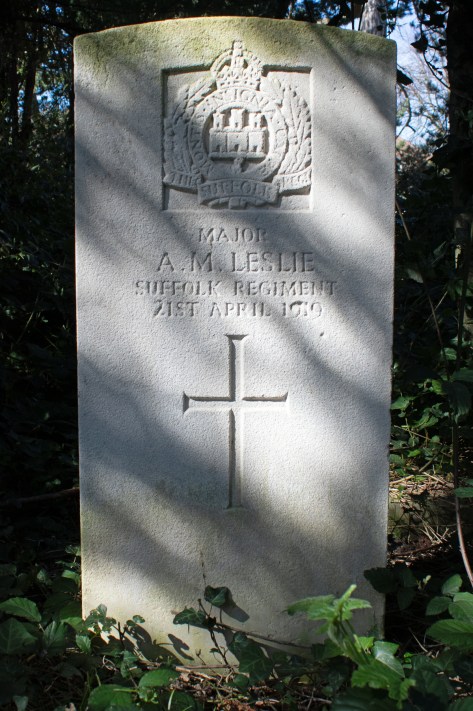
Alexander Augustus Maurice Leslie was 67 years of age when he passed away on 21st April 1919. His body was laid to rest in Broadwater Cemetery, to the north of the town he had called his home for more than four years.


Private Gilbert Smyth

Private Gilbert Smyth

Gilbert Rowland Locke Smyth was born in the summer of 1897, and was the oldest of three children to Charles and Elizabeth. Charles was a postman and bootmaker and both he and his wife came from North Molton in Devon. The 1901 found the young family taking rooms in Dobbs Cottage on East Street, midway between two pubs: the Poltimore Arms and the Miner’s Arms.

Gilbert – who was better known as Roy – found work as a clerk she he finished his schooling. By the time war broke out, he was had moved to East Sheen, Surrey, and was employed by the civil service. He was keen to play his part, and enlisted in the army on 10th December 1915.

Initially assigned to the Suffolk Regiment, Private Smyth’s service records give an insight into the young man he had become. At eighteen years of age, he was 5ft 8.5ins (1.74m) tall, and weighed 112lbs (50.8kg). While he had worn spectacles for a couple of years, he was noted as being of fair physical development. The document confirms that he had a mole on the top of his right arm.

Roy was not formally mobilised until October 1916. After four months’ training on home soil, his unit, the 14th Battalion, was sent to France. Private Smyth remained overseas for nearly a year, during which time he transferred to the 12th Battalion of the York & Lancashire Regiment.

At the end of July 1918 Roy was caught up in a German gas attack, and this would have a long-term effect on his health, particularly his eyesight. He returned to Britain on 30th November 1918, and, after a couple more months spent in France, he was formally discharged from the army on medical grounds on 5th April 1919.

The deepest sympathy is extended to Mr and Mrs C Smyth in the loss of their eldest son, Roy… Deceased, who was employed in London in the Civil Service, was taken ill with pneumonia, and died before his father could arrive.

[Exeter and Plymouth Gazette: Friday 6th August 1920]

Gilbert Rowland Locke Smyth died on 3rd August 1920: he was 22 years of age. He was brought back to Devon for burial, and was laid to rest in All Saints’ Churchyard in his home village of North Molton.


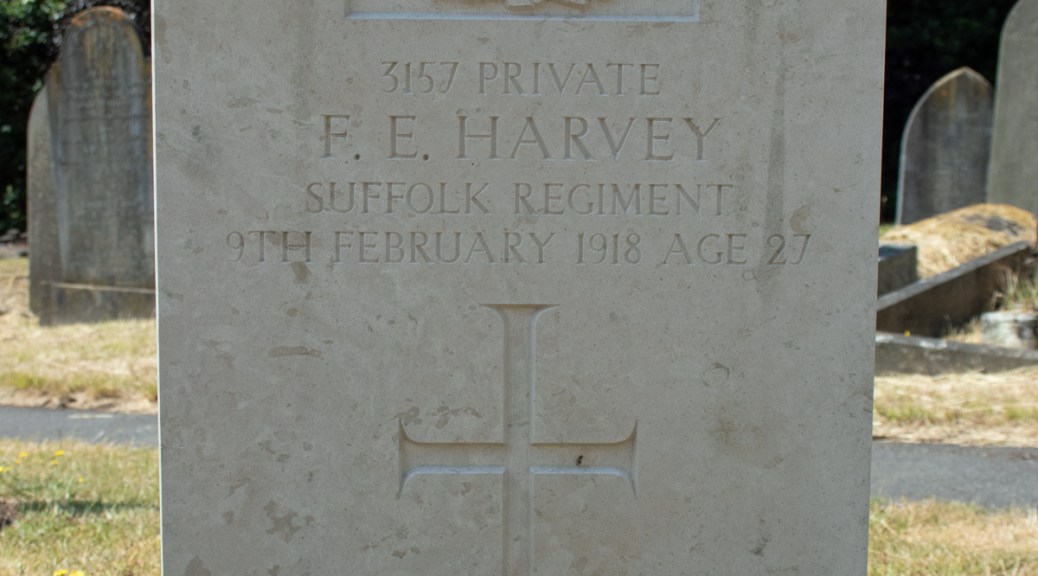
Private Frank Harvey

Private Frank Harvey

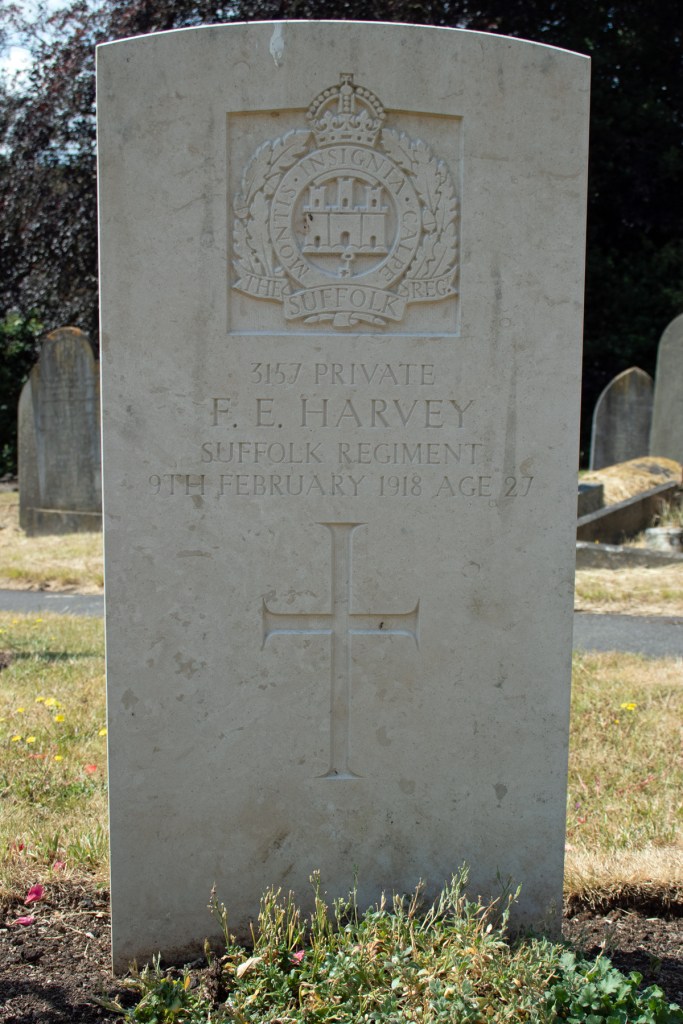
Frank Ernest Harvey was born at the start of 1892, the youngest of seven children to George and Clara Harvey. George was from Bethnal Green, London, and worked as a telegraphist clerk for the Post Office. By the time Frank was born, the family had moved to Leytonstone, while the 1901 census records them as living in Ilford.

On the day of the next census, in 1911, George and Clara were visiting friends in Guildford, Surrey. The four of their children who were still living with them were all at the family home. Ida, their daughter, was not listed as having any employment, while her three brothers were all working a clerks: one for an ironmonger, one for a stockbroker and Frank for an electrical engineer.

When war broke out, Frank stepped up to serve his king and his country. Little information is available about his military career, and, while his headstone confirms he was in the Suffolk Regiment, other records suggest that he had transferred to the regiment from the Royal Army Service Corps.

There is also little information about Private Harvey’s passing. Based on the fact that he was laid to rest in the Locksbrook Cemetery, Bath, it is likely that he had been admitted to the city’s War Hospital. This did not specialise in any single condition or set of conditions, so it could be that Frank was sent there to recuperate from an injury, or to recover from an illness.

Sadly, neither was to be the case, and Private Frank Ernest Harvey passed away on 9th February 1918. He was 26 years of age.


Private Albert Farrell

Private Albert Farrell

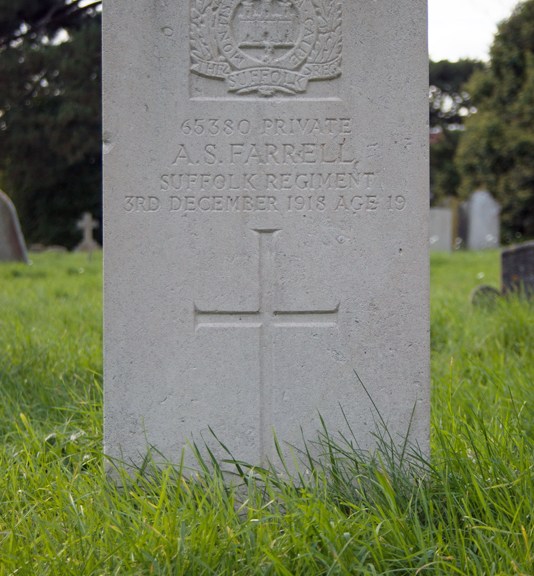
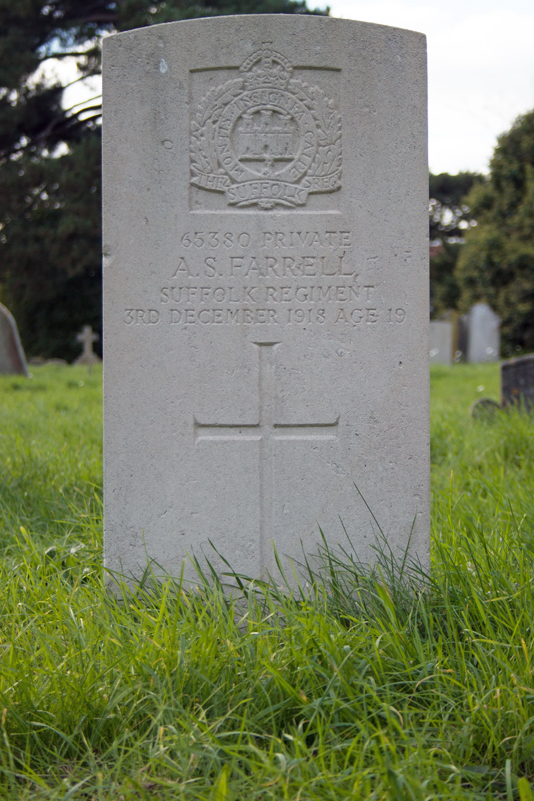
Albert Sydney Farrell was born in Mayfield, East Sussex, in the summer of 1899. One of four children his parents were gardener and coachman Arthur Farrell and his wife, Sarah Ann. Arthur had been born in Findon, a village to the north of Worthing, and is was to this town that he returned with his family. By the time of the 1911 census, when Albert was listed as a schoolboy, they were living in a small cottage within spitting distance of the sea.

Because of his youth, there is little further documentation on Albert’s early life. The war was coming, however, and he wanted to do his part. Dates cannot be confirmed, but he enlisted later in the conflict, at east before June 1918.

Private Farrell joined the Suffolk Regiment, and was assigned to the 1st (Reserve) Garrison Battalion. He would have carried out guard, escort and other similar duties from where he was based on the Isle of Grain in Kent.

Towards the end of the conflict, Albert fell ill; he was admitted to the Military Hospital in Sheerness, but sadly passed away on 3rd December 1918. He was just 19 years of age.

Albert Sydney Farrell was brought back to Worthing; he lies buried in the Broadwater Cemetery to the north of the town.


Private Harold Cook

Private Harold Cook

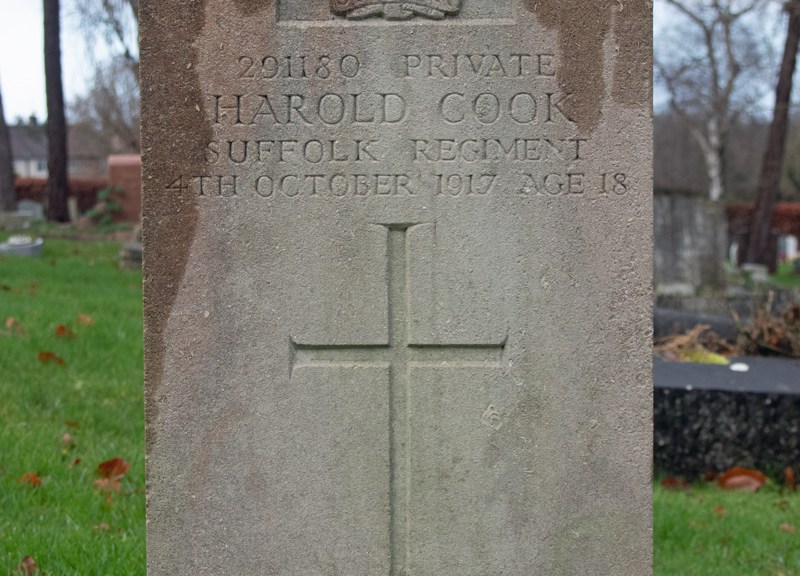
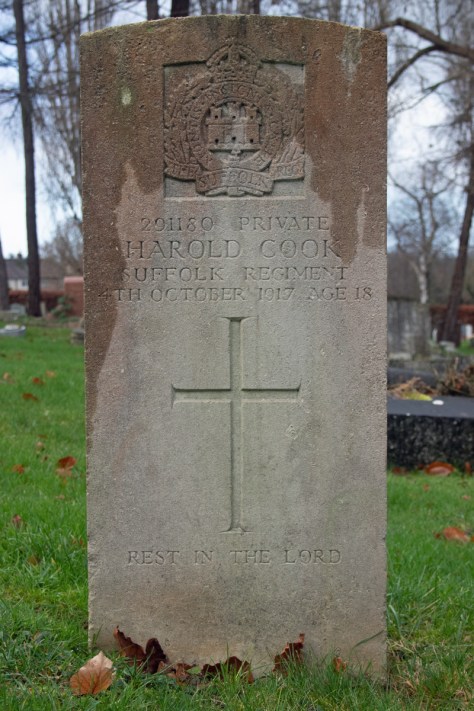
Harold Cook was born in February 1899, the youngest of nine children to George and Amelia Cook from the Somerset town of Street. George worked as a bootmaker, presumably for the Clark’s factory in the town.

Harold lost his mother at a young age; Amelia passed away in 1901, aged just 41 years old.

By the time of the 1911 census, George, his two older sons – Maurice and George Jr – and his four daughters – Beatrice, Florence, Alice and Gladys – were all employed by the factory. In fact, the only member of the family not employed by Clark’s was Harold himself, who was still at school.

Harold’s military records are not available, but, from the information I have been able to gather, it appears that he enlisted as soon as his age allowed. He joined the Suffolk Regiment, and was in training when an accident occurred.

The local newspaper – the Central Somerset Gazette – picks up his story:

It appears that about 11pm on August 24th [Private Cook was] in bed and suddenly got up, saying he was lying on something. This proved to be the oil bottle of his rifle and he said he would put it away. He got hold of his rifle and turned it muzzle downwards in order to put the oil bottle in the butt. When he closed the butt-trap the rifle went off.

He at once exclaimed “Who put the safety catch forward?”. Corporal Butler and [Private Johnson] then bandaged Private Cook’s foot (which was drilled clean through) and he was taken away at once.

From subsequent evidence by the Adjutant, it transpired than the rifle had been faultily loaded and that the safety catch had been broken.

Deceased had received every possible attention at the American Hospital in Cambridge, but his leg had to be amputated and subsequently septicaemia set in and to this he succumbed.

The jury, in accordance with the Coroner’s summing up, returned a verdict of “Accidental Death.”

Central Somerset Gazette: Friday 19th October 1917

Private Cook died on 4th October 1917, aged just 18 years old.

His body was brought back to his home town of Street and he lies at rest in the local cemetery.


Private Harry Pullen

Private Harry Pullen

What I have discovered while researching the Commonwealth War Graves, is that, despite the general themes I find, the people behind the names always have an individual story to tell. Sometimes that story raises an eyebrow, or produces a gasp.

Such was the story of Private Harry Pullen.

What raised the eyebrow? Two words, written on the Army Records of Soldiers’ Effects.

Accidentally Drowned.


Harry Pullen was born in Shirehampton, Gloucestershire in 1886. His father, Robert Edward Pullen, was a carpenter; he and his wife Hannah Presulga Cissy Pullen had three other children, Gwendoline, Herbert and John.

By the time of the 1901 census, Robert is boarding in a house in Bristol with his three sons; Hannah and Gwendoline are not listed (nor do they appear on any other census records I have been able to locate).

Harry is listed as a Telegraph Boy, as is his brother Herbert, but he seemed to have wanted to take up a trade; by 1910 he had moved up to London.

In March of that year, Harry married Harriet Critchell, a spinster fifteen years his senior. On their marriage records for Christ Church, St Pancras, Harry lists himself as a tradesman. The census a year later confirms this – head of the household, he is an Agent for the Provident Clothing Supply Company. (Founded in Bradford, West Yorkshire, Provident’s mission was to help working-class families provide for themselves through the use of vouchers. These were exchanged for goods in local shops, and paid for in affordable instalments.)

Harry enlisted at some point after 1916. His regiment, the 1st (Reserve) Garrison Battalion of the Suffolk Regiment, was not formed until March of that year, and, after starting in Buckinghamshire, it moved to Tilbury in Essex and Gravesend in Kent. The battalion was finally settled in Grain, North Kent in 1918, and it was here that he served.

Here the trail goes frustratingly cold…

Private Pullen’s enlistment and service records are not available, so research is limited to the Army Register of Soldier’s Effects and the Pension Ledgers.

All we have about his death are those two words – Accidental Drowning. There are no contemporary news reports of his passing, which you might expect given the circumstances, so the circumstances surrounding his death are elusive.

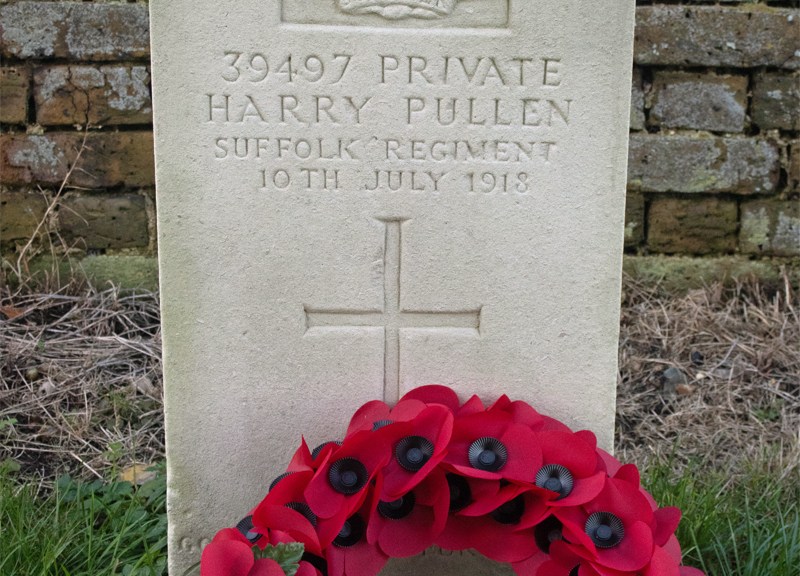
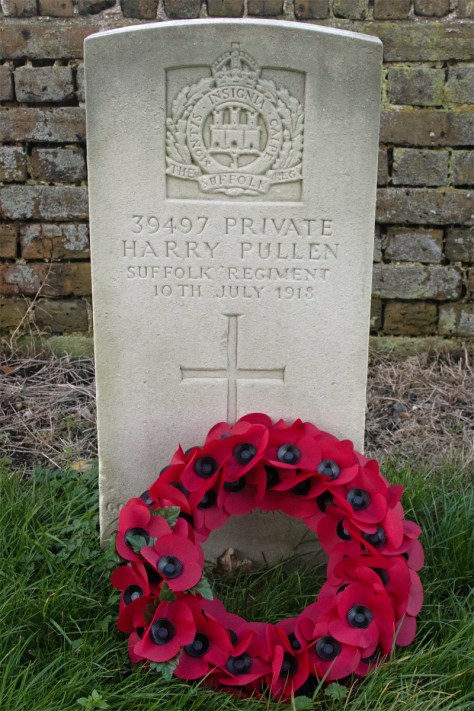
Private Pullen died on 10th July 1918. He was 31 years old.

His records confirm that Harriet was entitled to a weekly pension of 15s for the duration of the war and twelves months after.

Harry Pullen is buried in the graveyard of St James’ Church in Grain, Kent, close to where he was stationed.