Tag Archives: war

Private Samuel Smith

Private Samuel Smith

Samuel Herbert Smith was born on 15th March 1886 in Liverpool, Lancashire. He was one of six children to parents Henry – a road labourer for the local council – and Elizabeth.

There is little concrete information about Samuel’s early life. While the 1901 census confirms he was employed as an apprentice, the writing is not legible enough to identify the trade he was in. A later record suggests he spent two years in the Royal Engineers, although, again, no supporting documents evidences this.

Samuel married a woman from South Wales. Her details are lost, but his war pension record gives the name Mrs SH Smith, and gives her address as 34 Albany Street, Newport, Monmouthshire.

It would seem that Samuel was keen to build a bigger and better life for the couple, and left Britain to find work overseas. By 1914 he was living in Valcartier, Quebec, and working as a bartender. War was declared in the summer of that year, however, and he immediately stepped up to serve his country.

Samuel enlisted in the Canadian Expeditionary Force on 23rd September, and was assigned to the 13th Battalion of the Canadian Infantry. His service records suggest he cut a striking figure: he stood 6ft 1in (1.85m) tall and weighed 168lbs (76.2kg). He had light brown hair, hazel eyes and a medium complexion, and his records note that he had a crossed hands tattoo on his right arm.

His unit set sail for England and, by the end of October, Private Smith was installed at Bustard Camp on Salisbury Plain, Wiltshire.

An enquiry was led into the death of Samuel Herbert Smith… Private Smith was travelling… in a motor car, and while the car was passing over uneven ground he fell into the road and was almost instantaneously killed.

George William Hincks, a private in the Canadian Force… was driving from Salisbury… in a motor car, which was meant to carry a machine gun, and was, therefore, open at the sides. Private Smith was seated next to [him] and was inclined to be rather sleepy. He had travelled in the train from Liverpool on the previous day. hey had gone some distance on their journey when deceased said “I want to get out of this.” [Hincks] said “Sit still, Bert. We will be soon be there,” Smith smiled and said “Oh, all right.” Almost immediately the car jolted on a rough piece of road, and Smith pitched on his head in the road. The car was immediately stopped, and [Hincks] went back to him and found him lying with his knees up, on his back, with wounds in his head. He was dead. [Hincks] returned to Salisbury and reported the occurrence to superior officers. The road on which fatality happened was rough and had been badly cut up, more especially at the place where deceased fell from the car.

Salisbury and Winchester Journal: Saturday 31st October 1914

The accident occurred on 29th October, Private Smith was just 28 years of age.

Samuel Herbert Smith’s widow was unable to cover the cost of bringing her husband back to Wales for burial. Instead, he was laid to rest in Amesbury Cemetery, not car from Bustard Camp.


Lieutenant Keith Beddy

Lieutenant Keith Beddy

Keith Charles Beddy was born in Port Elizabeth, South Africa. His parents were Walter and Isabella Beddy, and he was the sixth of eight children.

Little additional information is available about Keith’s early life. When war broke out, he enlisted in the army, eventually becoming assigned to the 5th Battalion of the Hampshire Regiment. Rising through the ranks to the rank of Lieutenant, he eventually transferred to the Royal Flying Corps.

Lieutenant Beddy was based on Boscombe Down, near Amesbury, Wiltshire. On 6th February 1918, he was flying his RAF BE 2e aircraft when he attempted a turn at a low altitude. The plane nose-dived and crashed into the ground, and Keith was killed instantly. He was just 21 years of age.

With his family on the other side of the world, Keith Charles Beddy was laid to rest in Amesbury Cemetery, not far from the airfield where he had been based.


Private Henry Preece

Private Henry Preece

The early life of Henry George Preece is a challenge to piece together.

The Commonwealth War Graves Commission give his father’s name as Edwin Preece, and suggest that the was the landlord of the George Hotel in Milverton.

The Army Register of Soldier’s Effects give the sole beneficiary of Henry’s estate as his sister Bessie.

The census record of 1911 appears to link the three members of the family, but give only a tenuous connection to Somerset. Edwin was a Coachman from Nunney, but the family – including Edwin’s wife Elizabeth, and two children, Henry and Bessie – were all living in Bayford, Hertfordshire, where the siblings had been born in 1900 and 1902 respectively.

It seems likely that the Preece family moved to Somerset not long after the census was taken, and this is potentially when Edwin took up his new role in Milverton.

War broke out in 1914, and Henry stepped up to play his part. He enlisted in the Devonshire Regiment, and was assigned to the 2nd Battalion. Full service details are lost to time, but Private Preece had joined up by April 1918.

Henry’s trail goes cold again at this point. He was admitted to a military hospital in Chatham, Kent, in the autumn1918, although the reason for this is unclear. He passed away there on 29th October: he was just 19 years of age.

The body of Henry George Preece was taken back to Somerset for burial. He was laid to rest in the graveyard of St Michael’s Church in Milverton.


Private William Whaites

Private William Whaites

William Whaites was born on 12th April 1879 in Milverton, Somerset. One of nine children, his parents were George and Anne Whaites. George was an agricultural labourer, and that is work that all of his sons went into at some point.

By the time of the 1911 census, George and Anne were living at Court Bottom in the village, with three of their adult sons – William included – living with them – and doing farm work.

When war was declared, William was called upon to play his part. He enlisted at some point after October 1915, joining the Somerset Light Infantry. Assigned to the 3rd (Reserve) Battalion, Private Whaites was sent to the unit’s base in Devonport, Devon, for training.

Army barracks were cramped places, and often breeding grounds for illness and disease. William was not to be immune to this, and, in the spring of 1916, he contracted pneumonia. He was admitted to the military hospital in Devonport, but quickly succumbed to the condition. He died on 21st April 1916, having just turned 37 years of age.

William Whaites’ body was taken back to Somerset for burial. He was laid to rest in the graveyard of St Michael’s Church in his home town, Milverton.


Serjeant John Chambers

Serjeant John Chambers

John Dwelly Chambers was born on 21st August 1846, in Holborn, Middlesex. The second of four children, his parents were John and Sarah Chambers. John Sr was a tailor, and this was a trade into which his oldest son followed.

Unusually, John Jr travelled widely with his work and, by the late 1860s, he was based in Devon. It was here that he met and, on 5th March 1870, married Isabella Smith. She was born in Exeter, and couple initially made a life for themselves there.

The 1881 census return shows just how far the family moved in the coming years. John and Isabella were to have nine children: their first, Louise, was born in Exeter a hear after their marriage. The second child, son John, was born in Armagh, Ireland, though; their third, Emily, was born in Glasgow; while their fourth, George, was born in Surrey. It was only by the time their fifth and sixth children, Thomas and Charles, were born that they family returned to Devon. Their youngest three children – Percy, Victoria and Ivor, were all born in Somerset, when the family had settled in Taunton.

The reason for these moves seem to have been because his tailoring work was for the army. The 1891 census found the family living in army barracks, where John was listed as being a soldier. Ten years on, and John was recorded as being a Lance Sergeant in the Somerset Light Infantry, the Chambers’ still being billeted in barrack accommodation in Taunton.

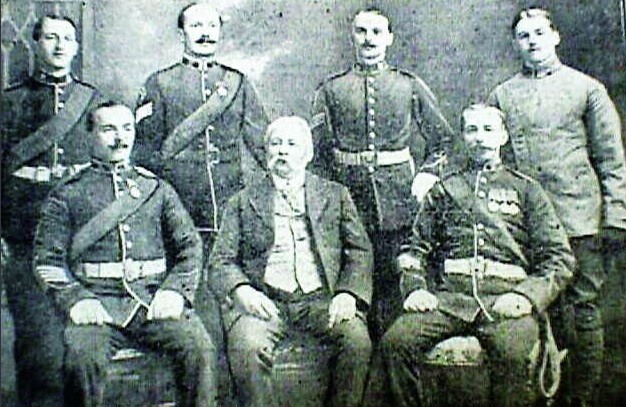
By this point, Percy, now 17 years of age, was employed as a gunsmith, and a later photo suggests that all six of John’s sons went into the army.

Isabella died in 1906, at the age of 58: the following year, John married Elizabeth Dunning, a widow with her own children to raise. The 1911 census found the extended family living in the barracks: John, Elizabeth, Ivor and Elizabeth’s two daughters, Kate and Beatrice. John, by now, was listed as being a master tailor (military), Ivor was now a gunsmith, and the two girls were employed as a book binder and dressmaker respectively.

John had officially been discharged from the army by this point, but it seems likely that the outbreak of war brought him back into service. His life over the next few years is largely undocumented, but it is fair to assume that Serjeant Chambers was called back to the army, possibly to train newer recruits in the trade he had been working in for decades.

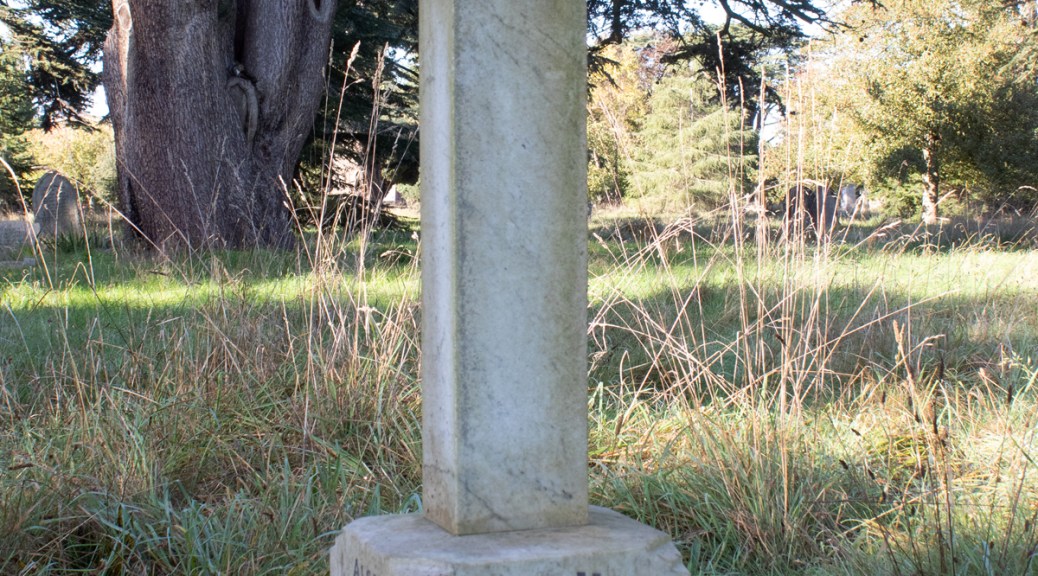
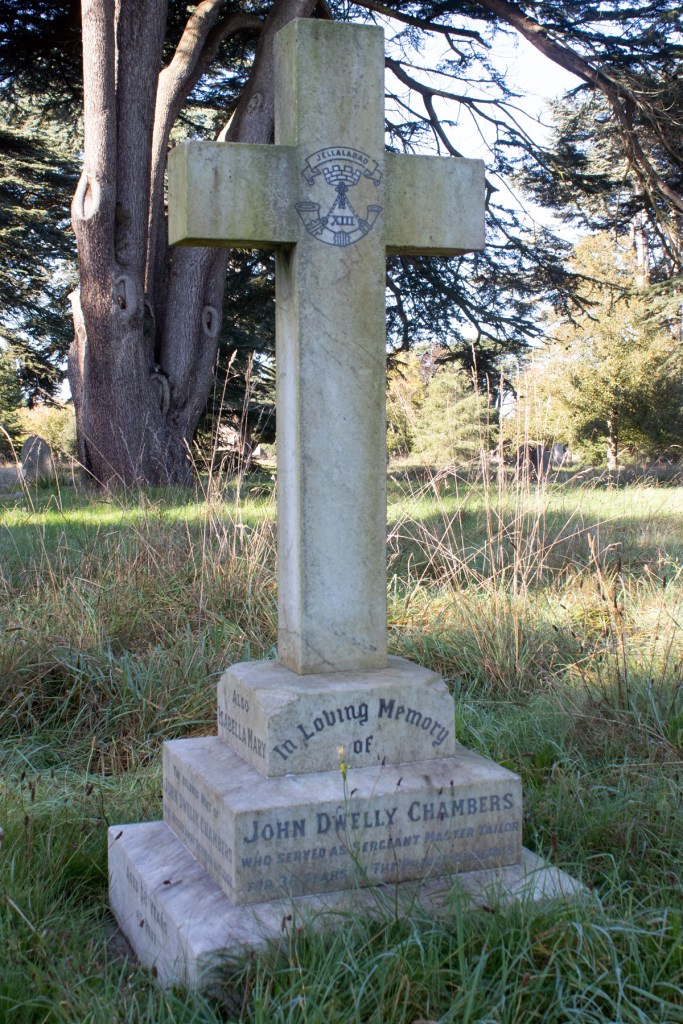
John Dwelly Chambers died of a heart attack on 2nd August 1915: he was just short of his 69th birthday. John was laid to rest in the sprawling St Mary’s Cemetery in Taunton, not far from the barracks to which he had devoted his life.


Serjeant John Chambers (seated middle, with his sons)
(from ancestry.co.uk)

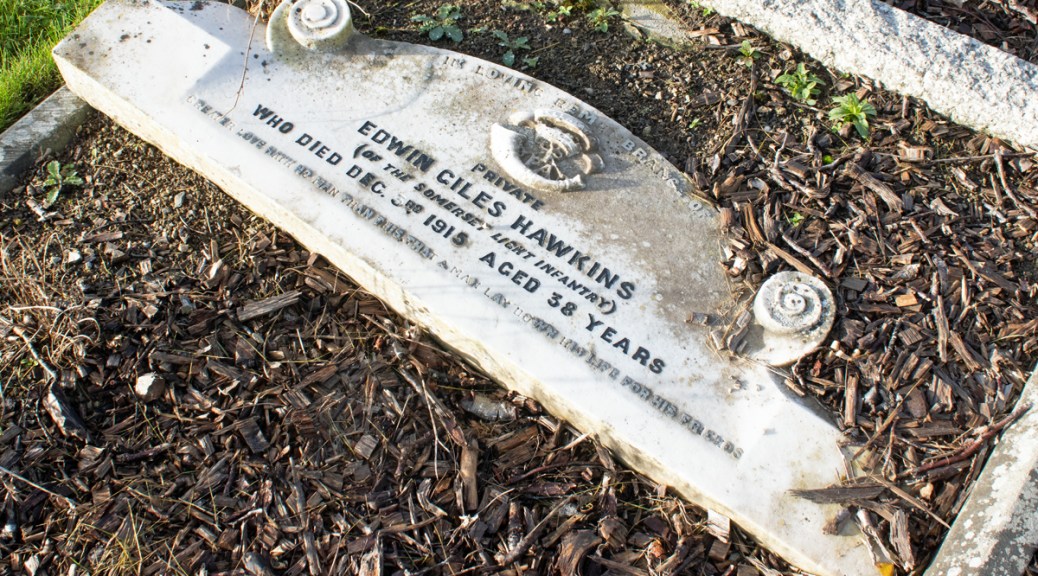
Private Edwin Hawkins

Private Edwin Hawkins

Another sudden death has occurred… when Edwin Giles Hawkins, Divisional Reserve company, 8th Divisional Train, BEF, passed away at the age of 38 years. Deceased… was called up with the National Reserves, and for some time he had been in France. On December 2nd he was granted eight days leave from the Front and arrived at home the same evening. He retired to rest at 10pm, apparently in his proper health. At 5am next morning he called his mother and complained of pains in the stomach. Hot water was applied and a doctor sent for but before the latter arrived he passed away.

Western Chronicle: Friday 10th December 1915

Edwin Giles Hawkins was bornin the autumn of 1877, the oldest of six children to Giles and Elizabeth. Giles had been born in West Coker, Somerset, and the family grew up in the Anchor Inn, Yeovil, where he was the innkeeper and glover.

By the time of the 1891 census, Giles had stepped down as landlord, and the growing family were living in a cottage next to the pub. He was working as a leather dresser and glover, working to feed his wife and five children.

Little information about Edwin’s time in the army before the First World War is available. However, his details are missing from the 1901 census, which would suggest that he was serving overseas at that point.

Edwin was called upon to due his duty once more when war was declared. Joining the Somerset Light Infantry, he was assigned to the 1st Battalion, and, by December 1914, he was in France. Private Hawkins was caught up at Ypres the following spring and returned home on leave in December 1915.

The cause of Private Hawkins’ death was recorded as being heart failure. As the newspaper report noted, he was 38 years of age.

Edwin Giles Hawkins was laid to rest in Yeovil Cemetery, a short walk from where his parents still lived.


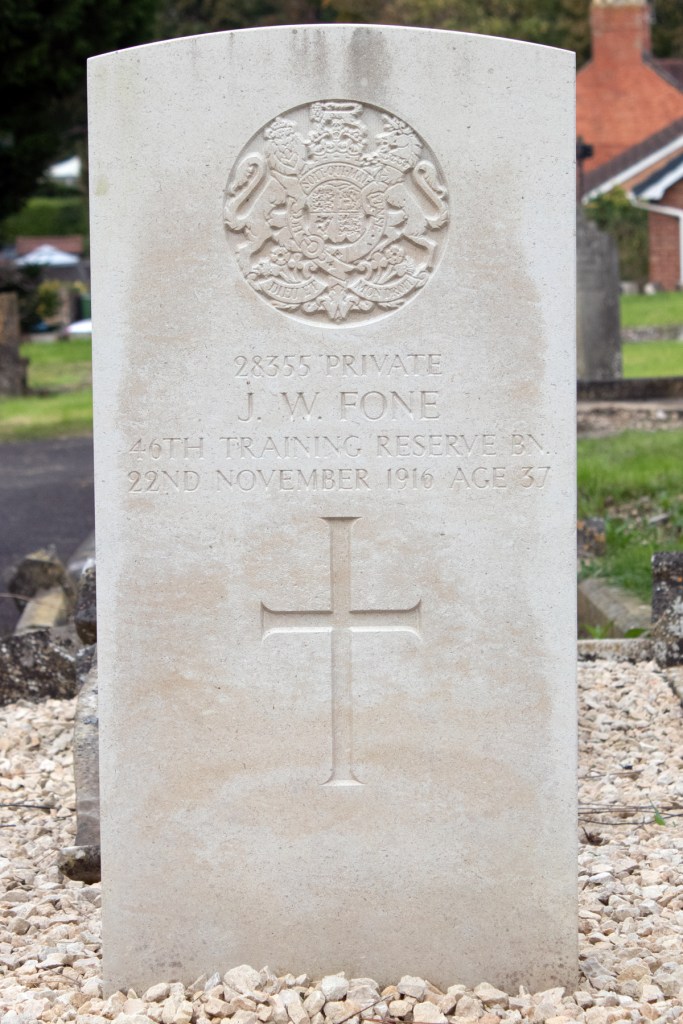
Private James Fone

Private James Fone

James Walter Fone was born in Crewkerne, Somerset, late in 1878. The sixth of seven children, his parents were Edward and Emma Fone. Edward was an insurance agent who had moved the family to Yeovil by the mid-1880s.

When James left school, he found work as a clothier’s assistant. Emma died in 1906, and he moved to Bristol. By the time of the 1911 census, he was employed by, and boarding with, James Johnstone.

Details of James’ life become a bit sketchy from here on. He enlisted in the army when he received his call-up in the autumn of 1916. Joining the 46th Training Reserve Battalion, Private Fone was sent to a camp near Swanage in Dorset.

Barracks at this point in the war were tightly packed, and breeding grounds for illness and infections. James was not to be immune to this, and came down with cerebrospinal meningitis. He was admitted to the camp hospital, but died there on 22nd November 1916, at the age of 37 years old.

James Walter Fone’s body was brought back to Somerset for burial. He was laid to rest in Yeovil’s sweeping cemetery.


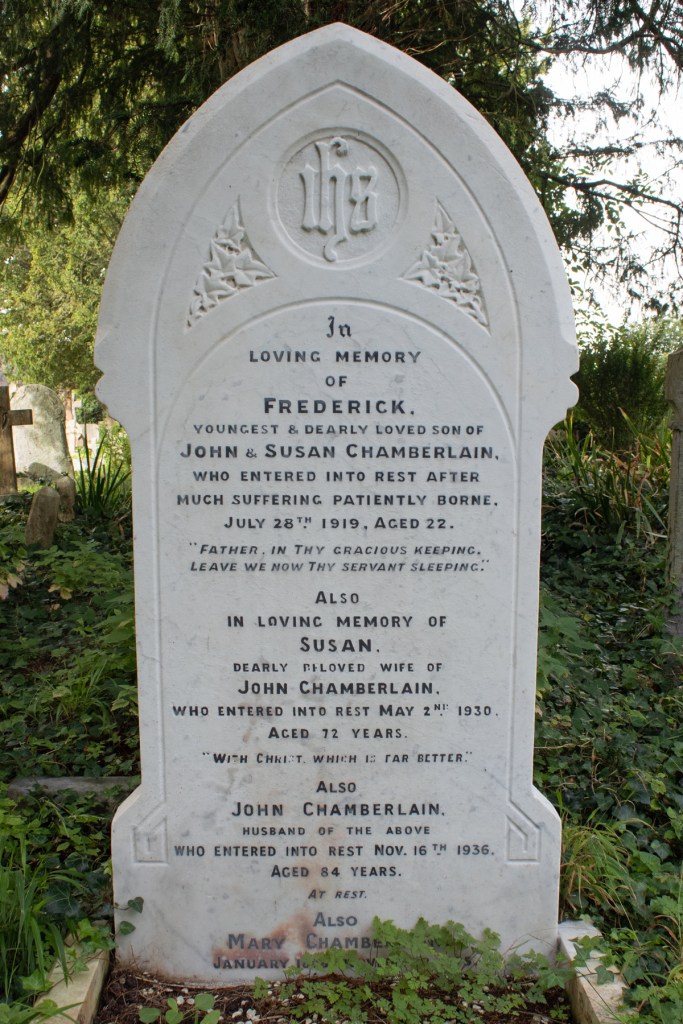
Corporal Frederick Chamberlain

Corporal Frederick Chamberlain

Frederick Chamberlain was born in the summer of 1896, the youngest of six children to John and Susan Chamberlain. John was a gardener from Dulverton in Somerset, but it was in Abbots Leigh, near Bristol, that the family were born and raised.

When he finished his schooling, Frederick found work in service and, by the time war broke out, he was employed as a footman. War presented a new adventure, however, and he was quick to step up and serve his country. He enlisted on 1st September 1914, just a few weeks after hostilities were announced, and was assigned to the 1/4th (City of Bristol) Battalion of the Gloucestershire Regiment.

Private Chamberlain’s service records are pretty sparse, but his unit was sent to France in May 1915, and he was to spend the next thirteen months on the Western Front. He seemed to have performed his duty well, however, and during that time was promoted to Corporal. Frederick returned to Britain in the summer of 1916, for what seemed to be health reasons. He was discharged from the army on medical grounds in November, suffering from phthisis, or tuberculosis.

At this point, the trail goes cold. He returned to Somerset, but his health deteriorated. Frederick passed away at home on 18th July 1919: he was just 22 years of age.

Frederick Chamberlain was laid to rest in the family plot in Holy Trinity Churchyard, Abbots Leigh. His funeral was presided over by Reverend Walter Brinkley, who had performed his baptism two decades earlier.


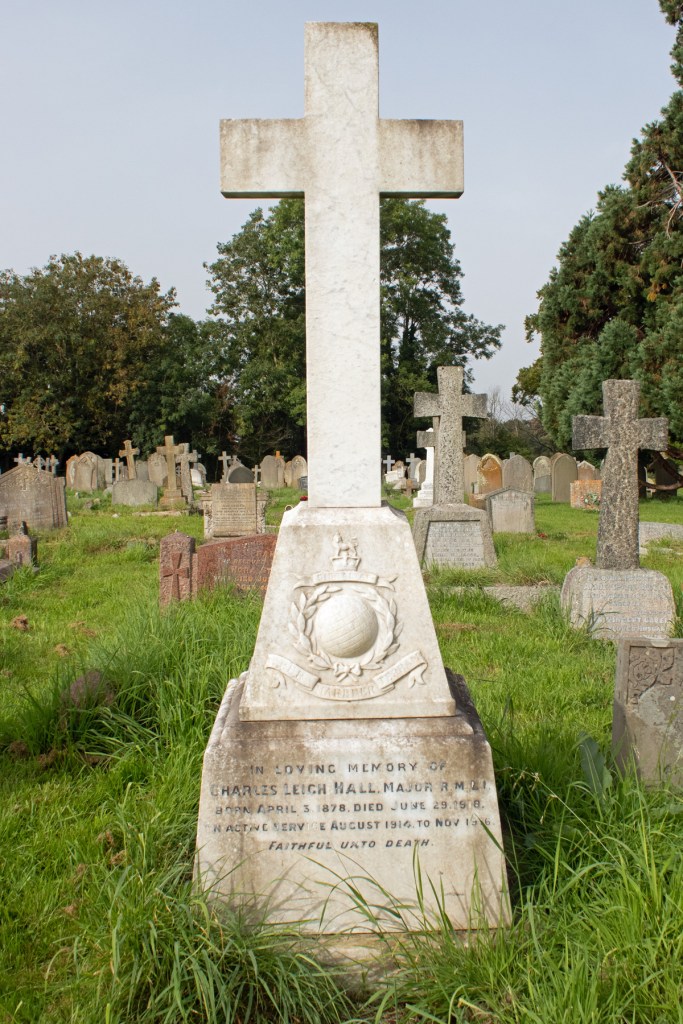
Major Charles Hall

Major Charles Hall

Charles Leigh Hall and his twin Maud, were born on 3rd April 1878 in Clifton, Gloucestershire. Two of eight children, their parents were Pedro and Anne Hall. Pedro, whose full name was Pedro Henrique Sinclair Hall, was better known as Henry, and was a mathematics tutor and Assistant Master at Clifton College, and it goes without saying that the Hall children had a educated upbringing.

Charles was always to be destined for great things. By the time of the 1901 census, when he was 22 years of age, he was a Lieutenant in the Royal Marines Light Infantry. Based on the cruiser HMS Amphion, he travelled the Pacific and, on the night the return was taken, was moored in Vancouver, Canada.

On 15th June 1910, Charles married Sophia Elinor Veale. Born in Caledon, South Africa, the couple wed in the village of Littleham, Devon. They set up home in Gosport, Hampshire – presumably as the now Captain Hall’s work was based from the docks there – and went on to have two children, Anthony and Nicholas.

By September 1915, Charles had been promoted again, this time to the rank of Major. His wartime service included a lot of work in Africa, including in Cameroon in 1914 – for which he was mentioned in Dispatches – German East Africa (Burundi, Rwanda and Tanzania today) in 1915 and Saadani (Tanzania) in 1916.

In October 1916, he was invalided out of the Royal Marine Light Infantry for reasons that are unclear, and returned to Britain from Simonstown, South Africa. While Charles seems not to have gone to sea any more, his experience was still respected, and, on 15th January 1917, he was promoted to Brigade Major.

The family settled back down in Portsmouth, Hampshire, and remained there for the next eighteen months. By the summer of 1918, Charles was in Bristol – either based at the docks there, or hospitalised in the city – and passed away on 29th July 1918. He was 40 years of age.

Sophia and her boys were still in Portsmouth, but Charles Leigh Hall was laid to rest in the graveyard of St George’s Church in Easton-in-Gordano, Somerset. The headstone incorrectly gives the month of death as June. Charles’ will divided his estate – £4467 (£318,000 in today’s money) – between his brother, Arthur, and Charles Garnett, a barrister, possibly as a trust for his sons.


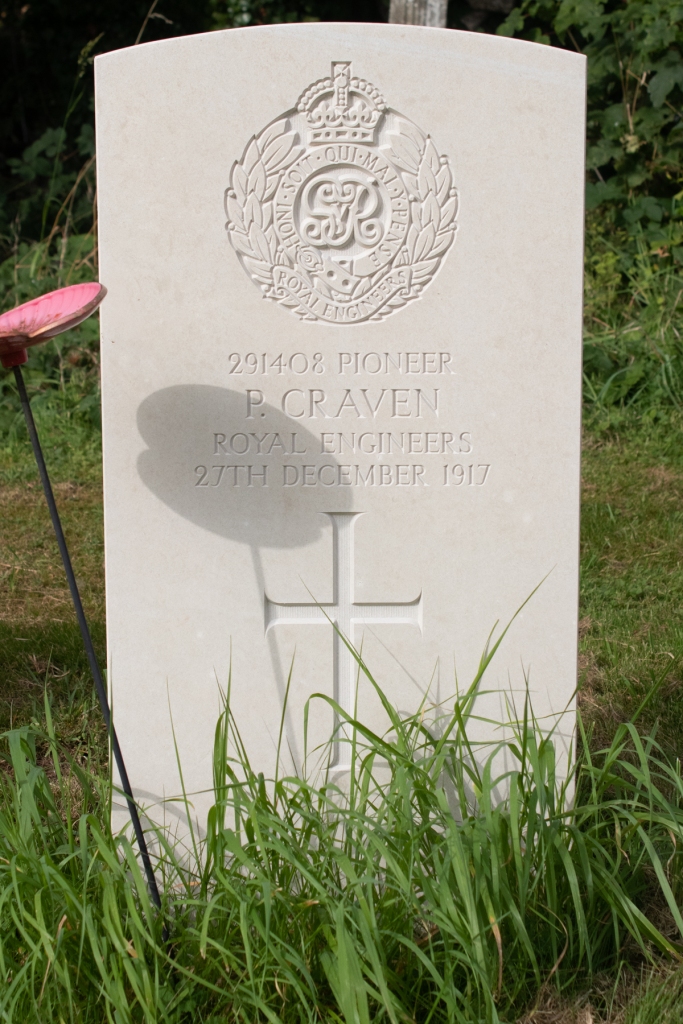
Pioneer Patrick Craven

Pioneer Patrick Craven

Patrick Craven was born in the summer of 1898 in Drogheda, County Louth. The oldest of three children, his parents were Francis (or Frank) and Mary Craven. Mary died in 1909, and the following year Patrick’s father remarried, to widow Kate Devin. The 1911 census found the extended family living in a cottage on North Road, Frank, Kate and their seven children.

Frank was a farm labourer, and this is work that Patrick also went into when he finished his schooling. War came to Europe in 1914, and he was to be called upon to play his part.

Patrick enlisted in the Royal Engineers on 6th June 1917. His service records confirm that he was 5ft 6ins (1.68m) tall, and weighed 127lbs (57.6kg). Pioneer Craven was assigned to the Inland Waterways Transport Division, and sent to Henbury, on the outskirts of Bristol, Gloucestershire, for training.

There was one blip on Patrick’s otherwise spotless service when, on 1st October 1917, he was confined to barracks for two days for ‘conduct to the prejudice of good order and military discipline, leaving the ranks without permission‘. Shortly after this, Pioneer Craven was assigned to a unit in Portbury, Somerset.

The wet summer of 1917 had given way to a cold, harsh winter, and the conditions were to lead to Pioneer Craven’s tragic demise on 27th December. The detailed report from the Medical Officer explained what had happened:

This man was found dead… in a small harness room at the Lodway Brewery, Pill, a room occupied by the IW&D, Portbury. I was called in to see him and pronounced him dead, the body was quite stiff and cold and death had probably taken place several hours before. When first discovered the body was fully pronated, with the mouth flattened against the floor, the hands were gripping the Army greatcoat which he had pulled over himself.

The harness room was heated by a coke stove the flue of which passed through the room to the ceiling and was cracked, allowing the fumes of the burning coke to emanate into the room. There was no ventilation except through a door communicating with the stables, which was found shut at the time the cadavre [sic] was found. The stove was situate[d] between the position where the body lay and the door, in a cul-de-sac.

One other man slept in the same room the same night, the deceased man having evidently entered the place after the former had fallen asleep. The second man was not affected by the fumes to any degree, but was lying between the stove and the door under which there was a certain amount of draught.

Sheltering himself from the cold winter night, Private Craven had passed away in his sleep from carbon monoxide poisoning. He was just 19 years of age.

Patrick Craven’s family were unable to afford to bring him back to Ireland for burial. Instead, he was laid to rest in the peaceful graveyard of St George’s Church in Easton-in-Gordano, not far from the brewery stables where he had passed.