Joseph Shore Chivers was born in the summer of 1889 in Walcot, Bath, Somerset. He was the youngest of seven children to William and Jane Chivers. William was a blacksmith and, after he and Jane died within nine months of each other in 1904/05, Joseph went to live with his brother, Edward, remaining there with his sister-in-law when his sibling also died in 1910.
Joseph had found work as a French polisher and cabinet maker by this point and this is what he was doing when he married local woman Ellen West in on 11th September 1915.
War was on the horizon by this point and Joseph was soon called on to serve his country. On 26th July 1916 he enlisted in the Royal Flying Corps, as an Air Mechanic 2nd Class. His service records give little away, but do confirm that he was 5ft 8ins (1.73m) tall.
Joseph was dedicated to his role and, on 1st January 1918, was promoted to Air Mechanic 1st Class. Three months later, when the Royal Flying Corps and Royal Naval Air Service combined to become the Royal Air Force, Joseph made the transfer across.
In August, Air Mechanic Chivers moved to RAF Bracebridge, to the south of Lincoln, where he remained until the end of the war and beyond. He was attached to 120 Squadron, which delivered mail and communications to the troops overseas. Little additional information is available about his life there, other than his admission to the 4th Northern Hospital in April 1919, through causes unknown.
Whatever the cause of his need to be admitted, he was to succumb to it. Air Mechanic Chivers passed away on 1st May 1919, at the age of 29 years old.
Joseph Shore Chivers’ body was brought back to Somerset for burial. He was laid to rest in St James’ Cemetery, in his home city of Bath.
William John Mells was born in Southwark, Surrey, on 13th November 1873. His parents were Thomas and Elizabeth Mells, although much of his early life is lost to time.
The 1891 census found the 19-year-old William as one of four boarders living with the Skinner family in Peckham, Surrey, where he was working as a shoe maker. By the turn of the century, however, he had changes jobs, and was employed as an advertising contractor, possibly fixing signs to walls across the country.
It was while William was working in Somerset when he met Ethel Pryor. She was the daughter of a caterer, born and bred in Somerset. On 16th August 1903, the couple married at Ethel’s parish church in Bath. They set up home in a small cottage on King Edward Road in the city, and went on to have two children, Edith, who was born in 1904, and John, who was born the following year.
Storm clouds were brewing across Europe at this point, and William was called upon to play his part in the autumn of 1918. He had previously served as part of the Army Service Corps Volunteers, and had reached the rank of Lance Corporal. When his time to actively serve King and Country came, however, he chose the fledgling Royal Air Force and, on 24th October 1918, joined them as an Air Mechanic 3rd Class.
William was sent to Blandford Forum, Dorset, for training. While here, in packed and busy billets, he contracted influenza, which developed into pneumonia. He passed away from the conditions at the camp hospital on 3rd November 1918, ten days short of his 45th birthday, eight days before the end of the conflict and after just ten days’ service.
William John Mells’ body was brought back to Somerset for burial. He was laid to rest in the city’s St James’ Cemetery, and was joined by his widow, when she passed away in 1955.
The Commonwealth War Graves Commission headstone and website gives Air Mechanic Mells’ name as John William, but all other records – including censuses, marriage document and service records – confirm his name as William John Mells.
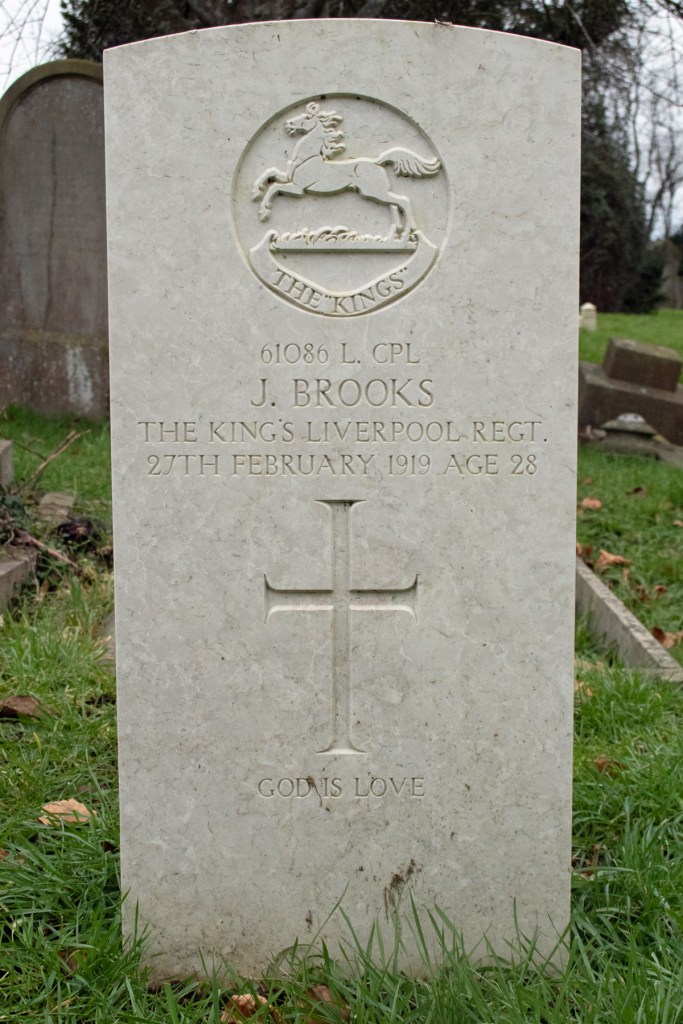
Jack Brooks was born in the autumn of 1890 and was the second of nine children. His parents, John and Kate Brooks, both came from Bath, where they ran a bakery on Queen Street, in the centre of the city. When he left school, it was natural for Jack to follow in his parents’ trade.
When war arrived on Europe’s shores, Jack stepped up to play his part and, on 7th December 1915, he enlisted in the Wiltshire Regiment as a Private. His service records show that he was 25 years and 2 months old, was 5ft 8.5ins (1.74m) tall, and weighed 156lbs (70.8kg). He was also noted to have a scrotal hernia, had flat feet and an upper set of dentures. These were enough for him to be passed for home service only, and he was formally mobilised on 10th February 1916.
Private Brooks seems to have taken a while to settle into army life. He was soon transferred across to the East Lancashire Regiment and, in May 1916, was attached to the 8th Works Coy as a Lance Corporal. In February 1917 he was transferred again, this time to the King’s Liverpool Regiment. On 6th June 1917 he was demoted to Private for ‘neglect of duty’, for not taking proper care of the stores that he was in charge of.
He married a woman called Rosina Elizabeth in 1917: the couple went on to have a son, William, who was born on 22nd November that year.
Jack continued serving after the end of the war and, by the beginning of 1919, was based in Aldershot. It was while here that he fell ill, and was admitted to the town’s Connaught Hospital on 11th February, suffering from influenza and pneumonia. Sadly the combination of illnesses was to prove to much: he succumbed to them, breathing his last on 27th February 1919. He was just 28 years of age, a boy with his mother, Kate, with him when he passed.
The body of Jack Brooks was brought back to Somerset for burial. He was laid to rest in the city’s St James’ Cemetery.
In St James’ Cemetery, Bath, is a headstone dedicated to one William Parry, once a Private in Devonshire Regiment. A lot of his life is lost to time, but his death highlights the length to which soldiers returning from the Great War were often left to fend for themselves.
On 4th November 1919, Private Parry “was found in an exhausted state lying under an arch in a suburb of [Bath], and told the police he had been there for 17 days. Crawling there to rest, he found himself afterwards too weak to move owing to trench feet” [Western Gazette: Friday 14th November 1919]
On 18th November, having been admitted to the Royal United Hospital in Bath, he passed away from pneumonia. “The police are endeavouring to ascertain something as to the man’s antecedents. He stated to them that he had no home.” [Western Gazette: Friday 21st November 1919]
An inquest into William’s death was held, and a miserable tale unfolded.
Parry was described as a seaman, and his address was given as 36 Catherine Street, Exeter…
[He had] said he was born at Swansea, had served in the 2nd Devons, and was demobilised at Exeter last March. He got into the arch because his feet were aching. He had come from Bristol. He did not say where he was going.
[When he died] Parry’s belongings… included a ration book, issued to him for the address in Exeter, his insurance card, and his out-of-work book. Parry had 10s 8d [approximately £11 in today’s money] in cash on him; but 10s 6d of this sum was given him by a lady since his arrival at the hospital. Parry had received various other gifts sent him by ladies from all over the country, who had read of the account of his discover in the Press. The last out-of-work donation received by him was on June 26th, and the ration book was issued at Exeter on March 24th. The address at Catherine Street, Exeter, as which Parry had stayed was that of a Church Army Home. He had also with him a card indicating membership of the Comrades of the Great War. The entries on his insurance card showed he was last employed on September 8th.
Inspector Lovell… gave the Coroner the result of exhaustive enquiries which he had made… regarding Parry’s antecedents… By the Exeter police he was informed that Parry registered at the Labour Exchange there as a seaman on March 25th. He then produced a certificate showing him to be a member of the Mercantile Marine. He had apparently served with the 2nd Battalion of the Devon Regiment for 2½ years. On May 16th, 1919, he obtained work as a painter in Exeter. He retained this employment till June 21st. A week later he obtained similar employment with another Exeter firm at 1s 3d [approx. £1.68] an hour and his earning averaged £2 [around £87] or more a week. He lest the Church Army Home on September 12th, explaining that he was going to Barrow-in-Furness, where he expected to obtain employment with Messrs Vickers, Sons, and Maxim. While staying at the Church Army Home he appeared to have been regarded as of a morbid disposition…
Inspector Lovell added that the members of the Exeter branch of the Comrades of the Great War had assisted him… and he was able to furnish the Court with a letter from Mr FW Drew, with whom Parry had lodged at the Church Army Home. The writer said he had met Parry in the latter part of April, and their friendship lasted until ten weeks ago, when deceased left Exeter. As they were two ex-Service men they became intimate friends, but apparently before the war he belonged to London.
After enlistment he had served in France, and was taken prisoner by the Germans. He was in their hands for three months; and acted as interpreter between his captors and the other British prisoners. He could speak German and other foreign languages, and undoubtedly was a man of superior education. Apparently, so far as his relations were concerned, he was “one of England’s lonely soldiers.” He said he was badly treated by the Germans, and suffered from a bad cough, the result of a wound in the chest. He was liable to depression when out of work, and the writer well remembered how pleased he was to think that he had obtained work at Barrow-in-Furness… “I deeply regret,” concluded the writer, “that he has come to such an untimely end. He was a good fellow, and would do anyone a good turn, if possible.”
In summing up, the Coroner remarked that exhaustive enquiries had been made into the case. There was no doubt from the medical evidence that the cause of death was pneumonia. It would appear that Parry had been on the road for some time when he crawled under the arch where he was found…
Bath Chronicle and Weekly Gazette: Saturday 22nd November 1919
Private William Parry died on 18th November 1919, aged around 44 years old. The British Federation of Discharged Soldiers and Sailors and the Comrades of the Great War jointly made arrangements for, and funded, his funeral, at which he was given full military honours. He was laid to rest in St James’ Cemetery, Bath.
Funeral of William Parry (from britishnewspaperarchive.co.uk)
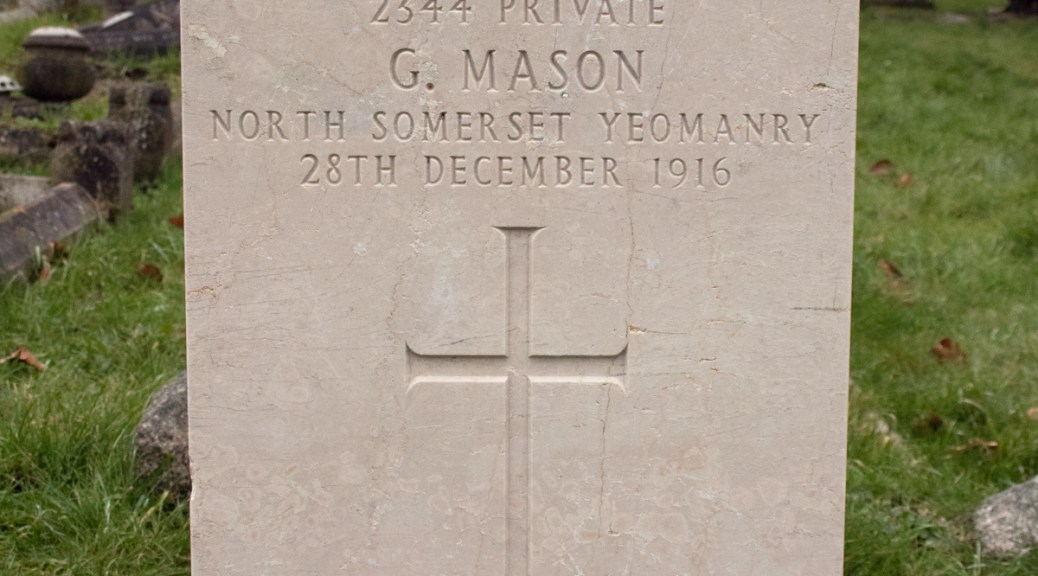
Much of George Mason’s life is destined to remain elusive, and much of the information comes from just a couple of documents.
His Commonwealth War Grave headstone confirms that he was a Private in the North Somerset Yeomanry and that he died on 28th December 1916. Sadly, his service records no longer exist, but his pension records state that he ‘died of disease’ and give his mother as Harriet Mason.
There is only one census record for a Harriet Mason with a son called George. This dates from 1901, and give the head of the household – Harriet’s husband and George’s father – as bootmaker Albert Mason. It also gives George’s age as 9 years old, suggesting he was born in around 1892.
Further research brings nothing further to categorically link to the Mason family, and so it is impossible to add any further details to Private Mason’s life.
All that can be determined is that George Mason died of an illness on 28th December 1916, and that he was around 24 years of age. He was laid to rest in St James’ Cemetery in his home city of Bath.
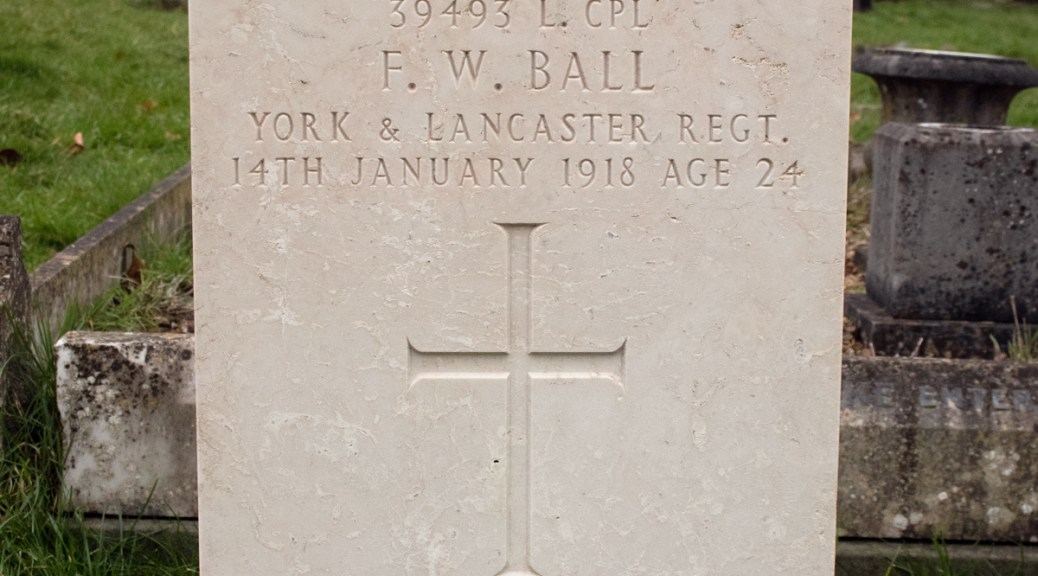
Francis William Ball was born in the spring of 1893 in the village of Wrington, Somerset and was one of ten children to Joseph and Mary Jane Ball. Joseph was a general labourer while Mary Jane took in washing to earn a little more money for the family.
Little information is available about Francis’ early life. The family travelled the county when he was growing up, and, according to the 1911 census, they were living in Walcot, a suburb of Bath. The same census notes that Francis was apprenticed, although crucially the trade he was learning is missing from the document.
When war came to Europe, he enlisted in the Yorkshire & Lancashire Regiment as a Private. Francis’ service records are lost to time, but he would have enlisted by the summer of 1917, and during his time in the army, he was promoted to Lance Corporal. He was attached to the 2nd/4th Battalion, who served in France, most notably at Arras and Cambrai.
At some point late in 1917, or early in 1918, Lance Corporal Ball was injured and medical evacuated to Britain for treatment. He was admitted to the 2nd Western General Hospital in Manchester, but his wounds were to prove too severe. He passed away on 14th January 1918, at the -age of just 24 years old.
Francis William Ball’s body was brought back to Somerset for burial. He was laid to rest in the St James Cemetery, Bath.
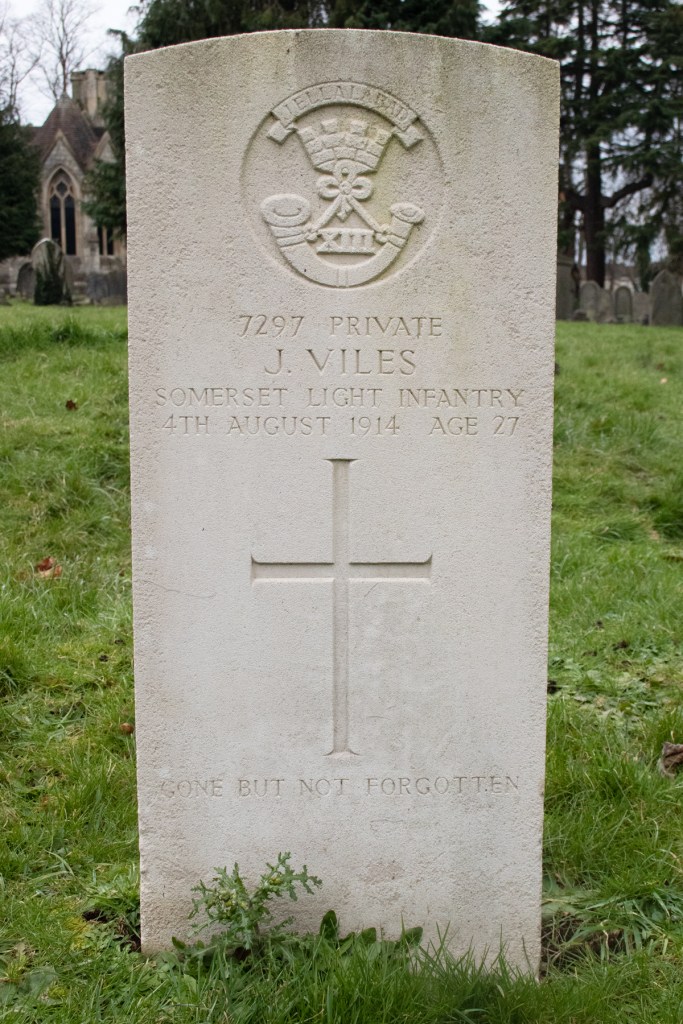
Joseph Viles was born at the end of 1886 in Bath, Somerset. One of seven children, his parents were collier-turned-general labourer Joseph Viles and his wife, Sarah.
When he left school, Joseph found work as an errand boy, but, in reality, there is little documented about his life. There are only really two records that give an insight into the man he became.
The first is the 1911 census, which confirms he was a Private in the 2nd Battalion of the Somerset Light Infantry. The return gives his location as the St Andrew’s Barracks in Malta.
The second document dates from 29th June 1909, and is a court martial for Private Viles’ for the use of insubordinate language towards a senior officer, in this case a Major. The trial was held in Portland, Dorset, and Joseph was sentenced to 30 days’ imprisonment.
Sadly, a lot of the service records for the Somerset Light Infantry have been lost over time, and those relating to Joseph are amongst them. The only other confirmed detail for Joseph is that of his passing, but even this raises questions.
Private Joseph Viles died on 4th August 1914 – just seven days after war was declared. His regiment was actually based in Quetta, India, at this point, so it is likely that he was at home on leave at the time he died. No cause for is death is noted, and it is likely to have been from an illness of some description, as nothing unusual was reported in the newspapers of the time. Joseph was 27 years of age.
Joseph Viles was laid to rest in Bath’s St James’ Cemetery, where his parents would also be buried, Joseph Sr in 1948, and Sarah in 1958.
The early life of Francis Albert Millard is lost to time. He was born in 1894 in Bath, Somerset. His gravestone notes that he was the adopted son of AE and H Evans, though there are no census records confirming the three as a family. His military records specifically note that he has “no relations alive only one brother who is younger than myself nor have I any guardians”.
Interestingly, when Private Millard passed, Mrs Harriet Evans, who was noted as a foster mother, applied for his personal effects. Two days later, and Albert Francis Millard, who was claiming to be Francis’ father, also put in an application.
Francis was working as a seaman when he formally enlisted. He had previously been a volunteer in the Durham Light Infantry, and was readily accepted in the regiment’s 2nd Battalion. He joined up in November 1911, his service records noting that he was 5ft 3ins (1.6m) tall, 104lbs (47.2kg) in weight, with a fresh complexion, blue eyes and light brown hair. He was also noted as having a tattoo of the figure of a woman on his right forearm and a scar on his left buttock.
Over the next couple of years Private Millard was reprimanded a couple of times for small misdemeanours – being absent from bread rations on 15th September 1912, and being absent from the company officer’s lecture on 22nd February 1913. During this time he had been promoted to Lance Corporal, but the reprimand he received demoted him to Private once more. Overall, however, his service appears to have been a positive one and, when war was declared, he soon found himself on the Western Front.
[Priavte Millard] was present at the retreat from Mons. He took part in the advance over the Marne and the Aisne, and [had] been engaged in the battles around Ypres. In the early part of August [1915] a charge was ordered, and in this he took part. The late Captain RH Legard… to whom Millard was servant, fell. Millard ran to his assistance, and was wounded in two places…
Bath Chronicle and Weekly Gazette: Saturday 21st August 1915
Francis received gun shot wounds to his thigh and across his spinal column. He was medically evacuated to Britain for urgent treatment. Admitted to the King George Hospital in South London, his admission notes make for stark reading:
Patient very collapsed. Sunken eyes, some delirium. Small circular wound on right shoulder behind level 1st Dorsal spine 2″ from middle line; wound on inner side of left thigh, with suppuration and cellulitis. Can move both arms but very poor power. Patient continued to go downhill rapidly after admission despite stimulation (brandy, [strychnine], saline).
A telegram was sent to Harriet and she took the first train to London. She arrived on the evening of Tuesday 17th August, and remained by Francis’ bedside until he passed away the following morning. He was just 21 years of age.
The shattered body of Francis Albert Millard was brought back to Somerset for burial. He was laid to rest in the city’s St James Cemetery.
Details of Alfred Lawrence Stoyle’s life a challenging to piece together. Most of the information comes from his service records, but even that is limited.
The Somerset Light Infantry records suggest that Private Alfred Stoyle was born in March 1890 in Widcombe, Bath. Physically, he was 5ft 8ins (1.73m) tall, and weighed 109lbs (49.4kg). He had blue eyes, brown hair, a tattoo of crossed flags on his right forearm and a scar above his right eye.
According to the document, Alfred’s parents were Alfred and Ellen Stoyle, and he had been working as a mason’s labourer before he enlisted on 13th February 1909. Early records for the Stoyles are hard to come by, The 1891 census found Alfred and Ellen living in Walcot, Somerset, with their eight children. They have a son, Alfred, although he is noted as being 19 at the time, which does not match the service records for the Alfred who enlisted. They have another son, Albert, who was born in 1886, and it seems that he may have used the name Alfred when enlisting (indeed, those service records note not only Alfred’s parents, but his older siblings Nellie, Ada, Henry and Alfred).
The next census, in 1901, recorded Alfred Sr as being a pauper in the Bath Union Workhouse. He was also listed there in the 1911 census, while that document recorded Ellen living in two rooms in the centre of Bath with Albert/Alfred and her youngest son, William.
Alfred Jr was recorded as being a general painter. By this time, he had enlisted in the Somerset Light Infantry, and was on reserve status, allowing his daily life to continue. He undertook annual training, and, when war broke out in August 1914, he was formally mobilised.
Private Stoyle was sent to France the following month, and ended up spending four months there. In January 1915 he returned home, and there appears to have been a medical reason for doing so. Within a matter of months, he was discharged from the army as he was no longer physically fit. The service records do not give a reason for his dismissal.
At this point, Alfred’s trail goes cold. He seems to have returned home to Somerset, and passed away on 21st August 1915. Based on his service records, he was just 25 years old, although his true age is debatable.
Alfred Lawrence Stoyle was laid to rest in St James’ Cemetery Bath.
William Charles Green was born on 27th December 1897, one of five children – and the only son – to William and Mary Green. The family’s backstory is a bit hard to decipher.
William Sr was born in the Bath Union Workhouse in 1869 and the only details of his parentage comes in his marriage certificate, which suggests that his father was also called William Green, who was deceased. The same document records the groom as being a miner, and that he and Mary were living in Widcombe, Bath.
The Greens do not appear on the 1901 census – or at least that census record for them is lost to time. The next census return, in 1911, does have the family recorded as living in three room in St George’s Place, Widcombe. This particular census was the first to put the onus on the resident to complete the form, and, in William Green Sr’s case, this has led to a handful of anomalies in the record.
William Sr notes his trade as “going out with commercial travellers and hotel work also”. He confirms that he was “Somerset-born”, but suggests that Mary was born in “South Wells” (a spelling error, which should be South Wales), even though her birth and marriage certificate confirm she came from Bath.
The Greens certainly spent some time in Wales – their eldest daughter was born in Merthyr Tydfil, while William Sr was working as a miner there. By the time of William Jr’s birth, however, the family seem to have returned to England – he is recorded as coming from Bath.
William was 13 years old at the time of the 1911 census, and still at school. When he left education, he found work at a fishmonger, but with war closing in on Europe by this point, he was keen to serve his King and Country.
On 7th May 1915, William enlisted in the Royal Navy and, as he was just under age, he was given the rank of Boy 2nd Class. His service records note that he was 5ft 1in (1.55m) tall, with brown hair, blue eyes and a fresh complexion. Intriguingly the records give the place of his birth as Aberdare, Glamorganshire, but whether it is this document or the 1911 census that is incorrect is impossible to confirm.
Boy Green was initially sent to HMS Impregnable, the training establishment based in Devonport, Devon. He spent four months there and, on the day he was promoted to Boy 1st Class, he was assigned to HMS Defiance, the navy’s Torpedo School, off the Plymouth coast. In October 1915 he was assigned to HMS Fox, and remained on board for the next three years.
Fox was a cruiser that patrolled the seas from the East Indies to Egypt and the Red Sea. While on board, William came of age, and was formally enrolled in the Royal Navy as an Ordinary Seaman. With a character that was classed very good, even if his ability was noted as satisfactory, within eighteen months he was promoted again, to Able Seaman.
In August 1918, William was assigned to HMS Mantis, a river gunboat that patrolled the Tigris around Baghdad. He remained on board until the end of the year, when he was assigned to HMS Vivid, the Royal Naval Dockyard in Plymouth.
Over the next fifteen months, Able Seaman Green’s time was split between Plymouth and HMS Columbine, the naval base at Port Edgar on the Firth of Forth. It was when he was back in Devon, early in 1920, however, that he fell ill.
Able Seaman Green had contracted influenza, which had developed into pneumonia, and it was the combination of lung conditions that was to ultimately take his life. He passed away at the naval base on 5th March 1920, at the age of just 22 years old.
William Charles Green’s body was brought back to Somerset for burial. He was laid to rest in St James Cemetery, Bath, to be reunited with his parents when William Sr died in 1938 and Mary passed away in 1959.










 Death and Service