Arthur John French was born on 3rd September 1889 in the Somerset village of Merriott. He was the youngest of three children to John and Annie French. John was a miller and baker in the village, and Arthur’s older brother Edward helped his father with the business. Arthur, however, followed a different path and, with Annie passing away in 1903, he had moved to London for work.
The 1911 census recorded Arthur boarding with his maternal aunt and uncle, who were both schoolteachers. He had found employment as a clerk in the head office of the National Telephone Company and shared the large terraced house with the couple, their son Alfred and their servant, Esther.
When war was declared, Arthur was in the first wave of those enlisting. He joined the Oxford & Bucks Light Infantry and, as a Private, was assigned to the 2nd/4th Battalion. Initially sent to Northampton for training, his troop soon came south again and, by April 1915, was based just outside Chelmsford, Essex.
Tightly-packed barracks, housing men from across the country soon became hotbeds for illness and disease, and Private French was not to be immune. He contracted meningitis, and was admitted to the 3rd London General Hospital in Wandsworth for treatment. Sadly he was to succumb to the condition, and he breathed his last on 16th April 1915, at the age of just 25 years old.
Arthur John French’s body was brought back to Somerset for burial. He was laid to rest in the graveyard of All Saints’ Church in his home village, Merriott.
Robert Muckart Templeton was born in Glasgow, Scotland, in 1894. He was the fourth of five children to shipyard labourer William Templeton and his wife, Agnes.
There is little information on Robert’s early life: the family’s 1911 census records are lost, so it is not possible to identify what work he took on when he left school. It is, however, reasonable to assume that he joined his father in the shipyards.
When war broke out, Robert was one of the first to enlist. He joined the Royal Scots Fusiliers, and, as a Private, was assigned to the 8th (Service) Battalion. His troop was sent to Salisbury Plain, Wiltshire, for training, and he was camped at Codford St Mary.
Towards the end of October, the 8th Battalion was moving to Bristol, and it was at this point that the fates intervened for Private Templeton. Suffering from an acute bout of appendicitis, he was admitted to the Abbas and Templecombe hospital. The condition was to prove his undoing and, on 1st November 1914, he passed away. He was just 20 years of age.
A shipyard labourer’s wages were not going to be enough to transport a body halfway across the country, so the Templetons were left with little choice but to have their son buried close to where he died. Robert Muckart Templeton was laid to rest in the quiet graveyard of St Mary’s Church, in Templecombe, Somerset.
Editor’s note: My gratitude goes to Christine Scott, who was able to furnish me with details of Robert’s death.
Bernard Charles Sugg was born in the spring of 1895 and was the third of eight children to Charles and Emma. Charles was a farm labourer from Somerset and the family were raised in Templecombe, to the south of Wincanton.
While Bernard’s older brother William followed their father into farm labouring, Bernard found employment working with a builder and mason when he left school.
When war broke out, the Sugg brothers wanted to step up and play their part for King and Country. William enlisted in the Royal Engineers in May 1915, while Bernard joined the Devonshire Regiment the following February.
Little information is available about Private Bernard Sugg’s military life. He was assigned to the 12th (Labour) Battalion, and was sent to France within a couple of months. He spent a year on the Western Front, but fell ill in the spring of 1917, and was brought back to Britain for treatment. Admitted to the Ladywell Hospital in Bermondsey, South London, with a fever, he passed away on 4th April 1917, aged just 22 years old.
Bernard Charles Sugg was brought back to Somerset for burial. He was laid to rest in the family plot in the graveyard of St Mary’s Church in his home village of Templecombe. Understandably distraught at her boy’s untimely death because of the conflict, on his mother’s wishes, his funeral was not accorded military honours.
Private William Sugg had an active career with the army. Having joined the Royal Engineers after being a platelayer for the local railway, he transferred across to the 2nd/4th Battalion of the York and Lancaster Regiment.
William was caught up in the fighting on the Western Front in the closing months of the war, and was killed on 25th August 1918. He was 25 years old, and was laid to rest at Gommecourt South Cemetery.
Charles and Emma had lost their two eldest boys to the Great War, but their younger three sons – Arthur, Reginald and Harold – were too young to be called up.
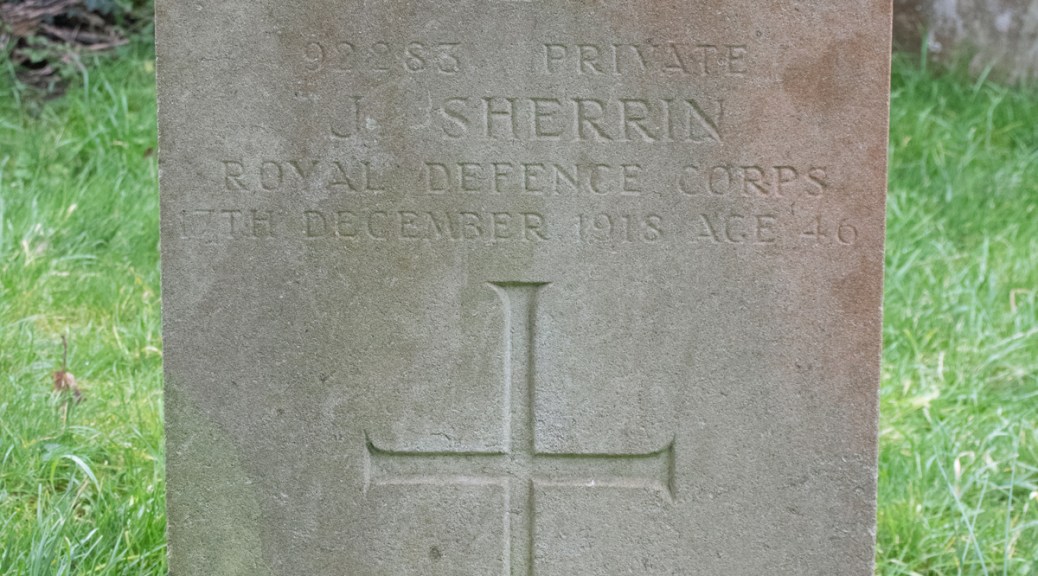
John Sherrin was born in Langport, Somerset, in the summer of 1874. The youngest of three children, his parents were Arthur and Elizabeth Sherrin. Arthur was a cowman and farmer, and John was to follow him into agricultural labouring when he left school.
Arthur took the family where the work was: by the time of the 1891 census, they were living in Broadchalke, a village to the west of Salisbury, Wiltshire. Ten years later, the census notes Arthur and Elizabeth living in Dorset, while John was in Swindon, Wiltshire, working on a farm as a butter churner.
John’s father died in 1906, and Elizabeth went to live with her daughter’s family in Devon. The same year, John returned to Somerset, where he married Bessie Kingsbury. She was a labourer’s daughter from Henstridge, who was working as a domestic servant. The couple went on to have four children – Marleen, Arthur, Albert and Grace.
John’s dairy work kept the family moving, and, according to the 1911 census, the Sherrins were living in a five-room cottage in Sturminster Marshall, Dorset.
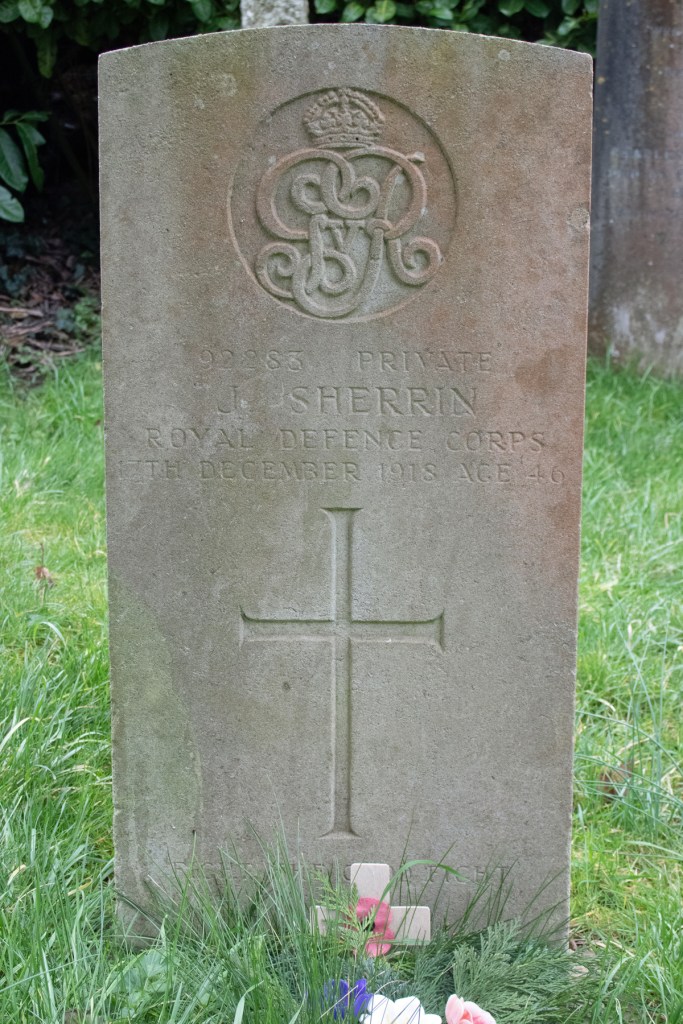
When war came to Europe, John had turned 39 years old. He did not initially enlist – presumably because of his farm work – and it seems that he was only conscripted in the closing months of the conflict. He was called up to the Royal Defence Corps during the summer of 1918, and was assigned to 254 Company.
Private Sherrin was sent to an army camp in Tidworth, Wiltshire, and it was here that he served through the Armistice. He was waiting to be demobbed in December 1918, when he was admitted to the camp’s hospital. Details of his condition are unclear, but it was in the hospital that he passed away on 17th December 1918. He was 44 years of age.
While her late husband was serving, Bessie had returned to her family in Henstridge, and it was there that John’s body was brought. He was laid to rest in the graveyard of St Nicholas’ Church in the village.
Herbert John Burgess was born in the spring of 1883 in the Somerset village of Henstridge. He was the only child to Stephen and Sarah Burgess. Stephen was a farm labourer and, by the time of the 1901 census, the family had moved to nearby North Cadbury, where Herbert had also found farm work.
At this point, Herbert’s trail goes cold. None of the Burgesses appear on the 1911 census and, when war broke out, while documents confirm that Herbert enlisted, further details are limited.
Private Burgess joined the Devonshire Regiment, and was assigned to the 12th (Labour) Battalion. The troop was sent to France in June 1916, although it is unclear whether Herbert also went abroad. The next available record for him is that of his passing. He died on 10th February 1918, although, again, the cause and location of his passing is unknown. He was 35 years of age.
Wherever and however Herbert John Burgess died, he was brought back to Somerset for burial. He lies in a quiet corner of the graveyard of St Nicholas’ Church in his home village, Henstridge.
Henry James Tabor was born in 1877, the second of six children to James and Sarah Tabor. Wiltshire-born James was a carpenter and joiner by trade, and the family were raised in Sarah’s home town of Milborne Port, Somerset.
Henry followed in his father’s footsteps when he left school and, by the time of the 1901 census, both were carrying out their trade (along with younger brother, Sidney) from the family home in East Street.
James died in September 1915, at the age of 75, and shortly afterwards, his oldest son stepped up to play his part for King and Country. He enlisted in the spring of 1916, joining the Royal Engineers as a Sapper.
Little information about his military life remains documented, but, according to a later newspaper report, he went to France and fought at both Ypres and the Somme. It was while he was overseas that Sapper Tabor contracted bronchitis, which then developed into tuberculosis. He was medically evacuated to Britain for treatment, but passed away on 28th March 1917, having been admitted to the Military Hospital in Southwark. He was 40 years of age.
The body of Henry James Tabor was brought back to Somerset for burial. He was laid to rest in the family plot in the cemetery of his home town, Milborne Port.
The loss of her husband and oldest son in such a short space of time, may have proved too much for Sarah Tabor. She passed away just two months after Henry, and he was reunited with both parents once again.
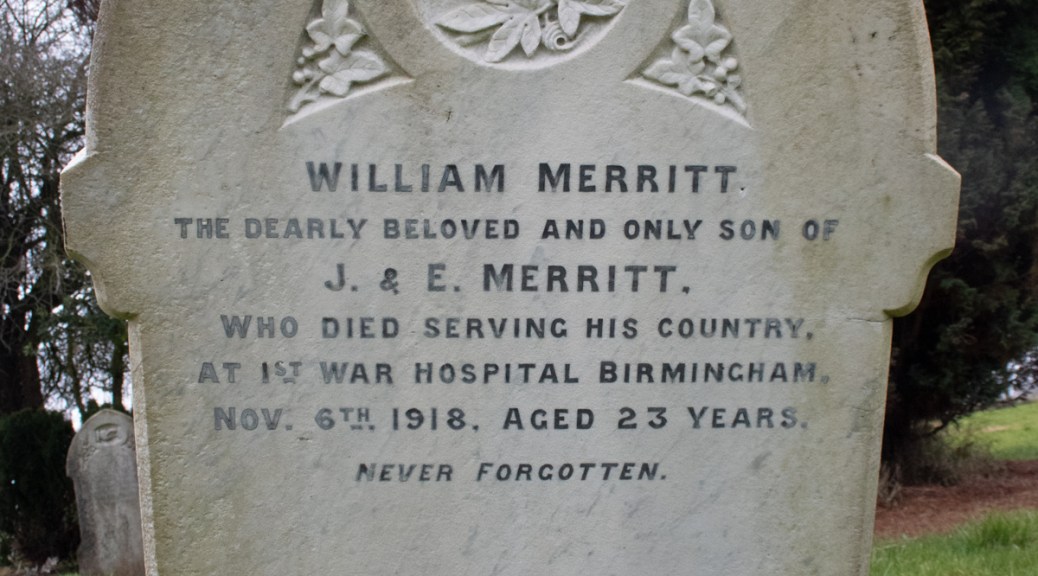
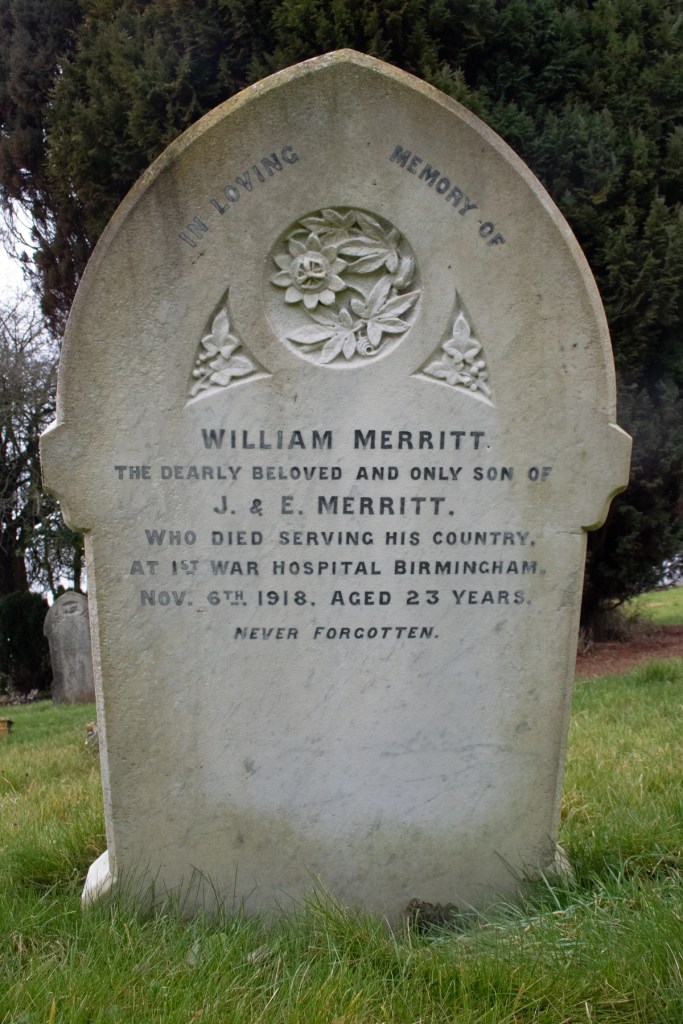
William Merritt was born in the summer of 1895 in Chippenham, Wiltshire. He was the youngest of three children to John and Elizabeth Merritt. John was a blacksmith, and he moved the family to Milborne Port, Somerset, when William was just a boy.
William found work as a shoesmith when he left school, but was one of the first to enlist when war broke out in 1914. He had his medical examination on 17th November, which confirmed that he was 5ft 5ins (1.65m) tall, had good vision and was of good physical development.
Initially assigned to the Dorset Yeomanry, Private Merritt’s trade soon found him taking on the role of Shoeing Smith for the battalion. He was obviously good at what he did, because by May 1915, he had been promoted to the rank of Corporal Shoeing Smith.
William had not enlisted in the army to make and mend shoes, however, and, in March 1916, he transferred to the Royal Garrison Artillery, back with the rank of Gunner. Rather than being sent to the Western Front, however, he found himself billeted at a camp in the West Midlands.
Little further information about Gunner Merritt’s service is available for the next couple of years. The next record for him comes on 5th November 1918, confirming his admission to the Birmingham War Hospital, as he was suffering from influenza and pneumonia. Sadly, his admittance to hospital was to prove too late: he passed away from heart failure the following day. Gunner Merritt was just 23 years of age.
William Merritt’s body was brought back to Somerset for burial. He was laid to rest in the cemetery of the town in which he had plied his trade before the war, Milborne Port.
William’s sparse personal effects were also returned to his parents. The records note that these included: “pair [of] boots, 6 postcards, razor, comb, toothbrush, shaving soap and brush, letter, pair of socks, bell.”
Another bureaucratic error is highlighted in a letter sent from the hospital in which William passed to his regiment’s records office notes that “I have to inform you that the body was forwarded to his Wife for burial…” William was unmarried, and his body was actually returned to his mother, Elizabeth.
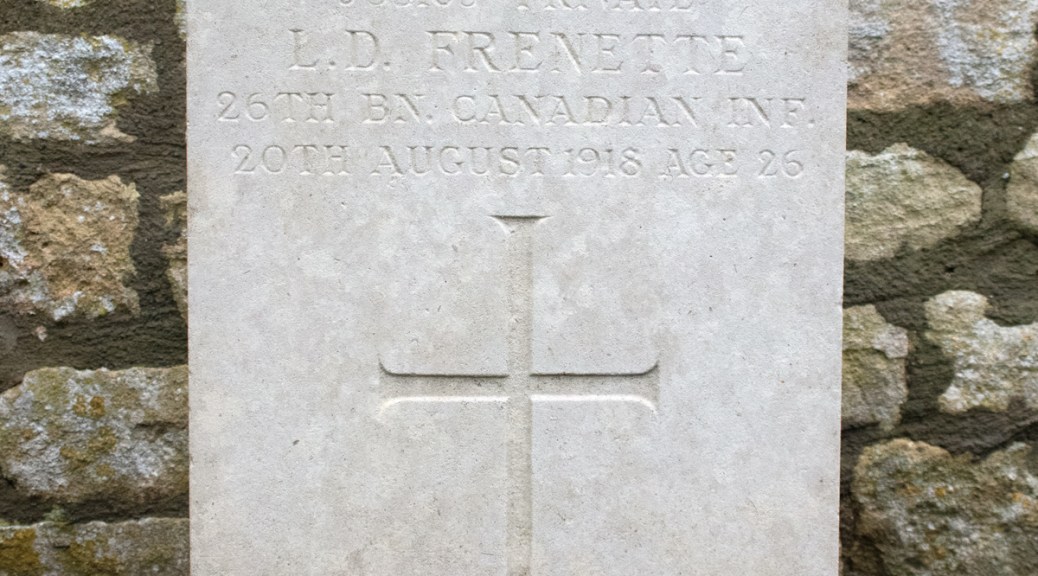
Leon D Frenette was born on 2nd June 1893, in the coastal village of Petit Rocher, New Brunswick, Canada and was the son of Denis and Sarah Frenette.
Leon’s early life is difficult to piece together – the 1901 Canadian census records five Frenette families living in the same neighbourhood, but of the two whose head is given as Denis, neither has a son by that name (although one has a son called Joseph Leon).
When war came to the distant European shores, Leon was working as a school teacher in Bathurst, a town 12 miles (20km) to the south of Petit Rocher. He stood up to play his part for King and Empire, though, having served in a local militia for a while.
Leon joined the Canadian Expeditionary Force as a Private. His service records give his height as 5ft 4ins (1.63m), his weight as 130lbs (59kg) and stated that he had a medium complexion, with brown eyes and black hair. In the section of the records that noted distinguishing marks, the medical officer had identified two small brown birthmarks on his left buttock.
Private Frenette arrived in England on board the SS Corsican on 5th November 1916. Assigned to the 132nd Battalion of the Canadian Infantry, he was based at a military camp near Bramshott, Hampshire. The influx of overseas soldiers would have been a bit of a shock to the locals, but Leon appears to have been up to the challenge. Within a matter of weeks, he was admitted to the camp hospital, suffering from a bout of gonorrhoea.
By the end of the year, Private Frenette had been transferred to the 104th Battalion, and moved to Witley Camp in Surrey. His ailment seems to have returned a couple of times, and he was admitted to the camp’s medical facility in January and March 1917.
By the autumn of 1917, Leon had been transferred again, this time to the 26th Battalion. The troop was based on the south coast at Shoreham, West Sussex, and it was from here, on 16th November 1917, that Private Frenette was finally sent to France.
Leon would have arrived at an already battle-scarred Western Front. Over the next year, he was involved in fighting at Cambrai and Arras. His time was not without incident, and he forfeited a day’s pay on 20th March 1918, for “contravention of full dress order, i.e. being without a belt.”
The 26th Battalion’s next offensive was at Amiens, and it was here, on 12th August 1918, that Private Frenette was badly wounded with a gun shot wound to his right arm. Initially treated on site, he was medically evacuated to England for further treatment.
Leon was first admitted to a hospital back in Bramshott, but then transferred to Bath War Hospital in Somerset. His medical report confirms that he was first seen there at 4:30pm on 20th March, and a compound fracture of his humerus. He haemorrhaged and died of shock at 11:45pm that day. He was just 25 years of age.
With family on the other side of the Atlantic, it was not going to be possible for Private Leon Frenette to be taken home for burial. Instead he was laid to rest in the Roman Catholic Cemetery of the city in which he had passed away, Bath.
Armand Joseph Marie Luchies was born in Antwerp, Belgium, on 3rd October 1888. Little accessible information is available for his early life, but when war broke out he joined the Belgian Army as a Soldier.
There is no confirmation of how Soldaat Luchies came to be in the UK – it seems likely that he was either injured or became unwell and was evacuated across the English Channel for treatment. Whatever happened, he passed away in Bath, Somerset – probably at the city’s War Hospital – on 9th August 1918. He was 29 years of age.
Armand Joseph Marie Luchies was laid to rest in the Roman Catholic Cemetery in on the outskirts of the city in which he died. The inscription on his headstone reads “Wie spreekt van dood leeft hij niet eeuwig in ons hart.” (“Whoever speaks of death does not live forever in our hearts.”)
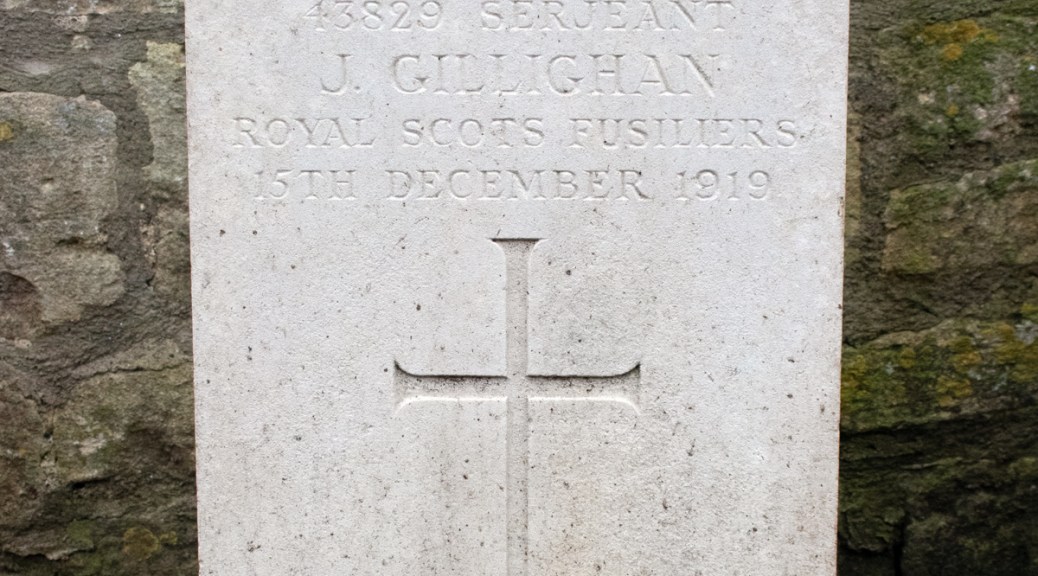
Some lives are destined to remain shrouded in mystery, and James Gillighan’s is one of those to be lost to time.
His headstone sits in the quiet Roman Catholic Cemetery in Bath, Somerset. It provides his regiment – the Royal Scots Fusiliers – and confirms that he was a Serjeant at the time of his death on 15th December 1919. The Commonwealth War Graves Commission adds that he served in the 2nd Battalion, but sadly James’ service records no longer exist.
The Army Register of Soldiers’ Effects notes that his next of kin was his brother, Matthew Gillighan, which suggests that James’ parents were not alive, nor that he was married. The document also notes that Serjeant Gillighan passed away in Bath War Hospital.
Another army document – the Service Medal and Award Roll – suggests that the service number on the headstone – 42839 – was actually James’ second number, given to him when he moved to the battalion depot. Tantalisingly, however, his previous regimental number – 15170 – sheds little more light to his service, other than the date he was sent to France – 15th September 1915.
Contemporary newspapers do not have any records for James’ passing, so it is likely to have been natural causes of some description – possibly an illness contracted while serving.
Sadly, there is little more detail that can be added to James’ life. He lies quietly, in a corner of the Bath cemetery, wrapped in mystery.








 Death and Service