Category Archives: illness

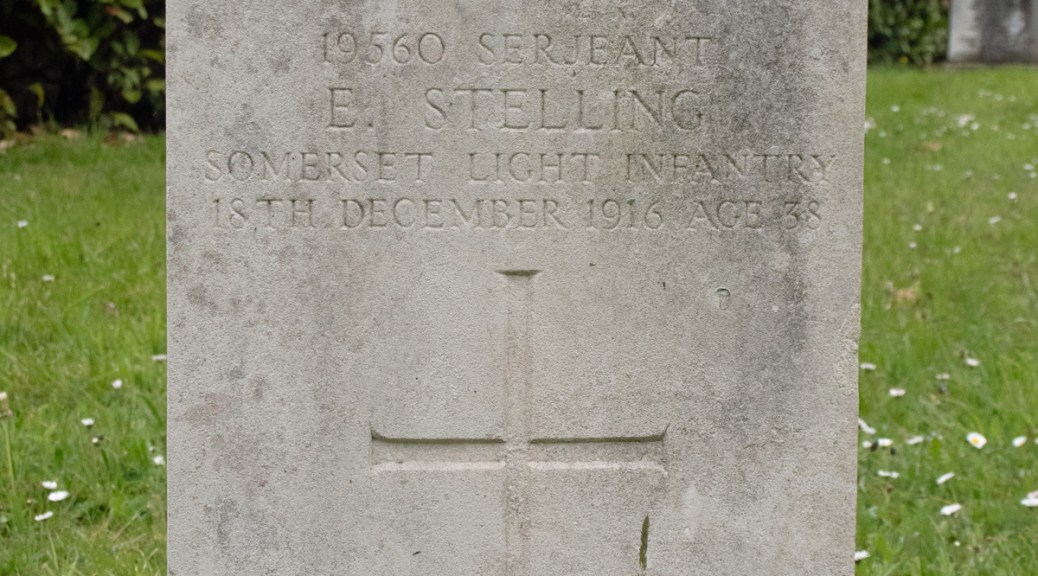
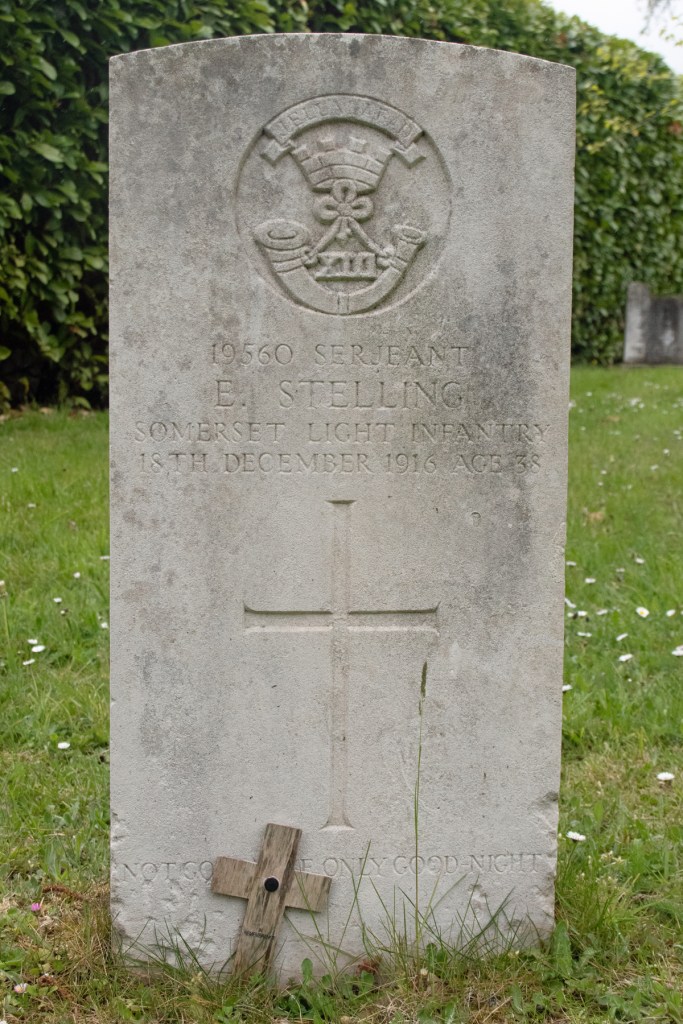
Serjeant Ernest Stelling

Serjeant Ernest Stelling

Ernest Leonard Stelling was born in the summer of 1881, the oldest of six children to Charles and Bertha Stelling. Charles was a tailor from London, and while Ernest was born in Suffolk, by the time of the 1891 census, the family had settled in Reading, Berkshire.

Ernest followed in his father’s footsteps, becoming a tailor and cutter in his own right. He met a woman from Reading called Lettie Eliza Mazey, and the couple married in 1904. The couple set up home with Lettie’s brother and his family in Tilehurst, but didn’t go on to have any children themselves.

Details of Ernest’s military service are a bit scarce. He initially enlisted in the Royal Berkshire Regiment, but quickly moved to the Somerset Light Infantry in the early stages of the First World War.

Sadly, no formal documents of Ernest’s time in the army are available, but a local newspaper gave a good insight into his Somerset service.

Death of a Master Tailor

After an illness of only seven days, the death took place at the military hospital on Monday afternoon of Sergeant EL Stelling, who has been master tailor of the Depot for the past two years. The cause of death was pneumonia, and the loss of so popular a member of the Depot staff is deeply regretted by all ranks.

Sergeant Stelling, who was 37 years of age, came to the Somersets from the Royal Berkshire Regiment, and succeeded the late Sergeant-Master-Tailor Chambers. He was a native of Reading, and one of four brothers serving their King and country. His father, Mr Charles Stelling, for many years carried on business as a master tailor in Reading.

Since he had been at Taunton barracks, Sergeant Stelling had made many friends, and actively identified himself with the social life of the sergeants’ mess, taking a prominent part in the arrangement of concerts, etc.

He was of a bright, generous disposition, and before his illness he was making a collection at the Depot on behalf of the Buffaloes’ Christmas treat to poor children of the town. He was a valued member of the local Lodge of the Royal Order of Buffaloes, and his death is greatly regretted by all the brethren.

He leaves a widow but no family. Much sympathy is felt for Mrs Stelling, who has for some years been a confirmed invalid.

The funeral took place with full military honours at St Mary’s Cemetery on Friday afternoon.

Taunton Courier and Western Advertiser: Wednesday 27th December 1916

This gives a real insight into Ernest’s personal life. He was obviously very active socially, and committed to the community. Whether Lettie’s infirmity contributed to the couple’s lack of family will never be known, but, from his support of the poor children of Taunton, it seems evident that he would have been a good family man.

The next document relating to Serjeant Stelling is his pension record; this confirms the news article’s report that he contracted pneumonia and influenza, and he succumbed to the conditions on 18th December 1916. He had, in fact, just turned 38 years old.

Ernest Leonard Stelling lies at rest in St Mary’s Cemetery in his wartime adopted home town of Taunton, Somerset.

Serjeant Ernest Stelling (from Ancestry.co.uk)

Private William Gulliford

Private William Gulliford

William Gulliford was born on 8th November 1877 in the village of Thurloxton, just to the north of Taunton, Somerset. William’s father – also called William – was an agricultural labourer who, with his wife Charlotte, had nine children in total.
William Jr found work as a labourer for a brewery and, by 1899, had moved to Staffordshire, met and married a local woman called Elsie Sutton. The couple settled down in Burton-on-Trent, and went on to have a daughter, also called Elsie.

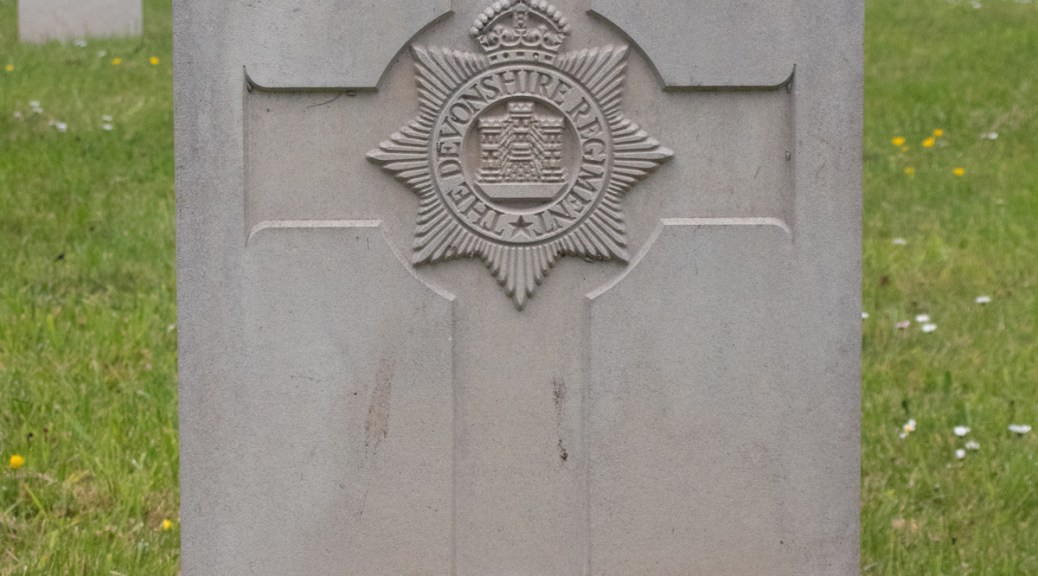
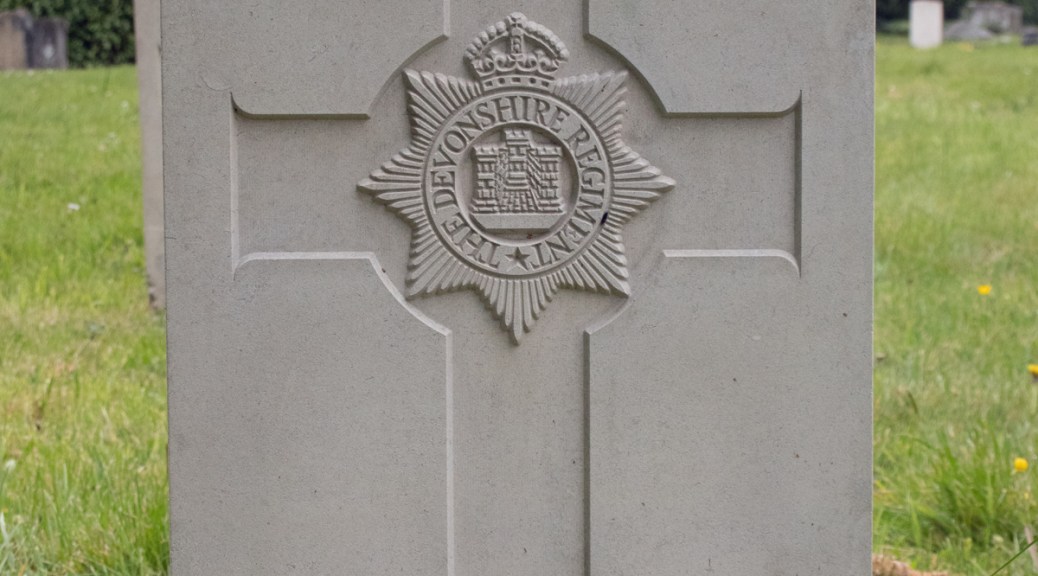
War was coming, however, and, in August 1916, William enlisted. Initially assigned as a Private in the 14th Devonshire Regiment, he was soon moved to the Labour Corps, and within a couple of months was on the Western Front as part of the British Expeditionary Force.

In November 1917, Private Gulliford was shipped back to England, suffering from ill health. He was admitted to the Military Hospital in Taunton with heart failure, and sadly passed away from this a month later. He had just turned 40 years old.

William Gulliford lies at rest in St Mary’s Cemetery in Taunton, Somerset.


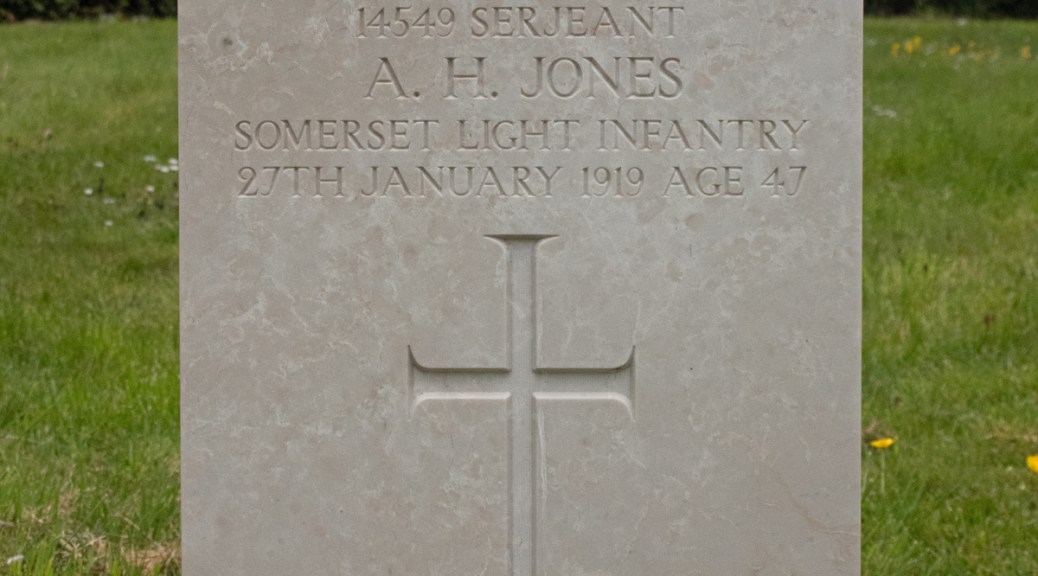
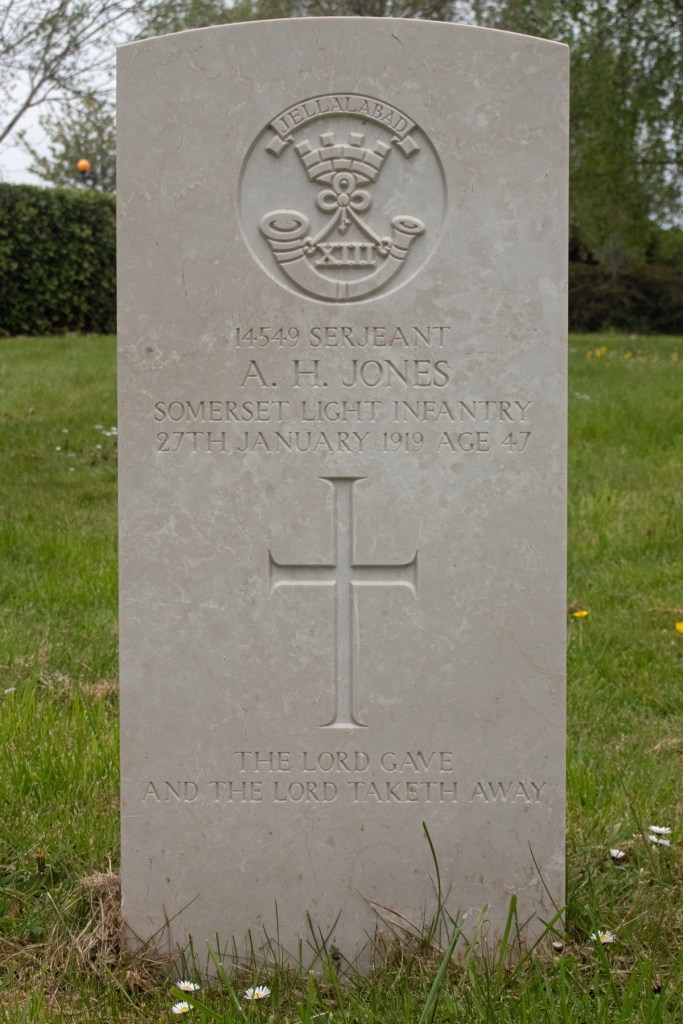
Serjeant Arthur Jones

Serjeant Arthur Jones

Arthur Henry Jones was born in 1874, the oldest of five children to James and Kate Jones. James worked as a coachman, and travelling seems to have been his thing.

Born in Wiltshire, he met and married Kate in Somerset, and this is where Arthur was born; by 1879, the young family had moved to Hampshire, and within a year they had relocated again, this time to Folkestone in Kent. Three years later, by the time James and Kate’s youngest two children were born, they were back in Wiltshire again, having competed their tour of the south of England.

Sadly, tragedy was to strike the Jones family, when Kate passed away in 1888, at the tender age of 31 years old. James had a family of boys to bring up, however, and he married again, this time to a Miriam Millard. The couple went on to have two children, giving Arthur a half-brother and half-sister.

At this point, Arthur falls off the radar. It may well be that he chose to take up a military career early on – if he was serving overseas, it is possible that the census documentation no longer exists. Twelve years’ service would certainly seem to account for his absence between 1881 and the next time his name appears on records.

These records relate to Arthur’s marriage to Fanny Hill. The couple were married by Banns in May 1906, marrying in Westbury, Wiltshire. They went on to have four children – Arthur, Kathleen, Gladys and Percival – between 1907 and 1911.

Again, at this point, Arthur falls off the radar. His service records no longer exist, but what evidence remains confirms that he enlisted in the Somerset Light Infantry and was assigned to the 7th (Service) Battalion. Initially formed in Taunton, they shipped out to France in July 1915, although there is no documentation to confirm when or if Arthur was involved.

Sadly, the only other reference to Serjeant Jones is his final pension record. This confirms that he succumbed to a combination of influenza and pneumonia on 27th January 1919. He was 44 years old.

Arthur Henry Jones lies at rest in St Mary’s Cemetery in Taunton, Somerset.


Private Thomas Winter

Private Thomas Winter

Thomas Henry Winter was born in 1887, one of six children to James and Mary. James was a farmer, and the family lived in Milverton, in the Somerset countryside to the west of Taunton.

James died in 1900, and Thomas found his way into farm work as well. He met and married a local woman called Ada Thynne in February 1909, and the couple went on to have five children: Beatrice, James, Charles, Frank and Thomas.

There is little confirmed information about Thomas’ military career. When he joined up, he enlisted in the 13th Battalion of the Devonshire Regiment, although, as his service records no longer exist, it is not possible to identify when this was.

Private Winter later transferred to the Labour Corps – again there are no records to confirm the dates – and this is the division in which he remained.

Illness was to dog Thomas, however; in early 1918, he contracted enteric fever (known nowadays as typhoid), and was hospitalised. Sadly, he succumbed to the disease, and passed away on 14th February 1918. He was 30 years of age.

Thomas Henry Winter lies at rest in St Mary’s Cemetery in Taunton, Somerset.


An additional tragic turn to Thomas’ story is that Ada was pregnant when he passed away. His youngest son, whom Ada named after him, would never know his father.


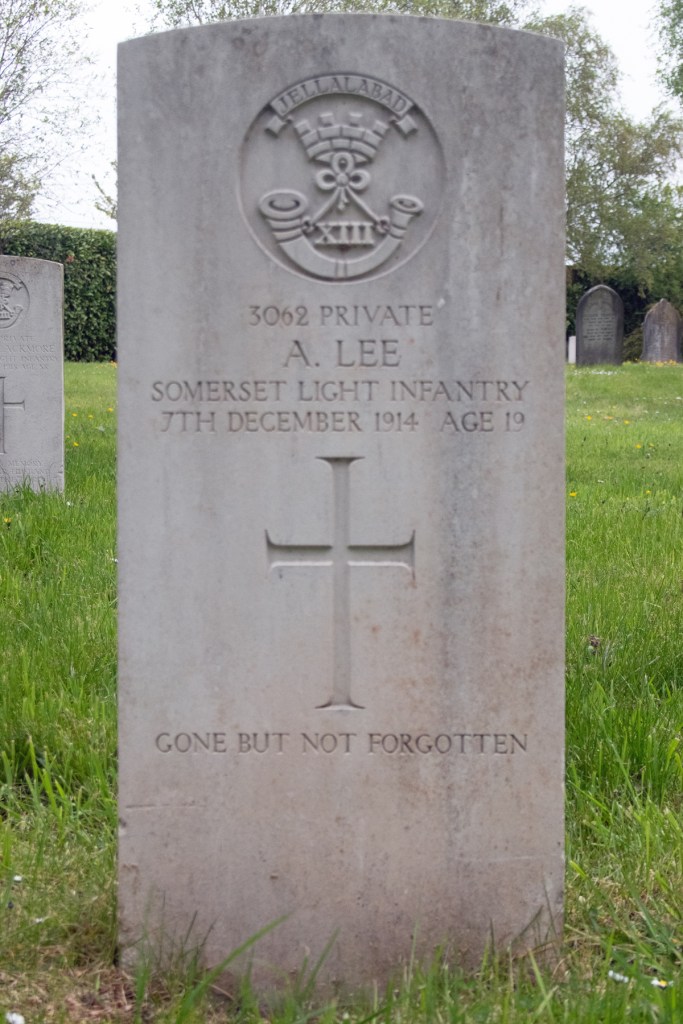
Private Arthur Lee

Private Arthur Lee

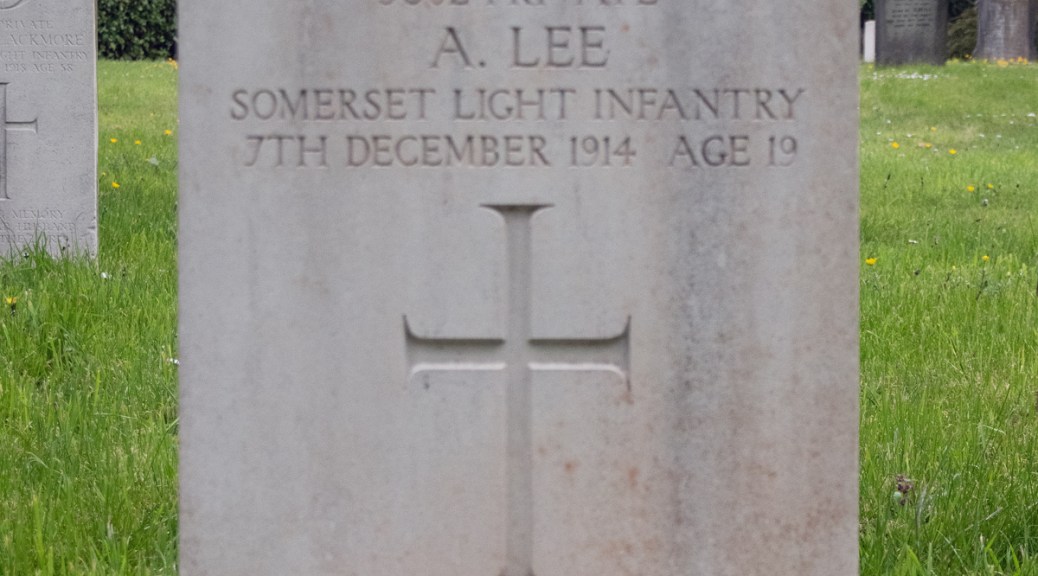
Arthur Henry Lee was born in April 1895, and was one of five children. His parents were Arthur and Hannah (or Annie) Lee, and the family lived in the Chard area of Somerset. Arthur Sr worked as a ‘twist hand’, operating the machines in a lace factory and, when his son left school, he too found work in the same factory.

There is little documented about Arthur’s early life. When war broke out, however, he was quick to enlist, and joined the Somerset Light Infantry as a Private. He was assigned to the 5th (1st Reserve) Battalion, and was stationed at Mansfield House.

Sadly, Private Lee’s military service was not to be a long one. As happened with lots of young men from different parts of the country coming together in large numbers, illness and disease spread quickly in the military encampments,

Arthur was not immune to this and was admitted to the Military Hospital in Taunton with meningitis. He passed away on 7th December 1914, aged just 19 years old.

Arthur Henry Lee lies in St Mary’s Cemetery in Taunton, Somerset.


Private Henry Underhill

Private Henry Underhill

Henry Thomas Underhill is one of those people whose lives are lost to time. Details of his early life were difficult to track down, but snippets helped unlock some of the mystery.


In late October 1914, a number of Somerset newspapers gave the following report:

Soldier’s Sudden Death

The West Somerset Coroner held an enquiry at Taunton Barracks on Saturday afternoon relative to the death of Private Henry Thomas Underhill, aged 44, of Street, which took place on Wednesday [14th October 1914].

Deceased was talking to Private TF Davis on a landing in the barracks, when he reeled and, throwing up his arms, fell heavily to the ground, his head striking the floor.

Major Stalkartt, RAMC, was at once summoned, but he found that life was extinct. He afterwards made a post mortem examination, which revealed fatty degeneration of the heart, with a fracture of the bae of the skull. The doctor considered that death was due to heart failure, and that the skull was fractured in falling to the ground.

The deceased was accorded a military funeral at St Mary’s Cemetery the same afternoon. He was an old member of the Somerset Light Infantry, which he recently re-joined on account of the war.

Wells Journal: Friday 23rd October 1914

Private Underhill’s pension record confirms that he was married to a woman called Mary Ann and that the couple had had a daughter, Beatrice Kate Lavinia Underhill, who had been born in December 1906. While searching for Henry directly drew too many variables to provide any certainty, his daughter proved the key to unlock his story.


Henry Thomas Underhill was born in the summer of 1860. One of nine children, his parents were William Underhill and his wife Elizabeth, who was also known as Betsy. William worked as a clerk for a button maker, and the family lived in Birmingham, which, at the time, was in Warwickshire.

When he left school, Henry found work as a ‘brass tube drawer’, making the metal tubes, using a die. He found love too, and, on 13th March 1881, aged just 20, he married Emma Howner. The couple went on to have a son, Ernest, in 1889 although, from the documentation about him, it seems likely that he passed away when only a toddler. Further tragedy was to strike Henry, when Emma also died in 1890, aged just 30 years old.

It may have been around this time that Henry found a focus in military service; he does not appear in the 1891 census and the next set of documentation for him dates from 1900.

It’s at this point that Henry married for a second time. Mary Ann Kelly was seventeen years younger than her new husband, and was the daughter of a carpenter from Solihull. Her father, Michael, had died when she was only a teenager, and she lived with her mother, Lavinia, helping to support her.

Henry’s previous experience with metalwork – and probably his time in the military – found him employment making gun components. The 1901 census finds him and Mary living in Yardley, to the east of Birmingham, with Lavinia and Mary’s younger brother William.

This was obviously a suitable and convenient arrangement; the next census, in 1911, shows the family still living together. By this time, Lavinia was still the head of the household, and shared her home with daughter Mary, Henry and four-year-old Beatrice; son William, his wife Ada and their new-born son, William. Making up the household on Census Day was a visitor, Amy.

War was on the horizon, and this is where we return to the initial news report about Private Underhill. It is likely that Henry had re-enlisted – or at least been called back up – as soon as hostilities broke out. Sadly, his service was not to be a long one, as he suffered the fatal heart attack within a couple of months of the start of the war. Private Underhill was 54 years old at the time of his death.

Henry Thomas Underhill’s body was buried in St Mary’s Cemetery in Taunton, Somerset.


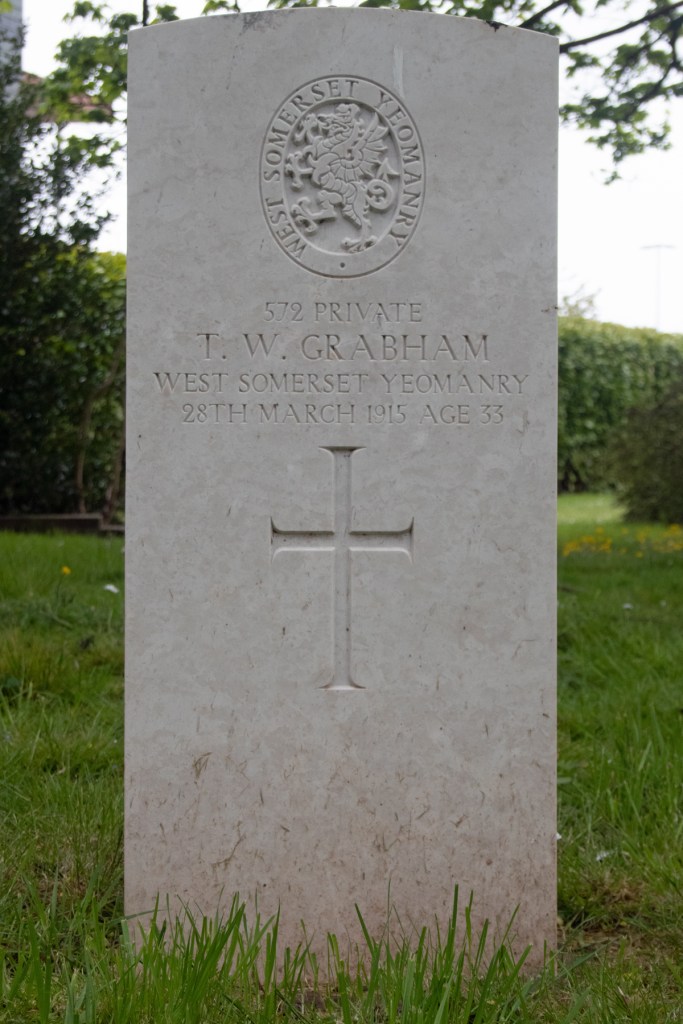
Private Thomas Grabham

Private Thomas Grabham

Thomas William Grabham was born in September 1883, one of six children to Thomas Richard Grabham and his wife Emma. Thomas Sr was a labourer and drayman for a brewery and the family lived in Taunton, Somerset.

When Thomas Jr left school, he found work as a grocer’s porter, before he too found work in a brewery, working as a maltster. He married a local woman, Maria Rowsell, and the couple went on to have a son, who they named after Thomas’ father.

Details of Thomas’ military service are sketchy; he enlisted in the West Somerset Yeomanry, but there are no details of when this was.

Sadly, Private Grabham’s period of service was short; his pension records show that he passed away from a perforated gastric ulcer on 28th March 1915. He was just 32 years old.

Thomas William Grabham lies at peace in St Mary’s Cemetery in his home town of Taunton.


Sadly, the tragedy for the young Grabham family was not to end there. Maria, Thomas’ widow, died just five months after her husband.

Young Thomas was just eight years old when his parents died; he seems to have been brought up by a Mrs Kate Barnes, possibly a maternal aunt. Here, however, the family’s trail goes cold.


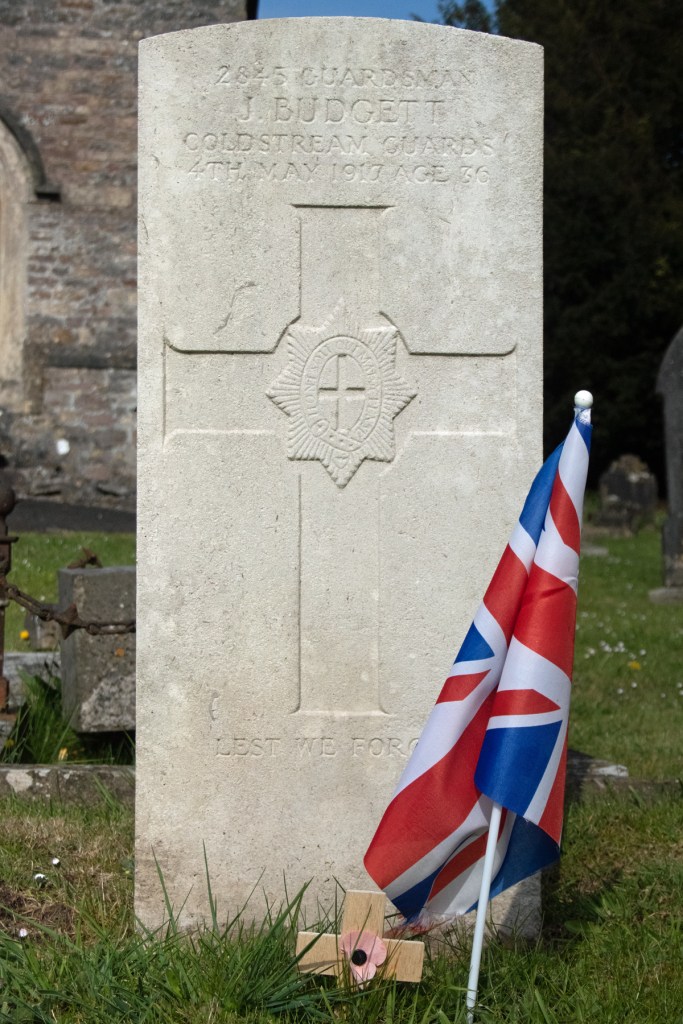
Guardsman James Budgett

Guardsman James Budgett

James Budgett was born in October 1880 and was one of nine children to Henry and Eliza Budgett. Henry was a labourer, and the family lived in the small village of Stoke St Michael, near Shepton Mallett in Somerset.

While initially following his father in to labouring, James was drawn to the military as a career. He enlisted in the army in August 1899, and was assigned to the Coldstream Guards. James’ bearing would certainly have stood him in good stead for this wing of the army; his medical examination shows he was 6ft 1in (1.85m) tall.

Guardsman Budgett’s initial service was for twelve years; during this time, he spent six months in Australia, but his records show that most of his time was spent on home soil.

When his term ended in August 1911, he enrolled for a further four years. Initially assigned to the Reserve Battalion, he was formally mobilised when war broke out. Sent to France as part of the British Expeditionary Force in August 1914, he was wounded in the foot two months later, and was sent home for treatment.

According to Guardsman Budgett’s medical records, the treatment unearthed a two other issues. One was that he was suffering from syphilis, which was treated. The other was that an x-ray identified an aneurysm in his aortic arch. This was considered harmful enough for him to be medically dismissed from the army, and he left active service on 25th March 1915.

After this, details of James’ life get a bit hazy. His pension records show that he married a woman called Bessie, but there is nothing to confirm when the marriage took place.

The next record for James Budgett is confirmation of his passing. He died from an aneurysm on 4th May 1917, at the age of 36. He lies at rest in the graveyard of St Michael’s church in his home village of Stoke St Michael, Somerset.


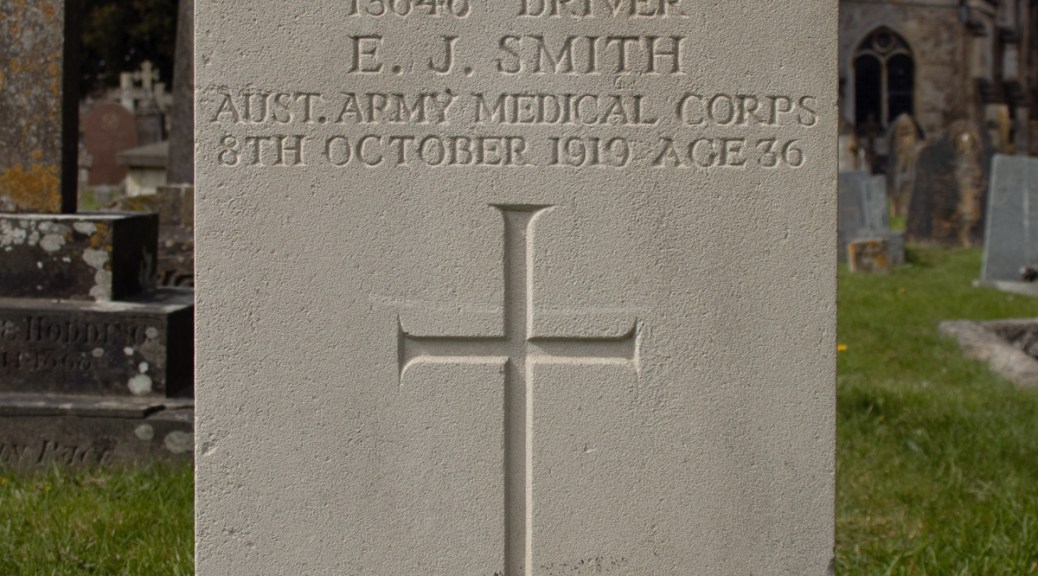
Driver Ernest Smith

Driver Ernest Smith

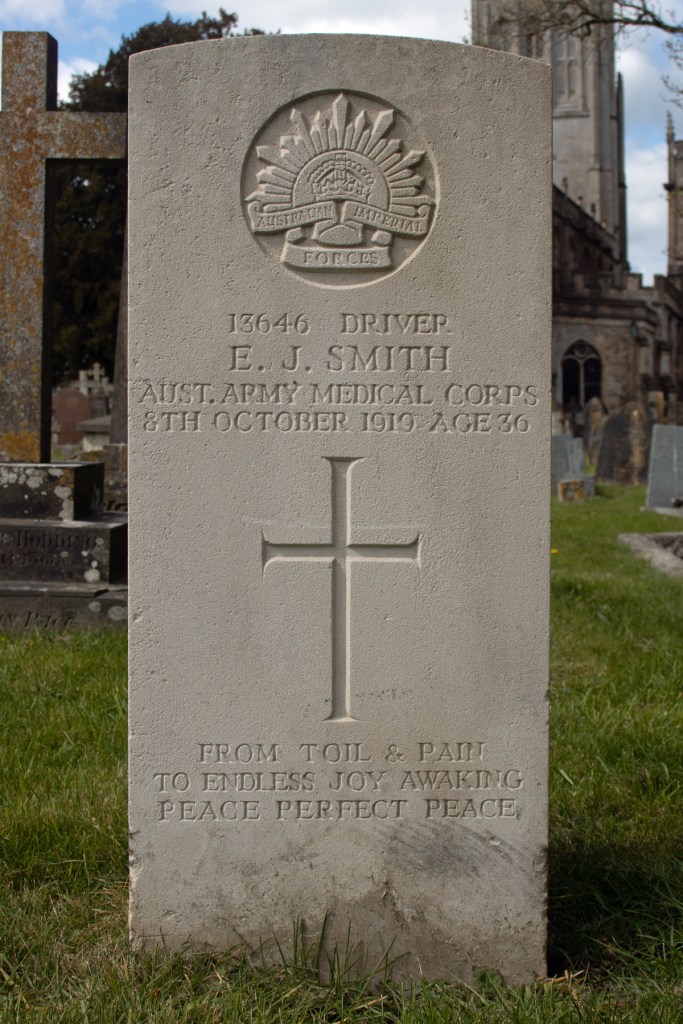
Ernest John Smith was born in 1883, one of seven children to John Smith and his wife Sarah Jane. John was a coal merchant, and the family lived in the Somerset town of Bruton. When Ernest initially left school, he worked as a farm labourer, but at some point, a sense of adventure caught him, and he emigrated to Australia. Sadly, details of his travels are not available, but he left England at some point before 1915.

When war broke out, however, he was still keen to do his bit. He was living in Queensland when he enlisted on 26th October 1915, and was assigned to the Australian Army Medical Corps.

Driver Smith’s battalion left Australia for Europe in March 1916, and served in France for the duration. He was dogged by ill health, catching pleurisy a couple of times, and had a number of fibromas operated on.

In October 1918, he was appointed Lance Corporal, but was shipped back to England later that year with ongoing fibroma issues. He was admitted to Torquay Hospital as dangerously ill in December of that year, and spent most of the next nine months in hospital, initially in Torquay, but then when he was able to be moved, he was transferred to the 1st Australian General Hospital near Warminster.

Sadly, the cysts Driver Smith has developing were malignant, and he passed away on 8th October 1919. He was just 36 years old.

Ernest John Smith was brought back to his home town for burial, and lies at rest in the graveyard of St Mary’s Church in Bruton.


Private Walter Selman

Private Walter Selman

Walter Charles Selman was born on 7th June 1899, the youngest of four children to Walter and Annie Selman. Walter Sr was a gardener and, by the time of the 1911 census he had moved the family to the sleepy Somerset village of Burrington.

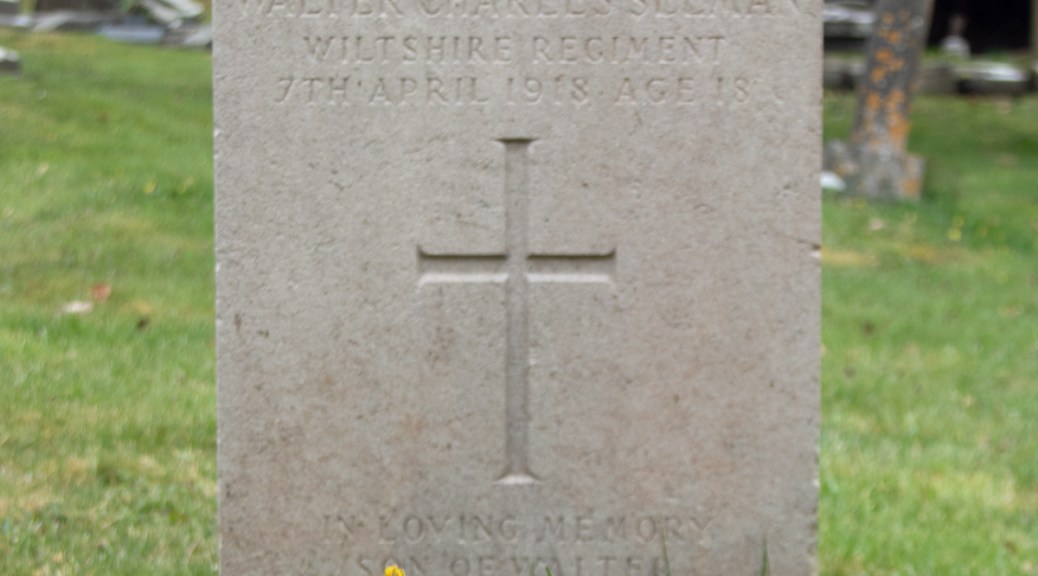
Sadly, there is little documentation surrounding Walter’s young life. His gravestone confirms that he enlisted in the Wiltshire Regiment; although there is no date to confirm when he enrolled, it is likely to have been in the second half of the conflict, given his age.

Private Selman was assigned to the 4th Battalion, but there is no clear confirmation of where he served. The 1/4th Battalion fought in India and Egypt; the 2/4th was also based in India but remained there for the duration. The 3/4th Battalion – the most likely to be Walter’s troop – was a reserve troop, based on home soil.

Where little is known about Private Selman’s military service, there is similarly little information about his passing. His pension records bluntly put his cause of death as ‘disease’; as with many other recruits towards the end of the war, it is likely that this was, in fact, either influenza or pneumonia.

Sadly, the mustering of the Allied armies – and the associated mixing of young men from across the country in crowded barracks – brought a real danger of disease, and lung complaints were commonplace. While there is no definite proof, it appears that Private Selman may have succumbed to one of these conditions; he passed away in a military hospital on Salisbury Plain on 7th April 1918, two months short of his 19th birthday.

Walter Charles Selman lies at rest in the graveyard of Holy Trinity Church in his home village of Burrington, Somerset.