Category Archives: illness

Captain Bertram Perkins

Captain Bertram Perkins

Bertram Falls Perkins was born in December 1872, the third of four children to Alfred and Mary Perkins. Alfred was a Colonel in the army and has met his wife while serving in Madras, India. He had retired by the time Alfred was born, and had brought his family back to England, where he set up as a Country Magistrate, living in the village of Wookey in Somerset.

Bertram was set for good things – by the time of the 1881 census, the family were living in Eastcott House, with a footman, cook, two ladies’ maids, two house maid and a governess to look after them.

Bertram’s military records are a little scant, but can be pieced together from his funeral notice.

The late Captain Bertram Perkins… joined the 1st Vol. Batt. of the Somerset Light Infantry as 2nd Lieutenant in February 1892, and, in November 1894, was transferred to his father’s regiment, the 3rd Batt. Welsh Regt. as Lieutenant… In October 1896 he went to South Africa and joined the Natal Mounted Police, in which he saw much active service… at the relief of Ladysmith and Dundee. Being stricken down with a very severe attack of enteric fever, he had to resign… and return home. As soon as he recovered his health he again retuned to South Africa as a Captain in the 3rd Battalion Welsh Regiment, where he saw much service…

Whilst at Vryburg, he was appointed Provost Marshal, and in recognition of his tact and energy in filling a very difficult position, was presented by the inhabitants of the district with a gold watch and an illuminated address. He was in possession of the Queen’s Medal with four clasps and the King’s Medal with two clasps. On his return home he took to farming… He retired from the Service in 1905, but on the outbreak of the present war was appointed as Captain to the 12th Battalion of the Sherwood Foresters. Unfortunately, his health, which had never been quite restored, broke down, and he was invalided out of the Regiment.

Wells Journal: Friday 16th June 1916

During the Great War, Captain Perkins’ regiment has been the 12th (Service) Battalion for the Nottinghamshire and Derbyshire Regiment. His unit been shipped out to France in August 1915, but it is likely that he saw little, if any, time on the Western Front. After being invalided out, he succumbed to his ongoing illness on 14th June 1916, aged 43.

Bertram Falls Perkins lies at rest in the graveyard of St Matthew’s Church, in his home village of Wookey, near Wells in Somerset.


Private Thomas Baker

Private Thomas Baker

Thomas Baker was born in 1877, the youngest of four children – all boys – to John and Anna Baker from Meare in Somerset. John was a farm labourer, and it was rural trades that his four sons followed, Thomas himself also becoming a farm worker.

Thomas married in August 1896; Phoebe Ann Willis was also from Meare and was just seventeen when the couple married. While I am sure there was love involved, something more practical might have prompted such a young marriage as, six months later, the couple had their first child, Henry.

Thomas and Phoebe went on to have four children, three of whom – Henry, Florence and Amy – survived. By the time of the 1911 census, the family were living in their home village of Meare, with Henry following in his father’s – and grandfather’s – line of work.

Full details of Thomas’ military services are not available. He enlisted in the Devonshire Regiment as part of the 13th Works Battalion and, while there is no documentation to confirm when he joined up, it was probably early in 1917.

Thomas and Phoebe’s son Henry had enlisted in 1915, joining the Gloucestershire Regiment. It seems likely he fought on the Somme, and he was killed in action in November 1916, aged just 20 years old. It may have been this loss that prompted Thomas to do his duty, albeit on the Home Front.

Whenever it was that Private Thomas Baker had enlisted, it was Phoebe that was to suffer the ultimate price. Having already lost a child young, her boy had died in the fields of France, and her husband was also about to add to that loss.

Thomas contracted pneumonia in the winter of 1916-17, and passed away in a military hospital on 22nd February 1917. He was 40 years old.

Thomas lies at rest in the graveyard of the Church of the Blessed Virgin Mary & All Saints in his home village of Meare in Somerset.


Private John Russell

Private John Russell

Born in September 1896, John Russell was one of thirteen children to Henry and Ellen Russell. Henry worked as a turf cutter on the Somerset levels, and the family lived in the village of Meare, near Glastonbury.

By the time of the 1911 census, John, aged 15, had left school and joined his father’s business.

When war broke out, John joined up; sadly, his military records are absent, but what we do know for certain is that he enlisted in the West Somerset Yeomanry, and was based at the Stanway Camp near Colchester in Essex.

Sadly, much is written of Private Russell’s death. He was acting as a sentry at the camp on the morning of Tuesday 19th October 1915 when he was hit by a car; taken to the military hospital in Colchester, he passed away the following morning.

An inquest was held into the incident, and the following was ascertained:

Vera Coysh, aged 19, was driving near the camp with two friends and her gardener; as she was approaching the entrance, a horse-drawn military wagon ahead of her turned and she swerved to avoid it. In doing so, she hit Private Russell “and carried him some way along the ground”.

John’s injuries were significant. When admitted to hospital, he “was suffering from bruises on the back of the head and haemorrhage from the right ear and nose. His left hand and the lower part of his left arm were swollen from bruising. He was semi-conscious and restless…”

The inquest identified some discrepancies in what happened.

Witnesses in the military wagon and a second one following it all saw a turning signal being given, although not necessarily in time for Vera to slow down or stop. All of the army witnesses stated that she was driving at a quick speed, possibly as much as 35mph.

Vera and her passengers all stated that they saw no signal, saying that the wagon pulled across without indication. They also stated that they were not travelling at speed.

The inquest was a lengthy one, but the final verdict was one of accidental death, with a recommendation that signs were put up on the road to warn of the entrance to the camp.

John Russell was just 19 years old when he died. He was laid to rest in the graveyard of the Church of the Blessed Virgin Mary and All Saints in his home village of Meare, Somerset.


It’s worth also having a look into the life of the driver of that fated motor car.

Vera Murdoch Coysh was born in September 1896, the eldest child of Commander William Henry Coysh and his wife Beatrice Murdoch. The family lived in Yorkshire and, by the time of the incident, William and Beatrice had had four other children – Humphrey Cecil (who became a Commander), Geoffrey Ernest (who went on to be Sub Lieutenant), John William and Barbara Daphne.

Three months after the accident, Vera married Second Lieutenant Trevor Davidson, of the Essex Regiment, and the couple soon emigrated to Mozambique.

All was not well, however, as, by 1924, Vera has moved back to England, the couple had divorced and she had remarried, to a Douglas Stuart-Jervis. The couple went on to have two children.

Meanwhile, Vera was also making a bit of a name for herself in the literary world, writing a number of novels under the name of Jane England. While rarely seen nowadays, she wrote books with such ‘pulp fiction’ titles as Red Earth, Romantic Stranger, Flowering Harvest, Stormy Passage and Winter Jasmine.

It’s bittersweet to see that Vera made a life for herself, in the way that John Russell was sadly unable to.


Private Hubert Labdon

Ashcott

Hubert Wilfred Labdon was born in the spring of 1896, to Alfred and Elizabeth Labdon, bakers in Ashcott, Somerset. One of five children, with two older brothers and two older sisters, he lost is mother at a very early age; Elizabeth died in 1901.

Hubert had left home by the time he was fifteen, but had not gone far – the 1911 census found him learning a trade from Edgar and Betsy Vining, farmers in the village.

When war came, Hubert enlisted – he joined up in February 1916, aged 19 years and five months. Private Labdon was initially assigned to the Somerset Light Infantry, but he must have quickly shown aptitude, because he was soon transferred to the Machine Gun Corps. After initial training, he found himself on a ship to France, arriving in Camiers, to the south of Boulonge, on 25th September 1916.

Private Labdon’s military records survive and are quite detailed – after an early mishap, where he was docked two days’ pay for losing part of his kit ‘by neglect’, he also spent time in hospital in June 1917.

By August of that year, he was based permanently at Camiers, where he was acting as a stretcher bearer. This was a role he continued to execute until he was demobbed at the end of the war.

His records show Hubert was granted two periods of leave; it was on the second of these, in November 1918, that he married Eva May Acreman. She was two years his senior, a farmer’s daughter from Ashcott as well, although the couple married in Ealing, London.

By mid-December, Private Labden was back in France, and here he stayed until February 1919, when his unit was finally demobilised. On returning to England, the young couple moved back to Ashcott, to be close to his family.

Sadly, Hubert seems to have succumbed to illness as many of his returning colleagues did. The local newspaper gave details of his passing:

The deceased, who was only 23, was recently married. He had served his country during the late war, part time as stretcher bearer. He had suffered from trench fever, which considerably injured his constitution and left him with a weak heart, which, no doubt, was the cause of death.

He had left his home for a short walk, and having been away rather longer than usual [a] search was made for him, and he was found sitting in an unconscious state. He died in a short time after reaching his home.

Deceased was of a very quiet and inoffensive disposition, and was much respected.

Central Somerset Gazette: Friday 2nd January 1920

While the end result was the same, Private Labdon’s military records adds the cause of death as ‘heart failure following influenza and acute diarrhoea’.

Hubert Wilfred Labdon lies at peace in the graveyard of All Saints’ Church, in his home village of Ashcott in Somerset.


Eva remained in Somerset after her husband’s death. In 1930, she married William Langford, a baker, and the couple went on to have a daughter.


Gunner Arthur Latcham

Gunner Arthur Latcham

Arthur James Latcham was born in 1889, the oldest of five children – all boys – to Walter and Matilda Latcham. The family lived in Street, Somerset, where Walter worked as a carpenter in the Clark’s shoe factory.

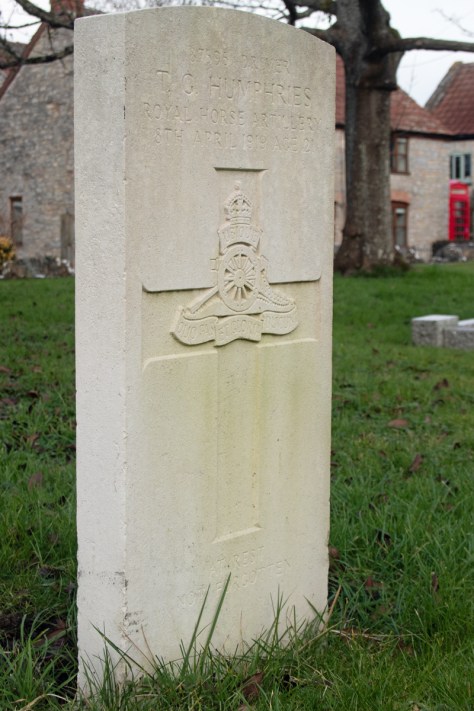
Initially following his father into shoemaking, Arthur was quick to enlist when war broke out. Details of Gunner Latcham’s military service is scarce, but documents confirm that he joined the Somerset Royal Horse Artillery on 8th October 1914. He did not see active service abroad, but had been stationed on the east coast for his training.

While little remains of his service records, contemporary media of the day includes a lot of information about both his passing and his subsequent funeral.

On Sunday, December 5th, having a few hours’ leave, he visited his parents at Street, and while at home complained that he was feeling unwell. On the following Wednesday, December 8th (which, by a coincidence, was his twenty-sixth birthday) Mr and Mrs Latcham received a post-card from him from Taunton [where the Somerset RHA was based] stating that he was very ill. They immediately engaged a motor car, and went to Taunton, where they found him in an extremely weak state, and on the point of collapse, he having had to walk to a hospital nearly a mile away three times a day for his medicine. Having obtained the captain’s permission, they brought him home in the motor car, and at once put him under the care of Dr MacVicker. He was then found to be suffering from pneumonia and congestion of the lungs… In spite of the greatest care, and best of nursing, however, he gradually grew worse, and never rallied.

Central Somerset Gazette: Friday 24th December 1915.

The following week’s newspaper included nearly a whole column on Gunner Latcham’s funeral, including two tributes, one from his captain and another from the local MP.

I am writing to tell you how very sorry all the officers of this battery are at your loss. Your son was the first member of the Somerset RHA to give his life for his country, and although he did not have the satisfaction of being killed in action, the honour is the same. I’m afraid the last few months he was in this battery were not very happy ones for him, owing to his trouble with his finger; but he bore the trouble and pain well. I had him with me for more than a year, so I can fully appreciate what a good fellow he was and how great your loss is.

Captain M Clowes (Central Somerset Gazette: Friday 31st December 1915)

I am very sorry indeed to learn of the sad loss you have suffered through the death of your son. I know that he was a fine fellow, an example of what an Englishman should be, and respected by all who knew him. I am sure you must feel proud to know that he has done all that a man can do, and has died serving his country.

Ernest Jardine MP (Central Somerset Gazette: Friday 31st December 1915)

Arthur James Latcham lies at rest in the graveyard of Holy Trinity Church in his home town of Street.


Arthur was the third son Walter and Matilda had lost. Their second-born, Herbert, passed when a little over a year old. Their third son, William, died a year before Arthur, when he was just 15 years old.


Private Martin Kiddle

Private Martin Kiddle

Martin Kiddle was born in 1871, the oldest of four children to Joseph and Annie Kiddle. Joseph was a butcher in the Somerset town of Street, and the family lived above the shop on the High Street.

When Joseph died in 1886, Martin took on the role of shopman, before taking over the business entirely.

In 1895, aged 24, Martin married Eleanor Freeman, four years his senior from the nearby town of Ilminster. The young couple had five children and, by the time of the 1901 census, they were running the business as a family, employing an assistant in the shop and a domestic servant.

It is evident that Martin left the butchery business behind him, though. Ten years later, on the 1911 census, he is listed as a Stock Room Manager in a local rug factory.

Martin joined up when war broke out, initially serving in the Somerset Light Infantry, before transferring across to the Royal Defence Corps.

While there is no date for his transfer, it is likely to have been at some point in 1915. Private Kiddle’s wife, Eleanor, passed away in May of that year, so it is reasonable to assume that he requested a transfer to support her before her death, or to support his children afterwards.

Sadly, however, Martin was also to succumb to illness. His pension ledger shows that he passed away on 5th March 1917, dying from carcinoma of the liver. He was 46 years old.

Martin Kiddle lies at rest in the graveyard of Holy Trinity Church in his home town of Street. The gravestone gives dedications to his father, Joseph, and his brother, John, who had died as just over a year old.


Guardianship of Martin and Eleanor’s five, now orphaned, children – Eleanor, Martin, John, Rachel and George – passed to Martin’s mother, Annie.


Private James Fowler

Private James Fowler

Thomas James Buckley Fowler – known as James – was born in 1872, the eldest of eleven children to Tom and Ellen Fowler.

Much of his early life is lost to time, but we do know that James married Emily Ann Gregory on December 26th 1898, and the couple went on to have four children – Wilfred, Harold, Violet and Ivy.

On his marriage certificate James lists himself as a shoemaker and, given the family were living in the Somerset town of Street, it is likely that he was employed at the Clark’s factory there. By 1911, however, the family had moved to Glamorgan, where he had taken work as a timber man in the coal mine in the village of Nelson.

Private Fowler enlisted when war broke out, joining the 10th Battalion of the Welch Regiment in October 1914. During his time with the regiment, he was promoted, first to Lance Corporal and then to Acting Sergeant.

He transferred to the Royal Army Medical Corps just under a year later. In November 1915, he was admitted to hospital with enteritis, which led to him being shipped back to England for treatment.

Once he had recovered, Private Fowler was enlisted in the Provisional Company of the RAMC, transferring again to the 7th Company in 1916. He then operated on home soil for the next few years.

James was admitted to the Royal Military Hospital in Bristol on 28th October 1918 with influenza and bronchial pneumonia. He sadly passed away a few days later, on 2nd November 1918. He was 46 years old.

James Fowler lies at rest in the cemetery in Street, Somerset.


Private Henry Boyce

Private Henry Boyce

Henry Leslie Boyce was born on 14th June 1872 in the parish of St Michael, in Barbados, then the British West Indies. His parents were Samuel and Mary Boyce.

Further details of his early life are scant, but Henry appears to have moved to England at some point in the early 1890s. The 1911 census shows him living in Ilford, Essex, and working as an iron and metal merchant. His wife Rosanna, a dressmaker, was born in Wincanton, Somerset, and they married in 1896. The young couple had two children; sadly they both died young.

Henry was quick to do his duty when war broke out, joining up in September 1914. He enlisted in the British West Indies Regiment, and after training on the home front, served in France from April 1917. While there, he was promoted to Acting Corporal, but contracted bronchial pneumonia and was sent back to England to recuperate after only five months.

A medical report from November 1917 states that Acting Corporal Boyce remained unfit for military service, and he was discharged from the army at the end of that year. The same report showed him as a former commercial traveller, living in Forest Gate. It marks him as having a very good military character – “Judging from his records, he is a steady, sober, well-conducted man“.

While no information after that point is available for him, it seems that he succumbed to the disease less than a year later.

Henry Leslie Boyce died on 24th October 1918. He was 46 years old.

He lies at rest in the graveyard of St Leonard’s Church in Butleigh, Somerset; presumably close to his widow’s family.


There is some discrepancy over Henry’s rank. He was discharged with the rank of Acting Corporal, although his headstone cites his previous rank of Private.

Private Herbert Pittard

Private Herbert Pittard

Herbert Leonard Pittard was born in 1896, the youngest of two children – both boys – to Frederick and Lily Pittard. Frederick was a bootmaker, employed by the Clark’s factory in the town.

Herbert’s mother died in 1910, and by the time of the 1911 census, he was living with his father, brother and grandmother in Park Terrace, Glastonbury. All three of the household’s men were bootmakers, all were working at the Clark’s factory in Street.

Frederick Pittard was out to seek pastures new, emigrating to America in 1912. Herbert is recorded as having visited his brother a year later.

Herbert’s military records are sparse; it seems that he enlisted in the Devonshire Regiment, joining the 3rd Battalion as a Private, before transferring to the Southern Command Labour Centre of the Labour Corps. When this happened, and for how long he enlisted, is not known, but he survived through to the Armistice in 1918.

A short notice in the Central Somerset Gazette (Friday 29 November 1918) confirmed that “Mr Pittard, Park Terrace [Glastonbury], has just lost his younger son through the influenza epidemic. Private Bert Pittard died in Bath War Hospital from pneumonia subsequent to influenza at the age of 22.

Herbert Leonard Pittard died on 26th November 1918. He lies at rest in the cemetery in Street, Somerset.


Private Albert Bond

Private Albert Bond

Albert Victor Bond was born in 1887, the only child of John and Sarah Bond. John was an engine driver, with a steam roller, and the family lived in the Somerset village of Butleigh.

Albert started working for the local baker and, by the time of the 1911 census, when his parents were celebrating their 25th Wedding Anniversary, this is the job he was doing.

He enlisted in March 1915, joining the Royal Army Service Corps. While his full service record is not available, Private Bond’s service was relatively short lived. He was discharged as medically unfit in February 1916, having served for just 332 days.

He was discharged with pneumonia, and this seems not to have cleared up and he was eventually admitted to the military hospital in Wool, Dorset. Albert passed away from the disease on 4th November 1918, just a week before the Armistice. He was 30 years old.

Albert Bond lies at rest in the graveyard of St Leonard’s Church in his home village of Butleigh.