Category Archives: injury

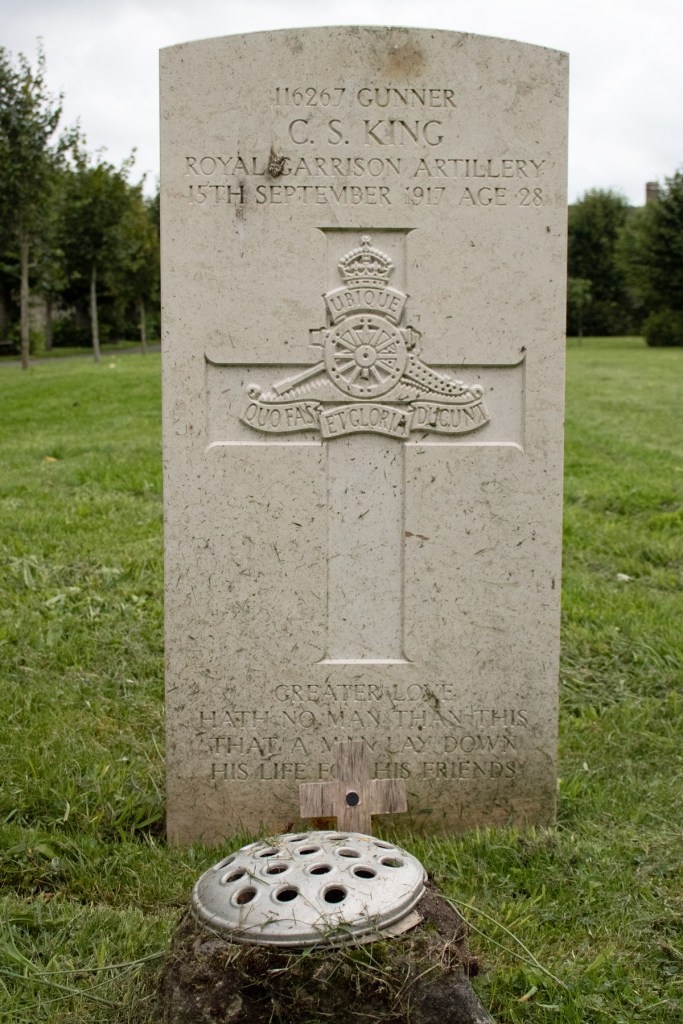
Gunner Charlie King

Shaftesbury

Charlie Stephen King was born in Dorset on 18th October 1888, one of six children to Stephen and Virtue King. Stephen was a painter, glazier and paperhanger from Gillingham, and this is where he and Virtue raised their children.

When Charlie left school, he also went on to become a painter, but specifically for the railways, but whether this was on the rolling stock or stations, is not certain.

In October 1909, Charlie married Bessie Imber, a postman’s daughter from Shaftesbury. The couple set up home in Gillingham, before moving back to Bessie’s home town; they went on to have three children.

War was coming, though, and Charlie enlisted in December 1915. He was not formally called up until August 1916, and was assigned a Gunner in the Royal Garrison Artillery. After initial training, he was sent to the Western Front in March 1917.

Exact details of Gunner King’s service are not available. He was certainly involved in fighting during the summer of that year, and, in September, was wounded. Evacuated back to England with a gunshot wound to his left ankle and shell shock, he was admitted to the War Hospital in Sunderland. Sadly, septicaemia set in, and he passed away on 15th September 1917, at the age of just 28 years old.

Charlie Stephen King’s body was brought back to Dorset, where he was laid to rest in the Holy Trinity Churchyard in Shaftesbury.


Private Sidney Alner

Private Sidney Alner

Sidney William Alner was born in Shaftesbury, Dorset, in March 1899, one of eleven children to Sidney and Ellen Alner. Sidney Sr was a grocer’s porter, and the family lived on the celebrated Gold Hill in the town.

War was to come when Sidney Jr was only young – he had just turned 15 when it broke out. He saw his older brothers go off to war and was obviously keen to do his bit as well. Until he was old enough, however, he worked as an errand boy for his father’s employers, Stratton Sons and Mead.

His time would come, of course, although dates for Sidney’s enlistment are not clear. A contemporary newspaper record confirms that he arrived in France in January 1918, so it is likely that Private Alner joined up at some point during the previous year.

He joined the Hampshire Regiment, and was assigned to the 1st Battalion. Heavily involved during most of the conflict, the battalion was seen as key to the Final Advance of the autumn of 1918. Private Alner was caught up in the fight to break the Hindenburg Line, fighting on the River Selle and capturing the town of Monchaux.

It was while his battalion was advancing on the village of Préseau on 2nd November, that Private Alner was injured. Shot in the arm, he was evacuated back to England, and admitted to the Cambridge Military Hospital in Aldershot. He would have survived his injuries, had pneumonia not set in, and it was to this that he would succumb on 19th November. He was just 19 years old.

Sidney William Alner’s body was brought back to Dorset. He lies at rest in the Holy Trinity Churchyard in Somerset, within walking distance of his family’s home.


Sidney was the second member of the Alner family to die as a result of the Great War.

His older brother Harry, who had become a chauffeur and went to live in London, joined the Royal Army Service Corps in 1915. Private H Alner had served three years in France when he was killed on the front line just three weeks before his brother. He was 32 years old, and left a widow and two children.


When researching Sidney Alner in newspaper articles, an interesting report surfaced.

An unfortunate accident has happened to a little girl, not quite four years old, the daughter of Sidney Alner, who resides in Gold Hill. Heals’ steam hobby horses visited the town on Friday and Saturday in last week, and on the evening of the former day, Alner took his little girl for a ride on the horses.

Whilst they were in motion, the bolt that kept the horse on which Alner sat with his child attached to the connecting rod came out, and he and the little girl were precipitated to the ground.

Alner escaped without injury, but his daughter had one of her legs fractured above the knee. She was taken home, and Dr Evans set the injured limb. Later in the evening she was removed to the Westminster Cottage Hospital.

Salisbury and Winchester Journal: Saturday 31st October 1891

This Sidney Alner was Private Alner’s father, and the daughter would have been his older sister Sarah. Nothing more is reported of the incident, and Sarah went on to live until 1945, when she was 57 years old.


Corporal Harold Mattick

Corporal Harold Mattick

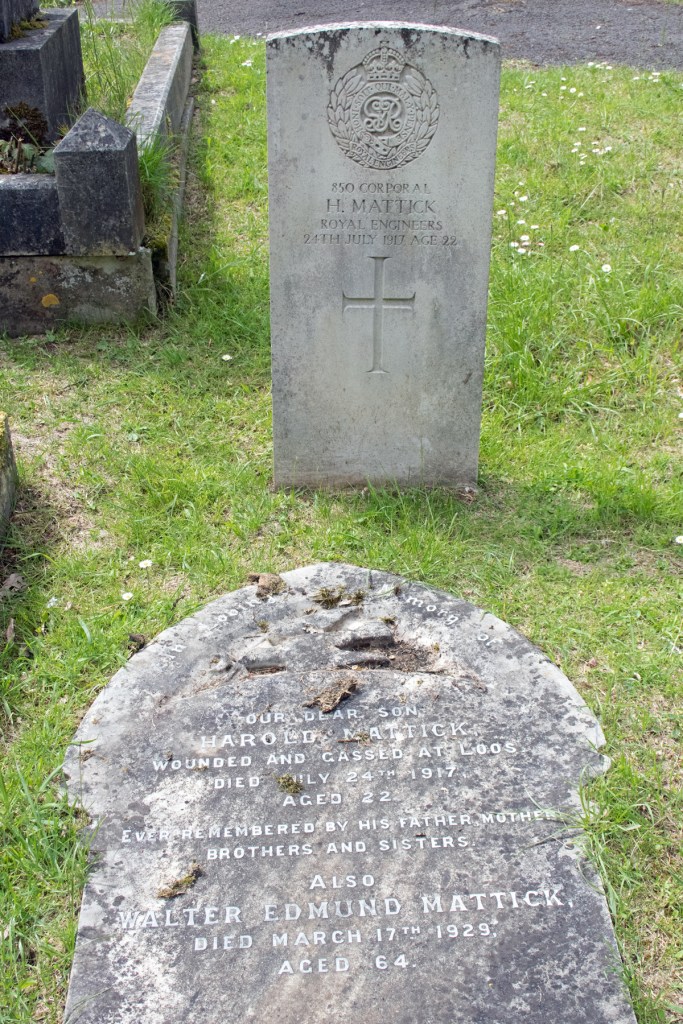
Harold Mattick was born in the spring of 1895, the youngest of four children to Walter and Augusta. Walter was a harness maker and brought the family up in his home town of Weston-super-Mare, Somerset.

When he left school, Harold found work as a plumber. He seemed to had sought a life of adventure, however, and, in 1908, aged just 14, enlisted in the Wessex Division of the Royal Engineers as a Bugler. He served for five years, fulfilling his duties at the same time as carrying out his plumbing work.

When war broke out, Harold immediately re-enlisted. As a Sapper, he was assigned to the 1st/2nd (Wessex) Field Company. After initial training, he was sent to the front as part of the British Expeditionary Force just before Christmas in 1914.

Sapper Mattick was caught up in some of the fiercest fighting on the Wester Front, including the First and Second Battles of Ypres. On 30th September 1915, at Loos, he received a gunshot wound in his right leg, which fractured his tibia. The Germans were also using gas to attack the Allied front lines, which also affected Harold.

Medically evacuated to England for treatment on 9th October, his condition was such that he was discharged from the army on health grounds six months later, on 30th March 1916.

Sadly, while Harold’s leg healed, the injuries he sustained in the gas attack were too severe for him to recover from. He died at home from a lung condition on 24th July 1917, aged just 22 years old.

Harold Mattick was laid to rest in the Milton Cemetery of his home town, Weston-super-Mare.


Private Montague Palmer

Private Montague Palmer

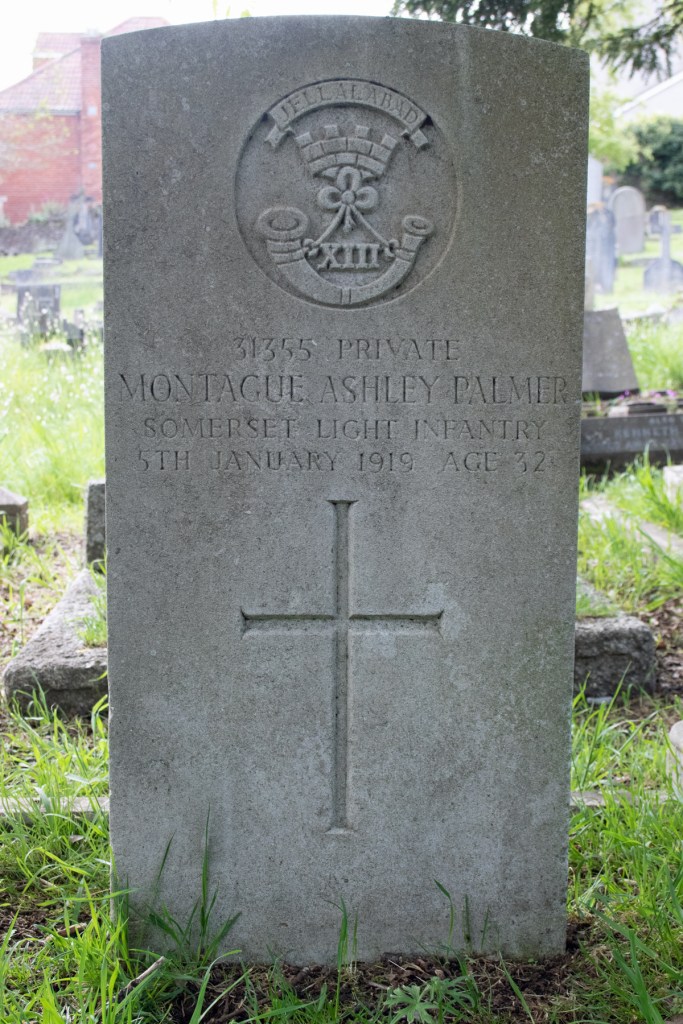
Montague Ashley Palmer was born in Weston-super-Mare, Somerset, in 1886, one of five children to Alfred and Martha. Montague’s father was a postman in the town for 25 years, retiring through ill health in February 1898. Sadly, Alfred’s retirement was not to last long, and he passed away that July aged 48, when his son was just 12 years old.

When he left school, Montague found work as a bus conductor and was now the oldest of Martha’s children to still be living at home. He was obviously an ambitious and inventive young man; by the time of the 1911 census, he had started work for the Ordnance Survey, and had moved to Didcot in Berkshire where he was boarding with Frances Battison, a suiter and greengrocer.

At this point, details of Montague’s life become a little hazier. At some point, he married a woman called Matilda, who either came from, or would go on to live in, Helston, Cornwall.

With war on the horizon, Montague enlisted – documented dates for this, again, are missing. He joined the 12th Battalion of the Somerset Light Infantry, which initially served in Egypt, before transferring to France in May 1918.

Where and for how long Private Palmer served is not clear, although he was definitely caught up in the fighting, and injured, towards the end of the war. Details of his wounds are not clear, but they were enough for him to be repatriated to England, and he was admitted to the Royal Hospital in Salford.

Private Palmer’s injuries appear to have been too severe for him to survive; he passed away in hospital on 5th January 1919. He was just 32 years old.

Montague Ashley Palmer’s body was brought back to Somerset, and he was laid to rest in the Milton Cemetery in Weston-super-Mare.


Private Peter McDonald

Private Peter McDonald

Peter McDonald was born in Tullamore, King’s County (now Offaly County), Ireland, on 28th May 1893 and was one of eight children to Michael and Mary McDonald. Michael had been in the army, and this seems to have been the route that Peter wanted to follow as well.

When he left school, however, he found work as a domestic servant at St Stanislaus College in his home town. War, by this time, was on the horizon, and so Peter was called on to other things.

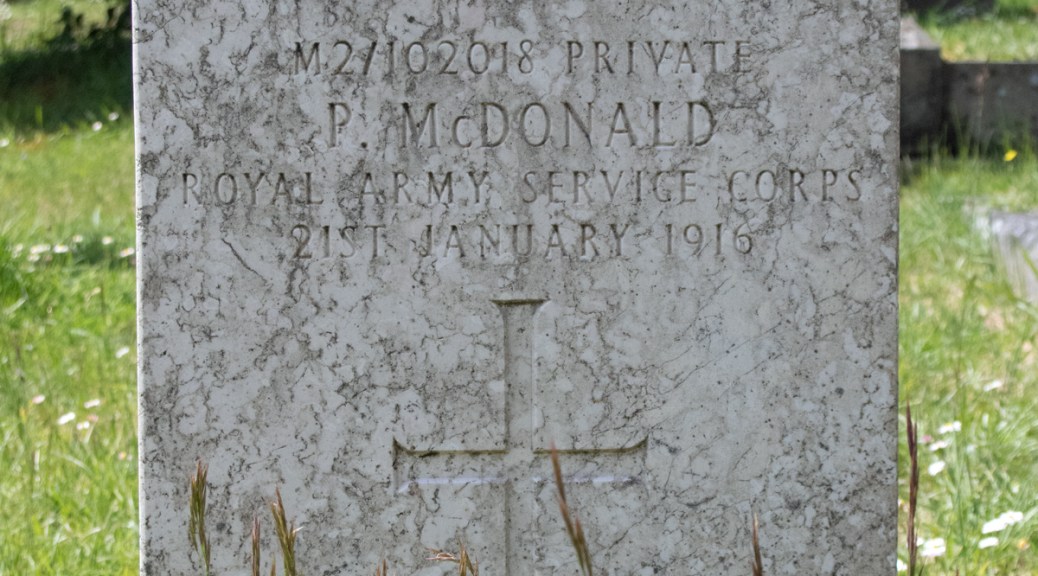
Unfortunately, a lot of the documentation around Peter’s military service is no longer available. He enlisted in the Royal Army Service Corps; while an exact date for his enrolment is not available, this would appear to have been at some point in the first year of the conflict.

Private McDonald was assigned to the 341st Mechanical Transport Company. This was formed in May 1915, and was designated an Ammunition Park (which was in essence a fleet of lorries and a workshop for maintaining them). While full details of his time with the RASC is not available, Peter certainly came to be based in Weston-super-Mare, Somerset.

Considerable sensation was created at Weston-super-Mare on Friday evening, by a rumour which prevailed that a member of the Army Service Corps billeted in the town had been shot and another man wounded.

Inquiries revealed the fact that the rumour had some foundation, and it appears that some half-dozen members of the corps were attending their motor-bicycles in a shed at headquarters in Beach Road, when Lance Corporal Goldsmith produced an automatic Colt pistol, which he handed to Private McDonald for inspection.

In the course of the examination the weapon went off, and Goldsmith was shot in the leg. He at once took the revolved from McDonald, observing that he was unaware that it was loaded, and was apparently in the act of unloading it when it was again discharged, the bullet entering the lower part of McDonald’s abdomen, severing the main arteries.

Medical aid was at once procured. The unfortunate man died as the result of internal haemorrhage about an hour later.

Goldsmith was removed to hospital, but his injuries are not regarded as serious.

Somerset Standard: Friday 28th January 1916

Private Peter McDonald has passed away from a gunshot wound on 21st January 1916, at the age of just 22 years old. His body was laid to rest in the Milton Cemetery in Weston-super-Mare, where he had met his fatal accident.


Private McDonald’s pension record gives his cause of death as ‘explosion’, something of a misinterpretation of the evening’s events.


Gunner Frederick Comer

Gunner Frederick Comer

Frederick George Comer was born on 8th July 1893, the older of two children to Fred Comer and his wife Fanny. Fred Sr was a decorator, and raised his family in his town of his birth, Weston-super-Mare.

While his younger brother Clifford followed in his father’s footsteps and became a decorator, Frederick Jr had set his sights elsewhere. The Western-super-Mare Gazette and General Advertiser reported on 31st December 1910, that he had gained a certificate by Pitman’s Shorthand with a speed of 60 words per minute. Within a year, he was working as a news reporter in the local area.

War was on the horizon, but sadly this is where Frederick’s trail goes a bit cold. He enlisted in the Royal Field Artillery, although existing documents do not confirm a date for this. Gunner Comer definitely served overseas, however, and was wounded in action.

Sadly, the other information available confirms that Gunner Comer died from his wounds on 5th December 1918. He was just 25 years old.

Frederick George Comer’s body was brought back to Weston-super-Mare; he lies at rest in the Milton Cemetery in his home town.


Private Arthur Lavender

Private Arthur Lavender

Arthur Reginald Lavender was born in Bath on 17th January 1889, the second of two children to George Charles (or Charles George) Lavender and his wife, Elizabeth. George raised the family in Bath and seems to have been a jack of all trades, finding work where he could, as a porter in a warehouse according to the 1891 census and a stationary engine driver ten years later.

On 1st December 1907, at the age of just 18, Arthur married Kate Pearce, a painter’s daughter from Weston-super-Mare. The young couple went on to have a son, Sidney, who was born the following year.

By 1911, Arthur was working in Weston-super-Mare as a warehouseman at a local laundry and, on the day of that year’s census, was staying with his father-in-law. Kate, meanwhile, had taken Sidney to see her brother, Frank, who lived in Bristol.

War was coming to Europe, and, in November 1915, Arthur signed up, joining the Royal Army Medical Corps as a Private. After initial training – including a course on First Aid, he was sent overseas on 11th April 1916, where he was assigned to the 27th Casualty Clearing Station.

Private Lavender’s time in the RAMC seems to have been a complicated one. He was admitted to a field hospital within a month of arriving in France with a double inguinal hernia, a condition that continued to dog him over the coming months.

Arthur was eventually shipped to England in March 1917 for an operation at the Metropolitan Hospital in London. The operation itself seemed to have been a success, but, while admitted, he contracted pneumonia, and it was this lung condition that was to end his life. Private Lavender passed away on 7th May 1917, aged just 28 years old.

Arthur Reginald Lavender was laid to rest in the Milton Cemetery in Weston-super-Mare.


Captain Arthur Poole

Captain Arthur Poole

Arthur George Poole was born in Brislington, Somerset, in April 1893. His father, George, was a master builder, and with his mother, Rhoda, the family raise their five children in the Bristol suburb.

Arthur was obvious a bright lad; he attended the Bristol Grammar School, excelling at football, hockey and cricket. After finishing school, he joined a firm of Bristol solicitors and was also appointed secretary of the Bristol Law Society. He went on to continue his studies, when he was accepted to read law at Emmanuel College, Cambridge.

The war was on the horizon, however, and he was called upon to do his duty.

He joined Bristol’s Own (12th Gloucester Regiment) in 1914, and was musketry officer at Chiseldon for some months before going to France in 1915, where he was attached to the 6th Gloucester Regiment.

Within three months he had a severe attack of trench fever, and was home on sick leave for a few weeks. He was severely wounded in October 1917, and came back to England for good. Some months later he was mentioned in despatches. He spent a year in hospital, and although not discharged, was allowed to resume his law studies.

Gloucestershire Echo: Saturday 14th December 1918

While in hospital, Captain Poole contracted influenza, which then became pneumonia. Although recovering from his injuries, it was these conditions that were to get the better of him, and he passed away on 23rd November 1918, at the age of 25 years old.

Arthur George Poole was laid to rest in the pretty graveyard of St Andrew’s Church in Clevedon, Somerset, where his parents now lived.


Private John Stainton

Private John Stainton

John Stainton was born in the Cumbrian village of Ambleside in January 1871. He was one of seven children to George and Mary Stainton, a labourer and his wife. John followed in his father’s footsteps as a labourer, as they took him to where the work was – by the time John was ten, the family were living in Barrow-in-Furness.

The 1911 census found John married to a woman called Mary. The couple wed in 1909 and were boarding with Maybrooke Cole, a fellow labourer, and his family.

The next record for John comes in the form of his enlistment papers. He joined up on 31st August 1914, but the document throws up a couple of anomalies.

To the question “Are you married?” John marked “No”. The fact that he didn’t confirm he was a widower presents more questions than answers.

The document also confirms that he has previous military experience. He served with 2nd Battalion King’s Own (Royal Lancaster Regiment), which fought in the Second Boer War, and was involved in Battle of Spion Kop in January 1900.

John re-enlisted in the same battalion on 31st August 1914, and remained part of a territorial force for the best part of a year. It was during this time that he married Rhoda Selina Cooper. She was born and brought up in Clevedon, Somerset, and it can only be assumed that John was stationed in the county at this time.

Private Stainton seemed to have a bit of a rebellious streak, and his service records identify three times when he was pulled up for dereliction of duty. In December 1914, he was admonished for overstaying his leave pass; in June 1915 he was reported for being absent from the base; a year later, he was admonished again, this time for losing a pair of handcuffs.

The battalion were sent to France in July 1915, and, in the end, Private Stainton served on the Western Front for just over a year. On 27th July 1916, he was sounded by shrapnel in the right shoulder, face and thigh, and was evacuated back to England for treatment. Admitted to the English General Hospital in Cambridge, sadly his wounds proved too much for him. Private Stainton died on 11th August 1916, at the age of 45 years old.

John Stainton’s body was brought back to his widow; he lies at rest in the picturesque churchyard of St Andrew’s in Clevedon, Somerset.


The Commonwealth War Grave for John Stainton incorrectly gives his name as T Stainton.


Lance Corporal William Neads

Lance Corporal William Neads

William John Neads was born on 16th December 1892, the middle of three children to cab driver and groom William Neads and his wife Ellen. Both William Sr and Ellen were from Somerset, although William Jr and his brother Charles – who was eleven months older – were both born in the Monmouthshire village of Cwmcarn.

William’s parents soon moved the family back to Clevedon in Somerset, and, when he left school, he found work as a farm labourer. He was eager to see more of the world, however and, in April 1913, he emigrated to Canada.

After working as a labourer there for a year or so, back in Europe war was declared. Keen to do his bit for King and Country, William enlisted in the 1st Battalion of the Canadian Infantry in January 1915. He soon found himself caught up on the Front Line.

In October 1916, he was involved in the Battle of the Somme – either at Le Transloy or The Battle of the Ancre Heights – and received a shrapnel wound to his left shoulder. Initially admitted to the Canadian General Hospital in Etaples, he was subsequently evacuated to England and the Northern General Hospital in Leeds. He spent three months recovering from his injuries, and was back on the Western Front in January 1917.

Later that year, William – now a Lance Corporal – was involved in the fighting at the Second Battle of Passchendaele (part of the Third Battle of Ypres). He was wounded again, this time receiving a rather unceremonious gunshot wound to the right buttock. Treated at the scene, he was evacuated back to England and admitted to the Fusehill War Hospital in Carlisle on 17th November.

Sadly, despite treatment, Lance Corporal Neads’ health deteriorated, and he passed away from his injuries on 16th December 1917, his 25th birthday.

William John Neads was brought back to his family’s home of Clevedon, and buried in the clifftop churchyard of St Andrew’s, overlooking the sea.


Tragically, William’s father had died in May 1917, at the age of 51. While no details of his passing are recorded, it meant that Ellen had, in just over a year, seen her son wounded, her husband die and her son wounded again and die as a result.