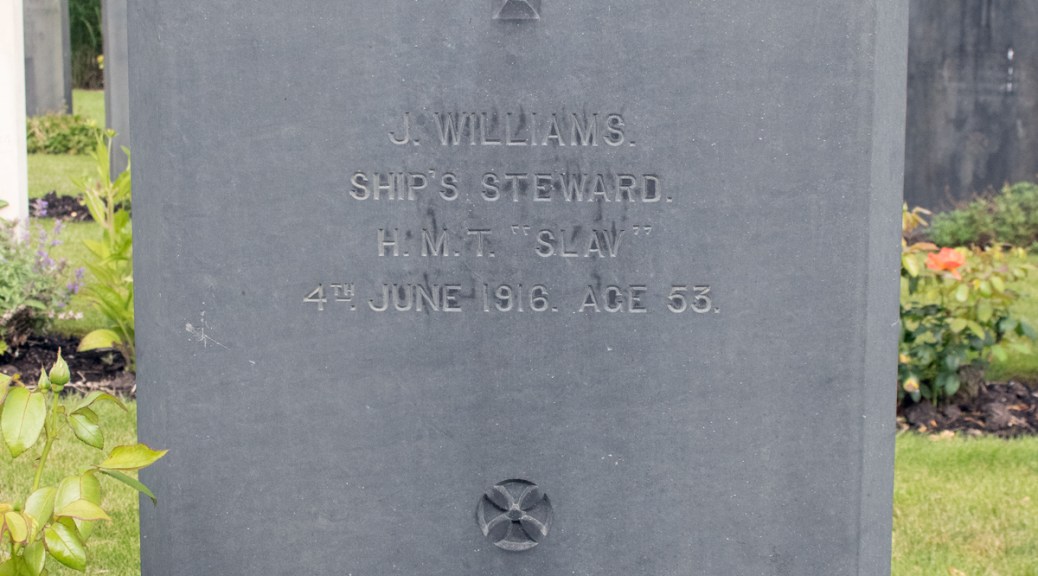
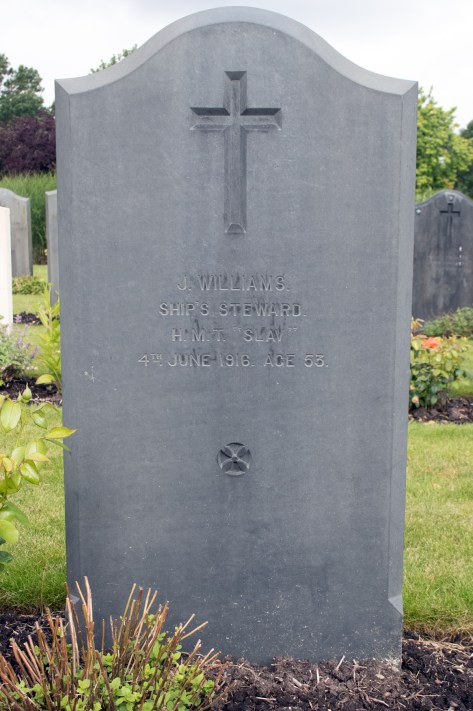
In the naval section of Woodlands Cemetery, Gillingham, Kent, is the grave of Ship’s Steward J Williams, of HMT (or Hired Military Transport) Slav, who died on 4th June 1916, at the age of 53 years old.
The Commonwealth War Graves Commission confirms that his first name was Joseph, but their documents do not confirm a place of birth or any relative’s names.
No crew records remain for the Slav, and she was not scrapped until after the war. There are no articles or obituaries in contemporary newspapers for Joseph’s funeral.
The life and times of Ship’s Steward Joseph Williams are therefore destined to remain a mystery, taken with him to the grave in that Kent cemetery.
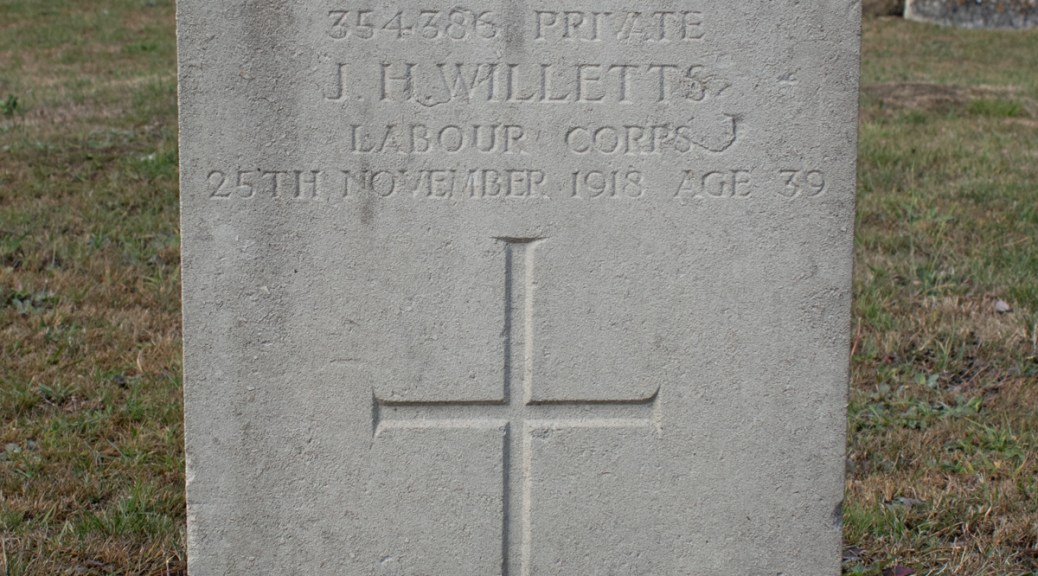
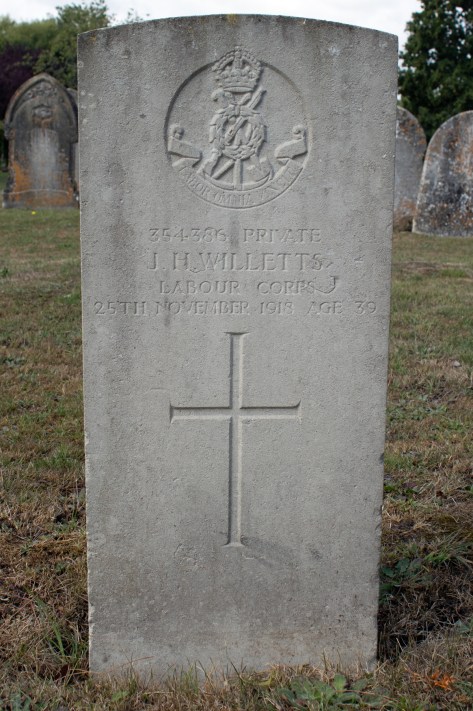
In the peaceful grounds of Gillingham Cemetery, Dorset, is the grave of Private James Henry Willetts of the Labour Corps, who died on 25th November 1918, at the age of 39 years old. The Commonwealth War Graves Commission records confirm that he was the son of James Willetts who, at the time of his son’s passing, was living in Springhill, Birmingham.
Private Willetts’ service records no longer exist, but his entry on the British Register of Soldiers’ Effects state that he was attached to the 443rd Agricultural Company, and died in Peasemarsh, Dorset. It also noted that his next of kin would not be able to claim a war gratuity: this suggests that he had served for less than six months when he passed.
A further document – the Pension Ledger Index Card – gives James’ dependent as his stepmother, Elizabeth Willetts. The record also confirms that his brother George had also died while serving as a Corporal in the Royal Warwickshire Regiment.
The challenge with trying to trace James’ early life is that there aren’t enough confirmed details. His mother’s name is not known, nor is it clear when James Sr married Elizabeth. Census records are available, but none give a clear match for father and son. Given James Jr shared his father’s name, it may also be that he went by his middle name, but this too could have been changed to Harry.
It seems, therefore, that James Henry Willetts’ life is destined to remain a mystery, taken to the grave in the Dorset cemetery.
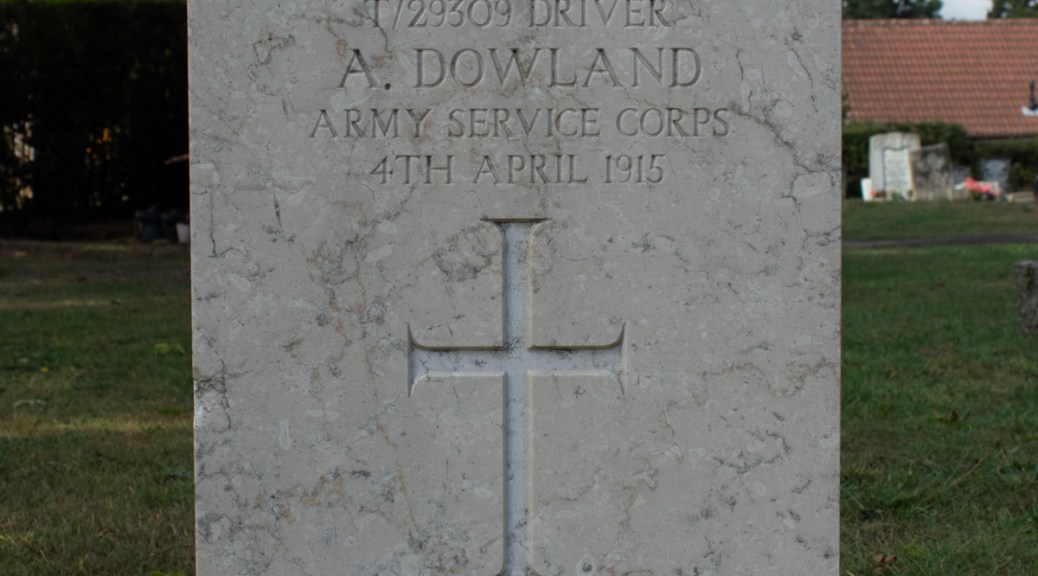
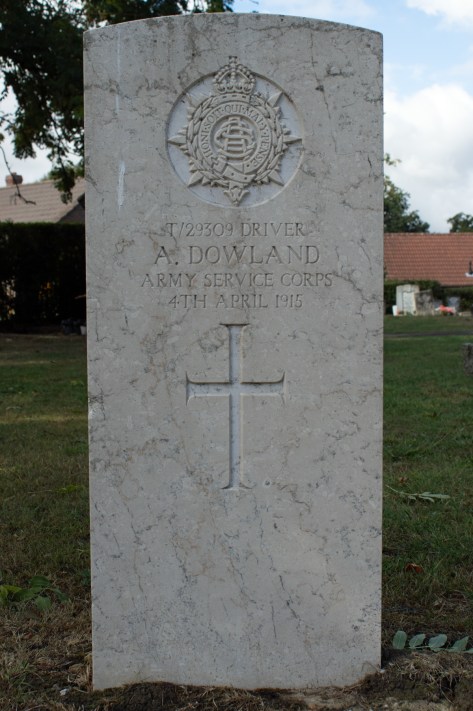
Arthur Dowland was born in the spring of 1884, and was the third of seven children to Austin and Maria Dowland. Austin was a coachman from Dorset, and the family seemed to travel with his work. By the time Arthur was born, they were living in Bourton, on the Dorset, Somerset and Wiltshire borders.
There is little in the way of documentation to track Arthur’s life. He does not appear in the 1911 census, and a separate record suggests that he may have emigrated to Canada for work, returning to Britain by the time war broke out.
Driver Dowland’s service papers have been lost to time, but it is clear that he had enlisted in the Army Service Corps, and was attached to one of the Horse Transport companies.
Arthur’s time in the army was not to be a lengthy one, and it appears that he fell ill while training. He passed away at his parents’ home in Gillingham, Dorset, on 4th April 1915, at the age of 31 years old.
The body of Arthur Downland was laid to rest in Gillingham Cemetery.
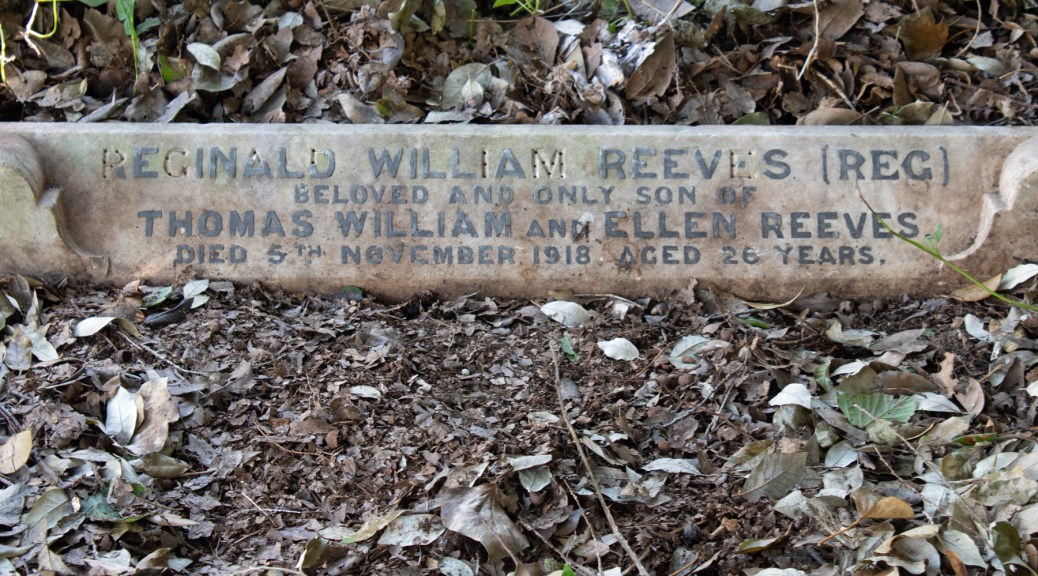
Reginald William Reeves was born in the summer of 1892. The older of two children – his sister Doris passed when she was just six years of age – his parents were Thomas and Ellen Reeves. Thomas was an ironmonger, and the family lived above the shop at 167 Montague Street, Worthing, West Sussex.
Reginald also took up metalwork, becoming his father’s apprentice. The 1911 census notes that the family had moved a short distance, and were now living at 153 Montague Street. A later advert in the Worthing Gazette highlighted special value gas mantles that were double strength and all British made, being sold by TW Reeves & Son, Ironmongers at 135 Montague Street, the family having moved even closer to the town centre.
When war broke out, Reginald would step up to serve his country. Full details of his time in the conflict have been lost, but it is clear that he served as a Private in the Royal Sussex Regiment, and was assigned to the 6th Battalion. The unit was based in Britain and Ireland during the war, and it seems that Private Reeves would not have spent any time in the thick of battle.
By the autumn of 1918, Reginald was back in Worthing, although his trail is pretty hard to follow. He died at a house on Shakespeare Road on 5th November through causes unknown; he was 26 years old.
The body of Reginald William Reeves was laid to rest in Broadwater Cemetery, to the north of Worthing, his parents thanking well-wishers for their sympathy in that week’s edition of the local newspaper.
Mrs C Hillier and Family wish to thank all kind friends for their kind sympathy and for their floral tributes.
[Worthing Gazette: Wednesday 4th December 1918]
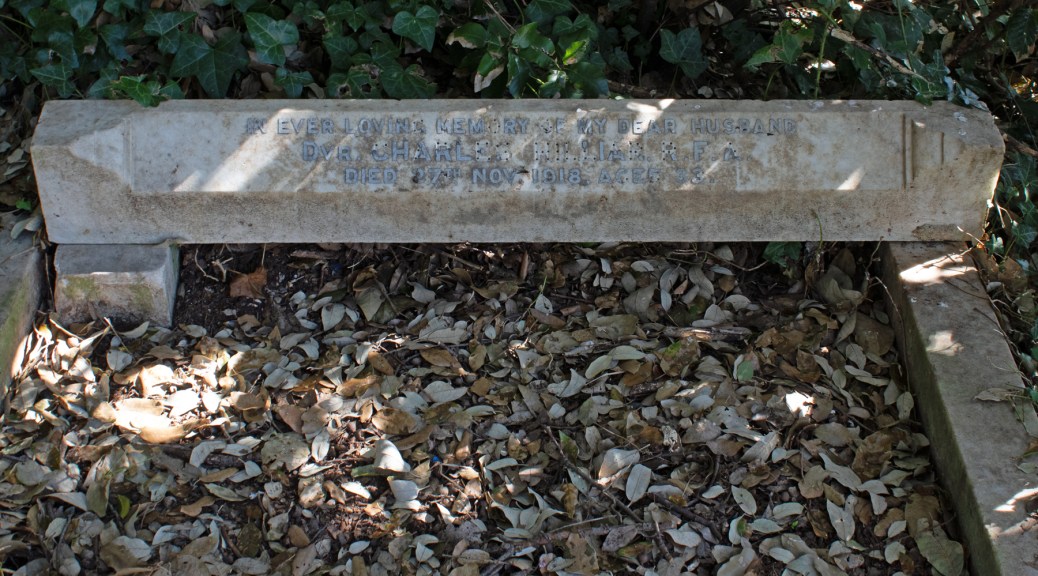
In a quiet corner of Broadwater Cemetery, Worthing, West Sussex, is the unassuming grave of Charles George Hillier. A Driver in the Royal Field Artillery, the Commonwealth War Graves Commission notes that he was 33 years old when he passed on 27th November 1918. He was the husband of Margaret Hillier, of 14 Warwick Place, Brighton Road, Worthing.
Charles’ life appears fated to unfold as a series of frustrating impasses, with details about him tantalisingly just out of reach. His service records have not survived, and there is no trace of his marriage to Margaret. He cannot be definitively identified in any census records and, without information about his parents or place of birth, tracing his life through existing documents remains impossible.
There is a 1920 record for a Margaret Hillier, widow, of Worthing, marrying engineer James Locke on 3rd July 1920. This is likely to be Charles’ widow, but again, she disappears from the records after that.
The quiet corner of the burial ground seems destined to keep its secrets, a permanent memorial to Charles George Hillier.
Arthur Noad was born in Wiltshire in January 1888, the younger of two children to butcher Joseph Noad and his wife, Cecilia.
On Friday one of the largest attended funerals for years past took place at [Rode]. It was that of Mr Joseph Noad, youngest son of Mr John Noad, butcher, of Lower Street.
[Wiltshire Times and Trowbridge Advertiser: Saturday 21th April 1888]
The now widowed Cecilia was left in a precarious position, with two young children to raise. But a solution was at hand:
MESSRS. HARDING & SONS are instructed by the Executors of the Will of the late Mr Joseph Noad, to SELL by AUCTION.. the whole of the Valuable LIVE & DEAD STOCK, Comprising:
HORSES: Powerful Grey Gelding, 8-years-old; Grey Mare, 7-yrs.-old, in foal; promising Black Filly, rising-yrs.-old…
PIGS: 10 capital Stores
IMPLEMENTS & MACHINES, &c: Spring wagon, nearly new; 2 spring traps, nearly new; spring cart… 3 sets trap and 1 set thrill harness, saddle and bridle, covered sheep rack… hurdles… chaff machine… turnip cutter, meal bins, hog tubs, iron and wood pig troughs, cake breaker, oat bruiser, horse rake, 6 large meat hampers and other effects…
Quantity of Maize, Potatoes, Barley Straw; stack of prime Pasture Hay, with liberty of removal.
[Trowbridge Chronicle: Saturday 21st April 1888]
Cecilia sold up and moved on and, by the time of the 1891 census, she and the boys were on Lower Street, Southwick, near Trowbridge, next door to her late husband’s sister and family, and her former mother-in-law.
She was unable to support herself indefinitely on the proceeds of the auction, however, and, in the summer of 1899, she married again, to commercial piano tuner Samuel Haskell. The next census return, taken in 1901, found the family still living next to Arthur’s aunt and grandmother: just thirteen years of age, his occupation was listed as a monitor at school (although this was subsequently crossed out).
Arthur would set out to carve his own path in life. By the time of his early 20s, he had left home, and taken on work as a grocer’s assistant in Hungerford, Berkshire. His accommodation was the gasworks on Charnham Street, as he was boarding with the manager and his family.
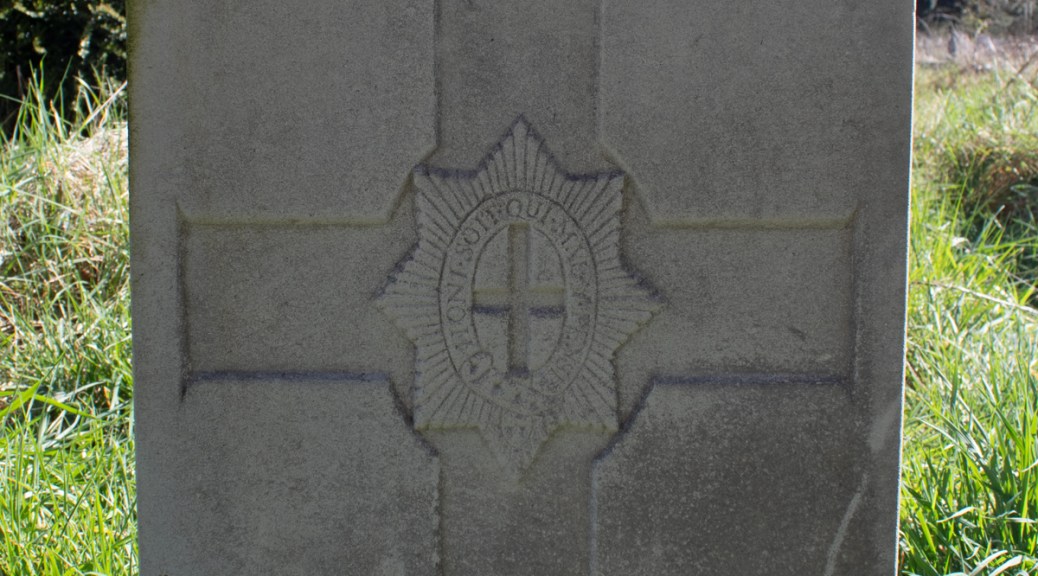
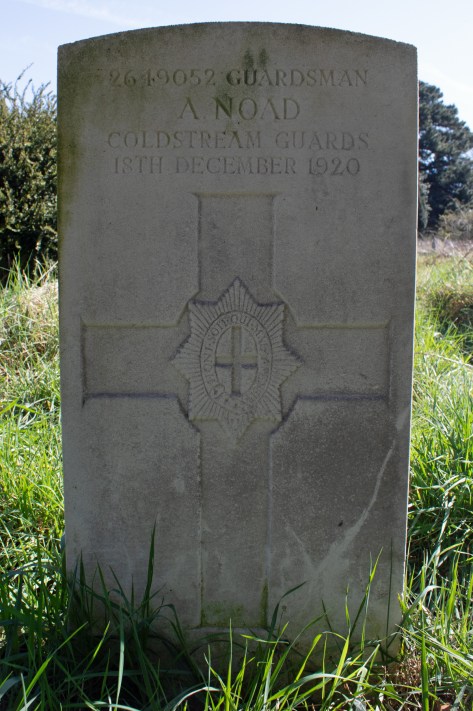
When war broke out, Arthur was quick to step up, joining the Coldstream Guards on 22nd December 1914. Sadly, there is little information about his time in the army, but it is clear that he was lucky to survive the conflict.
Arthur’s older brother, Henry, had joined the Royal Naval Volunteer Reserve, and rose to the rank of Able Seaman. When the war began, there were too many sailors for ships, and so he was re-assigned to the Nelson Battalion of the Royal Naval Division. Henry found himself on the Western Front, and was caught up at Arras and Ypres. He was killed on 31st December 1917, during the action of the Welsh Ridge, and was buried at Flesquières Hill British Cemetery, near Cambrai.
Guardsman Noad married Amelia May in the spring of April 1916: the daughter of a woodsman from Longparish, Hampshire, sadly there is little additional information about her. The couple did go on to have a child together, daughter Kathleen, who was born on 4th April 1918.
There is little further information about Arthur’s life. He survived the conflict and, when peace returned to Europe, he relocated to Worthing, West Sussex. There is little confirmation as to why this move happened: the 1939 Register records Amelia and Kathleen living on Meadow Crescent to the east of the town, but it isn’t clear who went there first.
The last documents for Arthur Noad relate to his passing. He died on 18th December 1920 at the age of 33 years old. He was laid to rest in Broadwater Cemetery, to the north of Worthing.
Amelia had lost her husband, but Cecilia had now lost both of her sons, and had outlived two husbands, Samuel having passed away nine years earlier. The 1921 census found her still living on Lower Street, Southwick. She lived until the age of 87, and passed away in Lothingland, Suffolk.
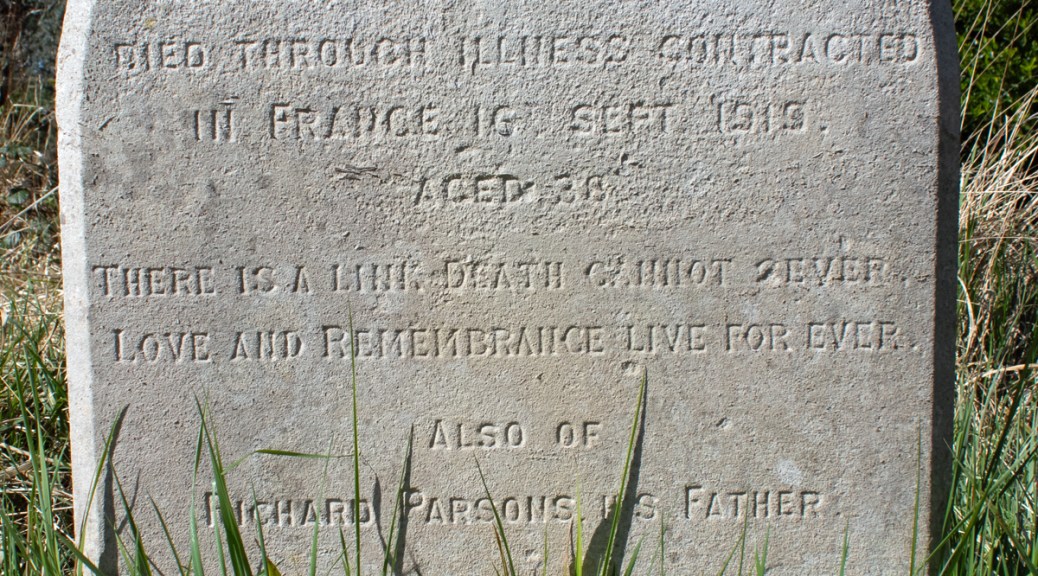
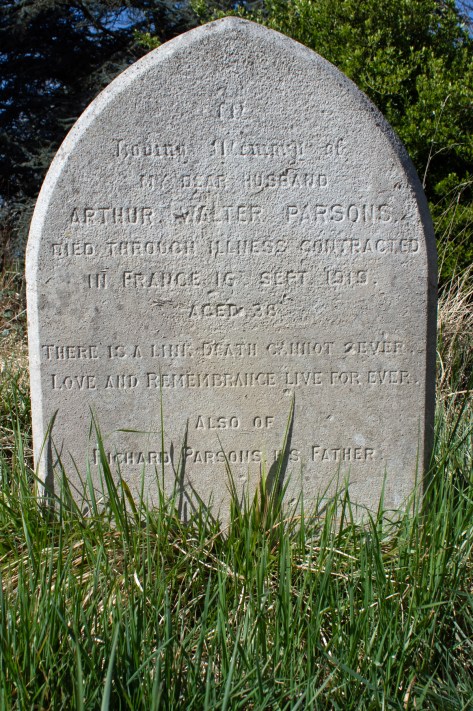
Arthur Walter Parsons was born in Broadwater, West Sussex, in the autumn of 1881. The fourth of nine children, his parents were Richard and Clara Parsons. Richard was a carter, and by the time of the 1891 census, the family had moved into Worthing, and were living at 64 Montague Street, a stone’s throw from the sea.
Richard died in 1899, and the following spring, Arthur married Emily Eagleton. She was the daughter of a domestic servant, and seems to have been born in Poplar Workhouse, Middlesex. The 1891 census found her as a boarding student at St Agatha’s Home Institute in Great Barlow, Cambridgeshire, but by the time here and Arthur exchanged vows, she too was living in Worthing. Their marriage certificate shows that Emily was three years older than her husband, and that he was working as a carter, and living at 23 Clifton Road when they married.
The next census record, taken in 1901, recorded the Parsons living at 25 St Dunstan’s Road in Tarring. Arthur was a carter, and the couple shared their home with Alice, Emily’s daughter and Arthur’s stepdaughter.
By the time of the next census, Arthur and Emily had moved closer to the town centre, and were living at 96 Station Road. Arthur was still employed as a carter – possibly connected to the railway at the end of his road – and was supporting his wife and their three children – Alice (now called Edith), Arthur and Hilda.
When war broke out, Arthur stepped up to play his part. His service papers have been lost to time, but it is clear that he enlisted in the Royal Field Artillery as a Driver, presumably because of his experience with horses. By 27th June 1915, he found himself in France. It is unclear exactly how or where Driver Parsons served, but his unit had moved to Mesopotamia by the start of 1916.
Arthur survived the war, and returned home to his family, which now included another son, Cecil, who had been born in 1915. It would seem that Driver Parsons’ health had become impacted, however, and he would be discharged from the army in 1919. That autumn, on 16th September, he would breath his last, passing away at the age of 38.
The body of Arthur Walter Parsons was laid to rest in Broadwater Cemetery, a short walk from where his grieving family still lived, in Station Road.
Emily was pregnant when her husband died: son Ronald Walter Parsons was born in December 1919. She would find love again, and married railway porter Arthur Browning in December 1929. The 1930 Register found them living at 81 Tarring Road, Worthing with her daughter Rose and son, Cecil.
The Second World War would bring Emily further tragedy. Ronald, who had never known his father, was serving in the Royal Navy, and attached to the destroyer HMS Grenville. She struck a mine off the Essex coast on 19th January, and he was killed. He was just 20 years of age.
The following year, Emily’s husband Alfred also died, passing away at home at the age of 66. Emily lived another eight years, and died in the spring of 1949, aged 69 years old.
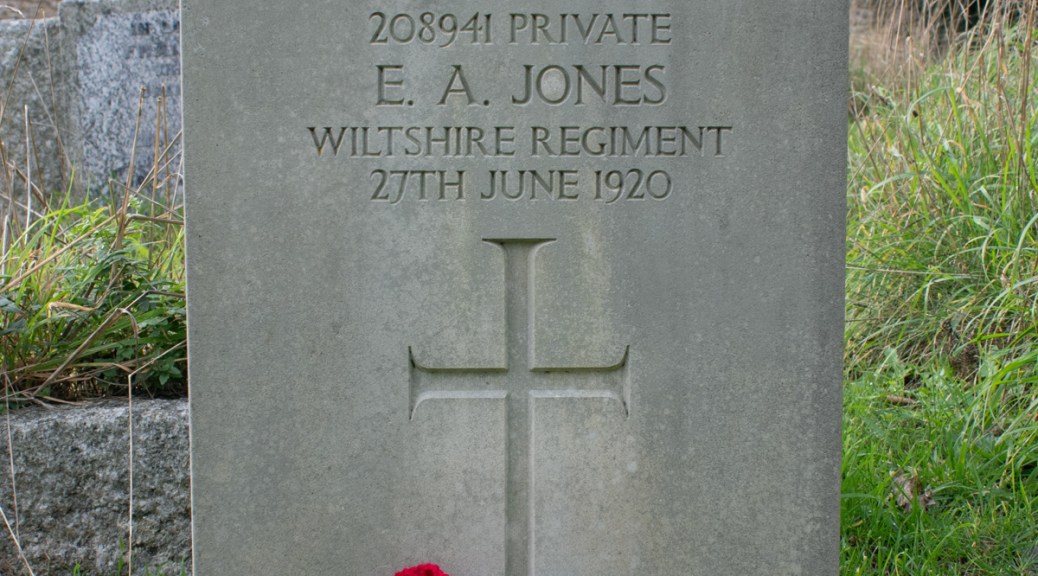
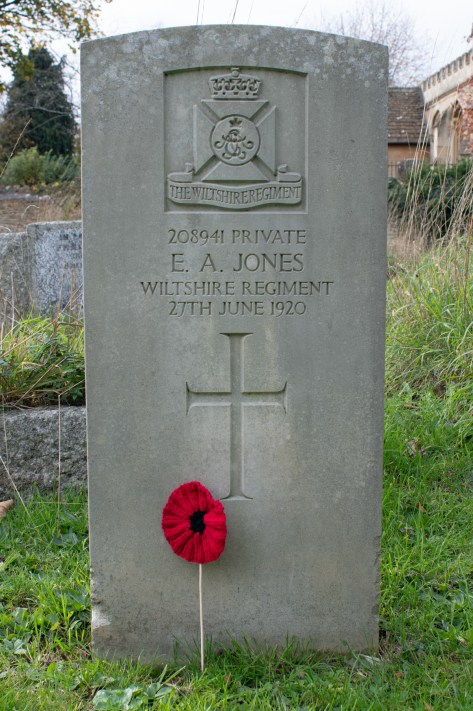
Ernest Albert Jones was born in the spring of 1878. The sixth of seven children, he wad the youngest son to Thomas and Maria Jones. Thomas was an agricultural labourer, and the family lived in a cottage on The Rank in the Wiltshire village of Holt.
Ernest found work as a gardener’s assistant when he completed his schooling, but, by the time of the 1911 census, he was employed as a leather dresser for a local fellmonger. According to the document, he was the only one of the Jones children to still be living at home, bringing in money to support his parents.
Maria died in the spring of 1911, and it is likely that Ernest remained at home to support his father. When war broke out, he stepped up to serve his country and, although his service papers have been lost to time, the documents that remain suggest he joined the Royal Warwickshire Regiment. He wasn’t with them for long, however, as he transferred to the Wiltshire Regiment.
It is unclear where or how Private Jones served. He was attached to the 6th (Royal Wiltshire Yeomanry) Battalion, who served on the Western Front from 1915 onwards, but nothing in Ernest’s remaining records suggest he spent any time overseas.
Ernest survived the war, and returned to the family home. He passed away on 27th June 1920, through causes unknown, at the age of 42.
The body of Ernest Albert Jones was laid to rest in Hold Old Cemetery, not far from the home in which his family had lived for more than four decades.
Thomas passed away nearly two years after his son, at the age of 87 years old. By this point, his granddaughter, Nellie, had moved in to look after him: it was she who Ernest had nominated as his next of kin.
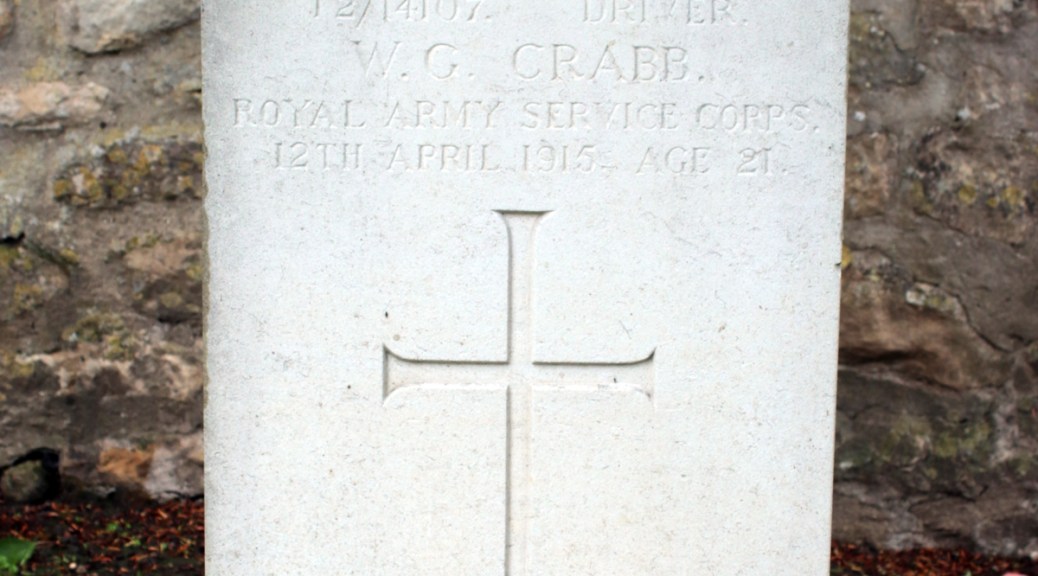
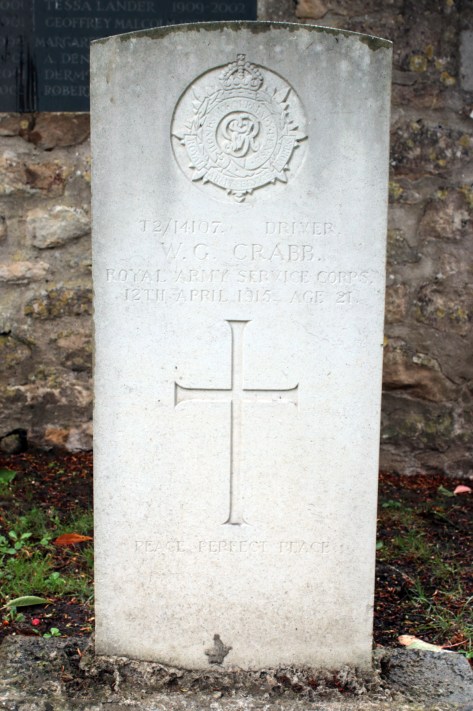
Walter George Crabb was born in the spring of 1893 in the Castleton area of Sherborne, Dorset. The oldest of ten children, his parents were Fred and Selina Crabb. Fred was a sawyer, but when Walter completed his schooling, he found employment as a bricklayer’s labourer. The 1911 census recorded the family as living in a 5-roomed cottage on Long Street.
When war came to Europe, Walter was quick to step up and play his part. His service records have been lost to time, but it is clear that he had enlisted by October 1914. As a Driver, he was attached to the 108th Horse Transport Company and, by the following spring, was barracked at Curragh Camp, to the south west of Dublin.
The next record for Driver Crabb is his entry in the British Army Register of Soldiers’ Effects. This confirms that he passed away in Curragh Hospital on 12th April 1915. The cause of his death is not recorded, but he was just 21 years of age.
The body of Walter George Crabb was taken back to Dorset for burial. He was laid to rest in the peaceful surroundings of St Mary Magdalene Churchyard, Castleton.
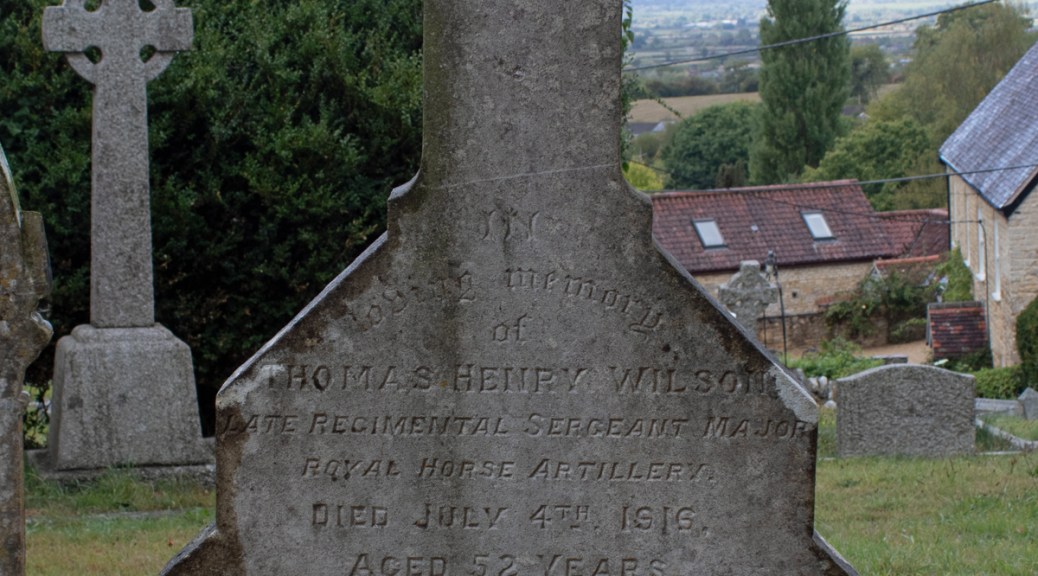
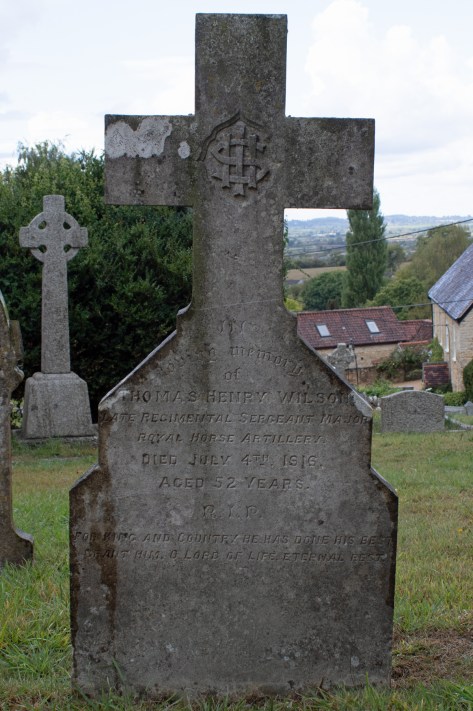
The life of Thomas Henry Wilson is challenge to piece together, and it is only through fragmented documents that the trail can be uncovered.
Thomas’ headstone confirms he was a Regimental Sergeant Major in the Royal Horse Artillery, and that he died on 4th July 1916, at the age of 52.
The Commonwealth War Graces Commission’s records confirm that he was married to Mary Ann Wilson (née Ralph), who lived in West Stour, Dorset. The couple’s wedding took place in Holy Trinity Church, Woolwich, Kent, on 14th February 1888. The marriage certificate gives their fathers’ names – farriers Charles Wilson and James Ralph. The document also confirms Thomas’ role as a a Sergeant in the RHA, and gives his age as 27, and Mary’s as 21.
The Wilsons’ appearance in the the census records is a little sporadic. They are not recorded on the 1891 census, but ten years later, they were living in Bilston, Staffordshire. They were listed as being caretakers of the town’s Conservative Club on Church Street. Their ages are given as 41 and 31, and Mary’s place of birth is given as Kington Magna, Dorset.
By 1911, Thomas and Mary had moved to London, and were boarding at the house of Joseph and Rosetta Johnson, at 5 Knivet Road in Fulham, Middlesex. Thomas was listed as being an army pensioner, while Mary was employed as a domestic cook.
At this point, Thomas’ trail goes cold. It is likely that he was called upon when war broke out, but there are no records to confirm where or how he served. He passed away in July 1916, and was laid to rest in All Saints’ Churchyard, Kington Magna, which would suggest that he and Mary had moved there to be close to her family.