Category Archives: Devon

Rifleman William McMullan

Rifleman William McMullan

William McMullan was born in Okaihau, on New Zealand’s North Island, on 10th May 1896. One of three children, his parents were James and Rose McMullan.

There is little concrete information about William’s early life. By the beginning of 1916, he was working as a bushman and volunteering for the local militia. The First World War provided an opportunity to put his skills to use, and he enlisted in the New Zealand Rifle Brigade on 15th January 1916.

Rifleman McMullan’s service records show that, at 19 years and 8 months of age, he was 6ft (1.83m) tall and weighed 12st 6lbs (79kg). A Roman Catholic, he had brown hair, blue-grey eyes and a medium-dark complexion.

William left New Zealand in May 1916, bound for Britain. The journey took ten weeks and, after disembarking in Devonport, Devon, his unit marched to Sling Camp, near Bulford, Wiltshire, arriving there on 29th July. Just a few weeks later, however, Rifleman McMullan was on the move again, and he found himself on the Western Front towards the end of September.

On 16th November 1916, while fighting at the Somme, Rifleman McMullan received a gunshot wound to his thigh. A blighty wound, it saw him medically evacuated to Britain for treatment, and he was admitted to the No. 1 New Zealand General Hospital in Brockenhurst, Hampshire. A few weeks later, he was moved to Codford, Wiltshire, for recuperation at the No. 3 NZ General Hospital.

William would spend the next few weeks in Wiltshire, but after initially being discharged from hospital, he was re-admitted on 25th January 1917. He had contracted broncho-pneumonia, and this would be the condition to which he would succumb. Private McMullan passed away on 13th February, at the age of just 20 years old.

Thousands of miles away from home, William McMullan was laid to rest in the ANZAC extension to St Mary’s Churchyard in Codford, close to the camp he had most recently called home.


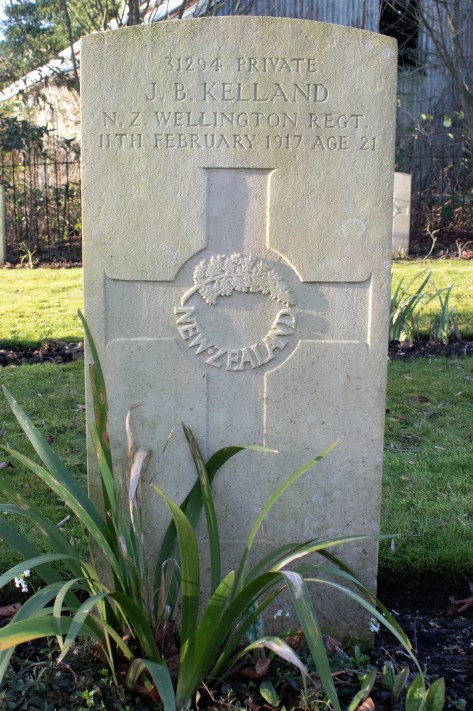
Private John Kelland

Private John Kelland

John Bodley Kelland was born on 4th June 1895 in Otakeho, on New Zealand’s North Island. The fifth of eight children, his parents were George and Mary Kelland. George died in 1902, and John’s mother married again: she and new husband Albert Bowers would have two further children.

There is little additional information available about John’s early life. He found work as a carrier when he left school, and by the time war broke out he was living in the town of Taumarunui. In his spare time, he seems to have volunteered for a local army brigade.

John formally enlisted on 24th July 1916. He joined up in Trentham, and was assigned to the New Zealand Wellington Regiment. His service records show that he was 5ft 9ins (1.75cm) tall and weighed 152lbs (68.9kg). A Roman Catholic, he had brown hair, grey eyes and a dark complexion.

Attached to B Company of the 19th Reinforcements, Private Kelland left his home country on 15th November 1916. He spent the next ten weeks on board the troop ship Tahiti, finally disembarking in Devonport, Devon, on 29th January 1917. From there his unit marched to Sling Camp near Bulford, Wiltshire, where many of the ANZAC troops were billeted.

Private Kelland’s time there was to be limited. His health had been impacted during the sea voyage, and he was admitted to the No. 3 New Zealand General Hospital in Codford, Wiltshire, on 8th February. Suffering from pneumonia, his condition worsened: he passed away on 8th February 1917, at the age of just 21 years old.

John Bodley Kelland was thousands of miles from home. He was laid to rest alongside his comrades in the newly-extended graveyard to St Mary’s Church in Codford.


Private John Kelland
(from findagrave.co.uk)

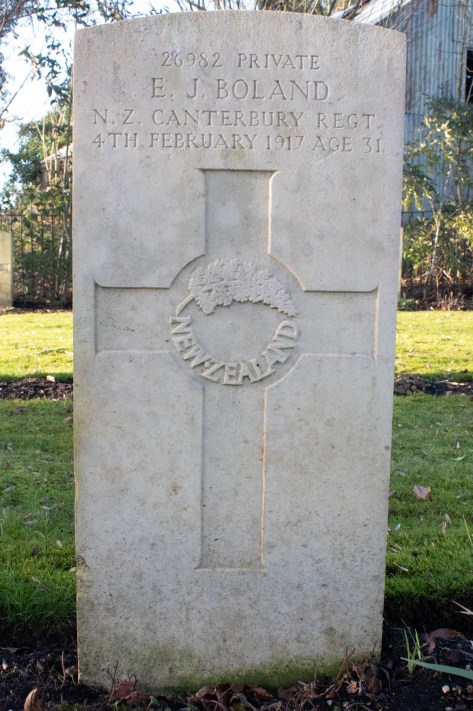
Private Edward Boland

Private Edward Boland

Edward James Boland was born on 14th August 1885 in the town of Darfield, on New Zealand’s South Island. Details of his early life are sketchy, but he was the fourth of nine children to Francis and Annie Boland.

When he finished his schooling, Edward found work as a farm labourer. In 1906, he married Ellen – or Nellie – Shea: their first child, son Raymond, was born the same year, and they would go on to have three more children by the time war was declared.

On 18th June 1916, Edward answered the call to serve the Empire. Enlisting in Trentham, he joined the New Zealand Canterbury Regiment as a Private. His service record notes that he was 5ft 8.5ins (1.74m) tall and weighed 144lbs (65.3kg). A Catholic, he had light brown hair, blue eyes and a fair complexion. A scar on his right thigh was also recorded as a distinguishing mark.

On 16th October 1916, Private Boland left from Wellington on board the steam ship Willochra. His unit – the 18th Reinforcements – arrived in Devonport, Devon, ten weeks later. They were then marched to their base at Sling Camp near Bulford, Wiltshire.

The journey from New Zealand, impacted Edward’s health. At the end of January 1917, he was admitted to the 3rd NZ General Hospital in Codford, Wiltshire, suffering from broncho-pneumonia. His condition deteriorated and would take his life. Private Boland died on 4th February 1917: he was 31 years of age.

As he was thousands of miles from his home, Edward James Boland was instead laid to rest in the newly extended graveyard attached to St Mary’s Church in Codford.


Private Edward Boland
(from findagrave.co.uk)

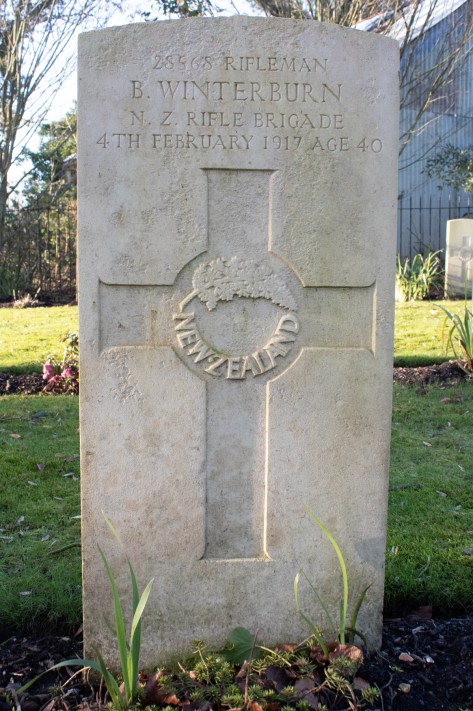
Rifleman Bertram Winterburn

Rifleman Bertram Winterburn

Bertram Winterburn was born in the city of Hutt, on New Zealand’s North Island, on 23rd April 1877. The oldest of eleven children, his parents were Arthur and Ada Winterburn. Arthur was a postmaster from South Island, and it would be here that he and Ada would raise their family.

There is little concrete information about Bertram’s life. The 1913 Post Office Directory records him as working as a labourer, and living in Otaki, a town back on North Island. He seems to have moved wherever the work took him, however, and, by the time war broke out, he was living in Hunterville, 110km (68 miles) further north.

Bertram stepped up to serve the empire when the call came. He enlisted in Trentham on 27th June 1916, and was assigned to the New Zealand Rifle Brigade.

Rifleman Winterburn left from Wellington on board the steam ship Willochra on 16th October 1916. His unit – H Company, 18th Reinforcements – would not arrive in Devonport, Devon, until 29th December. They were then marched to their base at Sling Camp near Bulford, Wiltshire.

The journey from New Zealand, would take its toll on the new recruits, with many falling ill before, or shortly after, they arrived. Bertram would not be immune from this and, at the end of January 1917, he was admitted to the 3rd NZ General Hospital in Codford, suffering from influenza. His condition worsened, developing into bronchitis, and this would take his life. Rifleman Winterburn died on 4th February 1917: he was 39 years of age.

Thousands of miles from his home, Bertram Winterburn was laid to rest in the newly extended graveyard attached to St Mary’s Church in Codford.


Naval Instructor George Carter

Naval Instructor George Carter

George Leslie Lewis Carter was born at the start of 1891 in New Cross, Kent. The oldest of three children, his parents were laundry managers William and Isabel Carter.

The Carters’ work seemed to take them across South London and the 1891 census found them living in Hammersmith. George’s two siblings had been born by this point, one in Gravesend, Kent, the other in Richmond, Surrey.

By 1911, William and Isabel had moved the family to Kingston-upon-Thames, Surrey. That year’s census recorded them as living at 142 London Road, which was noted as being a 12-roomed property. The couple were managing a laundry – possibly living in at the laundry itself. George was recorded as being a university student, while his younger brother Lionel was at school. The family also had a housekeeper, Frances Stoke, living with them.

When George finished his studies, he found employment as an Assistant Paymaster with the Royal Naval Reserve. On 15th February 1916, he married Ada Ritchie. She was a merchant’s daughter from Long Ditton, Surrey, and the couple exchanged vows in her local parish church.

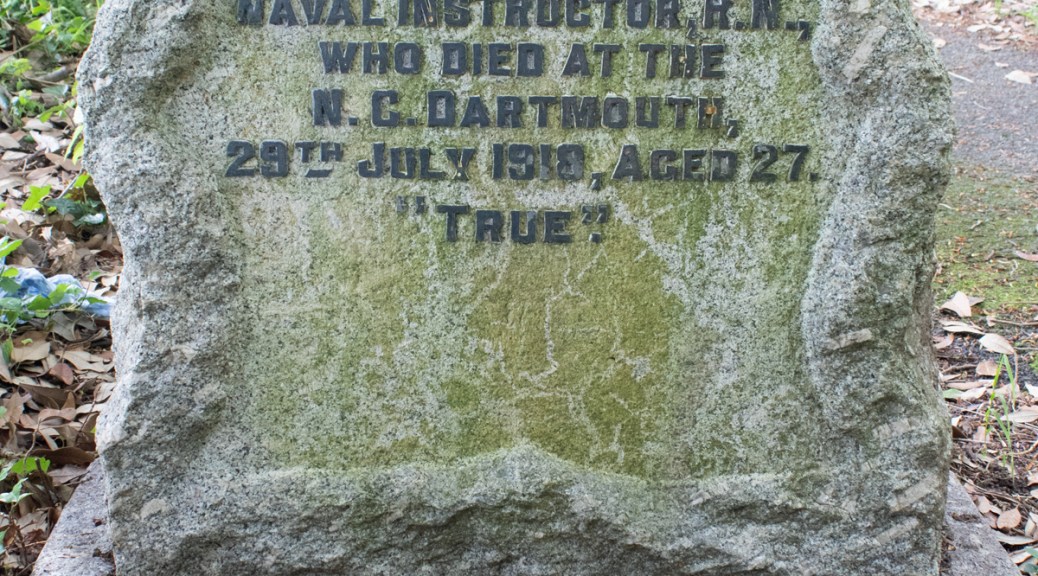
At this point, George’s trail goes cold. He became attached to the Royal Naval College in Dartmouth, Devon – also known as HMS Pomone – and took on the role of Naval Instructor. It is unclear what type of instructing he was doing, but it seems likely to have been connected with the administration or financial part of the Royal Navy.

The funeral of Naval Instructor George Leslie Lewis Carter, Royal Naval College, Dartmouth, who died on Monday from pneumonia following an attack of influenza, took place on Wednesday morning…

The mourners were Mrs Carter (widow), Mrs Carter, Surbiton (mother), Mr Carter (brother), and Mr Jamieson Ritchie, London (brother-in-law)…

[Dartmouth & South Hams Chronicle: Friday 2nd August 1918]

Naval Instructor Carter was 27 years of age when he died on 29th July 1918. The newspaper article’s distinction between Ada and Isabel would suggest that Ada may have been living in Dartmouth at the time as well.

George Leslie Lewis Carter was laid to rest in the graveyard of St Clement’s Church in Dartmouth, Devon.


Boy 2nd Class Albert Sampson

Boy 2nd Class Albert Sampson

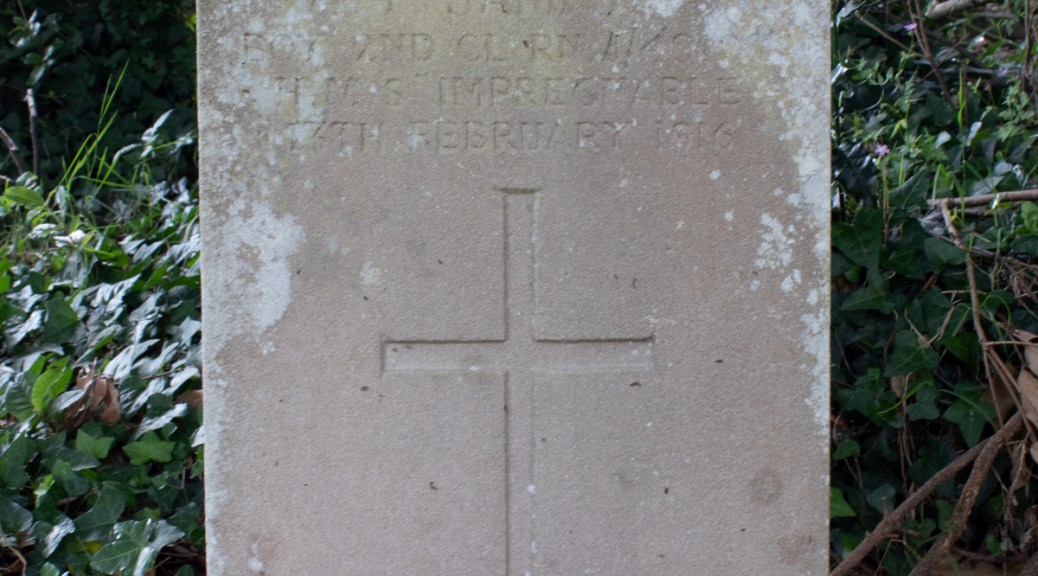
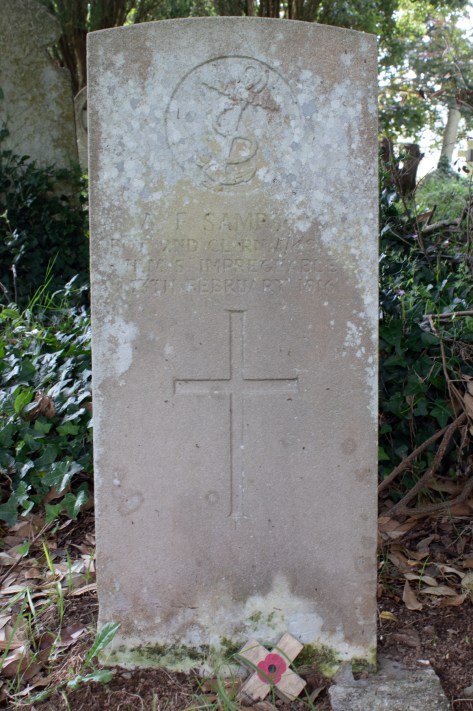
Albert Frederick Sampson was born on 7th November 1900, and was the older of two children to Albert and Beatrice. Albert Sr was a steward in the Royal Naval College in Dartmouth, Devon, and the family lived in a four-roomed cottage on Victoria Road.

When he finished his schooling, Albert found work as a cabin boy on a merchant vessel. When war broke out, the transition to the Royal Navy was an obvious one, and he enlisted at the start of 1916. His service records show that he was 5ft 4ins (1.62m) tall, with red hair, blue eyes and a fresh complexion. Still under the age to formally enlist, he was given the rank of Boy 2nd Class.

Albert’s time in the navy was to be tragically short. He was admitted to the Royal Naval Hospital in Plymouth, Devon, with acute quinsy, and passed away quickly. He died on 13th February 1916, at the age of just 15 years old.

Albert Frederick Sampson’s body was taken back to Dartmouth for burial. He was laid to rest in St Clement’s Churchyard.


Ordinary Seaman Thomas Fleet

Ordinary Seaman Thomas Fleet

Thomas Fleet was born on 3rd February 1879 in Kingswear, Devon, and was the sixth of nine children to Thomas and Emma. Thomas Sr was a fish dealer, and the family lived on Lower Street over the river in Dartmouth. Most of the family were involved in the fish industry, and by the time of the 1901 census, Thomas Jr was also working as a fisherman.

On Christmas Day 1901, Thomas Jr married Hannah Jury. She was a farm labourer’s daughter from Torquay, Devon. The couple married in Hannah’s home town, but settled back in Dartmouth. They had five children – Reginald, Elspeth, Edith, Florence and Thomas – and set up home in a five-roomed house on Victoria Road.

By the time of the 1911 census, Thomas had changed jobs, and was working as a yachtsman. The following year, Reginald died, at the age of just 9 years old. It is unclear how he died, but he passed in August 1912, and was buried on 2nd September, in St Clement’s Churchyard, Dartmouth.

When war broke out, Thomas would be called upon to serve. Unsurprisingly, given his job, he joined the Royal Navy, enlisting on 30th March 1917 as an Ordinary Seaman. His service records show that, at 5ft 2ins (1.57m) tall, he had brown hair, blue eyes and a fresh complexion.

Ordinary Seaman Fleet was sent to HMS Vivid, the Royal Naval Dockyard in Devonport, Devon, for his formal training. Tragically, however, his time in the service was to be a brief one. He contracted lobar pneumonia and was admitted to the barracks’ sick quarters. He passed away from heart failure on 13th May 1917, at the age of 38 years old.

The body of Thomas Fleet was taken back to Dartmouth for burial. He was laid to rest in the family plot in St Clement’s Churchyard, reunited with his oldest son, Reginald.


Flight Cadet Ernest Tracey

Flight Cadet Ernest Tracey

Flt-Cadet Ernest Osborn Tracey, RAF, who died on Friday, the result of injuries sustained through a collision in the air when undergoing his final training, was the only son of Rev. HF and Mrs Tracey, of Dartmouth. He was born in Oct. 1899, at St Saviour’s Vicarage, of which church his father was vicar for 23 years, retiring from the living in 1913 in order to take up clerical duties in New Zealand. Mr Tracey was educated at Blundell’s, where he held a house master’s scholarship. When he left in the middle of last year he was the winner of the Coles’ prize for science; was one of the shooting VIII, of which he had his cap and colours; a member of the Upper Sixth, the OTC, and he had also won the first prize for drawing. On leaving Blundell’s he obtained a cadetship at Woolwich, and was transferred to the RAF.

[Western Morning News: Tuesday 4th June 1918]

Ernest Osborn Tracey was born in Dartmouth, Devon, on 25th October 1899, and was baptised in his father’s church six weeks later. The younger of two children to Reverend Henry and Alice Tracey, he gave up his schooling to enlist in the Royal Flying Corps on 12th November 1917.

When the Royal Air Force was formed the following April, Flight Cadet Tracey automatically transferred across. Training to be a reconnaissance pilot, Ernest would have cut a dashing figure, standing 6ft 1in (1.85m) tall. He was based at Yatesbury Airfield in Wiltshire, and was learning to fly a BE2, twin seater biplane.

At 8:30pm on 31st May, his aircraft collided with another, sending Ernest’s machine spinning into a nosedive. He crashed into the ground and was killed instantly.

The body of Ernest Osborn Tracey was taken back to Devon for burial. He was laid to rest in the graveyard of St Clement’s Church, Dartmouth.


Ernest’s will gave his mother, Alice, as his beneficiary. The newspaper report suggests that Henry had travelled to New Zealand to tend a new flock there, and the Commonwealth War Graves Commission records him as being “Chaplain to the Forces” and Vicar of Dartmouth.

It certainly seems that any time spent in New Zealand was limited. By the time of the 1921 census, Reverend Tracey had found a new posting, in the Staffordshire village of Gentleshaw. The same census return found Alice staying with their daughter, Rosamond, and her family, in Totnes, Devon.


Petty Officer 1st Class Frederick Morgan

Petty Officer 1st Class Frederick Morgan

Frederick Morgan was born on 15th July 1871, the oldest of four children to Samuel and Selina. Samuel was a miner from Bristol, Gloucestershire, but it was in the Staffordshire town of Tipton that he and local girl Selina married and raised their family. The 1881 census found the Morgans living at 17 Brewery Street, to the south of the town centre.

Frederick was not destined to follow in his father’s footsteps, however, and had his sights set on a life at sea, rather than in the depths of a coal mine. On 23rd November 1896 he joined the Royal Navy, and was sent to HMS Impregnable, the training base in Devonport, Devon, for his induction.

Being too young to formally enlist, Frederick was given the rank of Boy 2nd Class. Over the next three years, he learnt the tools of his trade, and served at three further bases: HMS Lion, HMS Penelope and HMS Raleigh. During this time, he was promoted to Boy 1st Class and, on 15th July 1889, when he turned 18, he was formally inducted into the Royal Navy.

Ordinary Seaman Morgan’s service records show that he was just 5ft 2.5ins (1.59m) tall. He had light brown hair, blue eyes and a fair complexion. He also had a tattoo by this point, of a dancing sailor on the inside of his right arm.

Frederick remained at HMS Raleigh for the next couple of years, and was promoted to Able Seaman on 1st July 1891. From the autumn, however, his sea-going life really took hold. Over the next ten years, he served on five ships, and was to be based at HMS Vivid, the Royal Naval Dockyard in Devonport, in between voyages. His dedication to the service was recognised – his annual reviews regularly noted his character as very good, and he rose through the ranks to Leading Seaman in May 1898, Petty Officer 2nd Class that October, and Petty Officer 1st Class in January 1901.

Away from work, Frederick’s love life was blossoming. In the autumn of 1893 he married Zipporah Elizabeth Beatrice Griffiths. Better known as Beatrice, she was the daughter of waterman Thomas Griffiths and his wife, Zipporah. The family came from Dartmouth, and this is likely where the young couple got to know each other. They married in St Clement’s Church, Dartmouth, and went on to have two children, George and Kathleen.

On 15th July 1901, Petty Officer Morgan’s initial contract with the Royal Navy came to an end. He renewed it straight away, and would spend the next decade sailing the world. Again Frederick was based at HMS Vivid in between voyages. On 11th July 1911, after 21 years in service, he was formally stood down to reserve status, and he returned to shore.

Frederick’s trail goes cold over the next couple of years, but when war broke out, he was called into service once more. Petty Officer Morgan would serve on the depot ships HMS Leander and Cyclops, which served out of Scapa Flow. He also spent time at HMS Gunner, the naval base to the north of Edinburgh. By March 1919, with the Armistice signed, he found himself based back in Devon.

At the Royal Naval Hospital, Plymouth, on Saturday, an inquest was held relative to the death of Fredk Morgan, 47, a naval pensioner, who died suddenly in the train on Thursday last.

Wm. Griffiths, inspector, GWR, at Millbay, said that PO Morgan was removed from the 6.20 train from Saltash on Thursday, apparently in a fit. He was laid on a seat, and a doctor who was about to travel on another train pronounced life extinct.

Charles Evans Jenkins, surgeon-lieutenant at the Naval Hospital said death was due to fatty degeneration of the heart.

The Coroner, who expressed his sympathy with the widow, declared that death was due to natural causes.

[Western Times: Tuesday 1st April 1919]

Frederick Morgan died of a heart attack on 27th Match 1919. He was laid to rest in the graveyard of St Clement’s Churchyard, Dartmouth, where he and Beatrice had been married.


Corporal Stanley Vinton

Corporal Stanley Vinton

Stanley William Vinton was born on 30th April 1898 in Dartmouth, Devon. The second of eight children, his parents were William and Kate. William was an outfitter’s assistant, and by the time of the 1911 census, the family of ten were living in a four-roomed cottage on South Ford Road.

When he finished his schooling, Stanley was apprenticed to a shipwright. Away from work, he volunteered with the Dartmouth Cadet Company, and was drawn towards an army career. On 25th May 1914, he enlisted, joining the 7th (Cyclist) Battalion of the Devonshire Regiment. His service records show that he gave his age as 17 years and four months old. He was 5ft 6.5ins (1.69m) tall, and weighed 154lbs (69.9kg). Private Vinton was of good physical development and had good eyesight.

Stanley was formally mobilised on 5th August 1914. He remained on home soil for the next three years, primarily because soldiers were unable to fight on the Western Front until they turned 19 years of age. During this time, he appears to have impressed his superiors: in July 1916 he was promoted to Lance Corporal, and just four months later he rose to full Corporal.

In July 1917, Stanley’s chance to see some action arrived, when he was posted to the 2nd Battalion, and sent overseas. This move came with a caveat, however, and he reverted to the rank of Private. It was a challenging time for the regiment, and Stanley quickly found himself in the thick of it at Passchendaele.

On 30th November 1917, after four months on the Western Front, Private Vinton’s luck came to end. Caught up in the fighting, he was wounded in his left thigh by shrapnel and the fingers of his left hand by a gun shot wound. He was medically evacuated to Britain for treatment, and admitted to the Edinburgh War Hospital in Bangour.

Thankfully, the injury to Stanley’s hand was minimal, but his leg took longer to heal, and he remained in hospital for more than two months. When he was discharged, Private Vinton was transferred to the regiment’s command depot in Sutton Coldfield. In March 1918, he was promoted to Corporal, but his injured leg was still causing him discomfort. In the end, he was reassigned to a munitions works in Lowestoft, Suffolk, and this is where he would spend the remainder of the year.

Stanley’s constitution was weakened by this point, and that winter, he contracted influenza. The condition was to prove fatal, and he passed away on 2nd December 1918. He was just 20 years of age.

The body of Stanley William Vinton was taken back to Devon for burial. He was laid to rest in the graveyard of St Clement’s Church, Dartmouth, high above the town’s centre, but within walking distance of his grieving family’s home.