Category Archives: Dorset

Private Frederick Cox

Private Frederick Cox

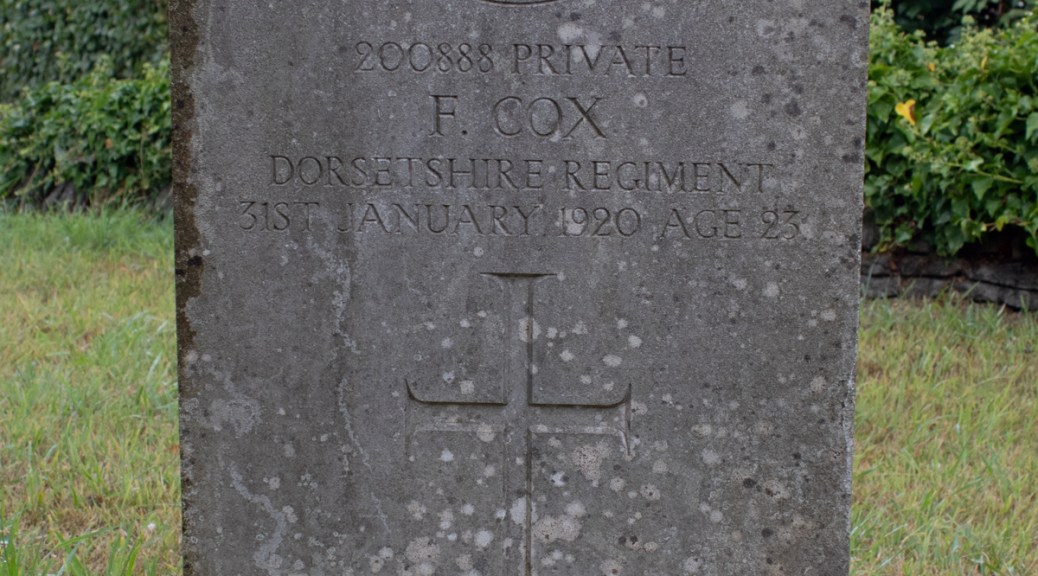
Frederick Charles Cox was born in the Dorset village of Kington Magna in the spring of 1897. One of seven children, his parents were agricultural labourer William Cox and his wife, Kate.

When Frederick completed his schooling, he also found work as a farm labourer. However, when war broke out, he was keen to play his part, possibly having seen his older brother, William Jr, also join up.

Unlike his sibling, Frederick enlisted in the Dorsetshire Regiment. His service papers have been lost to time, but it is clear that he took the role of Private, and that he was assigned to the 1st/4th Battalion. His unit began the war in India, but had moved to Basra in February 1916, remaining in Mesopotamia for the remainder of the conflict.

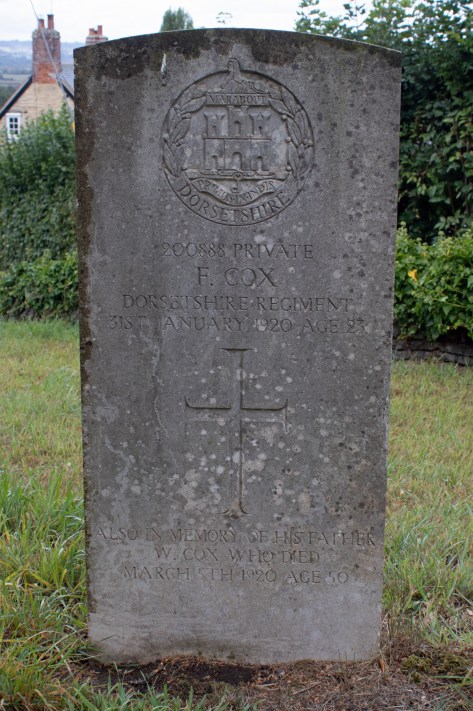
Private Cox survived the war, and had returned home by the end of 1919. His time in the army would impact his health, however, and during the winter of 1919/20, he came down with malaria, a condition which would prove fatal. Frederick passed away in hospital in Shaftesbury, on 31st January 1920: he was 23 years of age.

The body of Frederick Charles Cox was taken back to Kington Magna for burial. He was laid to rest in All Saints’ Churchyard, close to his brother, who had died a few years before.


Read more about Frederick’s brother William here.


Kate had lost two adult sons in a matter of years, and her tragedy was not to end. William Sr passed away less than five weeks after Frederick. He was buried close to his sons.
Private William Cox

Private William Cox

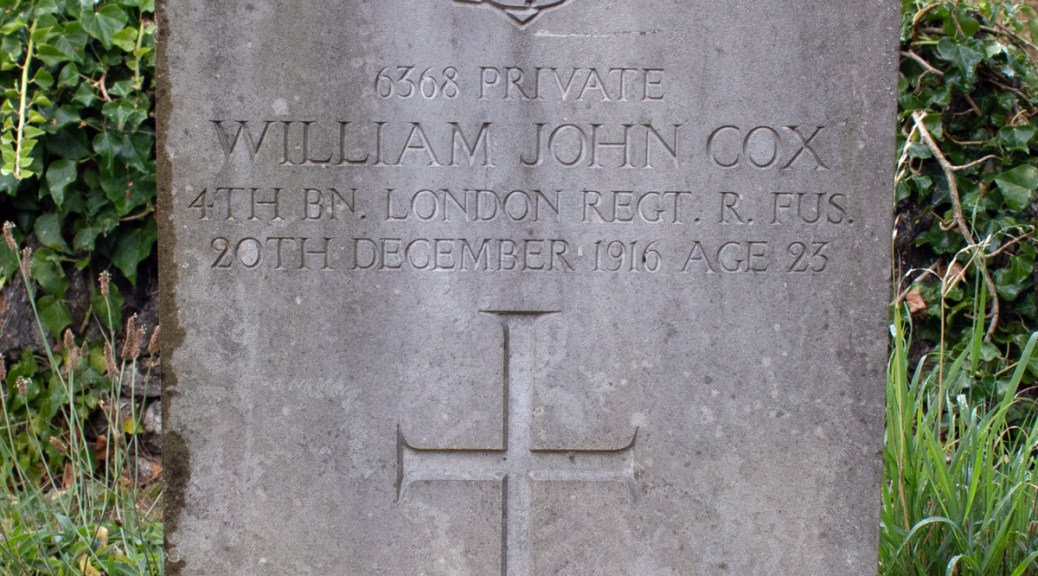
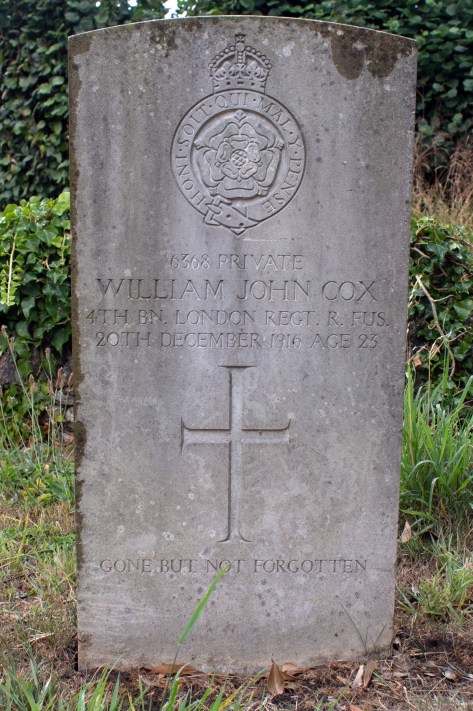
William John Cox was born in the autumn of 1893, and was the second of seven children. His parents – William and Kate Cox – were from Kington Magna, Dorset, and this is where they would raise their family.

William Sr was a farm labourer, and this is work into which his son would follow. By the time of the 1911 census, the family were living in a cottage on Church Street, with William Jr and his younger brother, Frederick, both agricultural workers.

When war came to Europe, William would step up to play his part. Full service details have been lost, but it is clear that he had enlisted in the army by the summer of 1916. As a Private, he was assigned to the 4th Battalion of the London Regiment (Royal Fusiliers).

Private Cox certainly saw action overseas, and would find himself entrenched at the Somme. At some point, he was wounded, and his injuries were bad enough for him to be sent back to Britain for treatment. He was admitted to hospital in Chatham, Kent, but his wounds would prove to be too severe. William passed away on 20th December 1916: he was 23 years of age.

The body of William John Cox was taken back to Dorset for burial. He was laid to rest in the tranquil surrounds of All Saints’ Churchyard in Kington Magna.


William’s younger brother, Frederick, also fought in the First World War. Read his story here.

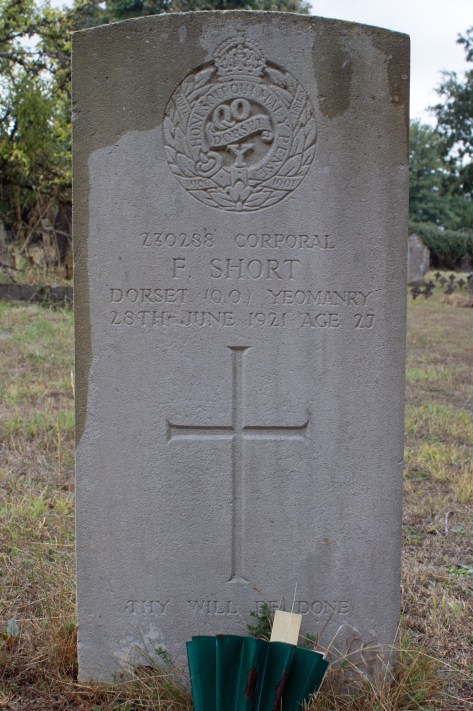
Corporal Frederick Short

Corporal Frederick Short

Frederick Short was born in Sturminster Newton, Dorset, in the spring of 1894. The oldest of five children, he was one of three sons to John and Martha Short. John was the caretaker of the village’s cemetery, and the family lived in a cottage on site.

When Frederick completed his schooling, he found work as a groom and, by the time of the 1911 census, he was boarding with John and Clara Binning in the village of Weare, Somerset.

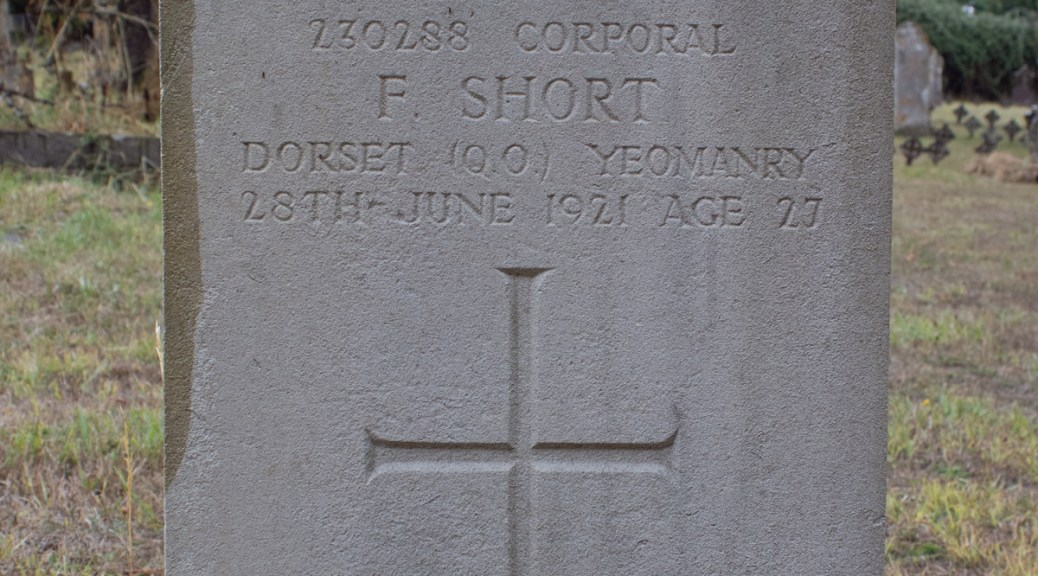
War came to Europe in the summer of 1914, and Frederick was called upon to play his part. Full details of his military service have been lost to time, but it is clear that he enlisted in the Queen’s Own Dorset Yeomanry. By the end of the conflict, he had risen to the rank of Corporal.

Frederick survived the conflict, and returned home. At the start of 1919, he married Mabel Heritage, a soldier’s daughter from Somerton, Somerset. Her father, George, had died by the time of the 1901 census, and Mabel moved with her mother to Milborne Port, on the Somerset-Dorset border. The 1911 census found her working as a leather glove machinist, in a four-roomed cottage on Paddock Walk, to the north of the town centre.

The war had had a negative impact on Frederick’s health. The 1921 census shows him and Mabel visiting his parents in Sturminster: his occupation was given as unfit (formerly a groom). It was only a matter of weeks later that his condition worsened. Frederick passed away from a combination of malaria and heart disease on 28th June 1921: he was 27 years of age.

The body of Frederick Short was laid to rest in Sturminster Newton Cemetery, close by, and in the care of, his caretaker father, John.


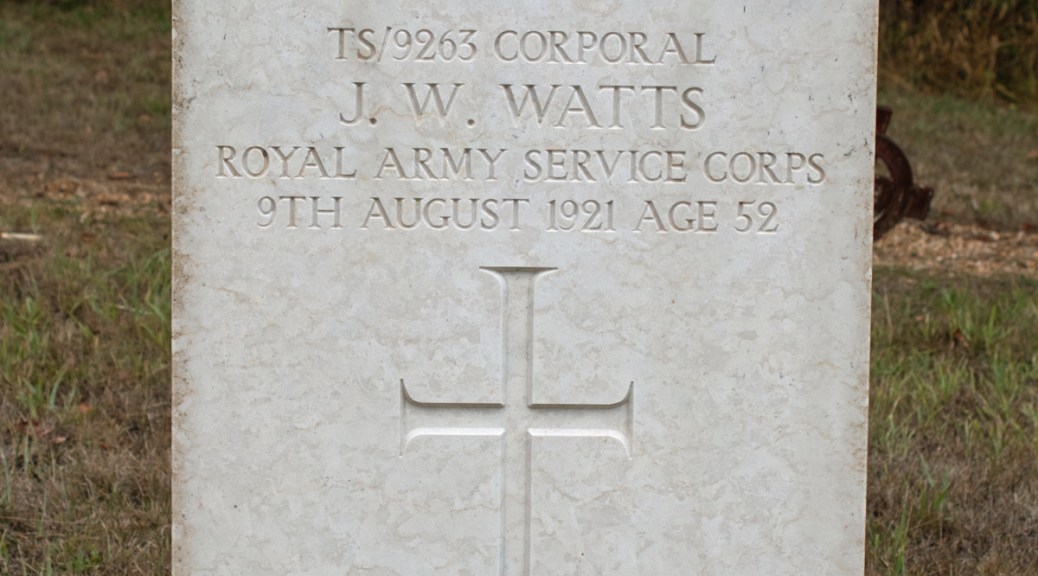
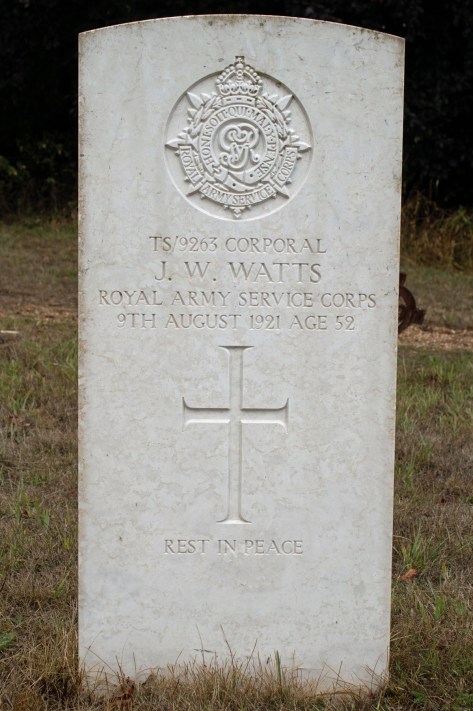
Farrier Corporal John Watts

Farrier Corporal John Watts

John William Watts was born in the summer of 1869, the youngest of six children to Reuben and Maria Watts. Reuben was a sawyer from Haselbury Brian, Dorset, and it was her that the Watts family were born and raised.

John seemed keen to progress himself, and found employment as a police constable. The 1891 census recorded him as living at the station in Blandford Forum. Three years later, he married Elizabeth Hallett, a shoemaker’s daughter from Lyme Regis. The couple would go on to have eight children before Elizabeth’s untimely death in 1912.

By this point, John’s career had taken a sharp turn: in 1901, when the family were living in Sturminster Newton, he was working as a blacksmith. The next return, taken in 1911, found them at 19 Church Street in the village, where John was employed as a journeyman shoeing smith.

With young children to raise, John took a new wife, marrying widow Rose Yeatman on 3rd August 1914. His oldest daughter, Elsie, and her father, Tom Bleathman, acted as witnesses. John and Rose would go on to have a daughter of their own, Muriel, the following year.

When war broke out, John stepped up to play his part. His service papers have been lost to time, but it is clear that he enlisted in the Royal Army Service Corps, and, presumably because of his age and experience, was assigned the rank of Farrier Corporal There is no indication that he served time outside of Britain, and it seems likely that he would have overseen the preparation of horses and training of blacksmiths for the Western Front.

Farrier Corporal Watts survived the conflict, but was medically discharged with malaria on 16th May 1919. The 1921 census found him living with Rose and five of his children and step-children in their Church Street home. He was employed as a bricklayer’s labourer, and was working for builder and contractor Mr J Silverthorne.

John’s health was suffering now, though, and he would only last until the summer. He passed away at home on 9th August 1921: he was 52 years of age.

The body of John William Watts was laid to rest in Sturminster Newton Cemetery, a short distance from his grieving family’s home.


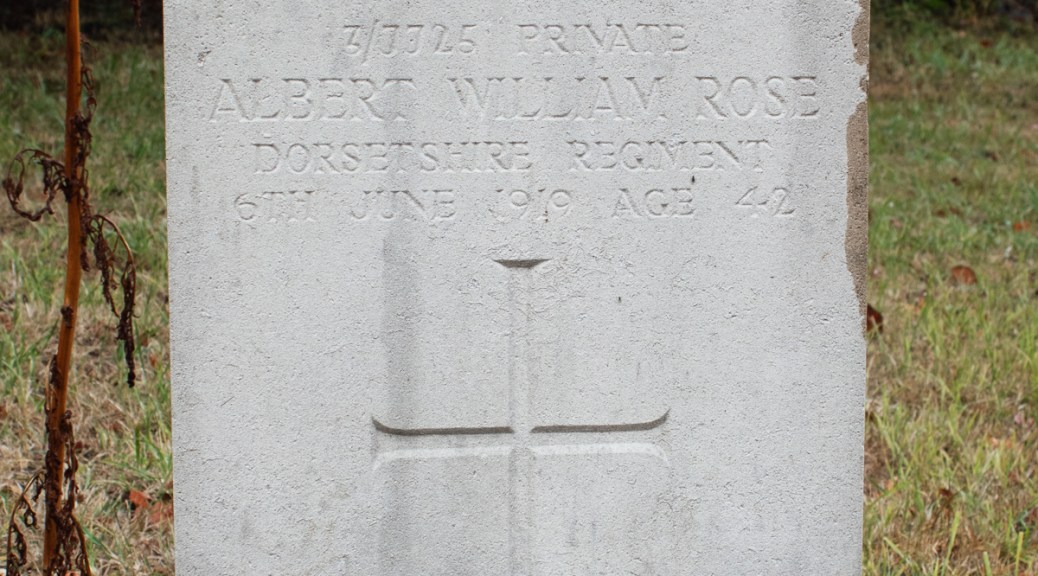
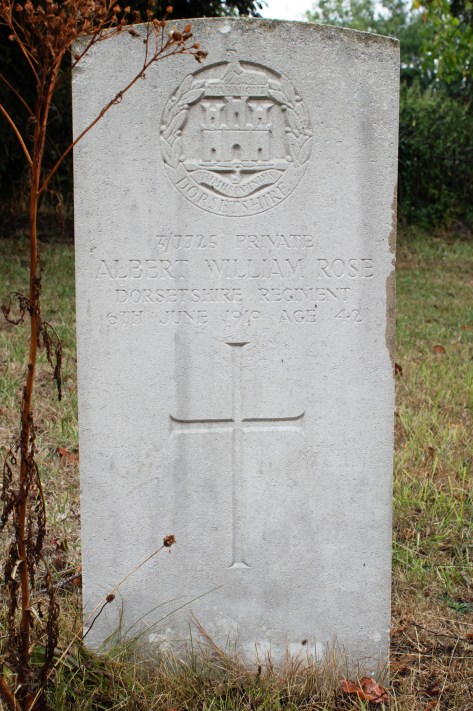
Private Albert Rose

Private Albert Rose

Albert William Rose – who was better known by his middle name – was born in the spring of 1876. One of eight children, his parents were Thomas and Amelia Rose. Thomas was a farm labourer from Sturminster Newton, Dorset, and this is the village in which the Rose family were born and raised.

William followed in his father’s footsteps, and was a farm labourer by the time he turned 14. The 1881, 1891 and 1911 census records all show him living with his parents: in 1901 he was a boarder with the Brown family at The Stables in Bryanstone, Dorset. He was employed as a stable keeper, one of eleven live-in employees at the stud.

Alongside his farm work, William was also an active volunteer in the local militia. When war broke out in the summer of 1914, he was quick to enlist, joining the 3rd Battalion of the Dorsetshire Regiment. His service papers show that he was 5ft 7ins (1.7m) tall and weighed 160lbs (72.6kg). He is recorded as having brown hair and grey eyes.

During the next four months, Private Rose undertook training on home soil. In December 1914, his unit was moved to France, and he would remain on the Western Front through to the Armistice and beyond. His time overseas was not without incident, and his age and health would be against him.

Over the next four years, William would he hospitalised at least a dozen times, for rheumatism, myalgia, a recurring heart condition and, in May 1915, from the effects of a gas attack and subsequent issues with catarrh. In December 1918, he returned to Britain with atherosclerosis, a clogging of the arteries, and was medically discharged from service the following month.

At this point, William’s trail goes cold. It is likely that he returned home, as , when he passed away, his death was registered in Sturminster.

Albert William Rose passed away on 6th June 1919: he was 43 years old. His body was laid to rest in Sturminster Newton Cemetery, not far from his family home.


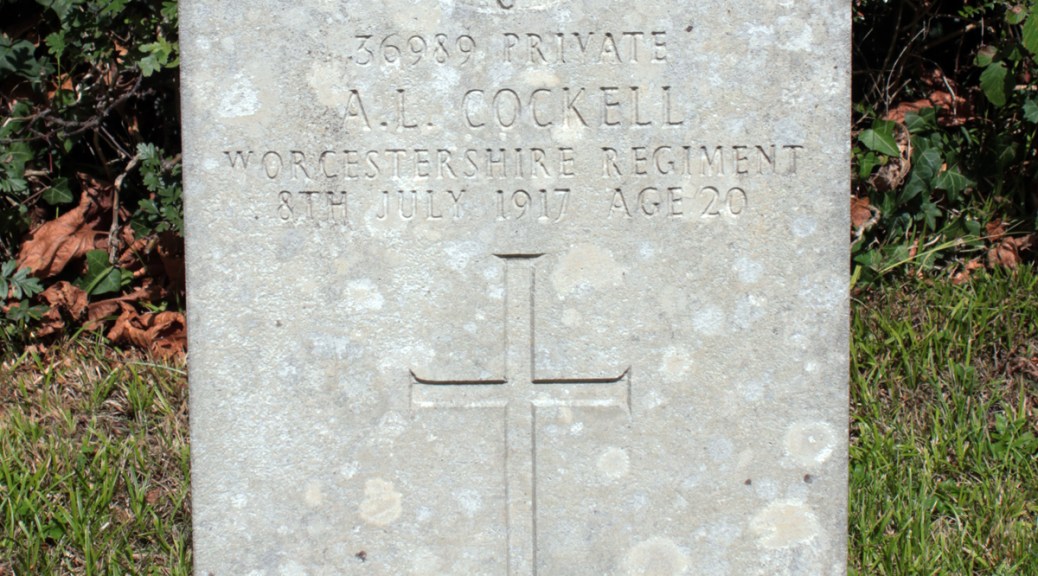
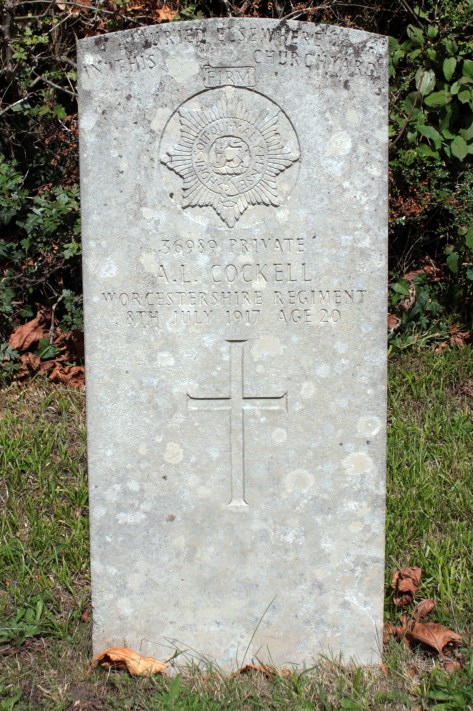
Private Albert Cockell

Private Albert Cockell

Albert Leonard Cockell was born in the spring of 1917, and was the youngest of four children to William and Annie Cockell. William was a plate layer and packer for Great Western Railways, and the family were born and raised in the village of Dilton Marsh, near Westbury, Wiltshire.

Albert finished his schooling early, to help bring in some money. The 1911 census recorded him – at 13 years of age – employed as a glove worker. When he was old enough, though, he followed in his father’s stead and, by the time war broke out, he was working as a porter at Westbury Station.

In the autumn of 1916, Albert stepped up to serve his country. He enlisted in the Worcestershire Regiment, and was assigned to the 4th Battalion. He soon found himself in the thick of things, and, by the spring of 1917, his unit was entrenched near Arras.

Sincere sympathies will be felt for Mr and Mrs William Cockell in the death of their son, Private Albert Leonard Cockell, Worcester Regiment, which took place on July 8th from wounds received while on active service in France. Private Cockell… joined the army about nine months ago, and during fighting on the 23rd April was struck by shrapnel. He was sent back to Dorchester and died on Sunday.

[Warminster & Westbury Journal: Friday 20th July 1917]

Albert Leonard Cockell was wounded on the first day of the Second Battle of the Scarpe. He died from his injuries on 8th July 1917, and his body laid to rest in the graveyard of Holy Trinity Church, Dilton Marsh.


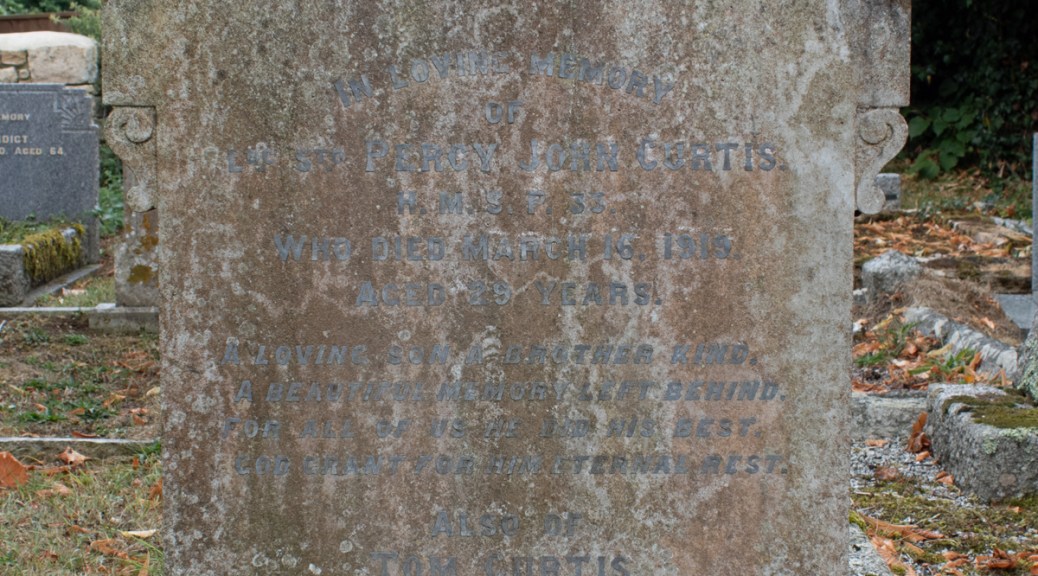
Leading Stoker Percy Curtis

Leading Stoker Percy Curtis

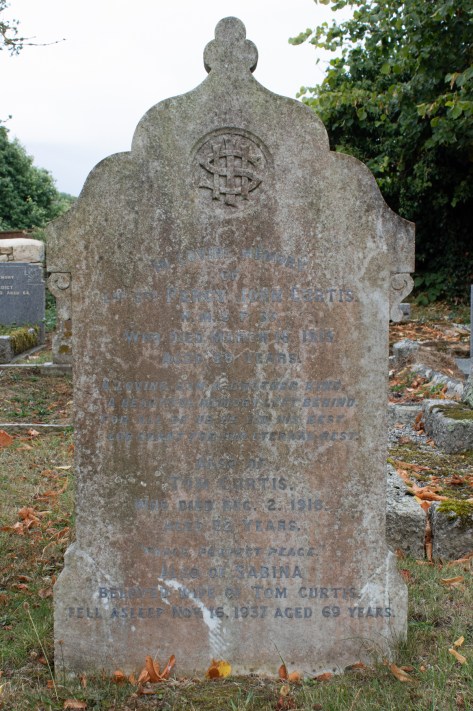
Percy John Curtis was born on 2nd January 1889, the second of twelve children to Tom and Sabina Curtis. Tom was a general labourer from Todber, Dorset, and this is where the family were born and raised.

Much of Percy’s life is a mystery. He found work at sea when he finished his schooling, and in October 1911 he enlisted in the Royal Navy as a Stoker 1st Class. His service papers show that he was 5ft 3ins (1.6m) tall, with brown hair, hazel eyes and a fresh complexion.

Stoker Curtis was initially assigned to the cruiser HMS Pathfinder, and remained on board until the summer of 1912. After a short sting at HMS Victory – the Royal Naval Dockyard in Portsmouth, Hampshire – he was given another posting, aboard the battleship HMS King George V. She would become his home for the next four years, during which time Percy was promoted.

In September 1916, the now Leading Stoker Curtis returned to shore and to HMS Victory. He would remain at the base for the rest of his time in the navy.

On 5th November 1918, Percy married Kathleen Francis. She was the daughter of a Co-operative store manager from Dovercourt, Essex. She seems to have stayed with her family while her new husband was working, and a later census records confirms that she had returned (or remained) there after his death.

Percy’s service record gives a intriguing hint as to what happened, to him. By the end of the war he had been assigned to HMS Victory’s accounting branch. His papers simply state that he “Found dead on board 17 March 1919”. No cause of death is confirmed, although another naval document does confirm that it was due to illness, rather than any foul play. He was 30 years of age.

The body of Percy John Curtis was taken back to Dorset for burial. He was laid to rest in the family plot in Todber Churchyard, alongside his father, who had passed away the year before.


Private George Topp

Private George Topp

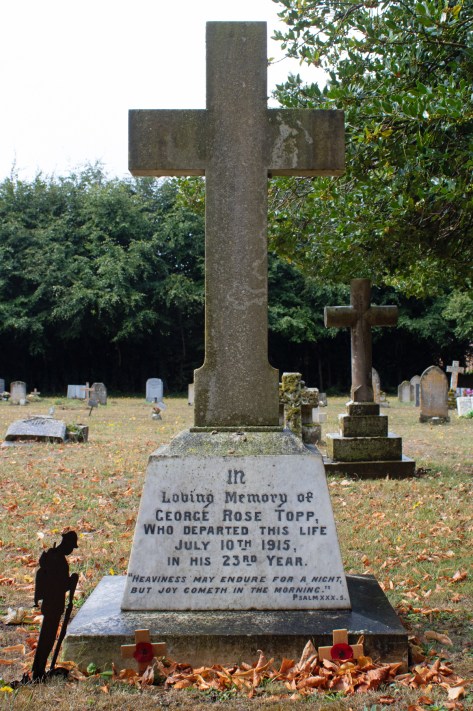
George Rose Topp was born in the autumn of 1891 in the Dorset village of Okeford Fitzpaine. The youngest of four children, he was the second son to Herbert and Louisa Topp. The 1901 census found the family living and working at Knacker’s Hole Farm, alongside George and Olive Savory.

When he finished his schooling, he helped with the farm; by the time of the 1911 census, they had moved on from Okeford Fitzpaine, and had taken up employment at Barter’s Farm in Hinton St Mary, Dorset.

War broke out in the summer of 1914, and George stepped up to play his part. There is little information about his time as a Private in the Queen’s Own Dorset Yeomanry, but a later newspaper report detailed what happened to him.

On Saturday morning a profound sensation was created at Hinton St Mary, when it became known that Mr George Rose Topp… had shot himself. It appears that the deceased was a trooper in the Dorset Yeomanry, who were mobilised in August 1914, and had been home on leave for three weeks, and was to return to camp on the day of the tragedy. Although the deceased had helped his father on the farm for some years, yet during the three weeks he had been home he had not been seen about very much. The deceased was well known throughout the district, and was very highly respected. Much sympathy is felt for the family in the sad occurrence.

An inquest was held on Monday at Barter’s Farm… [Herbert] deposed that his son, who had been living with him, was 23 years of age, and a bachelor… He was home on leave… and was supposed to return on Saturday, July 10th. He had been very bad in his head since he came home and had hardly been out. He had always complained of pains in his head, but not so much lately. He had been seen by the army doctor several times. He did not know of anything else except his head, and he had no trouble that he was aware of. He had never threatened to take his life. He was going by the eleven o’clock train on the day of the tragedy. He got up about seven o’clock and had his breakfast. Witness saw him about 9.45am, and he was getting ready to go to the station. He had packed everything ready to start. It was witness’s gun he used which he was in the habit of using, but had not done so for some time. The gun was kept in the kitchen. He did not think there were any cartridges in the house and he thought he used a “Bonex.” He did not know he was going to use the gun. The gun had a very light pull, and he had never seen any cartridge in the house like the one produced. He left no writing, and the gun had not been lent.

Mr Clifford Rose (cousin of the deceased) corroborated [Herbert’s] evidence, and said that on the morning of the tragedy deceased seemed brighter. He did not think he touched the gun at all before whilst home.

Henry Andrews… was working at Barter’s Farm on Saturday repairing the tibs to the back kitchen. They were out and in the house all the time, but he did not see deceased that morning. He heard a noise before the report of the gun about 10am. He went in and deceased was lying on his back with the gun by his right side. He had his coat on and he called for assistance. They heard the report, and Mrs Topp and Miss Topp were saying he was shot. The door he went in was shut, as was also the other door. He thought Mrs Topp thought he was shot through hearing the gun go off. The head was lying towards the furnace, and the body was in the same position when the police arrived. The gun had not been moved before the police came.

Dr THE Watts-Silvester deposed that he had attended deceased about three months ago for influenza. He knew nothing of the pains in the head. He was called and saw deceased at Barter’s Farm soon after 10am. In the back kitchen the deceased was lying dead on his back with his feet towards the two doors, and head resting on a large saucepan close to the copper. Almost the whole of the top of his head had been blown off to a level below the eyes, both having gone. It had practically disappeared. The gun must have been very close. Below the right chin there was a black mark.

The jury returned their verdict that the cause of death was a gunshot wound in the head whilst of unsound mind.

[Southern Times and Dorset County Herald: Saturday 17th July 1915]

George Rose Topp was just 23 years old when he ended his life on 10th July 1915. He was laid to rest in the church cemetery in the village of Hinton St Mary.


Private Sidney Oates

Private Sidney Oates

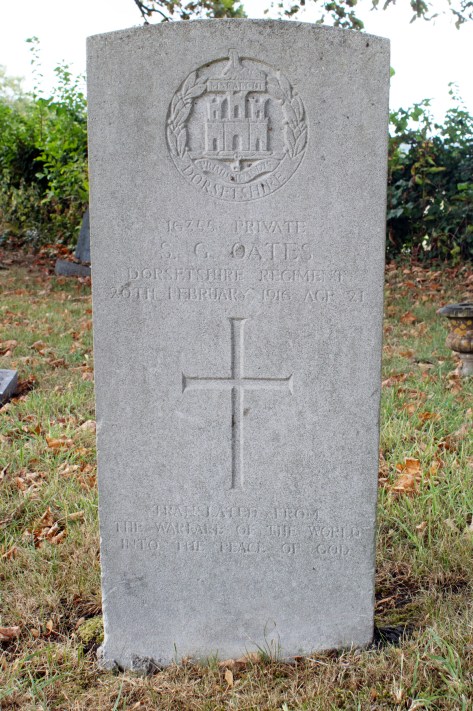
Sidney George Oates was born in the spring of 1895, and was the oldest of three children – all boys – to John and Eliza Oates. John was a general labourer from Parkstone, Dorset, but it was in the village of Odcombe in Somerset that the family were born and raised.

Eliza died in 1899, and John was left to raise three young children on his own. He re-married, to a Lucy Moores, but the a split of the family followed the wedding. Sidney’s younger brothers stayed with their father and his new wife, while Sidney himself was looked after by his maternal grandparents. Job and Elizabeth Green lived in Buckhorn Weston, a village to the west of Gillingham, Dorset.

When he finished his schooling, Sidney was apprenticed to a carpenter. War was on the horizon, however, and he soon stepped up to play his part. As with many others, his service papers have been lost to time, but it is clear that he had enlisted in the Dorsetshire Regiment no earlier than August 1915.

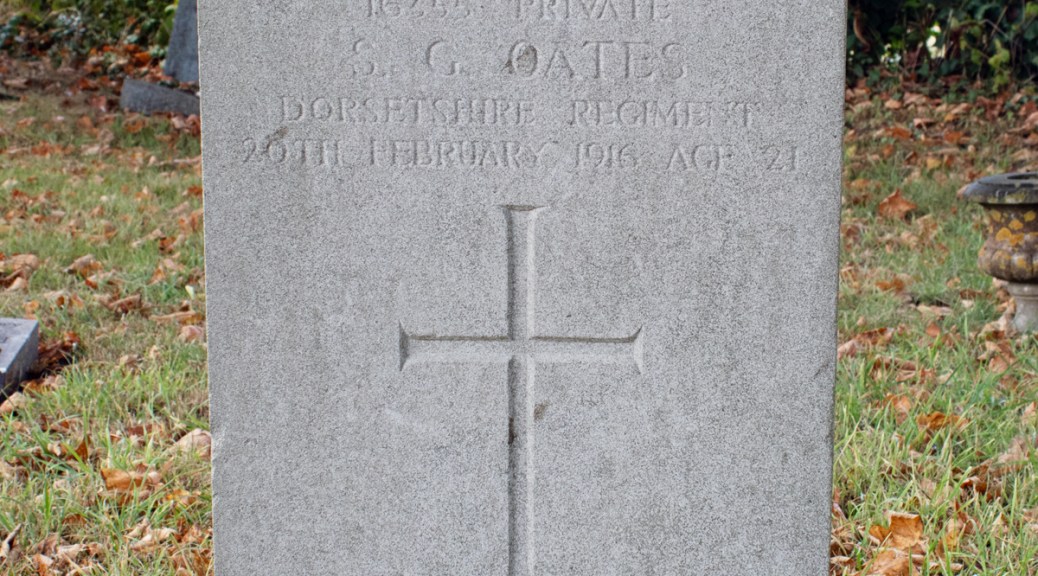
Private Oates was assigned to the 7th (Reserve) Battalion and sent to a training camp near Wool, Dorset. While there, however, he caught pneumonia, and was admitted to a military hospital in the village. The condition was to prove fatal: he passed away on 20th February 1916, aged just 21 years old.

The body of Sidney George Oates was taken back to Buckhorn Weston for burial. He was laid to rest in the village’s cemetery.


Sidney’s younger brother Edward also served in the First World War. A Pioneer in the Royal Engineers, he was killed in action in northern France on 12th April 1917. He was buried in Mory Abbey Military Cemetery to the north of Bapaume.


Private Ernest Kendall

Private Ernest Kendall

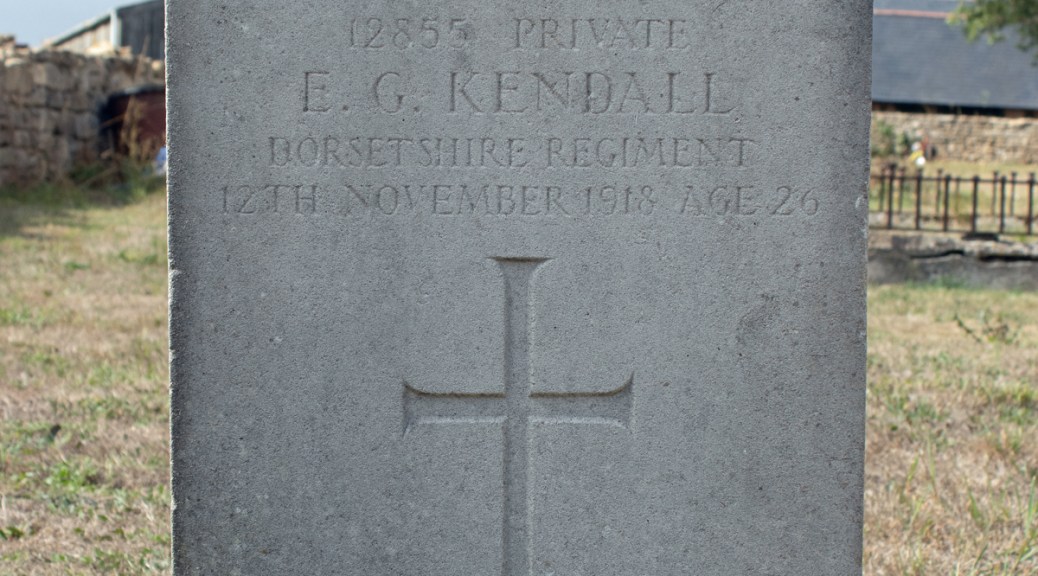
Ernest George Kendall was born in December 1891 and was the fourth of five children to Charles and Mary Kendall. Charles was a farm labourer from Dorset, and the family were living at Shearstock Farm in the town of Gillingham when Ernest was born.

By the time of the 1911 census, Ernest had found work as a farm labourer, alongside his father. When war broke out, however, Ernest felt the need to serve his country.

Full details of Private Kendall’s military service have been lost to time, but he had enlisted in the Dorsetshire Regiment by the autumn of 1915, and was assigned to the 5th (Service) Battalion. His unit left Britain on 15th October, and headed for the Eastern Mediterranean and Gallipoli.

Over the next few months, Ernest was caught up in fierce fighting. He was evacuated to the Greek island of Mudros in December 1915, and spent the winter in Egypt. By the summer of 1916, his unit had moved to France, and fought at the Somme.

At some point, Private Kendall returned to Britain, and transferred to the Labour Corps. The move was likely to be due to an illness or injury, although there is no documentation to confirm this either way. Attached to the 477th Agricultural Company, he seems likely to have been based in Wiltshire. Ernest was admitted to the Military Hospital in Fovant for reasons unknown, and passed away there on 12th November 1918, a day after the Armistice was signed: he was 24 years of age.

The body of Ernest George Kendall was taken back to Dorset for burial. By this point his family had moved to East Stour, and he was laid to rest in the village’s Christ Church graveyard.