Category Archives: Somerset

Private John Hallett

Private John Hallett

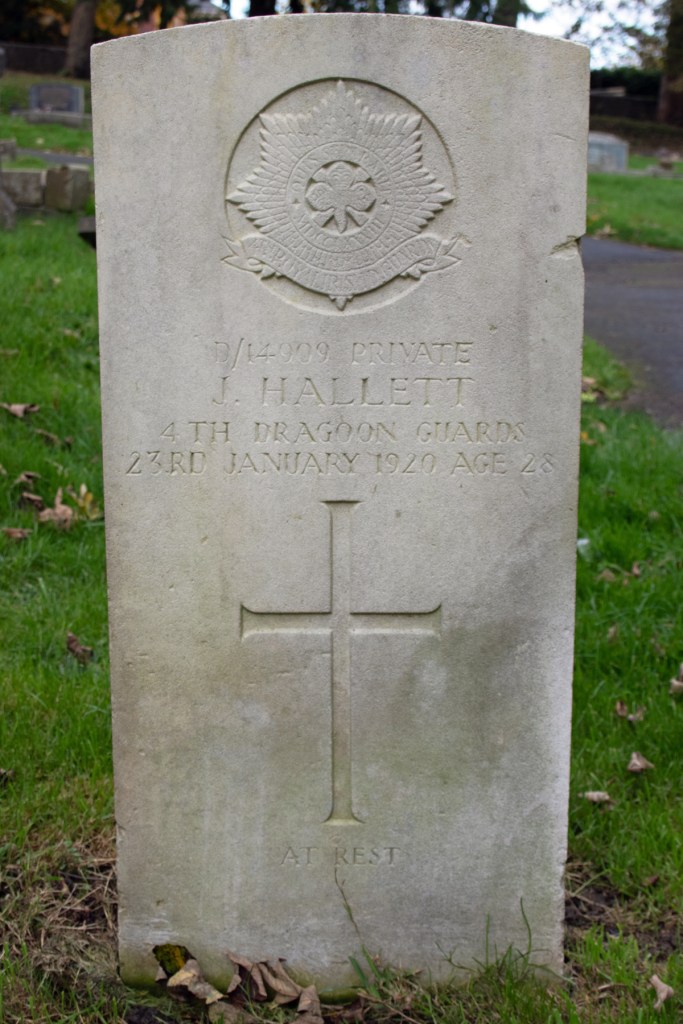
John Hallett – better known as Jack – was born in the spring of 1891 in the Somerset town of Frome. One of twelve children, his parents were carpenter Frederick Hallett and his wife, Elizabeth. When he left school, Jack found work at a printer’s, helping with the typesetting.

War was approaching, and Jack was keen to do his bit. While full details of his military service are not available, it is clear that he enlisted as a Private in the Royal Irish Dragoon Guards. He served in France with the 4th Battalion, arriving there in October 1915.

A later report suggests that Private Hallett was “seriously wounded several times during the war” [Somerset Standard: Friday 30th January 1920], although no specific details are available about his injuries. He survived the conflict and was awarded the British and Victory Medals and the 1915 Star for his service.

Demobbed and back at home, it seems that John did not fully recover from his wounds. He was admitted to the Victoria Hospital in Frome in January 1920, and died there a matter of days later. He was just 28 years old.

John Hallett was laid to rest in the graveyard of Christ Church in his home town of Frome, Somerset.


The local newspaper gave a more detailed report on John’s funeral:

Ex-Soldier’s Death

The funeral took place yesterday afternoon at Christ Church of Mr John Hallett, aged 29, of The Butts, Frome, who passed away at the Victoria Hospital on Friday last. Deceased had been seriously wounded several times during the war, and a day or two ago was removed to the hospital. The Rev. J Howard Lewis conducted the service, which was attended by local Oddfellows, to which society the deceased belonged, and by a number of other representative mourners.

Somerset Standard: Friday 20th January 1920
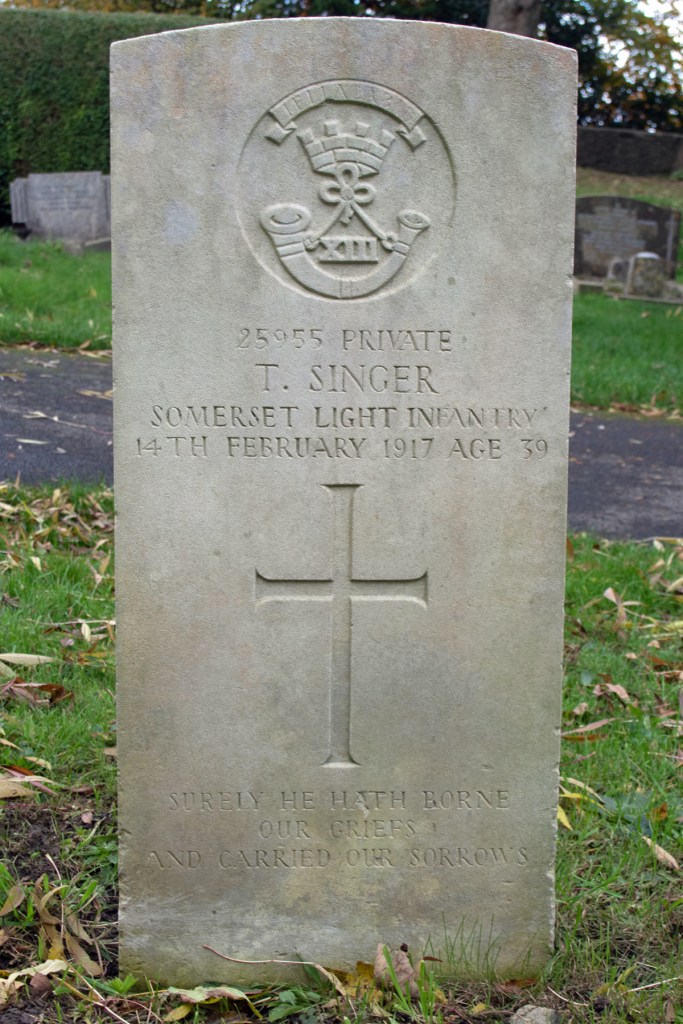
Private Thomas Singer

Private Thomas Singer

Thomas – better known as Tom – Singer was born in Frome, Somerset, in the summer of 1876, the youngest of seven children to John and Sophia Singer. John was a labourer on the railway, who sadly passed away when Tom was only three years old. Sophia was left to raise the family on her own, and she did so by taking in washing for other people (the 1891 census has her listed as a pauper, but she still managed to support her children). Sophia also died in 1892, meaning Tom was an orphan by the time he was just 16 years old.

Tom found work as an errand boy when he left school, although he soon moved on to labouring work. After Sophia’s death, he moved in with his brother Walter, who had also recently been widowed, and the money they brought in helped support Walter’s three children and pay for a housekeeper to do so.

On 21st July 1904, Tom married Edith Mary Bugler, a labourer’s daughter from nearby Selwood; the couple went on to have five children. With a growing family to support, Tom found new work as an ostler at the pub in Witham Friary, to the south of Frome.

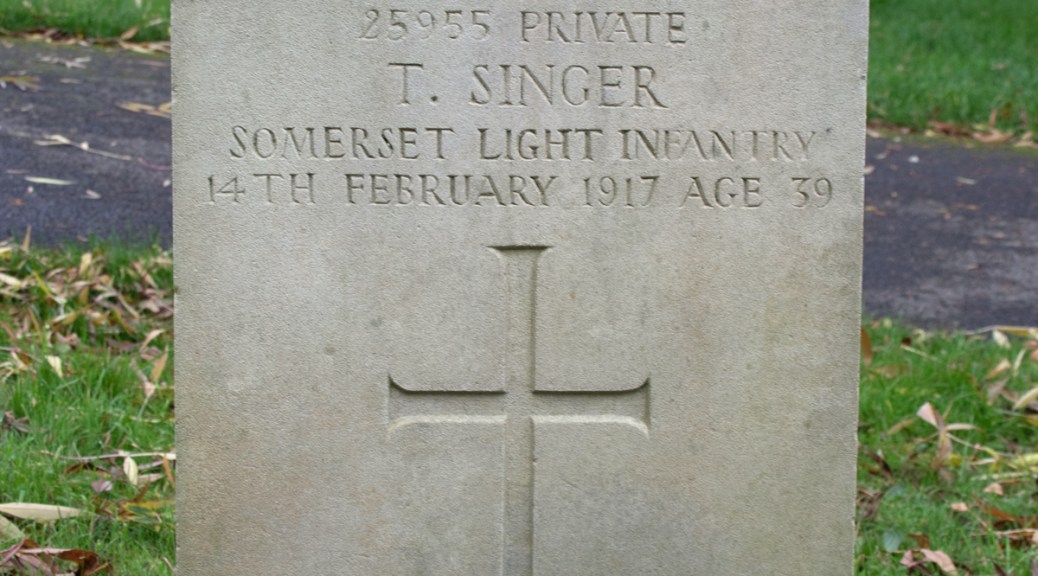
War was coming to Europe, and Tom was called upon to do his duty. Full details of his service are not available, sadly, but it is clear that he enlisted as a Private in the Somerset Light Infantry at some point before the summer of 1916.

Private Singer was sent to France in November 1916, but fell ill soon afterwards. He was medically evacuated back to England and admitted to hospital, where he underwent an operation. Sadly, he did not recover, and passed away on 14th February 1917, at the age of 40 years old.

Tom Singer was laid to rest in the graveyard of Christ Church in his home town of Frome.


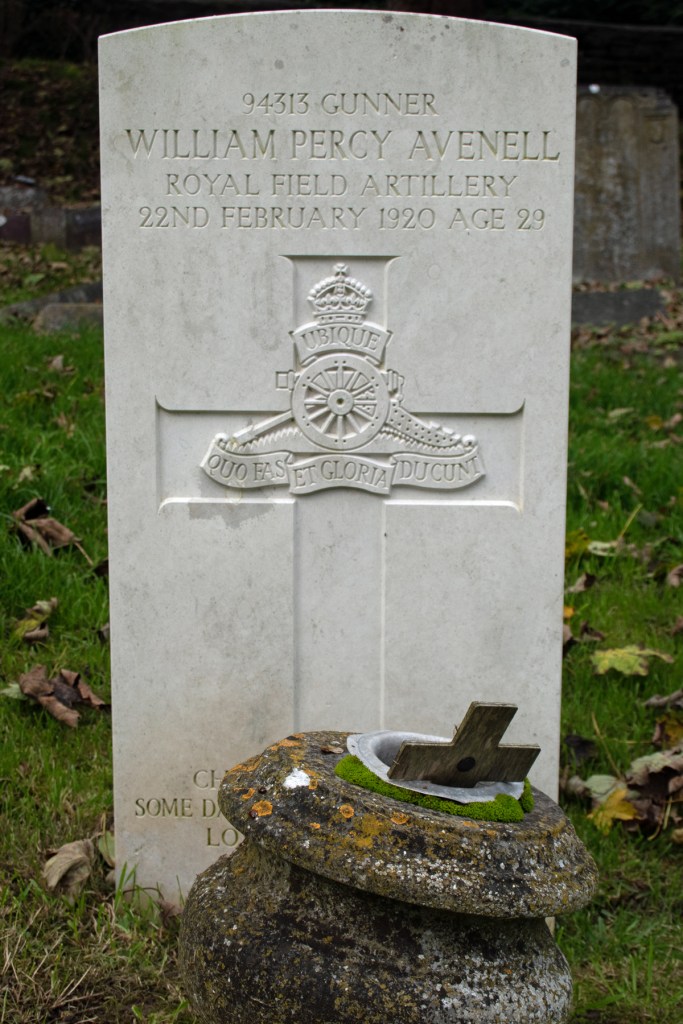
Gunner William Avenell

Gunner William Avenell

William Percy Avenell seems destined to remain lost to time, and there is little documentation about his life.

He was born in around 1891, and enlisted in the Royal Field Artillery as a Gunner in the summer of 1915, serving in France and earning the Victory and British Medals and the 1915 Star in the process. Gunner Avenell subsequently transferred to the 861st Employment Company of the Labour Corps.

William survived the war and returned to England. He had settled in the Somerset town of Frome (he may have been from the town, but there is nothing to evidence this) with his wife, Lily Beatrice.

Gunner Avenell’s passing is as lost in time as the rest of his life. He died on 22nd February 1920, at the age of just 29 years old.

William Percy Avenell lies at rest in the graveyard of Christ Church in Frome.


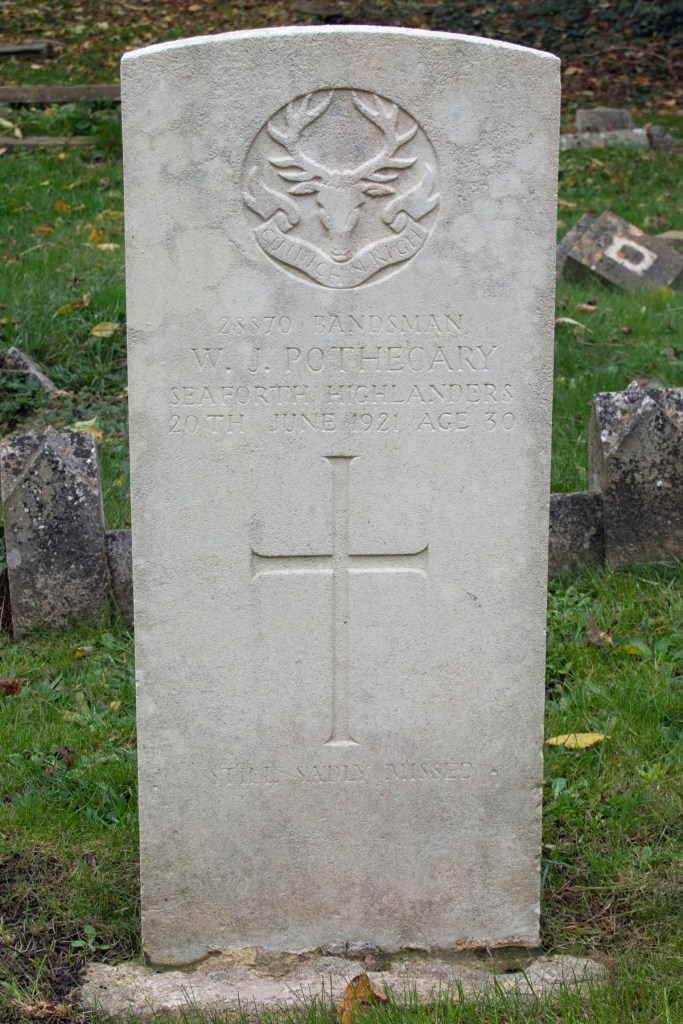
Bandsman William Pothecary

Bandsman William Pothecary

William James Pothecary was born in Frome, Somerset, on 24th April 1891, one of six children – and the only boy – to Francis and Annie Maria Pothecary. Francis was a groom, and the couple raised the family in Pilly Vale (now Willow Vale) which ran alongside the River Frome in the centre of the town.

Little further information on William’s early life is available, although it seems he was a keen musician, and took up the oboe at an early age. He joined the 2nd Seaforth Highlanders in 1909 as a Bandsman, and, from later reports, was a talented player.

When war broke out, William was sent to the front, but in 1915, while caught up in the Second Battle of Ypres, he was buried and seriously wounded by a bomb. He was sent to a convalescent home in Ireland, recovered reasonably well and returned to France, where he served until the end of the war.

Bandsman Pothecary was demobbed in July 1919 and returned to Somerset. The following year, he needed an operation following the recurrence of the issues he encountered following his injury, and all seemed to be going well for a long-term recovery.

William had a relapse in the summer of 1921, and was admitted to Bath Hospital. Sadly, however, he was not to recover this time, and he passed away on 20th June. He had just turned 30 years old.

William James Pothecary was laid to rest in the graveyard of Christ Church in his home town of Frome.


The Somerset Standard gave a glowing obituary for young William:

Death of an “Old Contemptible”

The was, through the fighting is over, still claims victims from the ranks of survivors. On Monday, Mr William James Pothecary, one of the “Old Contemptibles”, died in the Pensions Hospital at Bath from the effects of wounds which he received in 1915. He was the only son of Mr and Mrs FW Pothecary, of Bath Street, and very deep sympathy is felt with the parents and sisters in their great bereavement. Mt WJ Pothecary was an old Regular.

Nearly twelve years ago he joined the 2nd Seaforths. He was a talented player of the oboe, and it was his love of music which prompted him to become a bandsman in the 2nd Seaforths. He had previously been a bugle boy in the old Volunteers, and afterwards a member of the Territorial Band. And at the time of his death he was one of the most valued players in the Frome Town Military Band.

He went to France with his regiment in 1914. In 1915 he was seriously wounded and buried by a bomb. His condition was critical for a long time, but he slowly recovered and was sent to a convalescent camp in Ireland. He remained there for a considerable time, and when he was deemed medically fit he was sent to France a second time. He continued to serve in France until after the Armistice. He was discharged from the Army in July 1919.

Last year it was necessary for him to undergo a very serious operation in hospital. The operation was successful, and it was hoped there would be a permanent recovery. But on Thursday last there was a recurrence of an old trouble, and he was removed to Bath Hospital, where he died on Monday morning.

He was a talented and promising young fellow, and his death is deeply deplored by his many friends, and not least by his fellow members of the Frome Town Military Band.

Somerset Standard: Friday 24th June 1921

Boy Clifford Day

Boy Clifford Day

Clifford Day was born on 27th November 1897 in Weston-super-Mare, Somerset. He was one of eleven children to John and Sophia Day. John initially worked as a general labourer for a stonemason, but by the time of the 1911 census, he had begun working for a gas company. The family, at this point, were living in a five-room house a short distance from the town centre.

Living in a large household, a dream of escape may have fermented in young Clifford’s mind. To see some of the world, he joined the Royal Navy on 3rd September 1913. Given he was only fifteen, he was too young to formally enlist, but he was given the rank of Boy, and set to work.

Clifford’s service papers confirmed that he stood at 4ft 11ins (1.48m) tall, had brown hair, brown eyes and a fresh complexion. It was also noted that he had a scar on his forehead.

Boy Day’s service began on HMS Impregnable, where he spent nine months learning the ropes. He moved on to HMS Gibraltar in May 1914, before transferring to HMS Vivid – the shore-based establishment in Devonport – at the outbreak of the First World War.

On 3rd October 1914, Clifford was assigned to the battlecruiser HMS Tiger. He was on board for only three weeks, when he was taken back to HMS Vivid, and sent to the Naval Hospital there. He was admitted with a fractured skull, sadly passing the next day – the 26th October 1914 – at the age of just 16 years old. I’ve been unable to locate any further information about his injury, other than that an inquest found that it was accidental death.

Clifford Day was brought back to Weston-super-Mare for burial. He was laid to rest in the Milton Road Cemetery in the town.


Private Edmund Bevan

Private Edmund Bevan

Edmund Thomas Bevan was born in Weston-super-Mare, Somerset, in November 1867, the son of blacksmith George Bevan and his wife, Mary Ann.

Unfortunately, little documentation remains on Edmund’s early life; after his baptism record, the next evidence for him comes in the form of his military service record, twenty years later.

Looking for a life of adventure, Edmund gave up his labouring job and joined the Somerset Light Infantry. His enlistment papers confirm the date – 12th May 1887 – and showed that he stood at 5ft 4ins (1.62m) tall and weighed in at 120lbs (54.4kg). The papers also note that he had dark brown hair, hazel eyes and a fresh complexion. He also had a scar above his right eye.

Private Bevan joined up for twelve years’ service. He spent his first four years at bases in Essex and Hampshire, before being sent to Gibraltar in November 1891. He returned home after two years, and spent his remaining time in the army in his home county, Somerset. Noted that he had shown a very good character, he was discharged to the reserve brigade on 11th May 1899 in Taunton.

Sadly – tantalisingly – Edmund’s trail goes cold again at this point. When hostilities were declared in August 1914, it seems likely that he was brought out of reserve, but given his age at this point – he was 46 – he was assigned to the territorial force. As a Private in the 125th Coy of the Royal Defence Corps, he would have had civil protection in the London area, although again, specific details are not known.

The next confirmation of Private Bevan’s life is his gravestone. This confirms that he passed away 19th July 1917, at the age of 49. While no cause of death is evident, his pension record sheds a little more light onto his life in the early years of the twentieth century.

Edmund had married a woman called Martha, and the couple had gone on to have a child. Martha passed away in September 1913 and, according to the pension record, Edmund passed guardianship on to his brother Henry.

Edmund Thomas Bevan was laid to rest in the Milton Road Cemetery in his home town of Weston-super-Mare.


Private Charlie Badman

Private Charlie Badman

Charles Badman – better known as Charlie – was born in 1895 in the Somerset seaside town of Weston-super-Mare. His parents were stonemason Henry Badman and his wife Caroline.

Unfortunately, there is little documented information about Charlie’s early life. By the time of the 1911 census, the family were living in a terraced house in Clevedon Road, Weston-super-Mare, a short distance from the sea. Charlie’s four oldest brothers had left home by this point, but his other two siblings – his dressmaker sister Martha and his plasterer brother Arthur – were still living with their parents. Charlie, at this point, was still at school.

When war was declared, Charlie was keen to do his bit. He enlisted in the Royal Army Medical Corps, and was assigned to the 65th Field Ambulance as a Private. This section was connected to the 21st Division, which saw action on the Western Front at Loos, the Somme, Arras, Passchendaele and Cambrai, although it is not possible to determine how Private Badman was involved in these battles. He was awarded, however, the Victory and British Medals for his service.

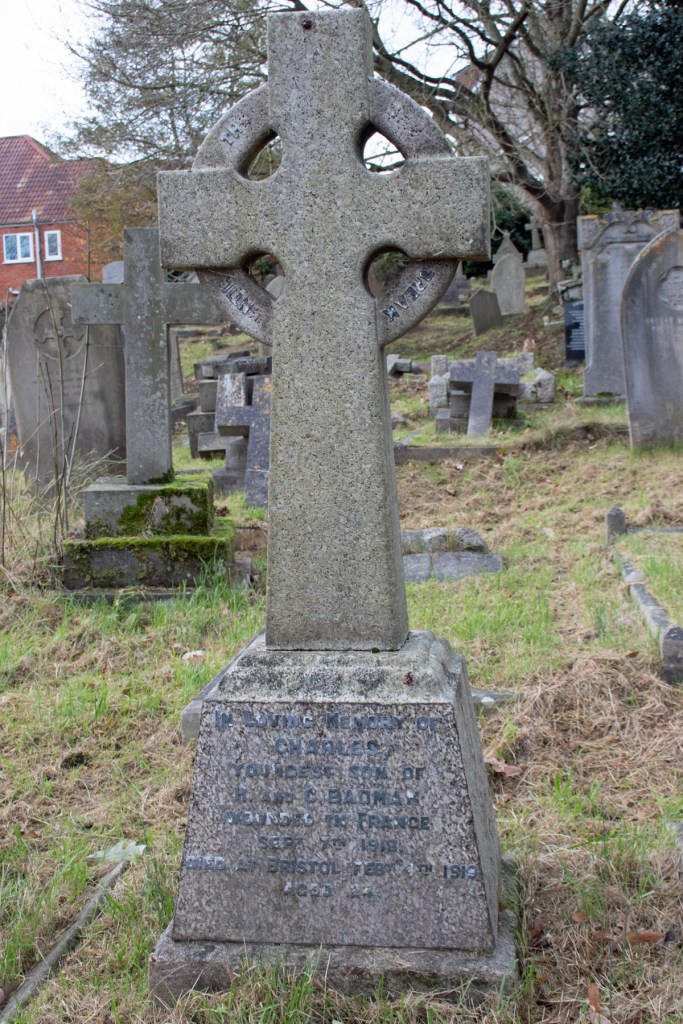
The only other concrete information available for Charlie is the inscription on his gravestone. This confirms that he was wounded in France on 7th September 1918. It seems that he was medically evacuated to England, and was admitted to a military hospital in Bristol, not far from his family in Somerset.

Sadly, it seems that his wounds proved too severe; he died at the hospital five months later, on 4th February 1919, aged just 25 years old.

Charlie Badman was brought back to Weston-super-Mare for burial. He lies at rest in the Milton Road Cemetery in the town.


Private Percy Coward

Private Percy Coward

Percy Herbert Coward was born in the Wiltshire town of Westbury in the autumn of 1896. He was one of seven children – all boys – to Lily Coward and her weaver husband Charles. Not long after Percy was born, the family moved across the county border to Frome, Somerset, presumably for Charles’ work.

By the time of the 1911 census, the Coward family were living in a five-room end-of-terrace cottage on the outskirts of the town. Charles and Percy were both working as warpers – threading looms – in the cloth industry; two of his brothers were working for a printer in the town. Percy was proving himself an integral part of the community.

[Percy] was very highly esteemed by a large circle of acquaintances… He was a worker with the YMCA and Frome Brotherhood, a member of the band and in other directions showed himself a young man of much promise. He was employed successively at Messrs Houston’s [Woollen Mill] and at the Silk Factory.

Somerset Standard: Friday 26th April 1918

An active member of the town’s territorial force, when the Great War broke out he was mobilised. Initially attached to the Royal Army Medical Corps, he subsequently served with the Royal Army Service Corps and the North Staffordshire Regiment, before obtaining his final transfer to the 42nd Company of the Machine Gun Corps.

During his time in the army, Private Coward would have seen action in some of the fiercest battles of the war – at the Somme, Arras and Ypres. In the spring of 1918, his battalion was involved in the Battles of St Quentin and the Avre, and it was during this last skirmish that he was wounded.

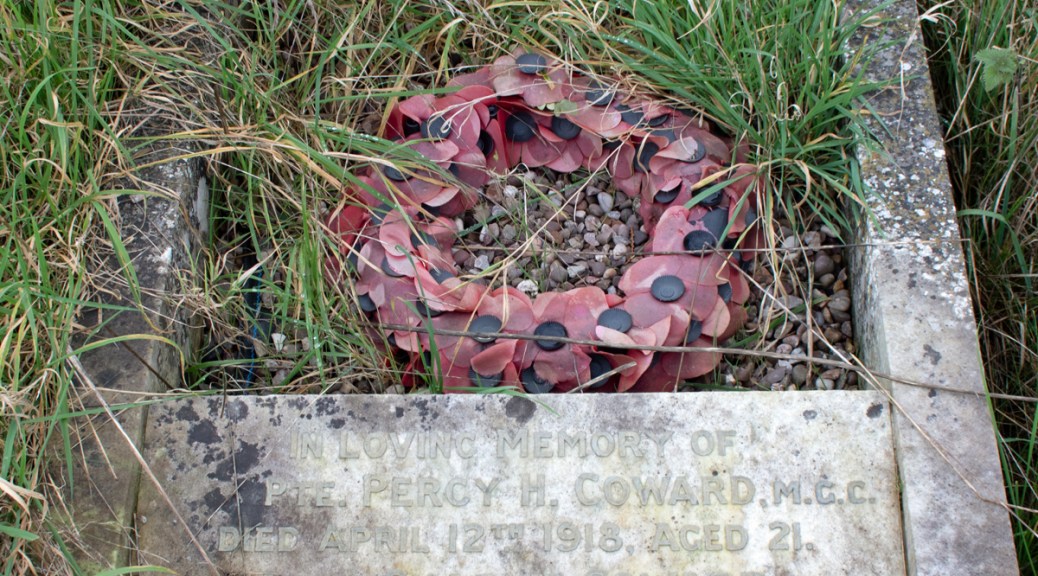
Percy’s injuries were severe enough for him to be medically evacuated back to England and, once there, he was admitted to the Royal Woolwich Hospital in South London. His wounds were to prove too much for him, however, and he passed away at the hospital on 12th April 1918. He was just 21 years of age.

Percy Herbert Coward was brought back to Somerset for burial. He was laid to rest in the Dissenters’ Cemetery, Vallis Road, within walking distance of his family home.


Stoker 1st Class Arthur Smith

Stoker 1st Class Arthur Smith

Arthur Edgar Smith was born in the Somerset village of Beckington on 12th January 1890. He was one of eight children to agricultural labourer and cowman George Smith and his wife Hester.

Arthur was after some adventure in his life, and didn’t want to be limited to Somerset. The Royal Navy offered this opportunity, and so, in December 1909, aged 19, he joined the service as a Stoker 2nd Class. His service records confirm that he stood at 5ft 7ins (1.7m) tall, had a fresh complexion, brown hair and hazel eyes. He signed up for the standard 12 years’ service.

After an initial five months’ training at HMS Vivid in Devonport, Stoker Smith was assigned to the battleship HMS Mars. During his two years’ service on board, he was promoted to Stoker 1st Class. In January 1912, he was reassigned, boarding HMS Orion, also a battleship.

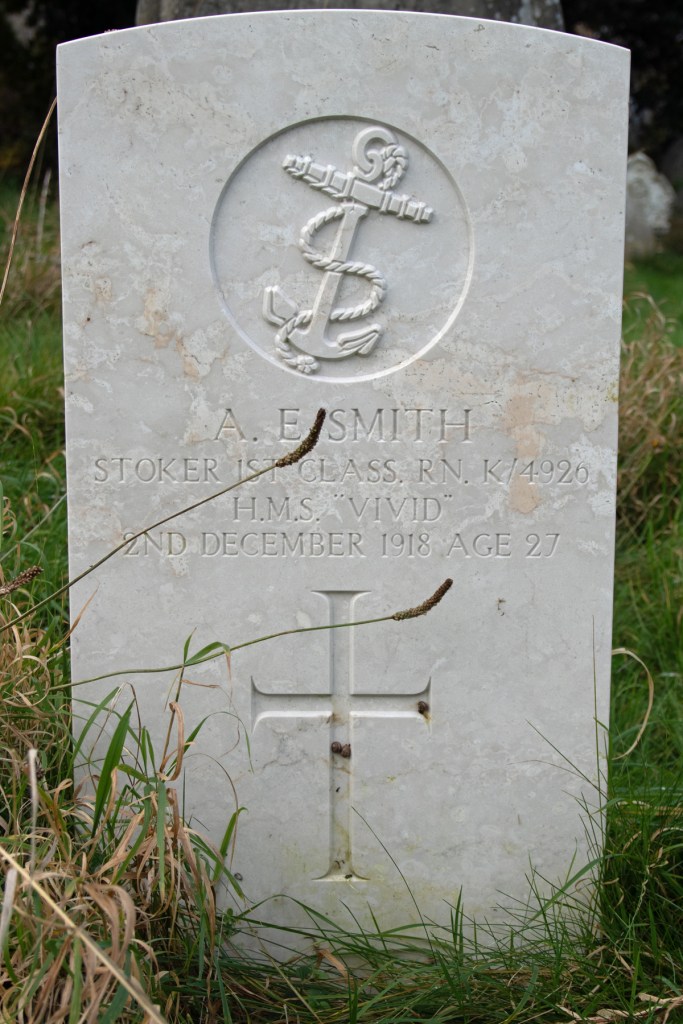
Over the next two years, Stoker Smith served on board two further vessels, HMS Hercules and HMS Narcissus. In April 1916, Arthur was transferred back to HMS Vivid, suffering from pulmonary tuberculosis. This ultimately led to him being medically discharged from the Royal Navy, and he left service in June that year.

At this point, Arthur’s trail goes a bit cold. It would seem that his lung condition ultimately got the better of him, and he passed away back at home on 2nd December 1918. He was just 27 years of age.

Arthur Edgar Smith was laid to rest in the Dissenters’ Cemetery on Vallis Road in Frome, where his parents now lived.


Stoker 1st Class Herbert Rose

Stoker 1st Class Herbert Rose

Herbert Hastings Rose was born on 19th August 1893 in the Somerset town of Frome. He was one of four children, all of whom were boys, to Hastings and Emily Rose. Hastings was employed as a labourer, but he died young, passing away in 1900, when Herbert was only seven years old.

Emily was left raising her four boys alone – the youngest of whom was a mere babe-in-arms – and found domestic char work to bring in some money. By 1905, however, local carter Enos Bainton had taken the family under his wing, and the couple married.

The census return six years later found the family living in a small cottage near the centre of Frome. Herbert and his older brother, who were in their late teens by this point, were working with their stepfather, carting coal for a local merchant.

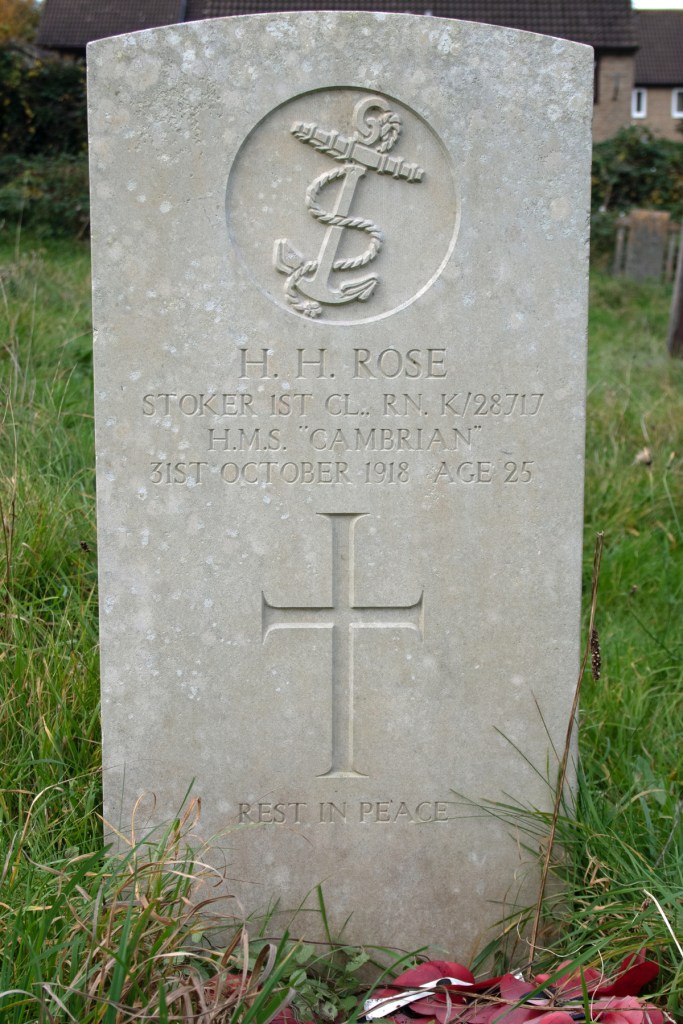
Herbert’s job was to stand him in good stead when hostilities broke out. When the call came in November 1915, he enlisted in the Royal Navy, and was employed as a Stoker 2nd Class. After his initial training on board HMS Vivid – the shore-based establishment in Plymouth – he was assigned to the cruiser HMS Constance. He served on board the ship for two years, gaining a promotion to Stoker 1st Class in the process.

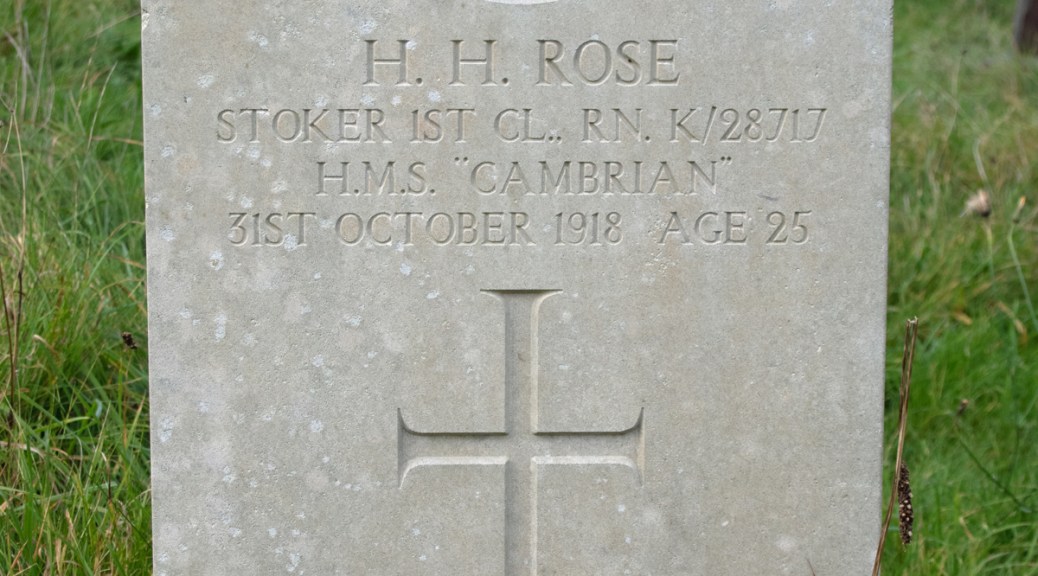
After a month back in Plymouth, Stoker Rose was transferred to HMS Cambrian, another cruiser, on board which he spent three months. He then returned to HMS Vivid. It was during this time that Herbert fell ill. Admitted to hospital in Plymouth with pneumonia, this was to get the better of him; he passed away on 31st October 1918, aged just 25 years old.

Herbert Hastings Rose’s body was brought back to Somerset; he was laid to rest in the Dissenters’ Cemetery in Vallis Road, Frome.