The life of Thomas Henry Wilson is challenge to piece together, and it is only through fragmented documents that the trail can be uncovered.
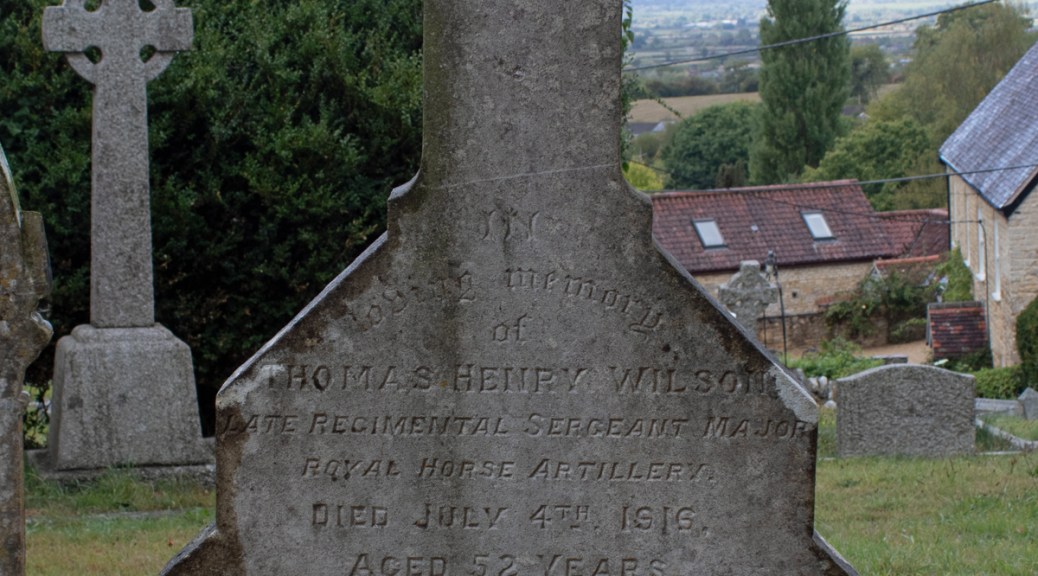
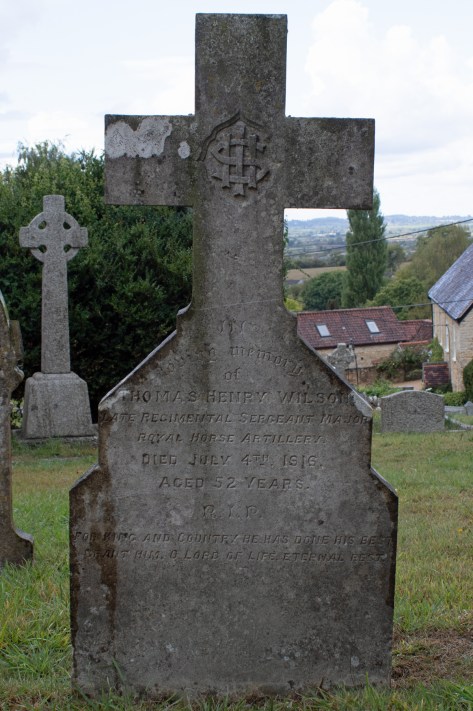
Thomas’ headstone confirms he was a Regimental Sergeant Major in the Royal Horse Artillery, and that he died on 4th July 1916, at the age of 52.
The Commonwealth War Graces Commission’s records confirm that he was married to Mary Ann Wilson (née Ralph), who lived in West Stour, Dorset. The couple’s wedding took place in Holy Trinity Church, Woolwich, Kent, on 14th February 1888. The marriage certificate gives their fathers’ names – farriers Charles Wilson and James Ralph. The document also confirms Thomas’ role as a a Sergeant in the RHA, and gives his age as 27, and Mary’s as 21.
The Wilsons’ appearance in the the census records is a little sporadic. They are not recorded on the 1891 census, but ten years later, they were living in Bilston, Staffordshire. They were listed as being caretakers of the town’s Conservative Club on Church Street. Their ages are given as 41 and 31, and Mary’s place of birth is given as Kington Magna, Dorset.
By 1911, Thomas and Mary had moved to London, and were boarding at the house of Joseph and Rosetta Johnson, at 5 Knivet Road in Fulham, Middlesex. Thomas was listed as being an army pensioner, while Mary was employed as a domestic cook.
At this point, Thomas’ trail goes cold. It is likely that he was called upon when war broke out, but there are no records to confirm where or how he served. He passed away in July 1916, and was laid to rest in All Saints’ Churchyard, Kington Magna, which would suggest that he and Mary had moved there to be closed to her family.
Joseph Tyler was born in the spring of 1882, and was the youngest of three children to Joseph and Sarah. Joseph Sr was a carter from Staffordshire, and the family were born and raised in Wordsley.
The 1901 census found the Tylers living in Brierley Hill, with Joseph Jr having found employment as a glass worker. His father passed away in 1907, and so he remained at home to support his now widowed mother.
By the 1911 census, Sarah and Joseph had moved to Birmingham, and were living at 32 Wiggin Street, a terraced house in the Ladywood area. Joseph listed his employment as a glassblower, while his mother gave no employment, presumably looking after the home.
When war came to Europe, Joseph stepped up to play his part. Full details of his service have been lost, but it is clear that he enlisted early on in the conflict. He joined the Hampshire Regiment, and was sent to Wiltshire for training.
Tragically, Private Tyler’s time in the army was not to be a lengthy one. Barracked near the village of Boyton, he was quickly admitted to the local military hospital. Suffering from heart failure, this would take his life: Joseph died on 13th October 1914, at the age of 32.
The body of Joseph Tyler was laid to rest in Boyton Cemetery, not far from the camp that had, so briefly, been his home.
Joseph Ward was born in Wednesbury, Staffordshire, on 13th January 1890. The four of five children – all boys – his parents were William and Caroline. William was a coal miner-turned-weighman, but Joseph found work as a riveter when he completed his schooling.
It seems that Joseph sought any employment to avoid going down the mines, and, on 26th August 1910, he enlisted in the Royal Navy. His service records show that he was 5ft 3ins (1,6m) tall, with brown hair, grey eyes and a sallow complexion. He was also noted as having a dot or mole on the back of this left forearm and another on the back of his left hand.
Joseph was given the rank of Stoker 2nd Class, and was sent to HMS Vivid, the Royal Naval Dockyard in Devonport, Devon, for training. This would be his base of operations, and he would return there a number of times in the coming years.
On 4th January 1911, Stoker Ward was given his first posting, on board the armoured cruiser HMS Cumberland. he remained on board for more than two-and-a-half years, and gained a promotion to Stoker 1st Class during this time.
In October 1913, Joseph returned to Devonport, remaining on shore for more than three months. His service record notes he was confined to the Dockyard Sick Quarters for three days, although the cause is not given. In January 1914, he returned to sea again, on board another cruiser, HMS Highflyer. This would prove another lengthy assignment, and Stoker Ward would not return to HMS Vivid for more than three years.
During his short spell ashore, Joseph returned to Staffordshire. He married Lily Wright, a tailoress from Wednesbury. Their honeymoon was brief, however, and he was given a new assignment.
Stoker Ward was attached to HMS Valkyrie, a newly commissioned destroyer attached to the Harwich Force. On 22nd December 1917, she was escorting a convoy to the Netherlands when she struck a mine. Twelve of the crew – including Joseph – were killed, while a further seven subsequently succumbed to their injuries. The Valkyrie was towed to the Royal Naval Dockyard in Chatham, Kent, for repairs.
Joseph Ward was 27 years of age when he was killed. He was laid to rest in the naval section of Woodlands Cemetery in Gillingham, not far from the Kent naval base.
Tragically, Lily was pregnant when her husband was killed. On 25th February 1918, she gave birth to their child, Flora, the daughter Joseph would never know.
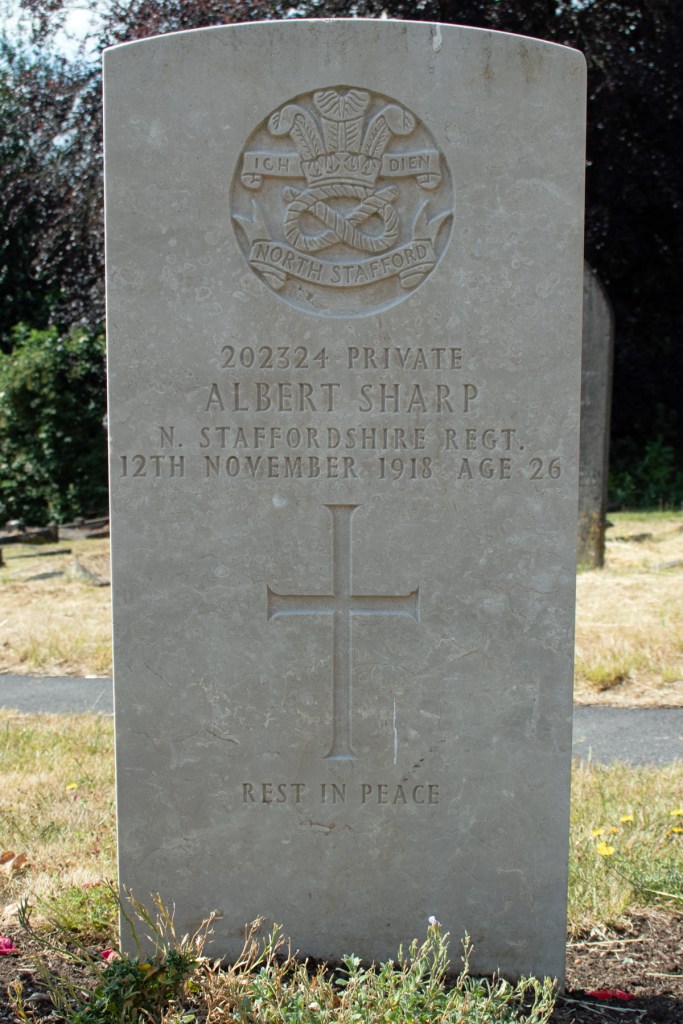
Albert Sharp was born in Rugeley, Staffordshire, in the summer of 1894. One of six children, his parents were George, who was a house painter, and Janet Sharp. When he left school, Albert found work as a bricklayer’s labourer, but, when war was declared, he sought a new adventure.
Albert enlisted in the army on 21st February 1916. Assigned to the North Staffordshire Regiment, he was initially attached to the 5th Battalion. His medical records show that Private Sharp was 5ft 6ins (1.6m) tall, and weighed 122lbs (553kg).
By November 1916, Albert found himself in France. Unusually, his life over the next couple of years is pretty well documented. His battalion saw action at the Hindenburg Line, the Third Battles of Ypres, Cambrai and the Third Battles of the Somme, but Private Sharp’s service records shed more light onto his life than simply where he fought.
Albert seems to have been a bit of a character, and this got him into trouble on more than one occasion. On 9th November 1916, he was confined to barracks for two days, for having untidy bedding and no towel on his bed. The following day, he was punished with another two days’ confinement for not attending his battalion’s role call.
On 18th December 1916, Private Sharp found himself in trouble again. This time, he was confined to barracks for five days for appearing dirty on parade, and committing a nuisance. Four days later, Albert was admitted to the camp hospital for reasons that are unclear. He returned to his unit just under a week later.
At the end of February 1917, Private Sharp transferred to the 31st Light Railway Operating Company of the Royal Engineers. He remained with the battalion for just under a year, although again his time there was not without incident. On 31st August 1917, Albert was confined to barracks for seven days for being absent from parade. The same punishment was meted out for the same offence on 8th January 1918.
Later that month, Private Sharp re-joined the North Staffordshire Regiment, and was this time attached to the 9th Battalion. He remained on the Western Front and was caught up in some of the fiercest fighting of the closing months of the conflict.
On 12th May 1918, Albert was caught up in a gas attack. Seriously injured, he was medically evacuated to Britain for treatment and admitted to the Bath War Hospital on 29th May. The next six months saw a slow and steady decline in his health. He passed away at 5:45am on 12th November 1918, the day after the Armistice was signed, from a combination of pneumonia and emphysema that was directly attributable to his injuries in France. Albert was 24 years of age.
It seems likely that Albert’s family were unable to pay for his body to be taken back to Staffordshire for burial. His service records give only his mother, Janet, as a next of kin, so it would seem that George had passed away by the time Albert enlisted. For some reason, however, while the British Register of Army Effects note that Private Sharp has effects to the value of £39 10s (£2250 in today’s money), this amount does not appear to have been paid. Janet passed away in the early 1920s, and Albert’s brother continued to try and obtain this gratuity on her behalf, but seems to have been unsuccessful.
Albert’s family did get his belongings when he died, however, which came to a postal order for 2s (around £3 today), 50 French centimes, a leather purse, two combs, two jack knives, a razor, a shaving brush, a toothbrush, two briar pipes and a pouch of tobacco, a nickel cigarette case, a text book, a wallet containing his pay book, his cap badge and six letters.
Unable to afford to bring Albert Sharp’s body back to his home town, he was, instead, laid to rest in the sweeping vista of Bath’s Locksbrook Cemetery, not far from the hospital in which he had breathed his last.
Cecil St John Harris was the son of Reverend Percy and Constance Harris. Born in Kilver, Staffordshire, on 13th July 1891, he was one of nine children, although, by the time of the 1911 census, four of them had passed away. The Harris family had, by this point, moved from Staffordshire, to Devon, to Cornwall, and had settled in Staplegrove, Somerset, where Percy had become the rector at St John’s Church.
According to the census record, Cecil was studying engineering. He was keen at sports, being a keen member of the village’s cricket club. When war broke out, he enlisted in the West Somerset Yeomanry, but soon took a commission as a Second Lieutenant in the Somerset Light Infantry.
Cecil’s troop, the 3rd/5th Battalion remained on home soil, and he was based in Somerset for the duration of his time in the army. This was not to be for a long time, however, as, in the summer of 1915, he fell ill with appendicitis. He underwent an operation, and made a slow recovery, before relapsing. He passed away on 10th September 1915, aged just 24 years old.
Cecil St John Harris was laid to rest in the north east corner of St John’s Churchyard, Staplegrove, where his father was still the vicar. His grave is now lost to time, but Second Lieutenant Harris is commemorated on a special memorial, close to the entrance of the building.
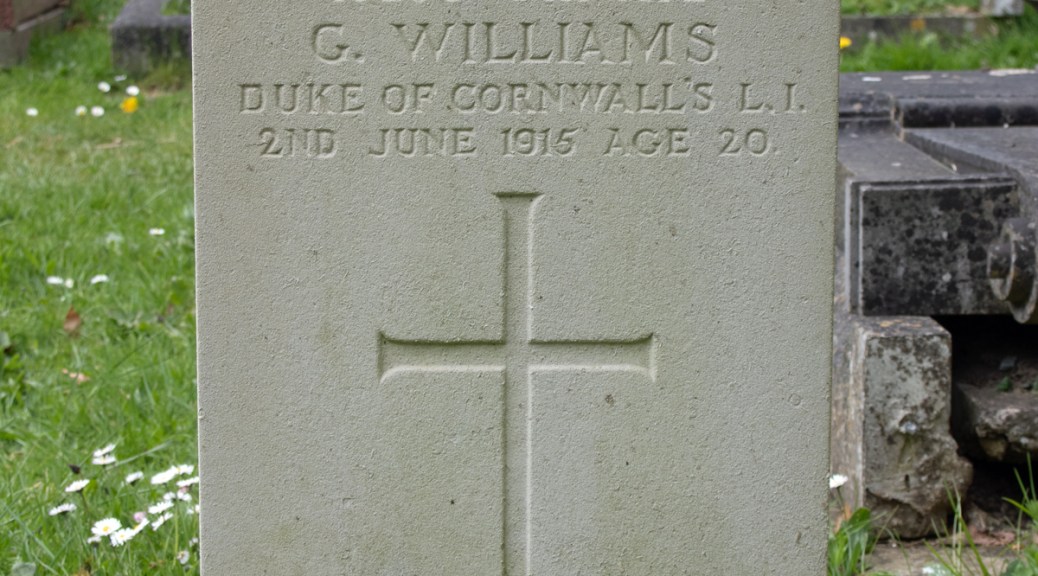
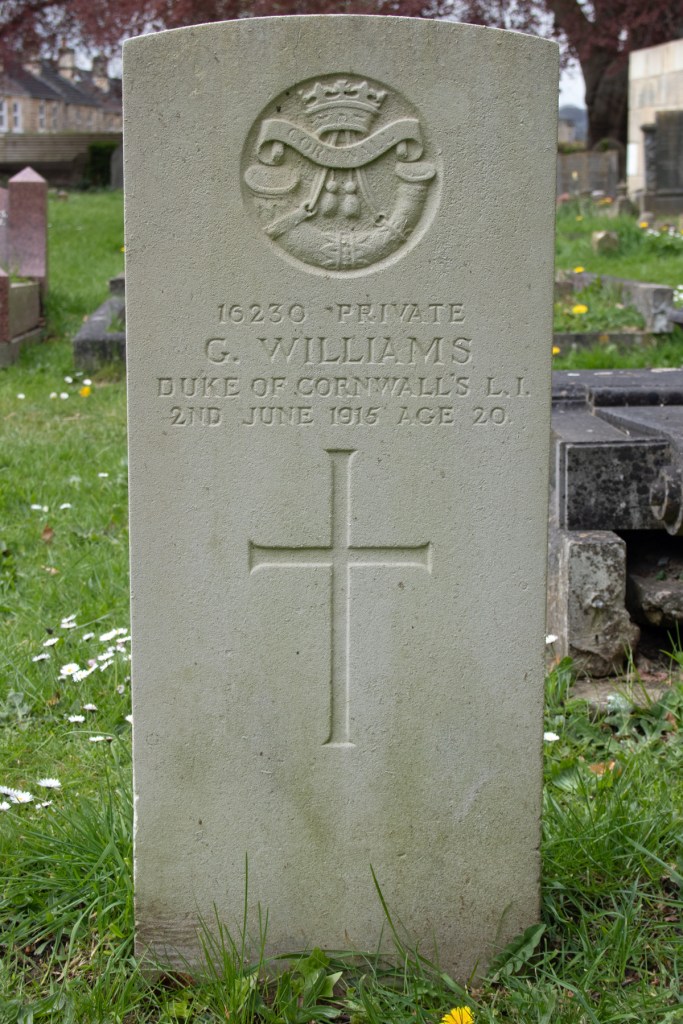
George Williams was born in West Bromwich, Staffordshire, in 1895. One of ten children, his parents were George and Sarah. When George Sr died in 1908, his widow was left to raise the family herself. By the time of the 1911 census, all of the children were still living at home, and four of them, including George Jr, who was working as a labourer, were bringing in a wage.
When conflict broke out, George stepped up to play his part. He enlisted in the Duke of Cornwall’s Light Infantry before the end of 1914 and, as a Private, was assigned to the 8th Battalion.
Little information is available about George’s military life and, indeed, the only other details available for him are that of his passing, based on reports available in a contemporary newspaper.
About half-past eight on Thursday [3rd June 1915] the body of a soldier was found in the river at Bath… The corpse was in a somewhat advanced state of decomposition, its condition suggesting it may have been in the river about three weeks. The man had on his full regimentals, with top coat.
Papers found in the pocket indicate that the deceased is Private George Williams, of the 8th Battalion Duke of Cornwall’s Light Infantry, now encamped at Sutton Veny, Wilts. This regiment was quartered in Bath during the winter, and left the city some weeks ago.
There are.. no marks of violence on the body.
There was found on the body a pass dated 14th May, giving him three days’ leave. The leave expired at 11:55pm on May 17th. The permit allowed him to proceed to Birmingham. There was also found on the deceased a telegram addressed to 22 Green Street, West Bromwich, which said “Leave extended.”
The supposition is that Williams returned as far as Bath, on his way back to camp, by Midland Railway, and when in the city by some means or other fell into the river.
Curiously enough, the Bath police had been advised of the absence without leave from camp at Sutton Veny of a soldier of the same name. But in this case the man belonged to the 10th Devons. They had received no notification regarding Private Williams of the 8th Cornwalls.
Bath Chronicle and Weekly Gazette: Saturday 5th June 1915
The telegram mentioned in the report is likely one sent to George’s family, who was living at 22 Queen Street (possibly an error on the newspaper’s part).
George was just 20 years old when he died: the army report gave the date of his death as 2nd June 1915, although it seems likely that he had passed some weeks before.
Sarah and the family were possibly unable to afford to have George’s body taken back to Staffordshire for burial. Instead, he was laid to rest in the Twerton Cemetery in Bath, with Sarah and two of his brothers, Leonard and William, in attendance. Another member of his battalion, “deceased’s chum” [Bath Chronicle and Weekly Gazette: Saturday 5th June 1915] Private Fred Cotton, was also at the funeral, and sent his own wreath – from “his old pal Fred” [Bath Chronicle and Weekly Gazette: Saturday 5th June 1915].
Arthur Ernest Selway was born on 30th October 1898 in Wellow, Somerset. The oldest of six children, his parents were Frederick and Mary Selway. Frederick was a coal miner, and this is likely to have been the line of work for Arthur to follow, had war not intervened.
Arthur enlisted in the Machine Gun Corps on 19th April 1918 and was assigned to the 44th (Reserve) Battalion. Sent to the Rugeley Camp in Staffordshire for training, Private Selway’s time in the army was not to last long, however. While his service records are lost to time, he is recorded as having passed away while at the camp on 3rd October 1918.
Private Selway was just 19 years of age and, having been in the army for just five months and two weeks, this meant that his family were not eligible to receive a war gratuity from the army, as he had not completed six months’ service.
Arthur Ernest Selway’s body was brought back to Somerset for burial. He was laid to rest in the peaceful Wellow Cemetery.
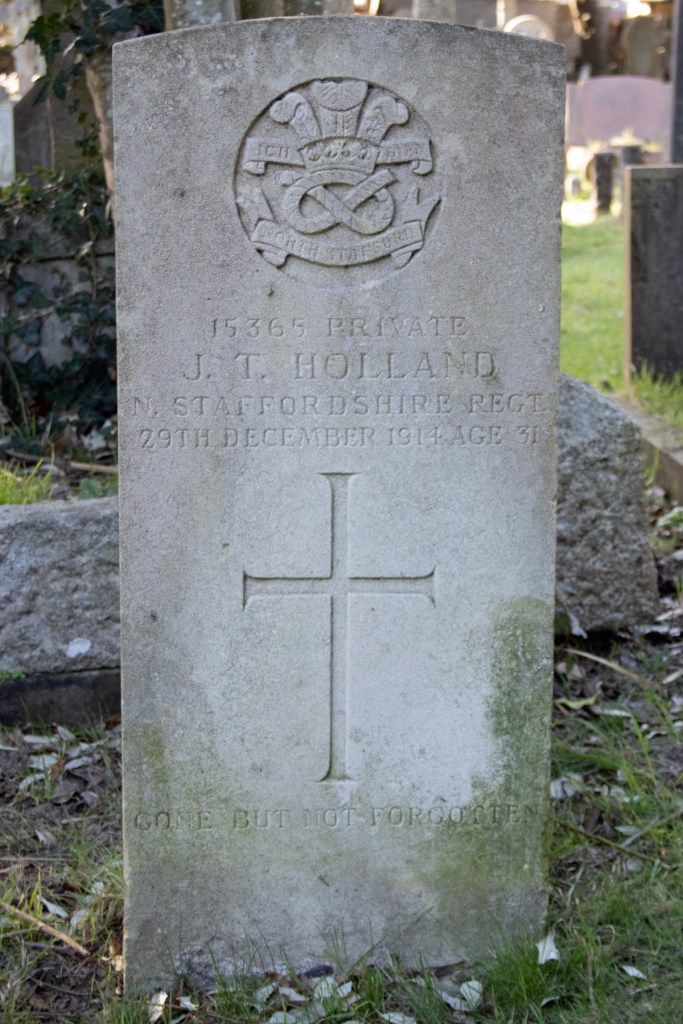
John Thomas Holland was born in 1883 in Tunstall, Staffordshire, and was the son of Jane Holland. Sadly, neither name was uncommon in that area at that time, so it is a challenge to determine any further information about his early life.
John was 31 years old when war broke out and, while his service records no longer exist, he enlisted early on, joining the North Staffordshire Regiment as a Private. He was assigned to the 8th Battalion, and was soon billeted in Weston-super-Mare, Somerset.
Sadly, the next information available for Private Holland is a coroner’s report in a local newspaper.
Considerable mystery was associated with the evidence given before Mr Craddock, at the inquest… concerning the death of Private John Holland… now billeted in the town. Deceased was found killed on the railway line near Weston-super-Mare Station on Tuesday. The evidence revealed that Holland left his billet at 8:15am on that day, and announced that he was going to see a doctor. His body was found down the line at 12:30, the legs having been severed. From enquiries, it transpired that Holland had walked along a slip of garden fringing the line at a distance of about two miles from his billet. It was stated that deceased was of sober habits, and that he bore a good character. A verdict of Accidental Death was returned.
Shepton Mallet Journal: Friday 8th January 1915
Private John Thomas Holland died on 29th December 1914: he was 31 years of age. He was laid to rest in Weston-super-Mare’s Milton Road Cemetery.
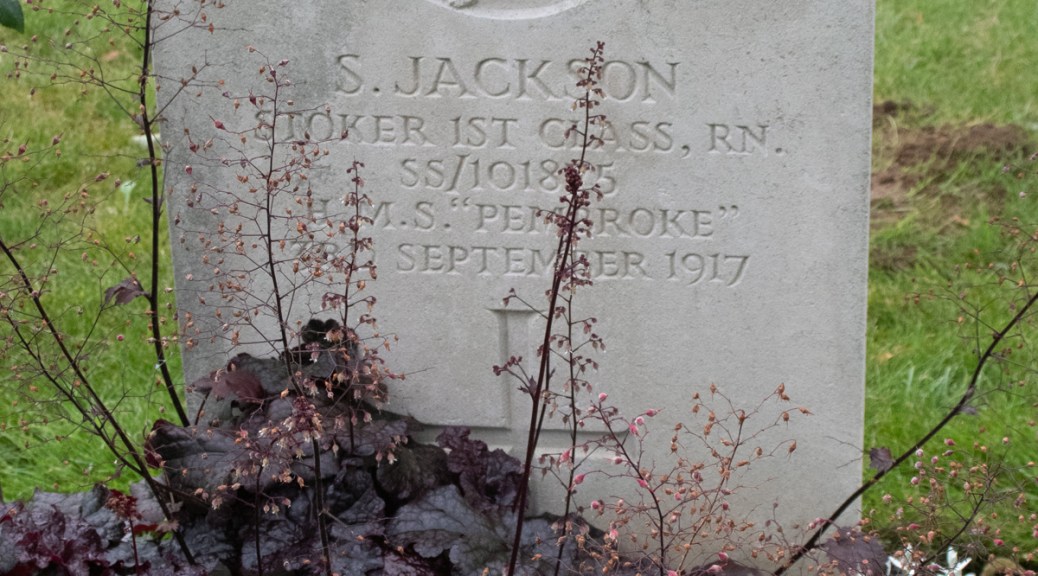
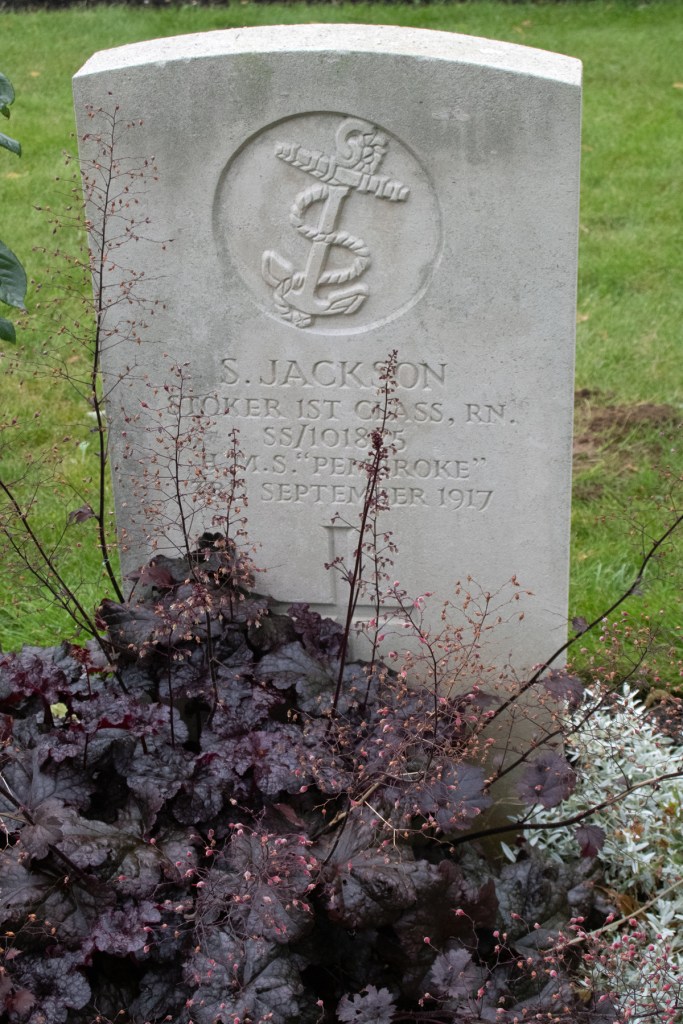
Sydney Jackson was born in Walsall, Staffordshire, on 1st May 1886. One of three children to William and Emma Jackson, he also had three older half-siblings through William’s previous marriage. William was a vice manufacturer, and this is something Sydney helped his father with when he finished school.
He had bigger plans, however, and, on 11th December 1905, Sydney enlisted in the Royal Navy. His service records show that he stood 5ft 6ins (1.68m) tall, had hazel eyes, dark brown hair and a fresh complexion. Sydney joined up for a period of 5 years, and was given the role of Stoker 2nd Class.
During his initial term of service, he served on seven different ships, rising to the rank of Stoker 1st Class in the process. Between each voyage he returned to HMS Pembroke, the Royal Naval Dockyard in Chatham, Kent, and this was to become his land base.
Stoker Jackson’s career was not to be blemish flee, though. In the autumn of 1906, he spent two periods of time in the brig – the first for seven days, the second for two weeks. There is nothing to confirm what infraction he had committed, but given that the two imprisonments were within weeks of each other, it seems likely that something external was going on with him at the time.
When Sydney’s initial term of service came to a close, he was placed on reserve. There is not a great deal of information available about this part of his life, although the 1911 census records him as boarding in the Bruce House Registered Lodging House in Central London; he is listed as being a stoker.
His time on reserve did not last for long, however, and in October 1912 he was recalled. Over the next five years, Stoker Jackson served on a further four ships. In the spring of 1917 he returned to HMS Pembroke; the base was a busy place that summer, and temporary accommodation was set up at the Dockyard’s Drill Hall. This is where Sydney found himself billeted.
On the 3rd September 1917, the German Air Force carried out its first night air raid: Chatham was heavily bombed and the Drill Hall received a direct hit; Stoker 1st Class Jackson was among those killed instantly. He was 31 years old.
Sydney Jackson was laid to rest, along the other victims of the Chatham Air Raid, in the Woodlands Cemetery, Gillingham.
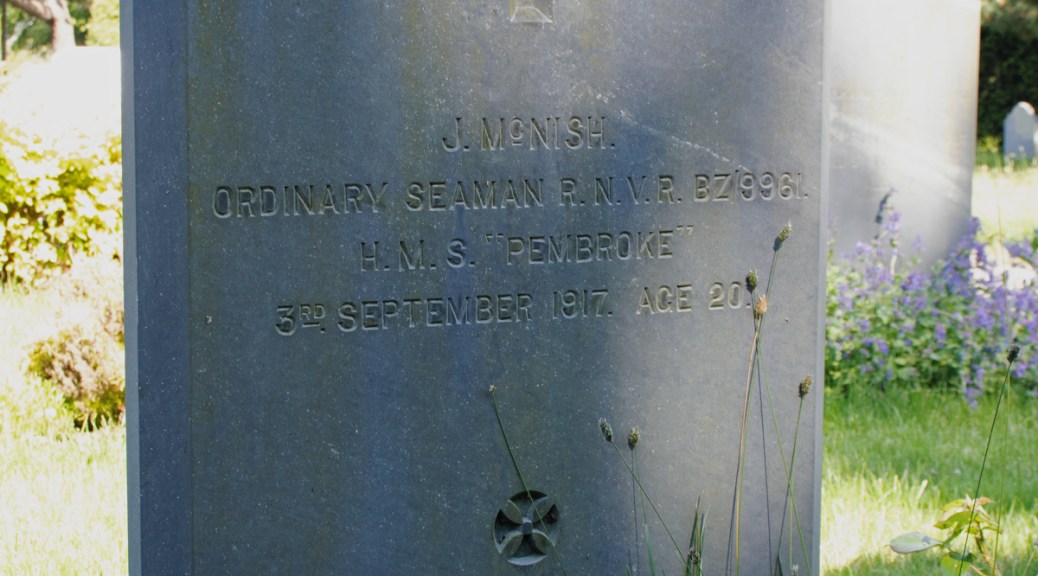
John McNish was born in the Staffordshire city of Wolverhampton on 26th June 1897. The oldest of six children, his parents were railway porter James McNish and his wife Mary Ann.
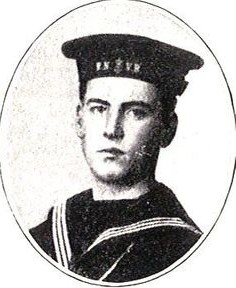
Sadly there is little documentation to evidence John’s early life. When he left school, he seemed to have joined his father in becoming a porter and, when war broke out, he joined the Royal Navy, given the rank of Ordinary Seaman in the Royal Naval Volunteer Reserve. He was based at HMS Pembroke, the shore-based establishment at Chatham Naval Dockyard in Kent.
In the summer of 1917 HMS Pembroke was becoming crowded and John was billeted at the Chatham Drill Hall. On the night of 3rd September, the building took a direct hit from a German bomber. Ordinary Seaman McNish, along with 97 others, was killed instantly. He was just 20 years old.
John McNish was buried in the nearby Woodlands Cemetery in Gillingham, along with dozens of others who perished that night.
Ordinary Seaman John McNish (from findagrave.com)
Full details of the night raid on Chatham Drill Hall can be found here.








 Death and Service