Category Archives: Sussex

Private Walter Lane

Private Walter Lane

Walter Frederick Lane was born in Sidcup, Kent, in the early part of 1893. The younger of two children, his parents were Frederick and Caroline Lane. Frederick was a carman and the transient nature of his work meant that the family moved on a regular basis.

The 1901 census found them in Eltham, Kent, while ten years later the family of three – Walter’s older sister having moved on – were boarding in Harton Street, Deptford. By this point, Walter was 17 years of age, and he was also working as a carman. (It is interesting to note that the earlier census recorded Walter’s parents by their first names, while the 1911 document used their middle names – Walter and Kate: transient work allowing for reinvention, perhaps?)

Walter sought a more permanent career, and, on 17th March 1913, he enlisted in the army. Full details of his military career have been lost to time and, in fact, most of his service details come from his discharge papers.

Walter enlisted in the Queen’s Own (Royal West Kent Regiment), although, as Private Lane, he was not formally mobilised until March 1914. When war broke out, his battalion, the 1st/5th, was sent to India, and he remained there for the duration of the war.

Private Lane’s time in the army was not without incident. He contracted malaria in 1915, and while he initially recovered, the condition was to continue to dog him over the following years.

By 1917 Walter’s troop was based in Jabalpur, Madhya Pradesh, but in December that year, the battalion set sail from Bombay for Basra, Mesopotamia.

While in Iraq, he had a couple of run-ins with his superiors. On 22nd December 1917 he was stopped a week’s pay for ‘disobeying an order: putting his equipment on a transport waggon’ and ‘losing by neglect his equipment.’ On 18th February 1918, a further 28 days’ pay was deducted for ‘making away with regimental necessaries (1 towel)’ and ‘neglecting to obey an order.’

During this time, though, Walter’s health was regularly impacted when malaria caught up with him. His discharge documents recorded that he had an attack about once a month, which lasted four or five days each time. In the end, he was released from active service, and left the army on 19th February 1919.

Walter had been discharged while admitted to the Dispersal Hospital in Brighton. His health did not improve, however, and he was soon moved to Somerset for respite care. It was here that he passed away on 7th August 1919. He was 26 years of age.

Walter Frederick Lane was laid to rest in the Holy Trinity Churchyard, Newton St Loe, Somerset.


My thanks go to Liz at the local parish office for her help in unpicking the details of Walter’s passing.

Thanks also go to Tim Hill, who has been researching the graves in the Newton St Loe churchyard.

Private Leon Frenette

Private Leon Frenette

Leon D Frenette was born on 2nd June 1893, in the coastal village of Petit Rocher, New Brunswick, Canada and was the son of Denis and Sarah Frenette.

Leon’s early life is difficult to piece together – the 1901 Canadian census records five Frenette families living in the same neighbourhood, but of the two whose head is given as Denis, neither has a son by that name (although one has a son called Joseph Leon).

When war came to the distant European shores, Leon was working as a school teacher in Bathurst, a town 12 miles (20km) to the south of Petit Rocher. He stood up to play his part for King and Empire, though, having served in a local militia for a while.

Leon joined the Canadian Expeditionary Force as a Private. His service records give his height as 5ft 4ins (1.63m), his weight as 130lbs (59kg) and stated that he had a medium complexion, with brown eyes and black hair. In the section of the records that noted distinguishing marks, the medical officer had identified two small brown birthmarks on his left buttock.

Private Frenette arrived in England on board the SS Corsican on 5th November 1916. Assigned to the 132nd Battalion of the Canadian Infantry, he was based at a military camp near Bramshott, Hampshire. The influx of overseas soldiers would have been a bit of a shock to the locals, but Leon appears to have been up to the challenge. Within a matter of weeks, he was admitted to the camp hospital, suffering from a bout of gonorrhoea.

By the end of the year, Private Frenette had been transferred to the 104th Battalion, and moved to Witley Camp in Surrey. His ailment seems to have returned a couple of times, and he was admitted to the camp’s medical facility in January and March 1917.

By the autumn of 1917, Leon had been transferred again, this time to the 26th Battalion. The troop was based on the south coast at Shoreham, West Sussex, and it was from here, on 16th November 1917, that Private Frenette was finally sent to France.

Leon would have arrived at an already battle-scarred Western Front. Over the next year, he was involved in fighting at Cambrai and Arras. His time was not without incident, and he forfeited a day’s pay on 20th March 1918, for “contravention of full dress order, i.e. being without a belt.”

The 26th Battalion’s next offensive was at Amiens, and it was here, on 12th August 1918, that Private Frenette was badly wounded with a gun shot wound to his right arm. Initially treated on site, he was medically evacuated to England for further treatment.

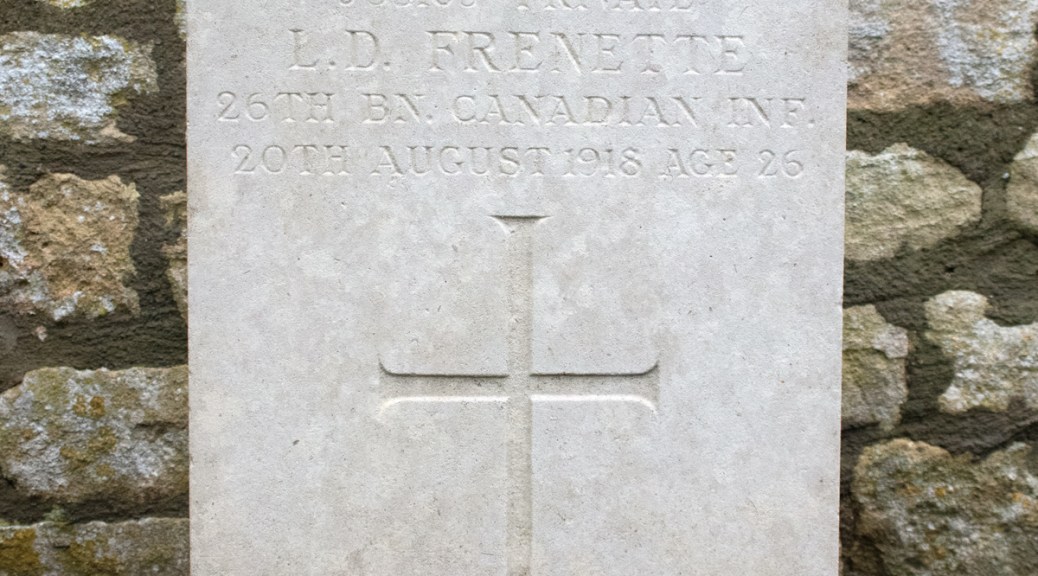
Leon was first admitted to a hospital back in Bramshott, but then transferred to Bath War Hospital in Somerset. His medical report confirms that he was first seen there at 4:30pm on 20th March, and a compound fracture of his humerus. He haemorrhaged and died of shock at 11:45pm that day. He was just 25 years of age.

With family on the other side of the Atlantic, it was not going to be possible for Private Leon Frenette to be taken home for burial. Instead he was laid to rest in the Roman Catholic Cemetery of the city in which he had passed away, Bath.


Air Mechanic 1st Class Harold Weston

Air Mechanic 1st Class Harold Weston

Harold Stanley Weston’s early life is destined to remain a mystery. He was born, according to his Royal Air Force service records, in Southgate, Middlesex in 1887 and, before war broke our, was working as a waiter before enlisting.

On 3rd August 1915, he married a woman called Gertrude in Hastings, Eat Sussex, and it appears that this is where the couple set up home. Harold has initially enlisted in the army, but transferred across to the Royal Flying Corps on 28th October 1915. Air Mechanic 2nd Class Weston’s service records show that he stood just 5ft 2.5ins (1.59m) tall.

Over the next three years, Harold rose through the ranks to Air Mechanic 1st Class, and served in France for nine months during 1916. He then returned to England, and was based at an airfield near Detling, Kent. When the Royal Flying Corps and the Royal Naval Air Service merged in April 1918, he transferred across to the newly-formed Royal Air Force, and was attached to 27 Squadron.

In November that year, Harold was admitted to the Military Hospital in Maidstone, also in Kent, having contracted influenza and pneumonia. Sadly, the lung conditions were to get the better of him, and he passed away on 1st November 1918, at the age of just 31 years old.

Air Mechanic 1st Class Harold Stanley Weston’s body was laid to rest in the quiet graveyard of St Martin’s Church in Detling, not far from the base at which he served. Gertrude posted her thanks to “all [their] friends for their kindness and sympathy shown to her in her sad bereavement, more especially Captain Saunders, RAF, Major Chapman, KCC [Kent County Council?], Sergeant Fowle, KCC, and Sergeant Weller, RAMC [Royal Army Medical Corps]” [Maidstone Telegraph: Saturday 9th November 1918]


Private George Sinclair

Private George Sinclair

In a quiet corner of the village cemetery in Cuckfield, West Sussex, is a headstone dedicated to Private WG Sinclair. Attached to the East Yorkshire Regiment, he passed away on 12th February 1919.

A search of military records gives a little more detail: this was a George William Sinclair, who had died from pneumonia at the West Hylands Institution, which was Cuckfield’s workhouse. George was 29 years old, but there is little concrete information about his early life.

A newspaper report from the day before Private Sinclair’s death, however, begins to shed a little more light onto his life:

George William Sinclair was charged with being a deserter from the Cuckfield Union Workhouse, on November 6th, and carrying away clothing to the value of £1, the property of the Guardians of the Cuckfield Union. PC Upton said that he arrested the prisoner at the Somerstown Police Station. Prisoner was remanded, but as he was taken ill he was removed to the Workhouse Infirmary.

Mid Sussex Times: Tuesday 11th February 1919

George’s entry in the Army Register of Soldier’s Effects does not give a next of kin, so it is not possible to determine categorically where he was born and raised, or who his parents were.

A little more digging found a George William Sinclair recorded in the UK Calendar of Prisoners in 1916. He had been arrested for “feloniously breaking and entering the dwelling house of Sarah Waddingham, and stealing one bicycle, one pair of shoes, one purse, one tobacco box, one tobacco pipe and one microscope, the property of said Sarah Waddingham, at West Halton [near Hull], on the 7th July 1916.

It is not possible to say definitively that this George William Sinclair is the same one buried in Cuckfield Cemetery, but, given the regiment he was attached to, and the newspaper report prior to his passing, it is likely to be more than just a coincidence.

George pleaded guilty, and was sentenced to six months’ hard labour. This was not his first offence, and had had spent a total of more than eighteen months behind bars over a period of ten years up to this point. On each occasion, he was convicted of theft.

It is possible, given that the country was at war by this point, that George was given the option to enlist, rather than serve his sentence. Again, this is an assumption, however, but Private Sinclair’s Pension Ledger confirms that he was discharged from the army on 6th November 1918.

George William Sinclair appears on another workhouse register, this time in Westminster, London, where he spent a couple of nights just before Christmas that year.

If these records all relate to the same man, his life seems to have been a troubled one. I can only hope that he found peace in that quiet corner of West Sussex.


Lance Corporal James Matthews

Lance Corporal James Matthews

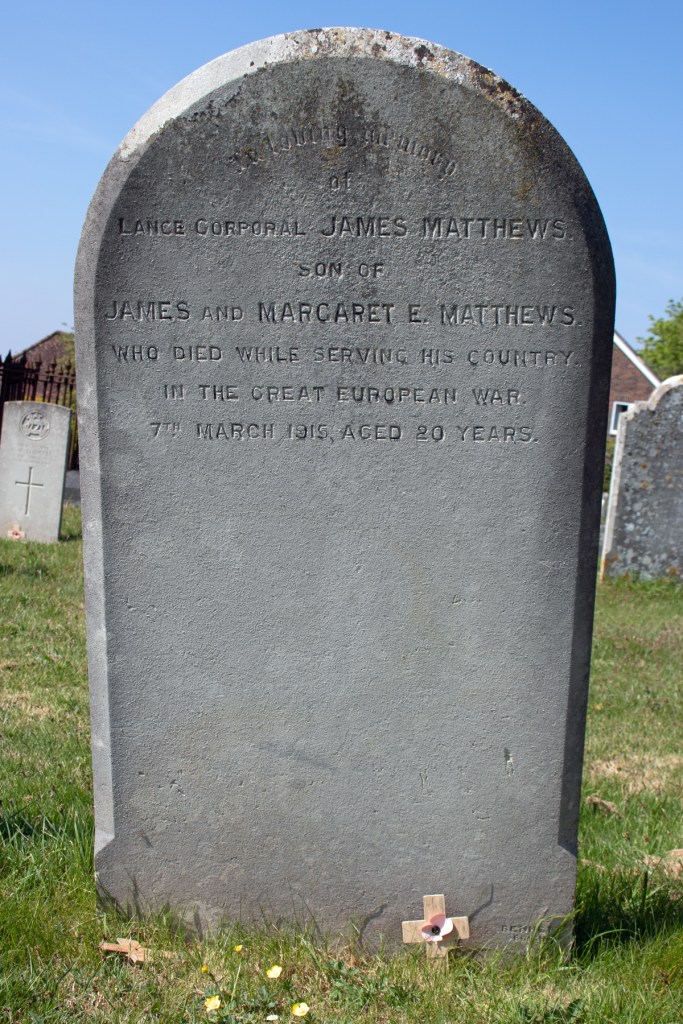
James Matthews was born in the summer of 1894, the youngest of five children to James and Margaret Matthews. James Sr was a farm worker from Cuckfield in West Sussex, and it was on Hodshrove Farm in nearby Ansty that the family were raised.

James Jr worked on the farm when he left school, but when war broke out, he found a bigger calling for himself. Full details of his military service are not available, but he seemed to have enlisted early on in the conflict, joining the 9th (Service) Battalion of the Royal Sussex Regiment. Originally formed in Chichester, West Sussex, he soon found himself billeted in the South Down near Portslade.

James must have impressed his superiors, as he was soon promoted to Lance Corporal for his work. All was not to go well, however, as, during the early months of 1915, he contracted pneumonia.

Lance Corporal Matthews was admitted to the 2nd Eastern General Hospital in Brighton, but the lung condition was to get the better of him, and he passed away on 7th March 1915. He was just 20 years of age.

James Matthews was brought back to his home village for burial. He lies at rest in Cuckfield Cemetery, in the shadow of Holy Trinity Church.


Lieutenant Frederick Tugwell

Lieutenant Frederick Tugwell

Frederick William Tugwell was born in Cuckfield, West Sussex, in the autumn of 1888. The youngest of three children to John and Mary Tugwell, his father was a tailor in the village.

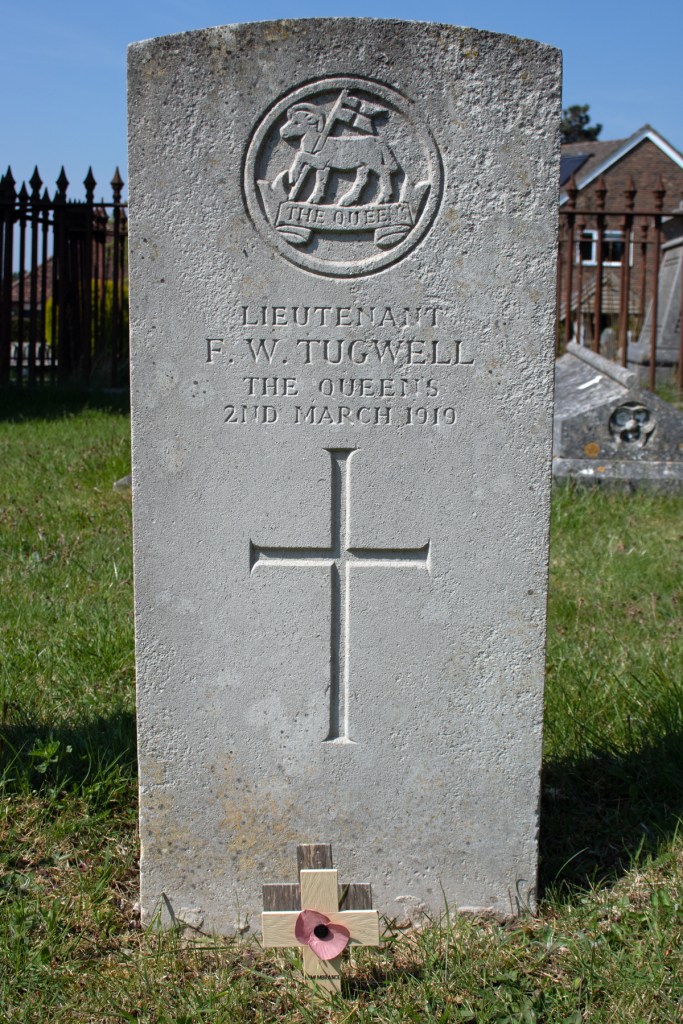
Little more is known about Frederick’s early life, but, when war broke out, he wad there to play his part. He enlisted in The Queen’s (Royal West Surrey Regiment) and, by July 1916 was in France. Frederick obviously made an impression in the army and rose through the ranks, reaching Lieutenant by the time the Armistice was declared in November 1918.

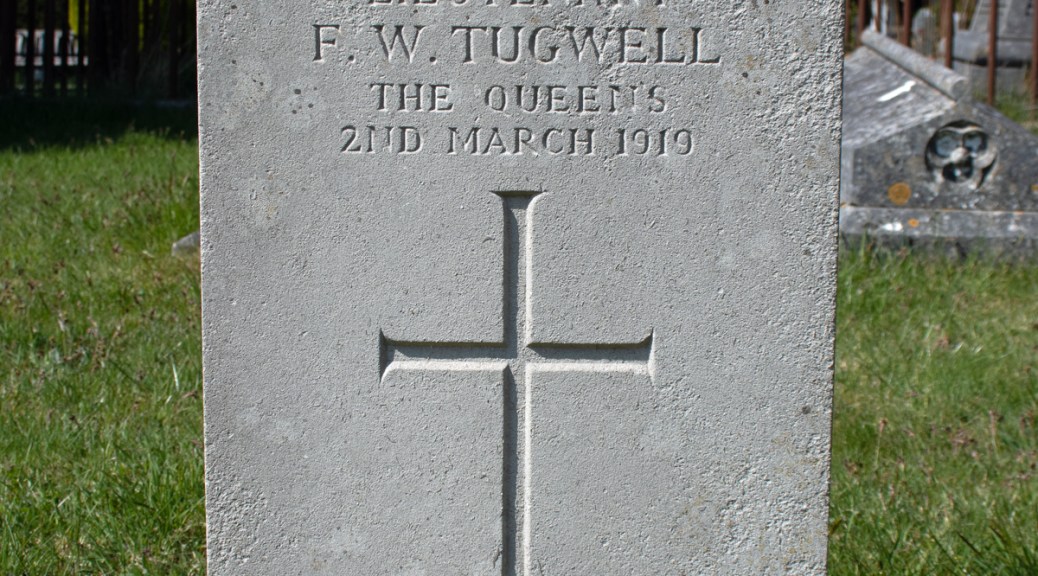
Lieutenant Tugwell remained overseas when the war ended and was based in Cologne. In March 1919, he returned home on leave, staying with his sister, Constance, who lived in Guildford, Surrey. It was here that he fell ill and here that he passed away, breathing his last on 2nd March 1919. He was just 30 years old.

Frederick William Tugwell was brought back to West Sussex for burial – he lies at rest in the cemetery of his home village, Cuckfield.


A mystery surrounds Frederick’s next of kin. His medal record suggests that it was his widow – Mrs FW Tugwell – who applied for that recognition. The address given for her is the same as for Constance. The newspaper report of his death gives no mention of a widow, only that he died at his sister’s home. There is also no clear evidence for Frederick getting married, although this may have been lost to the passage of time. His widow may, of course, have been living with her sister-in-law, but again, this cannot be confirmed either way.


Air Mechanic 1st Class Albert Young

Air Mechanic 1st Class Albert Young

Albert Franklin Young was born on 15th August 1899 in Marylebone, London. He was the older of two children – and the only son – to Kathleen (Kate) Young, and her photographer husband, Albert Antonio Young.

Albert Sr seemed to have made a successful of his photography business: Albert Jr attended St Hugh’s School in Chislehurst, Kent, before moving on to Margate College, also in Kent, and Watford Grammar School.

From leaving school, Albert Jr joined the Royal Flying Corps as a wireless operator on 28th September 1915. He was just sixteen years old, but within eight months he was serving with the British Expeditionary Force in France. He was involved in operations at the Somme and continued his flight training.

In November 1915, Albert was promoted to Air Mechanic 1st Class, and remained on the Western Front. On 28th March 1918, a German air raid hit No. 2 Air Depot, where Albert was working: he was badly wounded, and brought back to England for medical treatment.

Admitted to London Hospital in Chelsea, Air Mechanic Young was operated on a number of times, but was to finally succumb to his wounds on 9th June 1918. He was just 18 years of age.

As highlighted in de Ruvigny’s Roll of Honour, one colleague noted “I can assure you he was very greatly esteemed for his fine qualities by all with whom he came into contact, and the news of his death was received by all of us with most profound sorrow. He was a splendid boy.” Another said that the “great courage and coolness he always displayed at most critical moments were on many occasions an incentive to me. He was truly a gallant lad.”

Brought to West Sussex, where his parents were now living, Albert Franklin Young was laid to rest in Cuckfield Cemetery: “The scene… was very solemn and pathetic, yes beautiful and effective, and as all moved forward to the grave, and viewed the fair expanse of the Sussex Weald, the sweet melody of the Choir [was] ringing in our ears.” [Mid Sussex Tomes: Tuesday 18th June 1918]


Private William Haylor

Private William Haylor

William Charles Haylor was born in the summer of 1870, in the West Sussex village of Cuckfield. He was one of eight children to agricultural labour Michael Haylor and his wife, Betsy. Michael passed away in 1886 and, with children to raise, his widow took in washing to earn money.

William found work as a farm labourer and, by the time of the 1901 census was living in a cottage at Beech Farm in the village, with his mother, younger sisters, one brother-in-law and six nieces and nephews.

On 25th October 1905, William married Florence Linstead. She was a carter’s daughter from South London, and it is not exactly clear how they met. It seems likely, though, that Florence had taken work on one of the estates in the Cuckfield area. The couple exchanged vows at St Antony’s Church in Florence’s home town, Nunhead, before settling down back in West Sussex.

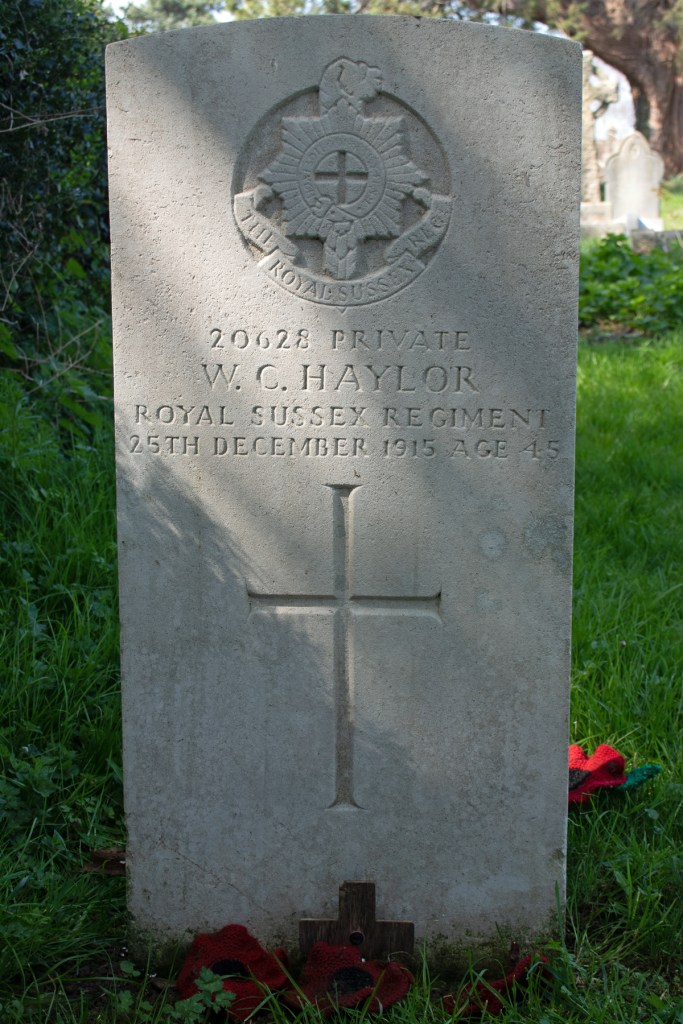
When war came to Europe, William was keen to play his part. He enlisted in the Royal Sussex Regiment on 9th November 1914 and was assigned to the No.6 Supernumerary Company of the 2nd/4th Battalion. This was a territorial force, set in place for those older volunteers keen to serve King and Country.

Private Haylor’s time in the army was to be brief, however, as at his medical he was found to be medically unfit for military service. No further details are available, but it meant that William had spent just 82 days in the army.

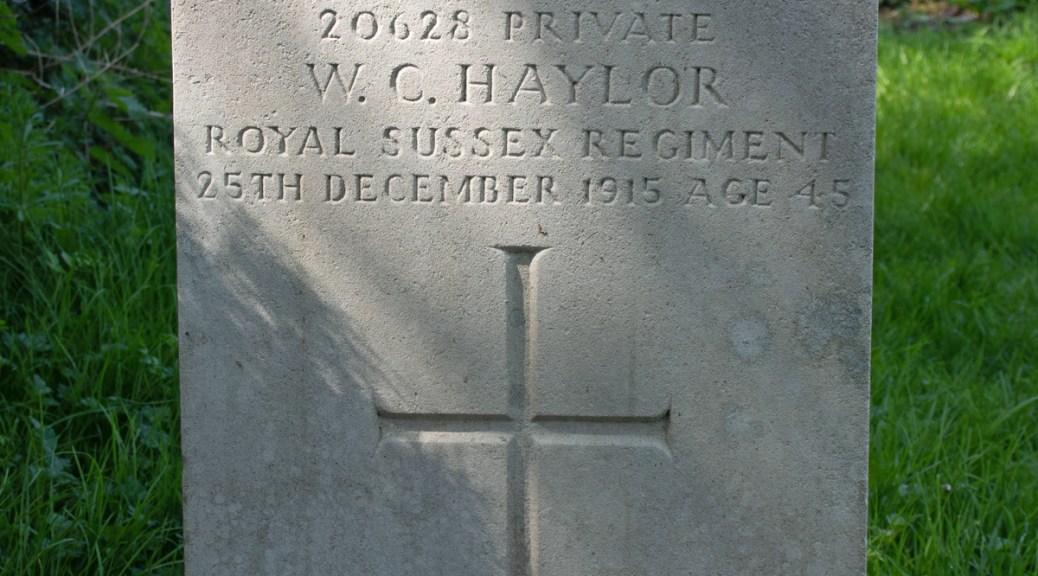
At this point, William’s trail goes cold. He returned home, and presumably continued in his previous line of work. Again, however, the status quo was not to continue for long. He passed away at home, through causes unknown, on Christmas Day, 25th December 1915. He was 45 years of age.

William Charles Haylor was laid to rest in the cemetery in his home village, Cuckfield. He was accorded a military funeral.


Pioneer Albert Henley

Pioneer Albert Henley

Albert James Henley was born in the spring of 1875, the youngest of nine children to Caleb and Ann Henley. Caleb was an agricultural labourer from Cuckfield, and it was in this West Sussex village that the Henley siblings were born and raised.

Albert found work on a farm when he left school, but soon found other employment as a bricklayer. On 15th August 1896 he married Sophia Leney: the couple went on to have four children – Kate, Minnie, Albert and William.

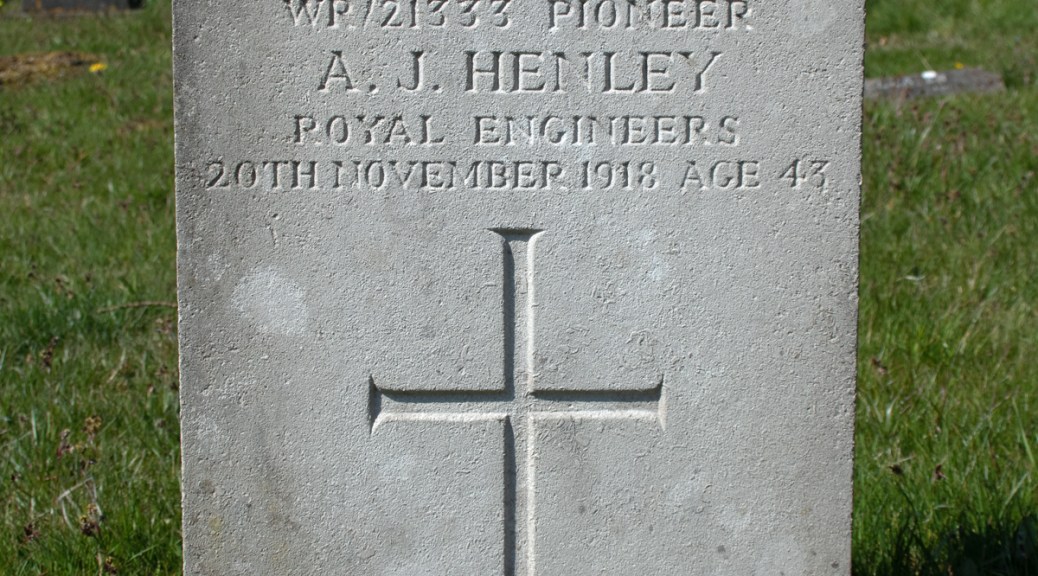
War came to Europe, but Albert was not initially called on to serve king and country because of his age. He did enlist, however, joining the Royal Engineers in January 1917. His service records suggest that he was a month short of his 45th birthday (which does not tie up with his baptism records) and stood 5ft 10.5ins (1.79m) tall. He is noted to have been of good physical development, weighing in at 159lbs (72.1kg).

Pioneer Henley was assigned to the 307th Road Construction Company and, after a month’s training was dispatched to France. He spent more than eighteen months overseas, before being medically evacuated to England in the autumn of 1918, having contracted bronchitis. Albert was admitted to hospital in Dover as soon as he had crossed the Channel, but died there the following day. He passed away on 20th November 1918 and was 43 years of age.

Albert James Henley was brought back to West Sussex for burial: he was laid to rest in the cemetery of his home village, Cuckfield.


A sad epilogue to Albert’s story is that his widow, Sophia, had to wait for his belongings to be returned to her. In a letter to the regiment on 14th December 1918, she wrote:

…it is nearly a month since he passed away, and I have not heard anything. When I came there on the 20th [November] they said his personal belongings would be sent on in a few days.

The Royal Engineers office responded that they were unable to forward his personal effects on until authority had been received from the War Office. It was to be another six months before Sophia finally got her late husband’s items – a purse, knife, notebook, letters, photo, gloves, watch (with case and chain), handkerchief, muffler and four coins – back.


Private Thomas Perrett

Private Thomas Perrett

Thomas William Perrett was born in October 1878, the seventh of eight children to Lewin and Ann Perrett. Lewin was an agricultural labourer from Wiltshire, and it was in Aldbourn, near Marlborough, that the family were raised.

Initially finding work as a farm labourer, Thomas was soon drawn to the bright lights and big city. By the early 1900s he had moved to London, and it was here that he met, and in 1909 married, Mary Sterry, a labourer’s daughter from Middlesex. The couple went on to have three children, Elsie, Rose and Alice.

Thomas, by this point, had found work on the railways: the 1911 census records him as a railway porter, presumably at Paddington Railway Station, which was within a few minutes’ walk of where the Perrett family were living.

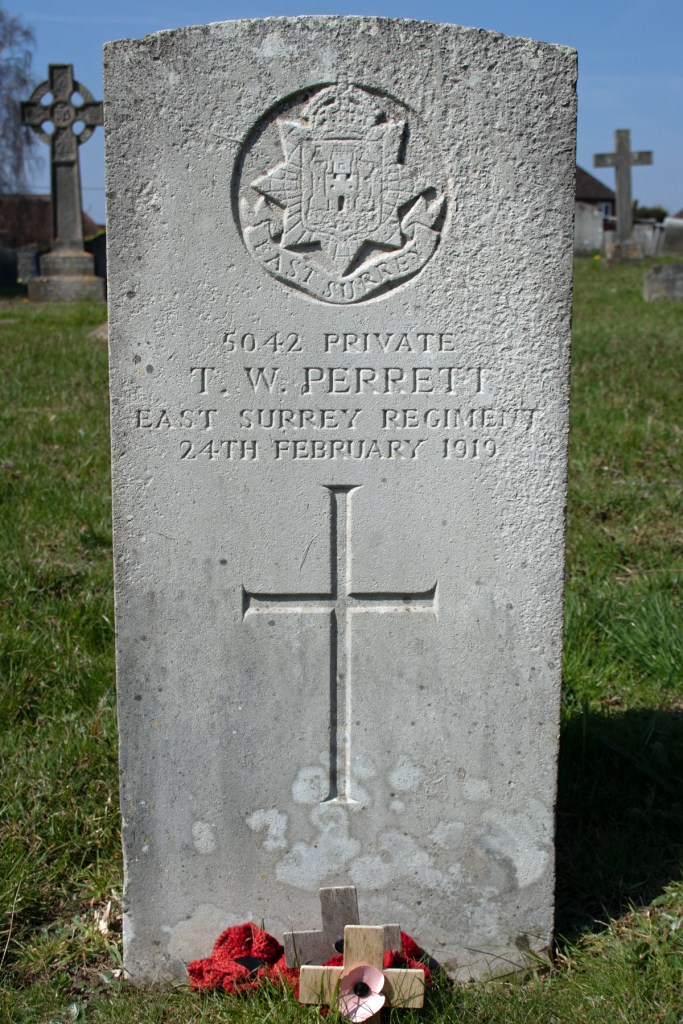
War came to Europe, and Thomas was keen to play his part. Full details of his service are not available, but he enlisted in the East Surrey Regiment, where he was assigned to the 2nd/5th Battalion. This was a second line unit, and Private Perrett remained on home soil for the duration of the war.

This territorial role was reinforced when he transferred across to the 696th Agricultural Company of the Labour Corps. Details of his work are not available, but it seems likely that he was assigned to farm work in the mid-Sussex area.

This too is where Private Perrett remained after the war and where, on 24th February 1919, he was to pass away. Details of his death are vague and the cause is unknown, but he was 40 years of age.

Thomas William Perrett was laid to rest in the cemetery in Cuckfield, West Sussex.