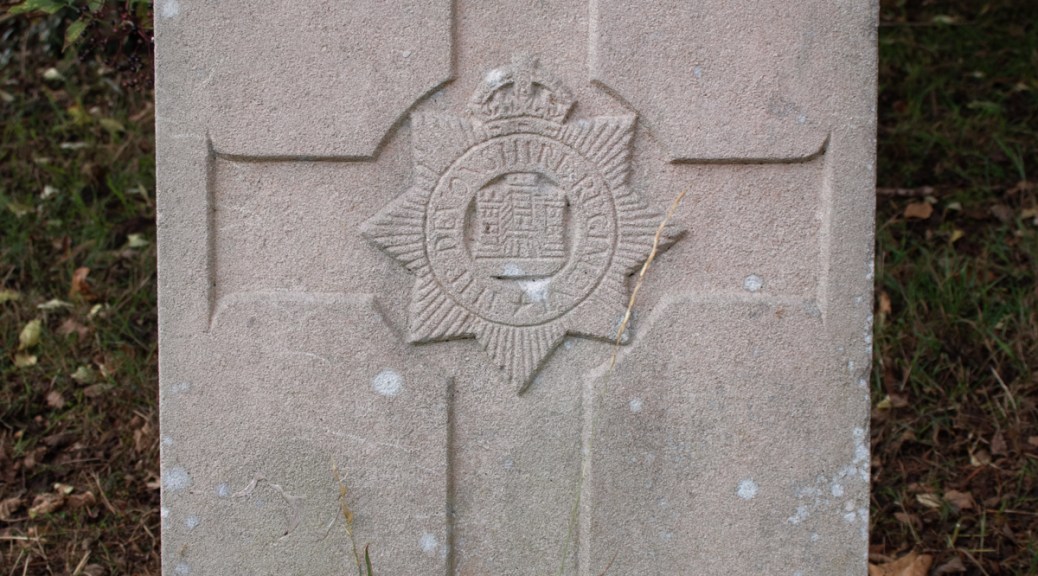
Category Archives: Devonshire Regiment

Serjeant Edwin Huxtable

Serjeant Edwin Huxtable

Edwin Huxtable was born in the summer of 1863, the youngest of eight children to William and Sarah. William was a tailor and Sarah a dressmaker, and they raised their family in their home village of South Molton, Devon.

William’s two younger sons followed him into tailoring, although the family disappears from records for more than 20 years. William passed away in 1889, and a later newspaper report suggests that Edwin enlisted in the army in some capacity, serving in South Africa during the Second Boer War.

Back in Britain, Edwin married Hester Cole in 1904. She was a dressmaker from South Molton as well: the couple set up home and their business at 10 Broad Street in the village. They had two children: Sidney was born in 1905, and Herbert in 1906, although their younger boy passed away when just a babe-in-arms.

When war broke out, Edwin was called back into service. Details of his military career have been lost, but it is clear from what remains that he enlisted in the Devonshire Regiment, and served in the 11th (Reserve) Battalion. His previous time in the army was taken into account, and he was given the rank of Serjeant.

It is unclear whether Edwin saw any time overseas as part of the First World War, but his age and health were against him. Suffering from pneumonia, he was admitted to a hospital in Torquay. The lung condition got the better of him, however, and he passed away on 14th April 1915. He was 52 years of age.

Taken back to South Molton for burial, Edwin Huxtable was laid to rest in the village’s cemetery.


The 1921 census showed that Hestor was keeping up the family business. She was living in East Street, South Molton, and listed as a dressmaker and employer.


Private Samuel Harris

Private Samuel Harris

Samuel John Harris was born in the spring of 1895, and was the oldest of three children to Samuel and Annie Harris. Samuel Sr was a cabinet maker from South Molton, Devon, and this was the village in which he and Annie raised their family.

The 1901 census found the Harrises taking rooms at 24 North Street, a house they shared with two other families. Move forward, and they were living four doors down the road at No. 28, a smaller cottage, but one they had to themselves.

Samuel Jr, at this point, was sixteen years old, but had completed his schooling and was working as a hotel waiter. His younger brother, Albert, had also started work, and was employed as an apprentice coach builder. Samuel Sr, meanwhile, was continuing with his cabinet making.

When war broke out, Samuel Jr was one of the first to enlist. While full details of his time in the army have been lost, it is clear that he joined the Devonshire Regiment, and he was initially attached to the 1st/6th Battalion.

Pte. SJ Harris proceeded to India and Mesopotamia with the Territorials. The hardships of campaigning and the trying climate in Mesopotamia proved too much for his constitution.

[Western Times: Friday 9th November 1917]

Samuel returned to Britain, and was admitted to the military hospital in Sutton Veny, Wiltshire. He passed away on 29th October 1917, from a combination of tuberculosis and a cyst in his back. He was 22 years of age.

Despite the apparent weakness in his constitution, the Western Times reported on his youth in South Molton:

The young man was very popular among his comrades in arms, and at Sutton Veny a general favourite. Prior to th war he was a familiar figure at football matches, having played for various teams at [South Molton] and in the district.

[Western Times: Friday 9th November 1917]

The body of Samuel John Harris was brought back to Devon for burial. He was laid to rest in the South Molton Cemetery, just a sort walk from his grieving family’s home.


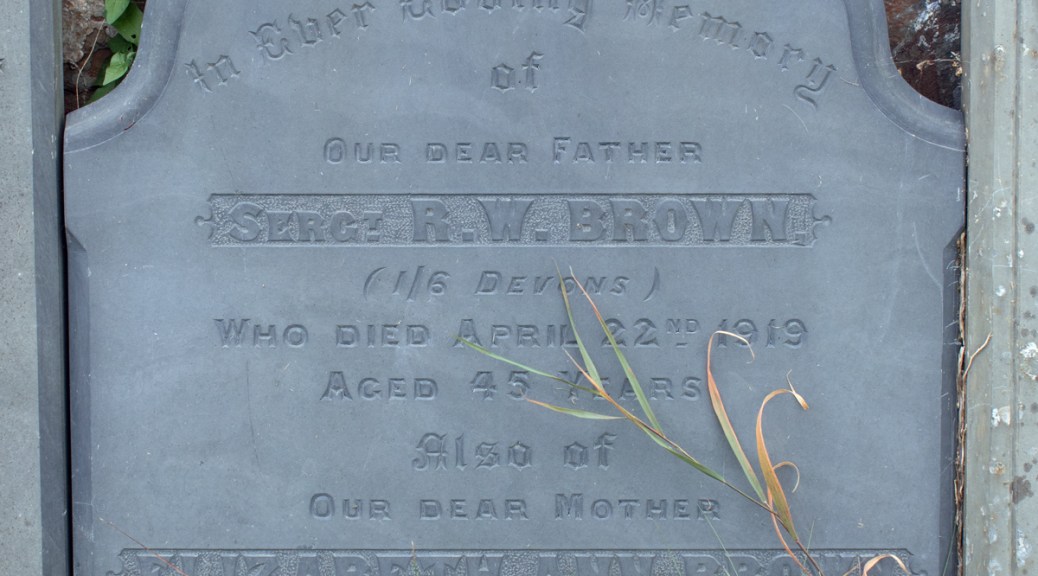
Sergeant Reginald Brown

Sergeant Reginald Brown

Reginald William Brown was born in South Molton, Devon, the summer of 1873. The second of four children – all boys – his parents were William and Mary Brown. William died when Reginald was just a child, and the 1881 census found Mary supporting her children by working as a mangler.

Details of Reginald’s early life are sparse. In the autumn of 1898 he married Elizabeth Mayne and the couple set up home at 13 Cook’s Cross. The couple went on to have six children, and Reginald supported his family with work as a gardener.

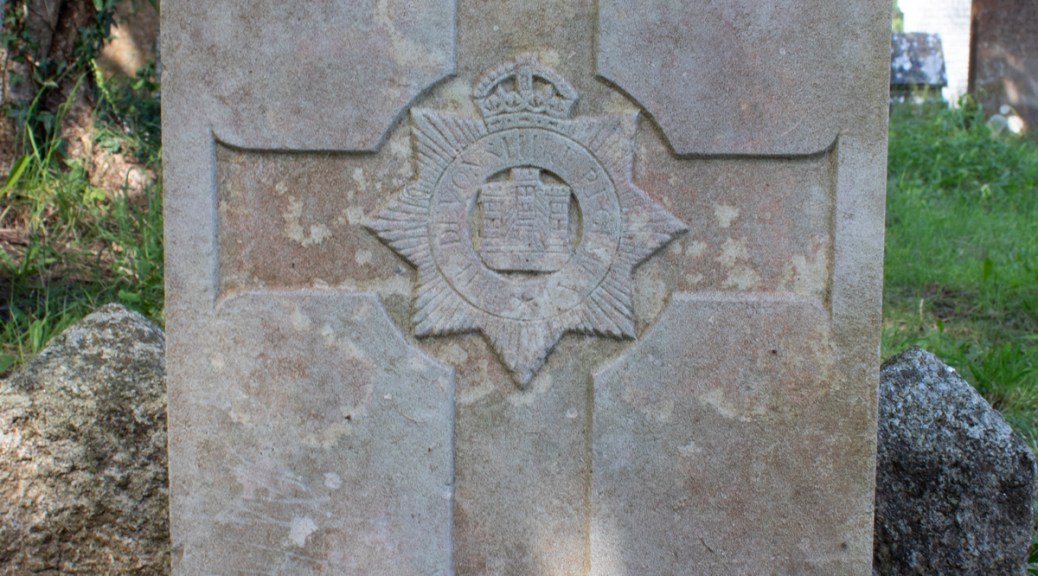
Alongside his gardening work, Reginald volunteered for army service. Again, full details are unclear, but he was attached to the Devonshire Regiment from 1908. Initially for a year’s contract, he seemed to renew this on-and-off for the next six years.

When war broke out, Reginald was formally called into service. HIs time in the army resulted in him being given the rank of Sergeant, and by October 1914, his unit – the 4th Battalion – was sent to India.

Reginald spent the next couple of years overseas, before being posted back to Britain in the spring of 1916. That November he spent six weeks admitted to the Manor County of London War Hospital in Epsom, Surrey, suffering from bronchitis. This was the result of malaria, and he would continue to suffer from lung complaints for the next few years.

In September 1917, Elizabeth passed away, and Reginald was left, at a distance at least, to raise his children. By now, his health was being severely impacted, and in April 1919, he was medically discharged from army service.

Reginald returned home, but he would quickly succumb to illness. He passed away at 43 South Street, South Molton, on 22nd April 1919. He was 45 years of age.

Reginald William Brown was laid to rest in South Molton Cemetery. His was a family plot, and he was reunited with his beloved Elizabeth.


Private James Burge

Private James Burge

James Thomas Burge was born in Plymouth, Devon, in the summer of 1887. The oldest of five children, his parents were sawyer James Burge and his wife, Alice. James Sr moved the family to where the work took him: by the time of the 1901 census, the Burges had lived in and around the Plymouth area, including Devonport and Stonehouse. They settled in Ashburton, Devon, and the document found them living on Mill Lane.

When James Jr finished his schooling, he found work as a mill hand. By 1911, he had moved to Buckfastleigh, and was living with the Crook family on Silver Street. Henry Crook was a mason’s labourer, while he and his wife Bessie had three children, Hilda, Ada and Ruby. Living with them when the census was taken, were Bessie’s widowed brother Samuel, his daughter, Bessie, and three boarders, including James.

There are two intriguing things about this census document. The first is that of James’ employment. While he was recorded as being a mill hand, it is evident from his service records that he had enlisted in the 5th (Prince of Wales’) Battalion of the Devonshire Regiment by this point. He had completed training on Salisbury Plain in August 1910, and would undertake further instruction in the summer of 1911, but in between times, he remained on reserve status, and would have needed to earn money.

The second point of interest is that his service records noted that, by the time he was formally mobilised in August 1914, he was married to a woman called Hilda, who lived on Silver Street in Buckfastleigh. While there are no documents available to fully confirm this, it seems likely that this Hilda was Hilda Crook, the daughter of the family James was boarding with in 1911.

Once embodied, Private Burge’s time in the army took him around the world. By October 1914, his unit had been sent to India, and he would remain there for the next eighteen months. After a two-month stint on home soil, he returned to India, before his unit moved to Egypt in March 1917.

On 7th November 1917, while advancing on the enemy forces in Gaza James was struck in his right leg by a fragment of shell. He was wounded near the top of his fibula and, after initially being treated in the field hospital, he was evacuated to Alexandria, Egypt, for treatment. He was operated on, but from that point on had difficulty walking.

Private Burge was transferred to the 4th Reserve Depot, but his injury prevented him from undertaking many of the duties required of him. He was recommended for permanent transfer to England. Ultimately, however, his wound proved too severe, and he was formally discharged from military service on 25th February 1919.

At this point, James’ trail goes cold. He returned to Buckfastleigh, but would not be back on civvy street for long. He passed away on 22nd May 1919, at the age of 31 years old.

James Thomas Burge was laid to rest in the graveyard of Holy Trinity Church, in the Devon town he had made his home.


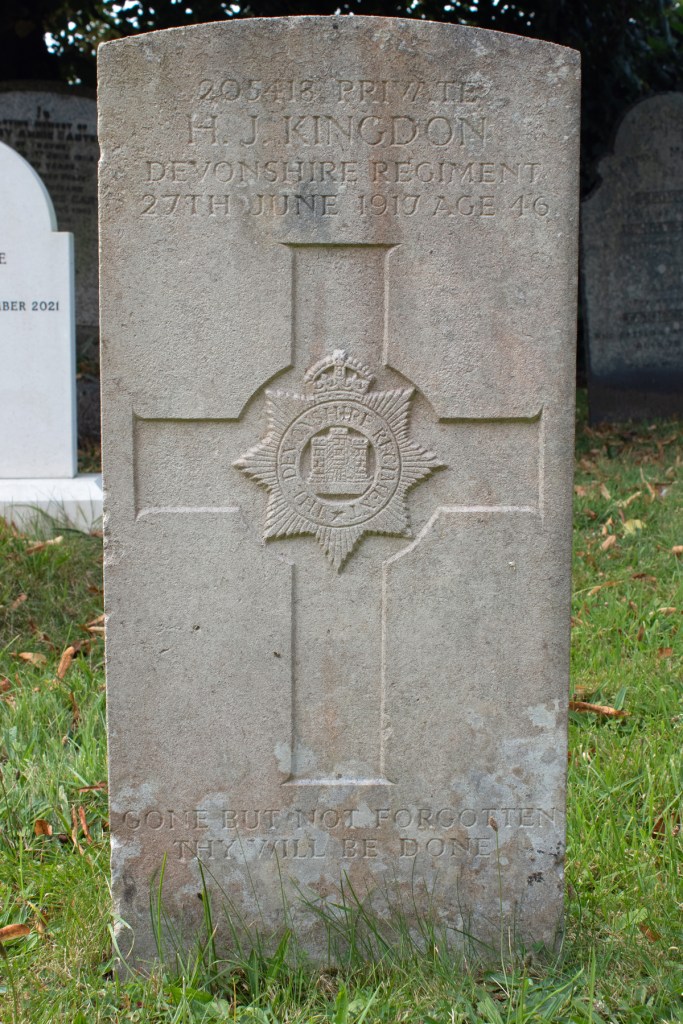
Private Herbert Kingdon

Private Herbert Kingdon

Born in the spring of 1872, Herbert James Kingdon was the ninth of ten children to George and Elizabeth. George was an agricultural labourer from the Devon village of George Nympton, it was here that the family was born and raised.

George died in 1900, at the age of 72, from this point on, Elizabeth also disappears from the records. In the spring of 1900, Herbert, now also a farm labourer, married Elizabeth – or Bessie – Speed. She was a farmworker’s daughter from South Molton, just two miles to the north. The couple set up home close to where Herbert had been living, and would go on to have five children by the time war was declared: Frederick, Florence, Frank, Annie and Herbert Jr.

George Nympton was a small village, and most of Herbert’s siblings remained close. The 1911 census found Herbert and Bessie living in the village, next door to Bessie’s parents who appear to have moved closer to support their daughter’s family. Three of their four children now old enough to attend the local school, while Herbert was still doing farm work, alongside his father-in-law, George Speed, and his brother-in-law, Fred.

When war broke out, Herbert stepped up to play his part. His full service records are no longer available, but the documents that do still exist suggest that he had enlisted by the start of 1917. Joining the Devonshire Regiment, he was assigned to the No. 4 Agricultural Company, and remained on home soil. By this point, Bessie had had a sixth child, Edward, and it is likely that she needed all the help she could get. With her husband remaining close by, and with her parents still living next door, she seems to have been supported.

By the summer of 1917, Private Kingdon had become unwell, and was suffering from a combination of pneumonia and pleurisy. Convalescing at home, the conditions were to get the better of him: he passed away on 27th June 1917, at the age of 45 years old.

Herbert James Kingdon was laid to rest in the graveyard of St George’s Church, George Nympton, in sight of his former home.


Bessie was pregnant when her husband passed: she gave birth on 13th January 1918, to a baby girl, Mary.

Bessie would only outlive her husband by five years. The last record for her is the 1921 census, when she was living in the family home with five of her children, and her parents, now in their mid-60s, living next door.


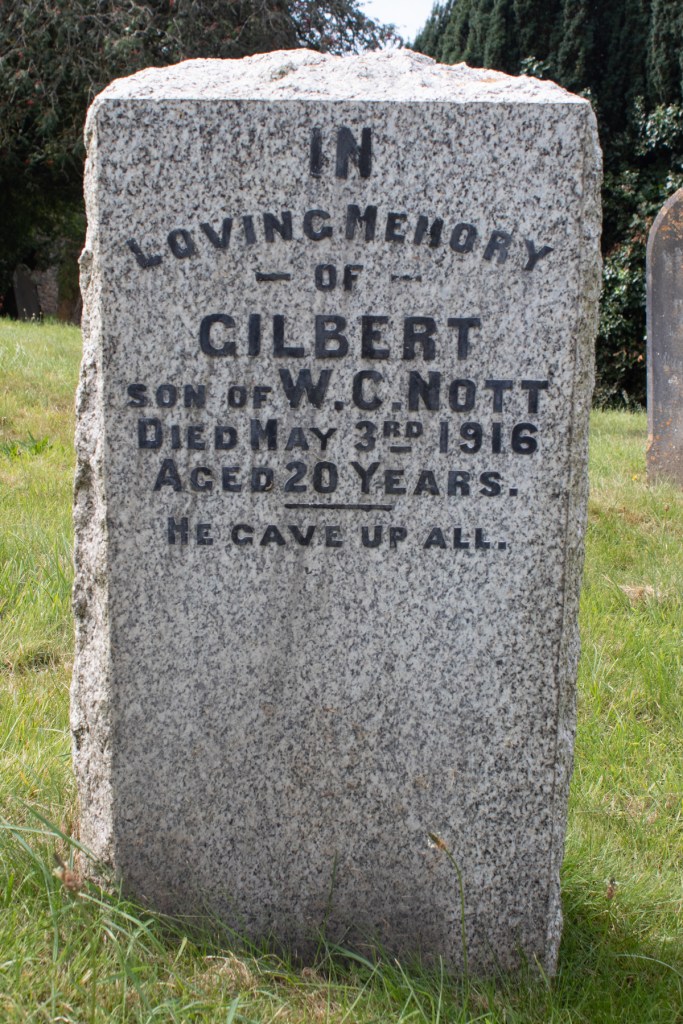
Private Gilbert Nott

Private Gilbert Nott

Gilbert Charles Nott was born in the autumn of 1895, and was the older of two children to William and Eleanor. William was a plumber and ironmonger from Bampton in Devon, and this is where the family were born and raised.

For the whole of Gilbert’s life, the Notts lived on Brook Street in the centre of the town. The 1901 census found the family at numbers 9 and 10, while the 1911 record confirmed they had moved up the road to number 7 Brook Street. At this point, however, Gilbert was recorded as living with his widowed maternal grandmother, Eleanor Besley. At 15 years of age, he was working, and was employed as a bookkeeper at the Bampton Lime & Stone Company.

When war broke out across Europe, Gilbert was called upon to play his part. He enlisted after December 1915, and was assigned to the 3rd/4th Battalion of the Devonshire Regiment. Sent to Hursley Park near Winchester, Hampshire, for training, his time in the army was to be brief.

In the spring of 1916, he was admitted to the Victoria Hospital in Winchester, passing away there on 3rd May. The cause of his death is not readily confirmed, but his sparse service records suggest that he died from ‘disease’. He was just 20 years of age.

At the family’s request, the body of Gilbert Charles Nott was taken back to Devon for burial. He was laid to rest in the graveyard of St Michael’s Church in Bampton, the church in which he had been baptised just two decades before.


Serjeant George Constable

Serjeant George Constable

George Constable was born in the summer of 1893 in Findon, West Sussex. His parents were Albert and Ruth Constable, and they had seven children: Ruth Jr, Thomas, Albert Jr, William, George, Arthur and Rachel.

There is little concrete information about George’s early life. The 1901 census found the Constable family living at 2 Mill Cottages in Findon, with George’s oldest brother, Thomas, helping his father’s gardening work.

When war came to Europe, George and his older brothers stepped up to play their part. Thomas joined the Dorsetshire Regiment and worked his way to the rank of Lance Corporal. His time in service was to be tragically brief, however. He was killed in France on 26th October 1914, aged 27 years old. He is commemorated on both the Le Touret Memorial, and on the headstone to the family ploy in St John the Baptist Churchyard, Findon.

George also joined the Dorsetshire Regiment and, like his brother, was assigned to the 1st Battalion. During his short time with the regiment – he enlisted no later than October 1914 – he rose through the ranks, and, by the spring of 1915, had been promoted to Serjeant.

Sent to France, George was wounded in April 1915, and medically evacuated to Britain for treatment. He was admitted to the 1st London General Hospital, but his injuries were to prove too severe. He passed away on 5th April 1915 aged just 21.

Albert and Ruth had lost two of their sons to the conflict within six months. While Thomas’ body lay in France, George was brought back to Sussex for burial.

George Constable was buried in the family plot in the graveyard of St John the Baptist Church, Findon.


William Constable was assigned to the Royal Sussex Regiment when he enlisted. He too rose through the ranks, and would take on the role of Serjeant, like his younger brother. His unit, the 2nd Battalion, fought at Loos in the autumn of 1915, and this is where William would be killed. He died on 25th September 1915, aged just 23 years old.

Serjeant Constable is commemorated on the Loos Memorial, while Albert and Ruth, having now lost three sons within a year, added his name to the family headstone.


Albert Constable Jr, was also involved in the conflict. Along with George and Thomas, he had joined the 1st Battalion of the Devonshire Regiment, but unlike his brothers, he survived the horrors of the Western Front.

By the last months of the war, Lance Corporal Constable was caught on in the Battles of the Hindenburg Line, and, tragically, he too was killed. Albert passed away on 15th September 1918, at the age of 29 years old. He was buried in Cologne Southern Cemetery, Germany.

By this point, the face of the family headstone was already full with commemorations to his three brothers, Albert is remembered in lettering around the edge of the grave marker.


Private Alfred Hurrell

Private Alfred Hurrell

Alfred Hurrell was born in the Devon village of Ugborough, in the autumn of 1885. He was the second of eleven children – of which five did not survive childhood – to Agricultural labourer Frank Hurrell and his wife, Hannah.

Soon after Alfred was born, the family moved to the village of Modbury, four miles to the south-west. Frank has found work on Hockenbridge Farm, on the edge of the village and, when he finished his schooling, Alfred also started working there, initially living in.

By the time of the 1911 census, Alfred was back living with his parents, on Galpin Street, Modbury. They shared their home with three of Alfred’s siblings, and his sister Jane’s two children.

When war broke out, Alfred was among the first to enlist. Full details of his military service have been lost, but it is clear from what remains that he had joined up by September 1914. Private Hurrell was attached to the 11th (Reserve) Battalion of the Devonshire Regiment, and seems to have remained in the county for his training.

The only other document relating to Alfred is his entry on the Army Register of Soldiers’ Effects. This confirms that he passed away on 16th February 1915 in Paignton, Devon. He was 29 years of age.

The body of Alfred Hurrell was laid to rest in Paignton Cemetery, not far from where he had breathed his last. It is unclear why he was buried there, rather than being brought back to Modbury.


Private Harold Spackman

Private Harold Spackman

Harold John Spackman was born on 24th May 1897 and was the youngest of two children to Frederick and Eliza Spackman. Frederick was a cowman from Wiltshire, and the family were raised on a farm in Manningford Bohune, near the village of Pewsey.

Harold was educated at Woodborough School, and found work as a nurseryman when he completed his schooling. When war broke out, he was quick to enlist, and joined the 10th (Service) Battalion of the Devonshire Regiment on 17th September 1914.

Private Spackman’s unit was sent to Somerset for training, and it was here, in cramped, busy barracks, that he contracted meningitis. He was admitted to the Red Cross Hospital in Bath, but succumbed to the condition on 12th March 1915. He was just 17 years of age.

Harold John Spackman was laid to rest in Bath’s Locksbrook Cemetery. His was a joint funeral with another Private from his unit, Albert Matthews, who had died on the same day in the same hospital.


Private Harold Spackman
(from findagrave.com)

Private Albert Matthews

Private Albert Matthews

In Bath’s sweeping Locksbrook Cemetery, lies the body of Private Albert Edwin Matthews, of the Devonshire Regiment. There is little information available to fully piece together his life, but a range of records give tantalising glimpsed into the world that he inhabited.

The newspaper report of Private Matthew’s passing confirms that he died of pneumonia in the Red Cross Hospital, Lansdown Place, on 12th March 1915. His was a joint funeral with Private Harold Spackman, also of the Devonshire Regiment. He had enlisted at the start of the conflict, and had come from Plymouth, Devon. Frustratingly, the report does not give either of the soldiers’ ages.

Albert’s entry on the British Army Register of Soldiers’ Effects backs up a period of service of at least six months, and gives his unit as the 10th (Service) Battalion. It also provides his father’s name: Edwin Matthews.

Father and son do not seem to appear on any census records, and without a year of birth it is a challenge to track down any additional documentation.

There is a baptism record for an Albert Edwin Matthews, son of Edwin, from 28th September 1881, but this was in Sandown, on the Isle of Wight. While a connection is possible, there is no definitive link between the two men and Devon. (There is a 1911 census return for this Albert, but he is married with three children by this point and, as the military record gives Edwin Matthews as the sole beneficiary, it is unlikely that the two Alberts are one and the same.)

Albert’s life is destined to remain lost to time, therefore, one of the many mysteries in Locksbrook Cemetery.