In the peaceful Congregational Chapelyard of Berea, St Davids, Pembrokeshire, is a headstone dedicated to Willie Howells, grandson of Benjamin and Mary. The inscription – in Welsh – confirms that he died on 26th November 1918, at the age of 23.
The 1901 census records the couple living at Rhos y Gorse with four of their eleven children and two of their grandchildren, including William. There is no documentation to confirm which of their children was his parent.
Tragically, Willie’s military records are also lost to time. The Commonwealth War Graves Commission give his name as Private BW Howells. They suggest that his first regiment was the South Wales Borderers, and that he transferred to the Northern Command Labour Centre of the Labour Corps. His service numbers for both units draw a blank, however.
The life of Willie Howells is destined to remain a mystery, one of the many whose stories were buried with them.
George William John Whiteway was born in Paignton, Devon, on 4th February 1893. The youngest of three children, and the only son, his parents were William and Sarah Whiteway.
William was a journeyman painter, and from at least when his son was born, the family lived in a small terraced house, 9 Tower Road, on the outskirts of the town centre.
By the time of the 1911 census, George had completed his schooling, and was working as an apprentice painter. It is unclear whether this was under his father’s tutelage, as he gave his employment as verger and caretaker of the local parish church.
When war broke out, George stepped up to play his part. He enlisted in Torquay on 1st December 1915, and his service records note that he was of good physical development, stood 5ft 6.25ins (1.68m), and weighed 126lbs (57.2kg). He was also recorded as having light brown hair, brown eyes and a fair complexion.
Initially assigned to the Duke of Cornwall’s Light Infantry, Private Whiteway was transferred to the London Regiment and attached to the 3rd/21st Battalion. By the summer of 1916 George had transferred to the 1st/21st (County of London) Battalion, also known as the First Surrey Rifles. On 15th June his unit was sent to France, and he soon found himself in fighting on the Somme.
Private Whiteway’s time in France was to be a brief one. Caught up in the Battle of Flers-Courcelette, he was wounded in the back and neck, and, after initial treatment on site, he was medically evacuated to Britain.
It is unclear where George was first admitted, but by February 1917, he was being tended to in the Voluntary Aid Detachment Hospital in his home town, Paignton. He remained there for a couple of month, before being released back to duty.
Private Whiteway’s time fighting was over. He was transferred to the 619th Home Service Employment Company of the Labour Corps, and would spend the next year in and around Winchester, Hampshire. It is evident, however, that George’s health had been impacted. By March 1918 he was in hospital again, this time close to his army base. Suffering from a combination of peritonitis and tuberculosis, the contagious nature of the latter condition would lead to his dismissal from military service, and he was formally stood down on 29th April 1918.
At this point, George’s trail goes cold. It seems likely that he returned home, as his death was recorded in Totnes, Devon. He breathed his last on 25th August 1918: he was 25 years of age.
George William John Whiteway was laid to rest in Paignton Cemetery, a short walk from his family home.
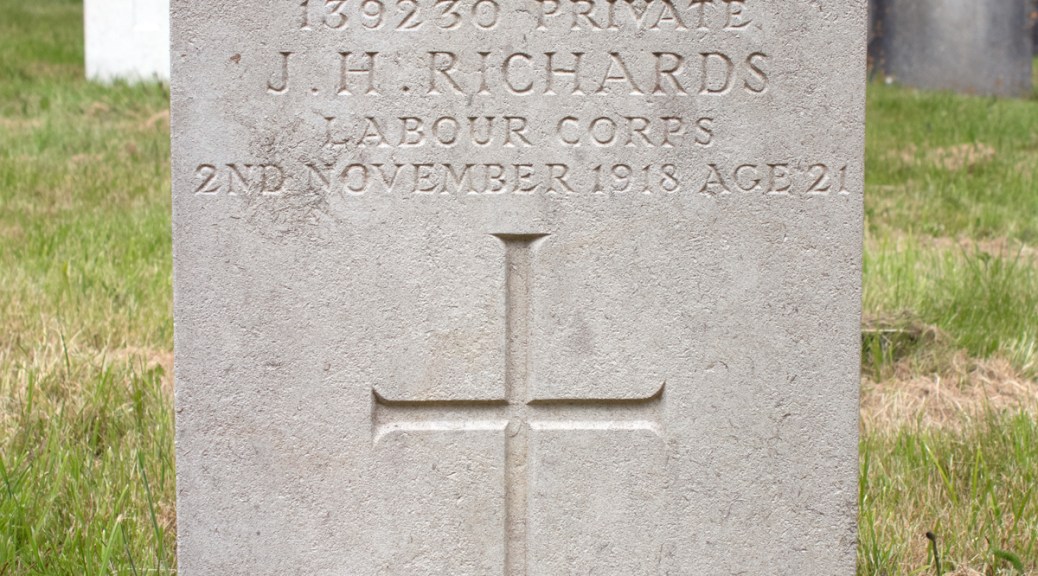
John Henry Richards was born in Sutton, Surrey, on 3rd June 1896. The third of four children, his parents were John and Harriet Richards. John Sr was an engine driver and stoker, while his son found employment as a greengrocer’s assistant when he finished his schooling.
When war came to Europe, John Jr stepped up to serve his King. Full details of his military service have been lost to the annals of time, but he had certainly enlisted by the end of 1917. Initially joining the Devonshire Regiment, he subsequently transferred to the Labour Corps, and was assigned to the 385th Coy.
Private Richards seems to have been based in Kennington near Lambeth, Surrey. He married Dorothy Ford on 23rd December 1917, at which point, both bride and groom were living at 47 Hartington Road.
The family’s geographical locations become a bit confused at this point: Dorothy had been born in Bristol, Gloucestershire, but the 1911 census found her living in Ottery St Mary, Devon, with her paternal grandparents. John seems to have served some time in Devon as well, but it is unclear whether the couple met in the South West or London.
By the autumn of 1918, Private Richards’ unit was certainly in Devon: it was here that he contracted pneumonia, and he was admitted to the No. 1 Section Hospital in Devonport for treatment. This was to prove ineffectual, however, and he passed away on 2nd November 1918. He was 22 years of age.
Dorothy’s family appears to have been living in Axminster by this point, and it is certainly somewhere he would return to in later years. The town’s cemetery is where she would bury her late husband: John Henry Richards at peace again.
Henry Ridler was born in Henbury, Gloucestershire, in the summer of 1862. He was the middle of three children to Abraham and Harriet Ridler. Abraham was a farm labourer who moved the family for work to the Weston area of Bath, Somerset, not long after Henry’s younger brother, John, was born.
The oldest Ridler sibling, Joseph, worked as a cabinet maker, and by the time of the 1881 census, both Henry and John were apprenticed to him. Henry married Emma Stone on Christmas Eve 1882, and the couple would go on to have seven children.
The 1891 census found Henry and the family living at 5 Comfortable Place in Bath, one of a row of terraced cottages then, but now sandwiched between the River Avon and the busy A4. Henry and Emma had four children by this point – all daughters – and the house was split between them and mother-and-daughter dressmakers Lucy and Lucy Batt.
By the time of the 1901 census, the family were growing up, and had moved literally just around the corner, to 2 Onega Terrace. Set slightly back from the main road, this terraced house had six rooms, and was better suited to the growing family. Henry was still working as a cabinet maker at this point, while his three oldest daughters – Mabel, Lilian and Maude – were all employed, as a corset fanner, a kitchen maid and a nurse girl respectively.
The next census return, taken in 1911, recorded the Ridler family still living in the same house. Henry and Emma had been married for 28 years by this point, and, while 2 Onega Terrace may have had six rooms, they would have become very cramped by this point. Six of the children – aged between 14 and 27 – were still living at home, with everyone in the household but Emma bringing in a wage of sorts.
War was closing in by this point, and, despite his advancing years, Henry was drawn to serve his King and Country. He enlisted in the Royal Army Service Corps on 20th October 1915, a date that confirms he volunteered for duty, as conscription wasn’t introduced until the following year. Henry’s service records show that he was 5ft 6ins (1.68m) tall, with greying hair and blue eyes.
Private Ridler spent two periods of time overseas. In November 1915, his unit was sent to the Eastern Mediterranean, and he served in Salonika, Greece, for seven months. While there, he was hospitalised following an injury to his right knee. He was medically evacuated to Malta, before being posted back home in Britain to convalesce in Woodcote Park Hospital, Epsom, Surrey.
By the summer of 1916, Henry was deemed fit once more, and was sent abroad again, this time to the Western Front. Details of his time there are sketchy, although he seems to have been transferred tot he Labour Corps at some point. It appears that his previous injury flared up again, and he was eventually discharged from the army on medical grounds on 30th July 1918.
At this point, Henry’s trail goes cold. He returned to Bath, but it is unclear whether or not he was able to resume working. The next confirmed documentation for Henry’s life is that of his passing. While the cause is unclear, he breathed his last on 3rd June 1921: he was 58 years of age.
Henry Ridler was laid to rest in Bath’s sweeping Locksbrook Cemetery, a short walk from the family home in Onega Terrace.
Emma remained in the family home for the next 17 years. When she passed away in 1938, she was also laid to rest in Locksbrook Cemetery, not far from her late husband.
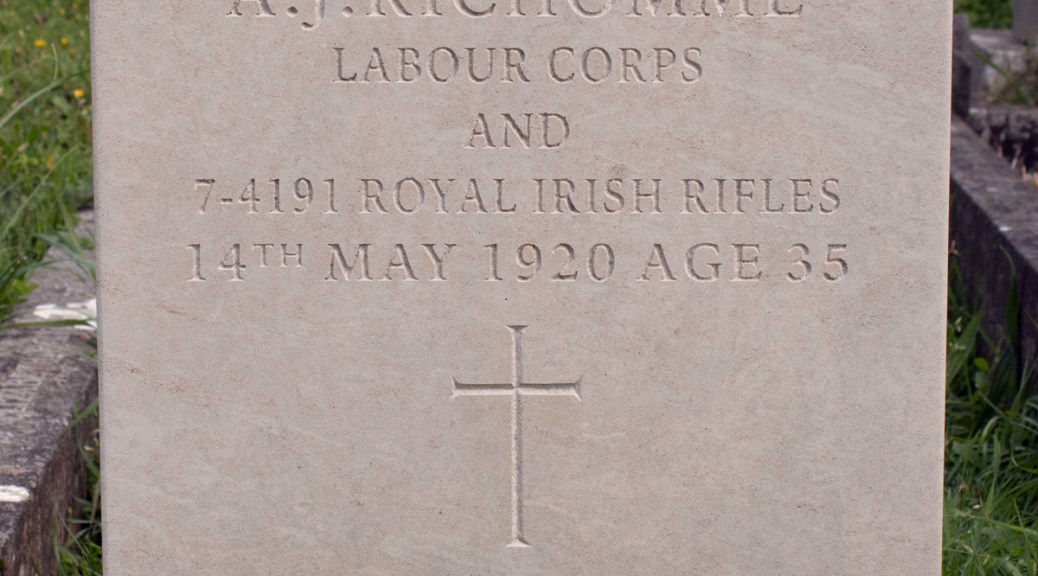
Albert John Richomme was born on 13th June 1885 and was one of eight children to Charles and Marie Richomme. Both were from France, but had moved to Jersey in the Channel Islands before Albert’s oldest sibling, Charles, was born. The couple farmed land near Grouville, the children helping out as they became old enough.
On 28th September 1904, Albert married Linda Rouland at St Thomas’ Roman Catholic Church. The couple set up home in Trinity, and went on to have six children. The 1911 census recorded Albert as being a jobbing gardener, with the family living in the four-roomed Sunny Side Cottage.
When war came to Europe, Albert stepped up to play his part. Initially enlisting in the Royal Jersey Militia, his unit was absorbed into the 7th (Reserve) Battalion of the Royal Irish Rifles. By the end of 1915, he found himself in France.
Full details of Private Richomme’s service are lost to time, but is seems that he was caught up in a gas attack and, after being medically evacuated to Britain to recuperate, he was transferred to the Labour Corps.
At this point, Private Richomme’s trail goes cold. He survived the war and returned home, but passed away from pneumonia on 14th May 1920, just short of his 35th birthday.
Albert John Richomme was laid to rest in the peaceful grounds of La Croix Cemetery in Grouville.
While meeting the appropriate criteria for his burial site to be granted a Commonwealth War Grave, Albert is not recognised by the Commission.
William Pollard was born at the end of 1887, the youngest of seven children to John and Alice Pollard. Agricultural labourer John hailed from Hinton Charterhouse in Somerset, while his wife was from Southampton, Hampshire. The family were living in the village of Buckler’s Hard when William was born, but moved back to Somerset when he was just a toddler.
As with most of his siblings, William followed in his father’s footsteps when he completed his schooling. By the time of the 1911 census, only he and his older brother Thomas we still living in the family home: the two siblings were working as carters, while their father, now 61 years of age, was a general labourer.
Alice died in the summer of 1911, and would net get to see her youngest boy wed. On 11th April 1914, William married Augusta Loveless, a carpenter’s daughter from Bath. The couple were living in 2 Rossini Cottages, on Hedgemead Road, to the north of the city centre, and would go on to have two children, William Jr and Geoffrey.
When war was declared, William was called upon to play his part. He enlisted in the Somerset Light Infantry on 30th November 1915, but soon transferred over to the 5th (Service) Battalion of the Dorsetshire Regiment. Attached to the 673th Labour Company, while his unit served at Gallipoli and in France, there is no evidence that Private Pollard spent any time overseas.
William’s brother Thomas had also been called up. He joined the Somerset Light Infantry, and, as a Private, was attached to the 1st Battalion. His unit fought at the Somme, and Thomas was badly injured. He died of his wounds, and was laid to rest in the Puchevillers British Cemetery. He was 31 years of age.
In fact, William seems to have been dogged by ill health. Full service records have been lost to time, but he was medically discharged from the army on 12th September 1917.
John had died that February, at the age of 68 years old, and was laid to rest next to his wife in St John the Baptist Church, Hinton Charterhouse.
At this point, William’s trail goes cold. He returned to Bath, and spent at least some time in the city’s War Pensions Hospital. His condition warranted an operation, but he died of heart failure following the procedure on 12th December 1920. He was 33 years of age.
William Pollard was laid to rest in Bath’s sweeping Locksbrook Cemetery.
Charles Henry Edwards was born in Padstow, Cornwall, in around 1888. One of three children, his parents were Charles and Elizabeth Edwards. Charles Sr was a farm labourer, and his son, who was one of four children, followed suit when he finished his schooling.
Charles Sr passed away in 1903: the next census record found Charles and two of his sisters living with Elizabeth. She was claiming parish relief, while her daughters were doing occasional char work to bring in a little more money.
Charles married a woman called Florence Dunn in the summer of 1911: little information is available for her, other than she was born in Devon, to Joseph and Maria. The couple set up home in Leadwell Street, Padstow, and went on to have four children: Lilian, Charles, Elsie and Alfred.
When war came to Europe, Charles stepped up to play his part. He enlisted 11th December 1915, by which point, he had found work as a cowman. He joined the Devonshire Regiment as a Private and spend the next fourteen months on home soil, moving across to the 5th Labour Company in February 1917.
At this point, Private Edwards was sent to France, and he spent most of that year overseas. He returned to Britain on 8th November, having contracted bronchitis while serving at Etaples. When he had recovered, Charles returned to duties, and was attached to the 650th Labour Coy.
Alfred, Charles and Florence’s youngest child, was born on 1st April 1918, but seemed to be a sickly boy. He passed away on 27th September, aged just six months, from a combination of influenza and bronchitis. Tragically, Charles was also unwell at this point, and he passed away just four days later from pneumonia. He was just 30 years of age.
Charles Henry Edwards was laid to rest in Padstow Cemetery. The report of his funeral does not mention Alfred, but it seems likely that father and son were buried together.
Florence lived on until 1964. She passed away in Bodmin, at the age of 78, and was laid to rest with her husband, reunited after more than four decades.
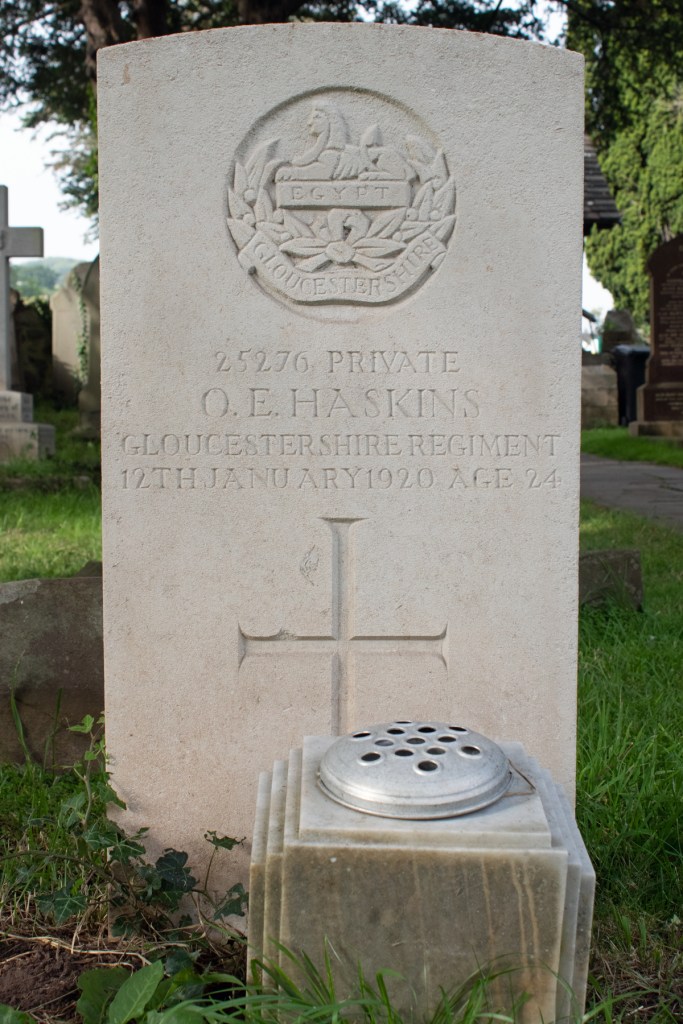
Oliver Edgar Haskins was born in 1896 in Portbury, Somerset. One of ten children, his parents were John and Hester Haskins. John was a gardener, and the 1911 census noted that Oliver was ‘working at home’, although no trade is listed.
When war came to Europe, Oliver stepped up to serve his King and Country, and was one of six Haskins brothers to fight in the conflict. He joined the Gloucestershire Regiment, and was initially assigned to the 15th (Reserve) Battalion. Based on home soil, his unit were barracked at Chiseldon Camp on the fringes of Salisbury Plain, Wiltshire.
At some point Private Haskins transferred to the Labour Corps, and became attached to the 207th Employment Company. It is not possible to identify exactly where he served, but he remained on home soil during the conflict.
The funeral took place at Portbury on Saturday of Mr Oliver Haskins… He was very popular in the village and at business, by virtue of his cheerful disposition and sterling qualities, and was beloved by everybody who came into contact with him. Mr Haskins was taken ill some ten days ago, and confined to his room, but he apparently made a quick recovery until Monday last, when he was suddenly taken worse and died in a few hours, at the age of 24.
Bristol Times and Mirror: Monday 19th January 1920
Oliver Edgar Haskins died on 12th January 1920. He was laid to rest in the once peaceful graveyard of St Mary’s Church in Portbury.
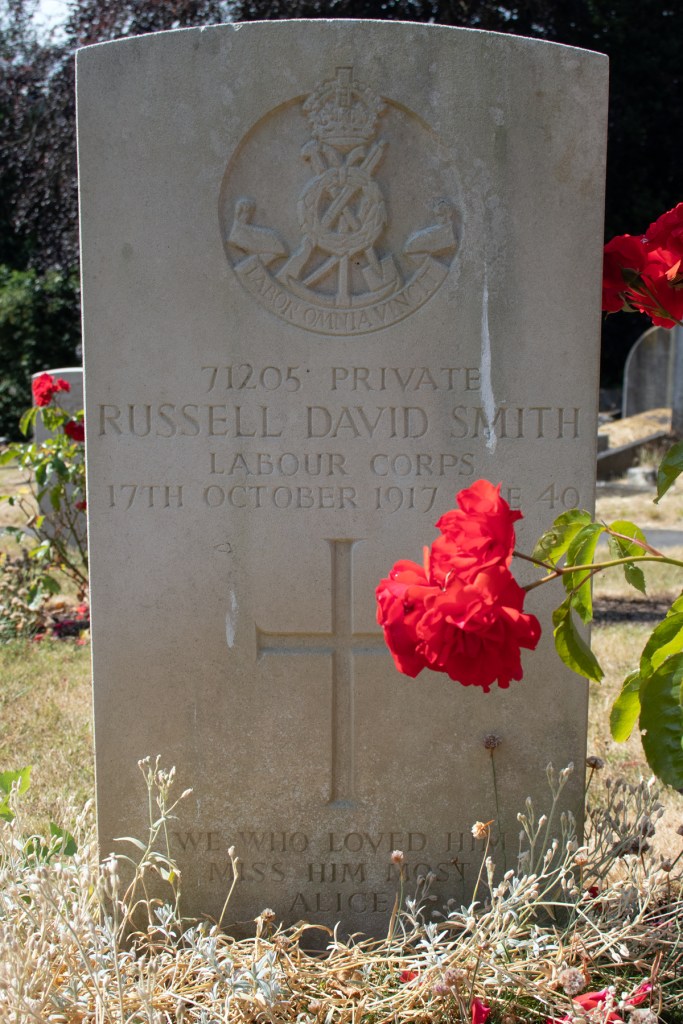
Russell David Smith was born in Shoreditch, London, in the summer of 1877. The second of four children, his parents were tailor Richard Smith and his wife, Emma.
When he finished his schooling, Russell found work as a bookbinder: by the time of the 1901 census, the family had moved to a small terraced house in Cassland Road, Hackney.
On Christmas Day 1902, Russell married Alice Stretch. A year younger than her new husband, she had been born in Islington, and was the youngest child to cabman Edwin Stretch. When the couple married, she was working as a mantle maker’s assistant, making elements for gas lamps.
The newlyweds settled in a cottage in Walthamstow, and went on to have three children. The 1911 census recorded the young family living at 39 Ritchings Avenue: they had taken in a lodger, Alice Carter, to help pay the bills.
War came to Europe in the summer of 1914 and Russell was called upon to play his part. Details of his military service are sketchy, but from the documents available, it is evident that he had enlisted by the summer of 1917 joining the Labour Corps. Private Smith was attached to the 119th Labour Coy. which seems to be been based in Somerset.
It is impossible to trace Russell’s trail any further. The next record for him is that of his passing, on 17th October 1917. The cause of his death is not readily apparent, but he was 40 years old at the time.
Finances seem to have prevented Alice from bringing her husband home. Russell David Smith was, instead, laid to rest in Locksbrook Cemetery, Bath, probably as this might have been the closest burial ground to where he had passed away.
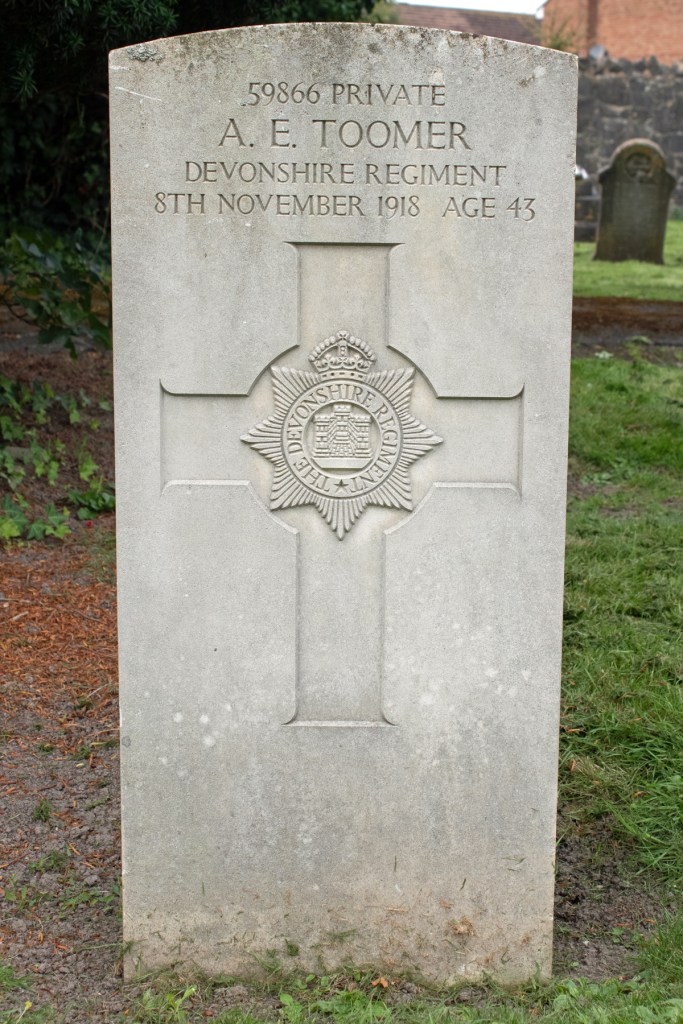
Albert Edward Toomer was born in the summer of 1875, one of eleven children to Joseph and Harriet Toomer. Joseph was a labourer from Meare in Somerset, but it was in Highbridge, near Burnham-on-Sea that the family were born and raised.
When he finished his schooling, Albert found work in a local brickyard and, by the time of the 1911 census, when he was the only Toomer child to still be living at home, he was employed as a tile maker. By this point he was 35 years of age, and, as a single man, was in a position to support his parents, who were both in their 70s.
Harriet died in 1914, Joseph following a year later. On 9th January 1915, Albert married Louisa Clark at the Ebenezer Chapel in Brent Knoll. The couple went on to have a child, Arthur, later that year.
By this point, war was raging across Europe. Despite his age, Albert stepped up to play his part, enlisting on 27th November 1915, at the age of 40 years old. Private Toomer’s service documents confirm he was 5ft 3ins (1.6m) tall, and weighed 110lbs (50kg). He was placed in the Army Reserve, and was not formally mobilised until March 1917.
Assigned to the 11th (Reserve) Battalion of the Devonshire Regiment, Albert was sent to France within weeks of being mobilised. He was transferred to the Labour Corps two months later, and remained in France until the autumn of 1918.
By this point, Albert’s health seems to have been suffering. In September, he was admitted to the 7th Canadian General Hospital in Northern France. He was suffering from a carcinoma, although his medical records are not legible enough to confirm what type of cancer. Invalided back to Britain, Private Toomer was sent to a military hospital in Whalley, Lancashire.
Albert’s time in hospital was not to be a lengthy one. He passed away on 8th November 1918, from a combination of the cancer and tuberculous peritonitis. He was 43 years of age.
Albert Edward Toomer was taken back to Somerset for burial. He was laid to rest in Highbridge Cemetery, not far from where his widow and son lived.









 Death and Service