
Category Archives: Company Sergeant Major

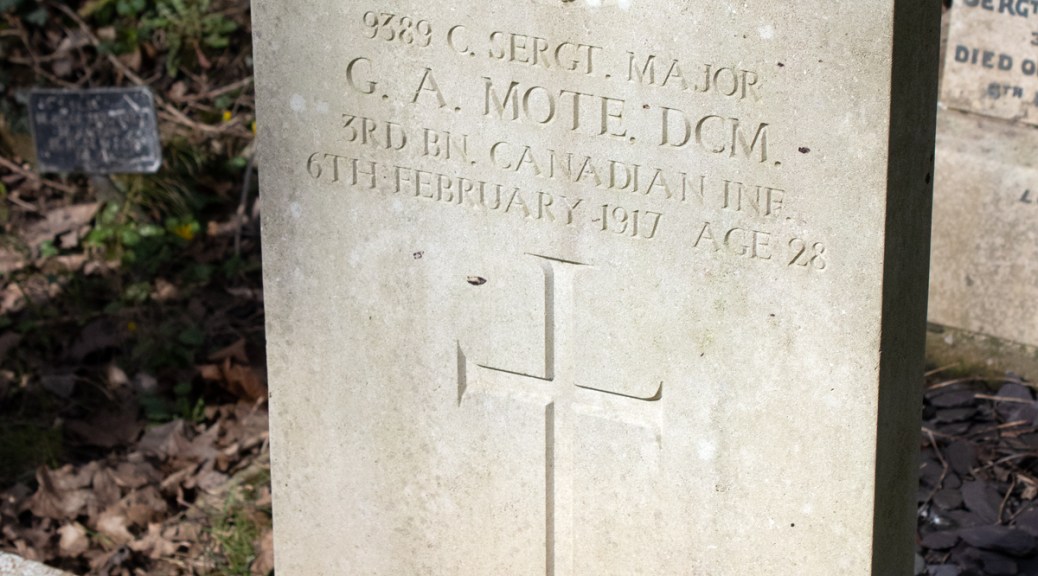
Company Sergeant Major George Mote

Company Sergeant Major George Mote

George Arthur Mote was born on the 25th August 1888 in Islington, Middlesex. The oldest of three children, his parents were Arthur and Norah Mote. The 1891 census recorded Arthur as a shoemaker’s finishing ink maker and the family had taken rooms at 45 Wyatt Road in Islington.

The next census return, taken in 1901, found that Arthur had been promoted, and was now a foreman or a leather dyer. The family had moved around the corner from the old address, and were living in rooms at 193 Blackstock Road.

At this point, George’s trail goes cold. By the autumn of 1914, he had emigrated to Canada, and was working as a corset cutter in Quebec. With war having broken out in Europe, it was here that he enlisted to serve his empire.

Goegre’s service records confirm the young man he had become. Standing 5ft 8ins (1.72m) tall, he had black hair, blue eyes and a dark complexion. A number of scars were also noted on his left forearm, the middle finger of his right hand, and on the left side of his neck.

While back in Britain, George had volunteered for the Middlesex Regiment, and this experience stood him in good stead, as he enlisted with the rank of Sergeant.

Attached to the 3rd Battalion of the Canadian Infantry, Sergeant Mote arrived in St Nazaire, France, on 11th February 1915. His unit was thrown into the deep end from the start, and George’s actions at the Second Battle of Ypres that spring won him the DCM. By the autumn, he had been promoted to Company Sergeant Major.

George continued to serve on the Western Front, but his luck was to change. On 5th June 1916, he was badly injured, receiving gunshot wounds to his right shoulder and back. Medically evacuated to Britain, he was admitted to Fort Pitt Hospital in Chatham, Kent. His medical records noted than he was paralysed, and, in October 1916, he was transferred to the Duchess of Connaught Hospital in Taplow, Berkshire.

Company Sergeant Major Mote spent the next four months admitted to the hospital, but his wounds would prove too severe to overcome. He passed away on 6th February 1917 at the age of 28 years old.

George Arthur Mote’s body was taken back to Middlesex for burial. He was laid to rest in the majestic Highgate Cemetery.

Company Serjeant Major Robert Pollard

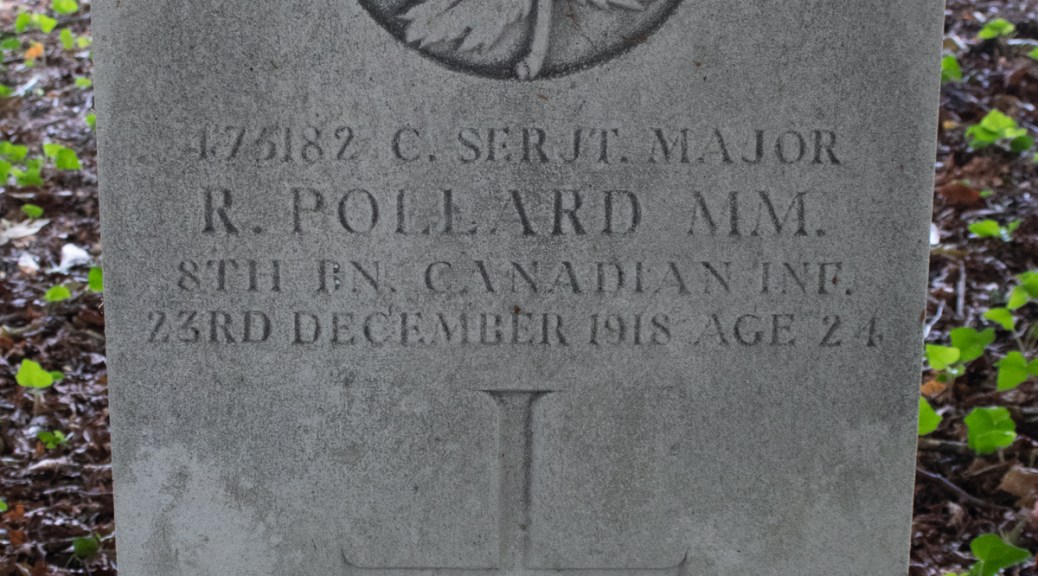
Company Serjeant Major Robert Pollard

Robert Edwin Dawe Pollard was born on 8th April 1894 in Bath, Somerset. The youngest of three children, his parents were Joseph and Elizabeth Pollard. Joseph was a gardener from Banwell, but it seems that Robert had his sights on bigger and better things.

At some point Robert emigrated to Canada, and, by the time war was declared in Europe, he was working as an insurance clerk in Winnipeg. He felt a duty to serve his country, however, and on 2nd August 1915, he enlisted in the Canadian Expeditionary Force.

Private Pollard’s service records confirm he was 5ft 6ins (1.69m) tall, with dark brown hair, brown eyes and a fair complexion. He was also noted as being a Presbyterian.

Robert’s commitment to the cause is underlined by his rise through the ranks. Attached to to the 8th Battalion of the Canadian Infantry (also known as the 90th Winnipeg Rifles), he arrived in France on 27th February 1916.

The 8th Battalion was involved in some of the fiercest fighting of the war, and, on the 1st June 1916, he was wounded in his left arm. Admitted to a hospital in Camiers, he was moved to Etaples, before returning to his unit before the month was out.

For good or for bad, this was just before the Battle of the Somme and, over the next few months, Private Pollard fought bravely and hard. Moving from the Somme, his unit fought at Passchendaele and Ypres. On 1st October 1916, Robert was promoted to Corporal, and made Sergeant just three months later.

In April 1917, Robert was admitted to hospital again, this time with an infected foot. Within six weeks he was back with his unit, though, and on 7th November 1917, he was promoted to Company Serjeant Major. He was obviously good at what he did, and this was recognised. On 28th December 1917, he was mentioned in despatches, and the following June he was awarded the Meritorious Service Medal.

As the war entered its closing months, Company Serjeant Major Pollard, still led from the front. He returned to Britain at the end of November 1918, and was attached to the 18th Reserve Battalion in Seaford, Sussex ahead of being demobbed.

It was here that Robert contracted influenza. Whether at his family’s request is unclear, but he was admitted to Bath War Hospital for treatment but, after everything that he had been through, it was a combination of the flu and toxaemia, or blood poisoning, that was to prove his undoing. Company Serjeant Major Pollard died on 23rd December 1918, aged just 24 years old. His mother, Elizabeth was by his side.

Robert Edwin Dawe Pollard was laid to rest Bath’s sweeping Locksbrook Cemetery, not far from where his family lived. His headstone recognises the Military Medal he was posthumously awarded.


Company Serjeant Major Robert Pollard
(from findagrave.com)

Serjeant Thomas Wood

Serjeant Thomas Wood

Thomas Wood was born in Bristol, Gloucestershire, in the summer of 1862. The third of ten children, he was the oldest son to Thomas and Emma Wood. Thomas Sr was a cabinet maker, but his son was not to follow in his father’s footsteps, seeking a life of adventure instead.

Thomas enlisted in the army and, while documents relating to his early life are not readily available, the 1891 census recorded him as being billeted at the Cambridge Barracks in Portsmouth, Hampshire. A member of the Royal Artillery, he seems to have been enlisted for a while, as he had risen to the rank of Corporal.

In 1894, Thomas married Leah Barrett, who was born in Oxfordshire. The army life underscored where the family would settle. They had four children and, according to their ages, the Woods were in Liverpool by 1895, Gosport, Hampshire, in 1896 and Cork in Ireland by 1899. The 1901 census found the family living in Wicklow, with Thomas having now achieved the rank of Company Sergeant Major.

Ten years later, and Thomas had stepped away from the army life. Now 48 years of age, he and Leah had been married for 17 years. The couple had settled in the Worle, on the outskirts of Weston-super-Mare, Somerset, where Thomas had set himself up as a butcher, with Leah assisting him.

War came to Europe in 1914, and it seems that Thomas felt drawn to play his part once more. He joined the Royal Defence Corps as a Serjeant when it was formed in the spring of 1916, and was assigned to the regiment’s 263rd Company.

Little information is available about Serjeant Wood’s army service, but by the autumn he had been admitted to the Shell Shock Hospital (now the Maudsley Hospital) in Denmark Hill, London. His entry to the hospital, however, was actually due to kidney disease, and this was what would claim his life. Thomas died from a combination of nephritis and uraemia on 21st November 1916. He was 54 years of age.

Thomas Wood was brought back to Somerset for burial. He was laid to rest in the graveyard of St Martin’s Church in Worle.


Serjeant Thomas Wood
(from ancestry.co.uk)

Serjeant Albert Rumbelow

Serjeant Albert Rumbelow

Albert Edward Rumbelow was born in 1879 in Wycombe Marsh, Buckinghamshire. One of eleven children, his parents were Suffolk-born paper maker Philip Rumbelow and his wife, Jane.

Little information is available about Albert’s early life, although by the time of the 1901 census, he is recorded as being a Private in the Rifle Brigade. The family had moved to the village of Little Chart in Kent by this point, where his father was still continuing in the manufacture of paper.

Private Rumbelow’s military service is evidenced in later documents. He served with the 1st Battalion from 1895 to 1907, was awarded the South Africa medals for 1901 and 1902: he was also granted the clasp for his involvement in the defence of Ladysmith. He appears to have been wounded at this point, and was invalided out of full military service and placed on reserve.

In 1904, Albert was back in England, and living in London. That year he married Ellen Sillis, a cordwainer’s daughter from Norfolk. The couple set up home in Fulham, and went on to have five children: Abert Jr, Iris, Florence, Doris and Hilda.

By the time of the 1911 census, Albert was working at the local Public Hall, as a labourer, hall attendant and cleaner. The family were living at 9 Crabtree Lane in Fulham, sharing the property with the Fitzgerald family.

War was closing in on Europe by this point, and, once again, Albert stepped up to plat his part. He enlisted within days of conflict being declared, and within weeks had been given the rank of Corporal. His service records note that he was 5ft 10ins (1.78m) tall, weighed 156lbs (70.8kg), had brown hair and blue eyes. He was also recorded as having a tattoo of crossed rifles and a crown on his right forearm, and scared on his left calf, knee and eyebrow.

By the spring of 1915, Albert had been promoted again, to the rank of Serjeant. He was sent to France on 19th May, having been assigned to the 7th (Service) Battalion. Serjeant Rumbelow was involved at the Somme and was awarded the Distinguished Conduct Medal “for conspicuous gallantry” on 3rd June 1916. “He exposed himself to machine-gun and rifle fire when going across the open to rescue a wounded man. Later he went under fire to fetch a stretcher.”

Serjeant Rumbelow appears to have been injured in the skirmish, and was invalided to the UK later that month. When he recovered he was posted again, this time to the 18th (London) Battalion of the Rifle Brigade.

The following February he made the transfer across to the Labour Corps, and by March 1917, Serjeant Rumbelow was back in France. In August he was promoted to Company Sergeant Major, but was invalided back to England with bronchitis in February 1918.

When he recovered Albert was assigned to the 364th Area Employment Coy. in Kent, and seems to have voluntarily taken a drop in rank – back to Serjeant – in doing so. His health was dogging him by this point and in the late summer of 1918, he was admitted to Preston Hall Military Hospital in Aylesford, suffering from VDH, or heart disease.

Sadly, the strain of his military service was to be his undoing. He passed away from the heart condition on 21st September 1918, at the age of 39 years of age.

Albert Edward Rumbelow was laid to rest in the graveyard of St Peter & St Paul’s Church in Aylesford, not far from the hospital where he had breathed his last.


Now widowed, Ellen was left with the unenviable task of raising five young children on her own. She married again, to Private William Lake, on 8th June 1919, and the family moved to Essex. She lived until the age of 79, and was laid to rest in Sutton Road Cemetery in Southend.


Company Serjeant Major Henry Bird

Company Serjeant Major Henry Bird

Henry Sidney Bird was born on 2nd December 1884 in Penarth, Glamorgan. He was the second of two children to painter and glazier Frederick Bird and his wife Emma. Henry’s mother passed away when he was only eleven years old and, by the time of the 1901 census, he was boarding with a family in the town, and working as a domestic gardener.

The next census – in 1911 – found the family back together again. Henry’s brother Frederick Jr was the head of the household, and she and his family – wife, Eliza, and three children – shared their home with Henry and his father. Harry, by this time, was working as a ship’s fireman.

Little information remains about Henry’s military service. He joined up when war broke out, and records show that he had enlisted in the South Staffordshire Regiment by the start of 1916. Assigned to the 8th (Service) Battalion, it is likely that he soon found himself on the Front Line.

Henry’s bravery seems to have been without fault. He went on to reach the rank of Company Serjeant Major in his battalion and was awarded the Distinguished Service Medal. The citation confirmed this was for “conspicuous gallantry. When the enemy rushed an isolated trench he saved the situation by collecting bombs and superintending the erection of stops and barbed wire. During the whole operations he set a splendid example to his company.

Company Serjeant Major Bird’s battalion was caught up in the fighting at Ypres early in 1916 and, by the summer, was involved in the Battle of Albert. It was here that Henry was wounded, and he was quickly evacuated to Britain for medical treatment. Admitted to the General Hospital in Northampton, his wounds were to prove too severe, and he passed away from them on 18th July 1916. He was just 31 years of age.

Henry Sidney Bird’s body was brought back to Wales for burial: he was laid to rest in the graveyard of St Augustine’s Church in his home town of Penarth.