Category Archives: Private

Lance Corporal Henry Rowell

Henry Edward Rowell was born on 22nd May 1898 in Southwark, Surrey. One of five siblings, of whom only three survived childhood, his parents were Henry and Jane Rowell. Henry Sr was a bricklayer’s labourer from Southwark, and the family were brought up in a small terraced house on Brandon Street, Walworth.

When he finished his schooling, Henry Jr found work as a turner’s improver but, when war came to Europe, he was called upon to play his part. He enlisted on 29th May 1915, and, as a Private, was attached to the 12th (Service) Battalion (Bermondsey) of the East Surrey Regiment. His service records tell a little of the man he was, confirming that he stood 5ft 3.5ins (1.61m) tall, and suggesting that he gave his age a 19 years old (he was just 16 at the time).

Henry seemed to have made an impression on his superiors as, in early October, he was promoted to Lance Corporal. His early service was based on home soil, primarily in Witney, Surrey.

In December 1915, Henry was temporarily released from military duty for munitions work. Sent to work for the engineering company Peter Hooker Ltd, in Walthamstow, Essex, Lance Corporal Rowell was to remain here for the next four months. On 25th March 1916, however, he was called back to service, as his battalion readied itself to move from its base, by that point in Aldershot, Hampshire, to Northern France.

Lance Corporal Rowell found himself in the thick of things very quickly. From 1st July, the 12th Battalion was caught up in the Battle of the Somme, and he remained entrenched there for the next couple of months.

On 15th September 1916, the British launched an attack on the German front line at Flers-Courcelette, mid-way between Albert and Bapaume. Lance Corporal Rowell was involved in the battle, which lasted until the end of the month, and was cut down on the very first day. He was just 18 years of age.

Henry Edward Rowell was laid to rest in the Bulls Road Cemetery in Flers, Picardie.


Henry Edward Rowell was my paternal grandmother’s first cousin.
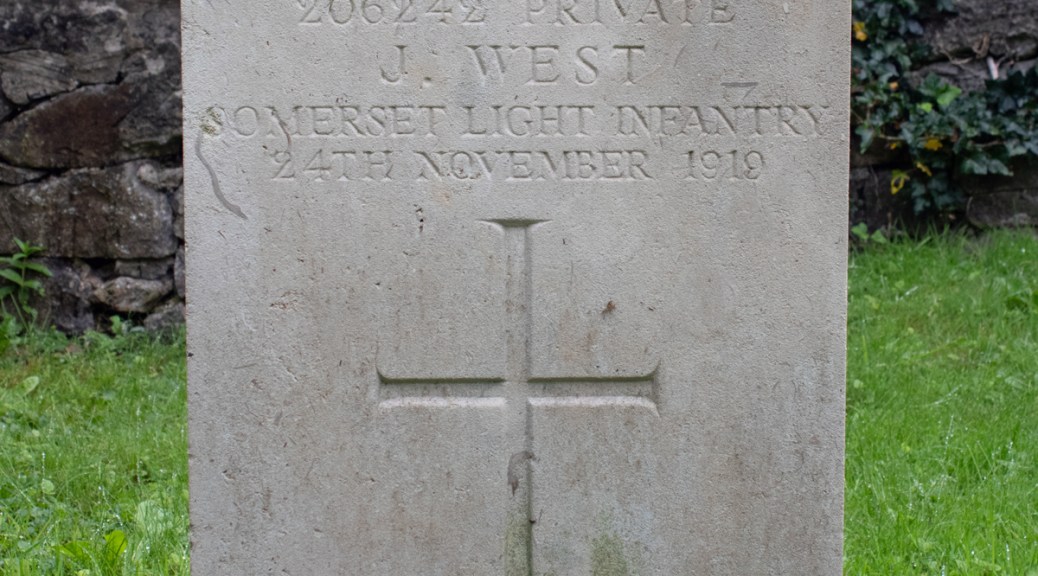

Private Jeremiah West

Private Jeremiah West

Jeremiah West was born in the spring of 1892, the oldest of eight children to John and Laura West. John was an agricultural labourer from Somerset, and it was in the village of Bleadon that the family were born and raised.

When he finished his schooling, Jeremiah followed in his father’s footsteps. By the time of the 1911 census, he was working as a servant on the nearby Shiplette Farm, where he was employed by Kate Poole.

War came to Europe in 1914, and Jeremiah stepped up to play his part. He enlisted in the Somerset Light Infantry in 1915, and was assigned to the 4th Battalion. Private West set sail for India that August, and seems to have remained overseas for some time.

Records are not clear, but it would appear that Jeremiah returned to Britain at some point, and became attached to the 3rd Battalion of the Bedfordshire Regiment. This was a garrison troop, based in Harwich, Essex, and Jeremiah found himself part of the battalion’s Labour Corps.

Private West survived the war, but came down with pneumonia in the autumn of 1919. He passed away on 24th November 1919: he was 27 years of age.

Jeremiah West was brought back to Somerset for burial. He was laid to rest in the peaceful graveyard of St Peter and St Paul’s Church in his home village of Bleadon.


Private William Griffin

Private William Griffin

William Richard Griffin was born in the summer of 1899, the fourth of six children to James and Joice Griffin. James was from Somerset and worked as a superintendent for a life assurance company. He met his wife while working in Wales, and this is where their oldest three children had been born. By the time of William’s birth, however, James had moved the family back to Somerset, setting up home in the Weston area of Bath.

There is little information about William’s life. When war was declared, he joined the Devonshire Regiment, and was assigned to the 51st (Graduated) Battalion. His troop remained on home soil – remaining in Norfolk for the duration – so it is unlikely that Private Griffin saw any active service overseas.

William survived the conflict and returned home. He passed away, possibly due to an infection, based on what little is documented, on 22nd July 1920. He had not long turned 21 years of age.

William Richard Griffin was laid to rest in the graveyard of St Martin’s Church in Worle, near Weston-super-Mare.


Serjeant Thomas Wood

Serjeant Thomas Wood

Thomas Wood was born in Bristol, Gloucestershire, in the summer of 1862. The third of ten children, he was the oldest son to Thomas and Emma Wood. Thomas Sr was a cabinet maker, but his son was not to follow in his father’s footsteps, seeking a life of adventure instead.

Thomas enlisted in the army and, while documents relating to his early life are not readily available, the 1891 census recorded him as being billeted at the Cambridge Barracks in Portsmouth, Hampshire. A member of the Royal Artillery, he seems to have been enlisted for a while, as he had risen to the rank of Corporal.

In 1894, Thomas married Leah Barrett, who was born in Oxfordshire. The army life underscored where the family would settle. They had four children and, according to their ages, the Woods were in Liverpool by 1895, Gosport, Hampshire, in 1896 and Cork in Ireland by 1899. The 1901 census found the family living in Wicklow, with Thomas having now achieved the rank of Company Sergeant Major.

Ten years later, and Thomas had stepped away from the army life. Now 48 years of age, he and Leah had been married for 17 years. The couple had settled in the Worle, on the outskirts of Weston-super-Mare, Somerset, where Thomas had set himself up as a butcher, with Leah assisting him.

War came to Europe in 1914, and it seems that Thomas felt drawn to play his part once more. He joined the Royal Defence Corps as a Serjeant when it was formed in the spring of 1916, and was assigned to the regiment’s 263rd Company.

Little information is available about Serjeant Wood’s army service, but by the autumn he had been admitted to the Shell Shock Hospital (now the Maudsley Hospital) in Denmark Hill, London. His entry to the hospital, however, was actually due to kidney disease, and this was what would claim his life. Thomas died from a combination of nephritis and uraemia on 21st November 1916. He was 54 years of age.

Thomas Wood was brought back to Somerset for burial. He was laid to rest in the graveyard of St Martin’s Church in Worle.


Serjeant Thomas Wood
(from ancestry.co.uk)

Private Ernest Badman

Private Ernest Badman

Ernest John Badman was born in Wick St Lawrence, Somerset, on 28th September 1898. The second youngest of ten siblings, although only six survived childhood, his parents were farm labourer William Badman and his wife, Fanny.

There is little specific documentation for Ernest. War came to Europe in the summer of 1914, and he had enlisted in the Wiltshire Regiment by the winter of 1916.

Attached to the 4th (Reserve) Battalion, Private Badman seems to have been in his initial training period by the following spring. However, this was not to last long. He passed away while on home soil on 21st March 1917: he was just 19 years of age.

Ernest John Badman was brought back to his home village for burial. He was laid to rest in the sleepy graveyard of St Lawrence’s Church.


Private Maurice Lock

Private Maurice Lock

Maurice Lock was born in Nailsea, Somerset, the seventh child to William and Rebecca Lock. Dates of birth vary according to documents available: census records suggest he was born around 1884, although his military records put his year of birth as 1877.

Maurice had a total of eleven siblings, with names including Merrick, Britannia and Cinderella. His father was a licensed hawker and this was something of a family trade.

The 1891 census recorded the family living at The Heath in Nailsea, although, unusually, it was noted that “this family now residing in a house occupy a travelling van in summer.” By the time of the next census return, the family business was continuing, with eight members, Maurice included, recorded as being peddlers, hawkers and horse dealers.

On 23rd January 1909, Maurice married Emily Hughes. There is little information available about her, but the couple continued Maurice’s parents’ travelling lifestyle, and went on to have four children: Albert, Mary, Gladys and Agnes.

Maurice was called upon to do his duty when war came to Britain. He enlisted on 4th September 1916 and was initially assigned to the Duke of Cornwall’s Light Infantry. Private Lock’s service record shows that he was 39 years and 10 months old when he joined up, and that he stood 5ft 8ins (1.73m) tall. He was working as a basket maker and farm labourer when he received the call to enlist.

Private Lock spent a couple of months on home soil, before his troop – the 12th (Labour) Battalion – were sent to France. He remained overseas for some sixteen months, before three separate bouts of trench fever within a month saw his return to Britain’s shores.

Maurice was transferred to the Labour Corps at this point and, once he had recovered, it was to be presumed that his previous farm work would be called upon once more. However, his age and the conditions on the Western Front conspired against him, and he developed rheumatism, which led to his discharge from the army. His medical records at this point noted that “he walks very lame with the aid of a stick. His left leg is especially [bad]. He has pains in his back, legs and shoulders. These pains are aggravated by pressure and weather changes.”

Maurice returned home, but his time back in Somerset was to be brief. His health deteriorated, and he passed away at home on 29th June 1918: he was in his late 30s or early 40s when he died.

Maurice Lock was laid to rest in the peaceful graveyard of Christ Church in his home town of Nailsea.


Private Joseph Staddon

Private Joseph Staddon

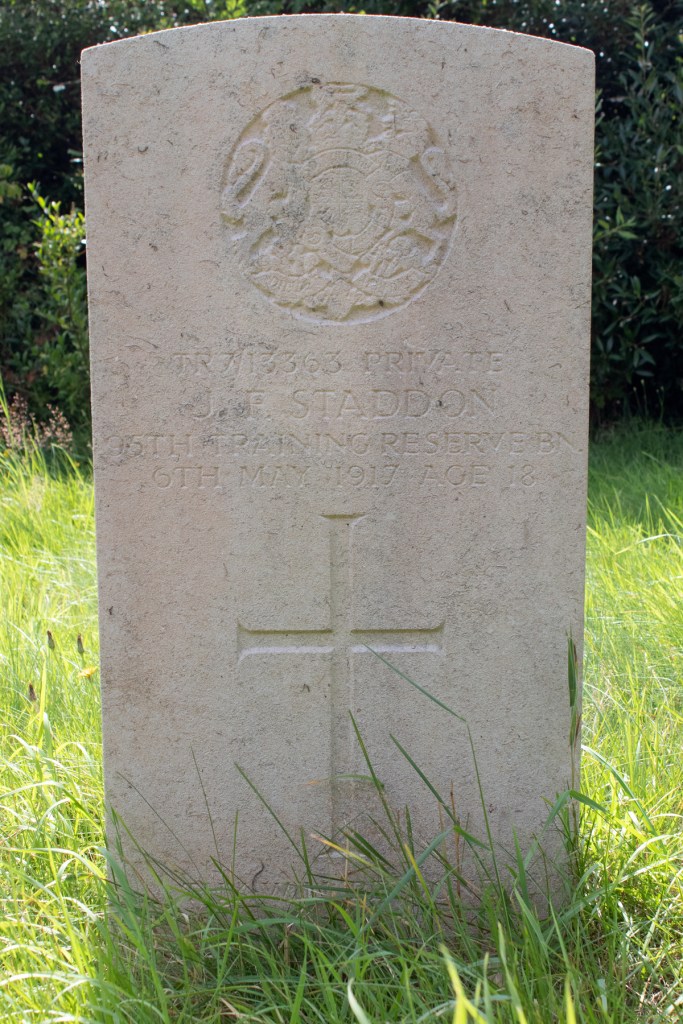
Joseph Frederick Staddon was born at the start of 1899, the oldest of seven children to John and Mary Ann Staddon. John was a farmer from Luccombe in Somerset, and it was in this small village that the family were born and raised.

There is little documentation to expand on Joseph’s life. He enlisted in the Duke of Cornwall’s Light Infantry when he turned 18, and was initially attached to the 95th Training Reserve Battalion.

Private Staddon was barracked in Chiseldon, Wiltshire, but his time in service was not to be a lengthy one. Admitted to a military hospital near the camp, he passed away from what was probably an illness on 6th May 1917. He was just eighteen years of age.

Joseph Frederick Staddon’s body was brought back to Somerset for burial. He was laid to rest in the cemetery extension to St Mary’s Church, Luccombe.


Tragedy was to strike again when, ten months after his son’s passing, John also died. Mary was left picking up the pieces, while supporting her six remaining children, the youngest of whom, Dorothy, was not even two years old.

The family survived, Mary running the farm with her oldest boy, Edward. She passed away on 4th August 1937, at the age of 63 years old.


Private Albert Daymond

Private Albert Daymond

Albert Daymond was born on 7th June 1893, in Porlock, Somerset. The youngest of seven children, his parents were Devon-born Albert and Maria, who was also born in Porlock. Albert Sr was a wall mason, and, by the time of the 1901 census, his work had moved the family to the sleepy village of Luccombe.

When he finished his schooling at the village’s Church of England School on 20th December 1908, Albert found employment in a bakery. This was the employment he would continue in until, in the summer of 1914, war broke out across Europe.

Albert enlisted on 9th October 1914, joining the West Somerset Yeomanry as a Private. Little information about his military service is available, although the Commonwealth War Grave Commission records note that he was known by the surnames of Daymond and Daiman.

Tragically, Private Daymond’s time in the army was not to be a long one. He passed away while in a camp in Minehead, Somerset, on 10th December 1914. The cause of his passing is not known, but he was just 21 years of age.

Albert Daymond was brought back to Luccombe for burial. He was laid to rest in the village’s St Mary’s Churchyard.


Albert’s older brother, Alfred, also served in the First World War. Read his story here.

Private Alfred Daymond

Private Alfred Daymond

Alfred Daymond was born on 9th July 1891, in Porlock, Somerset. The second youngest of seven children, his parents were wall mason Albert Daymond and his wife, Maria. By the time of the 1901 census, Albert’s work had moved the family to the sleepy village of Luccombe.

When Alfred finished his schooling, he followed his father into wall building. This was the career he was still following when, in 1914, war broke out.

Alfred was quick to play his part for King and Country. He enlisted on 4th November 1914, joining the Somerset Light Infantry. Private Daymond’s service records show that he was 5ft 10ins (1.78m) tall, with good vision and a fair physical development.

Initially serving as part of a territorial force, Alfred remained on home soil until September 1916. At this point he was transferred over to the Duke of Cornwall’s Light Infantry, and became attached to the 7th (Service) Battalion. Details of his time in the army are sketchy, but his troop certainly fought at the Somme in 1916, and at Ypres the following year.

In May 1917, Alfred returned to British shores. His health appears to have been suffering, although it is not clear from what ailment. On 8th February 1918, Private Daymond was discharged from army service as being no longer physically fit.

Alfred’s trail goes cold at this point. It is likely that he returned home to Luccombe, and this is where he passed away, on 11th November 1918, Armistice Day. He was 27 years of age.

Alfred Daymond was laid to rest in the family plot of St Mary’s Church, Luccombe. He was interred alongside his younger brother, Albert.


Alfred’s younger brother, Albert, also enlisted for war service. Read his story here.

Private Francis Prescott

Private Francis Prescott

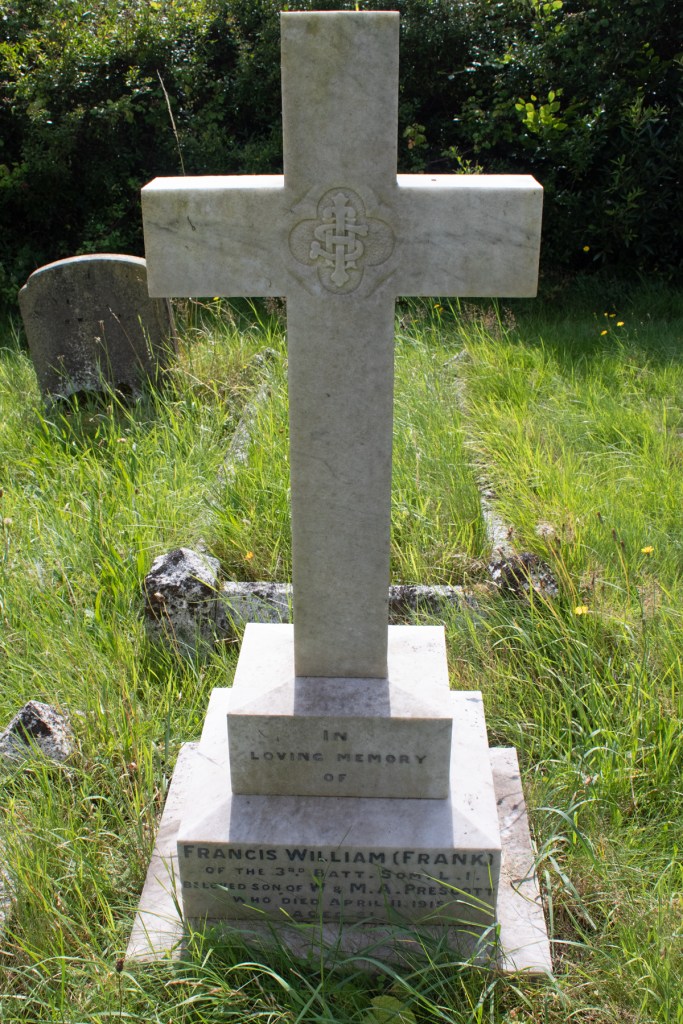
Francis William Prescott – better known as Frank – was born on 17th March 1894, and was one of four children to William and Mary. William was an agricultural labourer from Somerset, and, by the time of the 1901 census, the family had settled in the village of Luccombe, in the western outreaches of the county.

Frank went to school in Allerford, before spending a year at Luccombe’s Church of England school – from 13th May 1907 to 29th May 1908. Now aged 14 years old, he was considered old enough to be earning his keep. He found work as a farm boy on a farm on the outskirts of the village, but with storm clouds brewing across the Channel, he was keen to play his part.

Little information is available about Frank’s military service, but it is clear that he enlisted in the first weeks of the war, as imperial fervour gripped the country. He enlisted in the Somerset Light Infantry and, as a Private, was assigned to the 3rd (Reserve) Battalion. Contemporary documents do not confirm either way, but as this particular troop was based at Devonport, Devon, for most of the war, it is unlikely that Private Prescott saw any action overseas.

Indeed, he was in barracks on 11th April 1915, when he passed away. Again, the cause is lost to time, but he was just 21 years of age when he died.

Francis ‘Frank’ William Prescott was taken back to Somerset for burial. He was laid to rest in Luccombe Church Cemetery, not far from where his family still lived.


Frank’s younger brother, Harold, also enlisted in the war. He joined the Royal Engineers as a Private and, unlike his brother, he did go to the Western Front.

Harold was caught up in the fighting, and received a gunshot wound to his arm. He recovered, but the injury dogged him. He was formally discharged on 14th May 1919, and found work as a lorry driver. Harold married Kathleen Peck in December 1929: the couple’s only child, Edward, was born just over a year later.

Harold spent his life in Somerset. He died in Exmoor in the spring of 1968, at the age of 71 years old.