Charles William Debney was born in the spring of 1887, one of eight children to George Debney and his wife Susannah. George was a cooper for a cement works, who had brought his family from Norfolk to Kent in the mid-1890s, presumably for employment.
When Charles left school, he found work as a bricklayer; war was on the horizon, though, and when the call came, he signed up quickly.
While full details of Charles’ service are not available, it is evident that he had joined the Northamptonshire Regiment by November 1914. He was assigned to the 5th Service Battalion as a Private. Formed in Northampton, the battalion moved to Kent in the early months of the war, before moving to the Western Front at the end of May 1915.
Sadly, there is limited additional information available on Private Debney. He passed away on 29th May 1915, but there is no confirmation of the cause of his death. He was just 28 years of age.
Charles William Debney was laid to rest in the Woodlands Cemetery, in his home town of Gillingham, Kent.
Raymond Champ was born on 30th March 1880, one of eight children to coachman William Champ and his wife Eliza. While Raymond was born in the West Sussex village of Cowfold, within a year, the family had moved to Worthing, settling in the Broadwater area of the town.
The 1901 census gives more of an insight into Champ family life. William by now is listed as unable to work and gives his infirmity as paralysed. There are no newspaper records evident to highlight an accident of any sort, so the cause of his paralysis, and his inability to work, are destined to remain a mystery. The document does show, however, that the other members of the family stepped up to fill in the shortfall of money; Eliza was working as a laundress, Raymond was a bricklayer’s labourer, and his younger brother Francis (or Frank) was employed as a milk boy.
Fast forward ten years, and the next census give further information. It confirms that William was paralysed when he was 45 years old (in around 1894/1895). Raymond, now aged 30, was still working as a bricklayer, Frank was an iron founder, and the youngest brother, George, was a baker.
Raymond was a keen footballer, and went on to captain the Silverdale Football Club. By the time war broke out, he had found work at Wenban Smith, a renowned timber supplier in the town. The call to arms came, however, and, in September 1914, he enlisted.
Private Champ joined the Royal Sussex Regiment, and was assigned to the 2nd Battalion. Shipped overseas in February 1915, he served on the Western Front, but his time there was not to be a lengthy one. A local newspaper report picked up Raymond’s story:
The wretched conditions which our Troops had to contend with during February and March proved too much for his constitution, and having the misfortune to contract bronchitis, he was invalided home in April, being taken to one of the Military Hospitals in Manchester.
His recovery was regarded as hopeless from the first, but the careful nursing and attention which he received there brought about a temporary improvement, and he was eventually discharged in order that he might return to his home, where his death occurred on Sunday week.
The funeral on Thursday afternoon was of a very impressive character, and despite a heavy deluge of rain, there was a large number of sympathising friends at the Cemetery to pay the last tribute of respect.
Worthing Gazette: Wednesday 14th July 1915
Private Raymond Champ passed away on 4th July 1915 and just 35 years old. His body was laid to rest in Broadwater Cemetery, Worthing, not far from where his family were living.
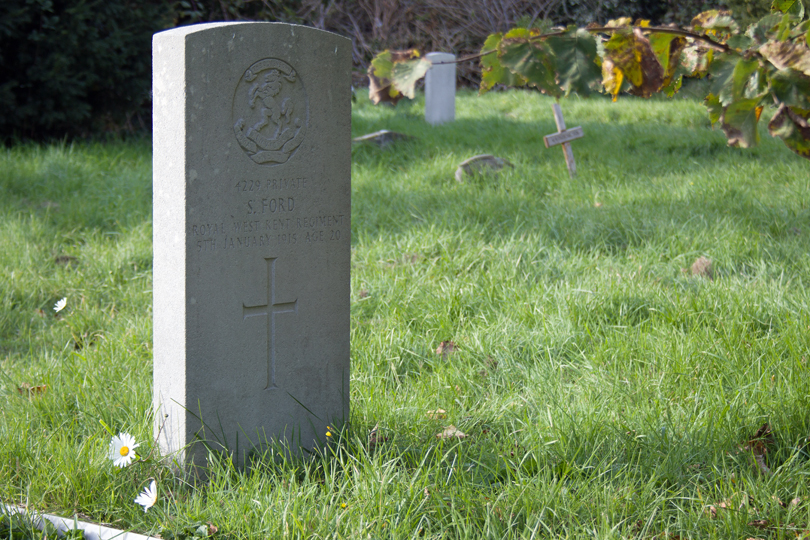
Sidney Ford was born in Kent in 1896, the son of Stephen John Ford and his second wife, Elizabeth Ann (née Underdown). The couple had four children – Frederick, Sidney, Ethel and Alice – although it seems that Elizabeth brought them up almost singlehandedly. Sidney’s military records gives his father’s name, although simply notes that he was an imbecile, in the stark way that only Edwardian officials could.
Sadly, little of Sidney’s early life remains documented. By the time war broke out, he was working as a farm labourer in Yalding, close to where he was born. He enlisted at the end of October 1914, joining the Queen’s Own (Royal West Kent Regiment), and was assigned to the 8th (Service) Battalion as a Private.
Joining up in Maidstone, by the end of the year, Private Ford’s battalion was soon billeted in Worthing, West Sussex. Tragically, his service was destined to be a short one, and he passed away after only a month in the town.
The first death from the Red Cross Hospital, Cecil’s, at West Worthing, had to be recorded. Since it has been opened there have been a large number of cases, and many of them have been of a serious nature, but happily all except the one under notice have made progress, thanks to the skill of the Medical Officers and Nursing Staff of the institution.
The deceased in this instance was a Private of the Eighth Battalion of the West Kent Regiment, now stationed locally. His name was Sidney Ford, and he was twenty-five years of age. He died on Friday, and at the funeral, which took place on Monday, full Military honours were accorded him.
Colonel Vansittart (who commands the Eighth Battalion) and Major Bock-Hollinshead attended, as also did other members of the Staff of the Hospital. A large number of the public were also at the Cemetery to witness the last rites, the progress of so long and so imposing a procession through the streets attracting considerable attention.
Worthing Gazette: Wednesday 20th January 1915
Private Ford has died on 15th January 1915, and was actually just 20 years of age, not 25, as had been reported. The Worthing Gazette does not give no mention to Sidney’s family, so it can only be assumed that they were unable to make the journey from Kent to the funeral. I have been unable to uncover details of the cause of his death, but, given that there is no mention of the cause in the newspaper, it is likely to have been following an illness than anything more sensational or unusual.
Sidney Ford lies at rest in the Broadwater Cemetery in Worthing, one of the first in the town to have passed because of the Great War.
Sidney’s older brother, Frederick, was also involved in the Great War. While there is little specific information about his service, it is evident that he was a Private in the Duke of Wellington’s (West Riding Regiment).
Unlike his younger brother, Frederick did see military action, but list his life on the Western Front on 4th November 1915, ten months after Sidney had passed in Worthing.
Frederick lies at rest in the Royal Irish Rifles Graveyard in Laventie, in Northern France.
Fred Ford was born in the Wiltshire town of Mere in 1877. One of eight children to John and Charlotte, his father was an agricultural labourer from the village.
When he left school, Fred initially found work as an errand boy; he soon moved into labouring and, by the time of the 1901 census, was employed as a bricklayer.
In 1904, Fred married Florence Phillips; she was the daughter of an agricultural labour from Somerset. Fred, by this time, had found work as a coal miner in the county, and the young couple set up home in the village of Babington, near Frome. They went on to have four children.
Conflict was on the horizon and, while full details of his military service are not available, it’s clear that he enlisted as soon as he was able to, almost as was was declared. Gunner Ford joined the Royal Field Artillery, and was assigned to the 108th Brigade of the regiment’s Ammunition Corps.
Initially based in Taunton, Fred was soon moved to Portsmouth and then Worthing, and it was here, in the first winter of the war, that he contracted influenza and pneumonia. Admitted to St Cecil’s Red Cross Military Hospital in the Sussex town, sadly the condition proved too much for him. He passed away on 8th February 1915, tragically hours before Florence arrived from Somerset. Gunner Ford was just 37 years old.
Finances not enabling her to transport his remains back home, Florence Ford laid Fred’s body to rest in Broadwater Cemetery in Worthing, the town where he died.
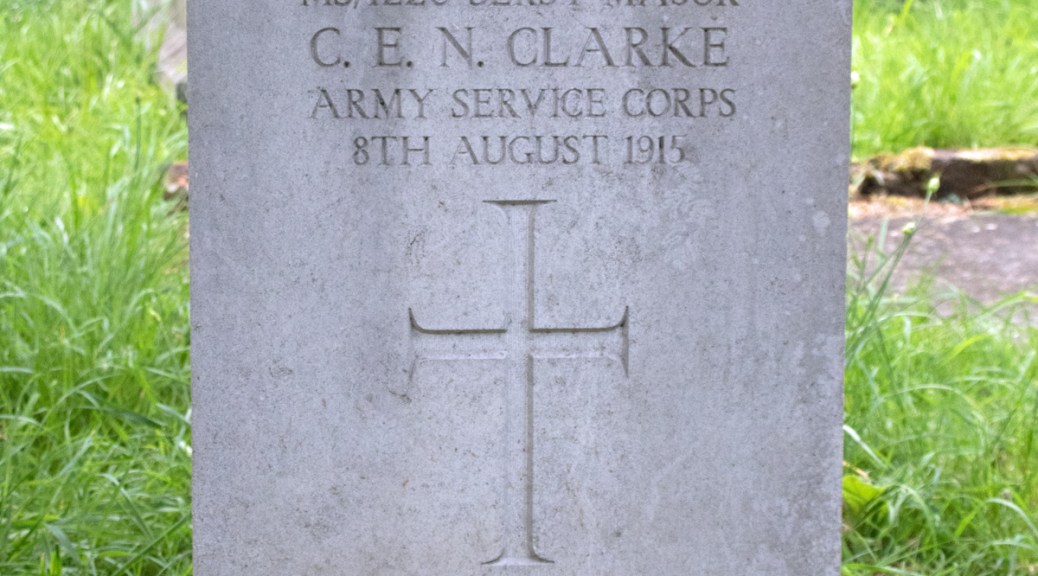
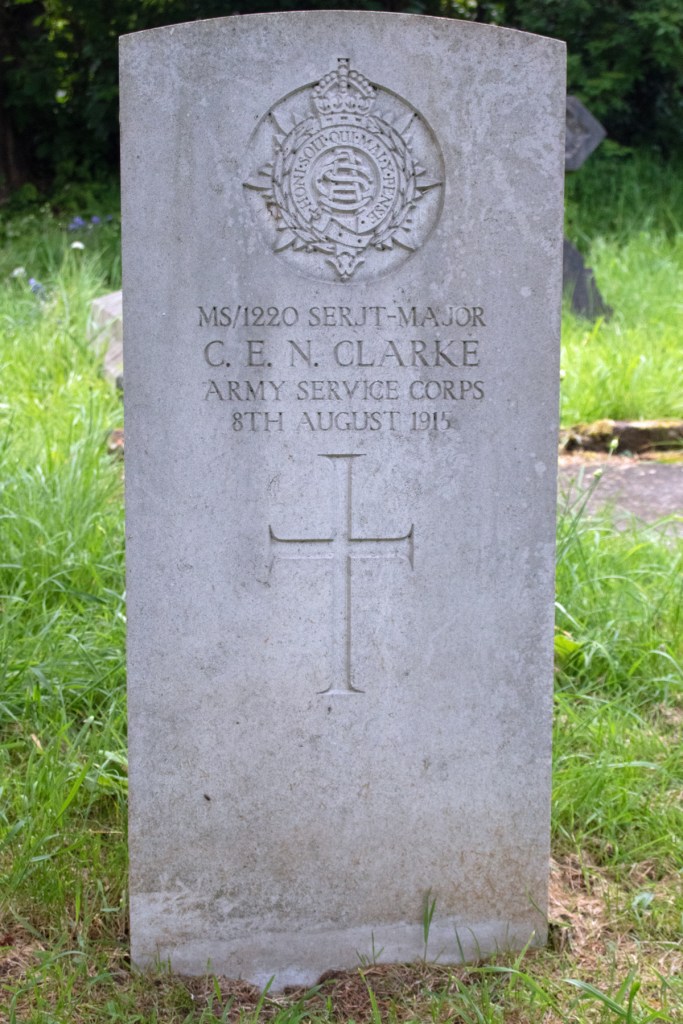
Charles Edward Nesbit Clarke was born in December 1884, the son of Ralph Clarke. Sadly, there is little documentation to flesh out his early life. He had at least one sibling, a sister called Nellie, and was born in London, possibly in Hampstead.
Charles seemed to have been mechanically minded; when he left school, he found work with a motor vehicle fitter, before going on to get employment as an electrical engineer.
He met a woman called Elizabeth Bertha Gould, and the couple married in Islington in November 1908. Four years later, the couple had a child, Edward. The boy’s baptism record shows that the family were living in the St John’s Road Workhouse in Islington, so things seemed to have been really tough for them. (There are no other workhouse records available, so it may be that it was a temporary residence, while Edward was born, but this cannot be confirmed either way.)
The Great War broke out, and Charles enlisted straight away. He had found employment as aforeman fitter by this point, and joined the Army Service Corps, in the Motor Transport Division. He was sent to France a week later, as part of the British Expeditionary Force, and served there for seven months.
When he returned to England, having gained the 1914 Star and the British and Victory Medals for his service, he was assigned to the military camp at Burnham-on-Sea, Somerset.
Five months later, a local newspaper picked up the sorry story of what happened next.
At Weston-super-Mare Hospital… Dr S Craddock held an inquest on the body of Staff Sergeant Major Charles Clark [sic], Army Service Corps, who was admitted to that institution suffering from a mortal and self-inflicted wound received at the Burnham military camp on Sunday morning.
Captain Budibent deposed that at the time the deceased was detained in camp as the result of having been absent from duty for four days without leave. On hearing of his return, witness (who liked the man and recognised his great value, having served with him in France) went to the tent to see him. Deceased was very upset, and in reply to a question said “I can’t account for staying away; I must have been mad.” Witness tried to cheer him up, reminding him that is was not “a hanging matter”, to which Clark replied “No, sir, I wish it was.” When they were in France together Clark confided to witness that a girl who once lived with him desired him to marry her on his returning from the Front, but he stated that he could not do so, as he loved another girl. As he was depressed, witness advised him on returning home to see the girl who considered she had a claim upon him, and, if it were a matter of money, to settle it, and then marry the other girl. On later returning to the Front from England, deceased said his troubles were over, that he had married the other girl, and that he could now do his work with a good heart. Witness, however, believed other troubles had arisen.
Sergeant Belt, ASC, said he had slept in the same tent with the deceased. Clark had a good night, but next morning became very depressed over the fact that half the Company were leaving the came for another destination, and would be losing close friends. He remarked “The last hour has been the worst in my life.” Later, when outside the tent, witness heard a rifle shot and, rushing in, found Clark lying in bed with a rifle wound in his chest. Deceased admitted that he had fired the rifle himself. Death occurred in Weston Hospital, whither he was removed the same night. The medical evidence revealed terrible internal injuries, the bullet having practically severed deceased’s liver.
The jury returned a verdict that Clark committed suicide while temporarily insane.
Taunton Courier & Western Advertiser: Wednesday 18th August 1915
The report, particularly Captain Budibent’s comments, raises some questions. By the time of the First World War, Charles was married to Bertha. There is no record of him having married anyone else, so where the girl he loved, and the other who loved him came into it, it is impossible to say.
Sergeant Major Clarke had taken his own life at the age of just 31 years old. Bertha and their son were living in Chatham, Kent, at the time, and it seems likely that the cost of moving him closer to home may have ruled that out.
Charles Edward Nesbit Clarke’s body was buried instead in the Milton Cemetery in Weston-super-Mare.
John Frederick Dyer was born in Crediton, Devon, on 3rd July 1864. He was one of twelve children to William Dyer, a shoemaker, and his wife Sarah.
When he left school, John initially found work as a tanner – presumably helping with his father’s business. He soon moved on from this, however, and worked as a labourer and then a stone mason.
In 1888, aged 24, he married a woman called Emily; they went on to have four children. By the time of the 1901 census, John was a fully fledged mason, and the family had moved to Weston-super-Mare in Somerset.
From this point in, there is little information available relating to John’s life. The 1911 census records him as living in the centre of Weston-super-Mare, in a six-room house with his wife, two of his children and his niece.
Storm clouds were on the horizon in Europe, but not much documentation records his military service. He was 50 years old when war was declared, and he was old enough to be exempt from volunteering or conscription. However, he did put his name forward, and enlisted at some point at the beginning of 1915.
Private Dyer joined the 4th Battalion of the Somerset Light Infantry. This was a primarily territorial force, that served in India and the Middle East, although there is no confirmation that he was anywhere outside of the UK during his time in the army.
In fact, Private Dyer’s service was not destined to be a long one; the next available record shows that he died on 9th July 1915 at the 2nd Southern General Hospital in Bristol. He had just turned 51 years old. Sadly, no details of the cause of death exist.
John Frederick Dyer’s body was brought back to Somerset for burial. He lies at rest in the Milton Road Cemetery in his adopted home town of Weston-super-Mare.
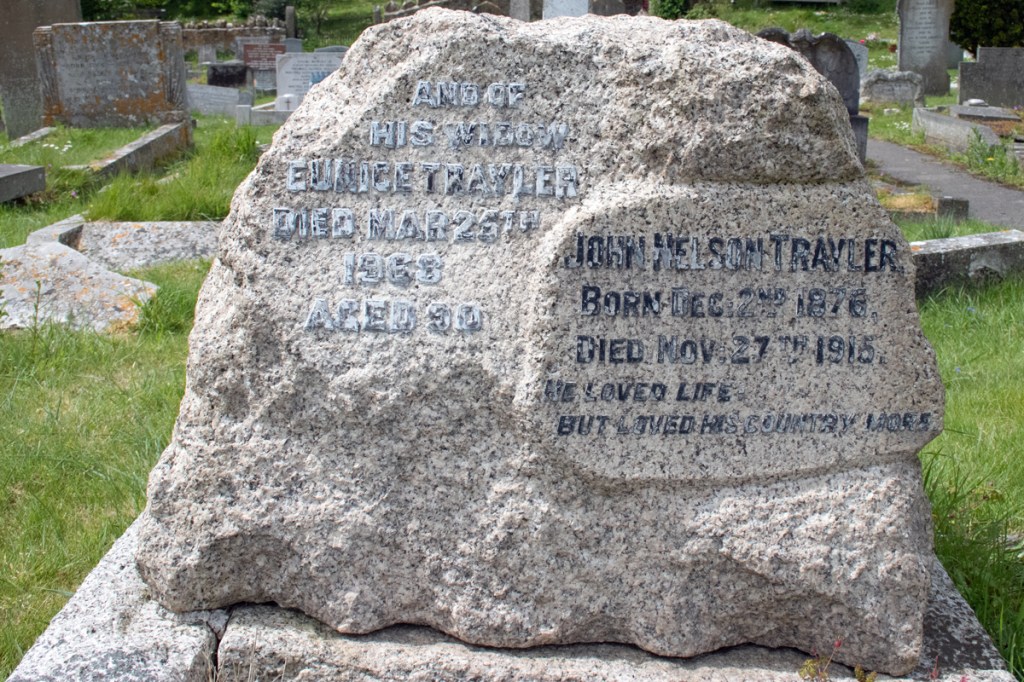
John Nelson Trayler was born on 2nd December 1876, the oldest of seven siblings. His father, Jonas Trayler, was born in London, but moved to South Wales to become a farmer. He married Elizabeth Green, who was from Haverfordwest, and John was their eldest child, born in Pembrokeshire.
In December 1895, having just turned 19, John joined the 1st Devonshire Volunteer Corps. He seemed eager for a life of action; given that the 1901 census lists his profession simply as ‘farmer’s son’, it’s easy to see why. By this time, the family had moved to a farm in Broadclyst, to the north east of Exeter in Devon.
There was a change of direction for the family, however. By 1908, both father and son were working as tanners; John had moved back to Wales, while Jonas had set up work in Bridgwater, Somerset.
John, by this time, had met Eunice Sully; she was the daughter of a gentleman, and her family lived in Wembdon, near Bridgwater. They married in July 1908, and lived in the village of Lamphey in Pembroke.
John was, by now, the managing director of a tannery and obviously had the business acumen to run a company. He joined the local freemason’s – the Lodge of Perpetual Friendship – but, in January 1914, it was reported in the local newspaper that the business was to be voluntarily wound up.
John’s father Jonas was also forging ahead with his ambitions, and was a councillor for the Bridgwater area.
When the Great War broke out, John’s time with the Devonshire Volunteer Corps was such that he had attained the rank of Captain. Assigned to the 11th (Reserve) Battalion, John was based out of Exeter and it is unlikely that he saw any active service in France.
In August 1915, the Exeter and Plymouth Gazette reported that Captain Trayler had relinquished his commission on account of poor health, and this seems to have been an ongoing issue. In fact, when he was staying with Eunice’s parents in Clevedon later that year, he fell seriously ill. While his medical condition is lost to time, sadly it was one he succumbed to. He died at his in-laws’ house on 27th November 1915, at the age of 39 years old.
John Nelson Trayler was laid to rest in the picturesque graveyard of St Mary’s Church in Clevedon, Somerset.
David Percy was born in 1896, one of ten children to Elizabeth Percy. By the time of the 1901 census – the first one on which David appeared – Elizabeth was widowed, so there is no record of who his or his siblings’ father was.
Elizabeth, working to make ends meet, found employment as a cook at Taunton Boys’ School, in her home town. The 1911 census shows her two youngest sons – David and his older brother Douglas – were living with her, as was a lodger, Owen Howe. David, by this time, had left school and found work as a labourer, while Douglas was employed as a carter.
David soon found a new job as a printer for Hammett & Co. in the town, but war was beckoning across the Channel. In October 1914 he enlisted, joining the West Somerset Yeomanry as a Private and was sent to Minehead for training.
The local newspaper picked up his story:
He there caught a chill and was in hospital for some time. At Easter [1915] he was removed to the Taunton Hospital, and subsequently sent home.
Taunton Courier and Western Advertiser: 26th May 1915
Sadly, after Private Percy’s discharge home, he passed away from his ‘chill’, breathing his last on 15th May 1915. He was just 19 years old.
David Percy was buried in St James’ Cemetery in his home town of Taunton.
Joscelin William Currey was born in the summer of 1897, one of six children to Job Arthur Currey and his wife, Eliza Jane. Job was a shoesmith, and brought his young family up in his home town of Taunton, Somerset.
When Joscelin left school, he worked as an errand boy, before becoming an apprentice with local foundry of Messrs. Rudman, Lancey and Co. But with war on the horizon, things were about to change.
Along with his older brothers, Joscelin enlisted in the army, joining the 3/5th Reserve Battalion of the Somerset Light Infantry in August 1914. Initially based on Salisbury Plain, he was soon transferred to Bath, and attained the position of Lance Corporal.
It was in Bath that he fell ill, and was admitted to hospital with cerebrospinal meningitis. Sadly, Joscelin was to succumb to this condition, and he passed away on 28th June 1915. He was just 18 years of age.
Joscelin William Currey was laid to rest in the St James Cemetery of his home town of Taunton.
The newspaper report of Lance Corporal Currey’s funeral confirmed that one of his brothers was a prisoner of war in Germany, while another was in the Royal Field Artillery. Joscelin was the only one of the three to die during the conflict.
Joscelin’s name is spelt variously as Jocelyn and Joslin across the documents relating to him, and his surname is also spelt Curry. For the purposes of this post, I have chosen to use the spelling cited on the Commonwealth War Graves Commission records.
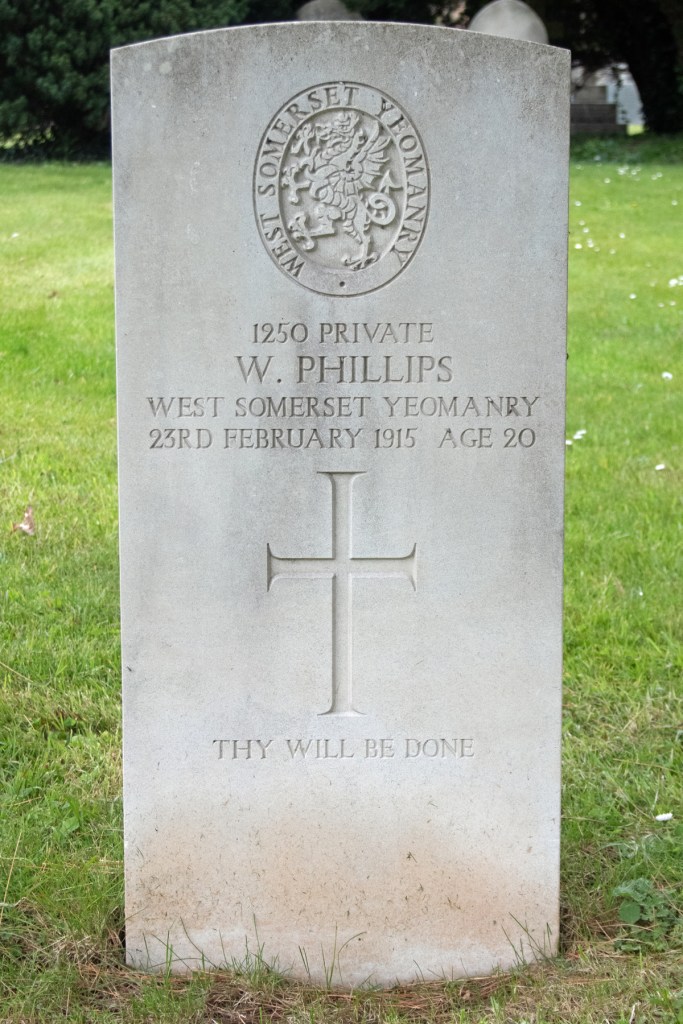
William Phillips was born in 1895, the youngest of seven children to Frank and Emily Phillips. Frank was a joiner and carpenter and, while his young family initially grew up in his home village of Thurloxton, Somerset, he and Emily soon moved them to nearby Taunton, where there would be more work and more opportunities.
By the time of the 1911 census, the young family were all tied up with different jobs. While William had become an office boy for an accountant when he left school, his siblings all had varying different roles: one was a boiler cleaner, another a mason, a third a cellarman and the fourth a shop assistant. With Frank’s own work, this meant that there were five wages coming into the home, albeit on a much smaller scale that we are used to these days.
War was coming, however, and, at the beginning of 1915, William enlisted in the West Somerset Yeomanry. Little information remains of his military service, but it is known that Private Phillips’ experience as a clerk was made use of, and he worked in admin at the reserve depot in Minehead.
William had, by this time, got himself a lady friend, who worked at the hospital in Taunton, and, while they did not see each other a lot, they corresponded regularly.
His new-found freedom from the family home seemed to have led to William being a bit freer with his money than his parents would like, and it appears that he may have run up a few debts He reassured his mother that he did not want to worry them with any business that he had. However, financial matters may well have played on his mind more than he would have liked to admit.
On Saturday 20th February 1915, Private Phillips travelled to Taunton to see his girlfriend; she was working, but he caught up with his sister instead, before returning to the base in Minehead that evening.
The following Tuesday morning, he received a letter from his girl and was last seen heading to breakfast in the hotel digs where he was billeted.
That afternoon, a local engineer was walking along the seafront, when he saw a body lying on the foreshore, about four feet (1.21m) from the high-water mark. The body – which was later identified as William – was wearing some clothing, but other bits were scattered around him. The police were called and Private Phillips’ body was taken to nearby Dunster.
The coroner confirmed William had drowned; the letter he had received was amongst his clothing, but there was nothing in it to suggest that anything was amiss. At the inquest, he suggested that “he could hardly suppose at this time of year that the deceased had taken off his clothing in order to bathe. [His conclusion was that William] got into the water with intent to drown himself.” [Taunton Courier and Western Advertiser: Wednesday 3rd March 1915]
The jury at the inquest returned the verdict of ‘found drowned’. Private Phillips was just 20 years old.
William’s body was brought back to Taunton for burial. He lies at rest in the St James Cemetery there.
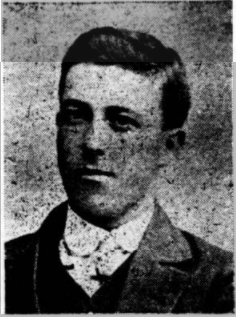
William Phillips (from britishnewspaperarchives.com)









 Death and Service