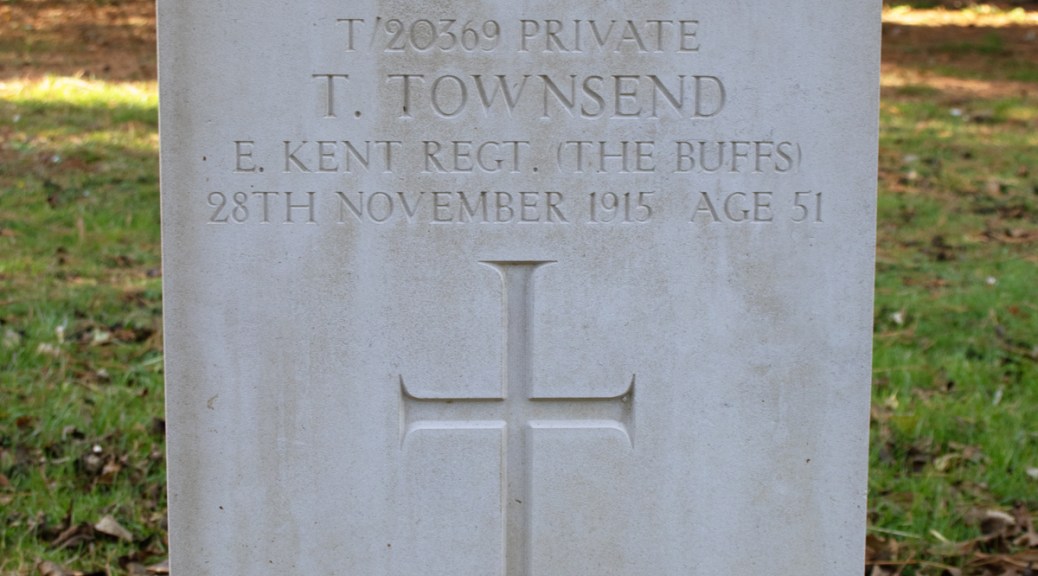
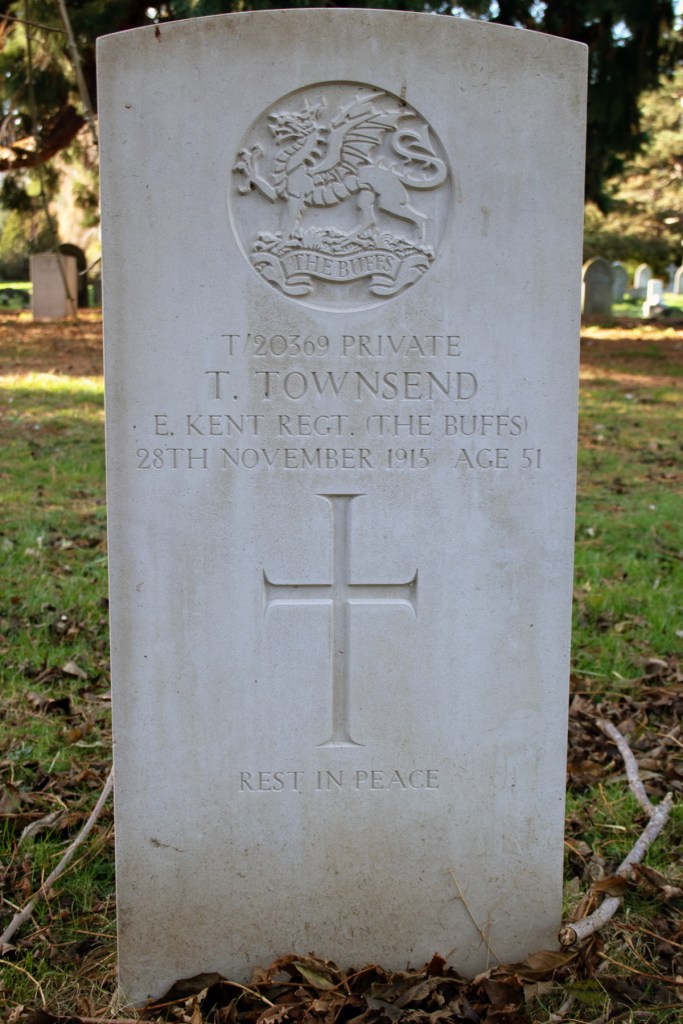
Thomas Townsend was born in Maidstone, Kent, in around 1864. Details of his early life are sketchy, but his mother was Mary Townsend, and he had an older brother, Henry.
Thomas worked as a labourer, mainly in brickyards, and, at the turn of the century, was living in to the north of Maidstone. The 1901 census records him as sharing his home with his wife, Lydia Townsend, her son, George Andrews, and a visitor, seven-year-old John Lassam.
The next census, in 1911, Thomas and Lydia are both shown as living in the same house, although it notes they had been married for eight years. John Lassam is still living at the property, by now as a boarder, while he was also working as a labourer.
Conflict was closing in on Europe and, despite being 50 when war was declared, Thomas was keen to play his part. He initially enlisted in the Queen’s Own Royal West Kent Regiment, but soon transferred across to The Buffs (East Kent Regiment). Full details of his service as unclear, but it seems he was assigned to the National Reserve Guard at Faversham, Kent.
Private Townsend’s role was guard duty, possibly at the munitions factory in the town. While carrying out this role in the autumn of 1915, he caught a chill, which then became pneumonia. He was admitted to the Faversham Military Hospital, but the lung condition was to get the better of him, and he passed away on 28th November 1915. He was 51 years of age.
Thomas Townsend was laid to rest in Faversham Borough Cemetery, not far from where he carried out his military role.
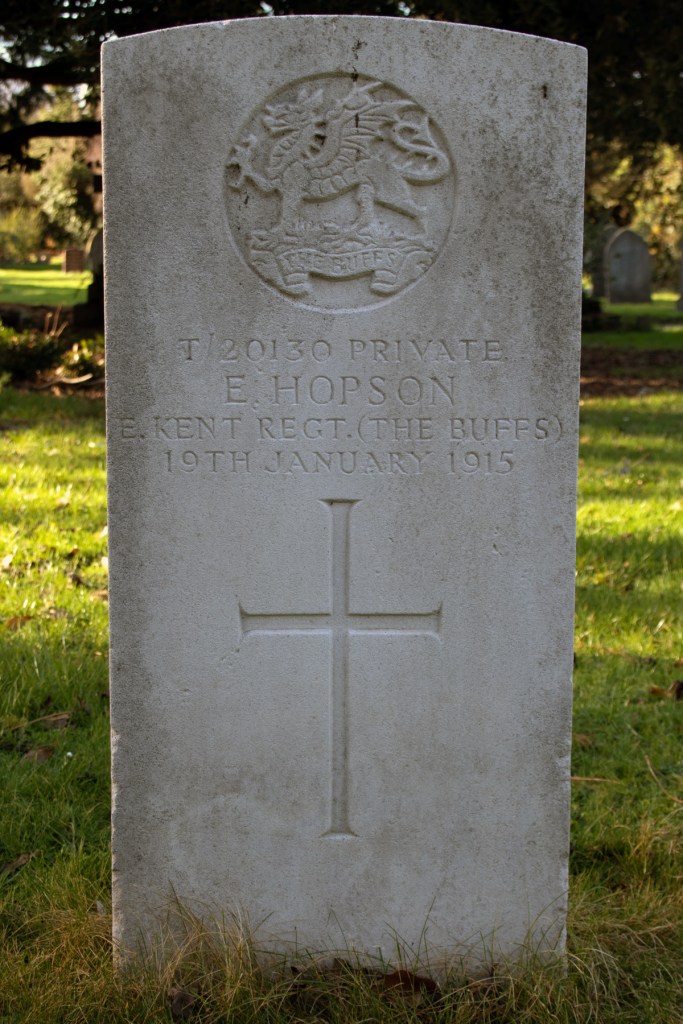
The life of Edward Hopson looks likely to remain a mystery, and what can be pieced together is done from a few fragmented documents. His gravestone sits in the Faversham Borough Cemetery in Kent.
A local newspaper, contemporary to his passing in January 1915, acts at the starting point:
Edward Hopson, a Maidstone [Kent] man, belonging to the National Reserve Guard doing duty at the Explosives Works at Faversham, died suddenly while proceeding on duty on Tuesday night.
Evidence of identification was given by Joseph Cornelius, a Lance Corporal in the Guard, who stated that so far as was known, the deceased’s only relative was a half-brother. The deceased gave his age as 49 when he enlisted, but witness believed his correct age was 61. He was apparently in good health when passed for duty on Tuesday at the works of the Explosives Loading Company at Uplees.
Charles John Link, engaged on patrol duty at the works, stated that about 10:30 on Tuesday night he was accompanying deceased to the point where he was to do guard duty. On the way deceased complained that he could not see, and shortly afterwards, as they came to a style, he exclaimed “Oh! dear,” and then, dropping his rifle, he fell into the witness’s arms and expired.
South Eastern Gazette: Tuesday 26th January 1915
The cause of death was given to be heart disease, and, at the inquest, a verdict of “Death from Natural Causes” was given.
The report suggests that Edward was born either in around 1866 or 1854. The Commonwealth War Graves Commission give his parents as Jack and Annie Hopson, but there are no surviving census records from the 1800s that would corroborate this.
The 1911 census records an Edward Hopson, aged 57 and from Maidstone, Kent, residing in the Maidstone Union Workhouse. He is listed as a former farm labourer, and his marital stated us given as widowed.
If this is the Edward Hopson commemorated in Faversham Cemetery, it seems likely that he used the outbreak of war – and the opportunity to enlist – as his escape route from the workhouse.
He joined The Buffs (The East Kent Regiment), and was assigned, as a Private, to the 4th Battalion. This particular troop was dispatched to India in October 1914, and it seems likely that Private Hopson was reassigned to the National Reserves Guard, and posted to Faversham.
This is all conjecture, of course, but, either way, Private Hopson died of a heart attack on the night of the 19th January 1915, aged approximately 61 years old.
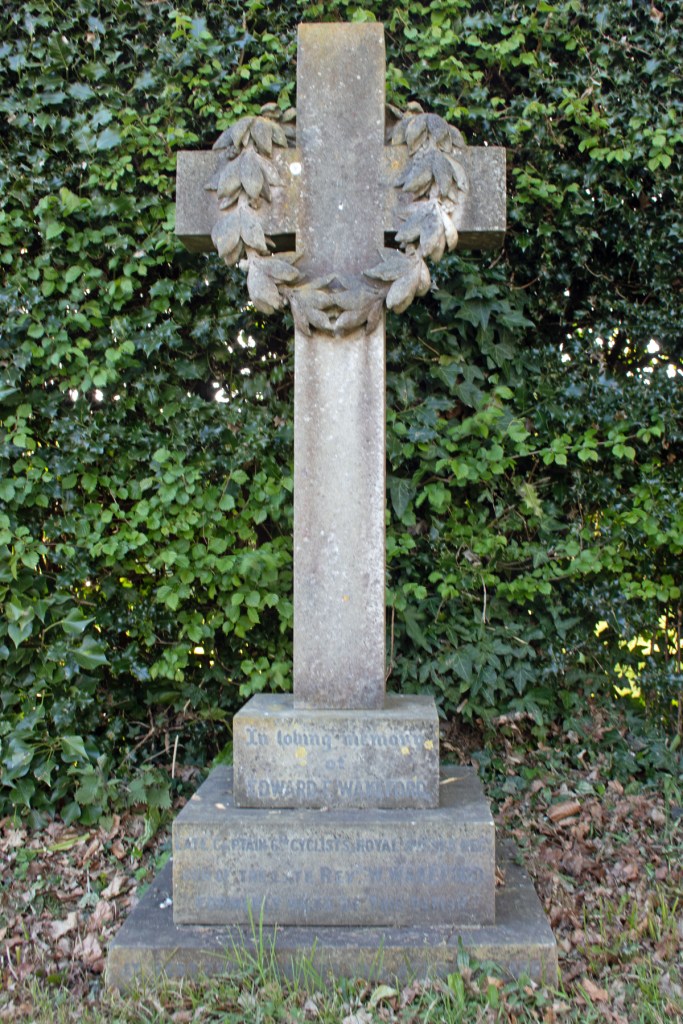
Edward Francis Wakeford was born in Rottingdean, near Brighton, Sussex, in February 1881. He was the younger of two children to curate William Wakeford and his wife, Eliza.
The family home was always a busy one; the 1881 census records one visitor, four boarders and a servant. Ten years later, confirms one boarder and two servants.
By 1901, William had taken up a post in St Peter’s Church, Henfield. This seems to have been a step up: helping look after the family and a visitor were four servants – a gardener, a cook, a housemaid and a kitchenmaid.
In March 1907, Edward married Annie West Thornton; she was the daughter of a well-to-do family – the census records show that her father, William West Thornton, lived by private means, while Annie was sent to Surrey to attend a boarding school.
Edward and Annie couple set up home on the Sussex coast, and, when William passed away in 1912, were soon also living by private means. They went on to have three children: two girls, Olive and Iris, and a boy, who they named William after both of their fathers.
War was coming to Europe by this point. While full details of Edwards military service are not available, he appears to have given a commission in the Royal Sussex Regiment. Initially serving as a Lieutenant, but October 1914, he was promoted to Captain.
Edward was assigned to the 6th (Cyclist) Battalion, and served in East Anglia. It seems that he fell ill while there, and was admitted to the Norfolk and Norwich Military Hospital, suffering with appendicitis. Sadly the condition proved too much, and Captain Wakeford passed away following the operation. He died on 23rd February 1915, not long after his 34th birthday.
Edward Francis Wakeford’s body was brought back to Sussex. He was laid to rest in Henfield Cemetery, not far from the church where his father had served for so long.
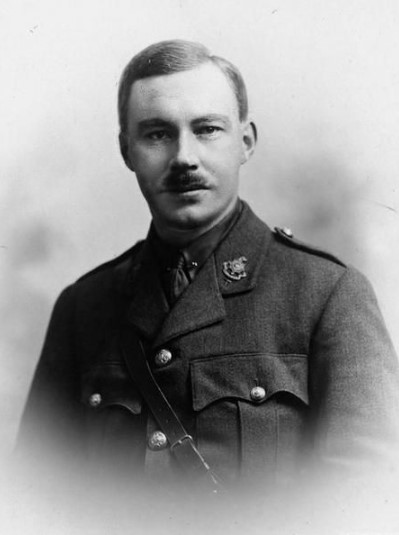
Captain Edward Wakeford (from findagrave.com)
The now widowed Annie wed again, marrying Reverend John Gurney in October 1917. Tragedy was to strike again, though, when she passed away just a year later, on 20th October 1918. She was laid to rest Henfield Cemetery, in the plot next to her late husband, Edward.
John Gurney went on to live a full live. He never married again, and settled in Buxted, near Uckfield. He passed away in November 1956, at the age of 76 years old. He was also laid to rest in Henfield Cemetery, where he was buried in the same plot as Annie.
Edward and Annie’s children also went on to have full lives, despite the early loss of their parents.
Olive never married, and passed away in Nottingham in 1986, aged 78 years old.
Iris married in Liverpool in 1934, and went on to have two children. When the marriage failed in the 1940s, she got wed again in 1949. She passed away in Cheltenham in 1965, at the age of 54.
William got married in 1940, at which point he was serving as a Lieutenant in the 1st King’s Shropshire Light Infantry. He saw action in Italy towards the end of the war, and was awarded a Military Cross for his service. When peace came to Europe again, he and his wife settled into a normal life, before emigrating to Australia. William passed away in May 1967, at the age of 54 years old.
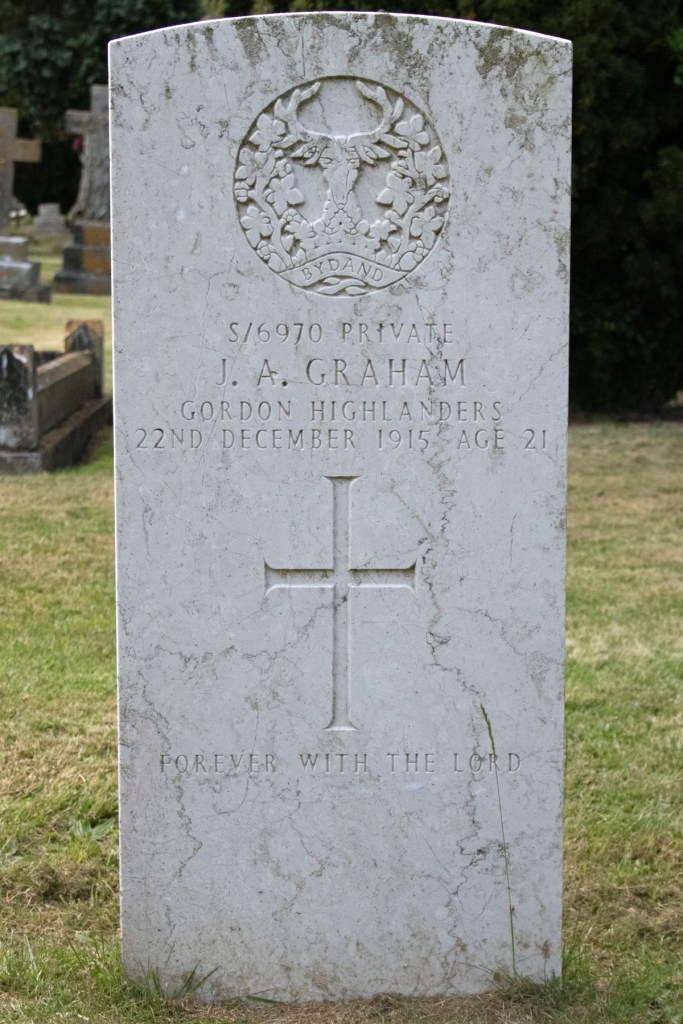
Joseph Aitken Graham was born in Kirkmichael, Dumfries, in 1894 and was the son of James and Bella Graham. There is little detail about his early life, but by the time war broke out, he was working with his father as a ploughman.
Joseph enlisted in November 1914, joining the 2nd Battalion of the Gordon Highlanders as a Private. His medical report records that he was 5ft 9.5ins (1.77m) tall, weighed 145lbs (65.8kg), had grey eyes, brown hair and a fresh complexion.
After a short period of training, Private Graham was sent to the Western Front, arriving in France on 2nd February 1915. He was involved in the fighting at Neuve Chapelle and Aubers Ridge. It was at Festubert, however, that things took a turn for the young private.
On the first day of the battle, 16th May 1915, Graham was badly injured, receiving gunshot and shrapnel wounds to his head and legs. He was initially treated at nearby Bethune, before being moved to Rouen. He was then evacuated to England in July, to further his recovery, and admitted to hospital in Wincanton, Somerset.
He was making such good progress that he was able to take a short walk each morning, and it was after one of these walks that he was taken ill. In spite of all that medical skill could do his condition became gradually worse, and it was thought advisable to send to Dumfries for his parents, who at once proceeded to Wincanton.
Dumfries and Galloway Standard: Saturday 8th January 1916
Sadly, nothing could be done for Private Graham: he passed away from a suspected brain haemorrhage on 22nd December 1915, at the age of just 21 years old.
Joseph Aitken Graham was laid to rest in the quiet and peaceful Wincanton Cemetery.
Albert William Cook was born on 29th August 1887, in the Somerset village of Chaffcombe. He was the oldest of six children – of which only three survived infancy – to William and Harriet Cook. William was a thatcher by trade, and moved his young family to nearby Chard when Albert was a youngster.
When he finished school, Albert found work as a wagoner for the local coal depot, Jarman & Co. War was on the horizon, however, and, at the start of 1915, he signed up to play his part for King and Country.
Private Cook joined the Somerset Light Infantry. While full details of his service are not available, his troop – the 1st Battalion – were heavily involved in the Second Battle of Ypres in the spring of 1915. While he seemed to have survived this, he was later injured, receiving a fractured skull and becoming paralysed on one side.
Albert was admitted to the Canadian No. 2 Stationary Hospital in Le Touquet, but subsequently evacuated to England for further treatment. He was operated on in a hospital in Birmingham, but his injuries proved too severe. He passed away on 3rd September 1915, and had just turned 28 years old.
Albert William Cook’s body was brought back to Somerset for burial. He was laid to rest in Chard Cemetery, not far from his family’s home.
Joseph William Vickery was born in the spring of 1865 in the Somerset village of Isle Abbots. He was the older of two children to farm carter James Vickery and his wife Sarah. James died when Joseph was around six years old, and Sarah remarried, going on to have five children with her new husband, John Kitch.
The new family moved to North Curry, where Joseph found work as a farm labourer when he finished school. The years passed and, on 15th September 1894, Joseph married Elizabeth Ann Saturday, a labourer’s daughter from Chard. The couple settled in the town, and went on to have five children.
By the time war broke out in 1914, Joseph was approaching 50 years old. He still felt a duty to play his part, however, and enlisted towards the end of the following year. Little information survives of Joseph’s military career, but he enlisted in the Somerset Light Infantry and was assigned to the 1/5th Battalion.
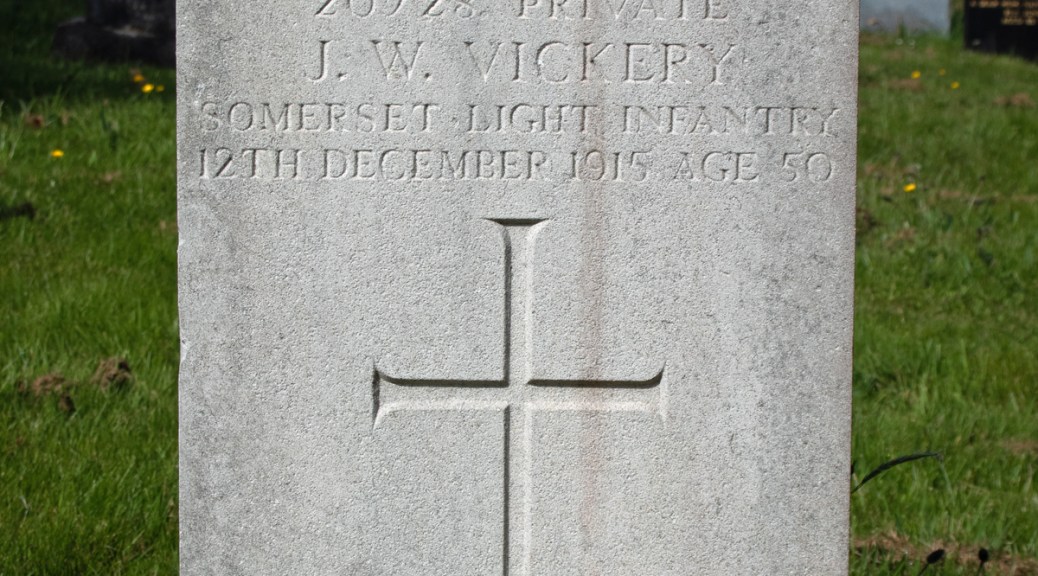
Sent to Salisbury Plain for training, Private Vickery was billeted at Tidworth, Wiltshire. While there, he contracted bronchitis and was admitted to hospital. Sadly, the lung condition was to prove too much for his body to bear, and he passed away on 12th December 1915, at the age of 50 years old.
Joseph William Vickery was brought back to Somerset for burial. He was laid to rest in Chard Cemetery.
Joseph and Elizabeth’s son Victor also played his part in the conflict.
Born in 1900, he was too young to enlist at the start of the war, but, by April 1918, he had joined the Scots Guards as a Private. There is no evidence of him serving overseas, and his service seems to have passed uneventfully. He was demobbed in February 1919, and returned to Somerset to continue his work as a furnaceman.
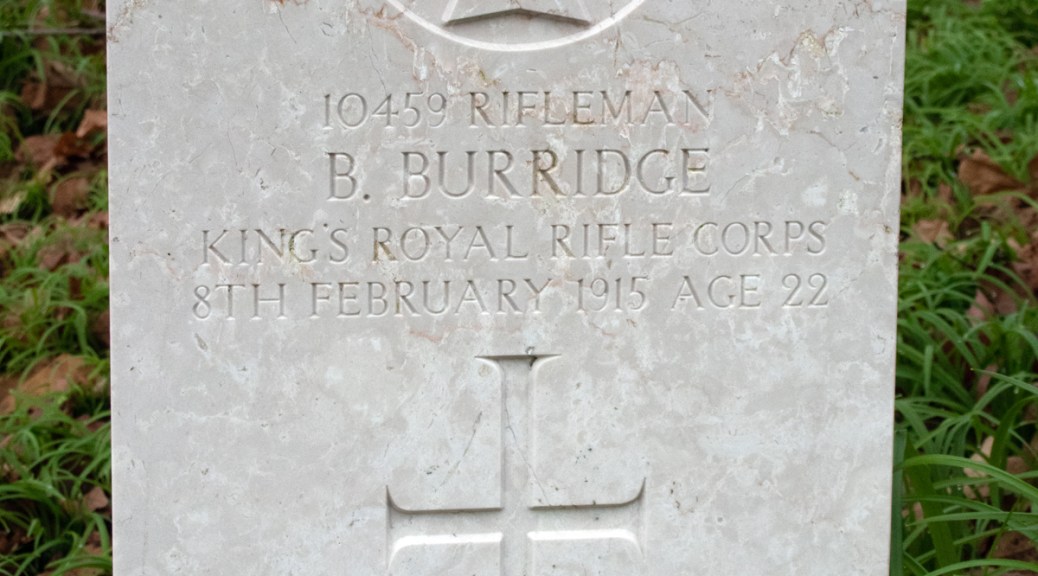
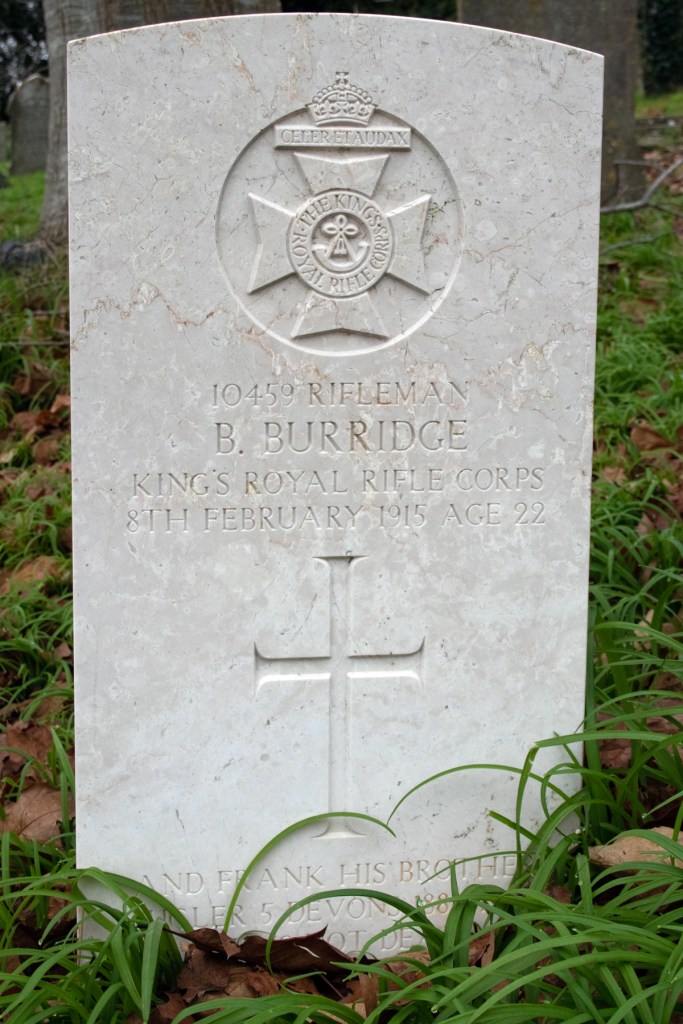
Bert Burridge was born in the spring of 1893, one of nine children to Charles and Elizabeth. Charles was a journeyman shoemaker from Crediton in Devon, and this is where Bert was born. By the time of the 1901 census, however, the family had moved south to Newton Abbot.
When Bert left school, he found work as a carriage cleaner for the railways; he soon moved out, and boarded with a family in Kingsbridge, in the south of the county.
War was coming to England’s shores, however, and Bert was keen to play his part. He enlisted in the 4th Battalion of the King’s Royal Rifle Corps as a Rifleman on 16th January 1912. His service records show that he stood 5ft 4ins (1.63m) tall, and weighed 121lbs (55kg). He had a fresh complexion, grey eyes, dark brown hair, and a tattoo on right wrist of two crossed hands.
When war broke out, Rifleman Burridge was sent to France and was caught up in the fighting early on. After three months at the front, during the winter of 1914, he contracted frostbite, and was medically evacuated back to England. He was admitted to the 2nd Eastern General Hospital in Brighton, but died of injuries on 9th February 1915. He was just 22 years of age.
Bert Burridge’s body was brought back to Devon for burial. He was laid to rest in the graveyard of St Mary’s Church in Wolborough, on the outskirts of Newton Abbot.
Bert’s headstone also includes a commemoration to his older brother, Frank. Seven years older than Bert, he had enlisted in the Devonshire Regiment as a Bugler when quite young. He passed away in the autumn of 1906, aged just 20, but further details are unclear.
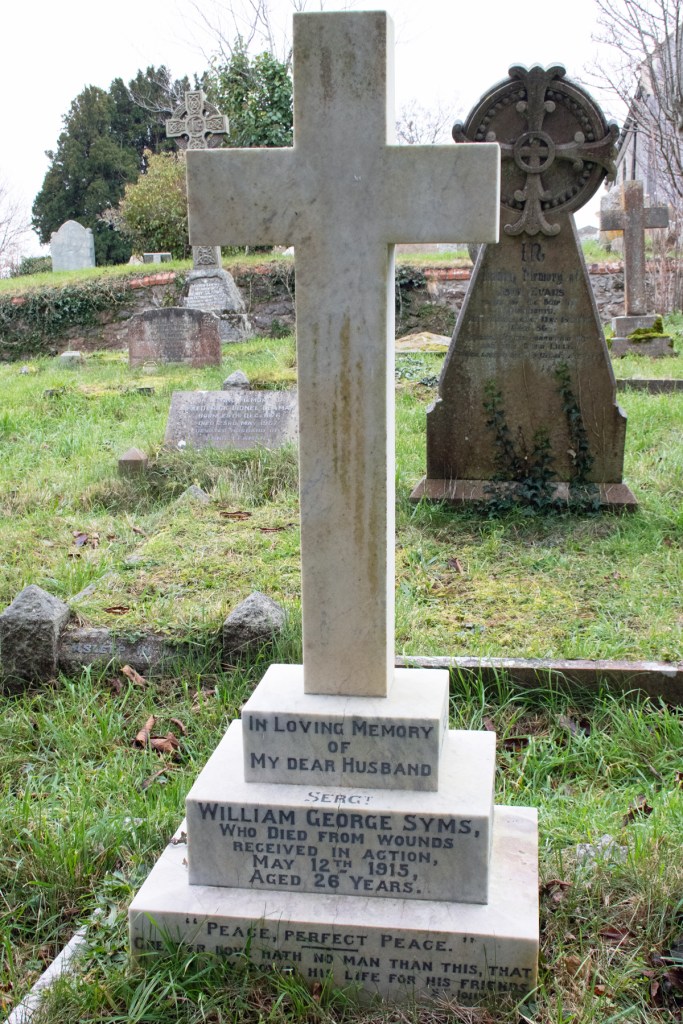
William George Syms was born in in the spring of 1889, the oldest of two children to George and Rose Symes (both spellings are recorded). George was a postman from Devon, and the family were born and raised in Highweek, Newton Abbot.
When William left school, he followed in his father’s footsteps becoming a postman in his home town. Life was not without its ups and downs, however, and the 1911 census record him as an inpatient, convalescing from an unknown illness in Exmouth.
In the summer of 1913, William married Amelia Oliver, a gardener’s daughter, who also from Highweek.
When war broke out William was eager to play his part, and enlisted in the early months of the conflict, alongside a number of his colleagues. He joined the Royal Engineers, and was assigned to the 1st (Wessex) Division Signal Company. He was sent to France on 22nd December 1914 and was involved on the Front Line from early on.
By the spring of 1915, he was fighting at Ypres, and was badly injured, fracturing both legs and suffering from the effects of being gassed. Serjeant Syms – as he was by then ranked – was medically evacuated to England for treatment. He was admitted to the Auxiliary Military Hospital in Manchester, but died of his injuries on 12th May 1915. He was just 26 years old.
William George Syms’ body was brought back to Devon for burial. He was laid to rest in the graveyard of All Saints Church in his home town of Highweek. Tragically, he was never to see his son, also called William, who had been born just two months before.
Bertie Ball was born in Westcott, Berkshire, in the spring of 1890, the oldest of ten children to John and Matilda Ball. John was from Berkshire, who raised his family in Wantage. He began life as a farm labourer, but, by the time of the 1901 census, he had found other employment, as a groom at a racing stable.
Details of Bertie’s life are scarce. When he left school, he found work as a garden labourer and, when war broke out, he enlisted in the Royal Army Service Corps. Private Ball was assigned to the Mechanical Transport Company, but whether he served overseas or on home soil is unknown.
Bertie died on 4th March 1915 from cerebrospinal meningitis. He was just 24 years old. He was laid to rest in the graveyard of St John the Baptist Church in Midsomer Norton – I can find no Somerset connection, so can only imagine that he passed away in or near the town.
Bertie’s younger brother Percival Ball also served in the First World War. He served with the 5th Battalion of the Wiltshire Regiment and fought in Mesopotamia. Sadly, he was killed there, dying on 5th April 1916. He was just 17 years of age. He is commemorated on the Basra Memorial in Iraq.
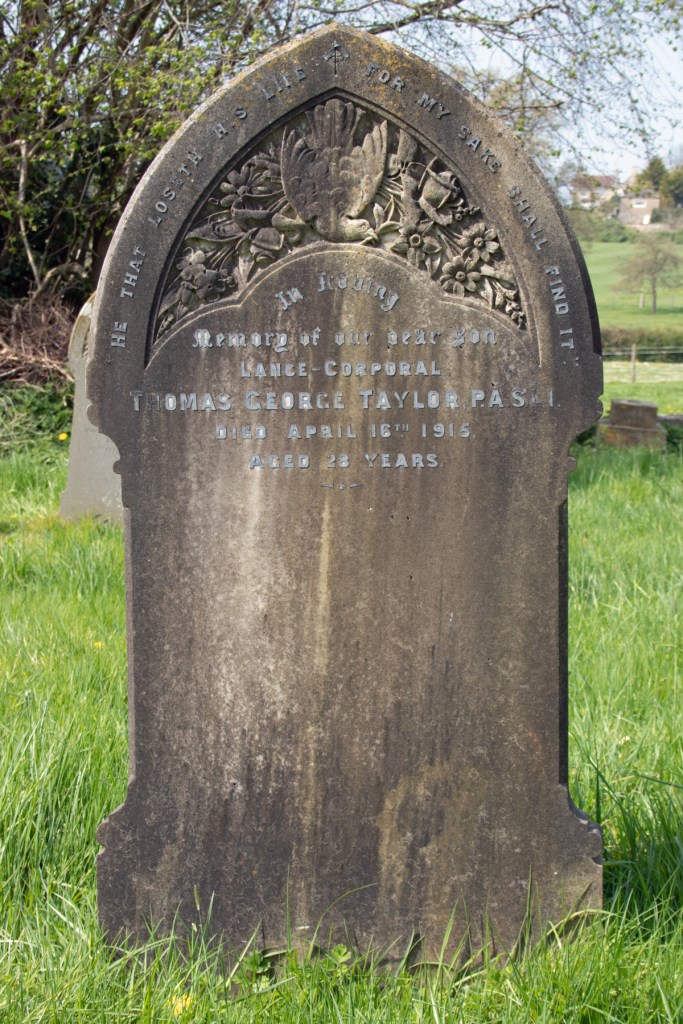
Thomas George Taylor was born in the summer of 1886, and was the youngest of five children to George and Sarah Taylor. George was a gamekeeper in Clutton, Somerset, and he and Sarah raised their family in Rudges Cottage opposite the village church.
Thomas’ older brother John found a variety of jobs, from boot finisher to coal miner, but Thomas followed in his father’s footsteps, and, by the 1911 census, was recorded as a butcher’s apprentice.
Storm clouds were brewing across Europe by this point and, when war broke out, Thomas was one of the first to enlist. Sadly, there is little information on his military service, but it is clear that he joined the 7th Battalion of the Somerset Light Infantry and was quickly promoted from Private to Lance Corporal.
The only other documentary evidence for Thomas is his entry in the Army Register of Personal Effects. This confirms that he was admitted to the Isolation Hospital in Aldershot, suffering from meningitis. Lance Corporal Taylor passed away from the condition on 16th April 1915, aged just 29 years old.
Brought back to Somerset for burial, Thomas George Taylor was laid to rest in the graveyard of St Augustine’s Church, across the road from his family home in Clutton.