Arthur Samuel Dudley was born in the spring of 1895, and was the second of six children to Arthur and Alberta Dudley. Arthur Sr was an fitter for an engineering works in Birmingham, and it was in the Kings Norton area of the West Midlands where he and Alberta raised their family.
When he finished his schooling, Arthur found work as a grocer’s assistant, but factory work offered better financial prospects, and by the time war was declared in 1914, he was working as a tube drawer for the company that employed his father.
The conflict brought further opportunity for a career and an adventure, and this was not something Arthur was able to let pass by. He enlisted on 3rd September 1914, but intriguingly did so in Bodmin, Cornwall, some 200 miles to the south of his home, and there seems to be no direct connection between the Dudleys and this part of the country.
Arthur joined the Duke of Cornwall’s Light Infantry and was assigned to the 6th (Service) Battalion. His medical report – which was completed back in Birmingham towards the end of September – showed that he was 5ft 6.75ins (1.69m) tall and weighed 120lbs (54.4kg). He had brown hair, green eyes and a fair complexion.
On 18th January 1915, Private Dudley transferred to the Army Cyclist Corps, and was attached to the 19th Divisional Cyclist Company. Based in Somerset, he soon found himself barracked near Burnham-on-Sea. It was here, just two weeks later, that Arthur became ill. On 30th January 1915 he was sent to the Volunteer Aid Detachment Hospital in the town, in a diabetic coma, and passed away same evening. He was just 19 years of age.
Unable to afford the cost of bringing their son’s body back to the West Midlands, Arthur Sr and Alberta instead made their way to Somerset for the funeral. Arthur Samuel Dudley was laid to rest in the peaceful Burnham Cemetery, not far from where he had breathed his last.
About 700 of his comrades followed the coffin… Mrs Duncan Tucker and Mrs T Holt, representing the staff of the Red Cross Hospital, were also present.
John Henry Wimble was born in the autumn of 1870, in Bathampton, Somerset. One of seven children, his parents were William and Charlotte Wimble. Charlotte had been married before, but her husband, John Eastment, had died in 1862, leaving her with three children to raise. She remarried in 1864, and William helped support the growing household.
John sought an escape to adventure and, when he finished his schooling, he enlisted in the army. Full service records are not available, but by the time of the 1891 census, he was noted as being a Private in the Somerset Light Infantry, and was living in barracks in Farnborough, Hampshire.
In the autumn of 1891, John married Eliza Hammond. She had been born in Calne, Wiltshire, and, at the time of their wedding, which took place in Bath, she was working as a parlour maid. The couple would go on to have two children, Percy and Victor.
John completed his army service and, according to the 1911 census, the family had settled in Cheddon Fitzpaine, to the north of Taunton. He was noted as being an army pensioner and that he was working as a warehouseman in the government stores. By the time war broke out, the family had moved to Burnham-on-Sea, where John had taken up the role of caretaker at the local Institute.
The war has cost another gallant local soldier, in the person of Sergt.-Major Wimble, of the Somersets, his life. This brave man re-joined the Army when war broke out on condition he could go to the Front. He was wounded, and died in a hospital at Edinburgh. The War Office had the remains sent to Burnham on Tuesday, where they were placed in St Andrew’s Church, and a large attendance of the public and the [Volunteer Training Corps] attended the funeral on Wednesday.
Taunton Courier and Western Advertiser: Wednesday 17th November 1915
John had been assigned to the 6th (Service) Battalion on re-enlisting, and was quickly sent to the front. Caught up in the Action of Hooge and the Second Attack on Bellewaarde, he was medically evacuated to Britain in the autumn of 1915, and passed away on 4th November, at the age of 45.
Here, though, accounts differ slightly. While the newspaper report suggests that he died of his wounds, the Army Register of Soldiers’ Effects gives the cause of death as gastritis.
After the funeral at St Andrew’s Church, John Henry Wimble’s body was laid to rest in Burnham Cemetery.
Regimental Serjeant Major John Wimble (from findgrave.com)
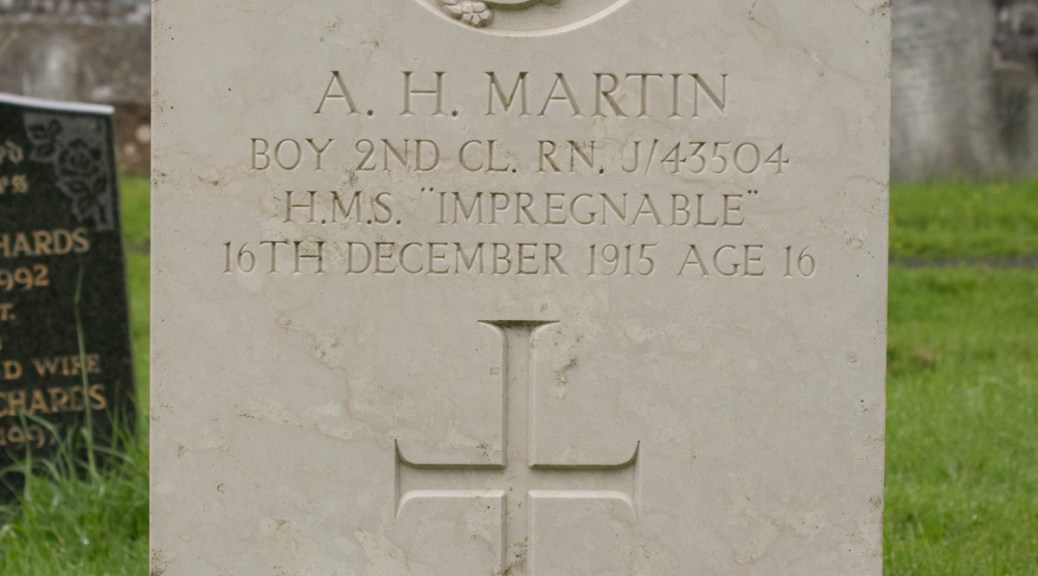
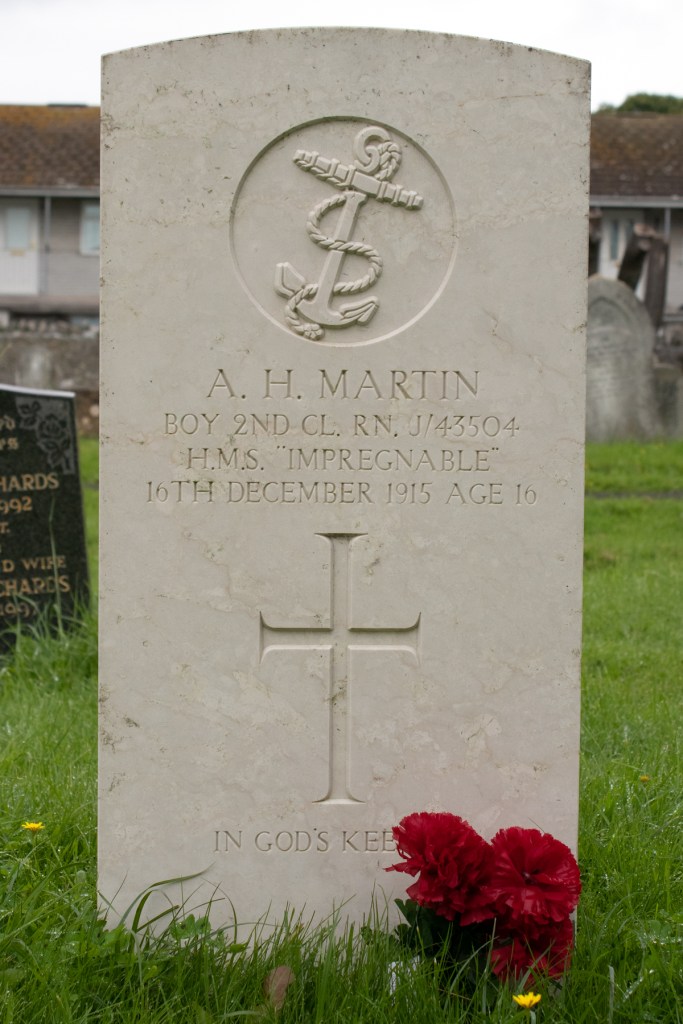
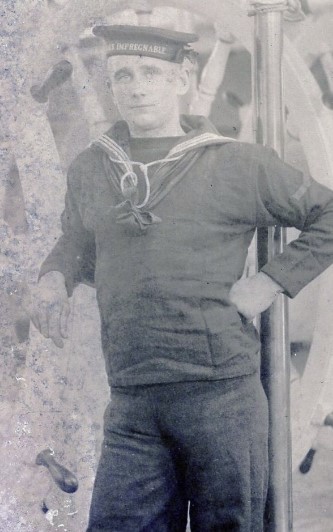
Alan Harold Martin was born on 24th May 1899 in Burnham-on-Sea, Somerset. The oldest of six children, his parents were bricklayer Clifford Martin and his wife, Augusta. The 1911 census found the family living at 64 Abingdon Street in the town, a terraced house not far from the seafront.
When war broke out, Alan was not long out of school. He had found work as a painter’s mate, but with adventure waiting for him, he had an obvious need not to miss out. He enlisted in the Royal Navy on 28th August 1915 and, as he was too young to be formally inducted into the service, he was given the rank of Boy 2nd Class.
Alan was sent to HMS Impregnable, shore-based establishment in Devonport, Devon, for his training. His service records show that he was 5ft 3.5ins (1.61m) tall, with brown hair, blue eyes and a fresh complexion.
Tragically, Boy Martin’s time in the Royal Navy was not to be a long one. Billeted in tightly-packed barracks, with new recruits from across the country, he quickly fell ill. Contracting pneumonia, he was admitted to the Royal Naval Hospital in Plymouth. The condition was to get the better of him, and he passed away on 16th December 1915, at the age of just 16 years old.
Alan Harold Martin’s body was taken back to Somerset for burial. He was laid to rest in Burnham-on-Sea Cemetery, a short walk from where his grieving family lived.
Arthur Edward Devas was born in Devizes, Wiltshire, on 29th July 1877. One of ten children, his parents were Reverend Arthur Devas and Louisa. Arthur Sr was chaplain at the County House of Correction, the prison a short walk away from the family home, over the Kennet and Avon Canal. The 1881 census showed the Devas’ were living to the south of the town centre, and were supported by three servants.
Arthur standing as a vicar’s son earned him an education. He was sent to the prestigious Haileybury College in Hertfordshire. When his father died in 1901, he felt a pull to see more of the world, and joined the army. Enlisting in the Essex Regiment in September 1902, he was taken on as a Second Lieutenant.
Promoted to the rank of full Lieutenant in January 1906, the next census, in 1911, recorded Arthur at the Warley Barracks in Billericay. When war broke out in August 1914, he was based in Mauritius: he remained there for the next five months, before his battalion – the 1st – were brought back to England.
Setting up camp in Banbury, Oxfordshire, the aim was to train the battalion in readiness for an assault in Gallipoli. For Lieutenant Devas, however, this was not to be. He had fallen ill on the journey back to Blighty and, having contracted typhoid, he was admitted to the 3rd Southern General Hospital in Oxford. He died at the hospital on 15th February 1915, at the age of 37 years old.
Louisa and some of her children had moved to Minehead, Somerset, after her husband’s death, and this is where Arthur Edward Devas’ body was brought for burial. He was laid to rest in the extensive Minehead Cemetery, to be reunited with his mother when she passed away some eighteen years later.
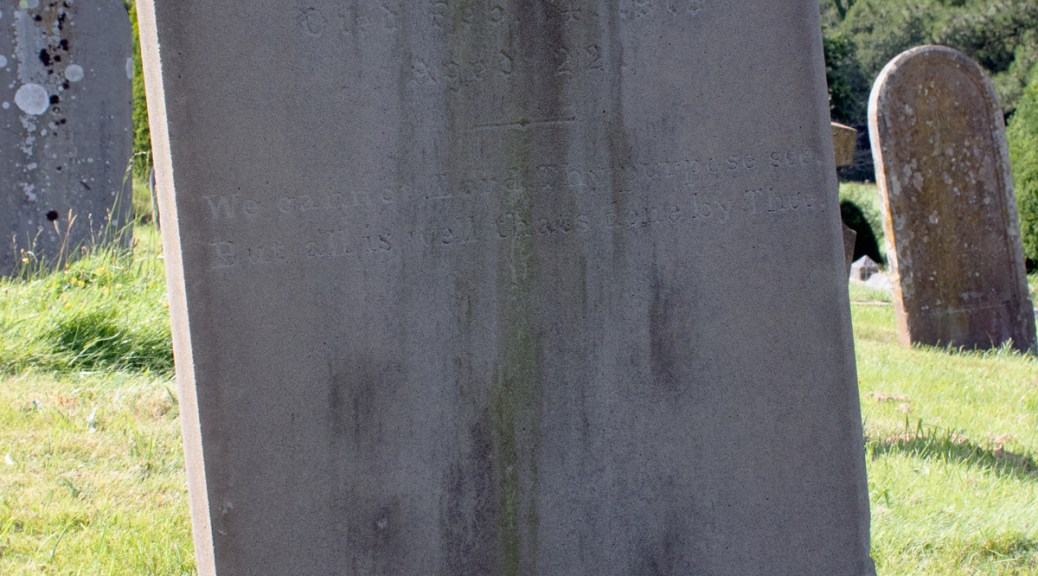
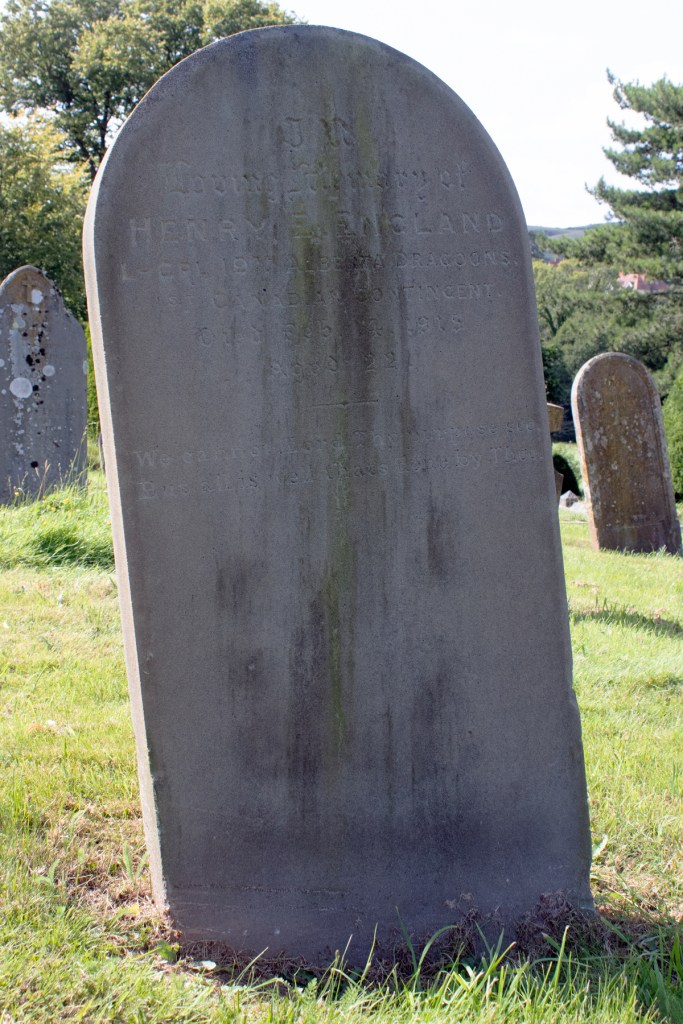
Henry Edward England was born in Gloucestershire on 7th October 1893. One of seven children, his parents were Charles and Unity England. Charles was coachman and groom to Sir Charles Cuyler, and the family were raised in Bristol.
There are gaps in Henry’s life that are a challenge to fill. He seems to have sought to better himself, emigrating to Canada and becoming a bank clerk in Quebec.
When war broke out, Henry was quick to enlist. He joined up on 21st September 1914, becoming a Private in the 19th Battalion of the Alberta Dragoons. His service records show that he was 5ft 8ins (1.73m) tall and weighed 140lbs (63.5kg). He was noted as being of average physical development with dark hair, brown eyes and a dark complexion.
Private England returned to home shores by December 1914, at which point he transferred to the 6th (Reserve) Battalion of the Canadian Infantry. His troop proceeded to Tidworth Camp in Wiltshire, on the edge of Salisbury Plain.
Army barracks at this time were melting pots: hundreds of men from different parts of the world cramped together in small billets proving breeding grounds for illness and disease. Henry was to prove a victim of the conditions: in the winter of 1914, he contracted meningitis. Admitted to the camp hospital, he was to succumb. Private England breathed his last on 14th February 1915, aged just 21 years of age.
Henry Edward England’s body was taken back to Somerset for burial. He was laid to rest in the sweeping vista of Minehead Cemetery, not far from where his family now lived.
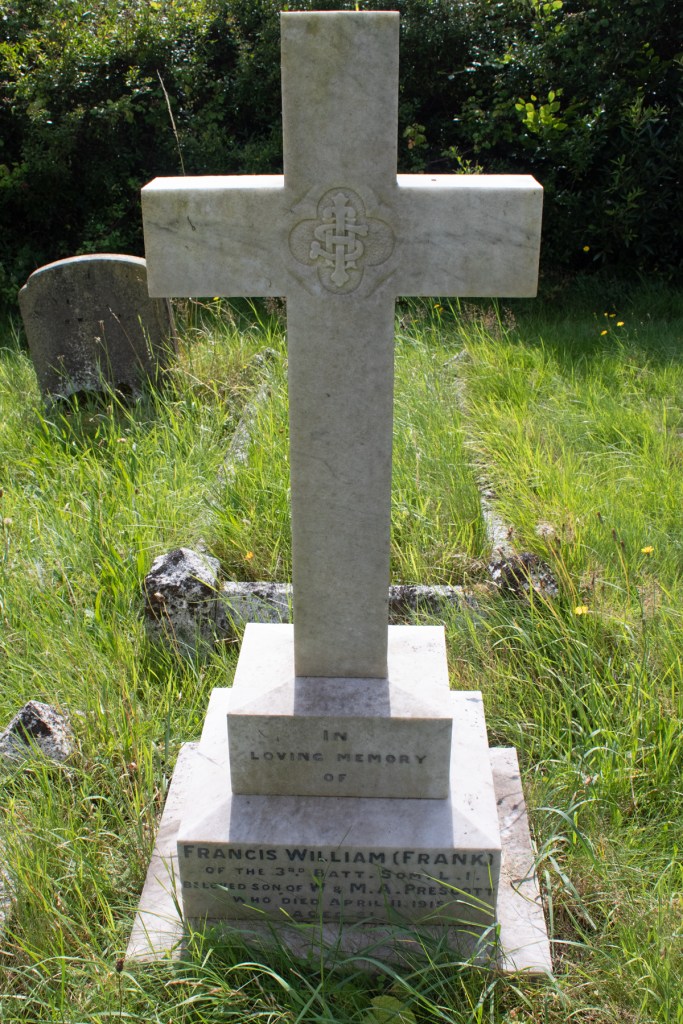
Francis William Prescott – better known as Frank – was born on 17th March 1894, and was one of four children to William and Mary. William was an agricultural labourer from Somerset, and, by the time of the 1901 census, the family had settled in the village of Luccombe, in the western outreaches of the county.
Frank went to school in Allerford, before spending a year at Luccombe’s Church of England school – from 13th May 1907 to 29th May 1908. Now aged 14 years old, he was considered old enough to be earning his keep. He found work as a farm boy on a farm on the outskirts of the village, but with storm clouds brewing across the Channel, he was keen to play his part.
Little information is available about Frank’s military service, but it is clear that he enlisted in the first weeks of the war, as imperial fervour gripped the country. He enlisted in the Somerset Light Infantry and, as a Private, was assigned to the 3rd (Reserve) Battalion. Contemporary documents do not confirm either way, but as this particular troop was based at Devonport, Devon, for most of the war, it is unlikely that Private Prescott saw any action overseas.
Indeed, he was in barracks on 11th April 1915, when he passed away. Again, the cause is lost to time, but he was just 21 years of age when he died.
Francis ‘Frank’ William Prescott was taken back to Somerset for burial. He was laid to rest in Luccombe Church Cemetery, not far from where his family still lived.
Frank’s younger brother, Harold, also enlisted in the war. He joined the Royal Engineers as a Private and, unlike his brother, he did go to the Western Front.
Harold was caught up in the fighting, and received a gunshot wound to his arm. He recovered, but the injury dogged him. He was formally discharged on 14th May 1919, and found work as a lorry driver. Harold married Kathleen Peck in December 1929: the couple’s only child, Edward, was born just over a year later.
Harold spent his life in Somerset. He died in Exmoor in the spring of 1968, at the age of 71 years old.
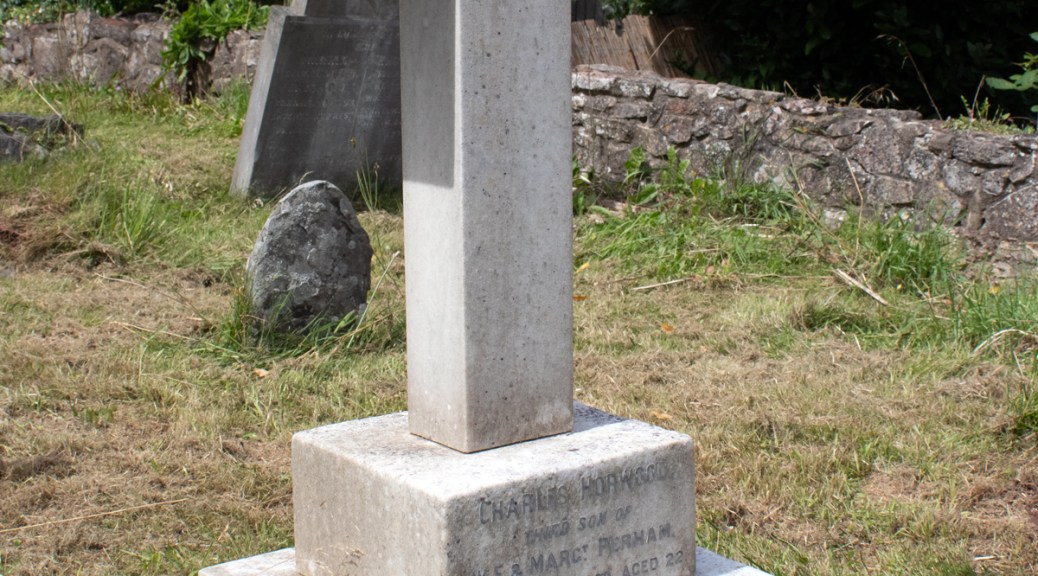
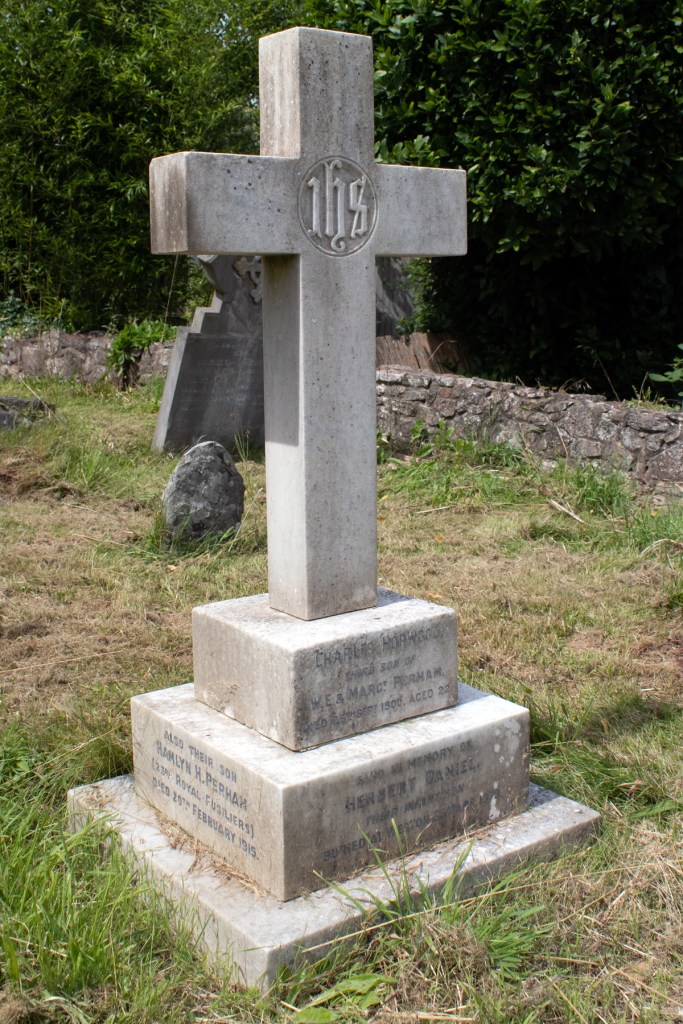
Hamlyn Horwood Perham was born in the autumn of 1872, one of seven children to William and Margaret. William was a solicitor from Wrington in the north part of Somerset, but it was in the village of Flax Bourton that the family settled.
Expectations were high for Hamlyn, who was the Perhams’ oldest son: the 1881 census found him boarding as a student in a private school in Weston-super-Mare. Ten years later, he was back home, but listed as a law student. The 1901 census recorded him as living with his family, but a practicing solicitor, presumably alongside his father (who, the document notes, was a solicitor and a Lieutenant Colonel in the Somerset Light Infantry).
Colonel WE Perham, the commanding officer of the 3rd Volunteer Battalion Somerset Light Infantry, had just been retired, after a connection with the corps dating from the year 1861, when he joined as a private. His retirement will occasion within the regiment universal regret, for he deservedly held the esteem and respect of all ranks. That Colonel Perham was well qualified to command is shown by the high state of efficiency in which he leaves the 3rd Battalion. He had taken the higher examinations, and in tactics passed with distinction. An officer who has worked through all grades from private to commander should, indeed, be a practical administrator and leader, and Colonel Perham was essentially both, and his knowledge of military matters singled him out for the important divisional and other commands. Latterly he was foremost in organising officers’ rides through the West Country – an instruction much valued at the War Office.
Somerset Standard: Friday 15th February 1907
The next census, taken in 1911, found Hamlyn still living with his parents and older sister. The family were supported by three live-in staff: a cook, a parlour maid and a housemaid. Hamlyn’s younger brother, Herbert, had also followed their father into law and, according to the same census, had set up a practice in Nailsea, where he lived with his wife of three years.
When war came to Europe, Hamlyn quickly stepped up to play his part. He enlisted in the Royal Fusiliers as a Private, and was assigned to the 23rd Service Battalion, also known as the 1st Sportsmen’s. Based at a camp in Hornchurch, Essex, Private Perham’s service was not to be a long one. He contracted meningitis, and was admitted to the South Western Hospital in Southwark. Sadly, the condition was to get the better of him: he died in hospital on 20th February 1915, at the age of 42 years old.
Hamlyn Horwood Perham’s body was brought back to Somerset for burial. He was laid to rest in the family plot in St Michael’s Church, Flax Bourton.
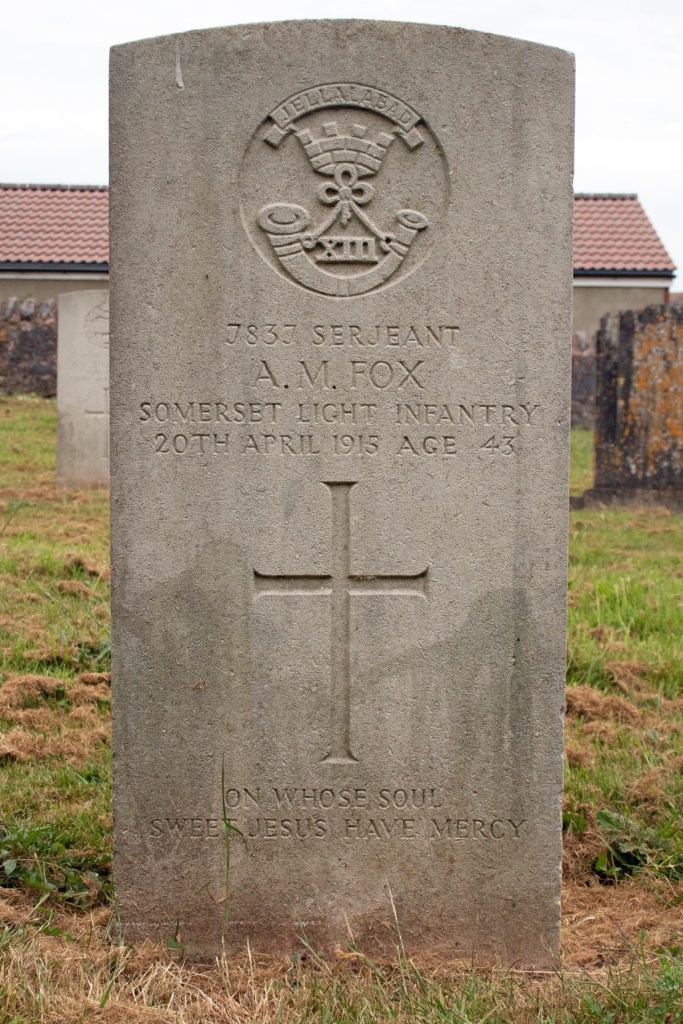
Andrew Michael Fox was born on 25th May 1871, the oldest of six children, to Michael and Eliza Fox. Michael was a Private in the 40th Regiment of Foot, and was based in Curragh Camp, Kildare, Ireland, when Andrew was born.
The family travelled where Michael’s work took him: Andrew’s oldest siblings were born in Uttar Pradesh, India, and the family were in England by the time of the 1881 census.
Given Michael’s military connections, it is no surprise that Andrew followed him into the army. He enlisted in August 1884, joining the South Lancashire Regiment. His service records give his age as 14 – he was, in fact, just 13 years old – and note his height as 4ft 9ins (1.44cm) and his weight as 73lbs (32.7kg). Andrew was recorded as having hazel eyes, brown hair and a fair complexion: his religion was also confirmed as Roman Catholic.
Andrew’s service records have become damaged over time, and a lot of his details are illegible. Because of his age when he enlisted, he was initially given the rank of Boy. In July 1887, he was formally mobilised, with the rank of Private. He remained on home soil for the next ten years, with the 1891 census listing him as being barracked in Fort Regent, Jersey.
It was in the Channel Islands that Andrew met Kathleen Dooling. The couple married on 7th January 1892, and went on to have ten children. Over the next couple of years, Andrew progressed through the ranks, achieving Lance Corporal in September 1892, Corporal in June 1894 and Lance Serjeant in August 1897.
In 1899, the Second Boer War led to the newly-promoted Serjeant Fox being posted overseas. He remained in South Africa for six months, while the conflict raged on. Andrew returned to Britain in April 1900, and was officially stood down from the army on 31st December that year, as he was deemed no longer fit for military service.
The 1901 census found Andrew and Kathleen still living in family barracks in Aldershot with their three eldest children, Andrew Margaret and Edith. Andrew was recorded as being an officer’s valet, likely now in a civilian role. The family remained in Aldershot until 1910, with five more of their children being born there.
Another change came at that point, however, as the following year’s census found the family living in Brighton Street, Warrington, Lancashire. Andrew was, by this point, working as a salesman for the Singer Sewing Machine Company, and the family were cramped into a four-roomed end-of-terrace house.
War came to Europe in the summer of 1914, and Andrew stepped up to play his part once more. Again, full details have been lost to time, but he took up the rank of Serjeant once more, and was attached to the Somerset Light Infantry. This necessitated another relocation for the family, and they moved to Cannington, near Taunton, Somerset.
Serjeant Fox was assigned to the 7th (Service) Battalion, but was not to remain in his role for long. He contracted phthisis, or tuberculosis, and passed away from the condition on 20th April 1915, just weeks before his regiment departed for the Western Front. He was 43 years of age.
Andrew Michael Fox was laid to rest in the peaceful Cannington Cemetery, not far from the family home.
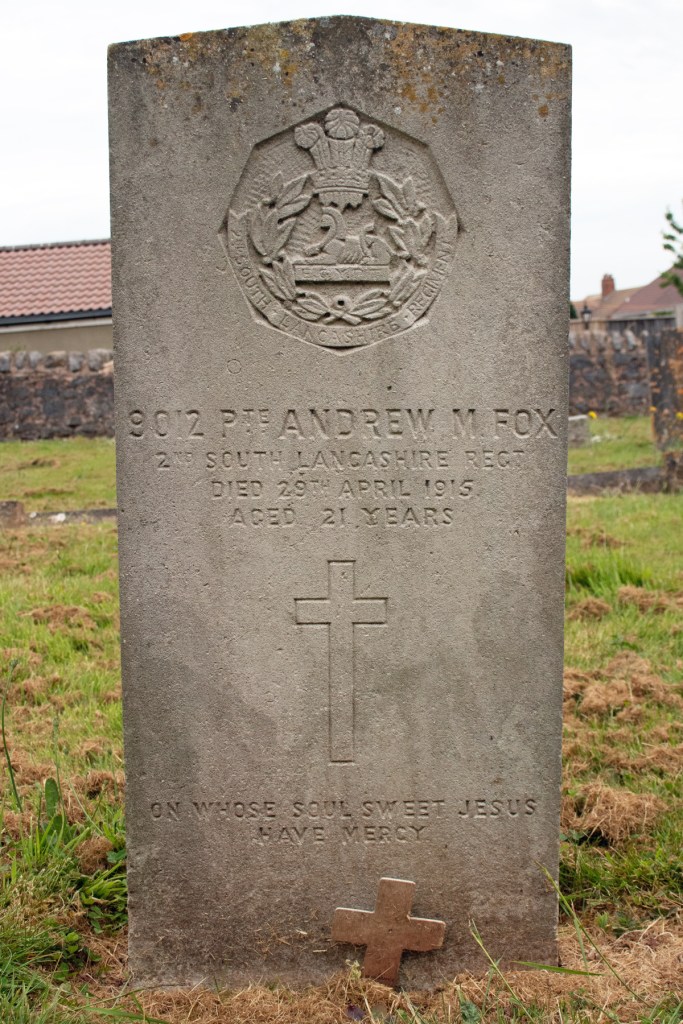
Private Andrew M Fox
In the plot next to Serjeant Andrew Fox is another, similar headstone. Not quite having the same form as the Commonwealth War Grave Commission headstone that Serjeant Fox has, this is dedicated to a Private Andrew M Fox, of the 2nd South Lancashire Regiment.
Andrew Moyse Fox was the eldest son of Andrew and Kathleen. Born on 31st March 1894 in Ireland, he wanted to follow his father and grandfather into the army.
Andrew Jr enlisted in the South Lancashire Regiment in August 1908. His service records confirmed that he was just 14 years of age, standing 5ft (1.52m) tall, and weighing 5st 2lbs (32.7kg). He was noted as having dark brown hair, hazel eyes and a fresh complexion, and that he has a scar on his right buttock.
As is the case with his father, there is limited information about Andrew Jr’s army career. He spent just under six years serving with the regiment, and was formally mobilised when he came of age in 1912. On 27th March 1914, however, Private Fox was discharged from the army on medical grounds, for reasons unclear. The next record available for him is that of his passing, just nine days after his father. He was 21 years of age.
Andrew Fox Jr was laid to rest next to his father in Cannington Cemetery. The heartbreak for Kathleen, to have lost husband and oldest boy within two weeks, must have been indescribable. While her son’s headstone is similar in design to her husband’s, he was not subsequently entitled to an official Commonwealth War Grave, as he had left the army before the outbreak of war: the Commission’s qualification dates (4th August 1914 to 31st August 1921).
Cecil St John Harris was the son of Reverend Percy and Constance Harris. Born in Kilver, Staffordshire, on 13th July 1891, he was one of nine children, although, by the time of the 1911 census, four of them had passed away. The Harris family had, by this point, moved from Staffordshire, to Devon, to Cornwall, and had settled in Staplegrove, Somerset, where Percy had become the rector at St John’s Church.
According to the census record, Cecil was studying engineering. He was keen at sports, being a keen member of the village’s cricket club. When war broke out, he enlisted in the West Somerset Yeomanry, but soon took a commission as a Second Lieutenant in the Somerset Light Infantry.
Cecil’s troop, the 3rd/5th Battalion remained on home soil, and he was based in Somerset for the duration of his time in the army. This was not to be for a long time, however, as, in the summer of 1915, he fell ill with appendicitis. He underwent an operation, and made a slow recovery, before relapsing. He passed away on 10th September 1915, aged just 24 years old.
Cecil St John Harris was laid to rest in the north east corner of St John’s Churchyard, Staplegrove, where his father was still the vicar. His grave is now lost to time, but Second Lieutenant Harris is commemorated on a special memorial, close to the entrance of the building.
Henry George Poole was born in the summer of 1892 in Creech St Michael, Somerset. The older of two children, his parents were carpenter Benedict Poole, and his wife, Louisa.
When he finished his schooling, Henry was apprenticed to a carpenter, but also devoted time to the village’s Friendly Society.
With war on the horizon, Henry was drawn to play his part and serve his country. He enlisted early in the conflict and, while full details of his military career are lost to time, documents confirm that he was assigned to the 8th (Reserve) Battalion of the Wiltshire Regiment.
It is unclear whether Private Poole served any time overseas but his battalion moved between Trowbridge in Wiltshire, to Weymouth and Wareham in Dorset. Indeed, by the end of 1915, Henry was based at Bovington Camp, to the west of Wareham. He was here when he fell ill, and when, on 28th November 1915, he passed away from an undisclosed condition in the camp hospital. He was just 23 years of age.
Henry George Poole was brought back to Somerset for burial. He was laid to rest in the peaceful graveyard of St Michael’s Church in the village of his birth.
A local newspaper reported on Henry’s funeral, but the article underlines how facts were gotten wrong then, as they are sometimes now. The Taunton Courier and Western Advertiser reported that Henry was 22, instead of 23, that he had ‘sisters’, when he only had one, and gave his father’s name as Benjamin, not Benedict.








 Death and Service