There are some times where no amount of research on a person will reveal their information.
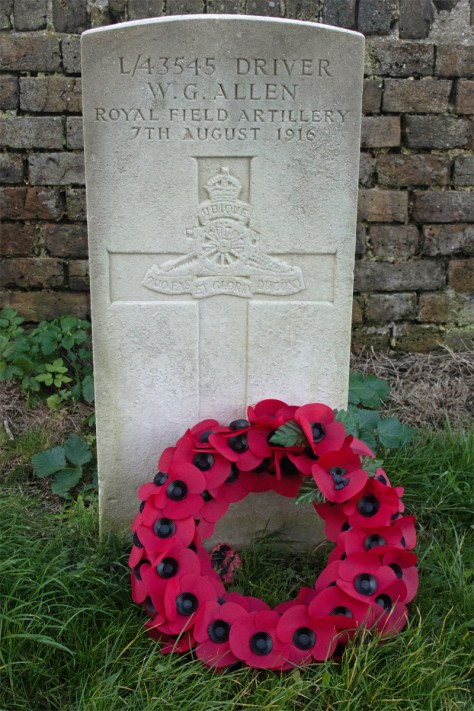
William George Allen is one such person.
The only details I have been able to uncover for this man is his gravestone and the Army Register of Soldier’s Effects.
William Allen was a driver for the Royal Field Artillery. His troop – the 156th Camberwell Brigade – was raised in South London in early 1915, although I have no record of when Driver Allen enlisted.
At some point, the 156th Brigade were stationed at Port Victoria – the fort on the Isle of Grain in Kent.
It was during their time at the fort that William died. He passed on 7th August 1916 and there is no cause of death recorded, and he does not appear in any contemporary newspapers. This might suggest that his death was not out of the ordinary or unexpected.
Unusually for the Register of Soldier’s Effects, nobody is listed for the war gratuity payments to be made (this would normally be a next of kin – father, mother or spouse). In total a payment of £6 19s 2d was paid out, not an extravagant amount for that regiment.
So Driver Allen remains a mystery. A (presumably) young life lost too soon, and lost to time.
William George Allen lies at peace in the graveyard of St James’ Church in Grain, North Kent, metres from the fort in which he passed.
John Henry Armes was born in Cannock, Staffordshire in 1881. One of eight children to Richard and Mary Armes, his father was a colliery worker and labourer. After their mother’s untimely death in 1890, this was a trade into which his three boys – Richard Jr, John and Alfred – followed.
The 1901 census finds John living with his widowed father and working as a coal hewer. A year later, he married Caroline Caldwell and, by the outbreak of the war, the couple were living in Ilkeston, Derbyshire with their growing family of seven children.
Records of John’s enrolment are not evident, but it is likely to have been later in the war, rather than earlier, given that his trade was one of those protected from enlistment.
By 1915, Caroline had given birth to the couple’s seventh child and John had signed up to the King’s Royal Rifles, stationed at the fort in Grain, North Kent.
Rifleman Armes’ pension record shows that he was accidentally killed on active service, and the contemporary media pick up the story.
[He] had been on outpost duty. On coming off duty about half-past seven on Monday morning he placed his rifle in a rack in a hut, and went to breakfast. Another rifleman names John Bathams Olliff, picked up the rifle to unload it, but having trouble with the extractor he took the magazine of the rifle out, and then thinking all the cartridges were in the magazine he pressed the trigger to close the bolt of the rifle, and a shot went off. At that moment Rifleman Armes came round the door of the hut and received a bullet in the chest.
Exclaiming, “My God, Armes is here,” Olliff rushed to his assistance, and Armes said “I am done for. It was an accident.” Medical aid was telephoned for, but Armes died shortly after the doctor arrived.
Est Kent Gazette: Saturday 5th February 1916
An inquest was held, which found that the two Johns were great friends and had asked to serve together. The jury exonerated John Olliff from blame and recorded a verdict of accidental death.
John Henry Armes died at the age of 34, likely without seeing his youngest child. He lies at rest in St James’ Churchyard in the village of Grain in Kent, close to the barracks where he lost his life.
There are a couple of other protagonists in this story.
John’s widow, Caroline, married again later in 1916, to a George Chapman. She went on to live to the age of 77, outliving three of her children and both of her husbands.
John Battams Olliff, who had accidentally shot John, was born in London in 1880. The son of a butcher, he had emigrated to Canada in 1911. John returned to the UK to fight in the war, joining the King’s Royal Rifles in May 1915. Little information about his post-war survives, but it appears that he remained in England. There is no record of him marrying, but he died in 1938, at 58 years old.
Tom Hallett Walter Rawlings was born in 1896, the eldest of six children (and only son) to Walter and Jane Rawlings. Dorset-born Walter had worked as a carpenter and a groom, and Tom had joined him as a stable lad by the time of the 1911 census.
By the time he enlisted in July 1915, Tom’s work with all things equine helped land him a role in the Royal Army Service Corps as a Saddler. His role was backed up as he had previously been apprenticed to Ernest Cottle, a saddler in Blandford, Dorset.
Initially he worked on the Home Front, but he was posted to France as part of the British Expeditionary Force in January 1916, as part of the 1st Company.
Saddler Rawlings’ time overseas was brief; within three months of being shipped overseas he had contracted phthisis (also known as tuberculosis), and he was sent home for treatment on 22nd April 1916.
His health reached the point where he was discharged as being medically unfit on 12th June, and within a matter of weeks, Tom has passed away.
Tom Hallett Walter Rawlings died on 20th June 1916; he was 19 years old. He lies at rest in the cemetery of his home town, Sherborne.
Tom’s father Walter also entered the army as worked in the Royal Army Service Corps. While records of his military career are not immediately evident, it seems that he survived the war, although he may have been discharged in 1919 having fallen ill with malaria.
Harold Stanley Russell was born in 1895, the third of six children to carpenter Henry Russell and his wife Mary. The family lived in Sherborne, Dorset, and this is where Harold grew up; by the time of the 1911 census, he was working as a hairdresser in the town.
While Harold’s military records are not readily available online, his last few weeks can be determined through the local press of the day.
He enlisted in the Dorsetshire Regiment in the summer of 1915, but was attached to the Wiltshire Regiment when battalions went to France in May 1916.
Lance Corporal Russell’s Lieutenant wrote to his parents to report on Harold’s injury:
[He] was wounded by a bomb on the morning of July 28th while on duty in the trenches. “At the moment of writing I do not know if it is a very serious case, but I do know he will lose the use of his left hand. He was a most popular fellow, and always willing to do his part nobly with a brave heart, and nothing grieved me more than to see him in pain. His wants were immediately attended to, and I suppose by now he is under treatment in the hospital. He is being well cared for, and the authorities will let you know how he is progressing.
Western Gazette, Friday 4th August 1916
A week later, the newspaper reported an update:
Lance-Corporal Harold Russell… is now at the Leicester Military Hospital in a critical condition. His parents were telegraphed for on Friday last, and visited him. They found he had been very seriously wounded by a bomb whilst on duty in the trenches in France. His injuries are in the chest and right arm, while his left hand has been amputated. [He] was acting platoon-sergeant at the time he was wounded, and had taken part in three battles. After being wounded he walked one and a-half miles to the dressing-station, but afterwards collapsed. His parents returned to Sherborne on Tuesday as he was slightly better, but were telegraphed for again on Wednesday.
Western Gazette, Friday 11th August 1916
The day of the second article, Lance Corporal Harold Russell lost his fight for life, dying in a Military Hospital in Leicester. He was just 21 years old.
The next week, the young soldier featured in the newspaper again, with an 80-line report on his funeral being featured on the Roll of Honour page.
Harold Stanley Russell lies at rest in the cemetery of his home town, Sherborne.
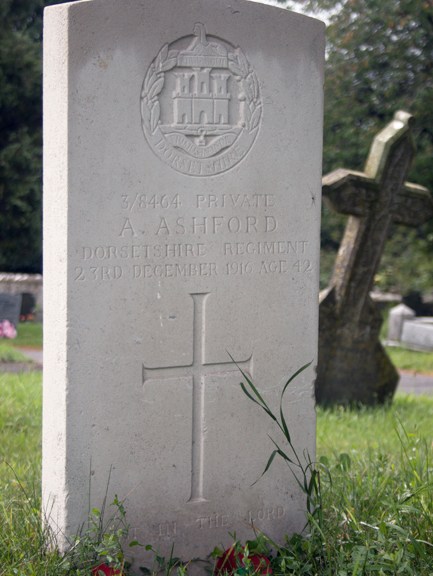
Arthur James Ashford was born in the Dorset village of Okeford Fitzpaine, to John and Tryphina Ashford. His father died when Arthur was only seven years old, leaving Tryphina to raise him and his three siblings.
Arthur had had a military career before the start of the Great War. He had enlisted into the Dorsetshire Regiment in 1891 and, while I have not been able to locate his records from that time, the regiment had been stationed in Ireland in the 1890s.
In 1899 he married Amy Upshall, at which point he was employed as a labourer. The couple had six children, though sadly, two of them – Arthur George and Elsie May – died in childhood.
He enlisted within months of the First World War beginning, returning to the Dorsetshire Regiment he had previously served on 30th September 1914. (It is interesting that on his enlistment papers he said that he had previously served for 12 years, although the dates don’t fully tally up.) This time, however, Private Ashford served on the Home Front, in Dorchester and Portland.
On the evening of 22nd December 1916, Arthur fell down a gulley in Portland. He was taken to the Verne Military Hospital in the town, but died of his injuries – a fractured skull – in the early hours of the following day.
Private Arthur Ashford was buried in his home village of Evercreech on Thursday 28th December 1916.
William Larkin was born in 1863, the eldest son of Alfred and Frances Larkin from Cranbrook in Kent.
He disappears off the radar for a few censuses – there are too many variations on his surname to identify exactly where he was on the 1881 and 1891 documents.
From later documents, however, we can identify that he married Eliza in around 1886; the couple had no children. By the 1901 censes the couple were living to the north of Maidstone; ten years later, they were running the Fox & Goose pub in Weavering, Kent.
Private Larkin’s military service is also lacking in documentation, but some information can be pieced together.
Originally enlisting in the Royal West Kent Regiment, he (was) transferred over to the Royal Defence Corps, and served on home soil.
On Sunday 2nd April 1916, Lance Corporal Larkin was on guard at a gunpowder factory in Faversham, Kent. As the Ministry of Munitions reported at the time:
During the weekend a serious fire broke out in a powder factory in Kent, which led to a series of explosions in the works.
The fire, which was purely accidental, was discovered at midday and the last of the explosions took place shortly after two in the afternoon.
The approximate number of casualties is 200.
Thanet Advertiser: Saturday 8th April 1916.
William was not killed during the Faversham Explosion, but Boxley Parish Council (who covered the Weavering area) carried out research on the names on the village war memorial. According to that research, William “developed cancer after the ‘Faversham Powder Works’ explosion”. He died two months later, on 8th July 1916. He was 53 years of age.
Lance Corporal William Larkin lies at rest in the graveyard of St Mary & All Saints Church in Boxley, Kent.
More details of the Faversham Explosion, along with the servicemen who died there, can be found here.
Thomas Griffith was born in Fulham in 1891. He was the eldest of five children to John Griffith and his wife Emma, although John had been married previously (to Eliza, who had died in 1880), and so Thomas had a further six half-siblings.
By the 1911 census, he was 20, working as a printer’s apprentice, while his father was unemployed and his mother worked as a charwoman.
The Great War had been fought for a year when Thomas enlisted in August 1915. He joined the 8th (Service) Battalion of the Bedfordshire Regiment. The regiment fought in most of the battles on the Western Front, and, during his time there, he was promoted to the role of Sergeant.
Beyond this, Sergeant Griffith’s service records give little more information about him. His war pension and the Register of Soldiers’ Effects show that he was killed in action on Monday 17th April 1916. He was 25 years old.
Sergeant Thomas Griffith is commemorated at the Essex Farm Cemetery in West-Vlaanderen, Belgium.
Thomas Griffith was my first cousin three times removed.
Sidney Horace Hornby was born to John and Emily in March 1880. John was a tailor’s assistant from Paddington, and the family – Sidney was the eldest of six siblings – initially lived in the Greenwich.
Sidney enlisted in the army in 1898. He joined the East Kent Regiment for a short service of seven years and was sent to South Africa. In March 1900 he was wounded at the Battle of Driefontein. His service, though, saw him promoted through the ranks from Private to Sergeant.
Something must have happened during his enlistment, however, as on 2nd September 1901 Sergeant Hornby’s military record marks him as having deserted.
Sidney’s records pick him up again on 24th April 1908, when he is put on court martial. Found guilty of desertion, he is reduced to the ranks and sentenced to three years’ penal servitude (later reduced to two years’ hard labour).
His attitude seems to continue, however, as within a matter of months he was discharged due to misconduct and denied any pension for his previous service.
Sidney’s family had moved from Greenwich to Kent at some point before the 1901 census, and his father died three years later. By the 1911 census, he had moved back in with his mother, and worked as a labourer to help look after them.
The Great War called, however, and it seems that Sidney’s previous misdemeanours did not excluding him from fighting again. He joined the Royal West Kent Regiment although his full service for the 1914-18 campaign are not accessible. Again, his service seems to have been good, as he was elevated to the rank of Sergeant for a second time.
Hints of Sergeant Hornby’s rebellious nature remain, however, as he was court marshalled again in February 1916. He was convicted of drunkenness, and reduced to the rank of Corporal.
That was the summer of the Battle of the Somme, and by the autumn Hornby was one of the many who fell during that time. He died on 4th October 1916 and was 36 years old.
Corporal Sidney Hornby is commemorated on the Thiepval Memorial.
Sidney Horace Hornby was my 1st cousin, four times removed.
Frederick Smith was one of twelve children to George and Ann Smith of Rainham in Kent. Sadly, the couple lost their first four children early on, but at least seven of Frederick’s siblings survived beyond childhood.
His father was a labourer, and Frederick’s two surviving older brothers followed him into this profession.
A lot of Frederick’s service records are missing, but I have been able to ascertain that he enlisted in early 1915, joining the 8th Battalion, Queen’s Own (Royal West Kent Regiment). He trained at Fort Darland in Chatham before being shipped overseas.
The battalion was involved in the Battle of Loos later that year, but it was the fighting at Wulverghem in Western Flanders that changed Private Smith’s life. The German army launched a gas attack on the Allied lines on 30th April 1916; in the second attack on 17th June, Frederick was injured by the gas, and was shipped back to home soil.
The East Kent Gazette takes up the story:
He was brought to Camberwell Hospital, where he was for seven weeks. Enteric fever developed, and young Smith died on Thursday in last week [14th September].
East Kent Gazette: Saturday 23rd September 1916.
Frederick was just 19 years old.
Private Frederick Smith lies at rest in the graveyard of St Margaret’s Church in Rainham, Kent.
There is tantalisingly little information available about Private J Lewin, and what I have been able to identify has come from a variety of disparate sources.
Jonathan William Lewin was born in 1877/8 in Essex. By the time of the 1911 census, he was working as a painter in Colchester. He was living in the town with his wife, Agnes Cudmore, who he had married in early 1902. The couple had no children.
The remainder of the information of Private Lewin’s life comes from a piece in the Western Gazette:
The death has occurred at the Yeatman Hospital [Sherborne, Dorset] of Private Jonathan Lewin, of the Army Veterinary Corps. The deceased soldier had been at the Front for a year, and about three months ago was brought home sick and sent to the Yeatman Hospital. He was there found to be suffering from a malignant disease, and his recovery from the first was hopeless. Deceased, who belonged to Colchester, and was 38 years of age, leaves a widow but no children. The funeral took place yesterday and was attended by a number of wounded soldiers and the members of the VTC.
Western Gazette: Friday 7th July 1916.
Private Jonathan Lewin lies at rest in Sherborne Cemetery.
One of the reasons I love researching this type of history, is trying to discover the person behind the name on the gravestone. It seems such an additional loss, therefore, when the life of a brave soldier, like Private Lewin, has disappeared through time.