William Alfred Woodbury was born in the Somerset village of Nether Stowey in April 1899, the oldest of four children to Alfred and Nellie Woodbury. Alfred was a farm labourer, and, by the time William was a couple of years old, he had moved the family to the town of Bridgwater to work as a carter.
After leaving school, William found work at Barham Brothers’ Brickworks in the town. When war broke out, he enlisted in the Somerset Light Infantry almost as soon as he was able to, at the beginning of 1916.
Assigned to the 6th (Service) Battalion and Private Woodbury was sent out to the Western Front in April. He would almost certainly have seen action at the Battle of Delville Wood – part of the Somme offensive – and was wounded in the shoulder and arm on 18th August 1916.
Shipped back to the UK for treatment, William was admitted to the Western General Hospital in Cardiff, but tragically died from his wounds less than a fortnight later on 30th August 1916. He was just 17 years old.
His funeral was reported in both the Shepton Mallet Journal and the Central Somerset Gazette; his father, who had been serving in France as part of the Army Veterinary Corps, managed to return home for his son’s funeral.
William Alfred Woodbury lies at rest in the St John’s Cemetery in his home town of Bridgwater.
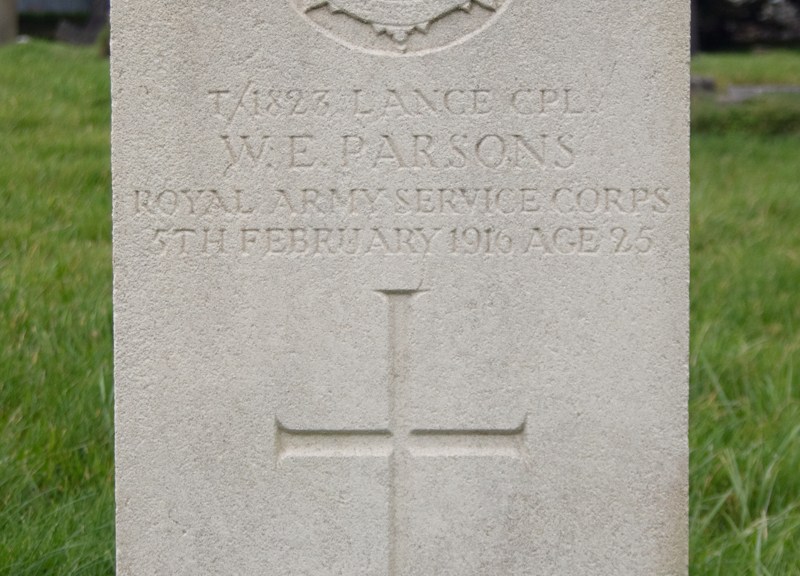
William Edward Parsons was born in 1890, one of six children to John and Prudence Parsons. John found work in a number of fields, working as a blacksmith, porter, dock labourer and a hobbler (towing boats along the River Parrett) in his time. Throughout this, he lived with his family in the Somerset town of Bridgwater.
William found work as a collar cutter in a local shirt factory, and went on to marry Matilda Mary Temblett on Christmas Day 1913. The young couple went on to have a son – Leslie William – who was born in February 1915. William was teetotal, and played full back for the local rugby football club, Bridgwater Albion.
Sadly, Lance Corporal Parsons’ military records are sparse; he had enlisted in the Royal Army Service Corps and was based in Fovant, to the west of Salisbury.
It was while he was on leave that William met his sad fate. On the evening of 5th February 1916, he had seen his parents and had set out to organise a football match in the town. He was walking over the town bridge, when a passer-by heard a splash. He saw a man in the water, who was crying for help, and then disappeared.
William’s body was found in the river a fortnight later close to a local brickyard. He was just 25 years old.
William Edward Parsons lies at rest in St John’s Cemetery in his home town of Bridgwater.
Frederick Hobbs was born in December 1886, the fourth of ten children to William and Martha Hobbs, from Bridgwater in Somerset. William was a mason, and all of his children seemed to be good with their hands. Frederick went on to become a plumber’s apprentice, while his siblings worked as a mason, a dressmaker and a carpenter.
The 1911 census found him living in Polden Street, Bridgwater with his mother and youngest sibling, Florrie. William, however, was living round the corner in Bath Road, with three of his other children, Clara, Tom and George. Both of Frederick’s parents are listed as married, which adds to the confusion of them being in separate houses.
Frederick enlisted with weeks of was being declared; he joined the 10th (Service) Battalion of the Devonshire Regiment and, after a year on home soil, his troop was shipped to France. This wasn’t the end of the Private Hobbs’ journey, however as, within a couple of months, he journeyed on as part of the Mediterranean Expeditionary Force, finally arriving in Salonica, Greece, in November 1915.
Private Hobbs has only been serving for a month when he was admitted to the Hospital Ship Asturias in Alexandria, with lacerations to his cheeks and eyelids. The initial report seemed to suggest the wounds were as a result of gunshot, although a more detailed report later confirmed that the injuries were caused by barbed wire.
While in hospital, Frederick’s urine was found to include a high level of sugar. He also confirmed having lost a lot of weight in recent months, but could not confirm when this had begun. He was diagnosed with diabetes, and was evacuated back to England for treatment for both his injuries and his illness.
The damage to his left eye healed, but he was left with significant ptosis, or drooping of the eyelid. When it came to his diabetes, specialists back in England determined that, while it could not be put down to Private Hobbs’ service, it had definitely been aggravated by it. He was deemed no longer fit for military service and furloughed in June 1916, with a follow-up report confirming this three months later.
Sadly, whether Frederick’s life returned to normal is not recorded. It seems likely, however, that the diabetes got the better of him, and he passed away on 25th November 1916, aged just 29 years old.
Frederick Hobbs lies at rest in St John’s Cemetery in his home town of Bridgwater, Somerset.
Frederick’s younger brother Herbert Hobbs also fought in the Great War. He enrolled in the Royal Marines Light Infantry and fought on the Western Front. Caught up in the Battle of Gavrelle Windmill, he was one of 335 Royal Marines to be killed in that skirmish. He lies buried at the Arras Memorial in Northern France.
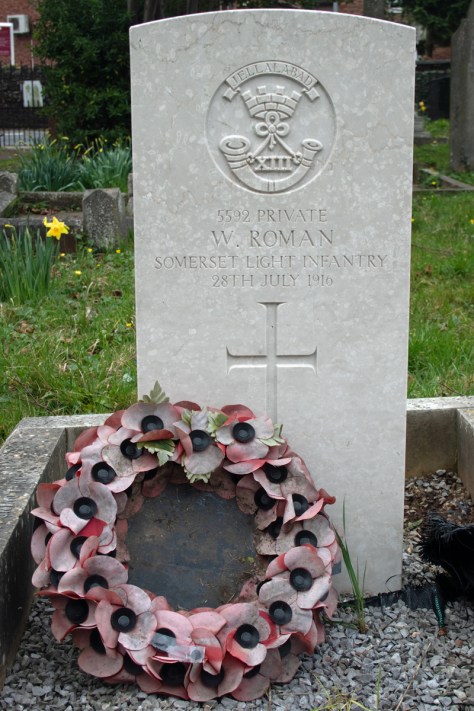
Walter James ‘Rattler’ Roman was born in July 1880, one of six children to George and Betsy Roman. George was a labourer in a brickyard, and the family lived in Bridgwater in Somerset.
Walter’s passion was rugby football, and he made the Bridgwater & Albion first team at the age of 15. Two years later had reached county level, and was playing for Somerset.
Walter enlisted in the army in around 1897, joining the Somerset Light Infantry. He spent several years abroad, serving as a Private in India and South Africa and fighting at Cawnpore and in the Second Boer War.
When Walter’s service ended, he returned to England, and continued his rugby career. He was a regular for the Bridgwater and Somerset teams, gaining the nickname ‘Rattler’, before being signed up by Rochdale Hornets in 1910.
Walter married Henriette Washer in Bridgwater in April 1911, and the couple had two children, Edna – born in 1912 – and Leonard – who was born a year later.
Continuing with rugby union, Walter was called to county level, where he joined Lancashire for a number of games. Walter also played for England, receiving a cap in the international match against Wales in February 1914, and he toured Australia and New Zealand the same year.
War broke out, and Private Roman was re-enlisted, one of twenty-five Hornets players to enlist. He served on the Western Front with the 1st Battalion of the Somerset Light Infantry and was caught up in the engagements at Ypres and Armentieres. Fighting at in the Battle of the Somme, he went over the top at Beaumont-Hamel at the start or fighting, on 1st July 1916 – his 36th birthday.
In that initial charge, he was shot several times, in both arms, a leg and the torso. Initially treated at a local field hospital, he was evacuated to England and admitted to the Voluntary Aid Hospital in Cheltenham. His condition initially improved, and he wrote letters to Henrietta, who was living back in Rochdale.
Sadly, Walter’s contracted sepsis and his health deteriorated; Henrietta was called to the hospital in Cheltenham on 27th July 1916. It is likely that she didn’t make it in time, as Walter passed away at 1pm the following day. He was just 36 years old.
Walter James Roman lies at rest in the Wembdon Road Cemetery in his home town of Bridgwater, Somerset, one of may sporting heroes to perish in the First World War.
Walter Roman (courtesy of findagrave.com)
Walter was one of 25 Rochdale Hornets players to enlist when war broke out. Of those men, five did not return: Private Walter Roman; Sergeant John Twigg; Private Archie Field; Private Tom West and Private CJ Burton.
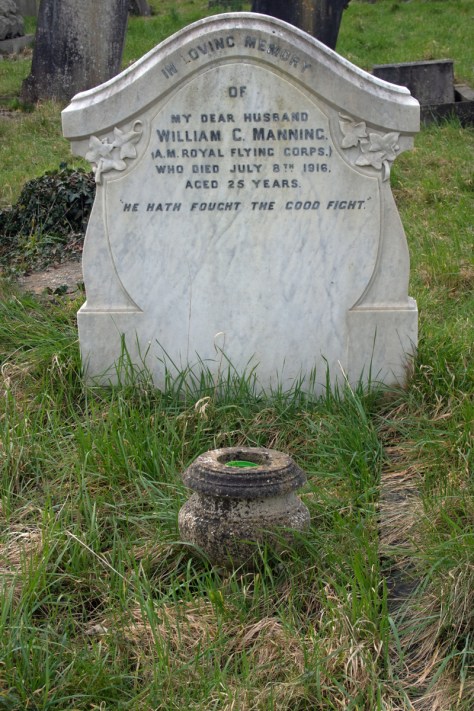
William Charles Manning – known as Willie – was born in Bridgwater in 1890, one of ten children to Samuel and Emily Manning. Samuel was a cabinet maker, and at least of three of his sons, Willie included, went into the family business.
There is little information available on Willie’s life, but he married Nellie Dodden, also from Bridgwater, in November 1915. Sadly, this was around the time that Nellie’s father passed away; tragedy for Nellie was still close by.
Willie’s military records are minimal, although details of his passing can be determined from the subsequent newspaper report.
He had enlisted in the Royal Flying Corps around October 1915, certainly around the time he and Nellie married. He was an air mechanic, something his woodworking skills probably drew him to and was based at Manston Airfield in Kent.
On 8th July 1916, Willie was a passenger in a flight piloted by Lieutenant Bidie. It seems that Bidie was turning the plane while at low altitude, while attempting to land. The plane crashed, and both Bidie and Willie were killed. Air Mechanic Manning was just 25 years old.
William Charles Manning lies at rest in the Wembdon Road Cemetery in his home town of Bridgwater, Somerset.
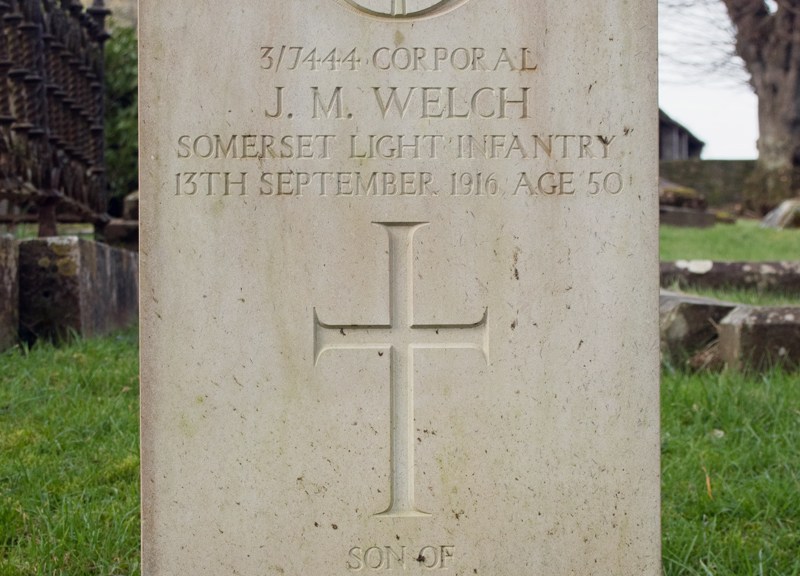
John Milton Welch was born in Yeovil on 19th February 1866, one of five children to William and Anne Welch. William was a chemist by trade, but John’s calling was elsewhere. He became a clerk, initially for a brewery, but by the time of the 1911 census, he was working for a political agency.
In that census, John can be found living with his parents – who were in their 80s by this point – and his two sisters, both school governesses. He is listed as single; although an earlier census suggests he had married a lady from the Isle of Wight called Sarah, I have found nothing to corroborate this, beyond the fact that she had wed a John M Welch, a brewery clerk from Yeovil.
War beckoned and even though he was 48 when the conflict broke out, John enlisted. Private Welch joined the Somerset Light Infantry; his service record no longer exists, but his medal record show that he arrived in France in May 1915, and was subsequently awarded the Victory and British Medals and the 1915 Star. His service obviously warranted promotion, and he was elevated to Corporal.
His troop – the 6th (Service) Battalion – was involved in several of the skirmishes of the Battle of Somme, and it is likely that Corporal Welch was injured during one of these – probably either the Battle of Delville Wood or the Battle of Flers-Courcelette. Wherever it happened, he was shipped back to England, and was treated for his injuries at the Royal Victoria Hospital in Netley, Hampshire
Sadly, Corporal Welch was not to recover; he passed away on 13th September 1916, at the age of 50.
John Milton Welch lies at rest in the graveyard of St James’ Church, in the quiet Somerset village of Milton Clevedon.
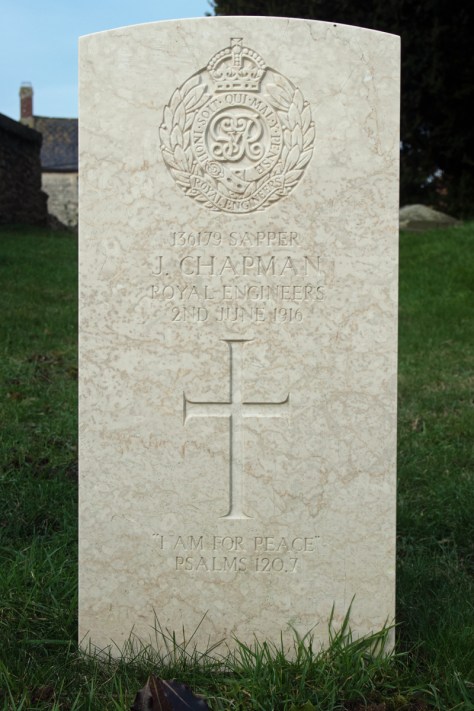
John Chapman was born in October 1892 in the small Somerset village of Ashwick, just to the north of Shepton Mallet. One of five children to Albert and Mary Ann, John followed his father into mining, and, by the time of the 1911 census, he was listed as a coal mining hewer.
In November 1914, he married Louisa Elizabeth Perkins from Shepton Mallet. The war had begun by this point, and before the couple had even been married a year, John had enlisted.
His background made him ideal for the Royal Engineers, and soon Sapper Chapman was bound for France with the British Expeditionary Force. He seems to have been abroad for around six months, and was shipped back to England at the end of April 1916.
John was admitted to a military hospital in Brockenhurst, Hampshire, with bronchial pneumonia, and this is what he succumbed to a matter of weeks later. He died on 2nd June 1916, at the age of 23 years old.
John Chapman is buried in the village of Croscombe, Somerset, where his widow now lived.
An additional tragedy to the loss of this young life is that Louisa was pregnant at this point. The birth of their daughter, Selina, was registered between April and June 1916, and, while I have been unable to pinpoint an exact date of birth for her, it is likely that John never got to see his daughter.
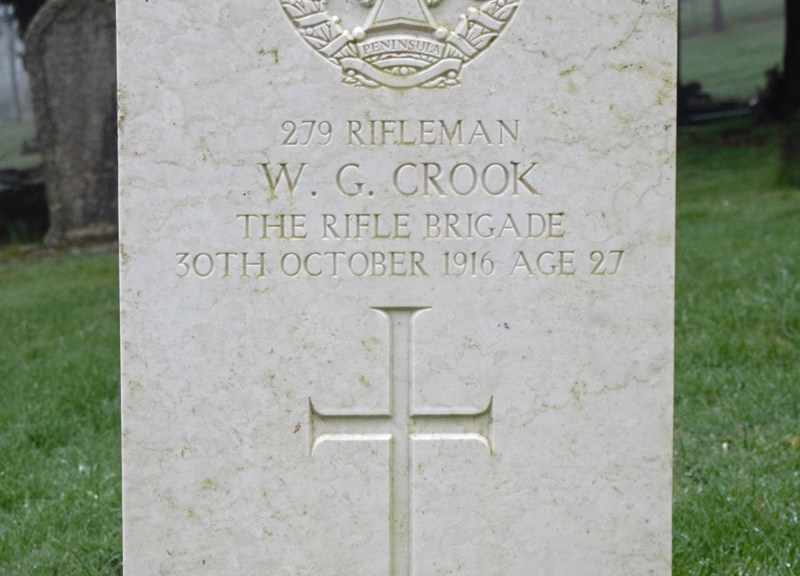
Walter George Crook was born in 1900, one of thirteen children to William – a gardener – and Elizabeth Crook from Shepton Mallet in Somerset.
When he left school, Walter worked as a printer for the town’s newspaper and, by the time of the 1911 census, he was living with his family in a six-roomed house in the middle of the town.
Walter moved on from the Shepton Mallet Journal, and found employment at the Hare and Hounds Hotel in the town. War was coming, however, and he enlisted in the 22nd (Wessex and Welsh) Battalion of the Rifle Brigade.
Rifleman Crook was stationed with his battalion in Salonica, Greece, and it was while he was here that he suffered a cerebral tumour. He was invalided home, and treated in the Royal Victoria Hospital in Netley, Hampshire. Sadly, he lost his fight, passing away on 30th October 1916, aged just 27 years old.
Walter George Crook lies at rest in the cemetery of his home town of Shepton Mallet.
Walter’s brother Gordon is also buried in Shepton Mallet Cemetery – read his story here.
A third brother, Bertie, was also gave his life in the Great War. The local newspaper had given a touching report on his death in April 1916.
Bertie Crook left school at the age of 13, and went into service with Mrs Dickinson at Whitstone, as a stable lad. He was there a year and then, on account of Mrs Dickinson giving up horses and leaving the town, they recommended him to Lord Derby’s stables at Newmarket, under the Hon. G Lambton. Small as he was, Bertie Crook undertook the railway journey alone, with a label in his buttonhole. He served five years apprenticeship, which expired at the beginning of October [1915]. He then tried to join the Royal Field Artillery, but not being tall enough he joined a West country regiment on the 20th October, and left Tidworth Barracks for France in the early part of January. He was in his 21st year, having been born on the 29th July. 1895.
The Hon. George Lambton writes “I was terribly shocked and grieved to hear of the death of your boy… Mrs Lambton and I send our deepest sympathy… I always liked your boy so much when he was in my stable; and I felt sure that with his quiet and courageous character he would make a good soldier. I shall have a plate put up in the stable in memento of his glorious death.”
Shepton Mallet Journal: Friday 21st April 1916
Lance Corporal Bertram Stanley Crook is buried at the 13th London Graveyard in Lavantie, France.
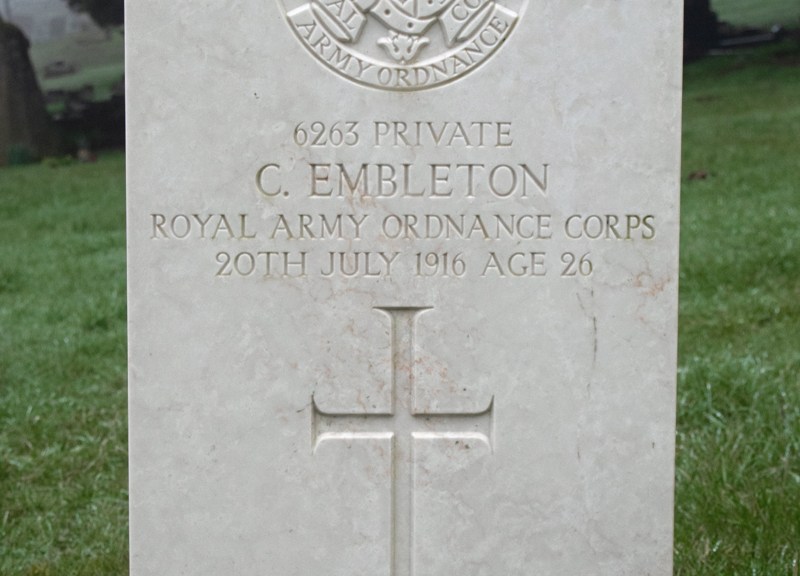
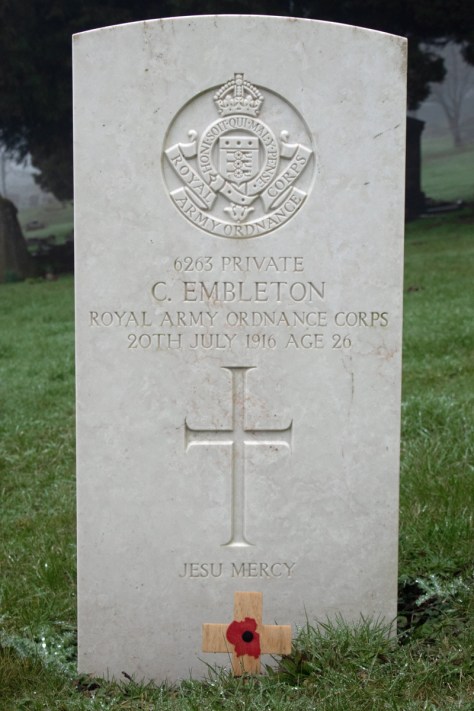
Charles Embleton was born in Alexandria, Egypt, in 1891. One of five children, his father John was a captain in the army, and his wife, Sarah was based wherever he was.
Military service was obviously in Charles’ blood. He joined up in 1908, and was assigned to the Army Ordnance Corps. After three years’ service, he was moved back to the Reserves.
Charles had met Mary Cooper, a baker’s daughter, from Farnham. They married in September 1911, and, two months later, Mary gave birth to their daughter, Florence. Her baptism records show that, by this time, Charles was working as a registry clerk for his former Corps.
When war broke out, Private Embleton was remobilised and by 14th August 1914, he was in France. His service abroad was brief, however. Within a fortnight he had been shipped back to England and there he stayed until he was medically discharged in March 1915.
While no cause for his dismissal is evident from his service records, his war pension document confirms that, when he passed away, it was from tuberculosis, contracted while on active service. It is reasonable to assume, therefore, what his lung condition was the cause for his initial discharge.
It seems that Charles and his family had relocated to the south west of England when his service was completed. It was here that he died – on 20th July 1916 – at the age of just 25 years old.
Charles Embleton lies at peace in Shepton Mallet Cemetery in Somerset.
William Charles Stevens was born in Wells in 1884. The eldest child of Alfred and Susan, William was one of eleven children. Alfred worked at the local paper mill, while William became a labourer, and found work as a stonemason.
William seemed keen to improve his prospects, however; he enlisted in the army at the start of 1903, serving in the Royal Field Artillery for a period of four years, before being demobbed to the reserves.
On Christmas Day 1907, William married Minnie Bailey; the census four years later gives the young couple as living in their home city. William, by now, was labouring on the railway, and the census shows, they had had a child, who had sadly passed away.
War was looming, and Gunner Stevens was recalled to duty in August 1914. Quickly posted overseas with the 23rd Brigade, he fell ill with myalgia and was shipped home to recover towards the end of the year.
Sent back to the front in 1915, William was promoted to Corporal and transferred to the 51st (Howitzer) Brigade. Sadly, his ‘tremble’ returned and he was sent back to England in October 1915. By this point, Minnie had given birth to their second child, a little girl they called Lilian.
Corporal Stevens’ condition continued, and he was medically discharged in March 1916. No further records exist, but it seems that he finally succumbed to the condition later that year. He passed away on 2nd November 1916, aged 32 years old.
William Charles Stevens lies at peace in the cemetery of his home town, Wells in Somerset.