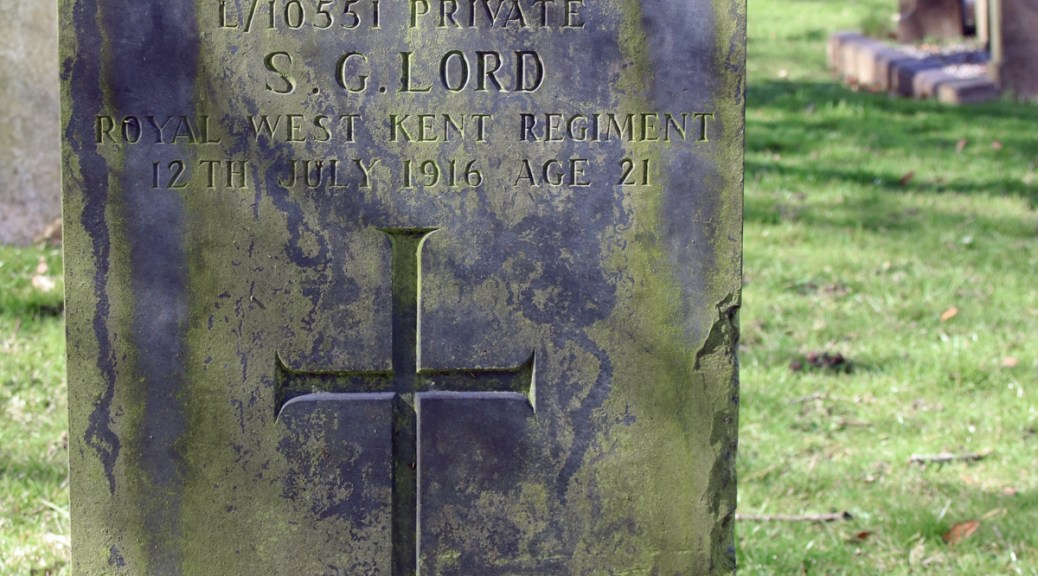
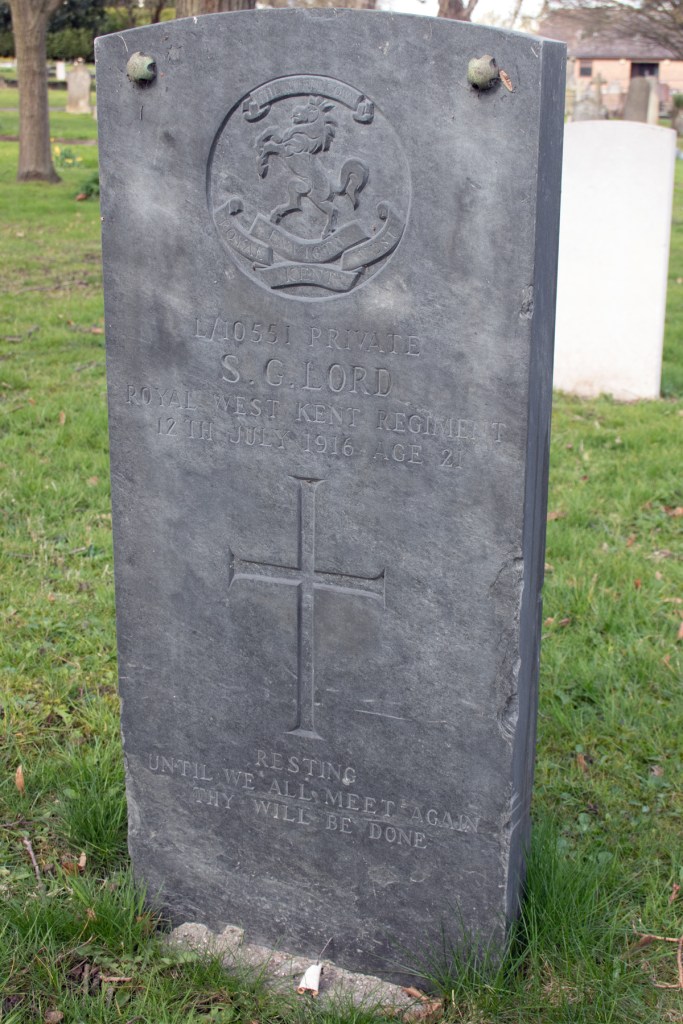
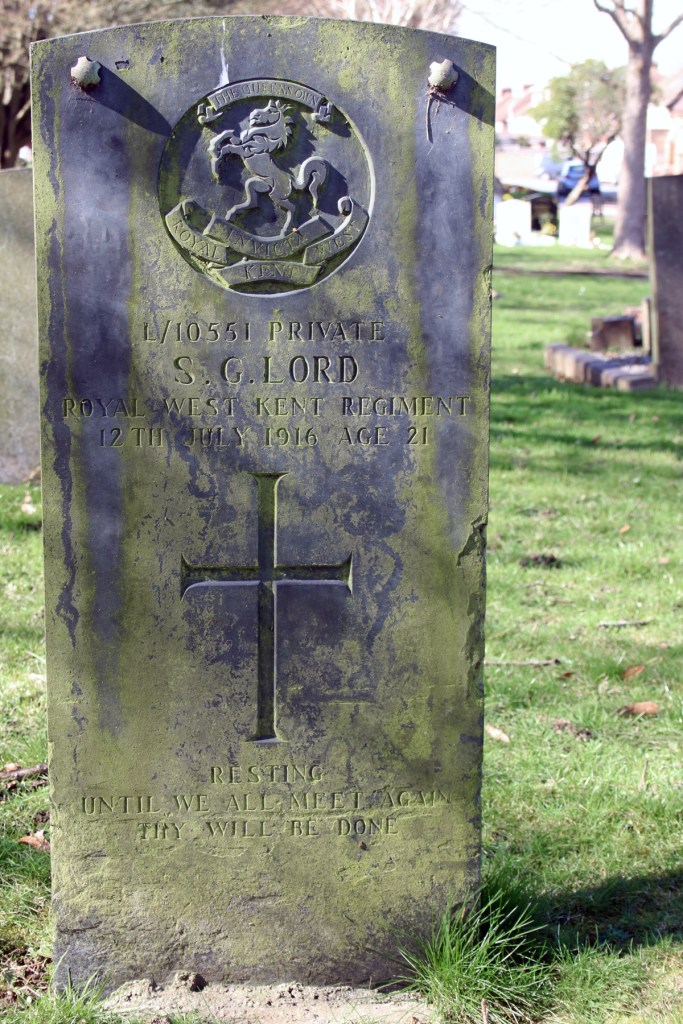
Sidney George Lord was born on 29th March 1895, one of six children to Sidney and Clara Lord. Sidney Sr was a shipwright from Bideford in Devon, and he brought the family to Kent, presumably for work at the Naval Dockyard in Chatham.
Sidney Sr passed away in 1912 and his son left school, finding work as a plumber’s apprentice. War was on the horizon, however and he was keen to do his bit as soon as possible. Sidney Jr enlisted in November 1914, joining the Queen’s Own Royal West Kent Regiment.
After his initial training, Private Lord was sent to the Front on 22nd April 1915, serving in France with his regiment for just over a year. Towards the end of this time he became anaemic, and was shipped back to England for treatment.
Private Lord was admitted to the Yeatman Hospital in Sherborne, but sadly succumbed to his anaemia a matter of weeks later. He passed away on 12th July 1916, having not lung turned 21 years of age.
Sidney George Lord was laid to rest in the Woodlands Cemetery in Gillingham, Kent, close to where his father was buried.
Ernest George Ware was born in the autumn of 1871 in Marylebone, London. Details of his early life are scant, but records show that he enlisted in the Royal Navy in February 1895, serving as a Stoker for an initial period of twelve years.
During this time, he worked on a number of different vessels – Wildfire, Theseus, Warspite, Amphion, Acheron and Sapphire. He was also based on a number of shore vessels; potentially Southsea in Hampshire and Pembroke in Wales.
In 1905 he married Mary Emery; she was the same age as Ernest, and was born in Hampshire. The young couple had a daughter, Muriel, and, by the time of the 1911 census, the family were living in Pembroke Dock, in South Wales.
War was inching closer, and Stoker Ware’s service was extended for the duration; he served on a number of other vessels – Leander, Blenheim, Blake and Tyne – before being promoted to Chief Stoker on HMS Blonde in 1911. He transferred to HMS St George two years later, before moving on shore to the training vessel HMS Victory II (based in Crystal Palace, South London) in 1915.
Chief Stoker Ware’s health seemed to have been in decline by this point; he was admitted to the Royal Naval Hospital Haslar in Gosport in early 1916, suffering from malignant endocarditis. Sadly, he passed away on 16th February, aged 44 years old.
Ernest George Ware was buried in the Woodlands Cemetery in Gillingham, Kent, close to where his widow was now living.
Henry McCahearty was born in Glasgow in October 1864, one of four children to Henry and Bridget McCaherty. Sadly, few records remain, but it seems that Henry Sr, who had been born in Northern Ireland, was a soldier.
Henry falls off the radar quite quickly; from later records we can determine that he worked as a skilled labourer at the Naval Dockyard in Chatham, although it is not certain what particular skills he had.
He married Alice Radford on 3rd September 1901 in Walmer, on the Kent coast, although the couple subsequently moved to Gillingham. They went on to have four children – Reginald, James, Leonard and Alfred.
Henry was 49 when war broke out. While over the initial recruitment age, he did enlist – becoming a Private in the Royal Marine Light Infantry – although it is not certain exactly when he joined up.
Sadly Private McCahearty’s passing is also a mystery. There is nothing in the newspapers of the time to suggest anything out of the ordinary, so I can only assume that he died as a result of one of the illnesses that were rife at the time. Either way, he died on 14th November 1916, at the age of 51.
Henry McCahearty lies at rest in the Woodlands Cemetery in Gilingham, Kent.
Alfred William Lowes was born in 1893, one of eight children to George and Ann. George was a railway porter from Kent, Ann was born in Berkshire, and the couple had settled in Gillingham, Kent, by the time they started a family.
The naval dockyard in Chatham was one of the main employers in the Medway area of Kent, and Alfred was drawn there for work. After leaving school, he found a job there as a messenger, following his older brother George, who was a labourer there.
In the spring of 1916, Alfred married Edith Kennett, and it seems like the timing was due to his military service. Private Lowes joined the Prince of Wales’ Own Civil Service Rifles (also known as the 15th Battalion London Regiment) and by the beginning of August his troop was bound for France.
Full details of Private Lowes’ military service is not available, although it seems not to have been a lengthy one. He would have fought on the front line, and was wounded as a result. Repatriated back to England for treatment, Alfred passed away at home on 12th November 1916. He was just 23 years of age.
Alfred William Lowes lies at rest in the Woodlands Cemetery in his home town of Gillingham.
Herbert Packer was born in December 1889, the youngest of nine children to Joseph and Ann Packer. Joseph was a railway carrier (or porter) and the family lived in Cheddar, Somerset.
The 1911 census found Herbert on his travels; he was working as a grocer’s assistant, and boarding with a family in Abergavenny, South Wales. He was obviously keen to develop his skills, and soon moved to Barnstaple in Devon to work for the Lipton’s grocery there.
In the autumn of 1914, Herbert married Lydia Snell, a dressmaker from Wales and the young couple lived together in the Devon town where he worked. He was very active in the community; he was a teacher at the local Wesleyan Sunday School, and active in the church choir having, according to a local newspaper, “a capital voice”.
Herbert enlisted in the spring of 1916, and had the honour of joining the Coldstream Guards. He did his training in London, and was due back to Barnstaple on leave before starting his active service when he was taken ill. Admitted to the London Hospital with pneumonia, within a couple of weeks he had succumbed to the condition. Guardsman Packer died on 3rd December 1916, aged just 26 years old.
Herbert Packer lies at rest in St Andrew’s Churchyard in his home town of Cheddar in Somerset.
William Alfred Woodbury was born in the Somerset village of Nether Stowey in April 1899, the oldest of four children to Alfred and Nellie Woodbury. Alfred was a farm labourer, and, by the time William was a couple of years old, he had moved the family to the town of Bridgwater to work as a carter.
After leaving school, William found work at Barham Brothers’ Brickworks in the town. When war broke out, he enlisted in the Somerset Light Infantry almost as soon as he was able to, at the beginning of 1916.
Assigned to the 6th (Service) Battalion and Private Woodbury was sent out to the Western Front in April. He would almost certainly have seen action at the Battle of Delville Wood – part of the Somme offensive – and was wounded in the shoulder and arm on 18th August 1916.
Shipped back to the UK for treatment, William was admitted to the Western General Hospital in Cardiff, but tragically died from his wounds less than a fortnight later on 30th August 1916. He was just 17 years old.
His funeral was reported in both the Shepton Mallet Journal and the Central Somerset Gazette; his father, who had been serving in France as part of the Army Veterinary Corps, managed to return home for his son’s funeral.
William Alfred Woodbury lies at rest in the St John’s Cemetery in his home town of Bridgwater.
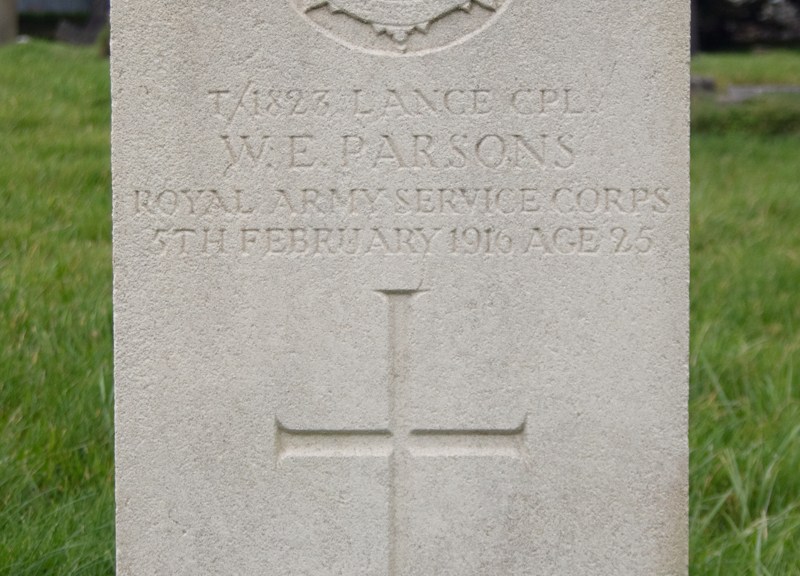
William Edward Parsons was born in 1890, one of six children to John and Prudence Parsons. John found work in a number of fields, working as a blacksmith, porter, dock labourer and a hobbler (towing boats along the River Parrett) in his time. Throughout this, he lived with his family in the Somerset town of Bridgwater.
William found work as a collar cutter in a local shirt factory, and went on to marry Matilda Mary Temblett on Christmas Day 1913. The young couple went on to have a son – Leslie William – who was born in February 1915. William was teetotal, and played full back for the local rugby football club, Bridgwater Albion.
Sadly, Lance Corporal Parsons’ military records are sparse; he had enlisted in the Royal Army Service Corps and was based in Fovant, to the west of Salisbury.
It was while he was on leave that William met his sad fate. On the evening of 5th February 1916, he had seen his parents and had set out to organise a football match in the town. He was walking over the town bridge, when a passer-by heard a splash. He saw a man in the water, who was crying for help, and then disappeared.
William’s body was found in the river a fortnight later close to a local brickyard. He was just 25 years old.
William Edward Parsons lies at rest in St John’s Cemetery in his home town of Bridgwater.
Frederick Hobbs was born in December 1886, the fourth of ten children to William and Martha Hobbs, from Bridgwater in Somerset. William was a mason, and all of his children seemed to be good with their hands. Frederick went on to become a plumber’s apprentice, while his siblings worked as a mason, a dressmaker and a carpenter.
The 1911 census found him living in Polden Street, Bridgwater with his mother and youngest sibling, Florrie. William, however, was living round the corner in Bath Road, with three of his other children, Clara, Tom and George. Both of Frederick’s parents are listed as married, which adds to the confusion of them being in separate houses.
Frederick enlisted with weeks of was being declared; he joined the 10th (Service) Battalion of the Devonshire Regiment and, after a year on home soil, his troop was shipped to France. This wasn’t the end of the Private Hobbs’ journey, however as, within a couple of months, he journeyed on as part of the Mediterranean Expeditionary Force, finally arriving in Salonica, Greece, in November 1915.
Private Hobbs has only been serving for a month when he was admitted to the Hospital Ship Asturias in Alexandria, with lacerations to his cheeks and eyelids. The initial report seemed to suggest the wounds were as a result of gunshot, although a more detailed report later confirmed that the injuries were caused by barbed wire.
While in hospital, Frederick’s urine was found to include a high level of sugar. He also confirmed having lost a lot of weight in recent months, but could not confirm when this had begun. He was diagnosed with diabetes, and was evacuated back to England for treatment for both his injuries and his illness.
The damage to his left eye healed, but he was left with significant ptosis, or drooping of the eyelid. When it came to his diabetes, specialists back in England determined that, while it could not be put down to Private Hobbs’ service, it had definitely been aggravated by it. He was deemed no longer fit for military service and furloughed in June 1916, with a follow-up report confirming this three months later.
Sadly, whether Frederick’s life returned to normal is not recorded. It seems likely, however, that the diabetes got the better of him, and he passed away on 25th November 1916, aged just 29 years old.
Frederick Hobbs lies at rest in St John’s Cemetery in his home town of Bridgwater, Somerset.
Frederick’s younger brother Herbert Hobbs also fought in the Great War. He enrolled in the Royal Marines Light Infantry and fought on the Western Front. Caught up in the Battle of Gavrelle Windmill, he was one of 335 Royal Marines to be killed in that skirmish. He lies buried at the Arras Memorial in Northern France.
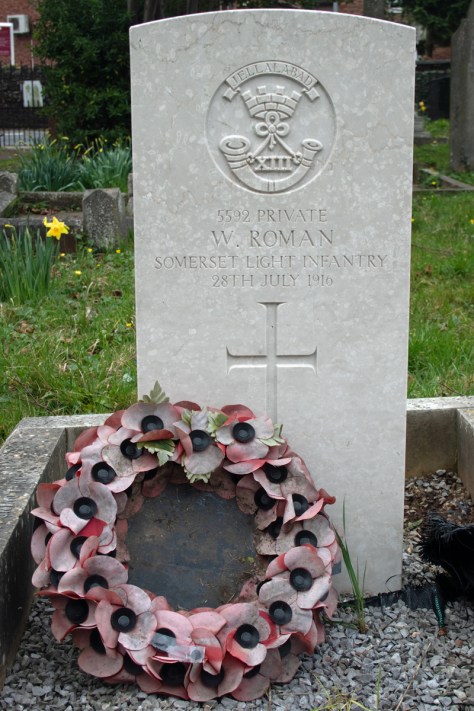
Walter James ‘Rattler’ Roman was born in July 1880, one of six children to George and Betsy Roman. George was a labourer in a brickyard, and the family lived in Bridgwater in Somerset.
Walter’s passion was rugby football, and he made the Bridgwater & Albion first team at the age of 15. Two years later had reached county level, and was playing for Somerset.
Walter enlisted in the army in around 1897, joining the Somerset Light Infantry. He spent several years abroad, serving as a Private in India and South Africa and fighting at Cawnpore and in the Second Boer War.
When Walter’s service ended, he returned to England, and continued his rugby career. He was a regular for the Bridgwater and Somerset teams, gaining the nickname ‘Rattler’, before being signed up by Rochdale Hornets in 1910.
Walter married Henriette Washer in Bridgwater in April 1911, and the couple had two children, Edna – born in 1912 – and Leonard – who was born a year later.
Continuing with rugby union, Walter was called to county level, where he joined Lancashire for a number of games. Walter also played for England, receiving a cap in the international match against Wales in February 1914, and he toured Australia and New Zealand the same year.
War broke out, and Private Roman was re-enlisted, one of twenty-five Hornets players to enlist. He served on the Western Front with the 1st Battalion of the Somerset Light Infantry and was caught up in the engagements at Ypres and Armentieres. Fighting at in the Battle of the Somme, he went over the top at Beaumont-Hamel at the start or fighting, on 1st July 1916 – his 36th birthday.
In that initial charge, he was shot several times, in both arms, a leg and the torso. Initially treated at a local field hospital, he was evacuated to England and admitted to the Voluntary Aid Hospital in Cheltenham. His condition initially improved, and he wrote letters to Henrietta, who was living back in Rochdale.
Sadly, Walter’s contracted sepsis and his health deteriorated; Henrietta was called to the hospital in Cheltenham on 27th July 1916. It is likely that she didn’t make it in time, as Walter passed away at 1pm the following day. He was just 36 years old.
Walter James Roman lies at rest in the Wembdon Road Cemetery in his home town of Bridgwater, Somerset, one of may sporting heroes to perish in the First World War.
Walter Roman (courtesy of findagrave.com)
Walter was one of 25 Rochdale Hornets players to enlist when war broke out. Of those men, five did not return: Private Walter Roman; Sergeant John Twigg; Private Archie Field; Private Tom West and Private CJ Burton.
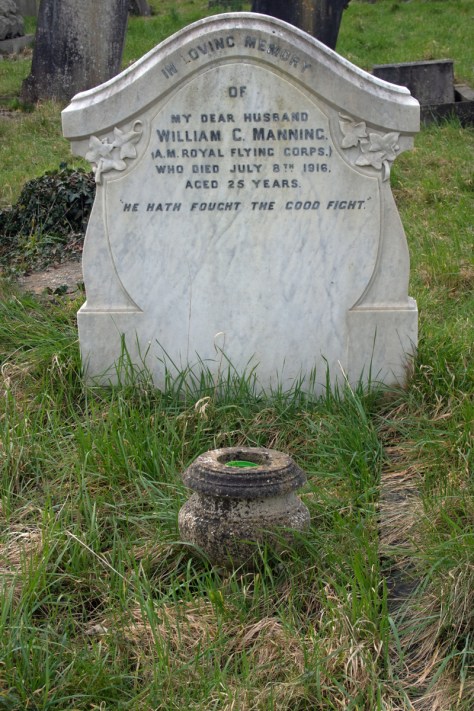
William Charles Manning – known as Willie – was born in Bridgwater in 1890, one of ten children to Samuel and Emily Manning. Samuel was a cabinet maker, and at least of three of his sons, Willie included, went into the family business.
There is little information available on Willie’s life, but he married Nellie Dodden, also from Bridgwater, in November 1915. Sadly, this was around the time that Nellie’s father passed away; tragedy for Nellie was still close by.
Willie’s military records are minimal, although details of his passing can be determined from the subsequent newspaper report.
He had enlisted in the Royal Flying Corps around October 1915, certainly around the time he and Nellie married. He was an air mechanic, something his woodworking skills probably drew him to and was based at Manston Airfield in Kent.
On 8th July 1916, Willie was a passenger in a flight piloted by Lieutenant Bidie. It seems that Bidie was turning the plane while at low altitude, while attempting to land. The plane crashed, and both Bidie and Willie were killed. Air Mechanic Manning was just 25 years old.
William Charles Manning lies at rest in the Wembdon Road Cemetery in his home town of Bridgwater, Somerset.







 Death and Service