Stanley Curtis was born on 31st October 1899, and was one of 21 children to Rowland and Sarah Curtis. Rowland was a gardener and labourer from Warminster, Wiltshire, and it was here, at 9 Marsh Street, that the family were raised.
There is little information available about Stanley’s early life: he was only two years old at the time of the 1901 census, and still at school for the next return in 1911. Later document, however, confirms that he worked as a farm labourer when he completed his schooling and that he was an active member of the Warminster Cadets.
Stanley was keen to play his part when war broke out. He enlisted in the Royal Navy as soon as he was able to, joining as a Stoker 2nd Class on 7th December 1917. His service records show that he was 5ft 4ins (1.62m) tall, with brown hair, brown eyes and a fresh complexion.
Stoker 2nd Class Curtis was sent to HMS Victory, the Royal Naval Dockyard in Portsmouth, Hampshire, for his training. After four months there he was given his first assignment, on board the protected cruiser HMS Amphitrite. Working as a minelayer, she served in the North Sea, and was positioned off Scotland when Stanley fell ill.
Stoker Curtis was disembarked in Edinburgh, and was admitted to the city’s Royal Naval Hospital with peritonitis. Sadly the condition was to prove fatal, and he passed away on 13th September 1918, a few weeks short of his 19th birthday.
The body of Stanley Curtis was brought back to Wiltshire for burial. He was laid to rest in the graveyard of Christ Church, Warminster, just a few minutes’ walk from where his grieving family lived.
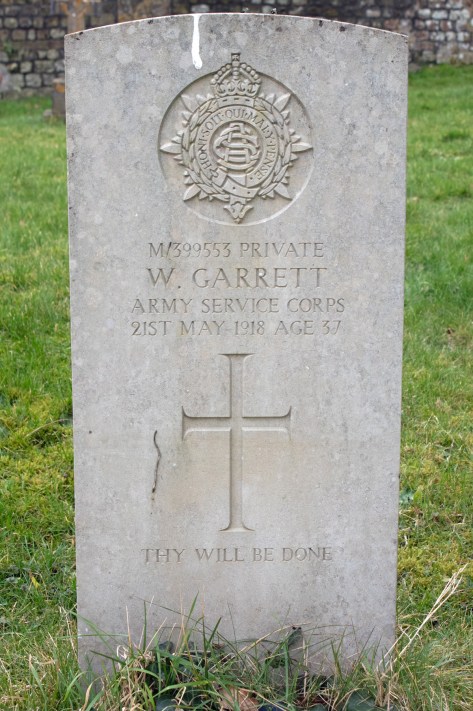
William Garrett was born in Warminster, Wiltshire, on 18th October 1880. The fourth of seven children, he was the fourth son to Henry and Mary Garrett. Henry was a groom, and the family lived at 80 Portway, a Victorian villa to the north of the town centre.
The 1901 census records the family having moved from No. 80. The document notes their address as 14 Portway and with this move, there appears to have been a change of circumstances. At some point in the previous ten years, Henry had given up working with horses, and had gone into baking instead. This too had taken a back seat, however, as the census confirms his employment as former baker. William, now 21 years of age, was still living with his parents, and was working as a printer for a local newspaper.
On 5th August 1905, William married Kate Macey. A labourer’s daughter from Bishopstrow, Wiltshire, the couple exchanged vows in her parish church. They settled in a house on Deverill Road, Warminster, and went on to have five children,
When war broke out, William would eventually be called upon to play his part. “He was previously employed at the ‘Warminster Journal’ office as monotype caster and operator, and served his apprenticeship at the office. It was very largely through his services that the ‘Journal’ was forced to suspend publication and though he might have obtained further exemption from military service, he preferred to leave civil employment and enter into the service of his country” [Wiltshire Times and Trowbridge Advertiser: Saturday 25th May 1918]
William enlisted in the Army Service Corps on 1st May 1918. As a Private, was attached to the Mechanical Transport Depot in Sydenham, Kent. His service records show that he was 5ft 3ins (1.59m) tall and weighed 126lbs (57.2kg). His medical records note that he was of good physical development.
The newspaper report continued:
[Private Garrett] left Warminster only a week or two ago and was billeted at Sydenham, being apparently in the best of health and spirits. On Tuesday his wife… received the following telegram from an officer: “I regret to have to inform you your husband died suddenly in his billet around 1:30pm today. All ranks convey deepest sympathy.”
The distressing news was confirmed by a letter from a comrade, Pte. Manley, who is a native of Taunton. He wrote “It is with extreme sorrow I write this letter to you. Your husband and I arrived here the same day and he slept in my room with two others – very nice fellows. We all send you our heartfelt sympathy in your sorrow. He spoke to me today about 1.10pm and then fell forward. I and others did everything possible for him but he was beyond human aid from the start. He only lived about two minutes and suffered no pain. We all liked him very much in our bedroom and indeed in the billet. I am sure he would have proved a credit to the ASC.”
[William] was a member of the Oddfellows Society and filled all the local lodge offices, and was also a member of the committee of the Co-operative Society. He belonged to the Warminster Volunteer Training Corps, and jus as he left to join the regular army he was about to be promoted.
[Wiltshire Times and Trowbridge Advertiser: Saturday 25th May 1918]
The inquest into Private Garrett’s death found he had died of natural causes. He was 37 years of age when he passed away on 21st May 1918. He had been in the army for just 20 days.
The body of William Garrett was taken back to Wiltshire for burial. He was laid to rest in the graveyard of Christ Church, Warminster.
John Adlam was born in the spring of 1883 in Warminster, Wiltshire. The youngest of seven children, his parents were William and Emily Adlam. William was a maltster’s labourer, and the family lived in a small cottage at 66 Pound Street, to the south west of the town centre.
When John finished school, he found work as a garden labourer. By this point the Adlam family had moved, and home was 29 Chapel Street. William himself wasn’t recorded there, however. Work had taken him away and he was living at Holcombe Malthouse, on the outskirts of Kilmersden, Somerset.
On Christmas Day 1906, John married Ethel Brown, a plasterer’s daughter from Westbury, Wiltshire. The couple would go on to have three children, and 1911 census shows them living at 24 Chapel Street, Warminster with John’s recently widowed mother.
When war broke out, John stepped up, or was called upon, to play his part. His service records no longer exist, although it is clear that he served as a Private in the Dorsetshire Regiment as a Private. He was based at on of the regimental depots, and served through to the end of the war.
The only other record for John are those relating to his passing. He died on 29th November 1918 and, as his death was registered in Warminster, it seems likely that he died at or close to home. He was 35 years of age.
The body of John Adlam was laid to rest in the graveyard of Christ Church in his home town of Warminster.
Interestingly, while an initial grant was paid to Ethel, John’s entry on the Pension Ledger stated that they had been “instructed to cease [temporary] payment as widow not eligible for pension in respect of her late husband.” There is no indication as to whether this was later overturned.
Frank Rice Reid was born on 1st September 1898 in Toronto, Canada. One of four children, his parents were Nova Scotians George and Annie Reid. George was a commercial traveller, and the family had moved back to Nova Scotia by the time of Frank’s youngest sibling’s birth in 1910.
When Frank finished his schooling, he found work as a clerk, but was drawn to the excitement of flight and, soon became an aviation cadet. War was raging across Europe by this point, and, on 9th October 1917, he enlisted in the Royal Flying Corps. At 19 years and one month old, his service papers show that he was 5ft 7ins (1.7m) tall.
By the spring of 1918, Frank was in Britain, and had been a commission to Second Lieutenant. Assigned to the newly-formed Royal Air Force’s No. 1 Training School in Beaulieu, Hampshire, within a matter of months he was working as an instructor, flying Sopwith Camels.
On the morning of the 30th September 1918, Second Lieutenant Reid was flying his aircraft, when it crashed into the ground and he was killed. He had not long turned 20 years of age. The report of the incident noted that “the cause of the accident was an error of judgement on the part of the pilot in doing a half-roll too near the ground and not having enough height to come out of the dive.”
The body of Frank Rice Reid was laid to rest in the graveyard of St Paul’s Church, East Boldre, not far from the base he had called home.
Douglas Walter Baker was born in Newbury, Berkshire, in 1898. One of seven children, his parents were Henry and Rosa Baker. Henry was a commercial traveller for a cornmeal, cake and flour merchants, and the family lived at 91 Crescent Road, Reading at the time of the 1901 census, then at 196 King’s Road, Reading, ten years later.
There is little concrete information about Douglas’ early life. When war broke out, he enlisted in the 4th Battalion of the Royal Berkshire Regiment, later documents seeming to suggest that he had added three years to his age to enable him to do so. His unit served in France from April 1915, but, as his army service records have been lost, it’s unclear when or if Private Baker went with them.
Douglas seemed to want more, though, and, on 18th December 1915, he transferred to the Royal Flying Corps. Given the rank of Air Mechanic 2nd Class, he was attached to No. 1 Aircraft Repair Depot. By March 1917, he had been promoted to Air Mechanic 1st Class. Again, however, he sought more and, just a few months after the Royal Air Force was formed, he started flying lessons.
The now Flight Cadet Baker had transferred to 29 Training Depot Station in Hampshire. Based at an aerodrome near Beaulieu, Douglas was taught in a Sopwith Camel. Two months into his instruction, he was undertaking a routine flight, when his aircraft got into a spin he was unable to get out of. The machine fell to the ground, and Douglas was killed instantly.
A report of the incident noted that: “the cause of the accident was in our opinion due to the machine spinning to the ground from about 500ft. The reason the pilot could not regain control of the machine is unknown.” [Royal Air Force Casualty Card]
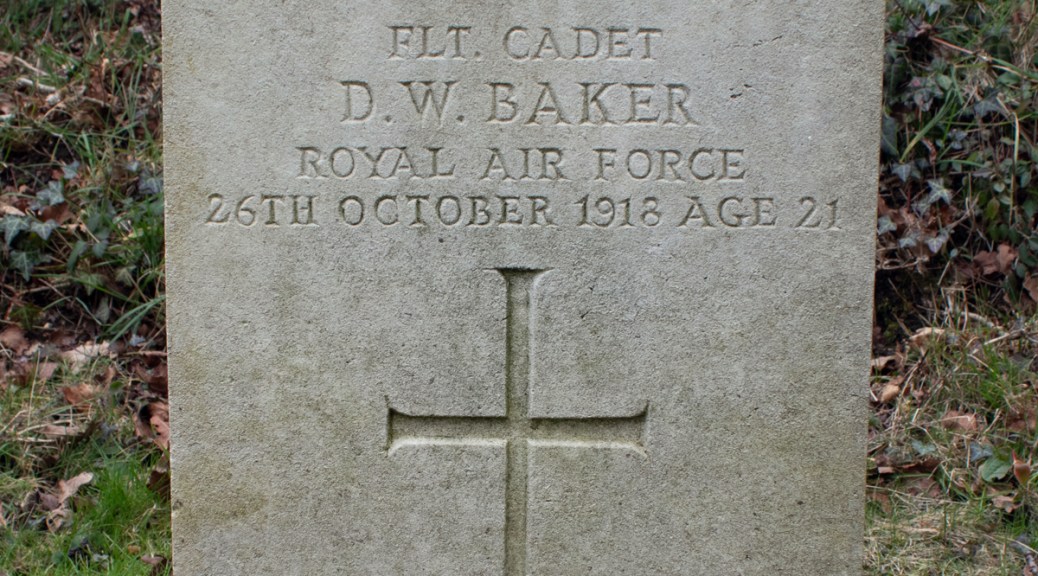
Douglas Walter Baker was just 20 years of age when he died on 26th October 1918. His body was taken to the graveyard of St Paul’s Church, East Boldre, not far from the air base at which he had been billeted.
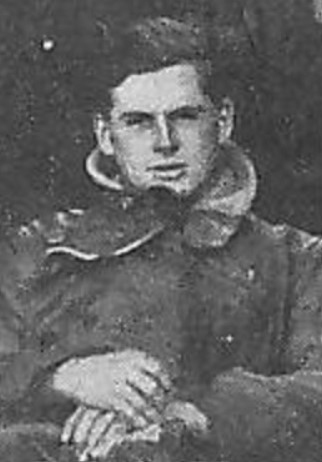
Flight Cadet Douglas Baker (from findagrave.com)
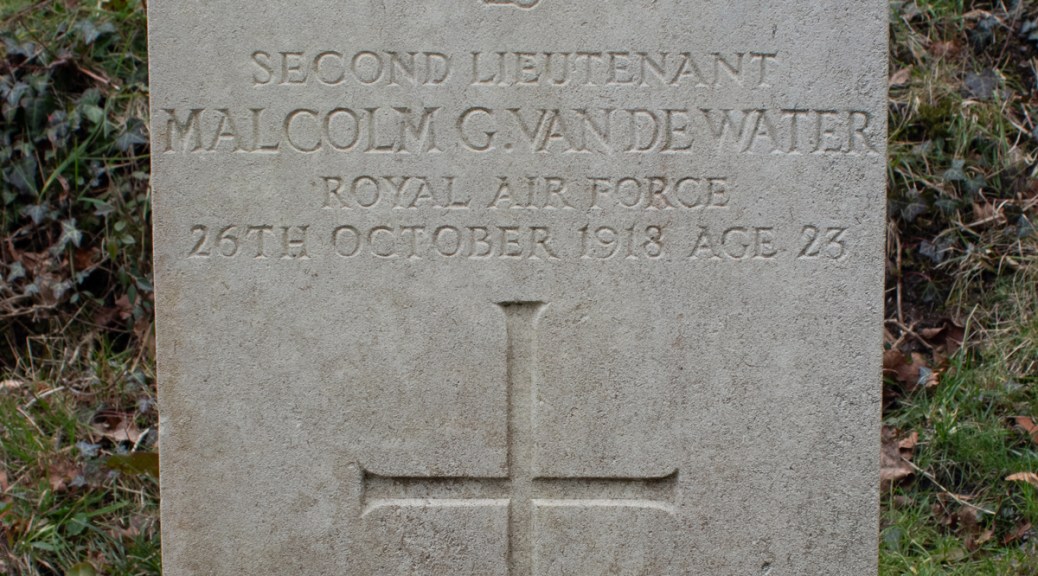
The life of a WW1 pilot was notoriously dangerous. On the same day of Douglas’ death, and at the same airfield, fellow pilot Second Lieutenant Malcolm Vande Water lost his life in a separate incident.
Malcolm Gifford Boggs was born on 14th August 1894 in Brooklyn, New York. The second of four children, his parents were Seth and Anna Boggs. Seth died in 1905, and Anna married again, to widower lawyer Charles Vande Water: her children took his name.
The next record for Malcolm is that of his Royal Flying Corps service records. Interestingly, they note that he enlisted on 10th September 1917, and did so in Toronto, Canada. While the United States had entered the First World War by this point, it may have been easier for him to join via a colonial route.
Malcolm’s papers show that he was 5ft 11ins (1.81cm) tall, and was a student aviator at the time he joined up. He was recorded as being an Air Mechanic 3rd Class, but that came to an end when, on 2nd February 1918, he was accepted for a commission.
Second Lieutenant Vande Water was attached to the 29th Training Depot Station in Hampshire. There is little information about his time there, but a later American newspaper provided details of what happened to him:
Intelligence reaching relatives of Lieutenant Malcolm G Vande Water, of the Royal flying corps, a former Passaic newspaper man, is that he was killed in a fall while testing a new airplane at the British airdrome in Beaulieu, France. Wande Water was the first member of the Pica club to pay the supreme sacrifice. He was on leave in England, after six months’ active service at the front, having operated a machine across the English channel to France on the day before his fatal fall. His machine gun shot off a propellor blade while he was flying 100 feet in the air and the airplane dove to the earth.
[The Morning Call: 17th December 1918]
The accuracy of the information included in the article is variable to say the least. Malcolm may have enlisted in the Royal Flying Corps, but, by the time of the accident on 26th October 1918, that had become the Royal Air Force. The Beaulieu aerodrome mentioned was in Hampshire, not France. The RAF’s records for the incident do confirm, however, that the propellor of his Sopwith Camel was indeed shot through, causing the aircraft to fall to the ground.
Second Lieutenant Vande Water was taken to the Forest Park New Zealand General Hospital in Brockenhurst, Hampshire, for treatment, but his injuries would prove too severe. He died later that day, at the age of 24 years old.
The body of Malcolm Gifford Vande Water was laid to rest in the graveyard of St Paul’s Church in East Boldre, Hampshire, not far from the base he had called home.
The life of a WW1 pilot was notoriously dangerous. On the same day of Malcolm’s death, and at the same airfield, Flight Cadet Douglas Baker was also killed, in a separate incident.
Edward Percival Augustus Topley was born on 6th November 1899 in Woolwich, Kent. He was the third of seven children to Percival and Sarah Topley. Percival was a grocer, and the 1901 census found the family living at 64 Eglinton Road, Plumstead.
Details about Edward’s early life are sketchy. There is a record of him learning to fly at the Cambridge School of Flying, and gaining his wings on 4th November 1917. “…he went through a course at the Royal Naval College, Greenwich. From there he was sent to Beaulieu Aerodrome, Hants…” [Kentish Independent: Friday 15th November 1918]
Edward rose to the rank of Second Lieutenant when the Royal Flying Corps and Royal Naval Air Service merged to become the Royal Air Force on 1st April 1918. Attached to the 29th Depot Training Station, he seems to have built up a fair amount of flying experience.
On 30th October 1918, Second Lieutenant Topley was flying his Sopwith Camel, when the engine stalled, and the aircraft crashed to the ground. Edward was killed instantly. He was a week shy of his nineteenth birthday.
The body of Edward Percival Augustus Topley – “a very promising young officer, and loved by all who knew him” [Kentish Independent: Friday 15th November 1918] – was taken to St Paul’s Church, East Boldre, not far from the base he had begun to call home, and laid to rest.
Second Lieutenant Edward Topley (from britishnewspaperarchive.co.uk)
Wesley Alexander Archibald was born in Flatlands, New Brunswick, Canada, on 19th October 1894. The oldest of ten children, his parents were Scottish-born couple James and Jane Archibald. It is unclear what employment James was in, but when he completed his schooling, Wesley found work as a telegraph operator.
When not working, Wesley was an active member of the Irish Fusiliers of Canada, and, by the time was broke out, he had been with the 11th Regiment for a year.
Wesley enlisted in the Canadian Expeditionary Force on 29th November 1915. His service records show that he was 5ft 6.5ins (1.69m) tall, with black hair, brown eyes and a fresh complexion. He was also noted as having a large scar on the outer side of his right thigh.
Private Archibald’s initial training was completed on home soil. His unit – the 121st Battalion – left Halifax on 14th August 1916, and arrived in Liverpool, Lancashire, ten days later. His dedication to the role was clear: his unit moved to Bramshott, Surrey, and he had been promoted to Corporal by the time he arrived there, and Sergeant just two months later.
In January 1917, Wesley was assigned to the 7th Battalion of the Canadian Expeditionary Force and sent to the Front Line. Over the next few months, his unit saw some fierce fighting at Arras, Vimy and Hill 70. On 9th July Sergeant Archibald was awarded the Military Medal for his actions.
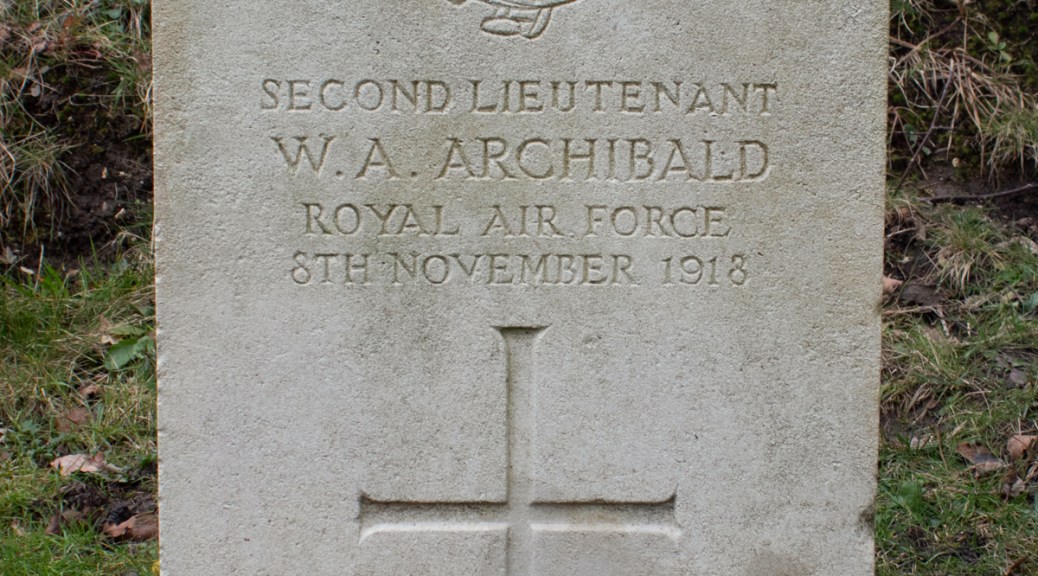
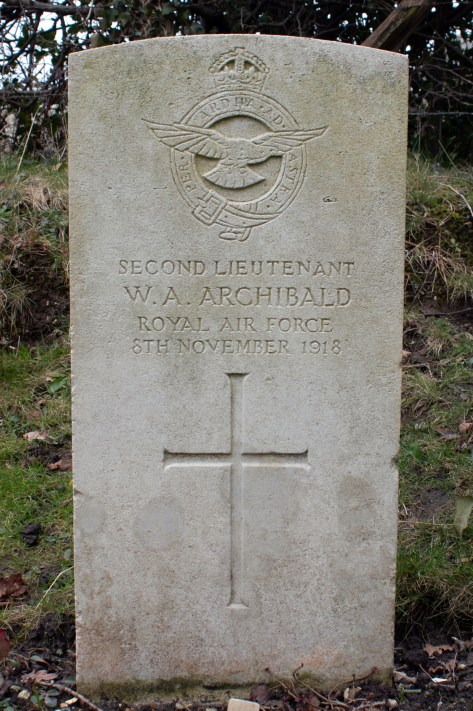
By the end of 1917, Wesley was seeking more adventure, and, on 10th December, he transferred to the Royal Flying Corps. Attached to the 29th Training Depot Station, he was based near Beaulieu in Hampshire when the Royal Air Force was created. Over the next year he learnt his new trade and, on 7th November 1918, he was appointed Second Lieutenant.
The following day, Wesley was preparing for a flight in his Sopwith Dolphin. The aircraft took off, but the engine stalled, and the plane crashed. Second Lieutenant Archibald was killed instantly. He was 24 years of age.
The body of William Alexander Archibald was laid to rest in the graveyard of St Paul’s Church in East Boldre, not far for the airfield he had called home.
Stanley James Isaiah Westaway was born on 2nd March 1898 in the Devon village of Marldon. One of twelve children, his parents were builder’s labourer George Westaway and his wife, Eliza.
Being a large family, Stanley may have felt the need to make his mark on the world. When war broke out, he found that opportunity and, on 10th April 1916, he enlisted in the Royal Navy.
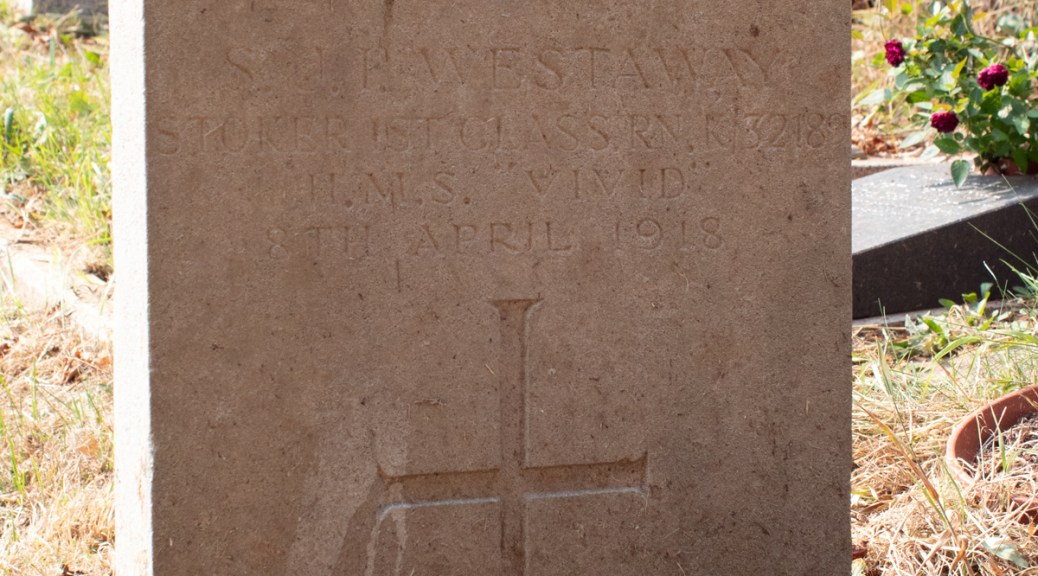
Taking on the role of Stoker 2nd Class, Stanley was sent to HMS Vivid, the Royal Naval Dockyard in Devonport, for his training. His service papers show that he was 5ft 3ins (1.6m) tall, with dark brown hair, brown eyes, and a fresh complexion.
Stoker Westaway’s first posting was aboard HMS Berwick, a cruiser that patrolled the English Channel. He remained there for eighteen months, and, during this time, he gained a promotion to Stoker 1st Class. In November 1917, he returned to his shore base, and remained there through to the following spring.
In early 1918, Stanley fell ill. As he was at sea at the time, he was sent to the closest Royal Naval Hospital in Pembroke Dock, Pembrokeshire. His condition worsened and the condition was to prove fatal: he passed away on 8th April 1918, at the age of 19 years of age.
The body of Stanley James Isaiah Westaway was taken back to Devon for burial. He was laid to rest in the graveyard of St John the Baptist’s Church in his home village.
Herbert Victor Creed was born in Warminster, Wiltshire, towards the end of 1898. One of eight children, his parents were David and Mary Creed. Davis was a railway porter, and, at the time of the 1911 census, the family were living at 41 Vicarage Street, to the west of the town centre.
When he finished his schooling, Herbert – who had begun to be known by his middle name – found employment working alongside his father. When war broke out, however, he stepped up to play his part. His service papers have been lost to time, but it is clear that he enlisted by the spring of 1918, and he was attached to the Machine Gun Corps.
Private Creed was sent to the Western Front. Where and when he served is not known, but he would definitely have been in the thick of it.
Victor Hubert Creed [sic] (21), third son of Mr and Mrs DJ Creed… who was attached to the Machine Gun Corps, was seriously wounded in action on October 21st. He was taken t a hospital in Manchester, where he passed away on Friday.
[Wiltshire Times and Trowbridge Advertiser: Saturday 9th November 1918]
Herbert Victor Creed – plain Victor to his friends – was 21 years of age when he died on 1st November 1918. His body was taken back to Wiltshire for burial and he was laid to rest in the graveyard of St Denys’ Church.










 Death and Service