Tag Archives: 1918

Second Lieutenant Edward Topley

Second Lieutenant Edward Topley

Edward Percival Augustus Topley was born on 6th November 1899 in Woolwich, Kent. He was the third of seven children to Percival and Sarah Topley. Percival was a grocer, and the 1901 census found the family living at 64 Eglinton Road, Plumstead.

Details about Edward’s early life are sketchy. There is a record of him learning to fly at the Cambridge School of Flying, and gaining his wings on 4th November 1917. “…he went through a course at the Royal Naval College, Greenwich. From there he was sent to Beaulieu Aerodrome, Hants…” [Kentish Independent: Friday 15th November 1918]

Edward rose to the rank of Second Lieutenant when the Royal Flying Corps and Royal Naval Air Service merged to become the Royal Air Force on 1st April 1918. Attached to the 29th Depot Training Station, he seems to have built up a fair amount of flying experience.

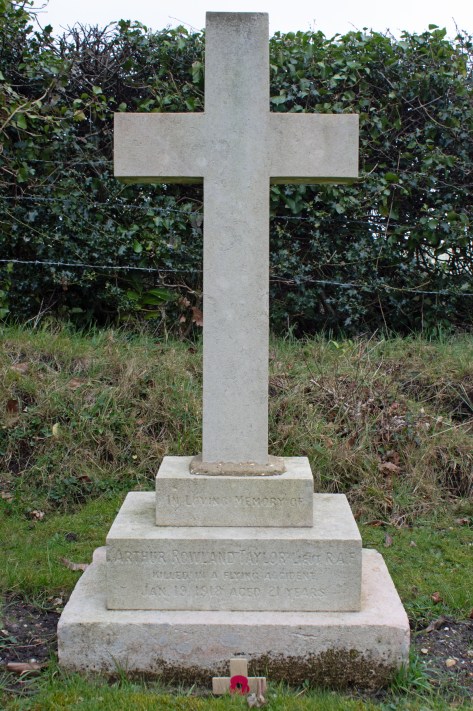
On 30th October 1918, Second Lieutenant Topley was flying his Sopwith Camel, when the engine stalled, and the aircraft crashed to the ground. Edward was killed instantly. He was a week shy of his nineteenth birthday.

The body of Edward Percival Augustus Topley – “a very promising young officer, and loved by all who knew him” [Kentish Independent: Friday 15th November 1918] – was taken to St Paul’s Church, East Boldre, not far from the base he had begun to call home, and laid to rest.


Second Lieutenant Edward Topley
(from britishnewspaperarchive.co.uk)

Second Lieutenant Wesley Archibald

Second Lieutenant Wesley Archibald

Wesley Alexander Archibald was born in Flatlands, New Brunswick, Canada, on 19th October 1894. The oldest of ten children, his parents were Scottish-born couple James and Jane Archibald. It is unclear what employment James was in, but when he completed his schooling, Wesley found work as a telegraph operator.

When not working, Wesley was an active member of the Irish Fusiliers of Canada, and, by the time was broke out, he had been with the 11th Regiment for a year.

Wesley enlisted in the Canadian Expeditionary Force on 29th November 1915. His service records show that he was 5ft 6.5ins (1.69m) tall, with black hair, brown eyes and a fresh complexion. He was also noted as having a large scar on the outer side of his right thigh.

Private Archibald’s initial training was completed on home soil. His unit – the 121st Battalion – left Halifax on 14th August 1916, and arrived in Liverpool, Lancashire, ten days later. His dedication to the role was clear: his unit moved to Bramshott, Surrey, and he had been promoted to Corporal by the time he arrived there, and Sergeant just two months later.

In January 1917, Wesley was assigned to the 7th Battalion of the Canadian Expeditionary Force and sent to the Front Line. Over the next few months, his unit saw some fierce fighting at Arras, Vimy and Hill 70. On 9th July Sergeant Archibald was awarded the Military Medal for his actions.

By the end of 1917, Wesley was seeking more adventure, and, on 10th December, he transferred to the Royal Flying Corps. Attached to the 29th Training Depot Station, he was based near Beaulieu in Hampshire when the Royal Air Force was created. Over the next year he learnt his new trade and, on 7th November 1918, he was appointed Second Lieutenant.

The following day, Wesley was preparing for a flight in his Sopwith Dolphin. The aircraft took off, but the engine stalled, and the plane crashed. Second Lieutenant Archibald was killed instantly. He was 24 years of age.

The body of William Alexander Archibald was laid to rest in the graveyard of St Paul’s Church in East Boldre, not far for the airfield he had called home.


Stoker 1st Class Stanley Westaway

Stoker 1st Class Stanley Westaway

Stanley James Isaiah Westaway was born on 2nd March 1898 in the Devon village of Marldon. One of twelve children, his parents were builder’s labourer George Westaway and his wife, Eliza.

Being a large family, Stanley may have felt the need to make his mark on the world. When war broke out, he found that opportunity and, on 10th April 1916, he enlisted in the Royal Navy.

Taking on the role of Stoker 2nd Class, Stanley was sent to HMS Vivid, the Royal Naval Dockyard in Devonport, for his training. His service papers show that he was 5ft 3ins (1.6m) tall, with dark brown hair, brown eyes, and a fresh complexion.

Stoker Westaway’s first posting was aboard HMS Berwick, a cruiser that patrolled the English Channel. He remained there for eighteen months, and, during this time, he gained a promotion to Stoker 1st Class. In November 1917, he returned to his shore base, and remained there through to the following spring.

In early 1918, Stanley fell ill. As he was at sea at the time, he was sent to the closest Royal Naval Hospital in Pembroke Dock, Pembrokeshire. His condition worsened and the condition was to prove fatal: he passed away on 8th April 1918, at the age of 19 years of age.

The body of Stanley James Isaiah Westaway was taken back to Devon for burial. He was laid to rest in the graveyard of St John the Baptist’s Church in his home village.


Private Victor Creed

Private Victor Creed

Herbert Victor Creed was born in Warminster, Wiltshire, towards the end of 1898. One of eight children, his parents were David and Mary Creed. Davis was a railway porter, and, at the time of the 1911 census, the family were living at 41 Vicarage Street, to the west of the town centre.

When he finished his schooling, Herbert – who had begun to be known by his middle name – found employment working alongside his father. When war broke out, however, he stepped up to play his part. His service papers have been lost to time, but it is clear that he enlisted by the spring of 1918, and he was attached to the Machine Gun Corps.

Private Creed was sent to the Western Front. Where and when he served is not known, but he would definitely have been in the thick of it.

Victor Hubert Creed [sic] (21), third son of Mr and Mrs DJ Creed… who was attached to the Machine Gun Corps, was seriously wounded in action on October 21st. He was taken t a hospital in Manchester, where he passed away on Friday.

[Wiltshire Times and Trowbridge Advertiser: Saturday 9th November 1918]

Herbert Victor Creed – plain Victor to his friends – was 21 years of age when he died on 1st November 1918. His body was taken back to Wiltshire for burial and he was laid to rest in the graveyard of St Denys’ Church.


Private Sydney Devenish

Private Sydney Devenish

Sydney Milton Devenish was born in Perth, Western Australia, on 27th October 1884. One of eight children, he was the oldest son to Ralph and Ann Devenish. There is little information about his early life, but when he completed his schooling, he found work as a carter.

On 28th December 1912, Sydney married Matilda Durnin. They set up home in Fremantle, and had four children: Olive Harold, Sydney and Flora.

When war was declared, Sydney was keen to play his part. He tried to enlist at the start of 1916, but was turned down because of a heart issue. He tried again a year later, and was taken on as a Private in the Australian Imperial Force. His service records show that he was 5ft 3ins (1.6m) tall, and weighed 139lbs (63kg). He was noted as having light brown hair, brown eyes and a fresh complexion.

Private Devenish set sail from Perth on 29th June 1917. The voyage to Britain would take two months and, after arriving in Plymouth, Devon, he was marched into base at Durrington, on Salisbury Plain, Wiltshire. The journey took a lot out of the soldiers, and many fell ill because of it. Sydney was soon admitted to the Fargo Military Hospital with influenza, and spent a week there.

Sydney was discharged from hospital on 15th September, and would continue with his training as part of the 51st Battalion. His health was still causing a problem, however, and he was admitted to a military hospital again, this time in Sutton Veny, Wiltshire.

This man paraded in sick at 1.30pm on 8.2.18.. He had a diffuse swelling on the right side of the jaw. This did not extend down to the next, nor were there any other signs of Oedema found. There was a history of these sudden swellings …three day’s medicince [sic] given [to] this man; he complained of no pain.

I was awakened at 3.25am this morning [9th February] and told by two men that a man was choking… On my arrival there I found that life was extinct but did artificial respiration for a few minutes proving that there was a block in the lower respiratory passages somewhere, as air was difficult to force out of the chest. This man was cyanosed and there was a diffuse swelling of the face and neck…

Private Devenish died of an acute angioneurotic odema: he was 33 years of age.

The body of Sydney Milton Devenish was taken to nearby Warminster for burial. He was laid to rest in the graveyard of St Denys’ Church.


Sydney’s personal effects were forwarded to Matilda. The extensive list included ‘5 prs sox, 1 pr knee pads, 3 khaki collars, 3 balaclavas, water-proof cap cover, 1 money belt, 2 hair brushes in case, 1 safety raxor & blades in tin, 1 tin cigarette cards, 1 coo-ee wallet with letters, 2 note books, 2 religious books, 1 Cpl’s chevrons, 1 holdall (containing 2 razors, 1 comb, 1 clasp knife, 1 razor strop, cotton, buttons, cord, badges, metal ring and ribbon), 1 pr mittens, 1 parcel addressed Bailey Devenish, Guildford (containing 5 pieces music, 1 housewife, 2 handkerchiefs, 1 religious book, 1 letter, 1 French book, 1 book of views, 3 pipes, 2 masonic books), 1 tin (containing letters, postcards, signalling and playing cards), 2 novels, 1 prayer book, 1 motor manual, 1 purse, 1 damaged watch, 1 leather watch case, 1 watch protector on strap, 1 pr pliers, 2 kit bag handles & 1 lock, 1 tin opener, 1 pipe, 1 scarf’.


Private Sydney Devenish
(from ancestry.co.uk)

Lance Corporal Herbert Sims

Lance Corporal Herbert Sims

Herbert Rowland Sims was born in Warminster, Wiltshire, on 27th May 1895. One of nine children, he was the youngest son to Edward and Mary Sims. Edward was a railway signalman, and the family lived on Imber Road, to the north east of the town centre.

When Herbert finished his schooling, he found employment as a tailor’s apprentice. When war broke out, however, he was keen to play his part. His service records no longer exist, but a later newspaper report fills in some of the details.

The death took place on Wednesday in last week at the Tewkesbury Red Cross hospital of Lance-Cpl. Herbert Rowland Sims… [He] went to India on the outbreak of war with the Wilts Regiment, and subsequently volunteered for service in Mesopotamia, being transferred to the Dorsets. He contracted typhoid, and after being in hospital in Egypt he was invalided home. He was about to receive his discharge, but was again laid low by an attack of pneumonia which, after the illness contracted in Mesopotamia, proved fatal.

A memorial service was held in Tewkesbury Abbey on Saturday, the body being escorted by wounded comrades from the hospital. From the Abbey the coffin was taken to the railway station to be sent to Warminster, and on Monday the internment took place in the Minster churchyard with military honours.

[Wiltshire Times and Trowbridge Advertiser: Saturday 26th October 1918]

Herbert Rowland Sims was just 23 years of age when he died on 16th October 1918. He was laid to rest in St Denys’ Churchyard in his home town of Warminster.


Lance Corporal Herbert Sims
(from ancestry.co.uk)

Seaman Angus McLeod

Seaman Angus McLeod

Angus McLeod was born on 18th April 1881 in the hamlet of Deiraclete (or Diraclett) on the Isle of Harris, Scotland. Little information is available about his early life, but a later record suggests his parents were called Norman and Mary.

Given the remote location of his birth, it is unsurprising that Angus was to gain knowledge of a life a sea, whether for work, or as a mode of transport. When war broke out, his expertise was called upon, and he joined the Royal Naval Reserve as a Seaman. He enlisted on 31st October 1916, and his records show that he was 5ft 9.5ins (1.77m) tall, with grey eyes and a fresh complexion.

Over the next fifteen months, Seaman McLeod was based out of HMS Pembroke – the Royal Naval Dockyard in Chatham, Kent. His exact records are unclear, although it seems that he served mainly on merchant vessels and travelled as far as India.

By the end of 1917, Angus was becoming unwell. He was suffering from stomach cancer, and was medically discharged from naval service on 1st February 1918. He had been admitted to the Royal Naval Hospital in Chatham by this point, but his condition was to get the better of him. He passed away on 14th February, at the age of 36 years old.

More than 500 miles from his home – and his widow, Johanna – Angus McLeod was laid to rest in the naval section of Woodlands Cemetery, Gillingham, Kent.


Stoker Petty Officer Henry Weller

Stoker Petty Officer Henry Weller

Henry Weller was born on 13th January 1877 in the village of Ashurst Wood, Sussex. The second of four children, his parents were John and Mary Weller. John was a farm labourer, and the 1881 census found the family living in a cottage on Brooklands Farm in East Grinstead.

Times look to have been tough for the Weller family. By the time of the next census, John, Mary and three of their children were lodging with Hartfield family. Henry, meanwhile, was living in Deptford, Kent, with James and Susannah Weller. He was noted as being a ‘cousin’, although his exact relationship is unclear. James’ nephew Joseph Weller, was also living with them. Just fourteen years of age, Henry was working as a general labourer, and the family were living at 21 Adolphus Street.

Labouring was an irregular way to being in money, and so Henry sought out a more regular career. On 18th November 1896 he signed up to the Royal Navy as a Stoker 2nd Class. His service records show that he was 5ft 4.5ins (1.64m) tall, with brown hair, brown eyes and a fresh complexion. He was also noted as having the letters HW tattooed on his left forearm, and shaking hands on his upper left arm.

Stoker Weller was sent to HMS Pembroke, the Royal Naval Dockyard in Chatham, Kent, for his training. He spent the next nine months split between there and HMS Wildfire – Sheerness Dockyard – learning his trade.

On 8th June 1897, Henry was assigned to the battleship HMS Victorious. Promoted to Stoker 1st Class three months after boarding, she would remain his home for the next three years. After a month aboard another battleship – HMS Revenge – he returned to Chatham.

Love blossomed and, on 8th July 1900, Henry married Alice Beldham, a dock worker’s daughter. The couple exchanged vows at All Saints’ Church, Rotherhithe, Kent, and moved in with Alice’s widowed father, George, at 12 Osprey Street. They went on to have three children: Henry, Harold and Ivy.

Newly settled, Henry seems to have voiced a preference to remain closer to home and, for the next couple of years he would remain based at HMS Pembroke. Alice relocated, and the family set up home at 51 King Edward Road, Gillingham, Kent. Close to the River Medway, the Wellers’ neighbours were all based at the docks, and, during her husband’s future absences, it is likely that Alice felt a sense of community.

After leaving HMS Pembroke, Henry was attached to the cruiser HMS Bacchante. Promoted to Leading Stoker 2nd Class, over the next six years, he would serve on three more ships, spending six-month stints back in Chatham in between assignments. In July 1903 he was promoted to Leading Stoker 1st Class, although he reverted to 2nd Class nine months later. Promoted again in June 1905, he took the rank of Stoker Petty Officer a year later.

Henry’s initial term of service came to an end in November 1908. He immediately re-enlisted, and remained in service until the spring of 1918.

By this point Stoker Petty Officer Weller had been assigned to the torpedo gunboat HMS Hebe for more than thirty months. Patrolling the North Sea coast, on 12th April, she moored at the Alexandra Dock in Hull, Yorkshire. A later inquest outlined what happened next:

Joseph Taylor, a chief petty officer, said that about 11:55pm… [Henry] and he were going from the town to their ship… Witness struck a match to light his pipe. [Henry] walked on for about two yards, and then disappeared. Witness raised the alarm, and went tot he bottom of the dry dock, into which he found [Henry] had fallen, a distance of about 50 feet. They did not know the docks, has they had only come in that morning… If he (witness) had not struck the match they would both have gone over.

[Hull Daily Mail: Wednesday 17th April 1918]

Alive, but severely concussed, Stoker Petty Officer Weller was quickly taken to a local hospital. He was operated on, but his injuries were too severe. Henry passed away on 16th April 1918: he was 41 years of age.

The body of Henry Weller was taken back to Kent for burial. He was laid to rest in Woodlands Cemetery, Gillingham, a short walk from where Alice and their children were still living.


Midshipman Randolph Lemon

Midshipman Randolph Lemon

Randolph Charles Lemon was born on 23rd September 1900. An only child, his parents were Charles and Edith. Charles was a schoolmaster from Hampton Wick, Middlesex, by he and Edith raised their son at 176 Union Road, Leytonstone, Essex.

There is little information available about Randolph’s life. When war broke out he stepped up to play his part, but the only documentation about his time at sea confirms that he served as a Midshipman in the Royal Naval Reserve. Randolph was assigned to the TSS Hurunui, owned by the New Zealand Shipping Company, in April 1916. By the spring of 1918, however, he had transferred to the destroyer HMS Exe.

That March Exe was sailing with HMS Kale south down the eastern coast of Britain, from Hull to Portsmouth. On 27th March 1918, both ships inadvertently steered six miles out of a clear channel and into a British-laid minefield. Both ships hit mines and the Kale was sunk, with the loss of 41 lives. The Exe floundered and, while the full impact is unclear, Midshipman Lemon was killed in the incident. He was just 17 years of age.

The Exe made it to the Royal Naval Dockyard in Chatham, Kent. Randolph Charles Lemon’s body was laid to rest in the naval section of Woodlands Cemetery, Gillingham, Kent.


The loss of their only child at such a young age must have been for his parents to bear. The 1921 census found Charles and Elizabeth had moved to Ilford, Essex, where Charles was now teaching.

Charles died in 1939, at the age of 65, Elizabeth passing away in February 1967, aged 90. Both were buried with their son: a family reunited after nearly five decades.


Leading Seaman William Coombes

Leading Seaman William Coombes

William Henry Marsh was born on 6th September 1879 in Whitstable, Kent. An only child, his parents were William and Maria Marsh, and, based on the census records, his early life seemed to have lacked some stability.

The 1881 census recorded William and his mother living on Beach Walk in the town. Marias was recorded as being a mariner’s wife. By 1891, William and his father was living with Maria’s sister and son. Still a mariner, with his son also working as a seaman, William Sr was listed as being a widower.

A decade on, and William Jr’s life had taken a different turn and the 1901 census listed him living on Whitstable High Street. Working as a labourer in the harbour, he is recorded as having a wife, Julia, and a two-year-old son, also William. Sadly, there is no further information about either of them.

The next document for William Jr is his First World War service papers. It shows that he enlisted on 10th March 1915, his previous time at sea making him an ideal candidate for the Royal Naval Reserve. His is noted as being 5ft 7ins (1.7m) tall, with blue eyes and a fresh complexion. He also had a tattoo of clasped hands on his right forearm. The most interesting thing about this document, however, is the fact that William had chosen to go by the surname of Coombes.

Given the rank of Leading Seaman, William would spend the next couple of years serving mainly on shore, at bases in London and Devonport. By the spring of 1918, while attached to the SS Eastville, he was admitted to the Royal Naval Dockyard in Chatham, Kent. Suffering from anaemia and malaria, the conditions would take his life. He died on 19th March 1918, at the age of 38 years old.

The body of William Henry Coombes was laid to rest in the naval section of Woodlands Cemetery, Gillingham, Kent, not far from the dockyard he would have known.


William’s will left £114 (around £8200) to his widow Julia, who was by now living in Leeds, Yorkshire. At his request, however his war pension, however, was given to his aunt, Mrs Rose Rout, of Hull, Yorkshire.