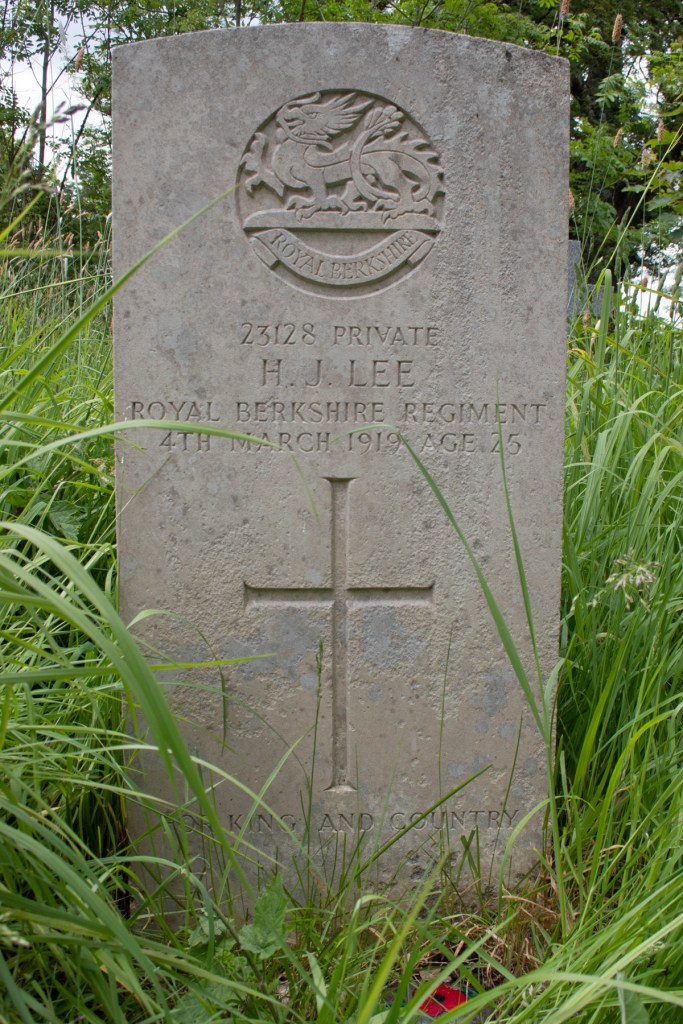
Herbert Jack Lee was born in the autumn of 1893 and was one of twelve children. His parents were Devon-born John Lee and his wife, Emily, who came from Churchstanton, Somerset, and it was here that the young family were raised. John was a bootmaker-turned-innkeeper, and the Lees lived in the village’s Rising Sun Inn.
By the time of the 1911 census, John had returned to boot-making once more. Herbert, meanwhile, had found work as a domestic gardener, bringing in a second wage to a household that included his parents and two younger siblings.
When war came to Europe, Herbert – who was better known by his middle name – stepped up to serve his King and Country. Little of his service documentation remains, but a contemporary newspaper report outlined his time in the army:
[Jack] joined the service in January, 1916, and was posted to the Wilts Regiment. He was subsequently transferred to the Royal Berks, and with them proceeded to France, returning to England suffering from trench feet at Easter, 1917. He was then posted to the Devon Regiment, and put into an Agricultural Company, and employed at Offwell, near Honiton.
Taunton Courier and Western Advertiser: Wednesday 12th March 1919
Private Lee’s health had suffered badly during the winter of 1916/17 and, in the spring of 1919, he came down with a severe bout of influenza. His body was too weakened to recover, and he passed away on 4th March 1919, aged just 25 years old.
Herbert Jack Lee was brought back to Somerset for burial. He was laid to rest in the peaceful graveyard of St Paul’s Church, in his home village of Churchstanton.
Interestingly, in the same edition of the Taunton Courier and Western Advertiser that had reported on Herbert’s funeral, was a report on the state of the Lee’s former home, the Rising Sun Inn.
…some of the rooms were very damp through water having come in… [and] was not fit to live in. The house had been very well conducted by the present tenant [Frank Gill], but… trade… had gone down by four-fifths since the war..
Taunton Courier and Western Advertiser: Wednesday 12th March 1919
Frank Gill was applying to the Licensing Board to avoid paying taxes for the year, given the drop in clientele and the number of other public houses in the area to support any customers. His case was referred on.
Montgomerie Boyle was born on 20th March 1859 in Hendon, London. The youngest of three children, his parents were John and Jane Boyle. John was a barrister, and the family lived in some comfort – the 1861 census found them living in a house in Harrow, Middlesex, with four live-in servants and a groom.
[Montgomerie] joined the South Notts Yeomanry 22 years ago. Subsequently he obtained an appointment at Weston-super-Mare, under the Somerset Territorial Force Association, and did much useful work in co-ordinating the Army Service Corps in the county.
Taunton Courier and Western Advertiser: Wednesday 2nd April 1919
In the spring of 1891, Montgomerie married Constance Smith. She was a banker’s daughter from Nottingham, and the couple tied the knot in Basford, now a suburb of the larger city. They went on to have a daughter, Marion, who was born the following year.
By the 1901 census, the young family had moved to Timsbury, Somerset. Montgomerie was recorded as living on his own means, and the family had a retinue of servants to support them. A decade later, they had moved into the manor house in Staple Fitzpaine, Somerset. Montgomerie was now listed as a Captain in the Army Service Corps.
Storm clouds were gathering over the continent and, when war broke out, Captain Boyle was called back into active service.
…he was stationed with his Regiment on the East Coast for twelve months, and then went to France, where he remained for six months. He was re-called for service with the Mechanical Transport Section of the Army Service Corps in German East Africa, contracted malaria at the end of fifteen months and was invalided home. On his recovery he was despatched to the Egyptian front, and was with the British troops in Jerusalem. He became ill while there, and, on going down to the base at Cairo, was for a month in the Citadel Hospital, where he was treated for a malignant disease. By slow stages, first in a hospital ship, then in a Red Cross train through France, he was conveyed to [Le] Havre. Here, curiously enough, the doctor in charge of the hospital ship upon which he was placed happened to be… an old friend and medical attendant. Major Boyle landed at Southampton, and went immediately to the 3rd London General Hospital at Wandsworth [Surrey], where he was examined by an eminent specialist. His condition was serious but on Monday week last he arrived at his old home, where, despite the devoted care of his wife and daughter, he passed away quietly.
Taunton Courier and Western Advertiser: Wednesday 2nd April 1919
Major Montgomerie Boyle passed away on 27th March 1919, a week after his sixtieth birthday. He was laid to rest in the quiet graveyard of St Peter’s Church, on the outskirts of the grounds of the manor house the Boyles had made their home ten years before.
When Constance died ten years later, at the age of 70 years old, she was laid to rest in the family plot, reunited with her late husband once more.
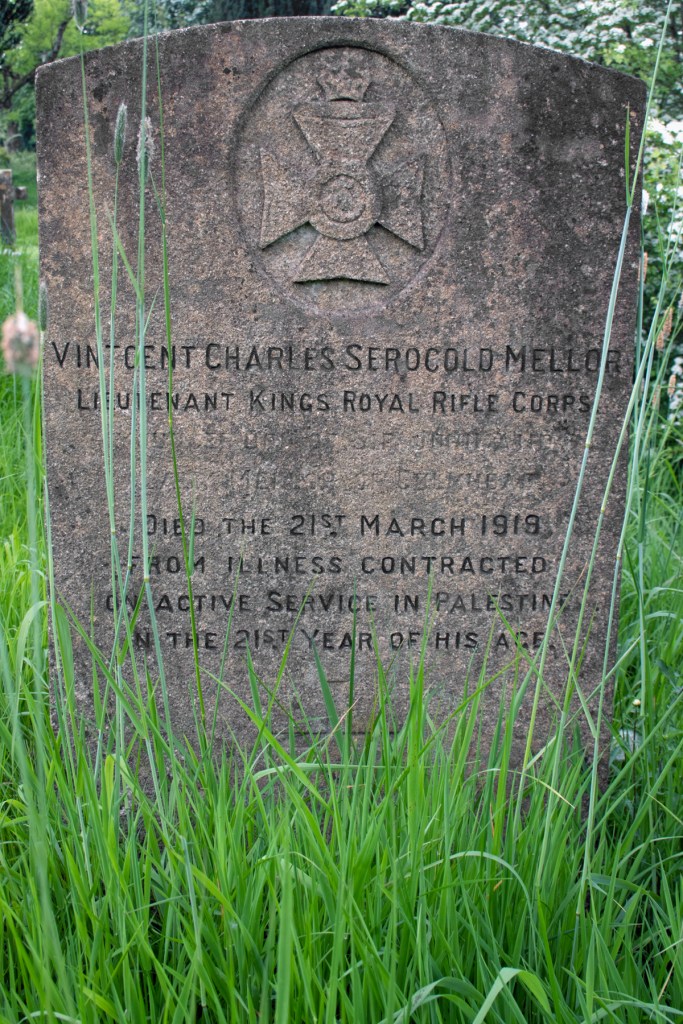
Vincent Charles Serocold Mellor was born in Chelsea, Middlesex, in the spring of 1897. The younger of two children, his parents were Chief Solicitor to the Treasury – and later Sir – John Paget Mellor and his Australian-born wife, Mabel. The 1901 census recorded the family living on Chelsea Embankment, with four servants: a cook, a nurse and two housemaids.
For someone with a relatively high standing in Edwardian England, there is surprisingly little documentation relating to Vincent – who was known as Vin. His name does not appear in the 1911 census, although nor does his family.
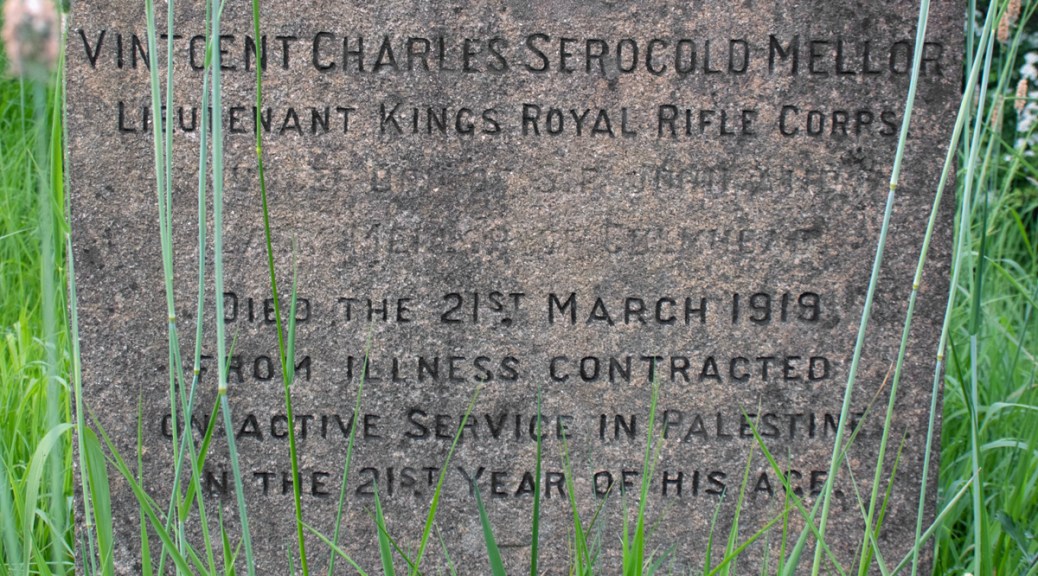
At some point, Vincent was given a commission in the King’s Royal Rifle Corps, but his service records are lost to time, which makes it impossible to find any specific information about his military career. Lieutenant Mellor’s headstone confirms that he served in Palestine, and that he fell ill while in the Middle East.
Vincent returned to Britain for treatment, and was admitted to the Red Cross Hospital for Officers in Portland Place, London. Whatever his condition, he was to succumb to it: he passed away on 21st March 1919, aged just 20 years of age.
Vincent Charles Serocold Mellor was brought back to Somerset for burial. He was laid to rest in the peaceful graveyard of St Paul’s Church in Churchstanton, close to the family’s country home, and the same church in which he had been baptised two decades before.
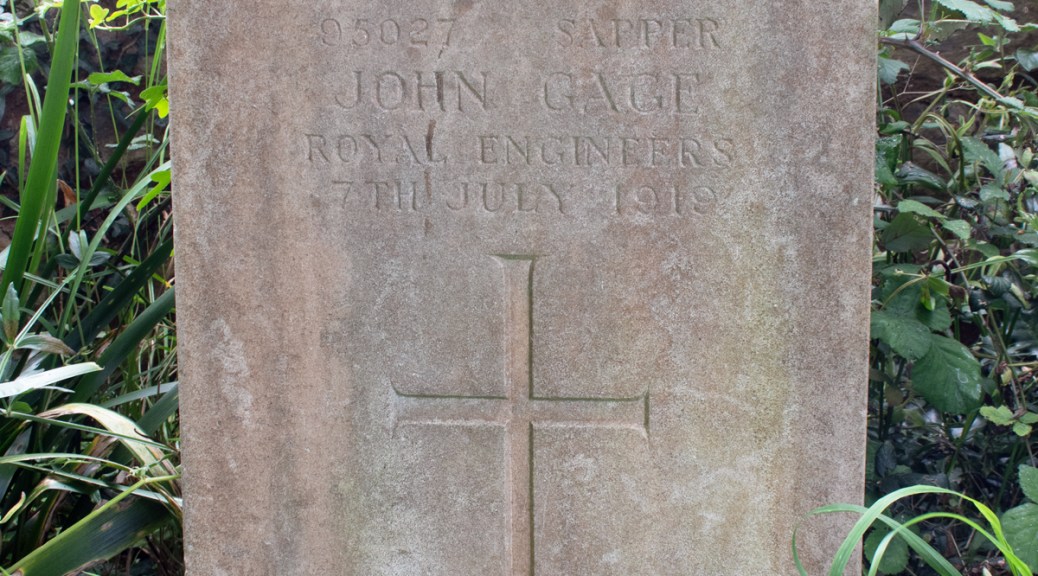
The life of John Gage seems destined to remain a mystery. His grave lies in a quiet corner of St Andrew’s Churchyard in West Hatch, Somerset. The Commonwealth War Graves Commission registration reads:
GAGE, Spr. John, 95027. “G” Depot Coy. Royal Engineers. 7th July 1919. Son of John Gage; husband of Lucy Gage, of Canal Cottage, Wrantage, Taunton. Born at Axminster, Devon.
There is no date of birth for John, and, while there is a possible census return for 1891, with a John Gage Sr and Jr living in the Axminster area, in isolation it is not concrete enough to connect to the man lying in St Andrew’s Churchyard.
The Army Register of Soldiers’ Effects confirms Lucy as John’s widow, but again no marriage documents remain to give a date for the nuptials or ages for the bride and groom. The document does confirm that Sapper Gage had been serving in the Royal Engineers for more than six months at the time of his passing, and that he died in a military hospital in Taunton.
There are no contemporary newspapers that report on John’s passing, which would indicate that is was nothing out of the ordinary, or connected directly to the war – through injury, for example. This might suggest, therefore, that John passed away though illness, although this cannot be confirmed either way.
Sapper John Gage’s life is set to be lost to time, therefore. He lies in the graveyard of St Andrew’s Church in West Hatch. Nearby is another grave, that of Lucy Gage, who died in 1942.
Hidden away above the busy A371 to the north of Axbridge, Somerset is an unassuming graveyard. Overgrown and haunting, with headstones lining the boundary of the copse, this is the cemetery for the former St Michael’s Sanatorium, now the St Michael’s Cheshire Home. In the middle of the plot, next to the central memorial, is a headstone dedicated to Sidney Gordon, notably buried somewhere else in the grounds.
Sidney Vincent Gordon was born in Upton Park, Essex, on 7th May 1897. There is little information about his early life, other than his mother’s name, May.
The 1911 census recorded Sidney as being an inmate at the Scattered Home for the West Ham Union, the workhouse that covered the area. At 13 years of age, he was one of the older of the thirteen students boarding in the home, which was overseen by Emma Caroline Simpson, the House Mother.
When Sidney completed his schooling, he managed to find employment as an undertaker’s boy. But he sought out bigger things and, on 8th June 1914, he enlisted in the Royal Navy. His service records note that he was 5ft 6ins (1.68m) tall, with brown hair, blue eyes and a fresh complexion.
Being under-age when he enlisted, Sidney was given the rank of Boy. He was first sent to HMS Pembroke, the Royal Naval Dockyard in Chatham, for training, and remained there for a couple of months. In August 1914, Boy Gordon was moved down the coast to HMS Actaeon, a torpedo school based in Sheerness, Kent.
After five months, he moved to HMS Wildfire, another part of the Sheerness base, and it was while there he turned 18, and could formally join the Royal Navy. He was given the rank of Officer’s Steward 3rd Class and remained at Wildfire until the end of 1915. After a short stint back in Chatham, Sidney was given a new posting on board the supply ship HMS Tyne, where he remained until the following May.
Officer’s Steward Gordon returned to HMS Pembroke once more, and was assigned to his final sea-going ship, the newly launched monitor, HMS Erebus. She was to be his home until June 1917, when, having become unwell, he was posted back to HMS Pembroke.
Sidney had contracted pulmonary tuberculosis, which led to him being invalided out of the Navy on 1st August 1917. At this point his trail goes cold once more, but it is likely that, by the start of 1919, his condition had led to his admission to St Michael’s.
When he died there, on 5th March 1919, Sidney was just 21 years old. Given his background, it seems probable that his mother, if she was still alive, would not have been able to afford for his remains to be brought back to Essex. Sidney Vincent Gordon was laid to rest in the sanatorium’s cemetery, in the foothills of the Mendips, finally at peace.
John Burge Parker was born in the spring of 1887, the second of eight children to George and Ann Parker. The family were raised in Huntspill, Somerset, where George was employed as a labourer in the local railway works.
When he finished his schooling, John found work on a farm and this is how he was employed when, on 30th April 1907, he married Alice Jane Grove in the parish church in Pawlett. The sleepiness of the area is underlined by the fact that this was both the only wedding to take part in the church that year, and for more than a year. John and Alice went on to have three children, Audrey, who was born in 1907, Elsie, who came along two years later, and Clifford, born in 1915.
With a growing family to support, John sought out more of a career. Indeed, by the time of the 1911 census, he was employed as a police constable, and the Parkers had moved to Bristol. When war came to Europe, however, John stepped up to play his part.
John enlisted on 17th November 1915, joining the Railway Troops Depot of the Royal Engineers. His service records show the kind of figure he must have cut in the police, and he was noted as being 6ft 1in (1.85m) tall, weighing 176lbs (79.8kg). Initially give the rank of Private, he was promoted to Lance Corporal in May 1916, just four months after being officially mobilised.
In October 1916, Lance Corporal Parker’s troop set sail from Southampton, their final destination being Alexandria in Egypt. He spent more than two years in North Africa, wand was promoted to full Corporal during this time.
John returned to Britain early in 1919. In February, John was visiting his brother in Highbridge, Somerset, and, on the evening of the 6th, he left to visit his father in Huntspill. He set off to Highbridge Station first, with the intention of checking the train times to return to Bristol, but that was the last time he was seen alive.
A painful sensation was created in Highbridge and neighbourhood… when it became known than on the previous evening.. the mutilated body of a soldier was found on the Great Western Railway metals, about a quarter of a mile below the Highbridge Station… The body was subsequently identified as that of John Parker… a corporal in the Royal Engineers, whose home it at Bristol and who leaves a wife and three children.
Central Somerset Gazette: Friday 14th February 1919
Nothing untoward was confirmed in the accident that killed John on the night of the 6th February 1919, and at the inquest the jury reached the conclusion that he had died through a tragic accident. He was 32 years of age.
The newspaper report gave more insight into the character of Corporal Parker: “He was a splendid specimen of manhood, standing over 6ft, and of proportionately fine physique… [He] was of a most genial temperament [and] was held in the highest respect both in the Highbridge district and at Bristol.”
The body of John Burge Parker was laid to rest in the quiet graveyard of St Peter’s Church in his home village of Huntspill.
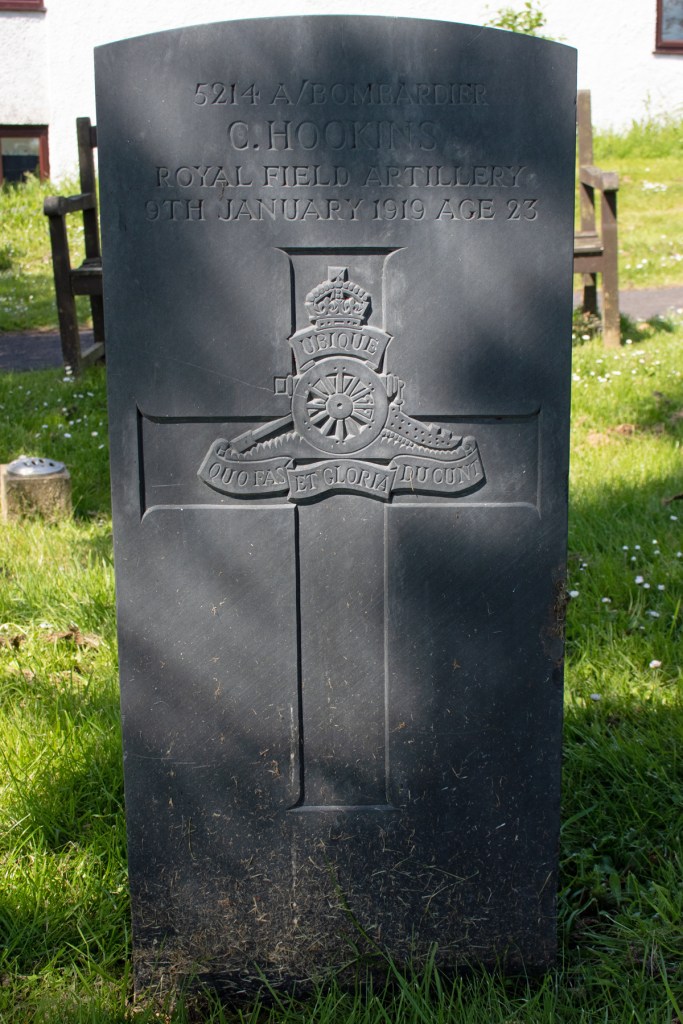
Charles Hookins was born on 15th October 1895 in Pawlett, Somerset. The eighth of nine children, his parents were William and Susan Hookins. William was a labourer in a brickyard, but when he finished his schooling, Charles went to work on his cousin’s farm in neighbouring Huntspill.
Farming was not what Charles had in his mind as a career, however, and on 7th April 1913, he joined the Great Western Railway. Initially employed as an engine cleaner, he was sent to work at the Duffryn Yard, South Wales. He soon moved on again, however, and by October 1913, he was living in Tondu, to the north of Bridgend, where he worked as an engine fireman.
War came to Europe in 1914, and, within weeks of hostilities being declared, Charles volunteered for service. He enlisted on 1st September 1914 in Bridgend, joining the Royal Field Artillery. His service records confirm that he was 19 years of age, stood 5ft 7.5ins (1.71m) tall, and weighed 135lbs (61.2kg). He was noted as having brown eyes, brown hair and a fresh complexion.
Gunner Hookins spent most of the next year on home soil training and became attached to the 57th Brigade. On 2nd August 1915 he set off for the Mediterranean, his troop unusually making their way across mainland France, rather than sailing around Spain and Portugal. They left European shores from Marseille on 7th August, and arrived at Suvla Bay on the Gallipoli peninsula just nine days later.
The 57th Brigade remained at Gallipoli for the next five months, and during this time, in November 1915, the now Acting Bombardier Hookins spent a week in the local field ambulance, through causes unknown.
Charles’ health seemed to be suffering by this point. On 17th January 1916, he was moved to Alexandria, Egypt, where he spent another week admitted to a field hospital. After a couple of months’ grace, he was transferred back to France, again disembarking at Marseille. After another week’s admission to hospital, he was invalided back to England, eventually arriving back home at the end of April.
Acting Bombardier Hookins had contracted pulmonary tuberculosis, and the risk to others, as well as his own health, led to him being discharged from military service on 15th July 1916, having served for just under two years.
Charles’ trail goes cold at this point. He returned home, but his medical condition was ultimately to get the better of him. He passed away on 9th January 1919, at the age of just 23 years old.
Charles Hookins was laid to rest in the quiet graveyard of St John the Baptist Church in his home village of Pawlett, Somerset.
Frederick William Reid was born in January 1876 in Liverpool, Lancashire. Little information is available for his early life, and his trail only really becomes traceable when he joined the Royal Irish Regiment at the age of 16 years old.
Frederick’s service records confirm that his mother was called Elizabeth, who lived in Bedminster, near Bristol. He was already volunteering for the regiment when he enlisted, and was working as a musician when he joined up. His papers confirm that he was 5ft 4ins (1.63m) tall, and weighed 112lbs (60.8kg). He had brown hair, hazel eyes and a fresh complexion.
Frederick was given the rank of Drummer when he joined up and was attached to the Royal Irish Regiment’s 3rd Depot. He spent more than seven years on home soil, rising to the rank of Corporal in May 1898. The following January he reverted to the rank of Private at his own request, but his superiors obviously saw something in him, and he was supported in a new role – Lance Corporal – just a month later.
In October 1899, however, Frederick’s life was to take a new turn, when he was sent to India with his troop.
Corporal Reid was based in Lahore, and had found the life that he was seeking. Over the next forty months, he successfully took on a variety of clerical roles. He was promoted to Lance Sergeant in October 1901 and given oversight of the Officers’ Room.
In March 1903, Frederick returned to Britain. With the move came a further promotion, to the rank of full Sergeant, again, overseeing the Officer’s Room. He seems to have been based in Gloucestershire by this point, as, on 18th November 1903, he married Isabella Jane Parke at a Registry Office in Bristol. There is no further record for the young couple, however, so the new Mrs Reid is destined to remain a mystery.
Frederick was destined to return to India, and in January 1905, that is exactly what he did. His regiment returned to Lahore, and he was given the role of Clerk Steward at one of the Lawrence Memorial Asylum. The name is misleading, as the asylums were a series of four military-style boarding schools across India. Sergeant Reid’s records do not confirm which of the four he was attached to, but it would have been Sanawar, Mount Abu, Lovedale or Ghora Gali.
Given his military background, it seems that the role of clerk was something Frederick settled into quite happily. He was recalled back to army service in November 1909, and, within seven months, he requested a discharge from the army. This was granted, as he had, by this point, completed more than eighteen years’ service.
Frederick remained in India, however, and on 28th September 1913, he married Elizabeth Marshall in Lahore. They had two children, Florence, who was born in Quetta on 2nd September 1914, and Lily, who was born on 1st January 1916 in Lahore.
War had come to the world by this point, and in spite of his age – he was 39 by now – Frederick felt it only right to step up and play his part again. On 28th October 1914, he enlisted again, and was assigned to the 1st Battalion of the Duke of Wellington’s (West Riding Regiment). His new medical noted that he was 5ft 7ins (1.7m) tall, and weighed in at 9st (57.2kg). His complexion was recorded as pale, while he had a number of tattoos on his left forearm: the crossed swords, harp and crown of the Royal Irish Regiment, along with the initials VR.
While part of the West Riding Regiment, Sergeant Reid was attached to the 3rd Mule Corps of the Indian Supply & Transport Corps. He was involved in arranging provisions for the various battalions who needed them.
By March 1916, his battalion had been sent to Salonika, and it was here that Frederick contracted tuberculosis. Medically evacuated to Britain, he was admitted to the Southwark Military Hospital. He was confirmed as no longer being medically fit for army service and was discharged on 16th August 1916. His medical report noted that he “is anxious to have sanatorium treatment, but is not an insured man, owing to having been stationed in India.”
On his discharge, Frederick moved to Weston-super-Mare, Somerset, which is where his mother was by now living. His wife and children also came to live in England and, the family settled in Pawlett, near Bridgwater.
After leaving the army, Frederick’s trail goes cold. The next confirmation of his life is that of his passing. He died on 12th October 1919, presumably from his lung condition. He was 43 years of age.
Frederick William Reid, who had been born in Liverpool, who had had two separate careers in the army, and who had lived and married in India, was laid to rest in the peaceful graveyard of St John the Baptist’s Church in Pawlett, Somerset.
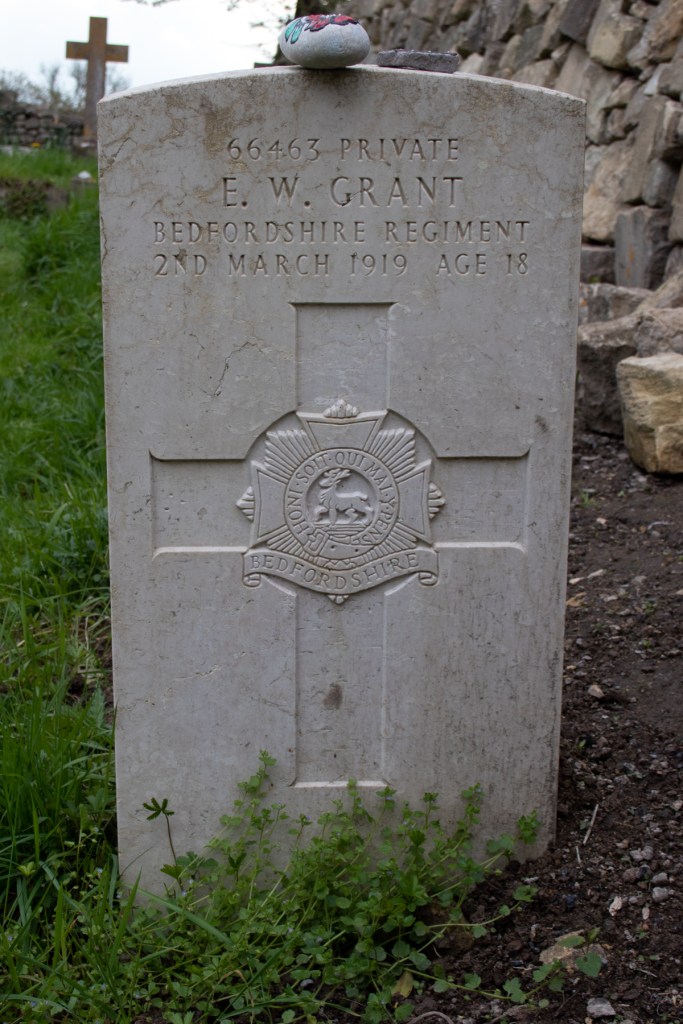
Eric William Grant was born at the start of 1901, the middle of three children to Ernest and Annie Grant. Ernest was a carpenter from Bath, Somerset, and it was here they he and Annie raised their young family.
Little information is available about Eric’s young life. When war came to Europe, his father joined up, enlisting in the Royal Engineers as a Sapper. Keen not to miss out, Eric also signed up, lying about his age to ensure he was accepted.
When he joined in February 1916, Private Grant was assigned to the 52nd (Graduated) Battalion of the Bedfordshire Regiment. Full details of his service are lost to time, but towards the end of the war, Eric was based in East Anglia.
It was here, in early 1919, that Private Grant fell ill. He was admitted to the Norfolk War Hospital, but whatever his condition, it proved fatal. He passed away on 2nd March, aged just 18 years old.
Eric William Grant’s body was brought back to Somerset for burial. He was laid to rest in the peaceful graveyard of St Michael’s Church, Monkton Combe, where the family now living.
Despite her understandable concern at seeing her husband and son go off to war, and for Eric to die because of it, Annie was to be reunited with Ernest. Again, full details of his service are lost, but the 1939 Register found him and Annie living with their daughter and Ernest’s brother in Bathavon, Somerset.
Annie passed away in 1947, at the age of 73. Ernest lived on until 1952, having lived to 76 years old. Both were buried in St Michael’s Churchyard, reunited with their son at last.
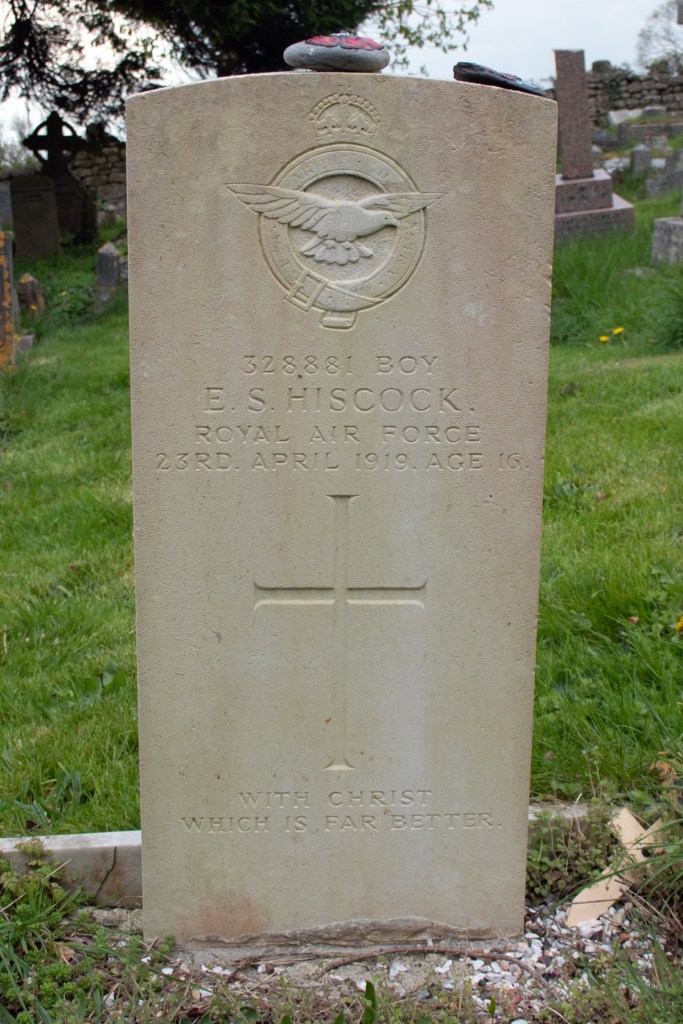
Edwin Sydney Hiscock was born in Corsham, Wiltshire, 11th November 1902. The older of two children, his parents were quarry manager Edwin Hiscock and his wife, Helen.
When he finished his schooling, Edwin Jr found work as a clerk, but as a young teenager, the thrill and excitement of the war going on around him, drew him to a life in the Royal Air Force. He enlisted on 27th March 1919, and was dispatched to the School of Technical Training at Halton Camp near Aylesbury, Buckinghamshire. Boy Hiscock’s service records note that he was 5ft 9ins (1.75m) tall, with dark hair, brown eyes and a fresh complexion.
Edwin’s life in the military was to be cut tragically short. He had lived a cosseted life in rural Somerset – the family having moved to Monkton Combe, near Bath. At the RAF base, he was surrounded by men and women from across the country, and was suddenly exposed to illnesses that he would not have encountered had he remained at home. It is unclear what he contracted but in the months after the First World War, influenza swept Europe, so this is a likely suspect. Edwin passed away at the base on 23rd April 1919, having completed 27 days’ service. He was just 16 years of age.
The body of Edwin Sydney Hiscock was brought back to Somerset for burial. He was laid to rest in the peaceful graveyard of St Michael’s Church, Monkton Combe.
Edwin’s headstone includes the epitaph “With Christ which is much better”, a bitter pill to swallow.










 Death and Service