Tag Archives: 1919

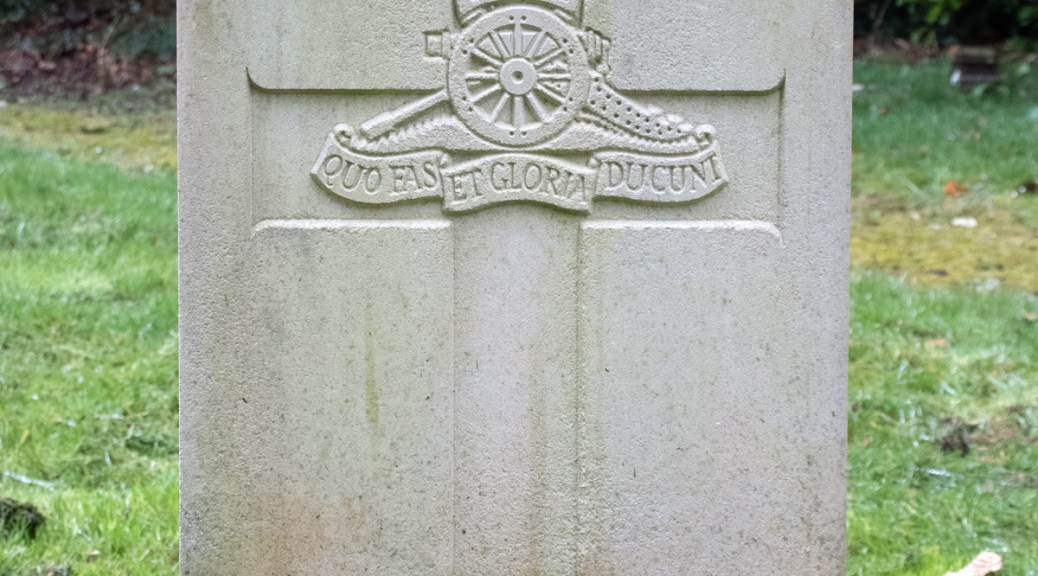
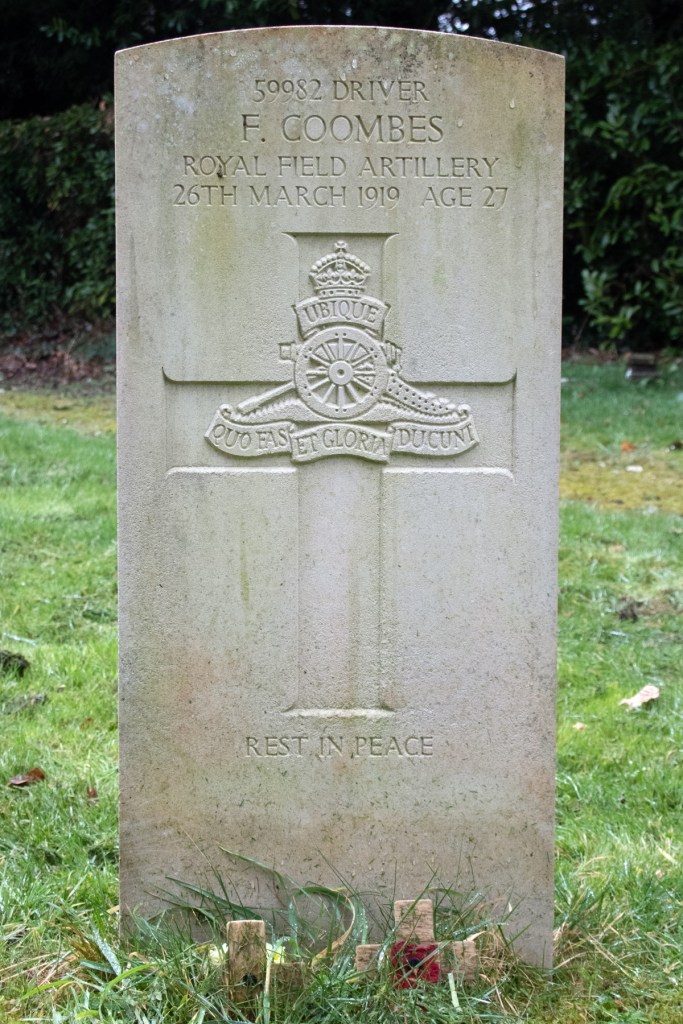
Driver Frederick Coombes

Driver Frederick Coombes

Frederick Walter Coombes was born in 5th July 1891 in Chard, Somerset. He was the oldest of eight children and his parents were mason’s labourer Walter Coombes and his wife, Sarah.

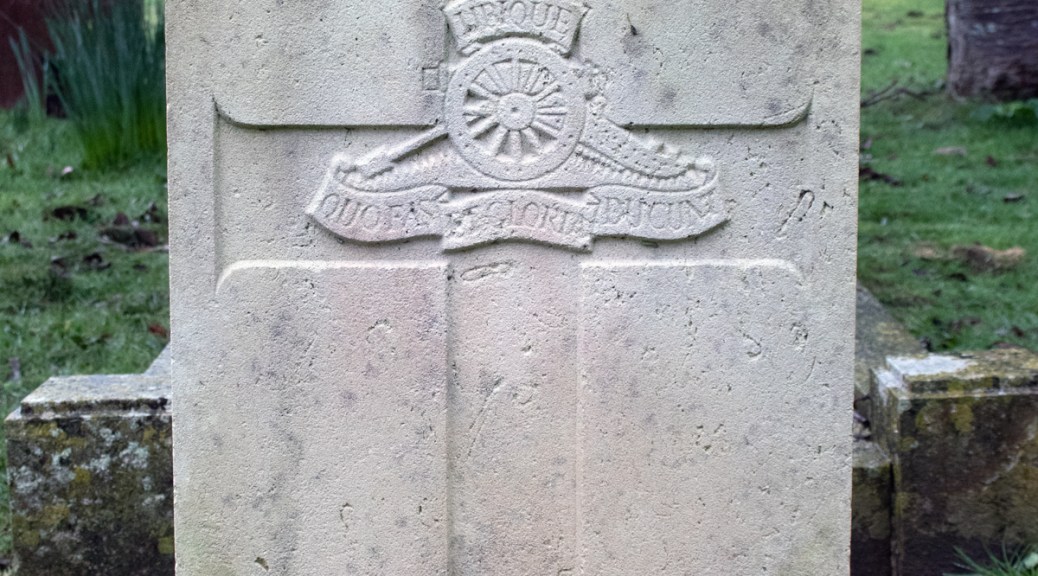
The family moved to nearby Crewkerne and, when he left school, Frederick found work as a weaver. He quickly realised, however, that he needed a career, and the the military could offer one. On 18th October 1909, he enlisted in the the Royal Field Artillery, signing up for three years with the regiment, followed by nine years on reserve.

Frederick’s service record confirms the man he had become. His medical examination gave his height as 5ft 6ins (1.68m) and his weight as 139lbs (63kg). He was noted as having brown hair, hazel eyes and a fresh complexion. He was also recorded as having a tattoo of a man’s head on the back of his right wrist and a small scar on his left hip.

After a year on home soil, Driver Coombes was sent to South Africa. He was to spend a little over two years in the country, the 1911 census recording him at the Roberts Heights Barracks in Transvaal, as part of the 98th Battery.

When his initial three year contract came to an end, Frederick was placed on reserve status and returned home. His trail goes cold for a couple of years, but when war was declared in 1914, he was immediately brought back into active service.

By the middle of August 1914, Driver Coombes was on the Western Front in France. Within a matter of weeks he was caught up in the Retreat from Mons, and was gassed in the process.

He soon recovered and, in December 1915 his troop was moved to Mesopotamia, modern-day Iraq. Within a month, Frederick fell ill again, having contracted malaria. He was treated at the base and, eventually remained in the Middle East for a year.

By December 1916 Frederick was on the move again, this time to India. His lungs had had a battering by this point, however, and he fell ill once more, this time having developed tuberculosis. Initially treated in India, by February 1917 he had been medically evacuated back to Britain. The condition was seen as unlikely to improve, and he was eventually discharged from the army as being no longer fit enough to serve.

Driver Coombes’ medical report confirmed that the condition was fully the result of his army service, and treatment at a sanatorium was recommended. His last day with the Royal Field Artillery was 7th May 1917: his career had lasted 7 years 202 days.

Again, Frederick’s trail goes cold at this point. It seems likely that he would have returned to Somerset and would possibly had been admitted to a medical facility for treatment and recuperation. The next record for him is that of his death, which happened at home on 26th March 1919. He was just 27 years of age.

Frederick Walter Coombes was laid to rest in Crewkerne’s Townsend Cemetery.


Driver Frederick Coombes

Driver Henry Sweet

Driver Henry Sweet

Henry – or Harry – Sweet was born on 31st July 1887 in the Somerset village of Merriott. He was the fourth of seven children to Edward and Emma Sweet. Emma had married Edward after her first husband, John, had died, and so Harry also had three half-siblings.

Edward was an agricultural labourer by trade, but by the time of the 1901 census he had turned his hand to brewing, and listed his trade as a maltster. Harry’s older brother John, was also recorded as a maltster, while he had left school and was noted as being a brewery hand.

The next census, in 1911, found Emma and Edward heading up the family in Crewkerne, brewing for, and working at, the Volunteer Inn. Harry was working with his father, while two of his sisters – Prudence and Beatrice – were still living at home and working as shirt and collar machinists. Making up the household were Harry’s other sister, Ellen, who was a shirt ironer, and her husband George, who was recorded as a web weaver. In all there were seven wages coming into the household, meagre salaries though they may have been.

On 26th December 1911, Harry married Rosina Woodland in the parish church in Crewkerne. She was the daughter of Walter Woodland, a local labourer, although there is little further information on her family.

When war came to Europe, Harry wanted to play his part. Full details of his military service are lost to time, although he had certainly enlisted in the Royal Army Service Corps by the start of 1917. Driver Sweet served in the Eastern Mediterranean, and was ensconced in Salonika, in Northern Greece, for nearly two years.

Harry suffered on and off with dysentery, and was moved to the 4th Scottish General Hospital in Glasgow in January 1919 for treatment. This was initially successful, but while was was admitted he contracted a combination of bronchitis and pneumonia, and these were ultimately to take his life. Driver Sweet passed away on 13th February 1919, at the age of 31 years old.

Henry Sweet’s body was brought back to Somerset for burial. He was laid to rest in the Townsend Cemetery in his home town of Crewkerne.


Private William Pinney

Private William Pinney

The details of William Pinney’s life seem destined to remain a mystery. His headstone – in Crewkerne Cemetery, Somerset – confirms that he was a Private in the Loyal North Lancashire Regiment, and that he died on 14th August 1919.

The British Army Register of Soldiers’ Effects expands a little on this, identifying that he was in the 2nd Battalion of the regiment. The document states that he died of wounds and had been admitted to the War Hospital in Southampton, Hampshire (this is likely to have been the Royal Victoria Hospital in Netley). It also confirms that his effects were to be passed to his widow, Sarah Pinney.

From this point on, some elements of supposition come in to the research.

There is a marriage certificate for a William Pinney and Sarah Jane Witheyman at the parish church in Crewkerne on 6th January 1911. This record gives William’s age as 23, and shows that he was a weaver and the son of weaver William Pinney Sr. Sarah, meanwhile, was five years older than her new husband, worked as a factory hand, and was the daughter of another factory hand, George Witheyman.

The same year’s census gives more information about William Pinney. He was one of eleven children to William and Mercy Pinney, and every member of the family over school age was involved in weaving and spinning. It should be noted, however, that the census was taken on 2nd April 1911, three months after William’s marriage and, while the ages on the document match, the document states that he is single.

The same census for Sarah tells a similar story. She is noted as being one of twelve children to George and Amelia Witheyman. George is noted as being a ‘hand ackler’, or handyman, while Sarah and the two of her teenage brothers still at home are all working as mill hands. The same anomaly arises as William, however, as she is also noted as being single.

Returning to the marriage certificate, an answer to the anomaly in the dates seems to resolve itself, however. The marriages are noted in chronological order, and the previous wedding to be solemnised in Crewkerne Parish Church was on 26th December 1911, while the following one was on 14th February 1912. It would appear, therefore, that Leonard Jackson, the curate of the church, entered the incorrect date on the certificate.

The census records and marriage certificate all seem to fit the William and Sarah Pinney who were separated by William’s death in 1919. There are certainly no documents suggesting another William Pinney in the Crewkerne area around that time period. It is reasonable to assume, therefore, that they do all connect to the gravestone in the town’s cemetery.

Private Pinney’s military records are missing, or no longer available, so it is not possible to trace his actions during the First World War. The 2nd Battalion of the Loyal North Lancashire Regiment served in India during the first half of the conflict, moving to Egypt in 1917 and to France the following year. It is not possible to confirm where William served, but wherever he fought, he was wounded, and these injuries were to prove fatal. He passed away in the Southampton hospital on 14th August 1919, nine months after the end of the war, aged around 31 years old.


Private William Harris

Private William Harris

The life of William Henry Harris is destined to remain shrouded in the mists of time. His headstone, in the Townsend Cemetery in Crewkerne, confirms he was a Private in the Essex Regiment, and that he died on 19th April 1911, at the age of 31 years old.

The Army Register of Soldiers’ Effects confirms that he was attached to to the 1st/5th Battalion and that he died of sickness in Rugeley Camp, Staffordshire. His widow, who is noted as Ada Harris, received a war gratuity, which suggests that he had enlisted prior to October 1918.

Private Harris’ Pension Ledger shows that Ada was living in Hermitage Street, Crewkerne, and that the couple did not have any children.

While William’s name is too common to try and identify family links through census records, his marriage index provides Ada’s maiden name, Furzer, which is easier to track.

Ada Furzer was born in Crewkerne on 22nd November 1887, the second of eight children to James and Ellen Furzer. James was a haulier, while Ada and her older sister Mabel, found work as machinists in a local shirt factory when they left school.

Ada did not remarry when William passed away: she died in Yeovil in the autumn of 1971, at the age of 83.


Lance Corporal Alfred Sowden

Lance Corporal Alfred Sowden

Alfred Edward Sowden was born in the autumn of 1883, in Bath, Somerset. He was the youngest of seven children to Robert and Mary Sowden. Robert had died by the time of the 1891 census, and Mary turned to charring to bring in money for the family.

In the summer of 1904, Alfred married Harriet Sumsion, a baker’s daughter also from Bath. The couple set up home in a small cottage on the main road to Bristol, and had a son, William, who was born the following year. Alfred was working as a house painter by this point, and the young family had a lodger, William Gabb, who was a local chef.

When war came to Britain’s shores, Alfred stepped up to play his part. He may have had some previous military experience, because he joined the Somerset Light Infantry as a Lance Corporal. Assigned to the 2nd/4th Battalion, by August 1915, he was on his way to India. His troop remained there for two years, before moving to Egypt in the autumn of 1917, then on to France the following June.

With the end of the conflict, the Empire’s forces were slowly demobbed. While he was waiting to be stood down, Lance Corporal Sowden fell ill. He developed influenza and septic pneumonia, and the combination was to prove fatal. He passed away on 30th January 1919, at the age of 35 years old.

Alfred Edward Sowden’s body was brought back to Bath for burial, where he was laid to rest in the city’s St James’ Cemetery.


Alfred’s widow had had a tragic few years. Her father, Walter, had passed away in February 1916, and her mother died just three months after Alfred.

Harriet never remarried after her husband’s passing. She remained in the family home for the rest of her life and, by the time of the 1939 Register, had a boarder, billiard marker James Jones. She was close to family, however, as her brother William lived just three doors away.

Harriet died in September 1941 at the age of just 56. She was laid to rest near her husband, reunited after 22 years.


Air Mechanic 1st Class Joseph Chivers

Air Mechanic 1st Class Joseph Chivers

Joseph Shore Chivers was born in the summer of 1889 in Walcot, Bath, Somerset. He was the youngest of seven children to William and Jane Chivers. William was a blacksmith and, after he and Jane died within nine months of each other in 1904/05, Joseph went to live with his brother, Edward, remaining there with his sister-in-law when his sibling also died in 1910.

Joseph had found work as a French polisher and cabinet maker by this point and this is what he was doing when he married local woman Ellen West in on 11th September 1915.

War was on the horizon by this point and Joseph was soon called on to serve his country. On 26th July 1916 he enlisted in the Royal Flying Corps, as an Air Mechanic 2nd Class. His service records give little away, but do confirm that he was 5ft 8ins (1.73m) tall.

Joseph was dedicated to his role and, on 1st January 1918, was promoted to Air Mechanic 1st Class. Three months later, when the Royal Flying Corps and Royal Naval Air Service combined to become the Royal Air Force, Joseph made the transfer across.

In August, Air Mechanic Chivers moved to RAF Bracebridge, to the south of Lincoln, where he remained until the end of the war and beyond. He was attached to 120 Squadron, which delivered mail and communications to the troops overseas. Little additional information is available about his life there, other than his admission to the 4th Northern Hospital in April 1919, through causes unknown.

Whatever the cause of his need to be admitted, he was to succumb to it. Air Mechanic Chivers passed away on 1st May 1919, at the age of 29 years old.

Joseph Shore Chivers’ body was brought back to Somerset for burial. He was laid to rest in St James’ Cemetery, in his home city of Bath.


Lance Corporal Jack Brooks

Lance Corporal Jack Brooks

Jack Brooks was born in the autumn of 1890 and was the second of nine children. His parents, John and Kate Brooks, both came from Bath, where they ran a bakery on Queen Street, in the centre of the city. When he left school, it was natural for Jack to follow in his parents’ trade.

When war arrived on Europe’s shores, Jack stepped up to play his part and, on 7th December 1915, he enlisted in the Wiltshire Regiment as a Private. His service records show that he was 25 years and 2 months old, was 5ft 8.5ins (1.74m) tall, and weighed 156lbs (70.8kg). He was also noted to have a scrotal hernia, had flat feet and an upper set of dentures. These were enough for him to be passed for home service only, and he was formally mobilised on 10th February 1916.

Private Brooks seems to have taken a while to settle into army life. He was soon transferred across to the East Lancashire Regiment and, in May 1916, was attached to the 8th Works Coy as a Lance Corporal. In February 1917 he was transferred again, this time to the King’s Liverpool Regiment. On 6th June 1917 he was demoted to Private for ‘neglect of duty’, for not taking proper care of the stores that he was in charge of.

He married a woman called Rosina Elizabeth in 1917: the couple went on to have a son, William, who was born on 22nd November that year.

Jack continued serving after the end of the war and, by the beginning of 1919, was based in Aldershot. It was while here that he fell ill, and was admitted to the town’s Connaught Hospital on 11th February, suffering from influenza and pneumonia. Sadly the combination of illnesses was to prove to much: he succumbed to them, breathing his last on 27th February 1919. He was just 28 years of age, a boy with his mother, Kate, with him when he passed.

The body of Jack Brooks was brought back to Somerset for burial. He was laid to rest in the city’s St James’ Cemetery.


Private William Parry

Private William Parry

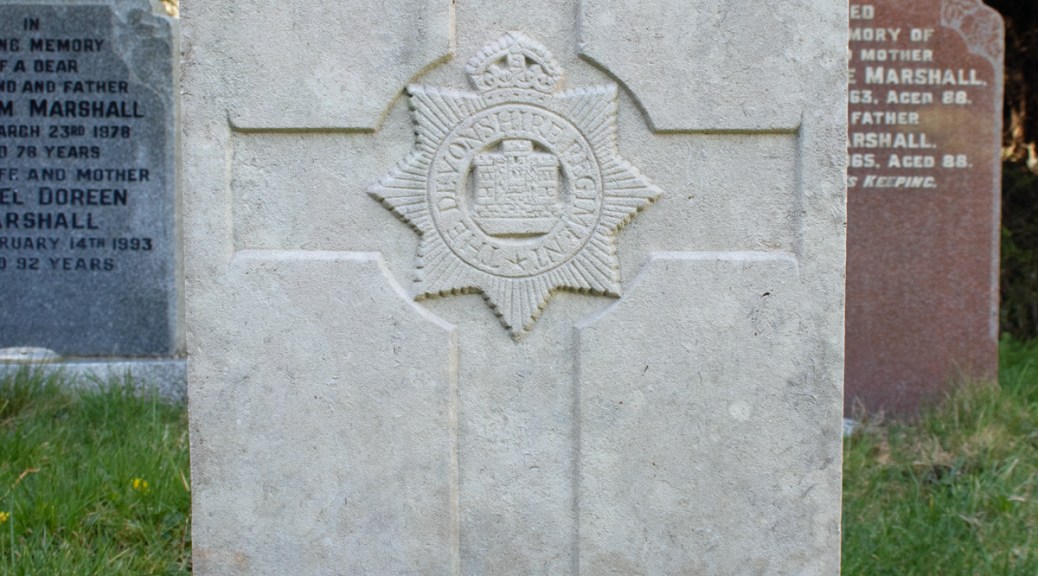
In St James’ Cemetery, Bath, is a headstone dedicated to one William Parry, once a Private in Devonshire Regiment. A lot of his life is lost to time, but his death highlights the length to which soldiers returning from the Great War were often left to fend for themselves.

On 4th November 1919, Private Parry “was found in an exhausted state lying under an arch in a suburb of [Bath], and told the police he had been there for 17 days. Crawling there to rest, he found himself afterwards too weak to move owing to trench feet” [Western Gazette: Friday 14th November 1919]

On 18th November, having been admitted to the Royal United Hospital in Bath, he passed away from pneumonia. “The police are endeavouring to ascertain something as to the man’s antecedents. He stated to them that he had no home.” [Western Gazette: Friday 21st November 1919]

An inquest into William’s death was held, and a miserable tale unfolded.

Parry was described as a seaman, and his address was given as 36 Catherine Street, Exeter…

[He had] said he was born at Swansea, had served in the 2nd Devons, and was demobilised at Exeter last March. He got into the arch because his feet were aching. He had come from Bristol. He did not say where he was going.

[When he died] Parry’s belongings… included a ration book, issued to him for the address in Exeter, his insurance card, and his out-of-work book. Parry had 10s 8d [approximately £11 in today’s money] in cash on him; but 10s 6d of this sum was given him by a lady since his arrival at the hospital. Parry had received various other gifts sent him by ladies from all over the country, who had read of the account of his discover in the Press. The last out-of-work donation received by him was on June 26th, and the ration book was issued at Exeter on March 24th. The address at Catherine Street, Exeter, as which Parry had stayed was that of a Church Army Home. He had also with him a card indicating membership of the Comrades of the Great War. The entries on his insurance card showed he was last employed on September 8th.

Inspector Lovell… gave the Coroner the result of exhaustive enquiries which he had made… regarding Parry’s antecedents… By the Exeter police he was informed that Parry registered at the Labour Exchange there as a seaman on March 25th. He then produced a certificate showing him to be a member of the Mercantile Marine. He had apparently served with the 2nd Battalion of the Devon Regiment for 2½ years. On May 16th, 1919, he obtained work as a painter in Exeter. He retained this employment till June 21st. A week later he obtained similar employment with another Exeter firm at 1s 3d [approx. £1.68] an hour and his earning averaged £2 [around £87] or more a week. He lest the Church Army Home on September 12th, explaining that he was going to Barrow-in-Furness, where he expected to obtain employment with Messrs Vickers, Sons, and Maxim. While staying at the Church Army Home he appeared to have been regarded as of a morbid disposition…

Inspector Lovell added that the members of the Exeter branch of the Comrades of the Great War had assisted him… and he was able to furnish the Court with a letter from Mr FW Drew, with whom Parry had lodged at the Church Army Home. The writer said he had met Parry in the latter part of April, and their friendship lasted until ten weeks ago, when deceased left Exeter. As they were two ex-Service men they became intimate friends, but apparently before the war he belonged to London.

After enlistment he had served in France, and was taken prisoner by the Germans. He was in their hands for three months; and acted as interpreter between his captors and the other British prisoners. He could speak German and other foreign languages, and undoubtedly was a man of superior education. Apparently, so far as his relations were concerned, he was “one of England’s lonely soldiers.” He said he was badly treated by the Germans, and suffered from a bad cough, the result of a wound in the chest. He was liable to depression when out of work, and the writer well remembered how pleased he was to think that he had obtained work at Barrow-in-Furness… “I deeply regret,” concluded the writer, “that he has come to such an untimely end. He was a good fellow, and would do anyone a good turn, if possible.”

In summing up, the Coroner remarked that exhaustive enquiries had been made into the case. There was no doubt from the medical evidence that the cause of death was pneumonia. It would appear that Parry had been on the road for some time when he crawled under the arch where he was found…

Bath Chronicle and Weekly Gazette: Saturday 22nd November 1919

Private William Parry died on 18th November 1919, aged around 44 years old. The British Federation of Discharged Soldiers and Sailors and the Comrades of the Great War jointly made arrangements for, and funded, his funeral, at which he was given full military honours. He was laid to rest in St James’ Cemetery, Bath.


Funeral of William Parry
(from britishnewspaperarchive.co.uk)

Private Henry Wheeler

Private Henry Wheeler

Henry William Edward Wheeler was born in early 1890, the fifth of thirteen children – and the oldest son – to Henry and Anne Wheeler. Henry Sr was a labourer from Witham Friary in Somerset, and this is where the family were born and raised.

When he left school, young Henry – who became known as Harry to avoid confusion with his father – found work as a postman. When war broke out, however, he enlisted as a Private in the Somerset Light Infantry. Full details of his military service are unclear, but his marriage certificate confirms that he was a soldier by the spring of 1915.

Harry’s wedding was to a woman called Mabel Hulbert, who was working as a domestic servant in Wotton-under-Edge, Gloucestershire. It was in the village’s church that the couple exchanged vows, and within a matter of weeks, Private Wheeler was sent to France.

Harry’s troop – the 1st Battalion – was involved in some of the fiercest fighting of the war, and it is likely that he was involved at The Somme in July 1916. At some point, though, he moved across to the 5th (Service) Battalion of the Dorsetshire Regiment, who had moved to France, having been fighting at Gallipoli. The specifics of Private Wheeler’s time in the army are, however, destined to be lost to time.

Private Wheeler’s trail can be picked up again after the end of the war, presumably when he had returned to Britain prior to being demobbed. Sadly, however, he was admitted to a military hospital in Wilton, Wiltshire, suffering from ‘disease’. He passed away on 8th February 1919, at the age of 29 years old.

The body of Henry William Edward Wheeler was brought back to Somerset for burial. He was laid to rest in the quiet graveyard of St Mary’s Church in his home village of Witham Friary.


Henry’s younger brother, John, also served in the First World War. He enlisted in the 8th (Service) Battalion of the Somerset Light Infantry, and arrived in France on 4th October 1915, just a couple of months after his older brother.

John was killed in fighting on 11th October 1917 – possibly as part of the opening salvos of the Battle of Passchendaele – and was just 20 years old. He was laid to rest in the Outtersteene Communal Cemetery in northern France.


Gunner Fred Meatyard

Gunner Fred Meatyard

Fred Radford Meatyard was born in Penselwood, Somerset, in September 1882. The son of Henry and Ellen Meatyard, they seem to have been distant in his life. Fred was raised by his paternal grandparents, Henry and Caroline, in nearby Wincanton.

Fred was an intelligent young man. The 1901 census found him boarding with printer and stationer Walter Eaglestone and his family, on Erith High Street, in Kent. He was working as a compositor himself, pulling the type together for his boss to print. This appeared to be a springboard for him, and he soon moved to Oxford finding similar work there.

In 1907 Fred briefly returned to Penselwood, where he married Lily Extence in the parish church. The marriage certificate showed that Fred was living in William Street, Oxford, and was still employed as a compositor, working for the local newspaper, the Oxford Chronicle. His father, Henry, is listed as deceased, and as having been employed as an engineer. Lily was the same age as her new husband, and was the daughter of labourer Francis Extence.

The couple moved back to Oxford, and went on to have three children: Linda (born in 1908), Joan (born 1913) and Frances (born in 1915). The 1911 census record found them living in an end of terrace house in Boulter Street, the River Cherwell flowing past the bottom of their cul-de-sac. Theirs was a five-room house, and they had a boarder, Mancunian William Murphy, who was employed as a vocalist and guitarist.

When war came to Europe, Fred stepped up to play his part. He enlisted on 30th August 1916, but was not formally mobilised into the Royal Field Artillery until the following January. Gunner Meatyard’s service records show that he was a wiry man, 5ft 10ins (1.78m) tall, and weighing 126lbs (57.2kg).

In June 1917, Fred was transferred across to the Royal Garrison Artillery, and was sent to France. Aside from a couple of periods of leave, he remained overseas until the end of the war, and was attached to a couple of the regiment’s Siege Batteries.

When hostilities ceased, Gunner Meatyard finally returned to Britain in the summer of 1919. Based on Salisbury Plain, Wiltshire, while waiting to be demobbed, he fell ill, and was admitted to the Fovant Military Hospital. He was suffering from acute appendicitis, and the condition came on so quickly, that any treatment did not come soon enough. Fred passed away at the hospital on 16th October 1919, at the age of 37 years of age.

Fred Radford Meatyard was brought back to Somerset for burial. He was laid to rest in the quiet graveyard of St Michael’s Church in Penselwood. The newspaper for which he had worked for so long noted that “he was buried with full military honours… Deceased was on the printing staff of the ‘Oxford Chronicle’ for some years… He was a member of the St John’s Ambulance Brigade. Some time ago he returned from the Rhine, having previously fought in France. Much sympathy is felt with the widow and three children, two of whom, it will be remembered, took a prominent part as dancers in the pagent.” [Oxford Chronicle and Reading Gazette: Friday 24th October 1919]