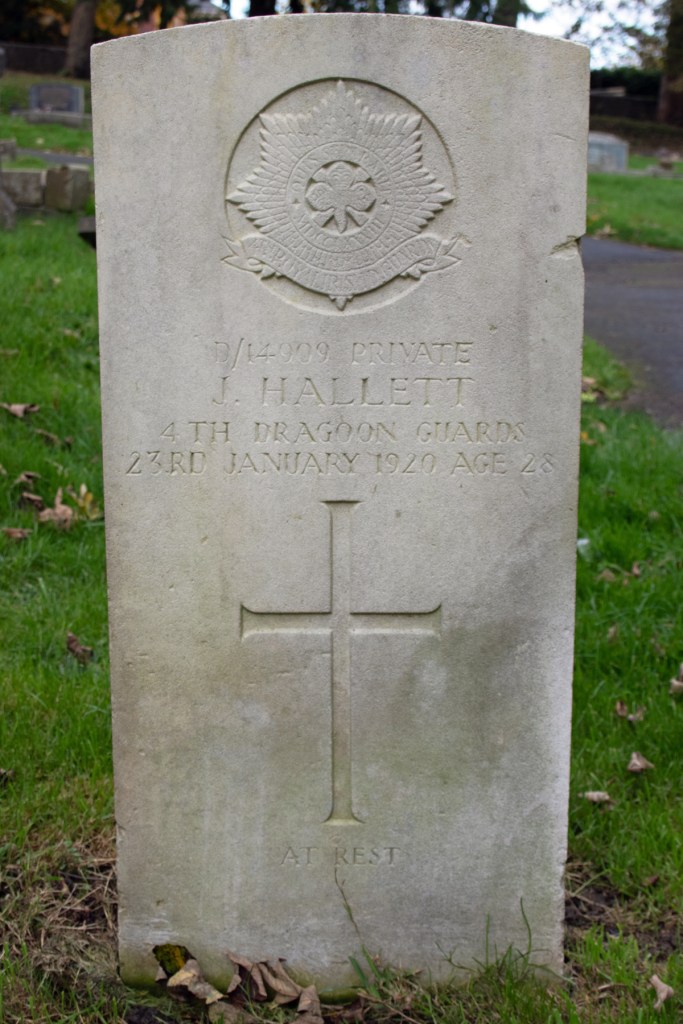
Tag Archives: 1920

Private Lawrence Sweet

Private Lawrence Sweet

Lawrence Allen Sweet was born on 28th May 1895, one of fourteen children to Thomas and Caroline Sweet. Thomas was a farm labourer from Somerset, and the family were raised in the village of Norton-sub-Hamdon, near Yeovil.

Lawrence found work on the farm – the 1911 census shows him living with his now-widowed mother, where he was employed as an ‘improver to poultry house and building’. Three of his older brothers were also living there, and all were employed in farm work.

War was coming to Europe, and Lawrence played his part. Full details of his military service no longer remain, but those that remain confirm that he enlisted in the Somerset Light Infantry in the spring of 1915, and was assigned as a Private to the 6th (Service) Battalion of the Somerset Light Infantry.

Sent to France on 21st May, Private Sweet saw action on the Western Front. His regiment was involved in the Battles of the Somme, Arras and Ypres and he earned the Victory and British Medals and the 1915 Star for his service.

Towards the end of 1917, Lawrence contracted pleurisy; invalided home, he was ultimately discharged from the army on medical grounds the following January.

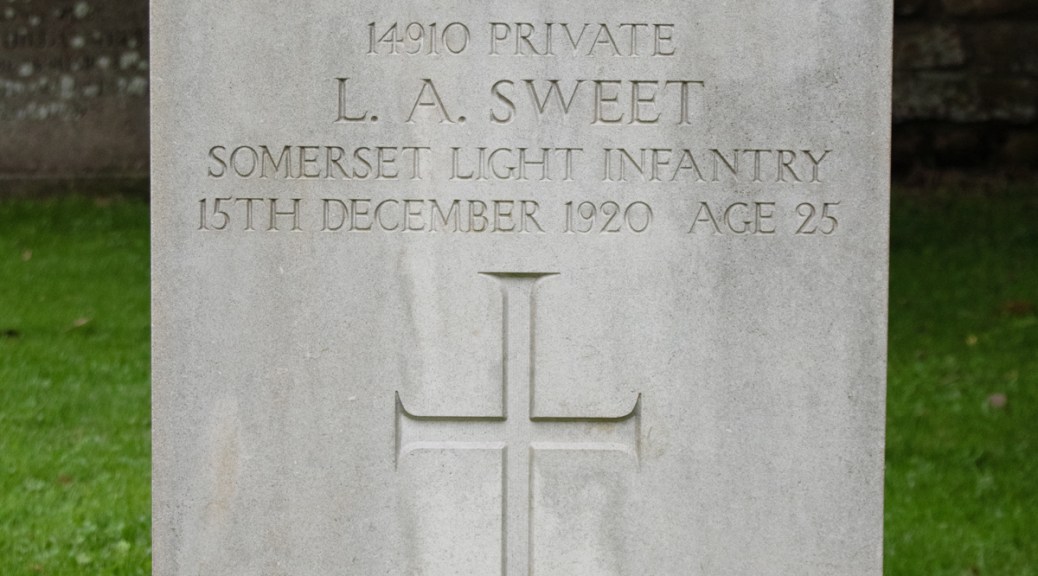
At this point, Private Sweet’s trail goes cold. The next document confirms that he passed away on 15th December 1920, at the age of 25 years old. No cause of death is evident, but is seems likely to have been connected to his previous lung condition.

Lawrence Allen Sweet was laid to rest in the graveyard of St Mary’s Church in his home village of Norton-sub-Hamdon.


Lawrence Sweet1
Lawrence Allen Sweet
(from ancestry.co.uk)

Officers’ Cook Carmelo Ellul

Officer’s Cook Carmelo Ellul

Carmelo Ellul was born in Valetta, Malta, on 26th May 1889. There is little information about his early life, other than the fact that he worked as a baker.

He came to England at some point in the early 1900s, and was living in Portsmouth. It was here that he met Selina Southcott, who had been born on the Isle of Wight, and the couple married in 1904. The couple would go on to have three children, all boys: Maurice, who was born in 1911; Alva, who was born in 1912, but who died as a toddler; and Edwin, who was born in 1916.

Carmelo seemed to want a life of adventure: in the summer of 1912, he enlisted in the Royal Navy. Over the next eight years, Officer’s Cook Ellul served on a number of naval vessels, including HMS Bacchante, which toured the North Sea, and was involved in the Battle of Heligoland in August 1914.

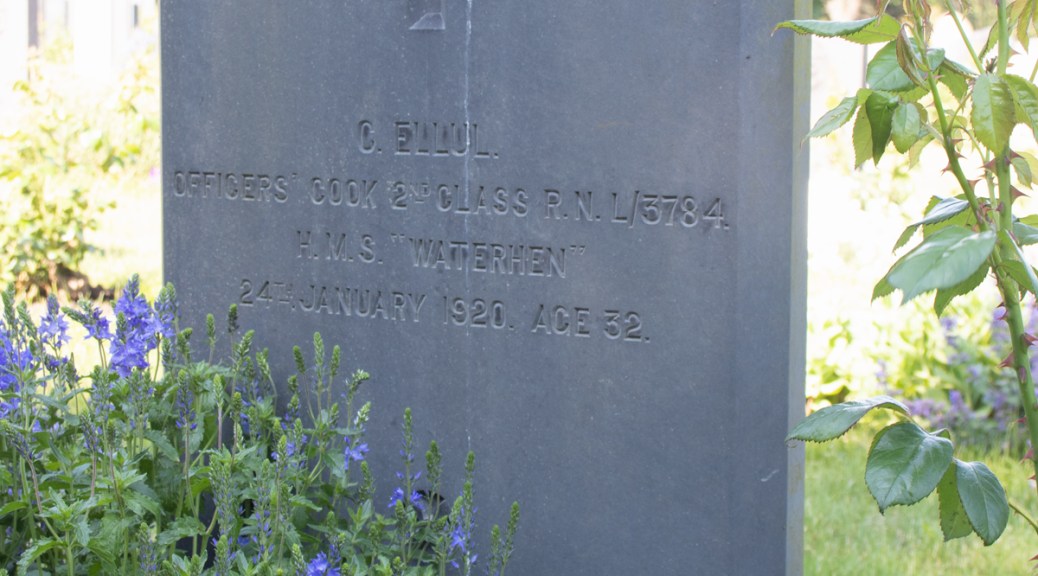
Carmelo’s naval life continued after the war ended, although he seems to have been more shore-based than before. He was serving on HMS Waterhen on 24th January 1920, when he collapsed with an epileptic fit, and died of heart failure. He was just 32 years old.

Carmelo Ellul was laid to rest in the Woodlands Cemetery in Gillingham, Kent, presumably as his ship was moored in the nearby Naval Dockyard in Chatham.


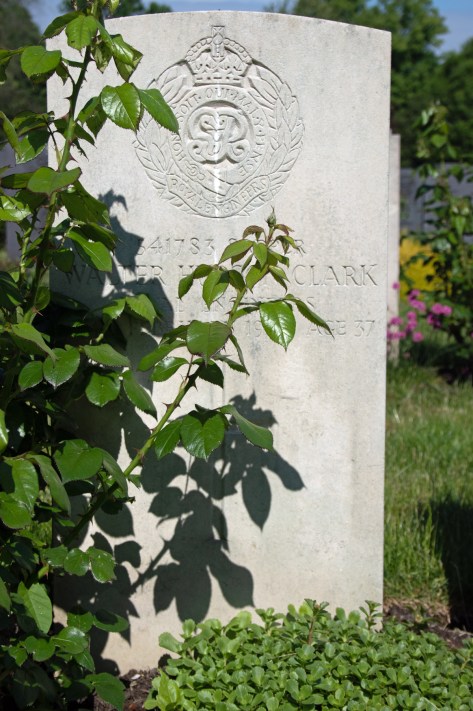
Sapper Walter Clark

Sapper Walter Clark

Walter Hudson Clark was born in 1883, the youngest of eight children to Thomas and Isabella Clark from Gillingham, Kent. Thomas was a miller who, with his wife, who was affectionately known as Sibella, raised their family in the centre of town.

When he left school, Walter found work as an apprentice to a painter and decorator. After Sibella died in 1903, he and two of his sisters remained living at home and, by the time of the 1911 census, he was supporting his father by working as a cooper in the nearby Naval Dockyard in Chatham.

Thomas passed away in December 1915, and this may have been the spur to guide his son into enlisting. Little documentation about Walter’s military service remains available although he joined the 480th Field Company of the Royal Engineers as a Sapper. He was in receipt of the Victory and British Medals, but there is nothing to confirm that he served abroad, so it seems likely that he was part of the territorial force.

Sadly this is where Sapper Clark’s trail goes cold. He survived the war, but died on 20th February 1920, at the age of 37 years old. There is no cause of death available either, but Walter was laid to rest in the Woodlands Cemetery in his home town of Gillingham, Kent.


Private William Bartin

Private William Bartin

William Bartin was born in the Somerset village of Montacute in the summer of 1893 and was the oldest of four children to Georgina Bartin. Georgina married George Gaylard in 1895 and, while the 1901 and 1911 censuses record William Gaylard as George’s son, later documentation suggests that George may not have been his father. George was a carter and labourer on a farm, and when he left school, William followed suit.

By the time of the 1911 census, most of the family were working – William was listed as a groom and gardener, while his mother and the oldest of his three sisters were employed as seamstresses.

Little specific information remains of William’s military career. He enlisted as a Private in the Somerset Light Infantry under his mother’s maiden name (and his birth name), Bartin. A local newspaper after he passed provides some information:

[He] enlisted in 1914, was badly wounded and for seven months was treated in the Bethnal Green Hospital, and then sent to the Southern General Hospital, Plymouth, where for 17 months he was treated for lung trouble. He was discharged in 1917 and has been practically ever since under treatment by the Ministry of Pensions. Much sympathy is felt with the bereaved widow and child.

Western Chronicle: Friday 19th November 1920

There are no details of William’s wife or child, albeit that his pension record refuses payment to them as he married after being discharged from the army.

There are similarly no details about the cause of his death, although, based on the newspaper report, it seems likely to have resulted from the lung condition that dogged the last few years of his life.

Private William Bartin died on 17th November 1920, at the age of 27 years old. He was laid to rest in the graveyard of St Catherine’s Church in his home village of Montacute.


George Gaylard had passed away in July 1919, at the age of 47. The Western Chronicle noted that:

There mourners were as follows: Mrs G Gaylard (widow), Mr WC Bartin (step-son), Misses Lucy, Florence and Edith Gaylard (daughters)…

Western Chronicle: Friday 25th July 1919

It was tragic for Georgina to lose both her husband and son within 18 months; it is also sad to note that George’s father – also called George – was still alive, and outlived both his son and step-son.


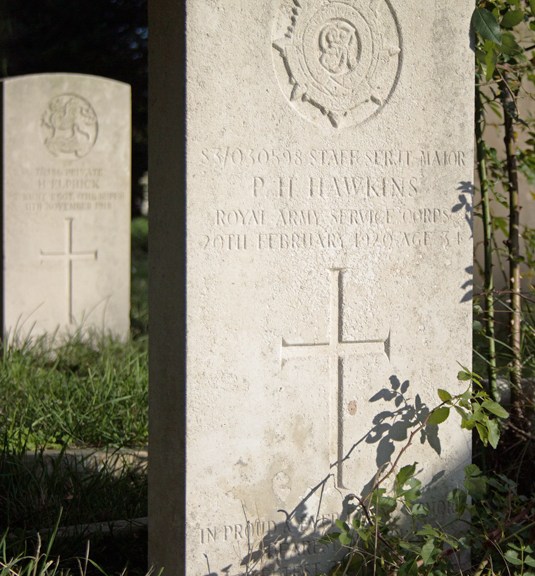
Serjeant Major Percy Hawkins

Staff Serjeant Major Percy Hawkins

Percy Harry Hawkins was born in Waltham Green, London, in 1886. One of five children, all boys, his parents were Frederick and Elizabeth Hawkins. Frederick initially worked as a brewer’s collector – collecting rent from tenant pub managers on behalf of the brewery – before working as a tobacconist.

In July 1908, Percy married Gladys Parnell. Sadly, tragedy was to strike and, over the next couple of years both Elizabeth and Frederick passed away in 1909 and 1910 respectively.

By the time of the following year’s census, Percy and Gladys were boarding with a dispensing doctor (or GP), and his wife. Percy listed his occupation as a ‘traveller’, was probably employed as some kind of salesman.

Tragedy was to strike Percy again. Months after the couple had their first child in July 1911, Gladys also passed away, leaving him as a widower and single parent at just 26 years old.

From his later military documentation, it seems that Percy married again in August 1915, this time to a woman called Mildred, and, by September 1919, he had gone on to have three children in total; one boy and two girls.

When war broke out, Percy was quick to enlist. He joined up in Birmingham on 10th August 1914, and gave his profession as a commercial traveller. His records show that he was 28 years and 120 days old, stood 5ft 6ins (1.69m) tall and weighed 131lbs (59.5kg).

After initially joining the Royal Warwickshire Regiment, Private Hawkins was transferred to the Royal Army Service Corps, and was assigned to one of the supply companies.

Over the four years of the war, Percy served on home soil, and was promoted a number of times, rising from Private to Lance Corporal, Staff Sergeant to Quartermaster Staff Sergeant. In September 1917, he was again promoted, this time to Staff Sergeant Major, a position he held for the remainder of the conflict, and on into 1919, when he volunteered for an extra year’s service, rather than being demobbed.

In February 1920, Staff Serjeant Major Hawkins fell ill; he was admitted to the military hospital that had been set up in Brighton Pavilion, Sussex. The diagnosis was heart failure, and, sadly, it was to this that he was to succumb. He passed away on 20th February 1920, aged just 34 years old.

Percy’s family was, by this time, living down the coast in Worthing; his body was brought there for burial and he lies at rest in the Broadwater Cemetery in the town.


Serjeant George Carpenter

Serjeant George Carpenter

George Palmer Carpenter was born in Worthing, West Sussex, in 1881, one of fourteen children to James and Elizabeth Carpenter. James ran the Steyne Hotel on the seafront, and sent his boys off to the Lucton Boarding School in Henfield for their education.

A regimented life seems to have suited George. When he left school, he enlisted in army, joining the Royal Engineers as a Sapper. The 1901 census found him billeted at the Elphinstone Barracks in Portsmouth.

Sadly, there is little further documentation on the life of Sapper Carpenter. He served through to and during the Great War, attaining the rank of Serjeant. He was sent to France in May 1915, though there is little to confirm his role there, or how long he stayed.

Serjeant Carpenter was subsequently attached to G Depot Company of the Royal Engineers, which received men returned from Expeditionary Force and also men enlisted for Tunnelling Companies, Special Companies and other specialist units. By this time – presumably later on in the conflict – he was based back in England, at the regiment’s barracks in Chatham, Kent.

When the war came to a close, George continued with his army career. With conflict in Europe coming end, he was shipped to Singapore in 1917, where he served through to 1920. A Sussex newspaper picked up his story from there:

Much sympathy will be extended to Mrs Carpenter and her family, of the Steyne Hotel, consequent upon the death of Sergeant George Carpenter, of the Royal Engineers, another of our Worthing boys whose life has been laid down in his country’s service. He arrived home in a bad state of health on the 25th of February last from Singapore, where he had been on duty for three years. Suffering from gastric influenza, it was found necessary that he should undergo an operation, which was carried out at midnight on Saturday. But he sank from weakness, and died at half-past eight on Sunday morning. This is the second son of whom Mrs Carpenter has been bereaved within a year, and there is pathos in the words addressed to us by her: “I have again the sorrowful task of sending the news of the death of one of my sons this morning.

Worthing Gazette: Wednesday 24th March 1920

George Palmer Carpenter was 39 years old. He was laid to rest in the Broadwater Cemetery of his home town, Worthing, in West Sussex.


The other brother referred to in the report was George’s younger brother Norman.

He had emigrated to Canada in 1906, but returned to Europe as part of the Canadian Expeditionary Force when war broke out. Wounded in battle in May 1917, he returned to the UK for treatment and recuperation, and remained on home soil for the rest of the war.

In the spring of 1919, he was admitted to hospital with pleurisy and anaemia, and seems that he never fully recovered, succumbing to the conditions in August of that year. He was just 32 years old.


Corporal Richard Cadenaci

Corporal Richard Cadenaci

Richard Edward Cadenaci was born in Sutton, Surrey, in around 1886. His father, who was also called Richard Edward Cadenaci, was a house painter and, with his wife Maria, had thirteen or fourteen children, of whom Richard Jr was the middle one.

Documentation on the Cadenaci family is scarce. On 5th April 1896, when Richard Jr was 10, he and three siblings were baptised together.

By the turn of the century, the family were living on Merton High Street, in Wimbledon. Richard Sr and Maria were there with their youngest five children.

Richard Jr seemed keen on a life of adventure – the 1911 census lists him as a Private in the 3rd Battalion of the Royal Fusiliers, and that he was based in Mauritius. His full military service records are not available, but it is likely that his term of service with the army was extended as war loomed.

Private Cadenaci was sent to France in January 1915 and, during his time in the Great War, he received the Victory and British Medals and the 1915 Star. At some point during the conflict he was transferred across to the Labour Corps, though the move came with a promotion to Corporal. Again, there is little further information about his service, but records suggest that he was discharged from the army – possibly through health reasons – on 20th September 1918.

Here, Richard’s trail goes cold. He died on 23rd March 1920, just eighteen months after the end of this military service, at the age of 32. There is no record of the cause of his passing and nothing to connect him to the town in which he was buried, Worthing, West Sussex.

It is possible that Corporal Cadenaci left the army for medical reasons, and his move out of London was for cleaner air, but this is only presumption on my part, and there is nothing to confirm this either way.

Richard Edward Cadenaci lies at rest in the Broadwater Cemetery in Worthing.


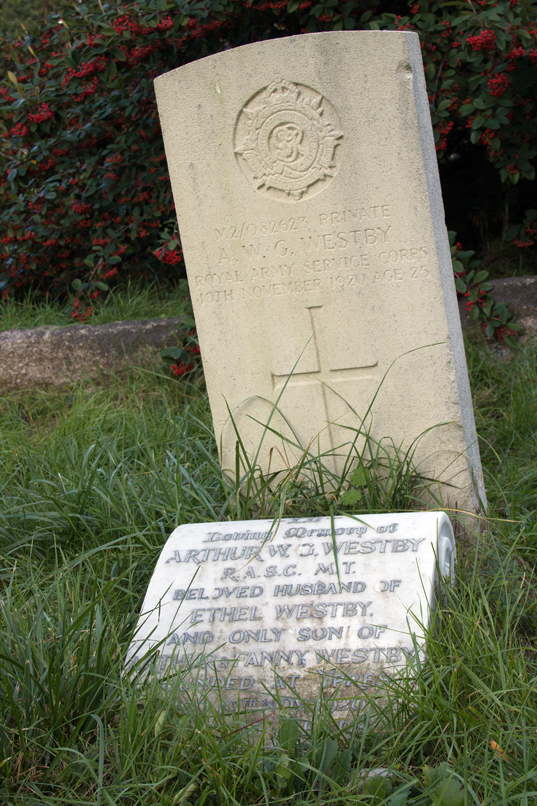
Private Arthur Westby

Private Arthur Westby

Arthur William George Westby was born in the spring of 1895, the only child to Arthur Henry Westby and his wife, Emma. Arthur Sr was a Corporal in the Scots Guards, but, beyond the fact that his son was born in Clapham, South London, there is little further information about Arthur Jr’s early life.

His father’s military career must have taken him across the country – the 1901 census lists Emma and Arthur Jr living in Bolton, Lancashire, even though there seem to be no connections with the county for them.

The records for Arthur Jr go quiet until 1920. At this point, documents hint at his military service during the Great War.

The death notices in the Sussex newspapers confirm his passing:

On November 19th 1920, at The Cedars, 13 Browning Road, Worthing, Arthur WG Westby (late MT, RASC), beloved husband of Ethel Westby, and only son of Ex-RQM Sergeant and Mrs Westby, 34 Wenban Road, Worthing. Patiently suffered to the end, result of Active Service.

Worthing Gazette: Wednesday 24th November 1920

There is no further information available about Ethel, and no marriage records to confirm a date for their wedding.

From a military perspective, Arthur enlisted in the Royal Army Service Corps, and was attached to the Motor Transport division. Again, there is nothing to evidence when he enlisted or for how long he served. It seems that Private Westby was injured in the line of duty, and was medically discharged in April 1918. The injury appears to have been life-changing, and it affected him until the end of his life.

Arthur William George Westby passed away in Worthing on 19th November 1920, aged just 25 years old. The specific cause of his death is unknown. He was laid to rest in the Broadwater Cemetery in the town, close to his parents and widow.


Private Henry Cowles

Private Henry Cowles

In a quiet corner of a cemetery in Somerset stands a gravestone to Private HJ Cowles. It confirms that he passed away on 26th April 1920, and that he was in the Bedfordshire Regiment during the First World War.

Little additional information on HJ Cowles is available. One document, the Medal Roll Index Card, confirms his first name as Henry, and that he had initially joined the Somerset Light Infantry. He was awarded the British Medal for his war service.

Cowles is a fairly common name in the Somerset area, and, without any additional information – date of birth, familial connections – it is impossible to narrow down the name on the gravestone to a specific Henry Cowles from the area or beyond.

There is also nothing in any contemporary newspapers to suggest that Private Cowles’ passing was anything out of the ordinary.

Sadly, therefore, he remains a name lost to history. Henry J Cowles, whoever he was, and however he died, lies at rest in the Milton Cemetery in Weston-super-Mare, Somerset.


Sapper Frank Hussey

Sapper Frank Hussey

Frank Hussey was born in the autumn of 1870, one of eight children to William and Ann Hussey. William was a mason, and raised his family in Weston-super-Mare in his home county of Somerset. When he left school, Frank found employment as a general labourer, initially in Somerset, but then in South Wales with his older brother Samuel.

By 1889, Frank has moved back to Somerset, where he married Elizabeth Webber in December. Work was obviously more available in South Wales, however, as the couple moved back to Glamorgan, and had their first four children – Beatrice, William, Edith and Hubert – there.

The turn of the century saw the Hussey family return to Somerset. Frank, by now, was working as a bricklayer, and they settled in a small house near the centre of Weston. Life continued on, with building work helping to support the family. Frank and Elizabeth had two more children – James and Marion – and, by the time of the 1911 census, the couple were living with their five youngest children in a two-up-two-down house on the then outskirts of the town.

Storm clouds were gathering over in Europe, and Frank was more than willing to do his bit for King and country. Having already been a volunteer with the Royal Engineers, he formally enlisted with the regiment on 5th May 1915.

Sapper Hussey was assigned to the 2nd (Wessex) Field Company, which was a territorial force. He was mobilised for fourteen months, before being discharged from the army as he was no longer physically fit for war service. Unfortunately, his military records give no further indication as to his ailment or condition.

Frank’s trail goes cold for a few years. Released from service in July 1916, the next identifiable record is from four years later. This confirms that he died from tuberculosis on 26th May 1920, aged 49 years old. Given the debilitating effect of the condition, it seems likely that Sapper Hussey contracted it during the war, and this is what had led to his dismissal.

Frank Hussey had died at home, and it was in the Milton Cemetery in Weston-super-Mare that he was laid to rest.