Tag Archives: Australia

Sapper Nuriel Evans

Sapper Nuriel Evans

Nuriel Ivor Evans was born on 22nd October 1892 in Lefroy, Tasmania, Australia. The older of two children, his parents were Powel and Mary Evans. There is little definitive information about Nuriel’s early life. The first concrete details come from his First World War service records.

Nuriel enlisted in the Australian Imperial Force on 31st August 1915. He was working as a tailor at the time, bring in money for his wife, Ida, who he had married in May 1913, and their daughter, Mollie, who was born that December.

Sapper Evans’ records confirm he was 5ft 3.5ins (1.61m) tall and weighed in at 131lbs (59.4kg). He was noted as having brown hair, grey eyes and a fair complexion, with a scar on his right shin.

Nuriel sailed for Europe on 23rd November, having been attached to the Australian Engineers. His unit left the Egyptian port of Alexandria in March 1916, and arrived in Marseille, France, ten days later. Leave aside, he was to serve on the Western Front for the next two years.

Barring one offence of being absent from parade (on 23rd March 1916, for which he was confined to barracks for a day), Sapper Evans had an unblemished record. On 23rd June that yeah, he was admitted to a field hospital because of a scald to his left foot. The injury was severe enough for him to be medically evacuated to Britain for treatment, and he only eventually returned to his unit on 24th February 1917.

Sapper Evans was badly wounded again on 27th April 1918, having received shrapnel wounds to his back, left buttock and right hand. Initially treated on site, he was moved to a hospital in Rouen, before being evacuated to Britain once more. By 1st May, he was in Bath War Hospital, Somerset, for treatment.

Sadly, any medical support was to prove too little. Sapper Evans passed away on 15th May 1918, from an “aneurysm shock following [a] secondary haemorrhage.” He was 25 years of age.

Thousands of miles from home, Nuriel Ivor Evans was laid to rest in the military section of Bath’s Locksbrook Cemetery.


Sapper Nuriel Evans
(from findagrave,com)

Private Charles Gregory

Private Charles Gregory

Charles Gregory was born in Buckfastleigh, Devon, early in 1879, the son of John and Mary Gregory. There is next to no information about his early life and, in fact, there is very little documentation for him at all.

Most of the details for Charles come from his First World War service records. These confirm that he was living in Australia, having emigrated there with his parents. His father had died by the time Charles joined up, but Mary was living in Welshpool, to the east of Perth.

Charles was 37 years old when he joined up in March 1916: his records show that he was 5ft 3.5ins (1.61m) tall and weighed 160lbs (72.5kg). He had light brown hair, grey eyes and a dark complexion, possibly from the time he spent outside, working as a groom.

As part of the Australian Imperial Force, Private Gregory sailed from Fremantle on 13th October 1916. He arrived in Plymouth, Devon, exactly two months later, and was assigned to the 4th Battalion of the Australian Infantry. He was sent to France on 8th February 1917 and, over the next few months, transferred between the 14th and 16th Battalions.

On 22nd September, Private Gregory was caught up in a bomb attack and badly injured. After initially receiving treatment to his shattered left ankle and lower ribs, he was medically evacuated to Britain for further medical intervention.

Charles was admitted to the Bath War Hospital in Somerset, but his injuries were to prove too severe. He died from tetanus on 29th October 1917, at the age of 38 years old.

With his family in Australia, the body of Charles Gregory was instead laid to rest in the military section of Bath’s sweeping Locksbrook Cemetery, next to where the war memorial would be constructed.


Private Charles Gregory
(from findagrave.com)

Private Robert Perham

Private Robert Perham

Robert Ivor Perham was born in the Dorset village of Purse Caundle in the autumn of 1892. The oldest of eight children – and thirteen years older than his youngest sibling – his parents were farmers Thomas and Annie Perham.

Thomas took the family where the work was: the 1901 census found them living at Manor Farm in West Chelborough, Dorset. Ten years later, they had moved north in the county, to Ryme Intrinseca. Robert was helping his father on the farm by now, his seven siblings all still being at school.

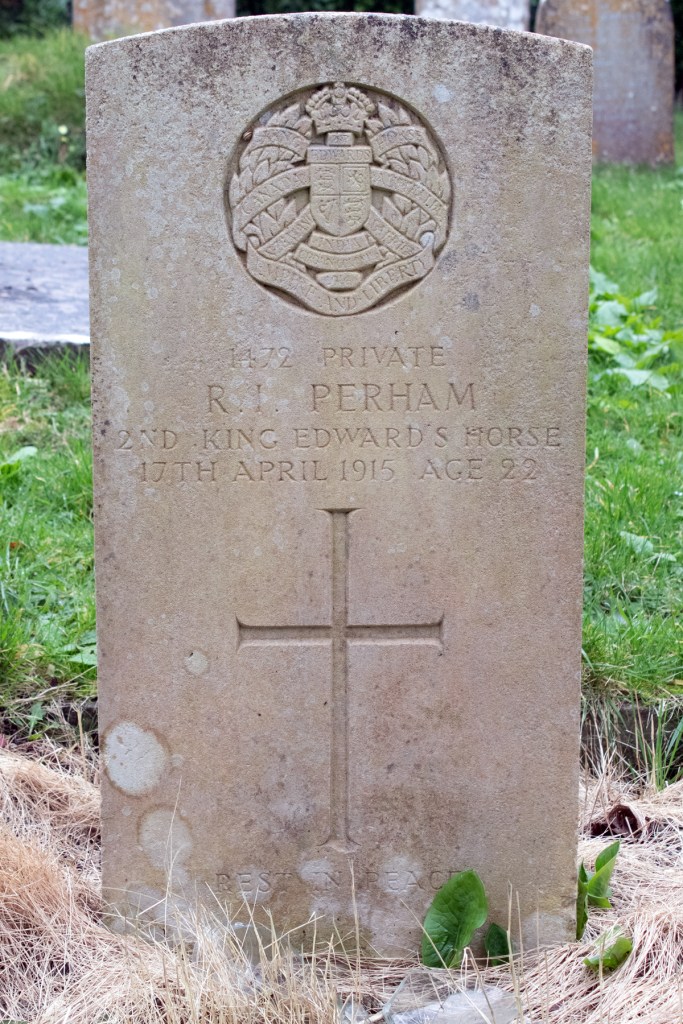
Robert saw an opportunity for farming to give him an adventure and, on 27th March 1913, he set off for Australia to work as a ranch hand. His time in the Antipodes was to be cut short, however, when, in the summer of 1914, war broke out in Europe. He made the lengthy journey back to Britain to serve his King, and was assigned to the 2nd King Edward’s Horse regiment.

Private Perham’s time in the army seemed not to have been a lengthy one. Full details of his service are lost to time, but it is likely that he arrived back in Blighty in the early weeks of 1915. He quickly fell ill – from ‘spotted fever’, or meningitis – and was admitted to the 2nd Eastern General Hospital in Brighton, Sussex. Sadly, it was a condition to which he would succumb: Robert passed away on 17th April 1915, at the age of 22 years old.

The body of Robert Ivor Perham was taken back to Dorset for burial. He was laid to rest in the peaceful graveyard of St Hippolyte’s Church in Ryme Intrinseca.


Sapper Arthur Naile

Sapper Arthur Naile

Arthur Edward Naile was born in the summer of 1888, the youngest of ten children to James and Mary Naile. Both of his parents were born in Bath, Somerset, and this is where they raised their growing family.

The Nailes lived in the Camden area of the city, consecutive census returns showing different addresses, as the children grew and then left home. In 1891, they lived at 11 Malvern Buildings, a small terraced house on a steep hill. Ten years later, they had moved to 3 George’s Road, to another terraced cottage close to their old home. By 1911, only Arthur was still living at home, which was now the four-roomed terrace at 51 Brooklyn Road, in the more built up Larkhall area no the northern outskirts of the city.

During all of this time, James had worked as a printer’s compositor. By 1911 he was 64 years of age, and was employed by a newspaper in the area. Arthur, meanwhile, was working as a grocer’s assistant.

On 9th August 1914, he married soldier’s daughter Bessie Brine. She was working as a dressmaker, and lodging with Charles and Eleanor Richman, in a small cottage in Dover Place. Their marriage certificate shows that Arthur was living three doors down, so it is likely she caught his eye not long after he moved in. They went on to have a son, Leslie, in November 1916.

War was raging across Europe by this point, and Arthur had stepped up to serve his country. He joined the Royal Engineers as a Sapper, but there is little concrete information about his time in the army. He was awarded the Silver War Badge, which was given to men medically discharged from military service during the conflict, which would suggest that he was badly wounded at some point. He died in a hospital in Hastings, East Sussex, an annexe of which was dedicated to personnel who had been blinded during the war.

Sapper Arthur Edward Naile passed away from a combination of influenza and diabetes on 31st October 1918: he was 30 years of age. His body was taken back to Somerset for burial, and he lies at rest in a peaceful corner of Bath’s sweeping Locksbrook Cemetery.


After Arthur’s death, Bessie was left to bring up their young son. In the autumn of 1923, she married again, to John Forman, and not long afterwards the three of them emigrated to Australia, in search of a better life. They settled in Bunbury, Western Australia, and went on to have two children, Ron and Nan.

When war broke out again, Leslie was old enough to step up, and joined the Royal Australian Air Force. By 1943, he found himself as a Flight Sergeant in Waltham, Lincolnshire. He had joined 100 Squadron of Bomber Command and, on the night of 25th June 1943, was piloting a Lancaster over the Netherlands. His plane was hit and destroyed, killing all those on board. Father and son both lost to war, Flight Sergeant Naile was just 26 years of age when he passed. He was buried in Westbeemster, and commemorated on memorials in Runnymede, Surrey, and Canberra, Australia.

Bessie lived on until her early 70s. She died on 8th December 1960, and is buried in the family plot in Bunbury Cemetery.


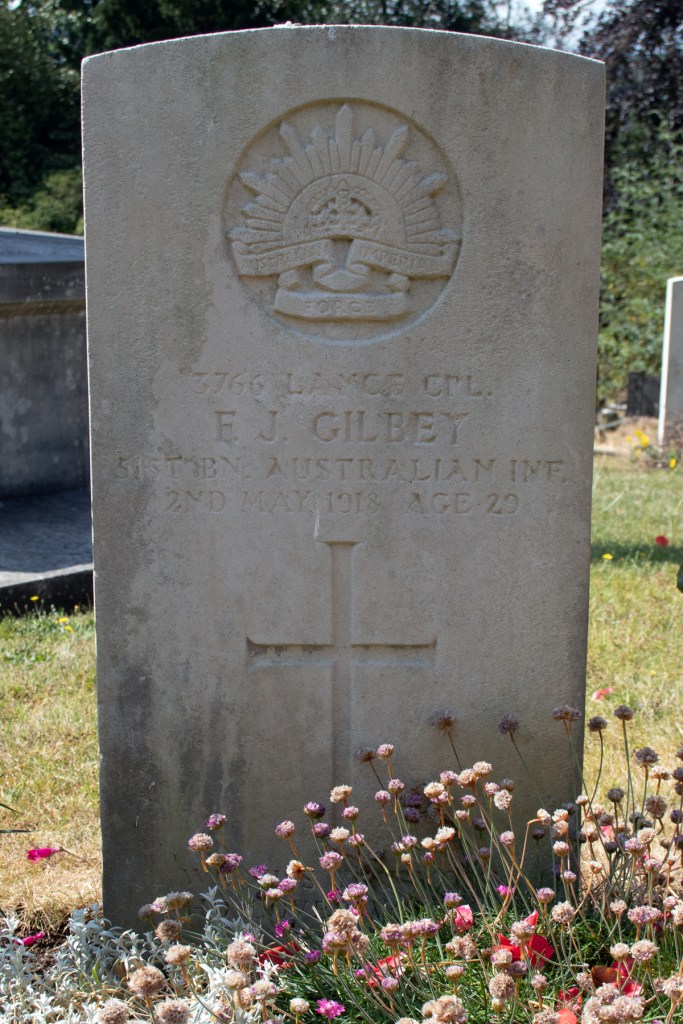
Lance Corporal Frederick Gilbey

Lance Corporal Frederick Gilbey

Frederick James Gilbey was born on 1st September 1888 in Walthamstow, Essex. The oldest of nine children, his parents were Alfred and Emily. Alfred was a general labourer, and the family initially lived on Chingford Road, before moving to an end-of-terrace house at 41 MacDonald Road.

On 28th August 1910, Frederick married Katherine Heathorn. Little more information is available about her, although the young couple’s marriage seemed to be the start of something bigger: the newlyweds emigrated shortly afterwards, arriving in Fremantle, Australia, in October 1910. Frederick’s immigration records noted that he was employed as a salesman, while Katherine was working as a dressmaker.

The couple settled into their new life well. The 1916 Electoral Records found the family living at 20 Oswald Street in the leafy Victoria Park suburb of Fremantle. Frederick was now working as a tram conductor, while Katherine was busy raising their two children, Leslie and Arthur.

By this point, Europe was two years into a bloody conflict. Frederick’s younger brother William, a Private in the Royal Fusiliers, had been killed at Gallipoli in August 1915, and it would seem that he also felt pulled to serve his King and Empire.

On 12th September 1916, Frederick enlisted in the Australian Imperial Force. His service documents note that he was 5ft 6.5ins (1.69m) tall and weighed 140lbs (63.5kg). Private Gilbey had auburn hair, blue eyes and a fresh complexion.

After initial training, he left Fremantle for the two-month journey back to Britain. Assigned to the 13th Training Battalion, his unit was based in Codford, Wiltshire. In November 1917, Frederick attended the 15th Rifle Course at the School of Musketry in Tidworth, where he qualified as 1st Class, with a fair working knowledge of the Lewis Gun.

The following February, Private Gilbey was transferred to the 51st Battalion of the Australian Infantry, and sent with his unit to France. On 20th April, days before the Battle of Villers Bretonneux, he was promoted to Lance Corporal.

The battle, however, was to prove to be his last. Wounded in the right thigh by gun shot, he was medically evacuated to Britain, and admitted to Bath War Hospital, Somerset, for treatment. His wounds were too severe, however: Private Gilbey passed away on 2nd May 1918, at the age of 29 years old.

With his widow and children on the other side of the globe, Frederick James Gilbey was laid to rest in the military section of Bath’s Locksbrook Cemetery.


Driver John McClymont

Driver John McClymont

John McClymont was born in Cowra, New South Wales, Australia, in 1865. Full details of his early life are lost to time, but later documents confirm that his mother was called Sophia.

Most of the information relating to John’s life comes from his army service records. These confirm that he enlisted on 13th September 1915, and that he was assigned to the 8th/20th unit of the 5th Australian Infantry Brigade. He was noted as being a labourer when he joined up, with brown hair, blue eyes and a fresh complexion. The record confirms that he stood 5ft 10ins (1.78m) tall, and weighed 169lbs (76.7kg).

Private McClymont arrived in Egypt in February 1916, and transferred to the 2nd Battalion of the Australian Imperial Force. He was initially based at Tel-el-Kebir camp, close to Cairo. From here on in, he seems to have been beset with poor health, and had numerous hospital admissions for heart ailments and haemorrhoids.

By April 1916, John’s unit had arrived in France, and his commitment to the job was not to go unrewarded. On 13th July 1916, he was appointed to the role of Acting Sergeant, and just three months later, he was reassigned to the 1st Australian Infantry Brigade Headquarters, where he was mustered as a Driver.

He was still battling health issues, however, and, in 18th August 1917, he was admitted to a hospital in Boulogne with heart disease. Within a month, Driver McClymont had been medically evacuated to Britain for treatment, and he was taken to Bath War Hospital in Somerset. It was here that he was diagnosed with diabetes, and, having slipped into a diabetic coma, it was here that he passed away, on 9th October 1917. He was 42 years of age.

With all of his family on the other side of the world, John McClymont was laid to rest in the military section of Bath’s Locksbrook Cemetery.


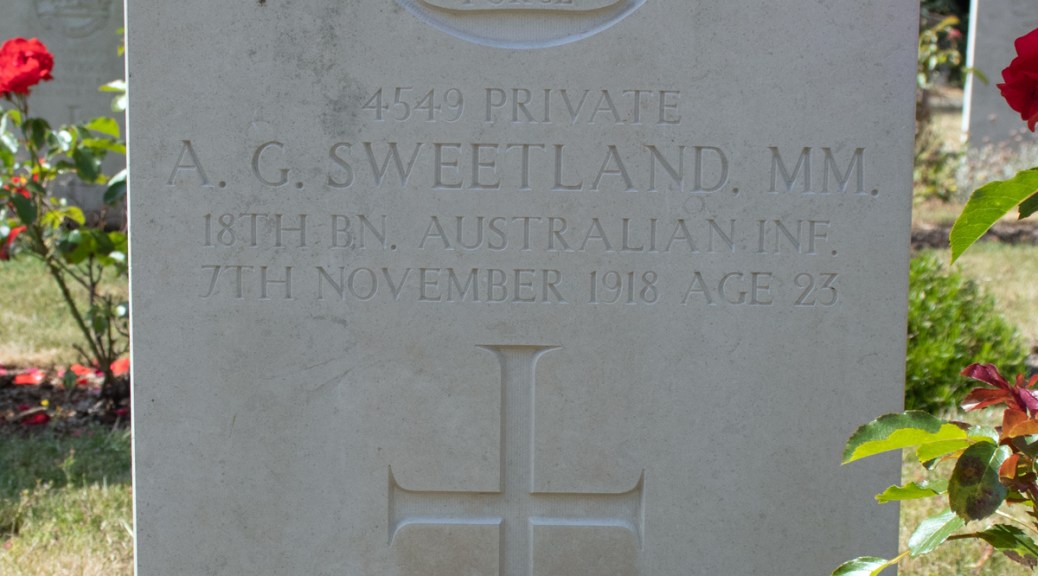
Private Albert Sweetland

Private Albert Sweetland

Albert Graham Sweetland was born on 6th January 1895 in Kensington, Middlesex. The oldest of seven children, his parents were mechanical engineer Albert Sweetland and his wife, Edith.

A work ethic was instilled into Albert Jr from an early age. By the time of the 1911 census, he had been sent to Truro, Cornwall, where he worked as a servant to the Faull family, tending to their poultry.

Albert was set on developing a life for himself and, in the next few years, he emigrated to Australia. He settled in the town of Liverpool, now a suburb of Sydney, and found work as a station hand. War was on the horizon, however, and people of the empire were called upon to serve their King.

Albert enlisted on 22nd January 1916, joining the 18th Battalion of the Australian Infantry. His service records tell a little about the man he was becoming. He was 5ft 7ins (1.7m) tall, and weighed 143lbs (64.9kg), with fair hair, blue eyes and a fair complexion. The document also notes that he was a Methodist, and that he had tried to enlist in the British army before emigrating, but that a slight defect in his right eye had prevented him.

Private Sweetland set sail for Europe on 9th April 1916. His unit sailed via Suez, reaching Folkestone, Kent, that November. His time back in Britain was to be brief, however: within a matter of days he was in Etaples, France.

Albert was thrown into the thick of things. On 5th May 1917, he was wounded while fighting at Arras. He was shot in the legs, and medically evacuated to Britain for treatment and recuperation. He was to remain on home soil for the next year, before returning to his unit in June 1918.

On 3rd October 1918, Private Sweetland was injured during the Battle of the Beaurevoir Line. His unit’s push forward was initially successful, but ultimately failed to capture the the village. The German forces attacked with gas, and Albert was caught up in it, receiving a gun shot wound to his back.

By the time Beaurevoir was in Australian hands three days later, more than 430 Allied soldiers had been killed. Albert was awarded the Military Medal for his bravery during the battle.

Private Sweetland was medically evacuated to Britain once more, and was admitted to Bath War Hospital for treatment. This time, however, he was not to be as luck as he had been eighteen months previously. He died on 7th November 1918, from a combination of appendicitis, pneumonia and heart failure. He was just 23 years of age.

Albert Graham Sweetland was laid to rest in the military section of Bath’s Locksbrook Cemetery, not far from the facility where he had passed. His parents and his sister Winifred attended the funeral.


Private Arthur Moore

Private Arthur Moore

On Wednesday 1st March, the relatives of Private Arthur Moore, formerly of Whatley, heard with great regret the sad news that he had passed away. Private Moore, who belonged to the 5th Battalion Australian Expeditionary Force, left Whatley about fourteen years ago for Australia, where he lived until last year. When war broke out he was among the first in Australia to respond to the call of the Motherland. After undergoing his training he was sent to the Dardanelles, and there with many other brave Anzac received what was to prove his death wound, being shot in the head last August by a Turkish sniper. He was brought to King George’s Hospital, London, where he remained for some time and was thence sent to a convalescent home at Isleworth. But three weeks ago his friends, who were expecting him home, were alarmed to hear that he had been sent to the hospital to be again operated on, the wound not having satisfactorily healed. The operation took place on February 28th, but was not successful, as he never rallied, and died the next day… So has passed away another who had tried to do his duty, another of Britain’s many sons who are dying that England may liv. May he rest in peace!

Somerset Standard: Friday 17th March 1916

Arthur Moore had been born in Warminster, Wiltshire, in around 1880, and was the son of Henry Albert and Elizabeth Thurzia Moore. Little further information about his early life is available, but some details can be gleaned from his service records.

Private Moore enlisted on 12th January 1915 in Colac, Victoria, around 150km west of Melbourne. His service records note that he was working as a barman, and that he had spent five years volunteering in the Yeoman Cavalry. Arthur’s medical report confirmed he was 5ft 8ins (1.73m) tall and weighed 168lbs (76.2kg). He had fair hair, blue eyes and a fair complexion.

Arthur gave his next-of-kin as Francis Moore, possibly his brother, but his service documents also noted that his father had died by the time he enlisted and recorded his mother’s details as well.

The Somerset Standard summarised Private Moore’s military career, cut tragically short when the Turkish sniper attacked. After he passed, Arthur’s body was brought back to Somerset for burial. He was laid to rest next to his father, in the quiet graveyard of Holy Trinity Church in Chantry, not far from the family home.


Bombardier Charles Newbery

Bombardier Charles Newbery

Charles James Anderson Newbery was born in Misterton, a stone’s throw from Crewkerne, Somerset, in the spring of 1895. The oldest of eight children, his parents were Benjamin and Edith Newbery. Benjamin was a farmer, who passed away in 1908, when his son was just 13 years of age.

Charles seems not to have spent a great deal of time in the family home, however: the 1901 census found him living with his paternal grandmother, while the 1911 census, taken three years after his father’s death, recorded him as living with his paternal aunt, and working on their farm.

The farming life seemed to suit Charles: indeed he emigrated to Australia to pursue the life. When war broke out in Europe, however, he returned to England’s shores to better serve King and Country. He enlisted in the Royal Garrison Artillery on 18th October 1915, and was given the rank of Gunner.

Charles’ service records confirm that he was 5ft 5ins (1.65m) tall and weighed 140lbs (63.5kg). He was noted as having a mole on his left shoulder and an upper denture.

Private Newbery was sent to France in April 1916 and, a little over a year later, was promoted to Bombardier. He was attached to the 137th Heavy Battery and all seemed to be going reasonably well for him. He had ten days’ in England in July 1917, and a further two weeks’ in March 1918.

On 13th August 1918, possible during the Battle of Amiens, Charles was injured by a gun shot wound to his right leg. He was initially treated at the 47th General Hospital at Le Treport on the French coast, but was medically evacuated to Britain for further treatment.

Charles was moved to the 4th Northern General Hospital in Lincoln. To complicate matters, he had contracted bronchitis and, while his injury was being managed, it was a combination of the lung condition and cardiac failure to which he succumbed. Private Newbery passed away on 2nd September 1918, his mother and sisters by his side. He was just 23 years of age.

Charles James Anderson Newbery was taken back to Somerset for burial. He was laid to rest in Crewkerne’s Townsend Cemetery, not far from the family home.


Bombardier Charles Newbery
(from ancestry.co.uk)

Edith had to write to the regimental office three times to get her late son’s belongings back, and in the end it took more than six months to do so. She received the items he had on him in Lincoln in April 1919: they included and “upper row [of] teeth, cigarette case, wallet containing letters, hair brush [and] comb, disc, letter, wristlet watch, note paper and envelopes.”


Private George Hutchings

Private George Hutchings

George Robert Hutchings was born towards the end of 1883 in Forest Gate, Essex. He was the oldest of four children to George and Mary Ann Hutchings. George Sr was a labourer for the railways, and this led to the family relocating to Swindon, Wiltshire, in the 1890s.

George Jr took up work with the Great Western Railway when he left school, while his father switched employment and, by the time of the 1911 census, he was working as a collector for a clothing supply company.

On 13th July 1911, George Jr married Daisy Smale in the Sanford Street Congregational Church, Swindon. Daisy was a school teacher, and was the daughter of an iron moulder. It is likely that the couple met through George’s workplace. The newlyweds had a son, Raymond, who was born in 1914 and, at some point moved to Bath in Somerset.

When war came to Europe, George stepped up to play his part. He enlisted in the Royal Army Service Corps and, unsurprisingly, given the work he was doing, was assigned to the Mechanical Transport division. Little information about his military service remains, but is it clear that he had enlisted in the second half of 1915.

The next available record for Private Hutchings is that of his passing. He had been admitted to the Royal Herbert Hospital in Woolwich, South East London, and died there on 15th December 1915. No cause for his death is evident, but he was 32 years of age.

George Robert Hutchings was brought back to Somerset for burial. He was laid to rest in Bath’s St James Cemetery.


When her husband died, Daisy was pregnant. In March 1916 she gave birth to a daughter, Winifred, who was never to know her father.

Daisy never remarried. By the time of the 1939 register, she was living in Northampton Street, Bath, sharing the house with a Mr and Mrs Spreadbury. Her employment was listed as unpaid domestic duties.

Daisy and George’s son Raymond was focused on his education. He made an eventual move to Birmingham, where, at the outbreak of war, he was working as a research chemist. He died in Bath in 1982, at the age of 68.

Winifred married grocer Kenneth Batten in Bath in 1938. The couple had three children and emigrated to Australia after the war, and settled in Coffs Harbour, New South Wales. Kenneth died in 1988, at the age of 72; Winifred died in 2003, aged 87.