Thomas George Bickley was born in Fremantle, Australia, in 1881, and was the second of six children to Absolom and Mary Bickley. May had been married and widowed twice before wedding Thomas’ father, and so he had eight half-siblings as well.
Thomas’ early life is a challenge to piece together, but his service records from the First World War fill in some of the detail. He confirms that he had served in the 1st Imperial Light Horse for eleven months, and that he fought in South Africa – presumably as part of the Boer War of 1899-1902.
At the time of enlisting on 13th September 1916, he was working as a carpenter, and had completed a five-year apprenticeship. He married Rose Buck in 1907, but they did not have any children.
Private Bickley was assigned to the 16th Battalion of the Australian Infantry, and his medical report confirms the man he had become. He was 5ft 10ins (1.77m) tall and weighed 170lbs (77.1kg). At 34 years of age, he had light brown hair, blue eyes and a fresh complexion.
Thomas’ unit left Fremantle on the Argyllshire. The troop ship arrived in Devonport, Devon, two months later, and his battalion was sent to their base near Codford in Wiltshire. The journey impacted a lot of soldiers, and Thomas was not to be immune from this.
On 12th February Private Bickley was sent to the camp hospital as he was suffering from bronchitis. The severity of his condition meant he was immediately transferred to an army hospital in nearby Sutton Veny, but it was to prove too late. Thomas died from the lung condition on 23rd February 1917: he was 35 years of age.
Thomas George Bickley was laid to rest in the ANZAC extension to St Mary’s Churchyard, Codford, not far from the based that had so briefly been his home.
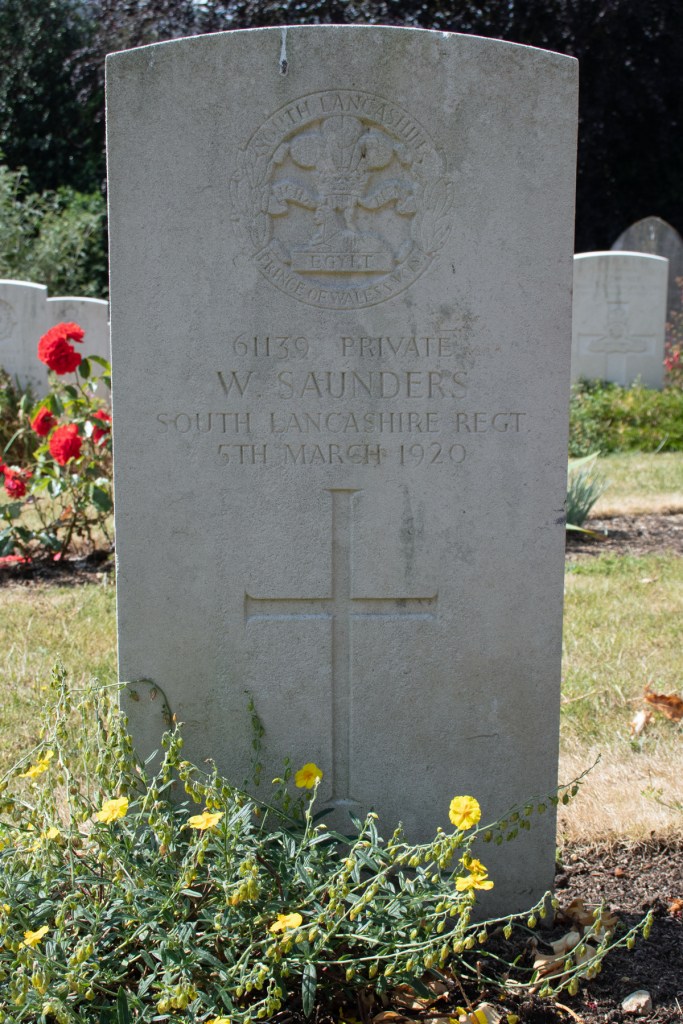
There is little concrete information about the life of Walter Saunders, and what details are available come from his limited military documents. These confirm that he was born in December 1862 in Widcombe, near Bath, Somerset.
Walter was unemployed labourer when enlisted in the army in January 1882. He joined the Somerset Light Infantry, and was attached to the 4th Battalion. His service records show that he was just under 5ft 5ins (1.64m) tall, with brown hair, hazel eyes and a fresh complexion. He was also notes as having a scar on his abdomen.
Private Saunders seems to have served in southern Asia, receiving the India medal and Burma 1885-1887 clasp. He then moved to South Africa, and was caught up in the Second Boer War. There is no further information about his initial time in the army.
When his contract came to an end, it would seem that Walter returned to the UK, finding work as a dock labourer in South Wales. When war came to Europe, though, he stepped up once more so serve his country, this time joining the South Lancashire Regiment. He was assigned to the 15th (Transport Workers’) Battalion, which served in the Mersey dockyards.
The next record for Private Saunders comes from June 1917, when he was sent to a medical board. He had been unwell for a while, it seems, and was suffering from arteriosclerosis, or hardened arteries. The medical report confirmed this was a permanent condition, and that he was no longer fit for military service.
At this point, Walter’s trail goes cold. It seems likely that he returned to Somerset, possibly still having family connections there. He passed away on 5th March 1920. He was 57 years of age.
Walter Saunders was was laid to rest in the military section of Bath’s sweeping Locksbrook Cemetery.
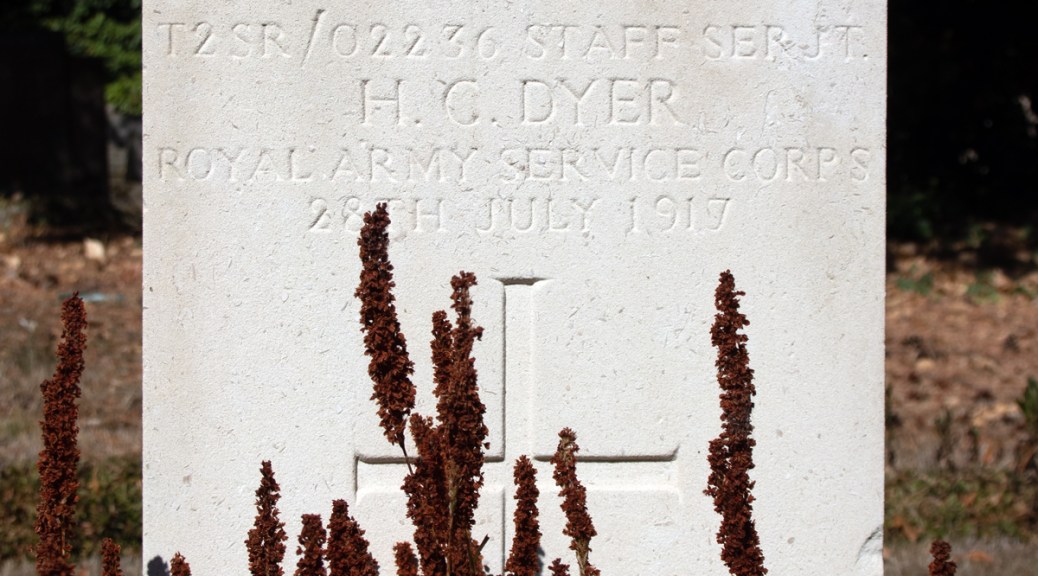
Henry Charles Dyer was born in January 1865 in the Devon town of Ivybridge. The oldest of five children, his parents were carpenter James and dressmaker Mary Dyer. When he left school, Henry found work as a cordwainer’s apprentice but, after James died in 1886, he sought out a career that would help support his mother.
Henry enlisted in the Army Service Corps on 10th July 1886 and, by the time of the next census was based at barracks in Woolwich, South London. His service records note that he was 5ft 4.5ins (1.64m) tall and weighed 124lbs (56.25kg). He had a dark hair, grey eyes and a dark complexion. He was also noted as having a tattoo of a cross on his left forearm.
Private Dyer served in the regiment on home soil for more than thirteen years, qualifying as a horse collar maker and saddler during this time and rising through the ranks. He was made a Driver in 1889, Corporal in 1895 and Staff Sergeant in October 1899.
Trouble was afoot on the other side of the world by this time and his promotion was linked to Henry being sent to South Africa. He was there for eighteen months, and was awarded the Queen’s South Africa Medal, as well as clasps for service at Tugela Heights, the Relief of Ladysmith, Laing’s Nek, Transvaal and Orange Free State.
Staff Sergeant Dyer went back to Britain in April 1901, where he remained for a further six years. On 4th July 1907, reached the end of his term of service and having completed 21 years with the Army Service Corps he returned to civilian life.
Henry moved back to Devon, moving back in with his mother and younger brother. Mary had remarried after James passed, but her second husband had also passed away, and so having two of her sons home would have been of comfort to her. The 1911 census records the family as living in three rooms of a house in Grenville Street, Plymouth. They shared the property with the Smith family, a husband, wife and two children. Henry was recorded as an army pensioner (saddler), while his brother Ernest was listed as being a watchmaker, while also in the army reserve.
War was on the horizon again, and, Henry was one of the first to step up when it was declared. He was 49 years old by this point, and so technically exempt from enlisting, but as an army life had served him well before, it must have seemed fit for him to serve King and Country once more.
Staff Sergeant Dyer’s new service records noted that he was formally employed as a saddler, and that he had put on 18lbs (8kg) since he initially signed up.
Henry was based firmly on home soil this time round, and while he was initially based in Aldershot, Hampshire, he seems to have been moved to barracks in Kent. He served for more than two and a half years, but his health seems to have been suffering by this point. At a medical on 24th July 1917, he was deemed to be no longer fit enough for war service and was discharged from the army.
It is likely that this discharge came while he was admitted to the Preston Hall Military Hospital in Aylesford. While Staff Sergeant Dyer’s earlier military service is fairly detailed, his later career is not. What is clear is that, four days after being discharged, he passed away. He was, by this time, 52 years of age.
A lack of funds may have prevented Mary from bringing her son home to Devon. Instead Henry Charles Dyer was laid to rest in the graveyard of St Peter and St Pauls Church in Aylesford, not far from the Kent hospital in which he passed.
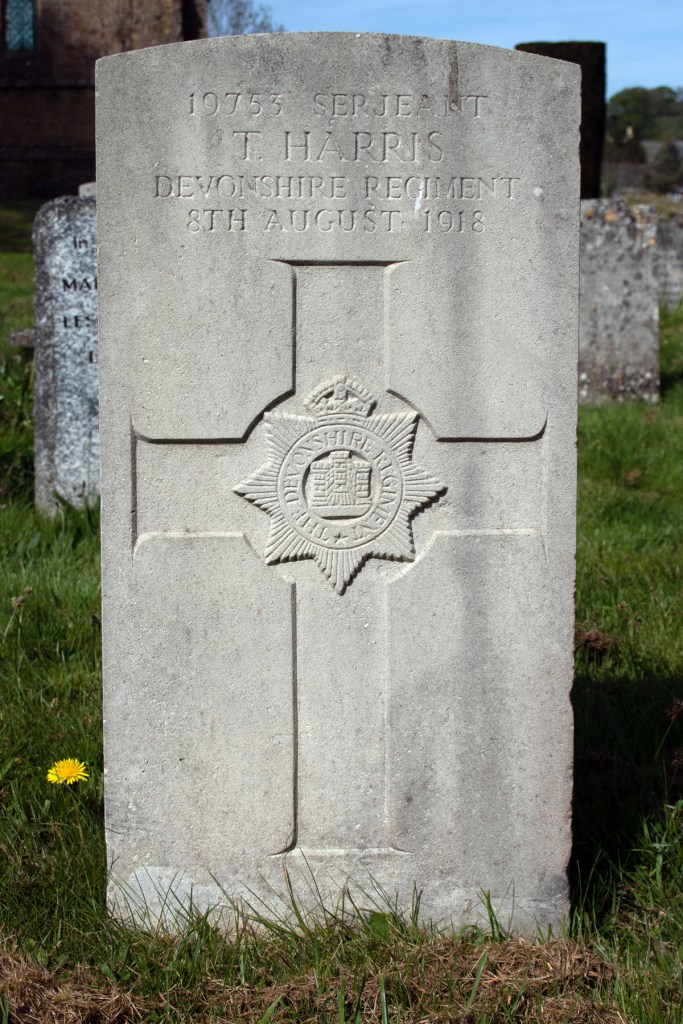
Thomas Harris – known as Tom – was born on 13th October 1876, the only son of Edmund and Mary Harris. Edmund was an agricultural labourer from the Somerset village of Seavington St Mary, and this is where Tom was born and raised.
Mary had married Edmund in the spring of 1876, but had been married before; she was widowed when her previous husband, Alfred Vickery, died ten years before. They had had seven children of their own, half-siblings to Tom.
Edmund died in the Wells Lunatic Asylum when Tom was only six years old. When he left school, he found work as a farm labourer, but sought bigger and better things, even though he was now the only one of Mary’s children still living at home.
Tom enlisted in the Somerset Light Infantry in January 1893, and soon found himself overseas. During his sixteen years’ service, he spent seven years in India and six months fighting in the Second Boer War. Corporal Harris seems to have had a sickly time of it, and while in India, was admitted to hospital a number of times for fever, ague and diarrhoea, as well as a bout of conjunctivitis.
When Tom’s contract came to an end in 1909, he returned to Britain, setting up home in Newport, South Wales, where he found work as a sheet weigher at the local steel works.
Mary died of senile decay and cardiac failure in May 1910. She was 74 years old, and sadly passed away in the Chard Workhouse, in similar circumstances to her late husband.
In October 1913, Tom married Ada Long in Chard. She was the daughter of a shopkeeper, and the couple set up home in South Wales, where Tom was still working.
War, by now, was closing in on Europe, and Tom wanted to use his previous experience to serve his country once again. He enlisted on 20th August 1914 in Newport, joining the Devonshire Regiment as a Private, although he was quickly promoted first to Corporal and then to Serjeant. His service records show that he was 5ft 8ins (1.73m) tall, had blue eyes, brown hair and a tattoo of a Spanish girl on his right forearm.
After a year on the Home Front, Serjeant Harris was sent to Egypt in September 1915. On the way out, he contracted a severe cold, which left him deaf in his left ear. He was also suffering from varicose veins, which left him in pain in his right leg. He was treated for both conditions, and put on light duties for three months.
In November 1916, Serjeant Harris was supporting a food convoy when it came under attack. Buried in sand and wounded, he was laid up in a hole for two days and nights before help came. He was initially treated for shell shock in the camp hospital, but was eventually evacuated to Britain for treatment.
The incident had put too much of a strain on Tom, and he was medically discharged from the army in April 1917. While his medical report confirmed that the general paralysis he was suffering from was a result of the attack, it also noted on six separate occasions that he had previously suffered from syphilis, suggesting this may also have been a contributing factor to his mental state.
Tom was discharged initially to an asylum in South Wales, before returning home to Ada. The couple were soon expecting a child, and a boy, Sidney, was born in February 1918. By that summer, however, Tom’s condition had worsened enough for him to be admitted back to the Whitchurch Military Hospital in Cardiff.
It was here that Tom passed away, dying from a combination of chronic phlebitis – an extension of the varicose veins he had previously complained of – and general paralysis on 8th August 1918. He was, by this point, 41 years of age.
Tom Harris was brought back to Somerset for burial. He was laid to rest – finally at peace – in Chard Cemetery.
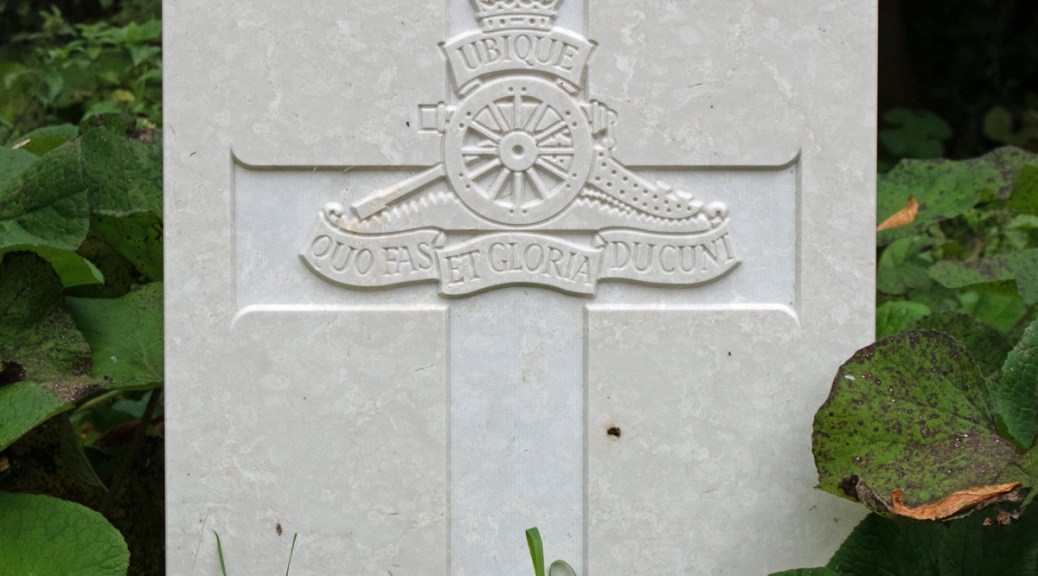
William Hann was born towards the end of 1871, the son of Harry Hann, who was a stonemason, and his wife Susan. Born in Stoke-under-Ham (now Stoke-sub-Hamdon), he was one of nine children, although sadly five of his siblings passed away at a young age.
Sadly, little of William’s early life remains documented. A newspaper article that reported on his passing, however, confirms that he served in the Royal Field Artillery, and was based in India for four years, before being shipped to South Africa to fight in the Boer War.
Back in Somerset in the early 1900s, he married a woman called Ellen, and the couple went on to have four children – Hilda, Herbert, Kate and Louisa.
At the outbreak of the [First World War], though under no obligation, [Gunner Hann] responded to the call of duty and was among the first to volunteer from Stoke. He was attached to the Indian Expeditionary Force and sent to France, and it is interesting to know that he saw some of the native soldiers whom he had bet while serving in India many years ago.
After serving in France for some time, he was transferred to Mesopotamia, and it was there that his health became impaired, which made him an easy victim of the disease which caused his death.
Western Chronicle: Friday 1st June 1917
Gunner Hann had contracted cellulitis in his right arm, which turned septic. He returned home on sick leave on 22nd May 1917, but died at home from blood poisoning just two days later. He was 48 years of age.
William Hann was laid to rest in the graveyard of St Mary’s Church, in his home village of Stoke-sub-Hamdon.
John Stainton was born in the Cumbrian village of Ambleside in January 1871. He was one of seven children to George and Mary Stainton, a labourer and his wife. John followed in his father’s footsteps as a labourer, as they took him to where the work was – by the time John was ten, the family were living in Barrow-in-Furness.
The 1911 census found John married to a woman called Mary. The couple wed in 1909 and were boarding with Maybrooke Cole, a fellow labourer, and his family.
The next record for John comes in the form of his enlistment papers. He joined up on 31st August 1914, but the document throws up a couple of anomalies.
To the question “Are you married?” John marked “No”. The fact that he didn’t confirm he was a widower presents more questions than answers.
The document also confirms that he has previous military experience. He served with 2nd Battalion King’s Own (Royal Lancaster Regiment), which fought in the Second Boer War, and was involved in Battle of Spion Kop in January 1900.
John re-enlisted in the same battalion on 31st August 1914, and remained part of a territorial force for the best part of a year. It was during this time that he married Rhoda Selina Cooper. She was born and brought up in Clevedon, Somerset, and it can only be assumed that John was stationed in the county at this time.
Private Stainton seemed to have a bit of a rebellious streak, and his service records identify three times when he was pulled up for dereliction of duty. In December 1914, he was admonished for overstaying his leave pass; in June 1915 he was reported for being absent from the base; a year later, he was admonished again, this time for losing a pair of handcuffs.
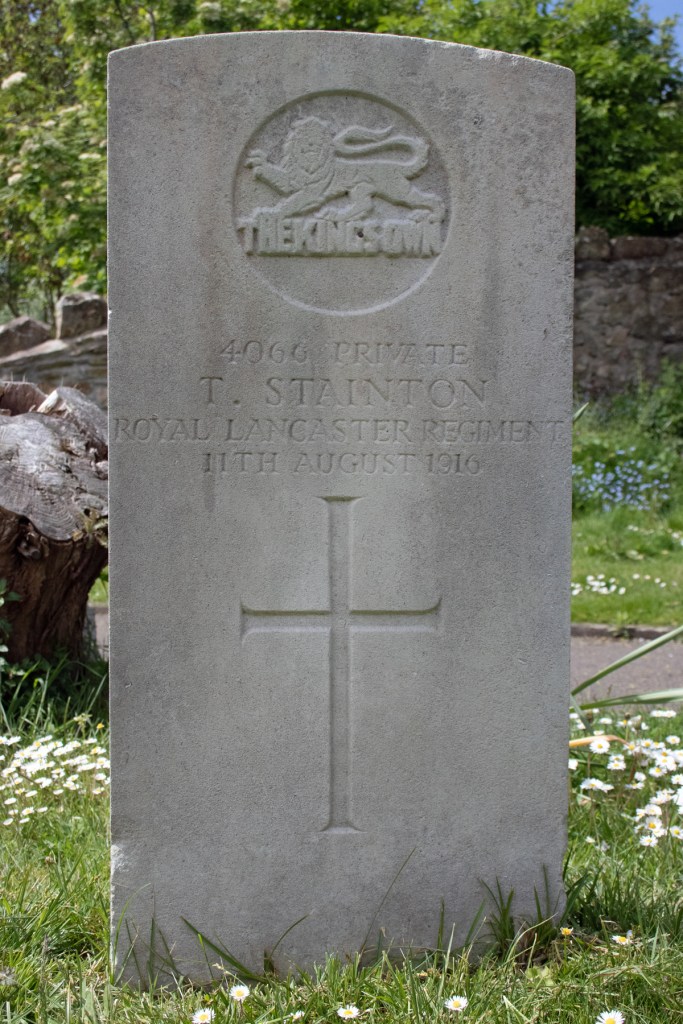
The battalion were sent to France in July 1915, and, in the end, Private Stainton served on the Western Front for just over a year. On 27th July 1916, he was sounded by shrapnel in the right shoulder, face and thigh, and was evacuated back to England for treatment. Admitted to the English General Hospital in Cambridge, sadly his wounds proved too much for him. Private Stainton died on 11th August 1916, at the age of 45 years old.
John Stainton’s body was brought back to his widow; he lies at rest in the picturesque churchyard of St Andrew’s in Clevedon, Somerset.
The Commonwealth War Grave for John Stainton incorrectly gives his name as T Stainton.
James Frederick Hain was born on 5th November 1881 in the village of Holmer in Herefordshire. He was one of seven children to James and Catherine Hain, and was more commonly known as Fred. On James Jr’s birth certificate, his father was listed as a manure agent, although by the time of the 1891 census, the family had moved to London, where James Sr was now running a coffee house.
When he left school, James Jr started work as a French polisher, but he had a taste for adventure and joined the army. He served in South Africa during the Boer War campaign of 1899-1900, attaining the Cape Colony, Orange Free State and Transvaal Clasps.
In 1900 James returned home, finding work as a French polisher. The military life was in his blood by now, though, and in September, he re-enlisted. Initially joining the Royal Berkshire Regiment, he was soon transferred over to the Royal Engineers as a Sapper.
James had signed up for a period of eight years and, as part of his role as a wireman (maintaining and fitting telegraph cables), he was stationed abroad. On one particular trip, when his battalion was travelling from Plymouth to Limerick early in 1908, he was injured. According to the accident report: “owing to bad weather on boat between Fishguard and Waterford he was thrown violently forward, striking his head against a girder.” Treated in Limerick, “the disability is of a slight nature, and in all probability will not interfere with his future efficiency as a soldier.”
Sapper Hain’s time with the service was nearly up, and he was put on reserve status in November 1908. By 1911, he was working as a linesman, and boarding in a house in Hayle, Cornwall.
War was on the horizon by now, and on 5th August 1914, James was called back into service. He saw action on the Western Front, adding the Victory and British Medals and the 1915 Star to his count. In October 1915, he was treated for shell shock, and evacuated back to England.
At the beginning of 1917, Lance Corporal Hain was transferred back to the Army Reserve, suffering from neuritis. His health was to suffer for the rest of his life.
In September 1917, having settled in Cornwall, James married Beatrice Opie, an innkeeper’s daughter from the village of Wendron, Cornwall. The couple would go on to have a son, who they called Frederick, two years later.
Discharged from the Army, James put his engineering experience to good use, joining the General Post Office to work with telegraphs.
By this time, James’ medical condition had been formally diagnosed as General Paralysis of the Insane. A degenerative disease, similar to Alzheimer’s disease, it was associated with brisk reflexes and tremors (usually most obvious of the lips, tongue, and outstretched hands) and characterised by failing memory and general deterioration.
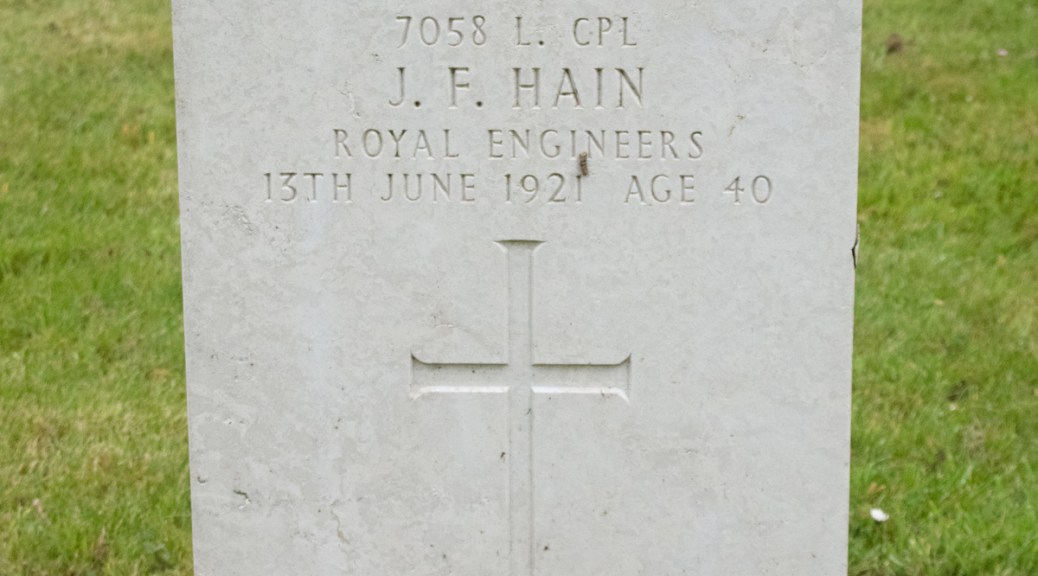
By August 1920, James was admitted to the Somerset and Bath Asylum in Cotford, because of his worsening condition. He was not to come out again, and passed away ten months later, on 13th June 1921. He was just 39 years old.
James Frederick Hain was buried in the St James’ Cemetery in Taunton, Somerset.
John Kennell was born in Yeovil in 1872. One of five children, he was the only son of bootmaker Francis Kennell and his wife Elizabeth.
John enlisted in the Dorsetshire Regiment in 1888. Interestingly, his enlistment records give his surname – and that of his parents – as Hosegood. When he was discharged, however, the documents give him as John Hosegood alias Kennell (the census records confirm his family name as Kennell, however).
Private Hosegood was initially based at The Citadel Military Barracks in Plymouth. His service meant he travelled the world – he spent two years in Egypt, four in India and two in South Africa (where he was involved in the relief of Ladysmith). In all, John served 14 years in the army and was discharged in May 1902.
John married Bessie Greenstock six weeks after being demobbed; the Banns show they wed in the Parish Church of Sherborne (or Sherborne Abbey), and list John as a soldier. He was 30, Bessie seven years older.
By the time of the 1911 census, the couple were living with their two young children – Francis and Edith – and Bessie’s widowed mother in the village of Oborne, two miles to the west of Sherborne in Dorset.
When war broke out, John reenlisted within weeks. After a period of re-training, Private Kennell was posted to France as part of the British Expeditionary Force on 23rd October 1914, and served nearly three years on the Western Front.
Private Kennell returned to the UK on 30th December 1916, and remained there until being discharged as no longer fit for war service in July 1917. Sadly, I have been unable to find any details of what led to him being discharged, but the service records do not suggest that he was wounded in any way.
After his discharge, details of John’s life are sparse. His name does not appear in any newspapers of the time, and all I have been able to find it that he passed away on Christmas Eve 1919. He was 47 years old and was buried five days later.
Private John Kennell lies at rest in Sherborne Cemetery, Dorset.
Sidney Horace Hornby was born to John and Emily in March 1880. John was a tailor’s assistant from Paddington, and the family – Sidney was the eldest of six siblings – initially lived in the Greenwich.
Sidney enlisted in the army in 1898. He joined the East Kent Regiment for a short service of seven years and was sent to South Africa. In March 1900 he was wounded at the Battle of Driefontein. His service, though, saw him promoted through the ranks from Private to Sergeant.
Something must have happened during his enlistment, however, as on 2nd September 1901 Sergeant Hornby’s military record marks him as having deserted.
Sidney’s records pick him up again on 24th April 1908, when he is put on court martial. Found guilty of desertion, he is reduced to the ranks and sentenced to three years’ penal servitude (later reduced to two years’ hard labour).
His attitude seems to continue, however, as within a matter of months he was discharged due to misconduct and denied any pension for his previous service.
Sidney’s family had moved from Greenwich to Kent at some point before the 1901 census, and his father died three years later. By the 1911 census, he had moved back in with his mother, and worked as a labourer to help look after them.
The Great War called, however, and it seems that Sidney’s previous misdemeanours did not excluding him from fighting again. He joined the Royal West Kent Regiment although his full service for the 1914-18 campaign are not accessible. Again, his service seems to have been good, as he was elevated to the rank of Sergeant for a second time.
Hints of Sergeant Hornby’s rebellious nature remain, however, as he was court marshalled again in February 1916. He was convicted of drunkenness, and reduced to the rank of Corporal.
That was the summer of the Battle of the Somme, and by the autumn Hornby was one of the many who fell during that time. He died on 4th October 1916 and was 36 years old.
Corporal Sidney Hornby is commemorated on the Thiepval Memorial.
Sidney Horace Hornby was my 1st cousin, four times removed.










 Death and Service