Tag Archives: Boy

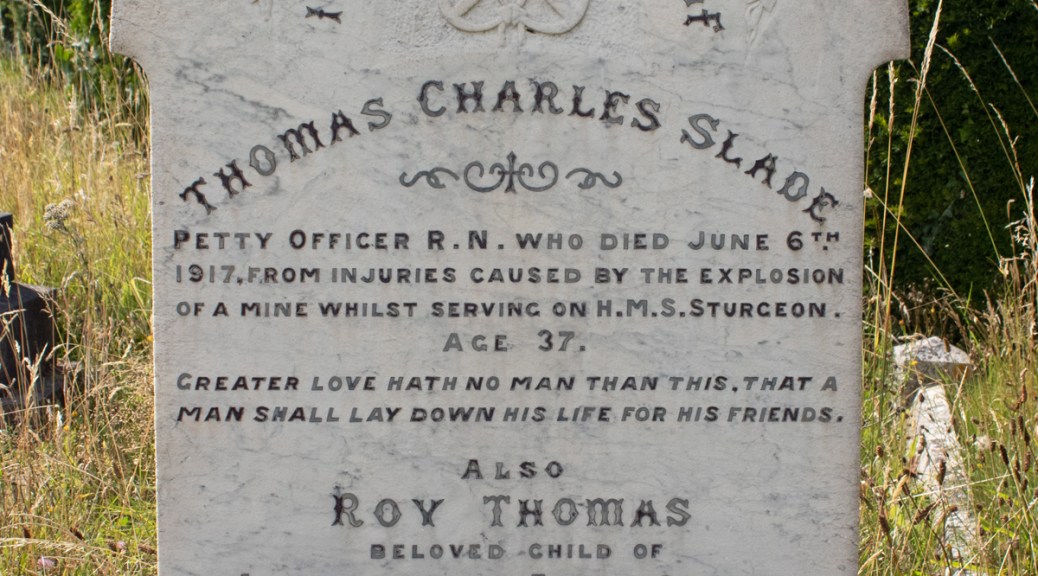
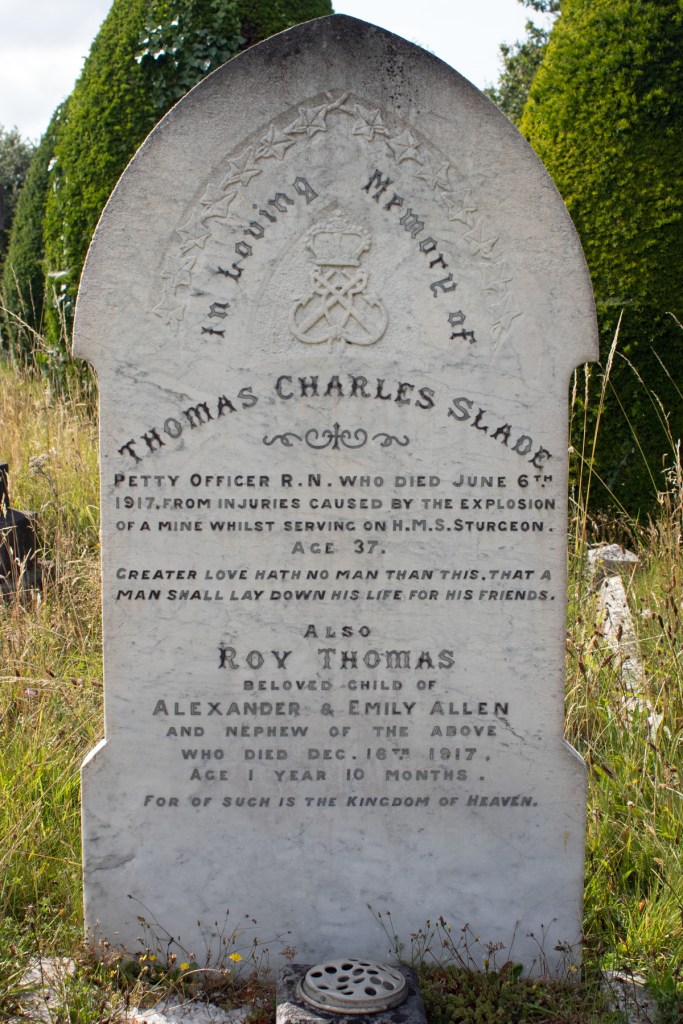
Petty Officer Thomas Slade

Petty Officer Thomas Slade

Thomas Charles Slade was born in Bristol, Gloucestershire, on 13th March 1880. One of twins, he and his sibling Ernest were two of nine children to Charles and Elizabeth Slade. Not long after the twins were born, the family had moved to Minehead, Somerset, where both Charles, who was a mason and bricklayer, and Elizabeth had hailed from.

Whilst Ernest seemed content to remain in Somerset – going on to become a poultry farmer – Thomas sought a life of adventure. Foregoing his gardening job, he enlisted in the Royal Navy, setting his sights on a life at sea.

Thomas’ service records show that he joined up on 12th November 1895. He stood just 5ft 2ins (1.57cm) tall, with brown hair, blue eyes and a ruddy complexion. As he was to young to formally join up, he was give the rank of Boy 2nd Class, and sent to HMS Impregnable, the shore-based training establishment in Devonport, Devon.

Boy Slade seemed to create a good impression. He was promoted to Boy 1st Class in July 1896, and the follow February was given his first posting, on board the battleship HMS Benbow. This was the ship he was serving on when he turned 18 and, having come of age, he was officially inducted into the navy, and given the rank of Ordinary Seaman.

And so began a glittering career for young Thomas. Over the twelve years of his contract, he served on nine different ships, returning to HMS Vivid – the Royal Naval Dockyard in Devonport – between voyages.

Small in stature, Thomas appears to have been a dedicated young man. His annual reviews noted his character was ‘very good’ every year, and his ability was either ‘very good’, ‘superior’, or ‘excellent’. He was promoted to Able Seaman in September 1898, just eighteen months after becoming an Ordinary Seaman. By June 1906 he rose in rank again, ending his initial term of service as a Leading Seaman.

Thomas was not done with the navy yet, however. He immediately re-enlisted and, over the ensuing years served on a further four vessels. He spent more and more time on board HMS Defiance, the torpedo and mining school ship in Devonport. Whether this was because he was being taught, or was supporting incoming students is unclear, but by September 1912, he had been promoted again.

In November 1915, the now Petty Officer Slade had moved to the depot ship HMS Dido. His new posting supported the Tenth Destroyer Flotilla in the North Sea, patrolling the waters off the East Anglian coast. In February 1917 he moved to another of the support vessels, HMS Sturgeon.

In June 1917, a mine exploded on board, injuring a number of the crew, including Petty Officer Slade. The wounded were transferred to a hospital near Ipswich, and it was here that Thomas was to pass away. The only one of those caught up in the incident to die, he was 37 years of age.

Thomas Charles Slade was brought back to Somerset for burial. He was laid to rest in the sweeping Minehead Cemetery, close to the grave of his mother, Elizabeth, who had passed away nine years before.


Thomas’ headstone also includes an inscription to Roy Thomas Allen, who died six months after him. Roy was the young son of Thomas’ younger sister Emily: an uncle and nephew reunited.


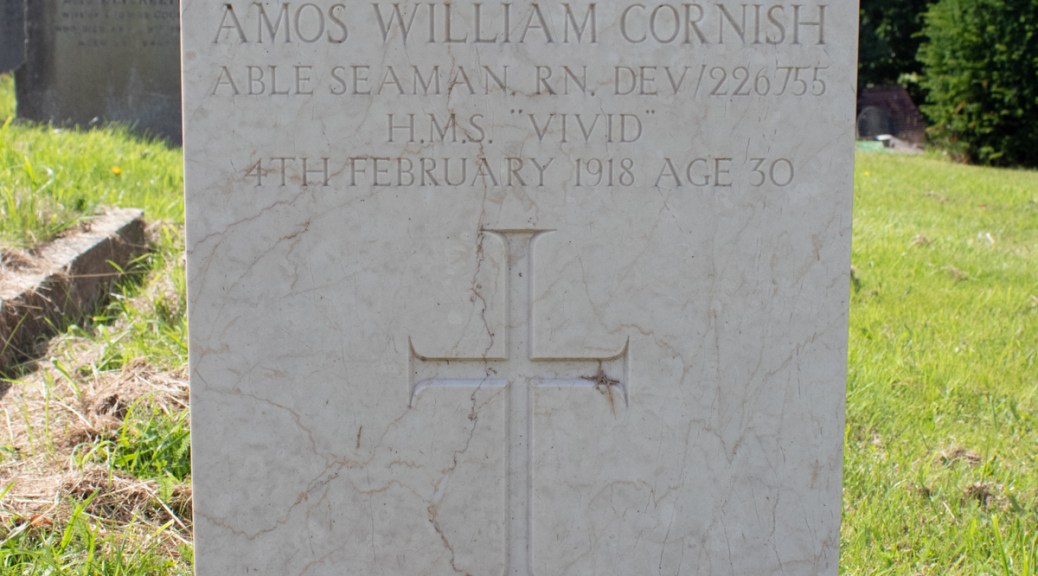
Able Seaman Amos Cornish

Able Seaman Amos Cornish

Amos William Cornish was born on 16th August 1887 in Dunster, Somerset. One of five children, his parents were George and Elizabeth Cornish. George, who was a brickmaker, died in 1893, and at this point the family relationships seemed to have broken down.

By the time of the 1901 census, Elizabeth had remarried, and was living with her new husband and Amos’ youngest sibling, sister Lily. Two of Amos’ brothers, Walter and George, were living with his maternal grandparents, while Amos himself was one of three hundred inmates at the Horton Kirby Home for Homeless Boys in the Dartford area of Kent.

Amos’ schooling would have finished by the time he was 14 years old, and he quickly sought work that allow him to support himself as a young man with no home to go to. A career in the Royal Navy seemed to provide that regular pay and, on 4th June 1902, he enlisted.

As he was under age, Amos was given the rank of Boy 2nd Class, and sent to the shore-based training ship HMS Impregnable in Devonport, Devon. His service records show that he stood just 5ft 4ins (1.63m) tall, had brown hair, brown eyes and a fresh complexion. He was noted as having a scar in the centre of his forehead, and a tattoo of clasped hands over a heart on his right forearm.

Boy Cornish transferred to another training vessel – HMS Lion – after a month or so, and it was here, in February 1904, that he was promoted to Boy 1st Class.

Over the next eighteen months, Boy Cornish served at two more training bases – HMS Boscawen and HMS Vivid. He was given his first sea-going posting in April 1905, aboard the cruiser HMS Blake. It was on his next assignment, however, that he came into his own.

In May 1905, Amos boarded HMS Carnarvon, an armoured cruiser that had been launched a couple of years before. He was to spend the next two years as part of her crew, gaining the rank of Ordinary Seaman when he came of age in August 1905, and Able Seaman a year later.

When his time on board Carnarvon came to an end, Amos returned to shore, to HMS Pembroke, the Royal Naval Dockyard in Chatham, Kent, which was to be his base on and off for the next eight years. During that time, he served on six more ships, and rose to the rank of Leading Seaman in December 1911. This new rank, however, seemed not to suit Amos, and he reverted back to his previous rank eight months later.

Able Seaman Cornish’s longest posting was on board the cruiser HMS Antrim. He joined her crew in September 1913 and, over the next three-and-a-half years he travelled far and wide. Initially patrolling the North Sea – particularly around the Scottish Isles – Amos was on board for a journey to Arkhangelsk in Russia. The ship then transferred to the Western Atlantic, patrolling around America and the West Indies.

Able Seaman Cornish returned to British shores in April 1917, to be based at HMS Vivid, the Royal Naval Dockyard in Devonport, for the nest nine months. During this time, he became ill and was admitted to the Royal Naval Hospital in Truro with double pneumonia. Tragically, this was something he was not to recover from: Amos passed away on 4th February 1918, at the age of 30 years old.

While somewhat stretched, Amos’ family bond still remained. Elizabeth was living in Minehead by this point, with husband Alfred and their two children. It was to the Somerset town, therefore, that Amos William Cornish’s body was brought. He was laid to rest in the town’s sweeping cemetery.


George’s death in 1893, and Elizabeth’s remarriage a few years later split the family, and Amos’ siblings all followed separate paths.

The oldest of his siblings, Walter, also followed a military path. He joined the Royal Garrison Artillery as a Gunner and, by the time of the census, was based in Gibraltar. On completing his service, he returned to Somerset, marrying Florence Peddle in 1925. The 1939 Register found the couple living with his cousin, Amelia, while he worked as a gardener. Walter died in Weston-super-Mare in 1962, at the age of 74.

Amos’ next sibling, brother Harold, seems to have had a less fortunate time of things. Absent from the 1901 census, he appears in prison records four years later. He was incarcerated for six months’ hard labour in Brecon Prison, having been found guilty of “Gross Indecency with another male person”. Harold was 14 years and three months old at the time. A newspaper report from around this time suggests that the other party was a George Williams, but there is no further information about him. Harold seems to have come out the other side of his experience, however: the 1911 census recorded him as living and working with draper and grocer James Ridler and his family in Dunster, Somerset.

Amos’ third sibling, sister Lily, found work as a servant to bakers Joseph and Minnie Bagley in Minehead. She married painter and decorator William Whitting in 1916 and the couple went on to have a daughter, Kathleen, eight years later. The family settled in Weston-super-Mare, Lily passing away in 1968, at the age of 75.

The youngest of the Cornish siblings was George. He remained living with his maternal grandparents in Dunster, and found work as a printer. In the spring of 1921, he married Clara Govier and, by the time of the 1939 Register, they couple were living in Aylesbury, Buckinghamshire, where George was working as a printer and compositor. He died in 1957, at the age of 62 years old.


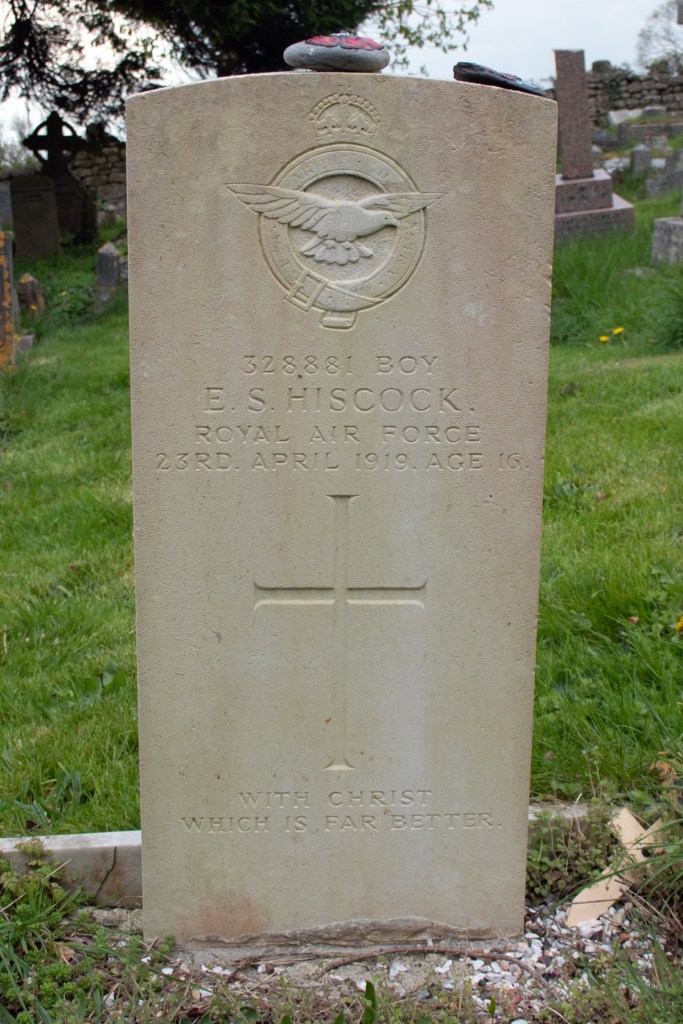
Boy Edwin Hiscock

Boy Edwin Hiscock

Edwin Sydney Hiscock was born in Corsham, Wiltshire, 11th November 1902. The older of two children, his parents were quarry manager Edwin Hiscock and his wife, Helen.

When he finished his schooling, Edwin Jr found work as a clerk, but as a young teenager, the thrill and excitement of the war going on around him, drew him to a life in the Royal Air Force. He enlisted on 27th March 1919, and was dispatched to the School of Technical Training at Halton Camp near Aylesbury, Buckinghamshire. Boy Hiscock’s service records note that he was 5ft 9ins (1.75m) tall, with dark hair, brown eyes and a fresh complexion.

Edwin’s life in the military was to be cut tragically short. He had lived a cosseted life in rural Somerset – the family having moved to Monkton Combe, near Bath. At the RAF base, he was surrounded by men and women from across the country, and was suddenly exposed to illnesses that he would not have encountered had he remained at home. It is unclear what he contracted but in the months after the First World War, influenza swept Europe, so this is a likely suspect. Edwin passed away at the base on 23rd April 1919, having completed 27 days’ service. He was just 16 years of age.

The body of Edwin Sydney Hiscock was brought back to Somerset for burial. He was laid to rest in the peaceful graveyard of St Michael’s Church, Monkton Combe.


Edwin’s headstone includes the epitaph “With Christ which is much better”, a bitter pill to swallow.


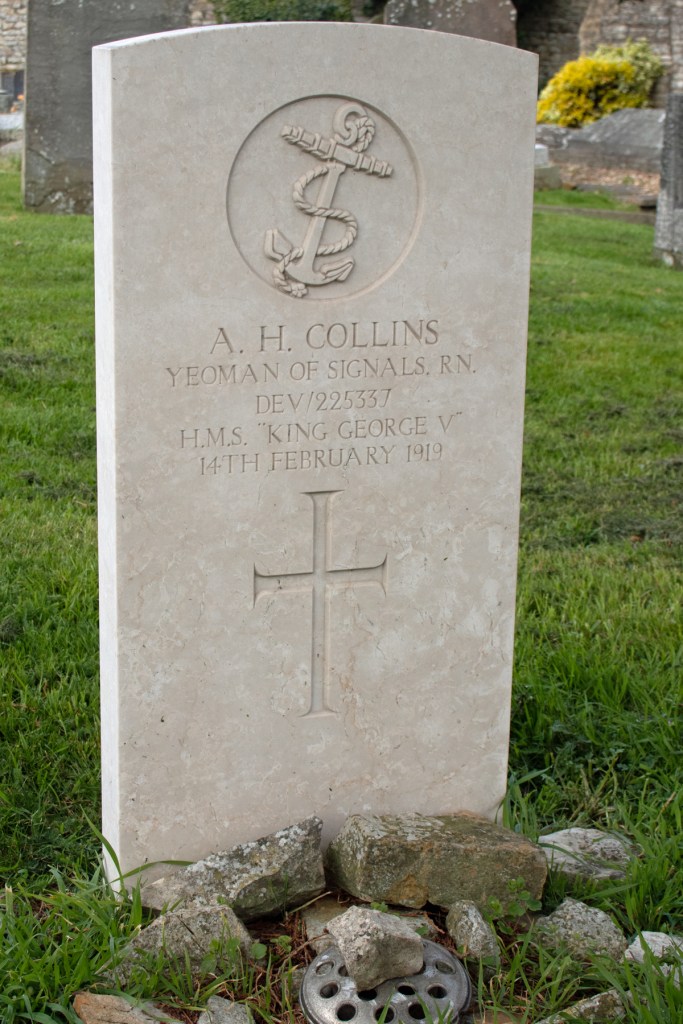
Yeoman of Signals Alfred Collins

Yeoman of Signals Alfred Collins

Alfred Henry Collins was born on 22nd August 1886, in the Gloucestershire village of Wotton-under-Edge. One of five children, his parents were cowman and farm labourer Samuel George Collins and his wife, Jane. Samuel’s work took the family south, and by the time of the 1901 census, the Collinses had settled in Whitchurch, near Bristol.

When Alfred finished his schooling, he also found employment labouring on a farm, but he was drawn to a more reliable career and a life at sea. On 9th March 1903, Alfred enlisted in the Royal Navy. His service records show the young man he was becoming. He was 5ft 4ins tall, with brown hair, brown eyes and a fresh complexion.

Alfred was still underage in the navy’s eyes, and so he was given the rank of Boy 2nd Class. He was assigned to HMS Northampton, a training ship, and must have shown some promise, as within three months he had been promoted.

In June 1903, Boy 1st Class Collins was assigned to HMS Victory, the Royal Naval Dockyard in Portsmouth, Hampshire, and his trajectory was still upwards. When he turned seventeen on 22nd August, Alfred was formally enrolled in the Royal Navy, and was given the rank of Ordinary Seaman. However, his training in Portsmouth continued, and by November he had become a Signalman.

In December 1903 he was posted to the cruiser HMS Isis and, over the next decade he served on ten different ships, returning to HMS Vivid, the Royal Naval Dockyard in Devonport, in between voyages. During this time he was promoted to Leading Signalman, and his annual reviews showed him as having a very good character and a superior ability.

With war now brewing across Europe, the role of the navy intensified. When conflict was declared, Leading Signalman Collins was serving on board the cruiser HMS Pomone and, after nine months back at HMS Vivid, possibly in a training role, Alfred was assigned to the newly-refitted battleship HMS Bellerophon, on board which he would serve for more than two years.

Bellerophon served at the Battle of Jutland, and remained patrolling the southern part of the North Sea for the rest of the war. In July 1917, Alfred was promoted again, to Yeoman of the Signals, and transferred to HMS King George. He remained in the North Sea, but his new ship was there to protect the convoys transporting good between the UK and Norway, so he was based in Scotland.

Yeoman of the Signals Collins survived the war, but in February 1919 he was admitted to the Royal Naval Hospital in Granton, near Edinburgh, suffering from pneumonia. Sadly, the condition was to get the better of him and he died on 14th February 1919, at the age of 32 years old. He had served for just short of sixteen years.

The body of Alfred Henry Collins was brought back to Somerset for burial. He was laid to rest in the graveyard of St Nicholas’ Church in Whitchurch.


Able Seaman William Green

Able Seaman William Green

William Charles Green was born on 27th December 1897, one of five children – and the only son – to William and Mary Green. The family’s backstory is a bit hard to decipher.

William Sr was born in the Bath Union Workhouse in 1869 and the only details of his parentage comes in his marriage certificate, which suggests that his father was also called William Green, who was deceased. The same document records the groom as being a miner, and that he and Mary were living in Widcombe, Bath.

The Greens do not appear on the 1901 census – or at least that census record for them is lost to time. The next census return, in 1911, does have the family recorded as living in three room in St George’s Place, Widcombe. This particular census was the first to put the onus on the resident to complete the form, and, in William Green Sr’s case, this has led to a handful of anomalies in the record.

William Sr notes his trade as “going out with commercial travellers and hotel work also”. He confirms that he was “Somerset-born”, but suggests that Mary was born in “South Wells” (a spelling error, which should be South Wales), even though her birth and marriage certificate confirm she came from Bath.

The Greens certainly spent some time in Wales – their eldest daughter was born in Merthyr Tydfil, while William Sr was working as a miner there. By the time of William Jr’s birth, however, the family seem to have returned to England – he is recorded as coming from Bath.

William was 13 years old at the time of the 1911 census, and still at school. When he left education, he found work at a fishmonger, but with war closing in on Europe by this point, he was keen to serve his King and Country.

On 7th May 1915, William enlisted in the Royal Navy and, as he was just under age, he was given the rank of Boy 2nd Class. His service records note that he was 5ft 1in (1.55m) tall, with brown hair, blue eyes and a fresh complexion. Intriguingly the records give the place of his birth as Aberdare, Glamorganshire, but whether it is this document or the 1911 census that is incorrect is impossible to confirm.

Boy Green was initially sent to HMS Impregnable, the training establishment based in Devonport, Devon. He spent four months there and, on the day he was promoted to Boy 1st Class, he was assigned to HMS Defiance, the navy’s Torpedo School, off the Plymouth coast. In October 1915 he was assigned to HMS Fox, and remained on board for the next three years.

Fox was a cruiser that patrolled the seas from the East Indies to Egypt and the Red Sea. While on board, William came of age, and was formally enrolled in the Royal Navy as an Ordinary Seaman. With a character that was classed very good, even if his ability was noted as satisfactory, within eighteen months he was promoted again, to Able Seaman.

In August 1918, William was assigned to HMS Mantis, a river gunboat that patrolled the Tigris around Baghdad. He remained on board until the end of the year, when he was assigned to HMS Vivid, the Royal Naval Dockyard in Plymouth.

Over the next fifteen months, Able Seaman Green’s time was split between Plymouth and HMS Columbine, the naval base at Port Edgar on the Firth of Forth. It was when he was back in Devon, early in 1920, however, that he fell ill.

Able Seaman Green had contracted influenza, which had developed into pneumonia, and it was the combination of lung conditions that was to ultimately take his life. He passed away at the naval base on 5th March 1920, at the age of just 22 years old.

William Charles Green’s body was brought back to Somerset for burial. He was laid to rest in St James Cemetery, Bath, to be reunited with his parents when William Sr died in 1938 and Mary passed away in 1959.


Able Seaman Jesse Baber

Able Seaman Jesse Baber

Jesse Baber was born on 28th February 1889 and was the youngest of thirteen children to John and Jane Baber. John was a farm labourer from Westcombe in Somerset, and it was in this village that he and Jane raised their family.

Jesse chose not to follow his father and siblings into farm work and instead, on 6th October 1906, he enlisted in the Royal Navy. As he was underage for full service at the time, he was given the rank of Boy 2nd Class and sent to HMS Ganges, a training establishment on the outskirts of Ipswich, Suffolk. His service records confirm that he was 5ft 5.5ins (1.66m) tall at the time of joining. He was also noted as having dark brown hair, grey eyes and a fresh complexion, with a mole on his right cheek being highlighted as a distinguishing mark.

Boy Baber spent six months at HMS Ganges, and was promoted to Boy 1st Class for his commitment. He was then transferred to HMS London, a dreadnaught battleship for a further six months. During his time on board, Jesse came of age, and was formally enrolled in the Royal Navy with the rank of Ordinary Seaman.

Over the next eight years, Jesse served on eleven different vessels, sailing between his British base of HMS Vivid in Devonport and the East Indies. His service seems to have generally been very good – he was promoted to Able Seaman in February 1909 – although he did spend five days in the brig in July 1912 for reasons unrecorded.

When war broke out, the ships that Able Seaman Baber served on patrolled the waters of the Mediterranean. In the summer of 1916, while on board HMS Dartmouth, he contracted malaria. Jesse was admitted to a hospital in Malta, where he remained for six weeks, and was then sent on leave home to recover.

He arrived at Castle Cary [in Somerset] on the evening of the 23rd August, on a visit to his sister, in a very serious condition, being practically in a state of collapse. Medical attention was immediately obtained, but his condition was hopeless, and he lay in an unconscious condition until Friday September 1st, when he expired, death being due to meningitis, following malaria.

[Shepton Mallet Journal: Friday 15th September 1916]

Jesse Baber was 27 years old when he passed away. He was laid to rest in the quiet graveyard of St Mary’s Church in Batcombe, not far from where his mother, who was now 74 years old, was living.


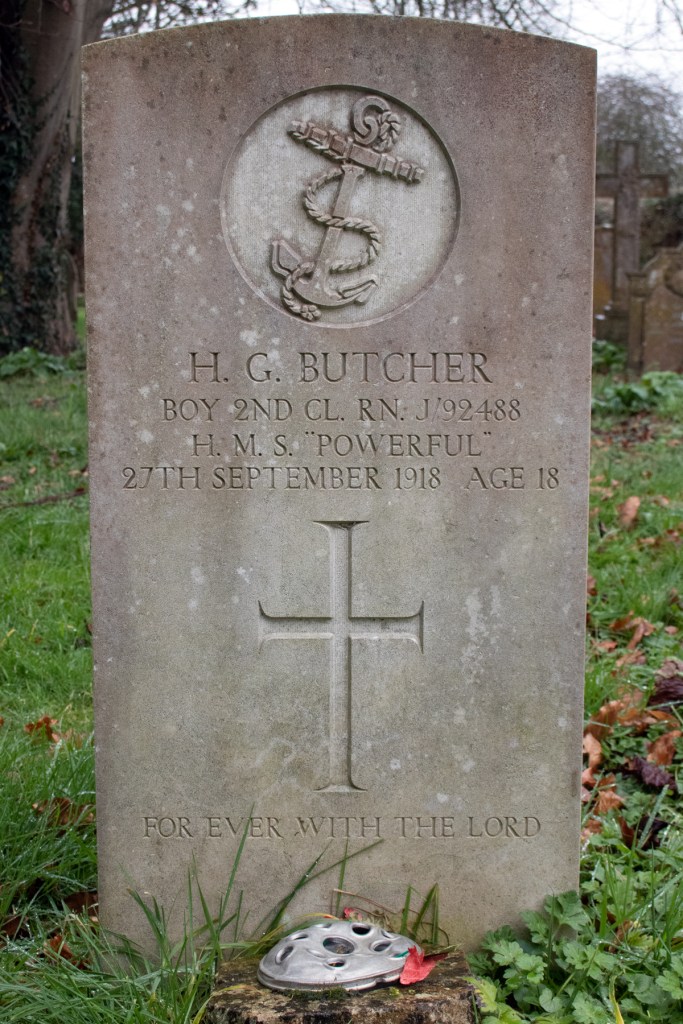
Boy 2nd Class Henry Butcher

Boy 2nd Class Henry Butcher

Henry George Butcher was born on 29th September 1900, the middle of five children to Henry and Sarah Butcher. Henry Sr was a labourer in a nursery and the family were born and raised in his and Sarah’s home village of Merriott, Somerset.

Henry Jr followed his father into agricultural labouring when he finished school. When war was declared, he was too young to enlist and, seeing his older friends head off to glory, he must have been desperate to play a part before it was all over.

Henry’s chance finally came when, on 2nd September 1918, he joined the Royal Navy. His service records show that he was 5ft 2.5in (1.59m) tall, had brown hair, blue eyes and a fresh complexion. As he was under-age when he enlisted, he was given the rank of Boy 2nd Class, and sent off to HMS Powerful, a training ship in Devonport.

Naval and army barracks were crowded places, and brought together boys and men from all over the country in a way that had never happened before. The cramped nature of the billets meant that disease would run rampant once it took hold, and it could prove fatal. In the last week of September 1918, seventeen boys from HMS Powerful died from a combination of influenza and pneumonia and, on Friday 27th, Boy 2nd Class Butcher was to join that list. He was two days from his eighteenth birthday, and had been in the Royal Navy for just 25 days.

Henry George Butcher’s body was brought back to Somerset for burial. He was laid to rest in the graveyard of All Saints’ Church in his home village of Merriott.


Private William Stringer

Private William Stringer

William Stringer was born in Warlingham, Surrey, on 4th December 1885, and was one of nine children to Stephen and Jane Stringer. Stephen was a carter, but is seems that William wanted an escape.

On 18th April 1901, he enlisted in the Royal Navy and, because of his age, he was granted the rank of Boy 2nd Class. He was initially sent to HMS Impregnable, the school ship, and remained there for just over a year, during which his hard work paid off and he was promoted to Boy 1st Class.

His basic training complete, and after a short stint at HMS Vivid, the Royal Naval Dockyard at Devonport, he was assigned to HMS Collingwood. Over the next couple of years, William served on a couple more vessels and, in 1903, when he came of age, he was formally inducted into the navy, and given the rank of Ordinary Seaman.

William’s service records show that he was 5ft 4ins (1.63m) tall, had auburn hair, brown eyes and a fresh complexion. For distinguishing marks, he was noted as having two dots on his left forearm and scars on his legs.

Now that he was tied to a twelve year contract, Ordinary Seaman Stringer’s seems to have viewed his life in a different light. His ‘very good’ conduct quickly changed to ‘fair’ and, at the end of 1904, he spent two separate stints in the cells, presumably because of his attitude or behaviour.

This shock to the system seems to have been what William needed, however, as in 1905, he took to the new role, and his ratings improved once more. Over the next couple of years, he served on HMS Montagu and HMS Diamond, returning to Devonport in between voyages. In January 1907 he was promoted again, this time to Able Seaman, but, as with the previous promotion, things began to go downhill again.

In March, he spent two weeks in Diamond’s brig, a punishment that was repeated in September. The following month Able Seaman Stringer’s service records not his character as ‘indifferent’ and, the following month he was discharged from the Royal Navy, having refused to work for 42 days.

It was while he was serving on board HMS Diamond that William met Lena Cropp, who was presumably working in one of the ports on the South Coast. She was the daughter of labourer Jesse Cropp and his wife, Philadelphia. When Jesse died in 1897, Philadelphia married bricklayer James Smith, who had boarded with the family for a number of years.

William and Lena had a son, Joseph, on Christmas Day 1907. Now removed from the Navy, William moved his young family back to Surrey, where he found work as a cowman, and Lena took in laundry to bring in an extra income. The couple went on to marry in 1911, and went on to have two further children – Elsie, who was born in 1912, but who died when just a toddler; and Gladys, who was born in the summer of 1918.

When war closed in on Europe, something of a sense of duty must have pulled on William. He enlisted in the summer of 1915, joining the East Surrey Regiment. He seems to have quickly transferred across to the Labour Corps, and arrived in France on 15th July.

It is unclear for how long Private Stringer served in France, but at some point he returned to Britain. In October 1918, he was admitted to the War Hospital in Bath, suffering from stomach problems. His health was to prove his undoing, and he passed away from a biliary calculi peritonitis on 8th October 1918, at the age of 34 years of age.

Finances may have been tight for Lena, as William was buried in the city where he died, rather than being brought back to Surrey, where she was living. Because of this, it is unlikely that he ever met his daughter, who had been born just two months before.

William Stringer was laid to rest in the Roman Catholic Cemetery in Bath.


William’s Pension Ledger notes Lena as his widow, but only mentions one child – Joseph – as a dependent. The document also records him as an illegitimate stepchild, as he had been born a couple of years before the couple married.

The record notes that it, while Joseph’s legitimacy meant he was not eligible for a share of his William’s pension, it had been decided that the basic rate should be provided while he remained in Lena’s care.


Petty Officer 1st Class Samuel Bailey

Petty Officer 1st Class Samuel Bailey

Samuel Inkerman Bailey was born in the summer of 1861 in Bath, Somerset. The youngest of five children, his parents were James and Mary Bailey. James was an ostler, or groom, but he died in August 1862, when his son was barely a year old.

Mary was left a widow, with a young family to raise and, as so many women in her position did in Victorian Britain, she remarried. She wed tailor Robert Lankesheer, a widower with four children of his own. The couple went on to have three further children – three half-siblings to Samuel.

While the 1871 census suggests that Robert welcomed Mary’s youngest into the family home, it seems that things were not so comfortable for Samuel. On 22nd May 1878, he enlisted in the Royal Navy, destined for a life at sea. He was only 16 years old at this point – although, interestingly, his service records give his date of birth as 27th March 1862. They also note that he was 5ft 2.5ins (1.59m) tall, with light brown hair, blue-grey eyes and a fair and fresh complexion.

As he was too young to formally enlist, Samuel was given the rank of Boy 2nd Class and sent to HMS Impregnable for training. Just over a year later, he was promoted to Boy 1st Class and, on 10th January 1880 he was given his first posting, on board the sloop HMS Dryad.

It was while Samuel was on board the Dryad that he came of age, and was officially inducted into the Royal Navy. He signed up for ten years service, and was given the rank of Ordinary Seaman 2nd Class. Samuel was certainly a dedicated young man: within three months he was again promoted, this time to Ordinary Seaman. He remained on Dryad until February 1884, by which time he had been promoted again, to Able Seaman.

Samuel ended up serving until 31st March 1900. During his time with the Royal Navy, he continued to distinguish himself, his character being noted as Very Good on each of his service reviews. He served on thirteen vessels, and was promoted through the ranks, to Leading Seaman (in August 1885), Petty Office 2nd Class (in January 1894) and Petty Officer 1st Class (in September 1897).

When he was stood down to the naval reserve, Samuel returned to Somerset. He found a job as a superintendent at the public baths in Bathwick and, on 15th April 1901, he married former housemaid and agricultural labourer’s daughter, Alice Clarke. As Samuel’s house came with his job, the couple set up home there, and went on to have five children: Samuel Jr, Emma, James, Alice and Joseph.

When war broke out, Samuel has been stood down from reserve status for more than two years. This did not stop him from stepping up to play his part again, however, and as Petty Officer 1st Class, he took up a training role at HMS Victory, the Royal Naval Dockyard in Portsmouth. He served for just over fourteen months, before he became ill, passing away from intestinal disease – which an inquest identified as ptomaine poisoning – at the city’s Royal Naval Hospital. He was 54 years of age.

Reporting on his death, the local newspaper recognised his fifteen years’ service at the public baths, as well as picking up on the fact that his unusual middle name was given to him in recognition of the death of his great uncle in the battle of that name during the Crimean War.

The same report outlined his dedicated naval career, although not always being correct with all of the details. It did note, however “two years or more on the Royal Yacht ‘Victoria & Albert,’ when used by Queen Victoria, a testament to the reliance placed in his trustworthiness.” [Bath Chronicle and Weekly Gazette: Saturday 16th October 1915] The then Able Seaman Bailey’s service records do note that he served aboard the Victoria & Albert, from 18th March to 11th May 1885, although whether the Queen sailed on her during this time is not known.

Samuel Inkerman Bailey was brought back to Somerset for burial. He was laid to rest in the Smallcombe Vale Cemetery in Bathwick, the community he had served for so long.


Petty Officer 1st Class Samuel Bailey
(from ancestry.co.uk)

Boy 2nd Class Charles Hancock

Boy 2nd Class Charles Hancock

Charles Henry Hancock’s story underlines the innocence and exuberance of youth, and a life cut tragically short.

He was born on 9th July 1900 in Newton Abbot, Devon, the oldest of four children to Edward and Annie Hancock. Edward – who was also known by his middle name of Charles – was a jobbing gardener. By the time of the 1901 census, he had found employment as a groom and gardener with artist and sculptor Frederick Sturge in Tintagel, Cornwall. Annie was also employed by the family as a cook.

Edward passed away in June 1912, aged just 38 years old. Charles stepped up to help his mother, finding work as a farm labourer when he left school. War came to Europe, and while he was only 14 at the start of the conflict, he was drawn to play his part.

On 1st April 1916 Charles enlisted in the Royal Navy, either as a way to a permanent career to help bring in much needed money for his family, or because he was seeing his older peers going of to fight or King and Country. He was still underage, however, and was given the rank of Boy 2nd Class. Charles’ service records show that he was 5ft 2in (1.57m) tall, had fair hair, grey eyes and a fresh complexion.

Boy Hancock was sent to HMS Impregnable, the training ship based in Devonport, for his initial service. Tragically, this service was not to be a long one. Billeted in crowded barracks, he contracted measles and bronchial pneumonia, dying on 1st May 1916, while admitted to the Royal Naval Hospital in Plymouth, Devon. He was just 15 years of age, and had been in service for exactly one month.

Charles Henry Hancock was brought back to Cornwall for burial. He was laid to rest next to his father in the peaceful graveyard of St Materiana’s Church in Tintagel.