Tag Archives: Cadet

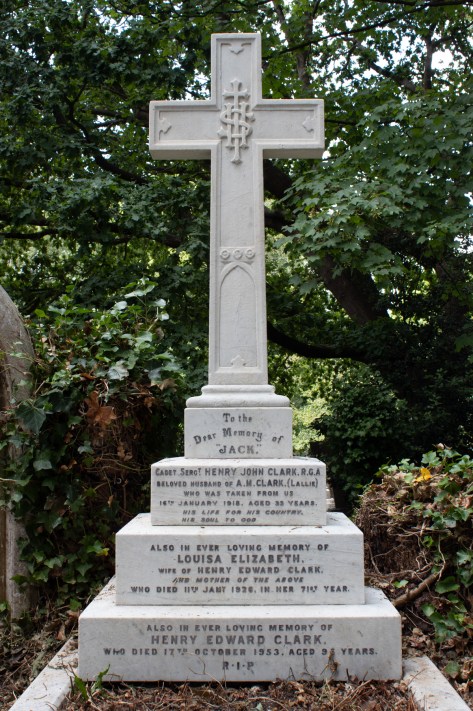
Cadet Sergeant Henry Clark

Cadet Sergeant Henry Clark

Henry John Clark was born on 17th January 1885 in Tufnell Park, Middlesex. The oldest of five children, his parents were wire worker and brass finisher Henry Clark and his wife, Louisa.

The 1891 census found the family living at 51 Cromwell Avenue, Highgate, Middlesex, and this would certainly remain Henry Sr and Louisa’s house for the next ten to fifteen years at least. Henry Jr – who was better known as Jack – is missing from the 1901 census, but by the next document, taken in 1911, he had moved back in with the family.

By this point the Clarks were living in a thirteen-room house on Shepherd’s Hill, Highgate. Henry Sr was now listed as an employer, manufacturing fenders, fire guards and metal good generally, with Jack and his brother, Cyril, also working in the business. The family were supported by two servants, with Henry Sr’s niece and another boarder living with them. Tragically, the census records that Louisa had had five children, although only Jack and Cyril were still alive.

The family business, according to De Ruvigny’s Roll of Honour, Messrs. J Clark, Ltd, of High Street, Bloomsbury, and Jack was one of the directors. The publication also notes that, in his spare time, Jack was “a prominent and active member of the Kit Marlowe Dramatic Club, and the Vaudeville Dramatic Club, and was a popular member of the Highgate Special Constabulary, which body he joined as soon as it was formed.”

On 19th June 1912,Jack married Alice King. Born in Finsbury Park, she was the daughter of a wine and spirit valuer and merchant. The couple exchanged vows at St George’s Church, Hanover Square, London, and would go on to have a child, John, in 1916.

When war broke out, Jack was called upon to play his part. He enlisted on 4th December 1916, joining the Royal Garrison Artillery as a Gunner. His service papers note that he was just over 6ft 2ins (1.89m) tall, and weighed 159lbs (72.1kg).

Gunner Clark served with the British Expeditionary Force from March 1917, returning to home soil just three months later. He had obviously impressed his superiors, as he was sent to the No. 2 RGA Officers’ Cadet School in Uckfield, Sussex, to be trained as a Sergeant.

While here, however, Jack came down with pneumonia, and was admitted to the No. 2 Eastern General Hospital in Brighton. The condition was to get the better of him, sadly, and he passed away on 16th January 1918, the day after his 33rd birthday.

Henry John “Jack” Clark was taken back to Middlesex for burial. He was laid to rest in the majestic Highgate Cemetery, a short walk from his grieving family.


Cadet Sergeant Henry Clark
(from De Ruvigny’s Roll of Honour)
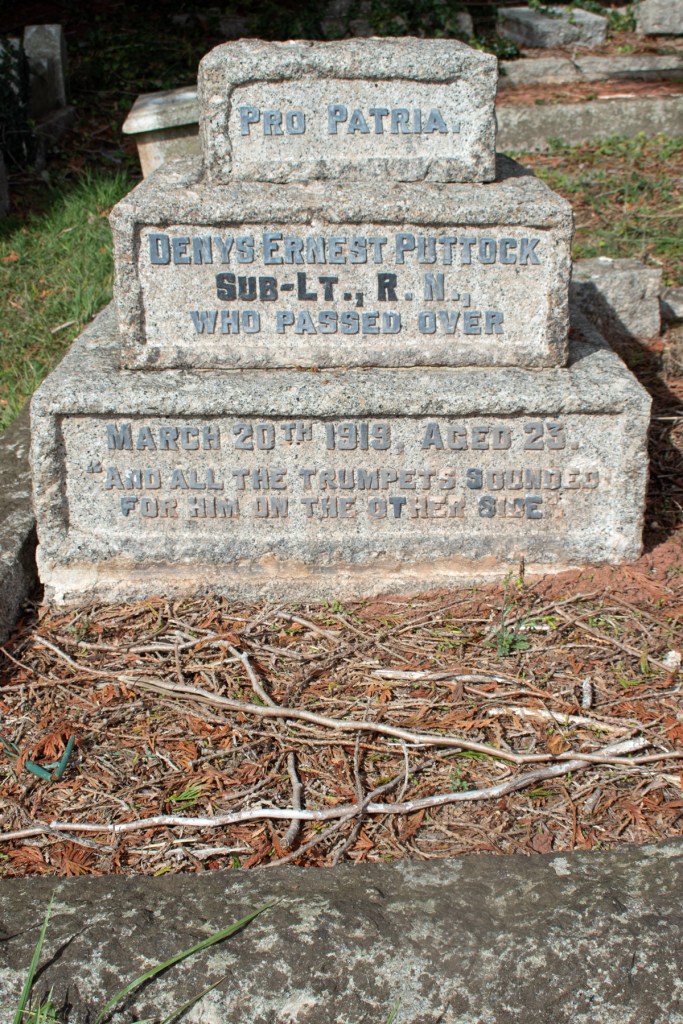
Sub-Lieutenant Denys Puttock

Sub-Lieutenant Denys Puttock

Denys Ernest Puttock was born on 14th September 1895 in the Devon village of Halwill. The middle of three children, his parents were Edward and Alice Puttock. Edward was a vicar of the village’s St Peter & St James’ Church, but died tragically early:

The Red. E Puttock, Rector of Hallwill died on Wednesday, after a brief illness… Mr Puttock had been in charge… for six and a half years. He was much beloved by those among whom he labourer and universally respected. His devotion to the due performance of all his sacred duties was unceasing and his visitations among the poor and afflicted were much appreciated by the whole parish. He was fond of all manly sports, and under his captaincy the Cricket Club at Halwill attained considerable success. Up to the day of his death he could hardly believe that he was ill, and up to the last it was hoped that his wonderful constitution might have carried him through the illness. About a fortnight since he contracted a chill. He would not be deterred from carrying out his duties, and against the advice of his friends, he persisted in taking every service at the church long after he was fit for it. On Sunday, the 24th January, although then in a high fever, he took both the morning and evening services at Halwill Church unassisted, and also the Sunday School in the afternoon. Pneumonia set in at the end of last week, and on Tuesday evening, the 2nd February, the action of the heart failed. He leaves a widow and three young children to mourn their loss.

[Exeter and Plymouth Gazette: Friday 5th February 1897]

After Edward’s death, Alice moved the children to Okehampton. The 1901 census found the family living at 4 Brondage Park, Alice by this time living off her own means. She felt that learning was important, and Denys was sent to Twyford School and St Edmund’s School in Canterbury, Kent. From here he took up a career in the Royal Navy, enlisting in September 1913.

He served in the Highflyer as a Cadet, and was Midshipman in HMS Conqueror, and later Sub-Lieutenant in the destroyers Patriot and Valorous. Long exposure to the rough weather in the North Sea during the winters of 1916 and 1917 brought on tuberculosis, which incapacitated him for further war service. He was invalided our of the Navy and spent many months in a Sanitorium.

[Exeter and Plymouth Gazette: Friday 4th April 1919]

Denys Ernest Puttock’s health was failing him, and he passed away on 20th March 1919, while still admitted. He was 23 years of age. The report of his funeral included comments from those who knew him:

His Headmaster writes: “He has not lived in vain, for he has exercised the power of unconscious influence on all those around him. He knew the secret of happiness – purity of soul and unselfishness of heart.” His Commanding Officer has written: “He was a zealous and capable young officer. Possessed of great charm of manner, he was popular with both officers and men.”

[Exeter and Plymouth Gazette: Friday 4th April 1919]

Alice, having moved to Paignton by this point, laid her son to rest in the town’s cemetery. When she passed away in 1932, she was buried alongside him.


Serjeant Fred Maynard

Serjeant Fred Maynard

Details of Fred Maynard’s early life are a challenge to piece together. His First World War service records give his age as 44 years old when he enlisted in September 1914, and confirm his place of birth as Melksham, Wiltshire.

A newspaper report of his funeral gives the name of three brothers – Charles, Frank and Arthur – while only one census return, from 1881, provides a potential match for the family. This suggests Fred’s parents were iron fitter Alfred Maynard and his wife, Deborah, and gives the family’s address as Waterworks Road in Trowbridge.

Fred joined the army in the autumn of 1888. Initially assigned to the Gloucestershire Regiment, he had transferred to the Wiltshire Regiment by the following spring. Private Maynard showed a commitment to duty: in December 1890 he was promoted to Lance Corporal, rising to Corporal in the summer of 1893.

Fred was stood down to reserve status after his seven years’ active duty, but was recalled to the army in December 1899, when war broke out in South Africa. Promoted to Serjeant, he was sent to fight in the Boer War, and was mentioned in dispatches on 2nd April 1901 for special and meritorious service in South Africa. He was stood back down to reserve status in October 1901.

On 21st November 1895, Fred had married Louisa Card. The couple set up home in Trowbridge, but soon moved to London. They went on to have six children: Ernest, Nora and Leslie, who were all born in the London; and Arthur, Martha and Stuart, who were born in Cardiff, the family having moved to Wales by 1910.

The army was not finished with Fred, however, and, within weeks of war breaking out in the summer of 1914, he was called back into service. Given the rank of Serjeant again, he was attached to the South Wales Borderers. Fred was 44 years of age by this point, his service records confirming that he stood 5ft 8ins (1.73m) tall, weighed 164lbs (74.4kg) and had brown hair and hazel eyes.

Attached to one of the regiment’s depots, it seems unlikely that Fred saw service overseas this time around. He was discharged from the army on 1st September 1916 and this seems to have been on medical grounds. Later documents suggest that Serjeant Maynard had been diagnosed with carcinoma of the pylorus, or stomach cancer.

Fred returned to Cardiff, but his time back home was to be short. He was admitted to the Lansdown Road Military Hospital, and passed away on 23rd November 1916. He was 46 years of age.

It seems that Fred’s brother’s had some sway in his funeral. Instead of being laid to rest in Cardiff, where Louisa and the children were living, he was, instead, buried in the Locksbrook Cemetery, Bath, Somerset. His sibling Charles, who was a sergeant in Bath City Police, lived in the city, as did another brother, Frank.


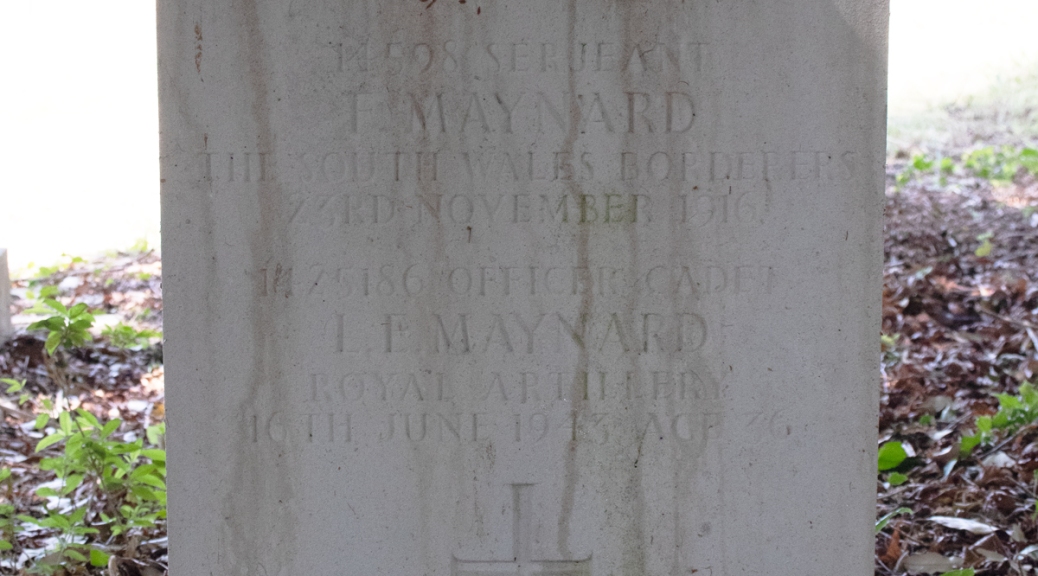
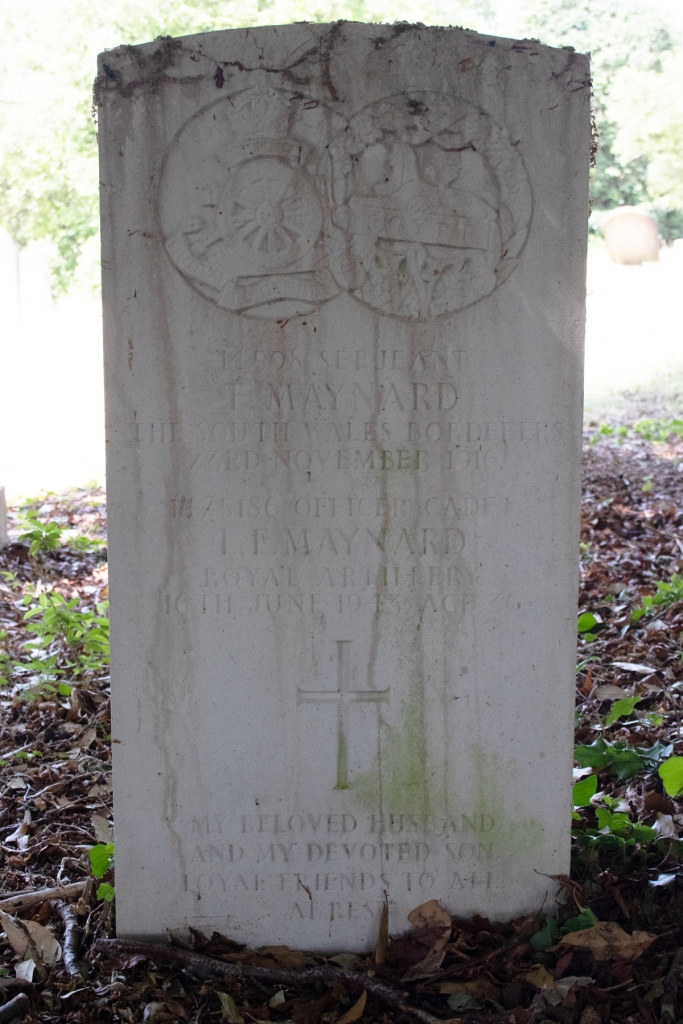
Fred’s headstone also commemorates his and Louisa’s son, Leslie. He had joined the army in the 1920s and, in the summer of 1943, was in Yorkshire, undergoing officer training.

The death of an officer cadet through the accidental discharge of a rifle whose bolt had jammed was described at an inquest…

Captain WH Price said he was in charge of an exercise on the moors which involved the used of small arms and the firing of live ammunition. A squad of cadets lay on the ground in front of a trench firing over a range. All finished firing except Cadet Frank Holroyd, who said his bolt had hammed while firing a second round. [Price] told him to release the bolt by knocking the cocking piece up and back.

This attempt failed, and he told Holroyd to get back into the trench, turn the rifle magazine upwards, place the butt on the side of the trench, and kick the bolt down with his foot. While Holroyd was doing this he noticed Maynard standing in the trench about 4ft away from Holroyd and on his right-hand side.

Captain Price said he saw the rifle was pointing down the range when Holroyd kicked the butt. The cartridge suddenly exploded and Maynard dropped into the trench, shot in the head, and was dead when they reached him.

[Bradford Observer: Saturday 19th June 1943]

Officer Cadet Leslie Maynard was 36 years of age when he was killed. His body was taken back to Somerset for burial: he was laid to rest in the same grave as Fred, father and son reunited after 27 years.


Louisa remained somewhat elusive as time wore on. Fred’s military records confirm that she had moved from Cardiff to the Isle of Wight by 1922. By the time of her son’s death, she was living in Sidcup, Kent.


Cadet Hubert Morley

Cadet Hubert Morley

Hubert Arthur Morley was born on 28th July 1900, the second of two children to Arthur and Annie Morley. The family were raised in Coventry, Warwickshire, but Arthur had been born in Manchester. The 1901 census recorded him as working as a cycle works timekeeper, but by 1911 he had found other employment as a dealer in hosiery and hats.

By the summer of 1918, the war was showing hints of coming to an end, and Hubert was keen not to miss out on the action. On 9th July, a few weeks before his eighteenth birthday, he enlisted in the Royal Air Force. His service record show that he was 5ft 7.5ins (1.71m) tall, with brown hair, greenish brown eyes and a fair complexion.

Cadet Morley had previously been employed as an engineer, and was sent to the No. 7 Observers School of Aeronautics in Bath, Somerset. His time here, however, was to be tragically short. Hubert contracted pneumonia, and was admitted to the Bath War Hospital. The condition was to prove his undoing: he passed away on 27th October 1918, at just eighteen years of age.

Finances may have limited Arthur and Annie’s ability to bring their son home. Hubert Arthur Morley was laid to rest in the military section of Bath’s sweeping Locksbrook Cemetery.


Cadet Richard Whitting

Cadet Richard Whitting

Richard Harcourt Whitting was born on 21st March 1900 in the Somerset village of Uphill. The younger of two children, his parents were local landowner and Justice of the Peace Charles Whitting and his second wife, Jessie. The 1911 census records father, mother and two children residing at Uphill Grange, where they were supported by six live-in staff: a cook, parlour maid, two house maids, a kitchen maid and a nurse.

As the son of a gentleman, education was an expected prospect for young Richard. Indeed, after finishing his schooling locally, he was sent to the Royal Military College in Sandhurst.

He entered the school in 1913 and left in April 1918. He was then Head of the Modern Side, and also a good runner who achieved a fine record when he won the Junior Athletic Cup and, still more, as mentioned in a notice of him in the Meteor of October 16th, 1918… “he had very delightful manners, and a sympathetic appreciation of the difficulties of other people, which is less rare in women than in men. These qualities, combined with a great fund of common sense, made him a particularly helpful and agreeable companion in all kinds of occupations, from spraying a potato field to managing a House.

He was intended for the University and the Bar, but the War caused him to leave School early and to go to the [Royal Military College], Sandhurst. There he showed himself a most promising Cadet, and continued his athletic successes by winning the Mile and being in the winning team in the Relay Race.

Memorials of the Rugbeans Who Fell in The Great War, Volume VIII

It was while he was at the college, that Richard met his untimely end.

On Saturday [21st September 1918] a cadet of the Royal Military College, named Richard H Whitting, was killed while cycling along the Bagshot main road near St Alban’s Church. Deceased, who was accompanied by two other cadets’ names respectively Money and Shute, was holding on to the rear of a motor vehicle, when his bike swerved, and he was thrown on his head. At the inquest a verdict of “Accidental death” was returned.

Reading Mercury: Saturday 28th September 1918

Cadet Whitting was just 18 years of age when he died. His body was brought back to Somerset for burial: he was laid to rest in the family plot at St Nicholas’ Church in Uphill.


Cadet Richard Whitting
(from fold3.com)