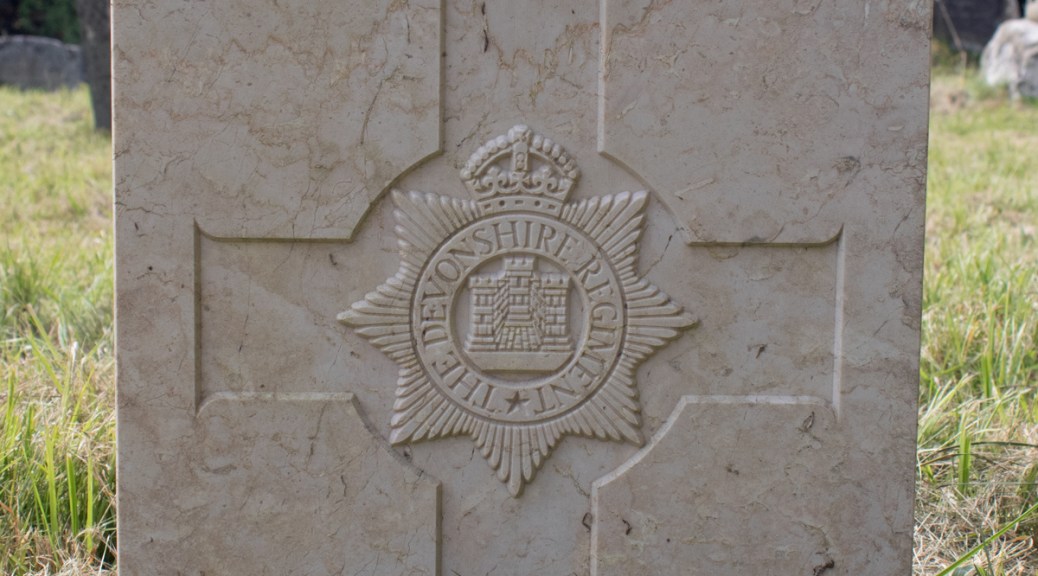
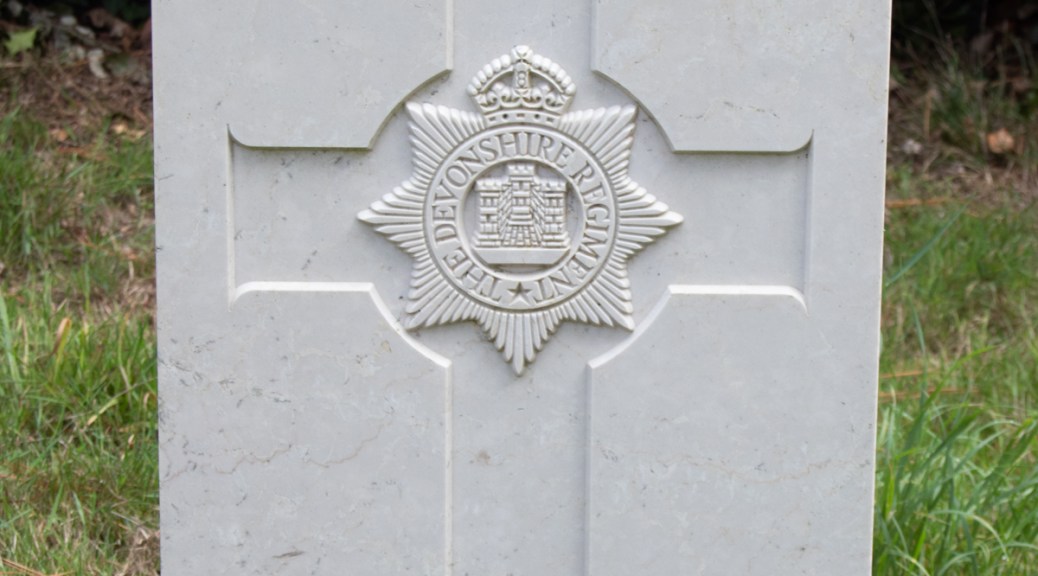
Tag Archives: Devonshire Regiment

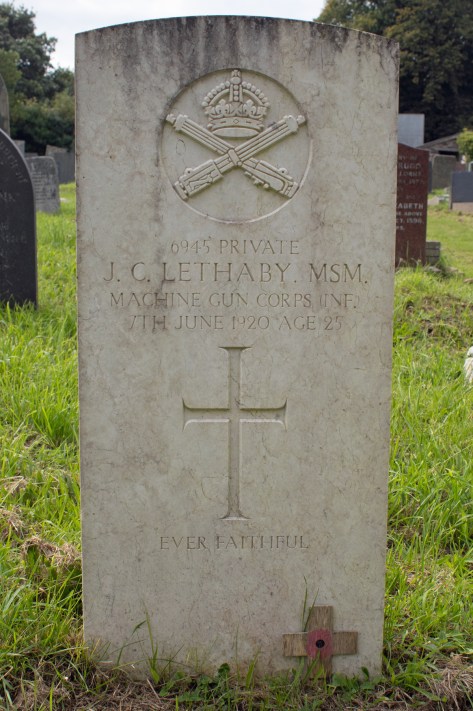
Private John Lethaby

Private John Lethaby

The news of the death of ex-Gunner JC Lethaby, who passed away early on Monday morning last. was received… with deep regret. On the outbreak of war he was only 16 years old, but when the call came for volunteers, he put his age to 19 and enlisted. He proved his worth on the battlefields of Flanders and after being wounded, was gassed, his work as a first class machine gunner calling him into much danger. He recovered from his injuries to some extent, but after demobilisation, his health broke down and he gradually sank. His pain and suffering during the past months were borne with much patience. Last week he earnestly begged to be removed to his home… and he was brought by motor car.. on Sunday afternoon, but he passed away the next morning. He leaves a wife and child to mourn their loss, and sympathy is expressed with them as also with his mother, father, brothers and sisters… Always of a cheerful disposition deceased had a host of friends, especially among the young men of the parish. He was awarded the Meritorious Service Medal and was entitled to the 1915-1915 Bronze Star.

[Tiverton Gazette (Mid-Devon Gazette): Tuesday 15th June 1920]

Despite the John Charles Lethaby’s obituary, there is little additional information about his early life. He does not appear on the 1901 or 1911 census returns, and there is no obvious sign of a birth or marriage certificate.

The Commonwealth War Graves Commission gives his wife’s name as Clara, and a later military record suggests that she moved to Hitchin, Hertfordshire, after her husband’s death. The 1921 census noted that she was living with her parents, Arthur and Eliza King, and had her daughter, Ada, with her.

The newspaper report suggests that John was born in 1898, which would have made him 22 when he died on 7th June 1920. His headstone gives his age as 25, which would fit in with the obituary commenting that he had added three years to his age in order to enlist. He appears to have joined the 3rd Battalion of the Devonshire Regiment, before transferring across to the Machine Gun Corps.

John Charles Lethaby was discharged from army on medical grounds on 19th April 1919. He died of pulmonary tuberculosis just over a year later, and was laid to rest in All Saints’ Churchyard, North Molton, Devon.


Corporal Alexander Sturrock

Corporal Alexander Sturrock

Alexander Albert Sturrock was born in the autumn of 1877. The second of two children, he was the only son of Alexander and Elizabeth Sturrock. Alexander Sr was a plasterer from Scotland, while his wife had been born in Bristol. It was in the Pimlico area of Middlesex, however, that the couple would raise their two children: Alexander and his older sister Eleanor.

The 1891 census found the family living at 253 Wellington Buildings, on Ebury Bridge Road. According to the next census, however, they had taken rooms at 52 Warriner Gardens, south of the Thames in Battersea.

By 1901, the Sturrocks had moved north again, and were living at 7 Fulham Place in Paddington. One of three families in the house, Alexander Sr and Elizabeth shared the rooms with their son and Eleanor’s son, Leslie. Alexander Sr was still working as a plasterer, while his son was now employed as a clerk.

Alexander Jr married Edith Concanen in 1910. A widow, she had a son, Douglas, and the three of them lived in her family home on Camden Road, Sutton, Surrey. Alexander was working as a commercial accountant, and at some point in the next five years, the family moved to Paignton, Devon.

When war came to Europe, Alexander stepped up to play his part. He enlisted in Exeter on 17th November 1915, and joined the Devonshire Regiment. His service records note that he was 5ft 11ins (1.8m) tall and weighed 185lbs (83.9kg). He was also recorded as having Edith’s name tattooed on his left forearm.

Private Sturrock was mobilised the following June, and was attached the 3rd (Reserve) Battalion. He was promoted to Lance Corporal in August 1916, and transferred to the 8th (Service) Battalion. Shipped to France in December, he would spend the next eighteen months overseas.

Alexander had ongoing issues with his health, however, and was hospitalised at least three times with diarrhoea. In July 1918, he was transferred to the Labour Corps, and reassigned to home soil. Promoted to Corporal by this point, he was attached to the 114th unit, although it is unclear where he served.

Corporal Sturrock’s health continued to dog him. The Armistice signed, he was medically discharged with nephritis on 14th June 1919, and returned home. Sadly, his reunion with Edith was not to be a lengthy one. Alexander passed away on 25th July 1919: he was 41 years of age.

Alexander Albert Sturrock was laid to rest in Paignton Cemetery, overlooking the town he had most recently called home.


Private Bernard King

Private Bernard King

Bernard Gale King was born in the spring of 1881, the seventh of eleven children to Charles and Charity King. Charles was a bookseller from Huntingdonshire, but he and Charity had moved to Wolborough, Devon by the time Bernard was born.

The 1901 census found that the family had moved again and Charles had set up shop in the Tormoham area of Torquay. By this point Bernard and his older sister, Florrie, were helping their father with the business, which was located at 99 Union Street .

On 5th March 1904, Bernard married Lilian Potter at the Wesleyan Chapel in Brixham. Sadly, there is little information available for her, but she was a year older than her husband, and had been born in Exeter. The couple set up home on Rock Road, Torquay, and had three children: Frederick, William and Gladys.

By the time of the 1911 census, Bernard had moved away from selling books, and had become a photographer. Storm clouds were brewing over Europe, however, and things were to change.

When war broke out, Bernard stepped up to play his part. He enlisted on 11th December 1915, and joined the Devonshire Regiment. His service records show that the family had moved along the coast, and were living at 22 Winner Street in Paignton.

Private King was notes as being 5ft 7ins (1.7m) tall and weighing 119lbs (54kg). He had dark brown hair, blue eyes and a pale complexion. Initially assigned to the 4th Battalion, by October 1916, he had transferred to a home service unit, and remained on home soil during his time in the army.

In the spring of 1917, Bernard contracted tuberculosis. The contagious nature of the illness meant that he was deemed no longer fit for any service, and he was medically discharged on 7th April 1917.

At this point Bernard’s trail goes cold. He seemed to have returned home, but would ultimately succumb to the lung condition he had contracted in the army. He passed away on 21st October 1918: he was 37 years of age.

Bernard Gale King was laid to rest in Paignton Cemetery, overlooking the town in which his grieving family still lived.


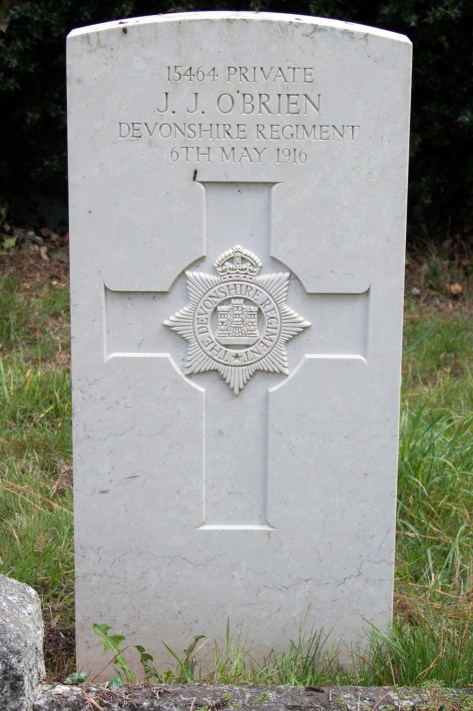
Private Jeremiah O’Brien

Private Jeremiah O’Brien

Jeremiah Joseph O’Brien was born in Paignton, Devon, in 1888. The fifth of seven children, his parents were James and Susan O’Brien. James was a general labourer, and his son followed suit when he completed his schooling.

The is little more information available about Jeremiah’s early life, and it is only in the papers for his military service that we pick him up again. These confirm that he was working as a labourer when he volunteered for the Devonshire Regiment on 20th January 1915.

The documents confirm that Jeremiah was living at 4 Well Street, Paignton, when he joined up, and that he was just over 5ft 5ins (1.65m) tall. Assigned to the 3rd (Reserve) Battalion, he remained on home soil, his unit being used to defend Plymouth, Devon.

Private O’Brien’s time in the army was not to be a lengthy one. He came down with haemoptysis, a condition he had initially suffered from in childhood. He was declared unfit for military service, and was discharged from the army on 4th March 1916.

Jeremiah appears to have returned home at this point and succumbed to the lung condition on 6th May 1916. He was 29 years of age.

Jeremiah Joseph O’Brien was laid to rest in Paignton Cemetery, overlooking his home town and the sea.


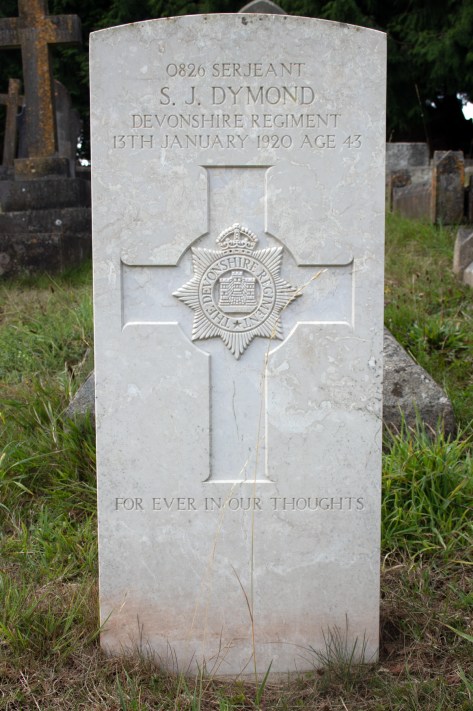
Serjeant Samuel Dymond

Serjeant Samuel Dymond

Samuel John Dymond was born in Broadhempston, Devon, in 1878. The son of Samuel and Jane Dymond, his childhood appears to have been disjointed: the 1881 census found him living with his uncle and aunt, while a decade later he was under his grandmother’s roof.

This background may have driven him to a more stable life and, on 22nd May 1896, he enlisted in the army. Joining the Devonshire Regiment, his service records show that he was 5ft 5.5ins (1.66m) tall and weighed 126lbs (57.2kg). He had fair hair, grey eyes, a fresh complexion and two scars on his right kneecap.

Private Dymond spent the first couple of years on home soil. In February 1898, however, he journeyed overseas, serving in the East Indies and South Africa, for which he was awarded the South Africa Medal, with a clasp for the defence of Ladysmith. By January 1902, Samuel was on the move again, and he spent the next two years in India.

At the beginning of 1904, Samuel returned to Britain. He remained on home soil until his contract came to an end on 21st May 1912.

Away from the army life, love beckoned. Samuel married Alice Reynolds on 9th October 1904 in the parish church at Marldon, Devon. The couple went on to have three children: Dorothy, Annie and Albert.

By the time of the 1911 census, Samuel was working as a labourer, and the family were living at Vine Cottage on Church Street, Paignton, Devon.

When war broke out, Samuel was called into service once more but, frustratingly, it is at this point that his trail goes cold. Returning to the Devonshire Regiment, he was certainly in France by 11th December 1914. Later on in the war he transferred across to the regimental depot, but whether this was on home soil of overseas is unclear.

The next record for Samuel is that of his passing. He died in a military hospital in Devonport on 13th January 1920, the British Record of Soldiers’ Effects only at that point confirming that he had reached the rank of Serjeant. He was 42 years of age.

Samuel John Diamond was laid to rest in Paignton Cemetery, overlooking the town that had become his home.


Private Thomas Legg

Private Thomas Legg

Thomas John Gladstone Legg was born in Dunster, Somerset, on 30th July 1898. The fourth of six children, his parents were John and Louisa Legg. John was a baker, and the family lived on West Street in the village.

By 1911, the Leggs had moved south, settling in Winsford, on the outskirts of Exmoor. Thomas was still in school, but his two older brothers were helping their father with the bakery business, and they had taken in a boarder – road worker John Jeffrey – to help bring in a bit of additional income.

When war broke out, Thomas stepped up to play his part. There is little information available about his military service, but it is clear that he had enlisted in the Devonshire Regiment by the spring of 1918.

Private Legg was assigned to the 15th Battalion, although he soon transferred to the 474th Agricultural Company of the Labour Corps.

The profound sympathy of parishioners goes out to Mr and Mrs J Legg… who have sustained a double bereavement. On October 22nd their daughter, Miss Ivy Marion Legg, aged 23, succumbed to pneumonia. Their son, Pte J Legg, came home from training to attend his sister’s funeral, and he was attacked by pneumonia and died in a few days. Amid general tokens of respect and sympathy, the interments were made in Highbray Churchyard. Both father and mother have been seriously ill, but are now recovering. There are still several critical cases of complications following influenza in the parish.

[North Devon Journal: Thursday 14th November 1918]

Thomas passed away on 2nd November 1918: he was 20 years of age. He was laid to rest alongside his sister in All Saints’ Churchyard, High Bray.


Serjeant Edwin Huxtable

Serjeant Edwin Huxtable

Edwin Huxtable was born in the summer of 1863, the youngest of eight children to William and Sarah. William was a tailor and Sarah a dressmaker, and they raised their family in their home village of South Molton, Devon.

William’s two younger sons followed him into tailoring, although the family disappears from records for more than 20 years. William passed away in 1889, and a later newspaper report suggests that Edwin enlisted in the army in some capacity, serving in South Africa during the Second Boer War.

Back in Britain, Edwin married Hester Cole in 1904. She was a dressmaker from South Molton as well: the couple set up home and their business at 10 Broad Street in the village. They had two children: Sidney was born in 1905, and Herbert in 1906, although their younger boy passed away when just a babe-in-arms.

When war broke out, Edwin was called back into service. Details of his military career have been lost, but it is clear from what remains that he enlisted in the Devonshire Regiment, and served in the 11th (Reserve) Battalion. His previous time in the army was taken into account, and he was given the rank of Serjeant.

It is unclear whether Edwin saw any time overseas as part of the First World War, but his age and health were against him. Suffering from pneumonia, he was admitted to a hospital in Torquay. The lung condition got the better of him, however, and he passed away on 14th April 1915. He was 52 years of age.

Taken back to South Molton for burial, Edwin Huxtable was laid to rest in the village’s cemetery.


The 1921 census showed that Hestor was keeping up the family business. She was living in East Street, South Molton, and listed as a dressmaker and employer.


Private Samuel Harris

Private Samuel Harris

Samuel John Harris was born in the spring of 1895, and was the oldest of three children to Samuel and Annie Harris. Samuel Sr was a cabinet maker from South Molton, Devon, and this was the village in which he and Annie raised their family.

The 1901 census found the Harrises taking rooms at 24 North Street, a house they shared with two other families. Move forward, and they were living four doors down the road at No. 28, a smaller cottage, but one they had to themselves.

Samuel Jr, at this point, was sixteen years old, but had completed his schooling and was working as a hotel waiter. His younger brother, Albert, had also started work, and was employed as an apprentice coach builder. Samuel Sr, meanwhile, was continuing with his cabinet making.

When war broke out, Samuel Jr was one of the first to enlist. While full details of his time in the army have been lost, it is clear that he joined the Devonshire Regiment, and he was initially attached to the 1st/6th Battalion.

Pte. SJ Harris proceeded to India and Mesopotamia with the Territorials. The hardships of campaigning and the trying climate in Mesopotamia proved too much for his constitution.

[Western Times: Friday 9th November 1917]

Samuel returned to Britain, and was admitted to the military hospital in Sutton Veny, Wiltshire. He passed away on 29th October 1917, from a combination of tuberculosis and a cyst in his back. He was 22 years of age.

Despite the apparent weakness in his constitution, the Western Times reported on his youth in South Molton:

The young man was very popular among his comrades in arms, and at Sutton Veny a general favourite. Prior to th war he was a familiar figure at football matches, having played for various teams at [South Molton] and in the district.

[Western Times: Friday 9th November 1917]

The body of Samuel John Harris was brought back to Devon for burial. He was laid to rest in the South Molton Cemetery, just a sort walk from his grieving family’s home.


Sergeant Reginald Brown

Sergeant Reginald Brown

Reginald William Brown was born in South Molton, Devon, the summer of 1873. The second of four children – all boys – his parents were William and Mary Brown. William died when Reginald was just a child, and the 1881 census found Mary supporting her children by working as a mangler.

Details of Reginald’s early life are sparse. In the autumn of 1898 he married Elizabeth Mayne and the couple set up home at 13 Cook’s Cross. The couple went on to have six children, and Reginald supported his family with work as a gardener.

Alongside his gardening work, Reginald volunteered for army service. Again, full details are unclear, but he was attached to the Devonshire Regiment from 1908. Initially for a year’s contract, he seemed to renew this on-and-off for the next six years.

When war broke out, Reginald was formally called into service. HIs time in the army resulted in him being given the rank of Sergeant, and by October 1914, his unit – the 4th Battalion – was sent to India.

Reginald spent the next couple of years overseas, before being posted back to Britain in the spring of 1916. That November he spent six weeks admitted to the Manor County of London War Hospital in Epsom, Surrey, suffering from bronchitis. This was the result of malaria, and he would continue to suffer from lung complaints for the next few years.

In September 1917, Elizabeth passed away, and Reginald was left, at a distance at least, to raise his children. By now, his health was being severely impacted, and in April 1919, he was medically discharged from army service.

Reginald returned home, but he would quickly succumb to illness. He passed away at 43 South Street, South Molton, on 22nd April 1919. He was 45 years of age.

Reginald William Brown was laid to rest in South Molton Cemetery. His was a family plot, and he was reunited with his beloved Elizabeth.


Private James Burge

Private James Burge

James Thomas Burge was born in Plymouth, Devon, in the summer of 1887. The oldest of five children, his parents were sawyer James Burge and his wife, Alice. James Sr moved the family to where the work took him: by the time of the 1901 census, the Burges had lived in and around the Plymouth area, including Devonport and Stonehouse. They settled in Ashburton, Devon, and the document found them living on Mill Lane.

When James Jr finished his schooling, he found work as a mill hand. By 1911, he had moved to Buckfastleigh, and was living with the Crook family on Silver Street. Henry Crook was a mason’s labourer, while he and his wife Bessie had three children, Hilda, Ada and Ruby. Living with them when the census was taken, were Bessie’s widowed brother Samuel, his daughter, Bessie, and three boarders, including James.

There are two intriguing things about this census document. The first is that of James’ employment. While he was recorded as being a mill hand, it is evident from his service records that he had enlisted in the 5th (Prince of Wales’) Battalion of the Devonshire Regiment by this point. He had completed training on Salisbury Plain in August 1910, and would undertake further instruction in the summer of 1911, but in between times, he remained on reserve status, and would have needed to earn money.

The second point of interest is that his service records noted that, by the time he was formally mobilised in August 1914, he was married to a woman called Hilda, who lived on Silver Street in Buckfastleigh. While there are no documents available to fully confirm this, it seems likely that this Hilda was Hilda Crook, the daughter of the family James was boarding with in 1911.

Once embodied, Private Burge’s time in the army took him around the world. By October 1914, his unit had been sent to India, and he would remain there for the next eighteen months. After a two-month stint on home soil, he returned to India, before his unit moved to Egypt in March 1917.

On 7th November 1917, while advancing on the enemy forces in Gaza James was struck in his right leg by a fragment of shell. He was wounded near the top of his fibula and, after initially being treated in the field hospital, he was evacuated to Alexandria, Egypt, for treatment. He was operated on, but from that point on had difficulty walking.

Private Burge was transferred to the 4th Reserve Depot, but his injury prevented him from undertaking many of the duties required of him. He was recommended for permanent transfer to England. Ultimately, however, his wound proved too severe, and he was formally discharged from military service on 25th February 1919.

At this point, James’ trail goes cold. He returned to Buckfastleigh, but would not be back on civvy street for long. He passed away on 22nd May 1919, at the age of 31 years old.

James Thomas Burge was laid to rest in the graveyard of Holy Trinity Church, in the Devon town he had made his home.