Tag Archives: fall

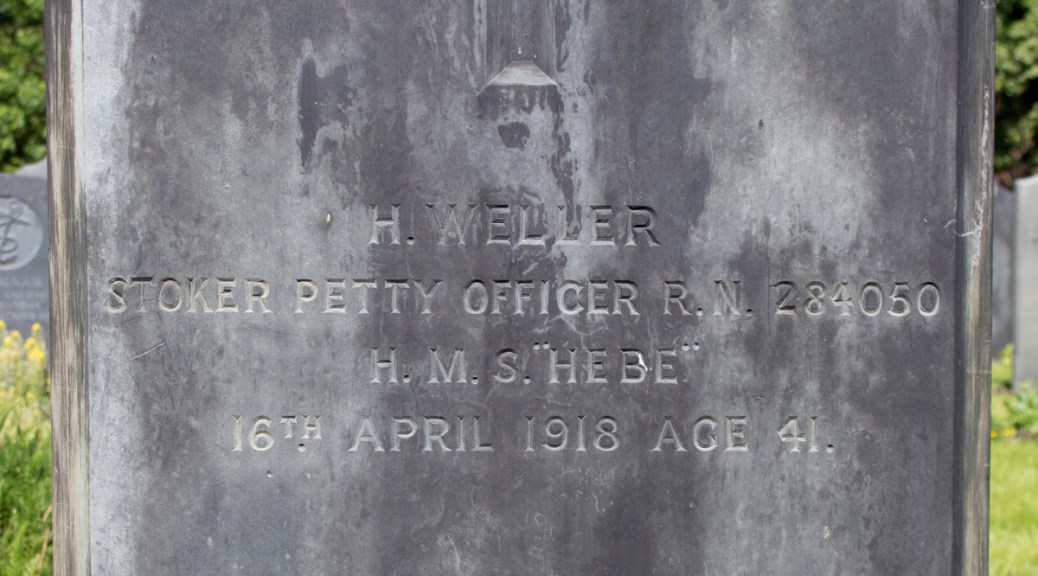
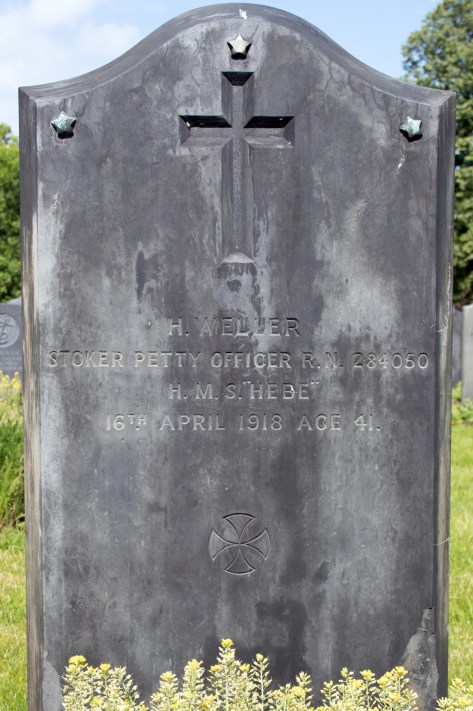
Stoker Petty Officer Henry Weller

Stoker Petty Officer Henry Weller

Henry Weller was born on 13th January 1877 in the village of Ashurst Wood, Sussex. The second of four children, his parents were John and Mary Weller. John was a farm labourer, and the 1881 census found the family living in a cottage on Brooklands Farm in East Grinstead.

Times look to have been tough for the Weller family. By the time of the next census, John, Mary and three of their children were lodging with Hartfield family. Henry, meanwhile, was living in Deptford, Kent, with James and Susannah Weller. He was noted as being a ‘cousin’, although his exact relationship is unclear. James’ nephew Joseph Weller, was also living with them. Just fourteen years of age, Henry was working as a general labourer, and the family were living at 21 Adolphus Street.

Labouring was an irregular way to being in money, and so Henry sought out a more regular career. On 18th November 1896 he signed up to the Royal Navy as a Stoker 2nd Class. His service records show that he was 5ft 4.5ins (1.64m) tall, with brown hair, brown eyes and a fresh complexion. He was also noted as having the letters HW tattooed on his left forearm, and shaking hands on his upper left arm.

Stoker Weller was sent to HMS Pembroke, the Royal Naval Dockyard in Chatham, Kent, for his training. He spent the next nine months split between there and HMS Wildfire – Sheerness Dockyard – learning his trade.

On 8th June 1897, Henry was assigned to the battleship HMS Victorious. Promoted to Stoker 1st Class three months after boarding, she would remain his home for the next three years. After a month aboard another battleship – HMS Revenge – he returned to Chatham.

Love blossomed and, on 8th July 1900, Henry married Alice Beldham, a dock worker’s daughter. The couple exchanged vows at All Saints’ Church, Rotherhithe, Kent, and moved in with Alice’s widowed father, George, at 12 Osprey Street. They went on to have three children: Henry, Harold and Ivy.

Newly settled, Henry seems to have voiced a preference to remain closer to home and, for the next couple of years he would remain based at HMS Pembroke. Alice relocated, and the family set up home at 51 King Edward Road, Gillingham, Kent. Close to the River Medway, the Wellers’ neighbours were all based at the docks, and, during her husband’s future absences, it is likely that Alice felt a sense of community.

After leaving HMS Pembroke, Henry was attached to the cruiser HMS Bacchante. Promoted to Leading Stoker 2nd Class, over the next six years, he would serve on three more ships, spending six-month stints back in Chatham in between assignments. In July 1903 he was promoted to Leading Stoker 1st Class, although he reverted to 2nd Class nine months later. Promoted again in June 1905, he took the rank of Stoker Petty Officer a year later.

Henry’s initial term of service came to an end in November 1908. He immediately re-enlisted, and remained in service until the spring of 1918.

By this point Stoker Petty Officer Weller had been assigned to the torpedo gunboat HMS Hebe for more than thirty months. Patrolling the North Sea coast, on 12th April, she moored at the Alexandra Dock in Hull, Yorkshire. A later inquest outlined what happened next:

Joseph Taylor, a chief petty officer, said that about 11:55pm… [Henry] and he were going from the town to their ship… Witness struck a match to light his pipe. [Henry] walked on for about two yards, and then disappeared. Witness raised the alarm, and went tot he bottom of the dry dock, into which he found [Henry] had fallen, a distance of about 50 feet. They did not know the docks, has they had only come in that morning… If he (witness) had not struck the match they would both have gone over.

[Hull Daily Mail: Wednesday 17th April 1918]

Alive, but severely concussed, Stoker Petty Officer Weller was quickly taken to a local hospital. He was operated on, but his injuries were too severe. Henry passed away on 16th April 1918: he was 41 years of age.

The body of Henry Weller was taken back to Kent for burial. He was laid to rest in Woodlands Cemetery, Gillingham, a short walk from where Alice and their children were still living.


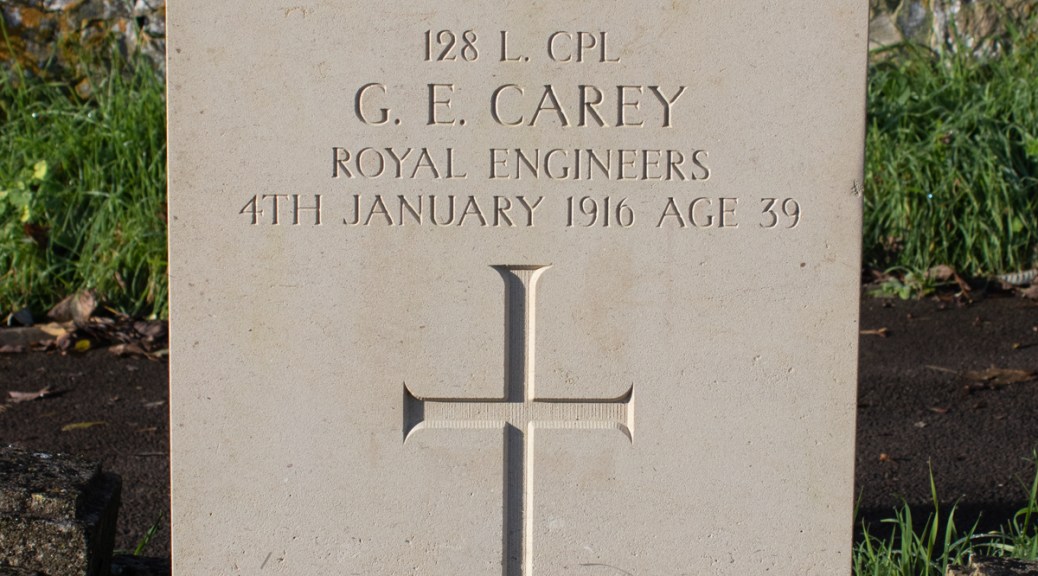
Lance Corporal George Carey

Lance Corporal George Carey

George Edward Carey was born at the start of 1877 and was the oldest of eight children to Samuel and Hester Carey. Samuel was a solicitor’s clerk from Clevedon in Somerset, and this is where the family were born and raised. Samuel was not one to sit on his laurels, however, and the 1891 census recorded his occupations as law clerk, innkeeper and insurance agent.

George followed a different path to his father, and found work as a printer’s apprentice when he finished his schooling. He worked up to being a full compositor quite quickly, and was employed as such when, on 30th January 1899, he married Lizzie Taylor. A civil engineer’s daughter, she was working as a teacher when the couple wed: they set up home in Clevedon, and went on to have four children.

By 1911, the Carey family were living in a seven-room house on Strode Road, Clevedon. George was still working as a compositor, but was employed by the local sanitary works. His widowed brother, Albert, who was lodging with his brother and sister-in-law also did the same job.

With storm clouds brewing over Europe, George stepped up to play his part. He enlisted in the Royal Engineers in the autumn of 1914 and was attached to the 503rd Field Company in Exeter. Little information is available about his time in the army, and he only comes to light again a year or so later.

Lance-Corporal Carey, 2nd Wessex RE, who has been employed at the office in Colleton-crescent, Exeter, was found dead, with his neck broken, at the bottom of a flight of stairs at the Grapes Inn, South-street, on Thursday morning. The discovery was made by Mrs Dorothy, wife of the licensee of the inn. Information was given to the police, and Dr Pereira visited the scene, and subsequently the body was removed to the mortuary by PCs Wise and Barrett. Carey was fully dressed. He was about 48 years of age, and leaves a widow and four children. For about fourteen months he had been engaged on the Wessex RE staff, and was billeted at a house in the Friars. His home is at Clevedon, Somerset, where he was engaged as a compositor before mobilisation with the Territorials. He was under orders for transfer to another station.

Taunton Courier and Western Advertiser: Wednesday 12th January 1916

George Edward Carey died on 4th January 1916: he was, in fact, not quite 39 years of age. His body was brought back to Somerset for burial and was laid to rest in the stunning graveyard of St Andrew’s Church in his home town of Clevedon.


Stoker 1st Class Albert Aven

Stoker 1st Class Albert Aven

Albert Aven was born on 18th December 1896 in the Somerset hamlet of Rodden. One of eleven children, his parents were Alfred and Elizabeth Aven. Alfred was a farm labourer, and farming was certainly something that his sons went into when they finished school.

When war came to Europe’s shores, however, Albert was keen to play his part. On 29th November 1915, he enlisted in the Royal Navy as a Stoker 2nd Class. His service records show that he was 5ft 5.5ins (1.66m) tall, with brown hair, blue eyes and a fresh complexion.

The record also suggests that he lied about his age, giving his year of birth as 1895. It is likely that Albert would have done this because there was a minimum age requirement, although, as he was already over that minimum age, it wouldn’t have made that much difference anyway.

Stoker 2nd Class Aven’s first posting was to HMS Pembroke, the Royal Naval Dockyard in Chatham, Kent, where he spent a couple of months undergoing training. At the end of January 1916, he was moved to HMS Gibraltar, an old cruiser, which patrolled the waters around the Shetland Isles.

After six months on board, and following a further month in Chatham Dockyard, Stoker Aven was assigned to HMS Test. She was a destroyer that patrolled the waters of the Humber Estuary, and Albert spent the next sixteen month with her. During this time, he was promoted to Stoker 1st Class, but the Test was also to be the last ship he served on.

On 8th November 1918, Stoker 1st Class Aven was ashore at the naval base in Hull, when he fell into a dry dock, dying instantly. Little additional information is available – and indeed contemporary newspapers are silent on the matter – but his service records report “Death caused by accidental fall into dry dock at Hull. Verdict of accidental death returned at inquest.” He was just 21 years of age.

Albert Aven’s body was brought home to Somerset for burial. He was laid to rest in the tranquil graveyard of All Saints’ Church in Rodden.


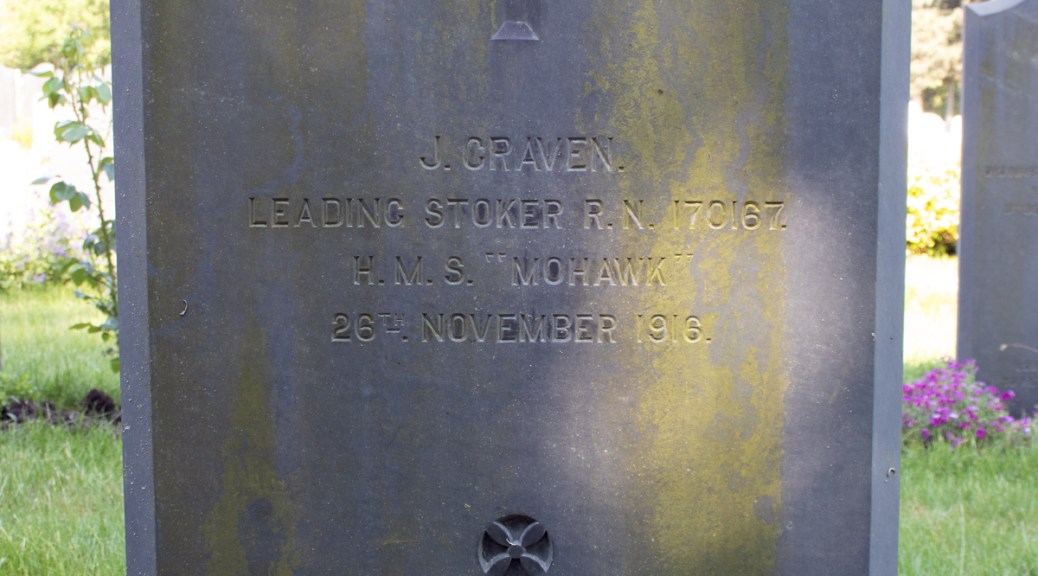
Leading Stoker Joseph Craven

Leading Stoker Joseph Craven

Joseph Craven was born in Liverpool on 6th January 1870. There is little information available about his early life, but by the time of the 1891 census, he was boarding with a blacksmith and his family in Bootle, Lancashire. By this point he was working as a fireman – probably a stoker-type role, rather than for the fire service.

The following year, Joseph found an opportunity to broaden his horizons and, on 21st October 1892, he enlisted in the Royal Navy as a Stoker 2nd Class. His papers show that, at the time of joining up, he was 5ft 4ins (1.62m) in height, had dark brown hair, blue eyes and a fresh complexion. No distinguishing marks were noted.

Joseph’s previous employment seemed to have stood him in good stead. After initial assessments at HMS Pembroke – the shore-based establishment at the Royal Naval Dockyard in Chatham, Kent – he was quickly moved on to HMS Wildfire, based in Sheerness. His first sea posting was aboard the battlecruiser HMS Howe, and, within a couple of months, he had been promoted to Stoker 1st Class.

By the time Joseph’s initial twelve-year contract came to an end, he had served on board nine ships and travelled the world. When the time came, he voluntarily renewed his contract and continued his life at sea.

When back in port, he developed a private life. He met a young widow called Sarah Baker in Portsmouth, and the couple married in 1908. The census three years later found Joseph as the head of the household, living in a seven-room house with Sarah, her 13-year-old daughter, 80-year-old widowed mother and two boarders.

Stoker Craven’s naval service was, by this point, continuing apace. By the time hostilities were declared in August 1914, he had served on twelve further ships, and been promoted again, this time to the role of Leading Stoker. In between his voyages, he was based primarily at HMS Victory, Portsmouth Dockyard’s shore-base.

By the end of the following year, Joseph was almost entirely shore-based, moving from HMS Victory in Portsmouth to HMS Pembroke in Chatham and HMS Attentive in Dover. On 26th November 1916, he was serving in Chatham. A local newspaper picks up on what happened to him next:

Joseph Craven… belonging to Portsmouth, met his death under shocking circumstances at Chatham Dockyard on Sunday. When walking by the side of his ship, which was in dry dock, he tripped over some hose and fell headlong into the dock, turning two or three somersaults in his descent, and falling upon his head at the bottom, 80ft [24.3m] below. He was killed instantly.

Kent Messenger and Gravesend Telegraph: 2nd December 1916

An inquest on the 46-year-old’s death was held, and a result of accidental death was returned.

Joseph Craven was laid to rest in the Woodlands Cemetery, Gillingham, walking distance from the dockyard in which he lost his life.