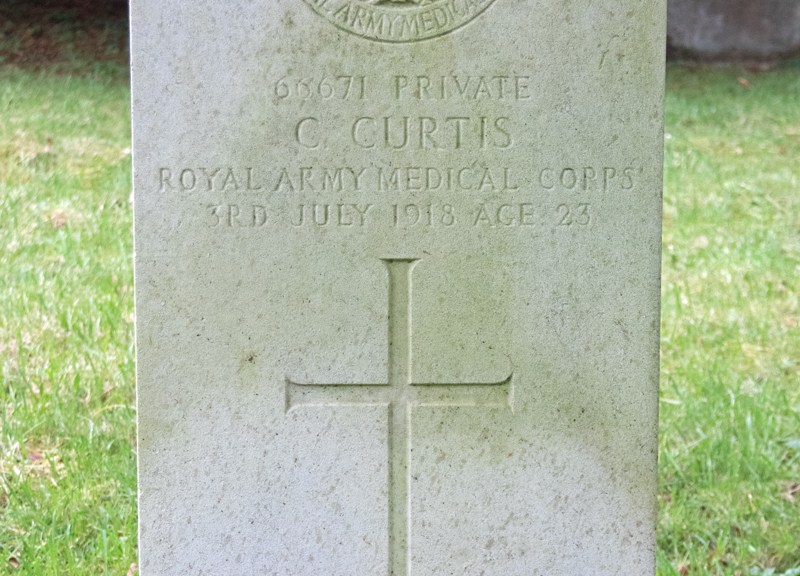
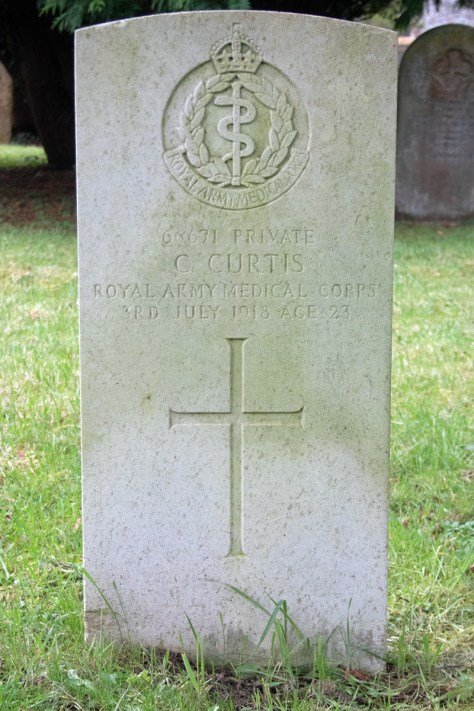
Charles Curtis was born in Wells, Somerset, in January 1894, one of fifteen children to Charles and Mary Jane Curtis. Charles Sr worked as a gardener in the Wells area, and, after leaving school, Charles Jr started work as a mill hand for the local paper mill (this would have been either St Cuthbert’s Mill in Wells, or the Wookey Hole Mill in the nearby village).
Charles enlisted in October 1915, joining the Royal Army Medical Corps. He was posted to France a month later and, while specifics of his military service are not readily apparent, Private Curtis was awarded the Victory Medal, the British Medal and the 1915 Star.
Charles was admitted to hospital on 1st November 1917 with an inflamed cervical gland (reported as Trench Fever), for which he underwent an operation. He remained hospitalised at Whalley Range for more than two months, and was passed for active service, having apparently recovered.
Private Curtis was suddenly taken ill again on 1st July, and his family telegrammed. His mother and one of his sisters boarded a train for the hospital – again in Whalley – but they had not gone far when word came that he succumbed to rheumatic fever. He was 24 years old.
Charles Curtis Jr lies at rest in the graveyard of St Matthew’s Church in the village of Wookey, Somerset.
A newspaper report of his funeral confirms that Charles was one of five brothers who had entered military service during the Great War. Amazingly, given that seven of the brothers ended up serving, Charles was the only one to die as a result of the war.
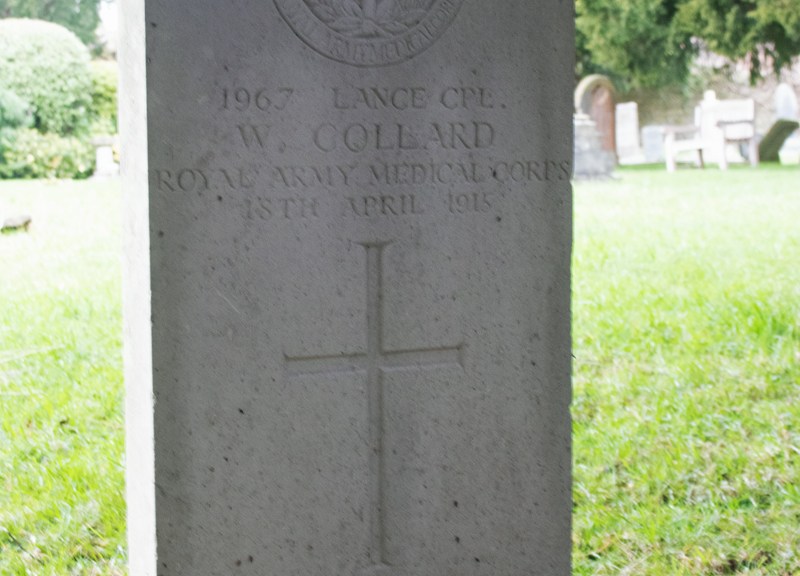
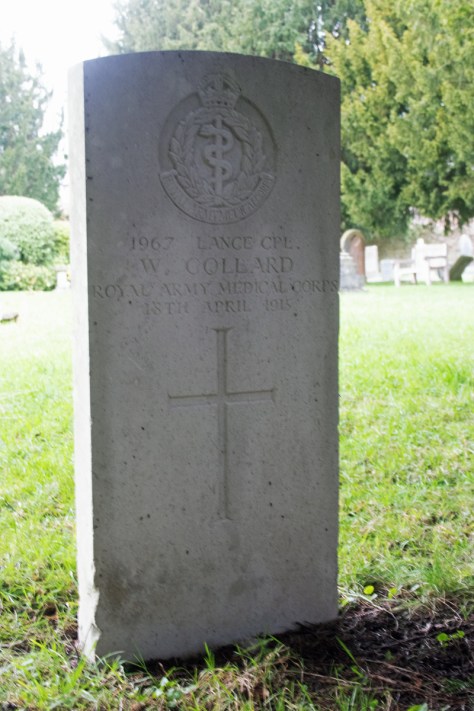
William Collard was born in August 1891, the youngest of two children to William and Agnes Collard from Wedmore in Somerset. William Sr was a carter for a local miller and his son followed him into labouring when he left school.
William’s life seems to have been a tragic one. His mother died in 1910, while his sister Mabel passed a year later.
William married Eva Heal, a woman from the same village, in April 1914. The couple didn’t go on to have any children.
There is limited information relating to William’s military service. What is apparent is that he enlisted in the Royal Army Medical Corps, presumably at some point after the start of the Great War.
Private Collard’s battalion, the 3rd South Midlands, were based in Essex and were shipped to France in March 1915. There is, however, no evidence that William went with his troop. His training must have gone well, however, and he was promoted to Lance Corporal.
Details of his death are vague; William’s gravestone confirms he passed on 18th April 1915; the cause of his death was not reported. He was 23 years of age.
A brief notice in a local newspaper gives a little more information:
Mr W Collard [Senior], of Wedmore, one of the patients at the Country Sanatorium, received last week the news of the death of his soldier son. The funeral took place on Thursday at Wedmore in the same grave as the mother and only other member of the family, a sister of the deceased.
Shepton Mallet Journal: Friday 30th April 1915
William Collard lies at rest in the churchyard of St Mary’s Church in his home village of Wedmore, Somerset.
William is remembered in on a plaque in Bristol Cathedral; this commemorates the fourteen members of the 3rd South Midland Field Ambulance who fell during the war.
Comment should also be made of William’s father. In the space of four and a half years, he had lost his wife and both his children. He was already in a sanatorium when his son died. He too passed away, in December 1924, at the age of 58.
William’s widow, Eva, never remarried. She went on to live the age of 96, and passed away in Poole, on the Dorset coast.
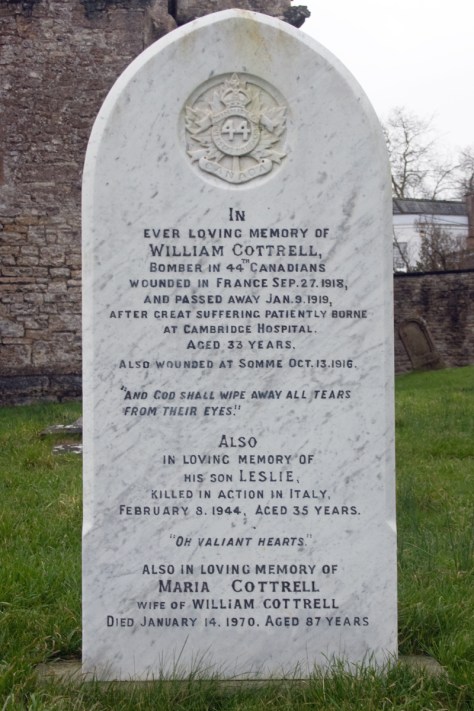
William Cottrell was born in April 1885, the third of twelve children to Henry and Annie Cottrell from Bampton, Devon. When William left school, he became an assistant to the village baker, but new opportunities lay ahead.
In May 1907, William married Maria Wall, the daughter of a stonemason from Wedmore in Somerset. With weeks, the young couple had embarked for a new life, boarding the Empress of Britain in Liverpool, setting sail for Canada.
Emigrating to Manitoba, William became a labourer, and he and Maria had three children – Leslie, Ronald and Kathleen.
War came, and William enlisted in the Canadian Expeditionary Force in August 1915. Shipped to England in the spring of the following year, Annie followed suit, returning to Somerset with the three children.
Private Cottrell was assigned to the 44th Battalion Canadian Infantry, setting off for France in August 1916, just weeks before his fourth child – Ruby – was born.
The battalion was involved in some of the fiercest fighting of the war, and it was during the Somme Offensive that William was shot in the left arm. Initially treated in the field, he was soon shipped back to England to recover in a military hospital in Epsom. Discharged after three months, he was returned to his battalion in early 1917.
The fierce fighting continued, and Private Cottrell was wounded again in October 1918. Further treatment back in the UK was needed, and he was admitted to the 1st Eastern General Hospital in Cambridge.
Details of the William’s injuries at the Somme are readily available, but information on his second lot of injuries is scarcer. They must have been pretty severe, however, as he was not discharged. He lost his final battle after four months, succumbing to his wounds on 9th January 1919. He was 33 years old.
William Cottrell lies at rest in the graveyard of St Mary’s Church in his widow’s home village of Wedmore, Somerset.
William’s gravestone is also a memorial to his eldest son, Leslie, who was killed during the Second World War.
Details of his military service are sketchy, but he enlisted in the Queen’s Own Royal West Kent Regiment. His battalion – the 1st – was involved in the fighting in Italy, and it was here that he lost his life. He was killed on 8th February 1944 and is buried in the Sangro River War Cemetery, in Abruzzo.
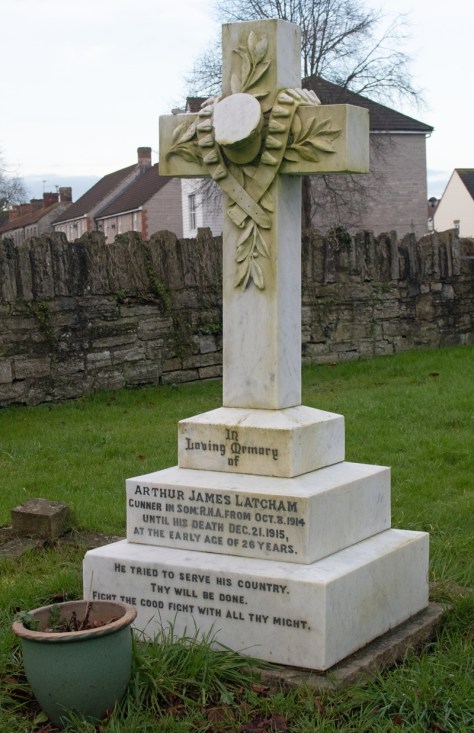
Arthur James Latcham was born in 1889, the oldest of five children – all boys – to Walter and Matilda Latcham. The family lived in Street, Somerset, where Walter worked as a carpenter in the Clark’s shoe factory.
Initially following his father into shoemaking, Arthur was quick to enlist when war broke out. Details of Gunner Latcham’s military service is scarce, but documents confirm that he joined the Somerset Royal Horse Artillery on 8th October 1914. He did not see active service abroad, but had been stationed on the east coast for his training.
While little remains of his service records, contemporary media of the day includes a lot of information about both his passing and his subsequent funeral.
On Sunday, December 5th, having a few hours’ leave, he visited his parents at Street, and while at home complained that he was feeling unwell. On the following Wednesday, December 8th (which, by a coincidence, was his twenty-sixth birthday) Mr and Mrs Latcham received a post-card from him from Taunton [where the Somerset RHA was based] stating that he was very ill. They immediately engaged a motor car, and went to Taunton, where they found him in an extremely weak state, and on the point of collapse, he having had to walk to a hospital nearly a mile away three times a day for his medicine. Having obtained the captain’s permission, they brought him home in the motor car, and at once put him under the care of Dr MacVicker. He was then found to be suffering from pneumonia and congestion of the lungs… In spite of the greatest care, and best of nursing, however, he gradually grew worse, and never rallied.
Central Somerset Gazette: Friday 24th December 1915.
The following week’s newspaper included nearly a whole column on Gunner Latcham’s funeral, including two tributes, one from his captain and another from the local MP.
I am writing to tell you how very sorry all the officers of this battery are at your loss. Your son was the first member of the Somerset RHA to give his life for his country, and although he did not have the satisfaction of being killed in action, the honour is the same. I’m afraid the last few months he was in this battery were not very happy ones for him, owing to his trouble with his finger; but he bore the trouble and pain well. I had him with me for more than a year, so I can fully appreciate what a good fellow he was and how great your loss is.
Captain M Clowes (Central Somerset Gazette: Friday 31st December 1915)
I am very sorry indeed to learn of the sad loss you have suffered through the death of your son. I know that he was a fine fellow, an example of what an Englishman should be, and respected by all who knew him. I am sure you must feel proud to know that he has done all that a man can do, and has died serving his country.
Ernest Jardine MP (Central Somerset Gazette: Friday 31st December 1915)
Arthur James Latcham lies at rest in the graveyard of Holy Trinity Church in his home town of Street.
Arthur was the third son Walter and Matilda had lost. Their second-born, Herbert, passed when a little over a year old. Their third son, William, died a year before Arthur, when he was just 15 years old.
Martin Kiddle was born in 1871, the oldest of four children to Joseph and Annie Kiddle. Joseph was a butcher in the Somerset town of Street, and the family lived above the shop on the High Street.
When Joseph died in 1886, Martin took on the role of shopman, before taking over the business entirely.
In 1895, aged 24, Martin married Eleanor Freeman, four years his senior from the nearby town of Ilminster. The young couple had five children and, by the time of the 1901 census, they were running the business as a family, employing an assistant in the shop and a domestic servant.
It is evident that Martin left the butchery business behind him, though. Ten years later, on the 1911 census, he is listed as a Stock Room Manager in a local rug factory.
Martin joined up when war broke out, initially serving in the Somerset Light Infantry, before transferring across to the Royal Defence Corps.
While there is no date for his transfer, it is likely to have been at some point in 1915. Private Kiddle’s wife, Eleanor, passed away in May of that year, so it is reasonable to assume that he requested a transfer to support her before her death, or to support his children afterwards.
Sadly, however, Martin was also to succumb to illness. His pension ledger shows that he passed away on 5th March 1917, dying from carcinoma of the liver. He was 46 years old.
Martin Kiddle lies at rest in the graveyard of Holy Trinity Church in his home town of Street. The gravestone gives dedications to his father, Joseph, and his brother, John, who had died as just over a year old.
Guardianship of Martin and Eleanor’s five, now orphaned, children – Eleanor, Martin, John, Rachel and George – passed to Martin’s mother, Annie.
Albert Edward Matthews was born in October 1901 in the Somerset village of Tintinhull. His father James was a glove maker, and he and his wife Mary had three children in all, Percival, born in 1897, Clementina, born in 1898, and Albert, the youngest.
Sadly, Clementina died in 1909, aged just 11 years old. Percival also passed away six years later, aged just 17. James and Mary must have been distraught when Albert announced his decision to do his bit for King and country.
He enlisted almost as soon as he was able to, joining the Royal Navy on 14th September 1918, and you can almost sense his enthusiasm to get involved before missing out on the glory of military service.
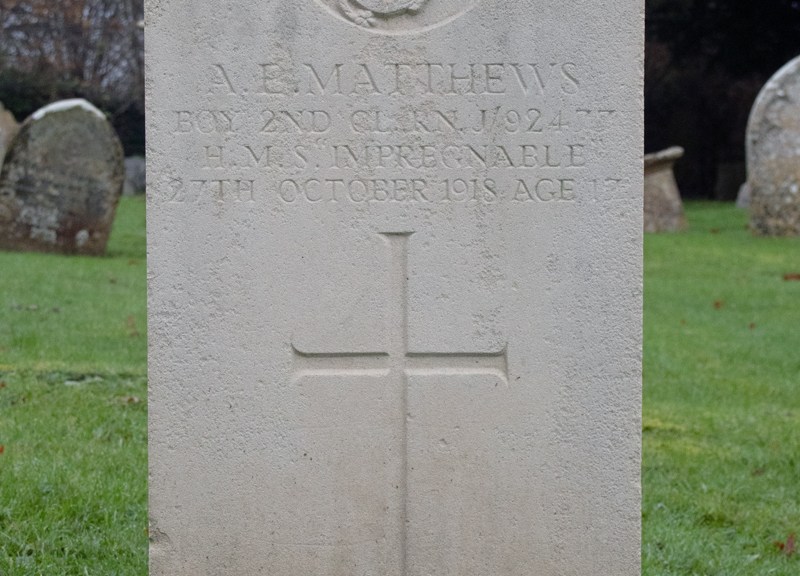
Boy Matthews was assigned to HMS Impregnable, the ship based in Devonport, Plymouth, where he was to receive his training. Standing at 5ft 8ins (1.73m) tall, with brown hair, brown eyes and a fair complexion, he was recorded as having a very good character and satisfactory ability.
Sadly, however, Albert was not destined to meet his full potential. Shortly after beginning his training, he contracted influenza and pneumonia, succumbing to the disease on 27th October 1918.
He had just turned 17 years old.
Albert Edward Matthews lies at rest in the graveyard of St Margaret’s Church in his home village of Tintinhull.
The story of this family continued to be tragic. By the time of Albert’s death, the Spanish Flu pandemic was sweeping the world and his tiny part of Somerset was in no way immune.
Just four days after Albert Matthews passed away, his mother, Mary, also fell victim to the illness.
In the space of just nine years, poor James Matthews had buried all three of his children and his wife. A newspaper reported on Mary’s funeral, recognising the “very heavy trials” he had undergone.
The same paper, reports that the influenza pandemic is fizzling out.
A large number of parishioners have been attacked with “flu”, but the epidemic is now on the wane. The school has been closed for the last fortnight.
Percy Norris was born in 1894, the youngest of eleven children to William and Julia Norris. William was the caretaker for the water works in Somerton, Somerset, and this is where the family of eleven lived.
By the time of the 1911 census, Percy’s older brother Henry had joined his father at the water works. Julia had passed away five years before, and Percy and three of his siblings continued to live with William. At this point Percy was working as a gardener.
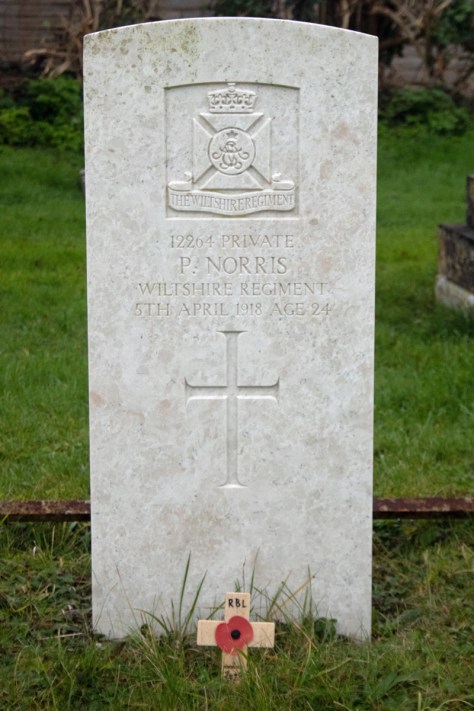
Private Norris’ full military records are not readily available, but it is evident that he enlisted in the 7th Battalion of the Wiltshire Regiment. This was a service troop, formed in 1914, who saw service in France and the Balkans.
It seems that it was during one of the skirmishes that Private Norris was injured. While there is no confirmation of exactly when or where this happened, it is likely to have been at some point in the spring of 1918. Percy was shipped back the England for treatment, and admitted to the Red Cross Hospital in Bridgwater, Somerset.
Sadly, Private Norris did not recover from his injuries. He passed away on 5th April 1918, aged 24 years old.
Percy lies at rest in the cemetery of Somerton, his home town.
Percy’s older brother Henry Norris also died in the Great War. Joining the Royal Naval Volunteer Reserves, Able Seaman Norris was also wounded on active duty, dying of his injuries in January 1918, aged 32. He is buried at the St Sever Cemetery in Rouen, France.
William Joseph Hagger was born in the spring of 1885, one of thirteen children to William Henry Hagger and his wife Emily Ann. The family lived on the Isle of Grain in Kent, where William Sr worked as a labourer in the local cement works.
William Jr was evidently keen to travel. On the 1901 census he is listed as a navyman on HMS Lion, a training vessel in Devonport, Plymouth.
His First World War records state that he officially joined the Royal Navy in 1906, travelling to West Africa as an Able Seaman. While there, he contracted a fever, and was invalided out of the service the following year.
William married Esther Elizabeth Reed in May 1909; by the 1911 census, she was living in Northfleet, Kent, working as a cartridge maker for the local arsenal. William himself is not recorded at the same property, and I have been unable to locate him at this point.
He next appears on the enlistment papers for the Royal Engineers. He joined up very early in the war – December 1914 – and after his training, Driver Hagger embarked for the Western Front in August 1915.
While serving, it seems that his previous affliction resurfaced, and William was dogged by colds and coughs. In the autumn of 1916, he was admitted to a field hospital with haemoptysis (coughing up blood), eventually returning to his unit three months later.
Driver Hagger’s health was fair until, in October 1917, his unit was gassed; he was sent back to England and hospitalised in Aldershot, and this time was discharged from the army six months later.
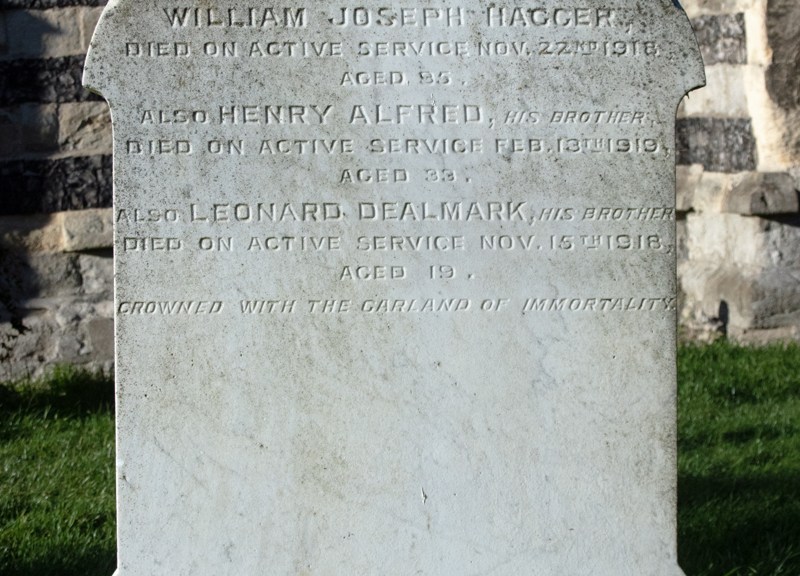
It seems that William did not recover from his illness and passed away on 22nd November 1918. He was 33 years old.
William Joseph Hagger lies at peace in a quiet corner of St Helen’s Churchyard, in Cliffe, North Kent.
William’s gravestone also acts as memorial to two of his brothers, Henry and Leonard.
Henry Alfred Hagger was born two years after William. He was also keen to make a name for himself, emigrating to California, and working as a streetcar conductor in Oakland. Initially declaring himself exempt from draft as he had a wife to support, he subsequently joined the British Columbia Regiment on 31st July 1917.
Henry was attached to the Forestry Depot of the Canadian Expeditionary Force, who were to be shipped to Europe to harvest trees for use on the Western Front. However, at the point of his medical – in September 1917 – he was discharged as unfit for active service due to his asthma.
Henry Hagger died on 13th February 1919, presumably of his lung condition. He is buried in Ross Bay Cemetery in British Columbia.
Leonard Dealimark Hagger was born in 1899. He enlisted as soon as he was able to, just short of his 18th birthday. Joining the York & Lancaster Regiment, he was posted in 1918.
His battalion saw some of the fiercest of the battles in the closing months of the war – Estaires, Messines, Bailleul, Kemmel Ridge, Scherpenberg, Selle, Valenciennes – and it is likely that Leonard was involved in some of these engagements.
Private Hagger was wounded in the closing weeks of the war, and passed away in a hospital in Liege, Belgium on 15th November 1918. He had just turned 19 years of age.
Private Leonard Hagger lies at peace in the Robermont Cemetery in Belgium.
Tom Hallett Walter Rawlings was born in 1896, the eldest of six children (and only son) to Walter and Jane Rawlings. Dorset-born Walter had worked as a carpenter and a groom, and Tom had joined him as a stable lad by the time of the 1911 census.
By the time he enlisted in July 1915, Tom’s work with all things equine helped land him a role in the Royal Army Service Corps as a Saddler. His role was backed up as he had previously been apprenticed to Ernest Cottle, a saddler in Blandford, Dorset.
Initially he worked on the Home Front, but he was posted to France as part of the British Expeditionary Force in January 1916, as part of the 1st Company.
Saddler Rawlings’ time overseas was brief; within three months of being shipped overseas he had contracted phthisis (also known as tuberculosis), and he was sent home for treatment on 22nd April 1916.
His health reached the point where he was discharged as being medically unfit on 12th June, and within a matter of weeks, Tom has passed away.
Tom Hallett Walter Rawlings died on 20th June 1916; he was 19 years old. He lies at rest in the cemetery of his home town, Sherborne.
Tom’s father Walter also entered the army as worked in the Royal Army Service Corps. While records of his military career are not immediately evident, it seems that he survived the war, although he may have been discharged in 1919 having fallen ill with malaria.
Private Roberts Pretoria Hallett was born in the summer of 1900, to Frank – a shepherd from Charlton Adam in Somerset – and Emily, who came from the neighbouring village of Charlton Mackrell. Roberts (the correct spelling) was the youngest of eleven children.
Roberts was just twelve when his father died, and, when war came, he enlisted in Taunton, along with his brothers, Francis and William.
Private Hallett was assigned to the 5th Battalion Royal Warwickshire Regiment. While his records don’t identify exactly when he saw battle, by the last year of the war the battalion would have been involved in the fighting in northern Italy.
What we can say for certain is that he was shipped home at some point towards the end of the war. He was admitted to the No. 1 Northern General Hospital in Newcastle-upon-Tyne in October 1918. Private Hallett’s records show that he died “of disease” on 16th October.
Roberts Pretoria Hallett lies at rest in the churchyard of St Mary’s in his home village of Charlton Mackrell, Somerset.
The Great War was not kind to Emily Hallett: having lost her husband in 1912, her son William died while fighting in India in 1916 and that is where he was buried. Her other son Francis died in the Third Battle of Ypres in June 1917 and lies at rest in Belgium.
Roberts Hallett, therefore, is the only one of the three brothers to be buried local to her.









 Death and Service