Tag Archives: Glamorganshire

Pioneer Herbert Dyer

Pioneer Herbert Dyer

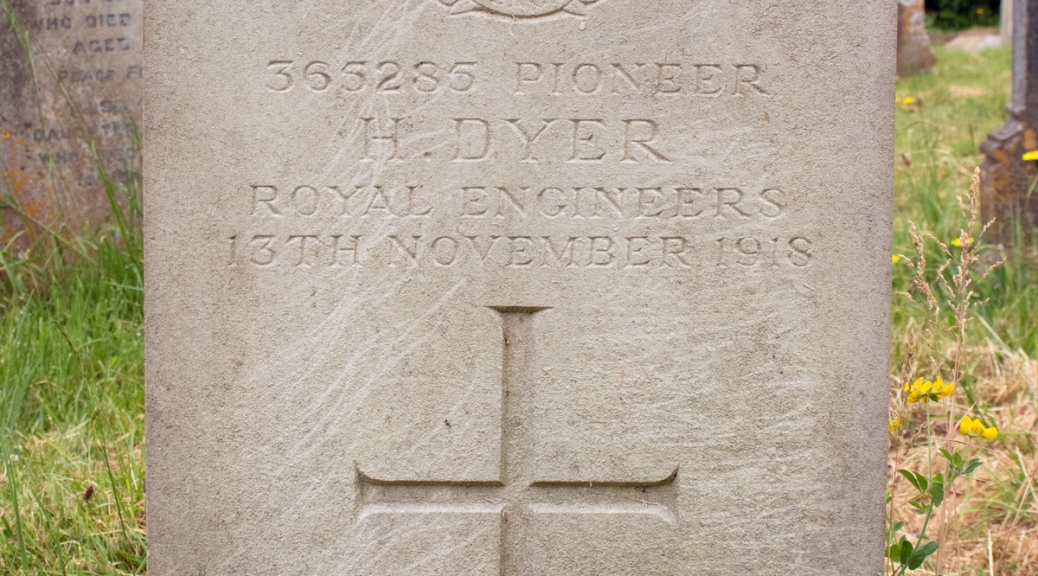
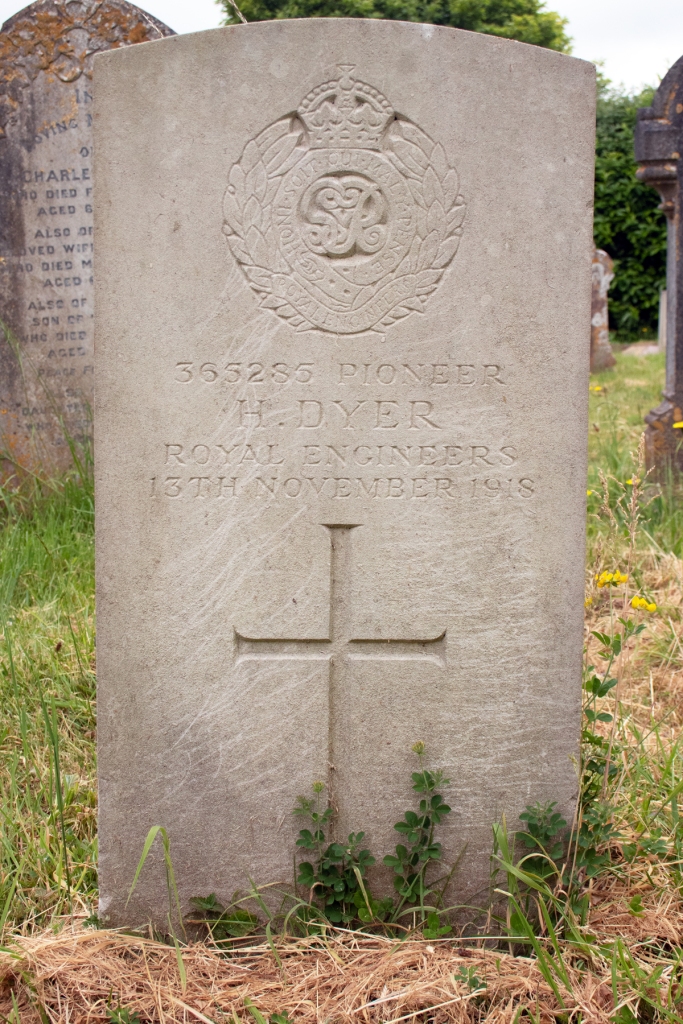
Charles Herbert Dyer was born in the Somerset village of West Monkton in the spring of 1890. One of eight children, his parents were farm labourer Charles Dyer and his wife Mary.

By the time of the 1911 census, Charles Jr had set out on his own, settling in Briton Ferry, near Port Talbot, Glamorganshire. He found work as a gardener and, from this point on, he went by his middle name, Herbert.

Over the next few years, Herbert continued his employment in Wales, although he did make a move to Newport, Monmouthshire. When war came to Britain, Herbert stepped up to serve King and Country, enlisting in the South Wales Borderers on 10th January 1916. Less than two weeks later, he married Ethel May Andrews, in All Saints’ Church, Newport.

Private Dyer was formally mobilised on 2nd March 1916. His service records show that he was 5ft 10ins (1.78m) tall and weighed 141lbs (64kg). Details of his service are a little scrambled, but it appears that Herbert was initially assigned to the 3rd (Reserve) Battalion, and remained on home soil throughout the conflict.

Herbert was based in Bottesford, Leicestershire, in December 1916, where he was put on report and docked 14 days’ pay for being absent from his post, and refusing to obey a superior’s order. Six months later, he had moved camp, and was confined to barracks for two weeks, and docked two days’ pay for being absent without leave for a day and ten hours.

By the summer of 1918, Herbert had transferred across to the Royal Engineers where, with the rank of Pioneer, he was assigned to the 15th Anti-Aircraft Company. Full details of his time in his new regiment have been lost, but he was certainly based in Essex as the war came to a close.

Pioneer Dyer’s health was, however, beginning to suffer by this point. He had a bout of influenza, which developed into pneumonia. He was admitted to the Warley Military Hospital in Brentwood, on 10th November 1918, but, by this point, his body had seemingly had enough. He passed away at 11:20am on 13th November 1918, at the age of 28 years old.

The body of Herbert Dyer was brought back to Somerset for burial. Ethel had moved in with her in-laws in West Monkton by this point, and was a couple of months’ pregnant. Herbert was laid to rest in the peaceful graveyard of St Augustine’s Church. His son – who Ethel named Herbert – was born on 6th June 1919, never to know his father.


Serjeant Joseph Smith

Serjeant Joseph Smith

Joseph Smith was born at the beginning of 1879 in Bath, Somerset. The fifth of six children – all boys – his parents were William and Sarah Smith. William was a carpenter and, while he did not follow in his father’s trade, Joseph found employment as a house painter when he left school.

Joseph married Alice May Martin in 1896: the couple were young, the groom being a year older than the bride, and they went on to have a daughter, Dorothy, who was born the following year. The newlyweds moved into a small, terraced house in Bath with Alice’s mother and sister, both of whom were widowed, and Alice’s nephew.

The 1911 census found the extended family living in larger home away from the centre of the city. Joseph was still employed as a house painter, Dorothy had left school and was apprenticed to a dressmaker. Alice looks to have been looking after the household, while her mother and sister were both living on their own means.

In his spare time, Joseph was also a member of staff at Bath’s Theatre Royal. He was sporty, with a keen interest in football and partial to a game of cricket. He was also very connected to St Stephen’s Church in the city, and was involved in parish life.

War was coming to Europe, and Joseph stepped up to play his part. Full details of his military service are lost to time, but from his gravestone and linked records, it is clear that he enlisted in the 6th Battalion of the Somerset Light Infantry. Further details are outlined in a contemporary newspaper report:

Though married, he was anxious to enlist practically as soon as the war began: and on January 16th, 1915, he offered himself for service, and was at once accepted. He did not leave England till 16th August [1916]. He had been selected for inclusion in 32 drafts on various occasions prior to that date; but had been obliged to remain behind from illness or some other cause. When he actually sailed, it was not as a member of a draft, but as one of five sergeants who had volunteered for special service.

Bath Chronicle and Weekly Gazette: Saturday 28th October 1916

Sergeant Smith made it to the Western Front, and was entrenched at the Somme. The newspaper report picks up on what happened next:

He was wounded in September, being struck by a bullet while leaving the trench preparatory to advancing. The bullet struck him in the thigh, and severed an artery… After doing what he could with his first-aid dressing, Sergt. Smith crawled some three miles from the firing line amid bursting shells. After five hours of this painful progress he was picked up by a stretcher party.

Bath Chronicle and Weekly Gazette: Saturday 28th October 1916

Sergeant Smith was medically evacuated to Britain for treatment, and was admitted to the 3rd Western General Hospital in Cardiff. Alice and Dorothy were a constant presence as his bedside, but the wound was to prove too severe, and he passed away at the hospital on 25th October 1916. He was 38 years of age.

Joseph Smith was brought back to Bath for burial. He was laid to rest in the Lansdown Cemetery, overlooking the city he called home.


Private William Parry

Private William Parry

In St James’ Cemetery, Bath, is a headstone dedicated to one William Parry, once a Private in Devonshire Regiment. A lot of his life is lost to time, but his death highlights the length to which soldiers returning from the Great War were often left to fend for themselves.

On 4th November 1919, Private Parry “was found in an exhausted state lying under an arch in a suburb of [Bath], and told the police he had been there for 17 days. Crawling there to rest, he found himself afterwards too weak to move owing to trench feet” [Western Gazette: Friday 14th November 1919]

On 18th November, having been admitted to the Royal United Hospital in Bath, he passed away from pneumonia. “The police are endeavouring to ascertain something as to the man’s antecedents. He stated to them that he had no home.” [Western Gazette: Friday 21st November 1919]

An inquest into William’s death was held, and a miserable tale unfolded.

Parry was described as a seaman, and his address was given as 36 Catherine Street, Exeter…

[He had] said he was born at Swansea, had served in the 2nd Devons, and was demobilised at Exeter last March. He got into the arch because his feet were aching. He had come from Bristol. He did not say where he was going.

[When he died] Parry’s belongings… included a ration book, issued to him for the address in Exeter, his insurance card, and his out-of-work book. Parry had 10s 8d [approximately £11 in today’s money] in cash on him; but 10s 6d of this sum was given him by a lady since his arrival at the hospital. Parry had received various other gifts sent him by ladies from all over the country, who had read of the account of his discover in the Press. The last out-of-work donation received by him was on June 26th, and the ration book was issued at Exeter on March 24th. The address at Catherine Street, Exeter, as which Parry had stayed was that of a Church Army Home. He had also with him a card indicating membership of the Comrades of the Great War. The entries on his insurance card showed he was last employed on September 8th.

Inspector Lovell… gave the Coroner the result of exhaustive enquiries which he had made… regarding Parry’s antecedents… By the Exeter police he was informed that Parry registered at the Labour Exchange there as a seaman on March 25th. He then produced a certificate showing him to be a member of the Mercantile Marine. He had apparently served with the 2nd Battalion of the Devon Regiment for 2½ years. On May 16th, 1919, he obtained work as a painter in Exeter. He retained this employment till June 21st. A week later he obtained similar employment with another Exeter firm at 1s 3d [approx. £1.68] an hour and his earning averaged £2 [around £87] or more a week. He lest the Church Army Home on September 12th, explaining that he was going to Barrow-in-Furness, where he expected to obtain employment with Messrs Vickers, Sons, and Maxim. While staying at the Church Army Home he appeared to have been regarded as of a morbid disposition…

Inspector Lovell added that the members of the Exeter branch of the Comrades of the Great War had assisted him… and he was able to furnish the Court with a letter from Mr FW Drew, with whom Parry had lodged at the Church Army Home. The writer said he had met Parry in the latter part of April, and their friendship lasted until ten weeks ago, when deceased left Exeter. As they were two ex-Service men they became intimate friends, but apparently before the war he belonged to London.

After enlistment he had served in France, and was taken prisoner by the Germans. He was in their hands for three months; and acted as interpreter between his captors and the other British prisoners. He could speak German and other foreign languages, and undoubtedly was a man of superior education. Apparently, so far as his relations were concerned, he was “one of England’s lonely soldiers.” He said he was badly treated by the Germans, and suffered from a bad cough, the result of a wound in the chest. He was liable to depression when out of work, and the writer well remembered how pleased he was to think that he had obtained work at Barrow-in-Furness… “I deeply regret,” concluded the writer, “that he has come to such an untimely end. He was a good fellow, and would do anyone a good turn, if possible.”

In summing up, the Coroner remarked that exhaustive enquiries had been made into the case. There was no doubt from the medical evidence that the cause of death was pneumonia. It would appear that Parry had been on the road for some time when he crawled under the arch where he was found…

Bath Chronicle and Weekly Gazette: Saturday 22nd November 1919

Private William Parry died on 18th November 1919, aged around 44 years old. The British Federation of Discharged Soldiers and Sailors and the Comrades of the Great War jointly made arrangements for, and funded, his funeral, at which he was given full military honours. He was laid to rest in St James’ Cemetery, Bath.


Funeral of William Parry
(from britishnewspaperarchive.co.uk)

Quartermaster Serjeant Iva Brewer

Quartermaster Serjeant Ivor Brewer

Iva Victor Brewer was born on 2nd May 1886, the fourth of four children to James and Annie Brewer. James was a farm labourer from Weston-super-Mare, but the family were living in Bathampton by the time of Iva’s birth. James died in 1887, and Annie remarried three years later. Her new husband, Thomas Dolman, was the manager of the George Inn in Bathampton, and the couple went on to have four children of their own, half-siblings to Iva.

Tragedy struck again when Annie passed away in February 1897, at the age of just 37 years old. By the time of the next census in 1901, Iva was boarding with his stepfather’s parents; the following year, however, Thomas also passed away, and the children were left to build their own lives.

Iva – who was now going by his middle name, Victor – found an escape in the army and, according to the 1911 census was an Acting Bombardier in No. 69 Company of the Royal Garrison Artillery, based in Colaba, at the tip of the Mumbai peninsula.

By the time war was declared, Victor had cemented his military career. Full details of his service are no longer available, but the summer of 1916 he had left India for Aden, and was then mentioned in dispatches that October for his bravery in the field at the Somme.

In November 1917, the now Battery Quartermaster Sergeant Brewer was injured in fighting at Passchendaele, and was medically evacuated to Britain for treatment. It seems that he was treated in South Wales, and it seems a whirlwind romance set in when he was living in Pontardawe, near Swansea. On 2nd January 1918, Victor married Laura Seddon, a railway inspector’s daughter from the village of Ystalyfera, just up the valley from Victor.

The couple moved to Bathampton before Victor returned to the fighting. He was badly wounded and, having been evacuated back to Britain in May 1918, he was admitted to the Northern Central Hospital in London where his shattered leg was amputated. Sadly, bronchial pneumonia set in while he was recovering, and he passed away from the subsequent sepsis. Quartermaster Sergeant Brewer passed away on 7th May 1918, days after his 32nd birthday.

Iva Victor Brewer was brought back to Bathampton for burial. He was laid to rest in the quiet graveyard of St Nicholas’ Church in the village.


Tragedy was to strike again, sadly. After his funeral, Laura returned to Wales and found employment at a draper’s store.

…the loss of her husband played on her mind.

On Monday she set off for Bathampton, and on her way posted two letters to her late husband’s relatives.

One ran: “I cannot live without my husband. If you don’t hear from me, search Bathampton, as I shall be there somewhere.” Another letter asked her relatives to let her mother in the Swansea Valley know.

She reached Bath, and it is thought she there took a taxi to Bathampton. She then paid a visit to the cemetery, and placed her hat and handbag on her husband’s grave. At the canal-side nearby she laid her fur coat on the bank, and, it is supposed about midnight, plunged into the water

Western Gazette: Friday 9th April 1920

Laura was just 27 years old when she died: she was buried with Victor, husband and wife reunited again.


Private Frederick Johnson

Private Frederick Johnson

Frederick Leonard Johnson was born in the spring of 1898, in Wandsworth, South London. His parents are recorded as Frederick and Catherine Johnson, although no other information about his early life remains.

On 16th February 1918, Frederick married Winifred Peters. She was a dock labourer’s daughter from Aberavon in Glamorganshire, and the couple wed at the parish church in the town. The marriage certificate confirms that Frederick was living in Port Talbot and working as a carpenter. It also notes that his father had died by this point.

It seems likely that the young couple married because Winifred was pregnant. The couple had a son, who they called Frederick, on 1st August 1918.

Frederick had enlisted in the army by this point. While his service records no longer exist, he joined up at some point towards the end of the war – no earlier than May 1918 – and was assigned to the 3rd (Reserve) Battalion of the Gloucestershire Regiment. This was a territorial force, and Private Johnson would have been based in Kent as part of the Thames and Medway Garrison.

Little else is known about Frederick’s service. The only other thing that can be confirmed is that he was admitted to the Preston Hall Military Hospital in Aylesford, Kent, in the autumn of 1918, suffering from a combination of influenza and pneumonia. Sadly, the lung conditions were to get the better of him and he passed away on 27th November 1918, at the age of just 20 years old.

Frederick Leonard Johnson was laid to rest in the graveyard of St Peter and St Paul’s Church, Aylesford, not far from the hospital in which he had passed. It is unclear whether he ever met his son.


Private William King

Private William King

William Samuel King was born in the summer of 1880, and was one of four children to Richard and Elizabeth King. Richard was a railway worker from Totnes, Devon, and this is where the family were born and raised.

When he left school, William found work as a house painter, and this is a job he continued to do through to the outbreak of the Great War. On 8th June 1908 he married Minnie Edmunds: the couple went on to have a son, Leslie, who was born in 1912. William and Minnie had, by this point, moved to Swansea, West Glamorgan, presumably as work was more plentiful here than in their Devon home. His work as a decorator seems to have been recognised, and he was admitted to the National Association Partnership, Swansea South.

On 1st December 1915, William enlisted and his service records show that he was 5ft 2ins (1.57m) tall. While it is clear that he spent his time on home soil, his service seems a bit disjointed.

Private King wasn’t formally mobilised until September 1916, when he was assigned to the 2nd/2nd Battalion of the Monmouthshire Regiment. In December he was transferred to the Royal West Kent Regiment before returned to his original battalion in February 1917. A month later, he moved to the Bedfordshire Regiment, before moving to the Middlesex Regiment a few weeks later. This also seems to have been a temporary move as, three weeks later, he was assigned to the 337th Works Company of the Labour Corps (although this was still part of the Middlesex Regiment).

The potential reason behind Private King’s haphazard service seemed to become a little clearer when, in September 1917, he was referred to Fort Pitt Hospital in Rochester, Kent. He was noted as being “very talkative, noisy [and] in a state of mental disease… he has… exalted and grandiose ideas and is difficult to restrain.” His mental health was obviously suffering, and he was discharged from military service in December 1917.

William returned home, although it was not to be for long. He passed away on 13th April 1918, at the age of 37 years old. While no cause of death is evident, it seems likely to have been connected to his ‘mania’, which had been exacerbated by his army service.

William Samuel King was laid to rest in Totnes Cemetery, not far from his parental home.


Second Lieutenant Francis Wakeford

Second Lieutenant Francis Wakeford

Francis Reginald Steele Wakeford was born in the summer of 1893 in Penarth, Glamorgan. The middle of five children, his parents were Herbert – who was a master printer – and Mary Wakeford. When he left school, Francis became a stockbroking clerk, but when war broke out, he was quick to ensure he played his part.

Initially enlisting in the Royal Engineers, he was attached to the Glamorgan Yeomanry. By the time he was sent to France, however, he had been assigned to the Lancashire Fusiliers.

After eighteen months of fighting, in the spring of 1918, Second Lieutenant Wakeford transferred to the Royal Air Force and gained his wings. “During six months’ flying he had many encounters with enemy airmen, many of whom he brought down, and was also in several bombing raids over Germany.” [Western Mail: Monday 30th December 1918]

When the Armistice was declared, Francis returned to Wales. He has been suffering from an ongoing illness, and this was to be to what he was to succumb. Second Lieutenant Wakeford passed away in Cardiff on Christmas Day, 25th December 1918. He was just 25 years of age.

Francis Reginald Steele Wakeford was laid to rest in the graveyard of St Augustine’s Church in his home town of Penarth.


Second Lieutenant Wakeford (from findagrave.com)

Francis’ grave also commemorates the passing of his only brother, Charles Herbert Stanley Wakeford.

Four years Francis’ senior, Charles had enlisted in the 24th (Pembroke and Glamorgan Yeomanry) Battalion of the Welch Regiment. As the war moved through its final year, Lieutenant Wakeford found himself caught up in the fierce fighting of the Second Battles of the Somme.

Charles was killed on 7th September 1918, aged 28 years old. He was laid to rest in Tincourt British Cemetery, in Picardie, France. He is also commemorated on the family grave in St Augustine’s Church, Penarth.


Private Charles Tucker

Private Charles Tucker

Charles Wilfred Tucker was born in the summer of 1898 in Penarth, Glamorgan. He was the oldest of four children to Wilfred and Elizabeth Tucker, restaurant owners on Windsor Terrace in the centre of the town.

Little information is available about Charles’ early life. When war broke out, he enlisted in the Welch Regiment, before transferring to the Machine Gun Corps at some point during the conflict. In the autumn of 1919, Private Tucker was put on furlough while waiting to be demobbed, and he returned home.

Sadly, it was while here that Charles contracted pneumonia, and it was from the lung condition that he was to pass away. He breathed his last on 30th October 1919, at the age of just 21 years old.

Charles Wilfred Tucker was laid to rest in the family grave in St Augustine’s Churchyard in his home town of Penarth.


Ordinary Seaman William Radford

Ordinary Seaman William Radford

William Richard Radford was born in the spring of 1900 in Cogan, on the outskirts of Penarth, Glamorgan. He was one of eight children to coal trimmer turned dock labourer Richard Radford and his wife, Susan.

Little information is available about William’s life. What is documented is that he enlisted in the Royal Navy, and, by the time he came of age in 1918, he held the rank of Ordinary Seaman. William was serving at HMS Victory, the Royal Naval Dockyard, by the end of the war.

At this point, details of Ordinary Seaman Radford’s life become a little unclear. He seems to have been stepped down to the Marine Mercantile Reserve, returning home in January 1919, when he passed away. His Pension Ledger Card gives the cause of death as a fractured shoulder, while another document states that he died from a sarcoma.

Whatever the cause of his passing, William Richard Radford was laid to rest in the graveyard of St Augustine’s Church in Penarth. He shared his grave with his mother, who had passed away the previous year. Richard Radford was also buried in the same plot when he passed away in 1926.


Private Edward Savage

Private Edward Savage

In the graveyard of St Augustine of Hippo Church in Penarth, Glamorgan, lies the Commonwealth War Grave for Private Edward Savage. The headstone confirms that he had died on 25th December 1915 and that he was in the Loyal North Lancashire Regiment.

The Commonwealth War Grave Commission website suggests that he was the son of Edward and Rachel Savage and that he was born in Beccles, Suffolk. Sadly, there are no available census documents to shed any further light on that early life.

The same website suggests that he served in Burma, and in the South African campaign, which would have placed him there in the late 1890s and early 1900s.

It is also noted that Edward was the husband of Emily Savage and that they were living in Fleetwood, Lancashire. Edward’s later pension ledger suggests this was an Emily Shannon, who is, in fact, noted as the guardian of his illegitimate child. Further information, however, is not available.

From a military perspective, it is likely that Private Savage was either still service at the point that the First World War broke out, or that he was called into service – or volunteered his services – shortly after its declaration. He was assigned to No. 5 Supply Company of the 3rd/4th Loyal North Lancashire Regiment and, by the autumn of 1915, he found himself based at Penarth Head Fort near Cardiff.

Edward’s death seems to have been a less than auspicious one, as a local newspaper reported at the time.

The district coroner held an inquest at Penarth on Tuesday touching the death of Private Edward Savage, who was found dead at the billets of the A Company of the Loyal North Lancashire Regiment on Sunday morning. Surgeon-Major Charles Parsons, the local medical officer, stated that the deceased had apparently fallen down some stone steps, causing a fracture of the base of the skull. The jury returned a verdict of “Accidental Death.”

Western Mail: Wednesday 29th December 1915

Private Edward Savage had died on Christmas Day, 25th December 1915. He was 54 years of age. He was laid to rest in the graveyard of St Augustine of Hippo Church in Penarth.


Edwards shares his grave with another member of the Loyal North Lancashire Regiment, Serjeant Frank Carter. Read his story here.