Walter James Ricketts was born in the summer of 1893, the fifth of ten children to James and Elizabeth (and, tragically, the first to survive childhood). James was a farm labourer from the Herefordshire village of Dilwyn, and this is where the family were born and raised.
When he completed his schooling, Walter found work as a groom. The 1911 census recorded him as living at the Moorhampton Hotel, seven miles (11km) to the south west of his home. His employer, Edith Pearman, is recorded as a hotel keeper and farrier, and he was one of two live-in staff.
Walter married Lucy Godwin in the spring of 1918. The oldest daughter of a clerk, she had been born in Lugwardine, near Hereford. By the time the couple married, Walter had enlisted in the army, and was serving in the Royal Field Artillery.
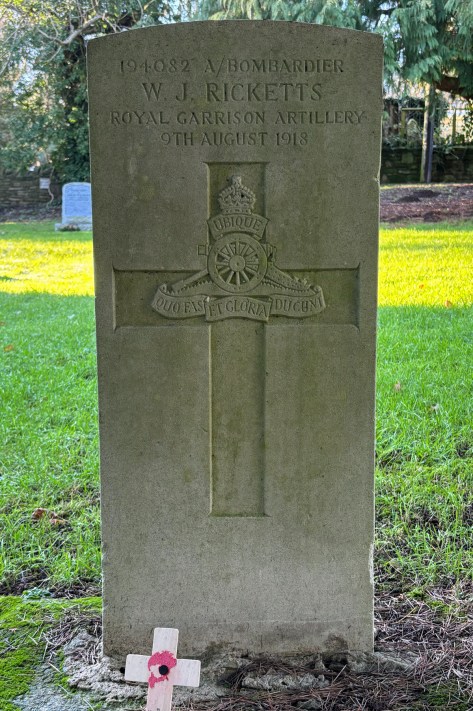
Full details of Gunner Ricketts’ service have been lost, but it is clear that he made the move to the Royal Garrison Artillery at some point. By the summer of 1918, the newly promoted Acting Bombardier was attached to the 57th Company, and based at a gun station in Dulwich, Surrey.
The only other record for Walter is his Pension Ledger card. This confirms that he died on 9th August 1918, following accidental contact with an electric current. There is no further information about the incident, but he was 25 years of age when he died.
The body of Walter James Ricketts was taken back to Herefordshire for burial. He was laid to rest in the tranquil setting of St Mary’s Churchyard in his home village, Dilwyn.
Ernest Harold Prince was born in the spring of 1891 in Warminster, Wiltshire. The eighth of eleven children, he was one of five boys to William and Mary Prince. William was a quarry worker, and the family lived at 33 Brook Street to the south of the town.
Ernest followed his father into quarry labouring. William was working in Abercarn, Monmouthshire, at the time of the 1901 census, and had returned to Wiltshire by 1911. Ernest, on the other hand, had sought work in Wales himself by this point, and is recorded as boarding with the Courtney family at 39 Rhyswg Road. The document notes that he was employed as a labourer below ground in a local colliery.
When war broke out, Ernest stepped up to play his part. Full details of his service have been lost to time, and it is unclear whether he was still working in the colliery, and therefore exempt from joining up initially because of his reserved occupation. What is certain, however, is that he had enlisted by the spring of 1918, and, as a Gunner, had joined the Royal Horse Artillery A Battery.
The next record for Gunner Prince relates to his passing. He is recorded as having died of disease on 29th October 1918. His death was recorded in Warminster, so it is safe to assume that he had been at home, or at least in his home town, when he passed. He was 27 years of age.
The body of Ernest Harold Prince was laid to rest in the graveyard of Christ Church in Warminster.
Ernest’s younger brother, Walter, also fought in the First World War. A Private in the 2nd Battalion of the Wiltshire Regiment, he had served on the Western Front during 1915.
Private Prince fought at Loos and was killed on 26th September 1915. He is commemorated on Panel 102 of the Loos Memorial.
Henry John Clark was born on 17th January 1885 in Tufnell Park, Middlesex. The oldest of five children, his parents were wire worker and brass finisher Henry Clark and his wife, Louisa.
The 1891 census found the family living at 51 Cromwell Avenue, Highgate, Middlesex, and this would certainly remain Henry Sr and Louisa’s house for the next ten to fifteen years at least. Henry Jr – who was better known as Jack – is missing from the 1901 census, but by the next document, taken in 1911, he had moved back in with the family.
By this point the Clarks were living in a thirteen-room house on Shepherd’s Hill, Highgate. Henry Sr was now listed as an employer, manufacturing fenders, fire guards and metal good generally, with Jack and his brother, Cyril, also working in the business. The family were supported by two servants, with Henry Sr’s niece and another boarder living with them. Tragically, the census records that Louisa had had five children, although only Jack and Cyril were still alive.
The family business, according to De Ruvigny’s Roll of Honour, Messrs. J Clark, Ltd, of High Street, Bloomsbury, and Jack was one of the directors. The publication also notes that, in his spare time, Jack was “a prominent and active member of the Kit Marlowe Dramatic Club, and the Vaudeville Dramatic Club, and was a popular member of the Highgate Special Constabulary, which body he joined as soon as it was formed.”
On 19th June 1912,Jack married Alice King. Born in Finsbury Park, she was the daughter of a wine and spirit valuer and merchant. The couple exchanged vows at St George’s Church, Hanover Square, London, and would go on to have a child, John, in 1916.
When war broke out, Jack was called upon to play his part. He enlisted on 4th December 1916, joining the Royal Garrison Artillery as a Gunner. His service papers note that he was just over 6ft 2ins (1.89m) tall, and weighed 159lbs (72.1kg).
Gunner Clark served with the British Expeditionary Force from March 1917, returning to home soil just three months later. He had obviously impressed his superiors, as he was sent to the No. 2 RGA Officers’ Cadet School in Uckfield, Sussex, to be trained as a Sergeant.
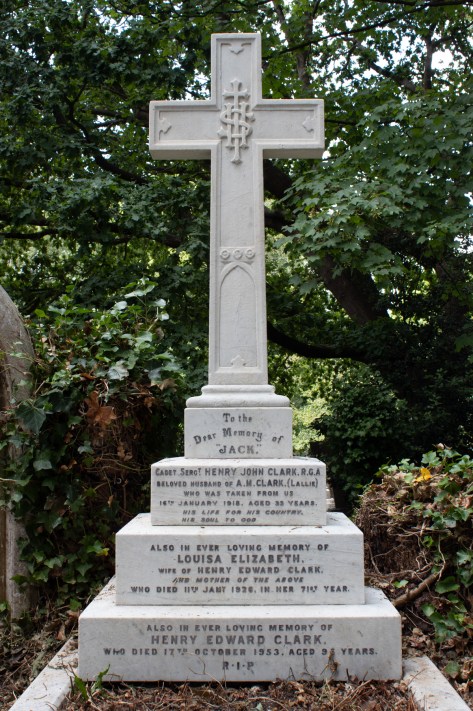
While here, however, Jack came down with pneumonia, and was admitted to the No. 2 Eastern General Hospital in Brighton. The condition was to get the better of him, sadly, and he passed away on 16th January 1918, the day after his 33rd birthday.
Henry John “Jack” Clark was taken back to Middlesex for burial. He was laid to rest in the majestic Highgate Cemetery, a short walk from his grieving family.
Cadet Sergeant Henry Clark (from De Ruvigny’s Roll of Honour)
Charles Archibald Walters was born in 1896, and was one of nine children to Arthur and Minnie. Arthur was a painter in the shipyards, and the 1901 census found the family living in a small cottage at 29 Cambrian Terrace in Neyland, Pembrokeshire.
By 1911, Charles had finished his schooling, and had found labouring work on a local farm. He was still living at home, however, and the family has moved to 46 Cambrian Road, overlooking the shipyard where Arthur still worked, and the Westward Pill and Cleddau Ddu rivers beyond.
When war came to Europe, Charles was called upon to play his part. Details of his military service are sketchy, but it is clear that he enlisted in the Royal Garrison Artillery, and was assigned to the Pembrokeshire Territorial Force.
Gunner Walters survived the war, but was suffering from nephritis. He was medically discharged from the army on 12th May 1919, and returned to the family home.
By this point Arthur had moved the family to Goodwick, near Fishguard, by this point, as he had taken up a job in the town as a painter for Great Western Railways.
Charles’ condition would ultimately get the better of him. He passed away on 4th April 1920: he was just 24 years of age.
Charles Archibald Walters was laid to rest in Llanwnda Cemetery, not far from where his family now lived.
The 1921 census found that two of Charles’ brother were also working for Great Western Railways, Frederick as a porter, and William as a boiler sealer in their engineering works (presumably the same place as Arthur).
Minnie died the following year, Arthur passing in 1924. Both were buried with their son, Charles, and they are remembered on his Commonwealth War Grave.
William George Foxworthy was born in Dartmouth, Devon early in 1880. The middle of five children, his parents were William and Mary Foxworthy. William Sr (whose full name was William George Foxworthy, and who was known by his middle name) was a house painter, but when he finished his schooling, William Jr found work as a boat builder.
The 1901 census found the family living in a small house on Crowther’s Hill, to the Dartmouth town centre. The cottage would have been cramped, but there were five wages coming in from George, William and William’s siblings.
William does not appear on the 1911 census, and it seems that he took the step from building boats to sailing on them. When war broke out, he was quick to step up and play his part, enlisting in Exeter on the 22nd October 1914. While he had previously been a volunteer in the Devonshire Regiment, William was assigned to the Royal Garrison Artillery.
Gunner Foxworthy’s service records show that he was 5ft 4.5ins (1.64m) tall, and weighed 121lbs (54.9kg). He was noted as having brown hair, hazel eyes and a fresh complexion. Deemed fit for military service, he was packed off to a base in Sheerness, Kent.
William spent the next year on the north Kent coast, before being reassigned. By 1st November 1915 he was on the Front Line, and remained in France until the following June.
In the spring of 1916, Gunner Foxworthy fell ill. He contracted tuberculosis, and this was to dog him for the rest of his life. The contagious nature of the condition meant that he was no longer fit for military service, and he was medically discharged on 11th July 1916.
The death occurred on Tuesday of last week at Roseville Street, of Mr William George Foxworthy, second son of Mr and Mrs Foxworthy, after a long and painful illness. In 1914 deceased joined the [Royal Garrison Artillery] as a gunner, and saw much fighting around Ypres in the winter of 1915-16, during which time he contracted the disease which has now terminated fatally. This is the second son Mr and Mrs Foxworthy have lost in the war, their youngest boy having been killed some two months ago. Great sympathy has been shown the parents in their second bereavement.
[Dartmouth & South Hams Chronicle: Friday 20th December 1918]
William George Foxworthy was 38 years of age when he died on 10th December 1918. He was laid to rest in the graveyard of St Clement’s Church in his home town, Dartmouth.
William’s younger brother, Louis Henry Foxworthy, was a Corporal in the 9th (Service) Battalion of the Devonshire Regiment. He served on the Western Front as well and, in September 1918, he was caught up in the fighting in St Riquier, near Abbeville. Corporal Foxworthy was killed in action on 8th October 1918: he was 31 years of age.
Louis’ body was not recovered, and he is commemorated on the Vis-en-Artois British Memorial in Harcourt, France.
Frank Sloman was born in the autumn of 1887, and was the youngest of five children to Frank and Emma. Frank Sr was a mason from Jersey, in the Channel Islands, but it was in Tiverton, Devon, that he and Emma made their home and raised their family. The 1891 census found the family living on Castle Street, but by 1901 they had moved down the road to St Peter’s Street.
Frank Jr found work as a painter when he finished his schooling, but he sought adventure and a career. He was already a volunteer for the Devonshire Regiment, and, on 7th May 1904, he officially enlisted as a paid member of the troop. Private Sloman’s records show that he was 5th 10.5ins (1.79m) tall, and weighed 129lbs (58.5kg). He was noted as having brown hair, grey eyes and a fresh complexion.
Private Sloman spent two years on home soil. He quickly extended his contract, and this led to more opportunities. By December 1906 his unit was in India, and he would go on to spend five and a half years there.
In December 1907, Frank transferred to the Royal Garrison Artillery. He initially held the rank of Gunner, before being promoted to Bombardier in January 1912, and Corporal just three months later. In October, Frank returned to Britain, and was stood down to reserve status. He returned to Tiverton, and found work as a porter at the local station.
War was on the horizon, however, and when conflict broke out, Frank was called upon to play his part once more. Initially taking up the rank of Corporal in the Royal Field Artillery, he reverted to the role of Gunner at his own request. By this point, his unit was in France, and he would remain there for the next eight months.
On 6th May 1915, Frank returned to Britain, and was attached to 2B Reserve Brigade. He was based at the training facility in Bettisfield Park in Clwyd, and would spend the next eighteen months there. In June 1916, he was once again promoted to the rank of Bombardier.
Love was on the cards, and, on 17th June 1916, Frank married Frances Hadlow. There is little information available for her, but the couple exchanged vows at the Register Office in Windsor, Berkshire.
By the autumn of 1916, Frank’s health was becoming an issue. He contracted phthisis, or tuberculosis, and was sent to the the south coast for recuperation. His condition would ultimately render him unfit for continued military service, and Bombardier Sloman was discharged from the army on 17th December 1916.
His papers show that he had grown to 6ft 2.5ins (1.89m) in height, and, while physically unfit, he was a steady, sober and reliable man. He and Frances had taken rooms at 7 Hawley Street, Margate, Kent, but it seems that the couple soon moved back to Devon. Their new home was a small cottage at 3 Westbrook Place in Tiverton.
At this point, Frank’s trail goes cold. It is unclear whether he took up work again – or was able to do so – but his lung condition was ultimately to get the better of him. He passed away on 3rd June 1918, at the age of 30 years old.
Frank Sloman was laid to rest in Tiverton Cemetery, on the outskirts of the town in which he had grown up.
The early life of Alfred John Potter is a challenge to piece together. The second of four children – and the only son – to John and Alice, he only appears on the 1911 census. This shows him living with his grandparents, William and Sarah Endacott, at 3 Lawrence Terrace in Paignton, the town in which he was born. Alfred was 16 at this point, and was employed as a mason’s apprentice.
The same census return found Alfred’s parents and siblings were also living in Paignton, but in a 5-roomed cottage on Polsham Road. There is nothing to confirm why he had moved out, although with three sisters, his grandparents may have offered the space and privacy he wanted.
Details of Alfred’s time in the army are similarly lacking. That he had enlisted by March 1918 is clear. He joined the Royal Field Artillery and was assigned to the Command Depot in Ripon, North Yorkshire.
By the late summer of 1918, Gunner Potter had contracted pneumonia. He died on 6th September at the age of 23 years old. Records state that he passed away in Torquay and, given the proximity to his home town, it is likely that he had been admitted to a hospital or convalescent home in the area.
Alfred John Potter was laid to rest in Paignton Cemetery, overlooking his home town.
Frederick William Lavers was born in Paignton, Devon, on 5th November 1889. The middle of five children, and the only son, his parents were John and Jane Lavers. John was a carman, and the family had rooms in a house on Winner Street in the town.
When Frederick finished his schooling, he found work as a butcher’s boy. This wasn’t the career for him, however, and, on 16th January 1905, he signed up to join the Royal Navy. His service records suggest that he had said he was a year older, and confirm that he was 5ft 3ins (1.6m) tall, with light brown hair, blue eyes and a fresh complexion.
As he was under the age to formally enlist with the Royal Navy, Frederick was given the rank of Boy, and dispatched to HMS Vivid, the dockyard in Devonport, for his training. Something was amiss, however, and, after eighteen months, he was discharged as being unsuitable.
Undeterred, Frederick tried another tack and, on 26th April 1909, he enlisted in the Royal Garrison Artillery. By the time of the 1911 census Gunner Lavers was stationed at West Ridge in Rawalpindi, India. There is little information available about his service, however, and Frederick is only picked up again on 30th December 1918.
At this point, the now Acting Bombardier Lavers was put on a hospital train from Marseilles, as he was suffering from psoriasis. He disembarked three days later in Le Havre, and, is appears, then returned to Britain for treatment. On 24th February 1919 he was medically discharged from army service, and awarded the Silver War Badge.
Frederick’s trail goes cold again after this. He appears to have returned home, and passed away on 20th October 1920. He was 28 years of age.
Frederick William Lavers was laid to rest in Paignton Cemetery, overlooking his home town.
Arthur Sidney Putt was born on 22nd October 1895 in Paignton, Devon. The youngest of five children, his parents were James and Elizabeth. James died when his son was jest five years old, leaving Elizabeth to raise the family in her own. By the time of the 1901 census, they Putts were living at 22 Roundham Cottages (four doors down from the fellow future soldier Charles Baker and his family), where Elizabeth was working as a charwoman to bring in the rent money.
When he finished his schooling, Arthur found employment as a wood chipper. At 15 years of age, he and his older brother, Frederick, were both bringing a wage into the household, and were the only two of Elizabeth’s children to still be living at home.
War broke out in the summer of 1914, and Arthur was one of the first to step up and play his part. He enlisted on 16th August, giving up his new job as a hairdresser, with the view of better prospects in the army. He joined the Royal Field Artillery, and was assigned to the 2nd Devon Depot Battery.
Gunner Putt’s initial medical report showed that he was 5ft 7ins (1.7m) tall, with good vision and normal physical development. He was sent for training, but a later, fuller, medical found that he was, in fact, not physically fit for army service. The report of the medical board of 27th April 1915 found that he had both rheumatism and valvular heart disease. He was dismissed from military service on 10th May 1915, after 267 days’ duty.
At this point, Arthur’s trail goes cold. It seems likely that he returned to Paignton, and to the life he had before the war, and the next record for him is that of his passing. He died on 14th May 1919, at the age of 23 years old.
Arthur Sydney Putt was buried in Paignton Cemetery, overlooking the town in which he had been born and raised.
Charles Baker was born on New Year’s Day 1884, the youngest of six children to Henry and Mary Baker. Henry, was 64 when his son was born, and 21 years his wife’s senior, was a fisherman from Dartmouth, Devon. By the 1870s, however, the family had settled in Paignton, and this is where Charles had been born and raised.
The 1901 census found Henry, Mary, Charles and the oldest Baker daughter, Emma, living at 25 Roundham Cottages, to the south of Paignton town centre. He would have known the Putt family at No. 22, being of a similar age to Arthur Putt, another future soldier. Charles’ father Henry, now 81, was living off his own means, while Charles had completed his schooling, and was employed as a house painter.
In the spring of 1905, Charles married Helen Davey. Born in Hayle, Cornwall and six years her husband’s senior, there is little information about the new Mrs Baker, other than her father’s name, Thomas. The 1911 census found the couple living in a 5-roomed house on Norton Terrace, Paignton. At this point Charles was still employed as a house painter.
When war came to Europe, Charles stepped up to serve his King and country. Initially enlisting on 11th December 1915, he was not formally mobilised until the following September, when he was assigned to the Royal Garrison Artillery as a Gunner. His service records show hat he was 5ft 8ins (1,73m) tall and weighed 159lbs (72.1kg).
As part of the 257th Siege Battery, Gunner Baker was sent to Mesopotamia on 10th March 1917. He would remain in the Middle East for the next couple of years, returning home in March 1919. Charles returned to Devon, and was placed on furlough, awaiting to be demobbed.
Within a matter of weeks, however, Charles had fallen ill, contracting pneumonia. The condition was to prove his undoing, and he passed away on 7th May 1919. He was 35 years of age.
Charles Baker was laid to rest in Paignton Cemetery, overlooking his home town.







 Death and Service