John Edmonds was born on 12th November 1871 in Bath, Somerset. The oldest of five children, his parents were market gardener Albert Edmonds and his wife, Ellen.
When he finished his schooling, John found work as a miner. He sought a more adventurous career, however, and, on 8th November 1894 he enlisted in the army. Assigned to the Royal Artillery, Gunner Edmonds’ service records noted that he was 5ft 8ins (1.73m) tall and weighed 149lbs (67.6kg). He had brown hair, grey eyes and a sallow complexion, with a couple of marks above and below his left eye.
Gunner Edmonds was assigned to the 4th Mountain Battery and spent most of the next year training on home soil. On 17th September 1895, however, he was transferred to the 5th Mountain Battery, and shipped off to India, where he was to spend the next nearly nineteen years. During his time on the Asian sub continent, John was awarded the India Medal, with clasps for the Punjab Frontier and Tirah (both 1897-98). He was also awarded the Delhi Durbar Medal in 1911.
When war came to Europe in August 1914, John was recalled to British shores. He was not to remain on home soil for long, however as, on 9th December he was sent to France as part of the Royal Garrison Artillery. He spent just over a year on the Western Front before his troop was dispatched to Salonika, Greece, in December 1915.
Gunner Edmonds was to remain in the Eastern Mediterranean for a little over three years. During this time he had a short period in hospital, having contracted malaria, but saw the war out in Greece, returning home in March 1919. John was formally stood down from military service on 25th April 1919, having completed 24 years 169 days in the army.
Returning to Bath, John’s health had started to suffer. He had developed cancer, and passed away from the condition on 4th October 1919. He was 47 years of age.
John Edmonds’ body was laid to rest in the military section of Bath’s Locksbrook Cemetery.
Stanley William Parry was born in the spring of 1890 in St George’s on the outskirts of Bristol, Gloucestershire. One of four children to Herbert and Susannah Parry, Stanley was a twin to brother Roland. Herbert was a commercial clerk for a chemical manufacturer, and this afforded the Parry boys a level of education, with both Roland and Stanley attended the Colston Endowed School in Bristol.
Tragically, Susannah had died when Stanley and Roland were just 3 years old: their younger brother, Wilfred, had died the year before, when just a babe-in-arms. By the time of the 1911 census, Herbert had moved the family to Portishead. He was still working as a clerk, while both of the twins were employed as insurance clerks. Their older brother, Edwin, was also a clerk, in the docks at Bristol, and Herbert had employed a live-in housekeeper, Mary Govier, to look after him and his sons.
When war came to Europe, both Stanley and Roland enlisted. The two of them joined the Royal Field Artillery as Gunners. While full service records are not available, Stanley was assigned to the 40th Trench Mortar Battery, while Roland became attached to A Battery of the 240th Brigade.
Stanley was serving in France in the summer of 1916, when he became ill.
The funeral took place on Saturday afternoon, at Portishead Cemetery, of Gunner Stanley Wm Parry, who… died at Mile End Hospital, London, on September 19th. The deceased, who was 27 years of age, was always somewhat delicate in health, but was anxious to serve his King and country, and joined the [Royal Field Artillery]. He was brought to London from France on the previous Saturday suffering from enteritis, and although he lived until his father reached him, he died shortly after. He was the third son of Mr HC Parry… whose two other sons are also serving, one in France and the other in Egypt.
Bristol Times and Mirror: Monday 25th September 1916
Gunner Stanley William Parry was laid to rest in Portishead Cemetery, just a short distance from the family home.
Gunner Stanley Parry (from findagrave.com)
Roland continued to serve his country in France, but tragedy was to strike the family once more.
Mr HC Parry… has received the sad intelligence that his son, Rowland G Parry [sic], of the [Royal Field Artillery], was killed in action on the 17th September. A letter from deceased’s officer stated that Gunner Parry was returning to the battery when a shell burst on the track, killing deceased instantaneously, death being absolutely painless. The letter further states that Gunner Parry had been a very valuable member of the battery, and will be missed by them all. Gunner Parry was the second of Mr Parry’s three sons to lay down his life in the great fight, a twin brother having died in a military hospital in London last year. The other son, the eldest, is serving in Palestine.
Bristol Times and Mirror: Saturday 29th September 1917
Roland George Parry was 28 years of age when he died. He was laid to rest in the Vlamertinghe New Military Semetery, in Ypres.
Gunner Roland Parry (from findgrave.com)
Herbert Parry passed away in the summer of 1920, at the age of 62. He had outlived three of his sons, as well as being a widower for 27 years. He was laid to rest in Portishead Cemetery with his son Stanley.
Edwin Parry, Stanley and Roland’s older brother, had returned from the First World War by the summer of 1919. He resumed his work as a clerk at the docks in Bristol, and married schoolteacher Annie Homewood in August 1919. They went on to have three children, Barbara, Gwladys and Roland. Edwin died in September 1959, at the age of 71 years old.
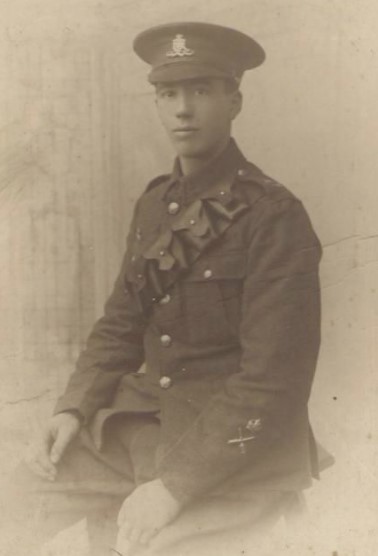
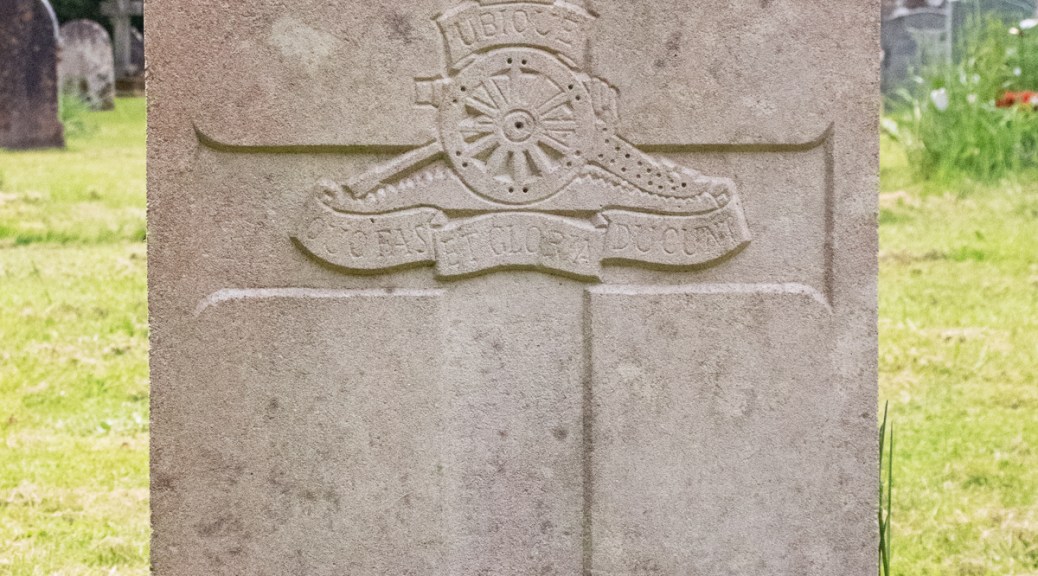
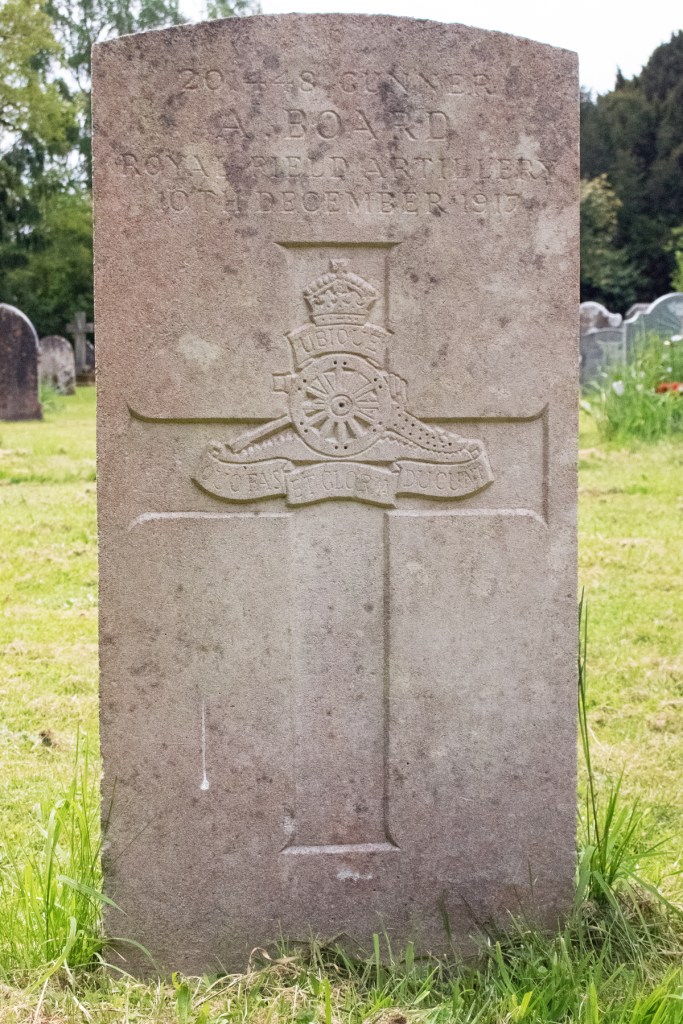
The funeral took place at Pitminster parish churchyard… of Gunner A Board, of the Royal Field Artillery, youngest son of Mr and Mrs W Board… who died in the 3rd Southern General Hospital, Oxford… from wounds received in action on 29th October. Deceased was only 21 years of age, and was buried with full military honours. Having been a former Boy Scout members of the Taunton and Trull Troops attended as a last tribute of respect and sympathy.
Taunton Courier and Western Advertiser: Wednesday 26th December 1917
Concrete information about the young life of Albert Board is destined to remain lost to time, but entries in the 1901 and 1911 censuses suggest that he had been born in Willesden, Middlesex. His parents were William and Annie Board, and the family moved to Pitminster, Somerset, at some point between the two documents.
One of seven children, by 1911 Albert had left school, and had found work as an errand boy. The youngest of the household, he was living with two older siblings – William, who was employed as a gardener; and collar making sister, Lily – and his parents. William, by this time, was working as a boot repairer.
When war came to Britain’s shores, Albert stepped up to play his part. He had enlisted in the Royal Field Artillery by the summer of 1917, and was attached to the 168th Brigade. Private Board fought on the Western Front, and may have been involved in the Arras Offensive of 1917.
Caught up in the fighting on 29th October, he was injured, and medically evacuated to Britain for treatment. He was admitted to the hospital in Oxford, but succumbed to his wounds on 10th December 1917. He was just 21 years of age.
Albert Board’s body was brought back to Somerset for burial. He was laid to rest with all due ceremony, in the quiet graveyard of Saint Mary and Saint Andrew’s Church, Pitminster.
Charles Hookins was born on 15th October 1895 in Pawlett, Somerset. The eighth of nine children, his parents were William and Susan Hookins. William was a labourer in a brickyard, but when he finished his schooling, Charles went to work on his cousin’s farm in neighbouring Huntspill.
Farming was not what Charles had in his mind as a career, however, and on 7th April 1913, he joined the Great Western Railway. Initially employed as an engine cleaner, he was sent to work at the Duffryn Yard, South Wales. He soon moved on again, however, and by October 1913, he was living in Tondu, to the north of Bridgend, where he worked as an engine fireman.
War came to Europe in 1914, and, within weeks of hostilities being declared, Charles volunteered for service. He enlisted on 1st September 1914 in Bridgend, joining the Royal Field Artillery. His service records confirm that he was 19 years of age, stood 5ft 7.5ins (1.71m) tall, and weighed 135lbs (61.2kg). He was noted as having brown eyes, brown hair and a fresh complexion.
Gunner Hookins spent most of the next year on home soil training and became attached to the 57th Brigade. On 2nd August 1915 he set off for the Mediterranean, his troop unusually making their way across mainland France, rather than sailing around Spain and Portugal. They left European shores from Marseille on 7th August, and arrived at Suvla Bay on the Gallipoli peninsula just nine days later.
The 57th Brigade remained at Gallipoli for the next five months, and during this time, in November 1915, the now Acting Bombardier Hookins spent a week in the local field ambulance, through causes unknown.
Charles’ health seemed to be suffering by this point. On 17th January 1916, he was moved to Alexandria, Egypt, where he spent another week admitted to a field hospital. After a couple of months’ grace, he was transferred back to France, again disembarking at Marseille. After another week’s admission to hospital, he was invalided back to England, eventually arriving back home at the end of April.
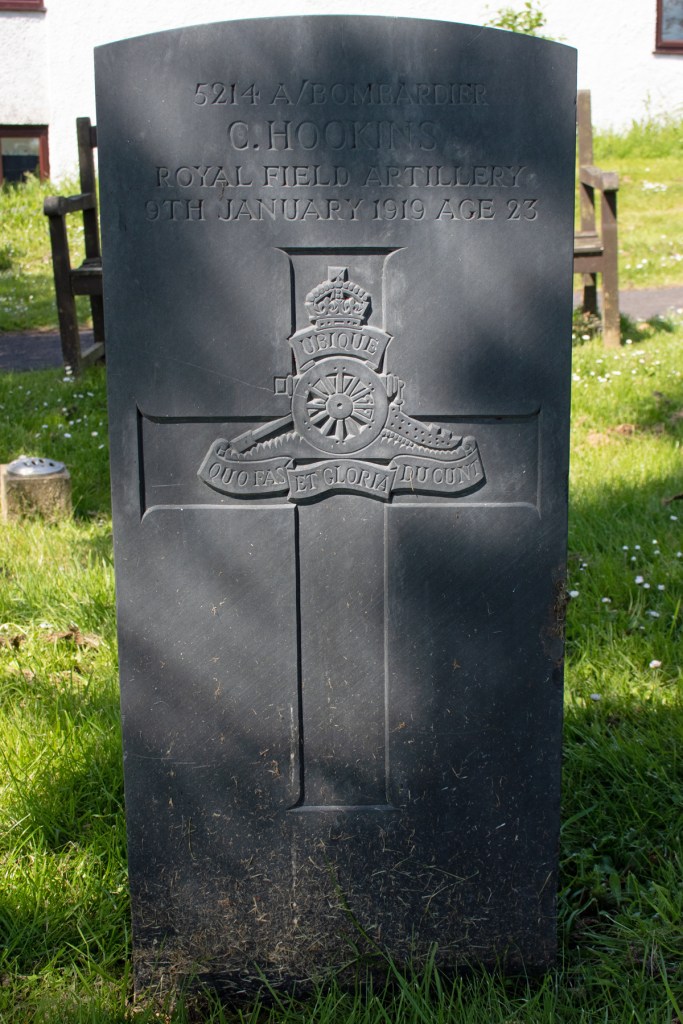
Acting Bombardier Hookins had contracted pulmonary tuberculosis, and the risk to others, as well as his own health, led to him being discharged from military service on 15th July 1916, having served for just under two years.
Charles’ trail goes cold at this point. He returned home, but his medical condition was ultimately to get the better of him. He passed away on 9th January 1919, at the age of just 23 years old.
Charles Hookins was laid to rest in the quiet graveyard of St John the Baptist Church in his home village of Pawlett, Somerset.
Frederick Chilcott was born in Bridgwater, Somerset, early in 1867. He was the fifth of thirteen children to labourer and kiln worker Henry Chilcott and his wife, Ellen.
When he finished his schooling, Frederick also found labouring work. He wanted bigger and better things, however, and the opportunity for a career in the army offered him just that. On 14th January 1888 he enlisted in the Royal Artillery. His service records confirm he was 5ft 6ins (1.68m) tall, and weighed 119lbs (54kg). He was noted as having dark brown hair, dark hazel eyes and a fresh complexion. He also had a scar on his forehead and a tattooed dot on his right forearm.
Frederick was initially given the rank of Driver and was assigned to the regiment’s 3rd Brigade Depot. He was sent to India in February 1889, and remained there until November the following year, when his troop returned to Britain.
Back on home soil Frederick’s role changed and he was given the rank of Gunner. On 1st January 1892, he was promoted to Acting Bombardier, but, on his own request, he reverted to his previous rank just three months later. On 15th January 1895, Gunner Chilcott was stood down to reserve status, having completed seven years’ service.
On 16th April 1895, Frederick married Eliza Stockham. She was a labourer’s daughter from the village of Puriton, to the north of Bridgwater, and it was here that the couple settled. Living in a small cottage, they went on to have six children between 1898 and 1911.
Frederick’s time in the army, however, wasn’t quite done. With the Second Boer War breaking out, he was recalled to the now Royal Field Artillery in January 1900. Sent to South Africa, Gunner Chilcott remained overseas for a year and was recognised for his commitment in the campaign.
Frederick returned to Britain on 3rd January 1901, and was finally stood down from the army in March that year, having fulfilled his twelve years’ contract. He returned home to Puriton, his service records noting that his character was ‘very good’.
The 1911 census found Frederick employed as a labourer in the local cement works. He and Eliza living in a small cottage in Puriton with four of the children (their oldest son was with Eliza’s parents, while she was pregnant with their youngest).
Conflict was knocking on England’s shore by this point, and when conflict broke out, Frederick appears to have stepped up to play his part once more. He was 47 years old when war was declared and, as such, would not have been required to enlist. Full details of his service are no longer available, but he had certainly joined the Army Veterinary Corps by the summer of 1917.
Private Chilcott is likely to have remained on home soil, but towards the end of his service was based in Curragh, County Kildare, Ireland. It was while here, on 23rd December 1917, that he suffered an aneurysm, passing away in the town’s military hospital as a result. He was 50 years of age.
Frederick Chilcott’s body was brought back to Somerset for burial. He was laid to rest in the quiet graveyard of St Michael’s Church in his home village, Puriton.
Valentine Burnett Wilkinson was born early in 1889 in Combe Down, Somerset. One of eight children, his parents were Harry and Eliza Wilkinson, Harry was from nearby Bath and worked as a gardener, and this is the trade into which Valentine also went when he finished school.
In the spring of 1913, Valentine married Florence Moody. She was the daughter of a stone mason and, at the time of the 1911 census, she was employed as a live-in sewing maid at Monkton Combe Junior School.
Gardening seems to have been a footstep to something bigger for Valentine, and he soon found other employment, as a police constable. He and Florence moved to Street, near Glastonbury, and this is where they were living when war broke out.
Keen to play his part, Valentine enlisted in the Royal Garrison Artillery on 11th December 1915. He was placed on reserve, possibly because of his occupation, and was not formally mobilised until the end of June 1917, just six weeks after Florence had given birth to their first and only child, Joan.
Gunner Wilkinson’s service records note that he was 5ft 11ins (1.8m) tall, and had a scar on his right wrist. He spent five months training, split between No. 3 Depot in Plymouth, Devon, 473 Siege Battery and No. 1 Reinforcing Depot in Bexhill-on-Sea, Sussex. On 3rd November 1917, however, he was sent to France, and was attached to the 234th Siege Battery.
Gunner Wilkinson’s time overseas was to be brief, however. He was caught up in a gas attack in December, and evacuated back to Britain for treatment. His health was now impacted and, during the summer of 1918, he was admitted to hospital having contracted pleurisy. After two months in hospital, Valentine was sent to the Military Convalescent Hospital in Ashton-in-Makerfield, near Wigan.
The war was in its closing stages by this point, and in November 1918 Gunner Wilkinson resumed some of his duties, albeit on home soil. His health was still suffering, and he contracted tuberculosis on the lung and throat. He was formally discharged from the army on 27th February 1919, no longer physically fit to serve.
Valentine returned home to Somerset, and it was here, on 1st April 1919, that his body finally succumbed to the lung conditions that had dogged him for nearly eighteen months. He was just 30 years of age.
Valentine Burnett Wilkinson was laid to rest in the quiet graveyard of St Michael’s Church in the parish of his childhood home, Monkton Combe.
Charles James Anderson Newbery was born in Misterton, a stone’s throw from Crewkerne, Somerset, in the spring of 1895. The oldest of eight children, his parents were Benjamin and Edith Newbery. Benjamin was a farmer, who passed away in 1908, when his son was just 13 years of age.
Charles seems not to have spent a great deal of time in the family home, however: the 1901 census found him living with his paternal grandmother, while the 1911 census, taken three years after his father’s death, recorded him as living with his paternal aunt, and working on their farm.
The farming life seemed to suit Charles: indeed he emigrated to Australia to pursue the life. When war broke out in Europe, however, he returned to England’s shores to better serve King and Country. He enlisted in the Royal Garrison Artillery on 18th October 1915, and was given the rank of Gunner.
Charles’ service records confirm that he was 5ft 5ins (1.65m) tall and weighed 140lbs (63.5kg). He was noted as having a mole on his left shoulder and an upper denture.
Private Newbery was sent to France in April 1916 and, a little over a year later, was promoted to Bombardier. He was attached to the 137th Heavy Battery and all seemed to be going reasonably well for him. He had ten days’ in England in July 1917, and a further two weeks’ in March 1918.
On 13th August 1918, possible during the Battle of Amiens, Charles was injured by a gun shot wound to his right leg. He was initially treated at the 47th General Hospital at Le Treport on the French coast, but was medically evacuated to Britain for further treatment.
Charles was moved to the 4th Northern General Hospital in Lincoln. To complicate matters, he had contracted bronchitis and, while his injury was being managed, it was a combination of the lung condition and cardiac failure to which he succumbed. Private Newbery passed away on 2nd September 1918, his mother and sisters by his side. He was just 23 years of age.
Charles James Anderson Newbery was taken back to Somerset for burial. He was laid to rest in Crewkerne’s Townsend Cemetery, not far from the family home.
Bombardier Charles Newbery (from ancestry.co.uk)
Edith had to write to the regimental office three times to get her late son’s belongings back, and in the end it took more than six months to do so. She received the items he had on him in Lincoln in April 1919: they included and “upper row [of] teeth, cigarette case, wallet containing letters, hair brush [and] comb, disc, letter, wristlet watch, note paper and envelopes.”
Albert Lowman was born in Crewkerne, Somerset, in the autumn of 1876. He was the younger of two children to Charles and Sarah Lowman. The 1881 census recorded the family – Charles, Sarah and their boys Charles Jr and Albert – living in Back Lane. Charles Sr was noted as being a labourer, although in the column highlighting any medical conditions (‘deaf-and-dumb’, ‘blind’, ‘imbecile or idiot’, ‘lunatic’), is one word: “afflicted”.
Charles Sr passed away in 1886, when Albert was just 9 years old. The next census, in 1891, found Sarah working as a charwoman, while her youngest, who had left school by this point, was employed as a labourer. Mother and son also had a lodger, Alice, who was a dressmaker. Charles Jr, by this point, had left home, and was living in Penarth, Glamorganshire, where he was apprenticed to his paternal uncle, who was a tailor.
On 28th November 1896, Albert married Sarah Ann Dodge, a weaver’s daughter who was also from Crewkerne. Albert recorded his job as a drayman, although this seems to have been piecemeal employment.
The next census found more permanent work, as he was cited as being a shirt factory packer, while Sarah was employed by the factory as a machinist. Making up the household was young Charles Lowman, the couple’s first son, who was just a month old although sadly, he survived only a couple of months more before dying.
Further tragedy is highlighted by the 1911 census, as it highlights that the couple had had a further child, who had also died when just a babe-in-arms. The Lowmans were now living on Hermitage Street near the centre of the town. Albert was still a shirt packer, and, even though their cottage was small, they had two boarders and a visitor staying. The lodgers brought the couple a little rent, which meant that Sarah no longer had to work.
War was closing in on Europe and, while his full military records are lost to time, it is clear that Albert had stepped up to play his part. He had enlisted by January 1918, and was attached to the Devonshire Regiment, through which he served with the 380 Company of the Labour Corps.
Private Lowman was barracked on Salisbury Plain, Wiltshire, and in July he was admitted to the military hospital in Salisbury itself, suffering from appendicitis. He was operated on, but died following complications. He passed away on 10th July 1918, at the age of 41 years old.
Albert Lowman was brought back to Somerset for burial. He was laid to rest in the cemetery of his home town, Crewkerne.
Private Lowman’s pension ledger record shows the beneficiaries of his army service. The document identified Sarah as his widow, but also Phillis Annie Matilda Denning, the couple’s adopted daughter, who had been born in August 1904.
Sarah was not to outlive her late husband for long, however.
The death occurred with tragic suddenness on Sunday afternoon, January 7th, at her residence in Hermitage-street, of Mrs Sarah Ann Lowman… The deceased, who was of middle age, was about as usual attending to her ordinary household duties in the morning. Just before dinner hour, however, she complained of not feeling well and went upstairs to lie down. Her niece took her up a cup of how water, and she then apparently went to sleep. She awoke about 3:40pm, and then had to get out of bed owing to sickness. Upon going back into bed again she expired almost immediately. Dr Wolfenstein was called, but he could only pronounce life extinct.
Langport & Somerton Herald: Saturday 20th January 1923
Sarah was 47 years of age when she passed away. It is likely that she was laid to rest near her husband, although records to confirm this have been lost.
Albert’s brother, Charles, survived his sibling by less than six months. He had left tailoring behind him in South Wales, and instead embarked on a military career. He joined the Royal Field Artillery in 1895 and, over the course of his twelve years’ service, served in the Caribbean and the Mediterranean.
Charles married Florence Dodge in 1908, and the couple went on to have two children – Cecil and Freda. When war broke out in 1914, he stepped up once more. Having already risen through the ranks from Gunner to Bombardier and Corporal, he re-entered service as a Sergeant in the Royal Garrison Artillery.
Based in Le Harve, Northern France, Sergeant Lowman was admitted to a hospital in Harfleur, having contracted bronchial pneumonia. Sadly, he passed away while admitted, on 8th November 1918, just three days before the end of the conflict. He was 43 years of age.
Charles Lowman was laid to rest in the Sainte Marie Cemetery, near the centre of Le Harve.
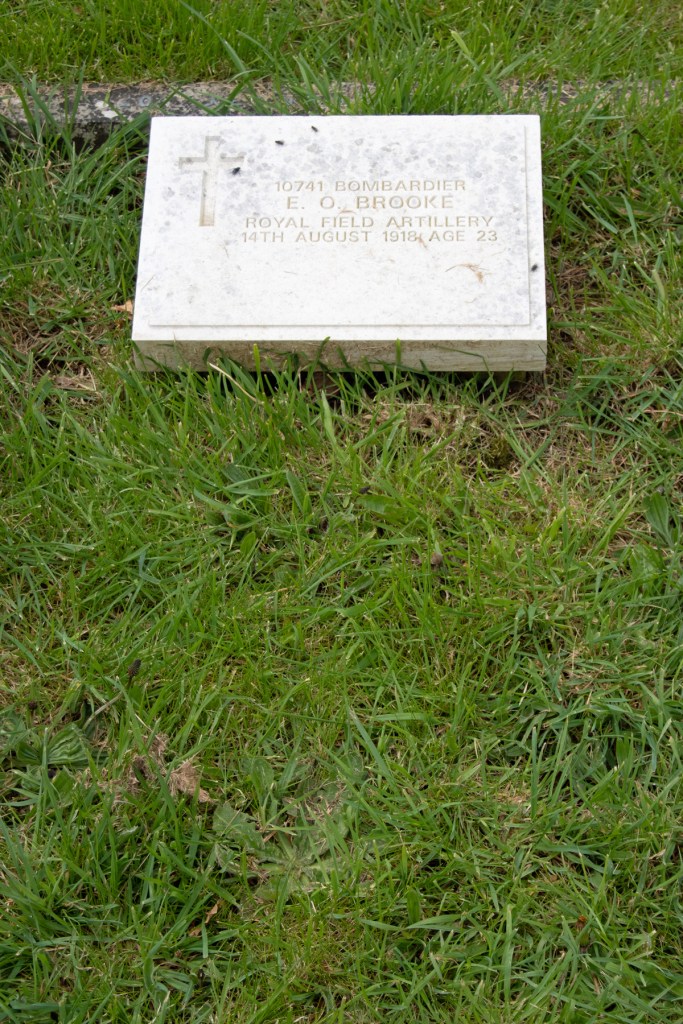
Ernest Oliver Brooke was born in 1895 in Bath, Somerset. The oldest of four children, his parents were tailor Oliver Brooke and his wife, Kate. Ernest did not follow in his father’s footsteps, however, and, by the time of the 1911 census, when the family were living in a Georgian town house in the Lyncombe area of the city, he was noted as being employed as an engine fitter.
Storm clouds were brewing over Europe by this point and, when war was declared, Ernest was one of the first to step up to play his part. He enlisted in 1st September 1914, and was assigned to the Royal Field Artillery.
Gunner Brooke’s service records show that he was 5ft 10ins (1.78m) tall and weighed 138lbs (62.6kg). He had brown hair, grey eyes and a fresh complexion.
Ernest spent ten months on the Home Front, learning and honing his skills. In July 1915 he was sent to the Mediterranean, and found himself in Gallipoli. After nearly a year in Eastern Europe, he was sent to serve on the Western Front in France.
His service records show that the now Bombardier Brooke was wounded on 10th November 1916. Little additional information about this is available, and he was certainly fit enough not to be sent back to Britain for treatment or recuperation.
Things had changed for Ernest, however, and by December 1916, he was transferred back to the UK, to serve on the Home Front once more. While serving in Gallipoli, he had contracted tuberculosis. Over the ensuing months, he had gradually lost weight and developed a distressing cough, which occasionally resulted in haemoptysis, or coughing up blood.
By the summer of 1918, Bombardier Brooke was admitted to a sanitorium. His health led to him being medically discharged from the army on 20th June, and his condition slowly deteriorating. On 14th August 1918 he finally succumbed, aged just 23 years old.
Ernest Oliver Brooke was laid to rest in the family plot in St James’ Cemetery, Bath.
Douglas Arthur James was born on 8th May 1893 near Shepton Mallet, Somerset (records variously quote Oakhill, Stoke St Michael and Shepton itself, but all are within a few miles of each other). One of seven children, his parents were dairy farmers Theo and Elizabeth James.
When Douglas and his siblings left school, they all took up work on the farm, but when war broke out, Douglas wanted to play his part. He would not get his chance to do so until the spring of 1917, when he joined the Royal Field Artillery.
Again, the records differ, one suggesting that he was assigned to the 3rd (Reserve) Brigade, while another suggests that Gunner James was actually assigned to the 15th Reserve Battery. Both units served overseas, although it is impossible to determine whether Douglas went as well.
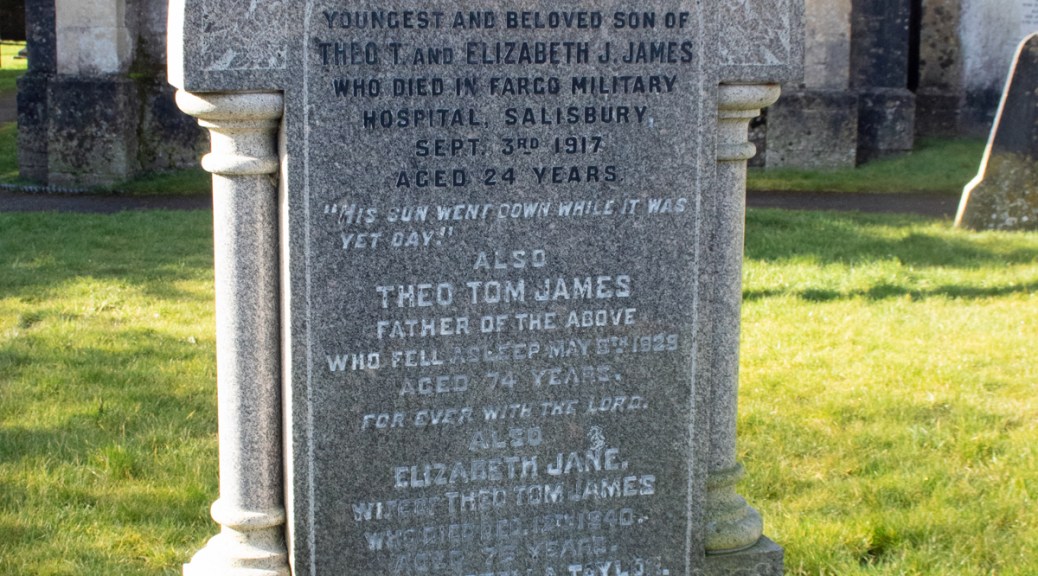
The only other identified document relating to Gunner James confirms that he was admitted to the Fargo Military Hospital at Larkhill, Wiltshire. The cause of his admission is unclear, but he passed away while there on 3rd September 1917. He was just 24 years of age.
The body of Douglas Arthur James was brought back to Somerset for burial. He was laid to rest in the family plot in the graveyard of St Bartholomew’s Church in West Cranmore.
Douglas remained alone in the family plot for a number of years. The family were eventually reunited, however, when Theo, who died in 1929, and Elizabeth, who passed in 1940, were also laid to rest there. Two of Douglas’ sisters were also buried in the plot – Evelyn, the oldest James daughter, who died in 1952, and Emily, the youngest of the siblings, who passed away in 1977.










 Death and Service