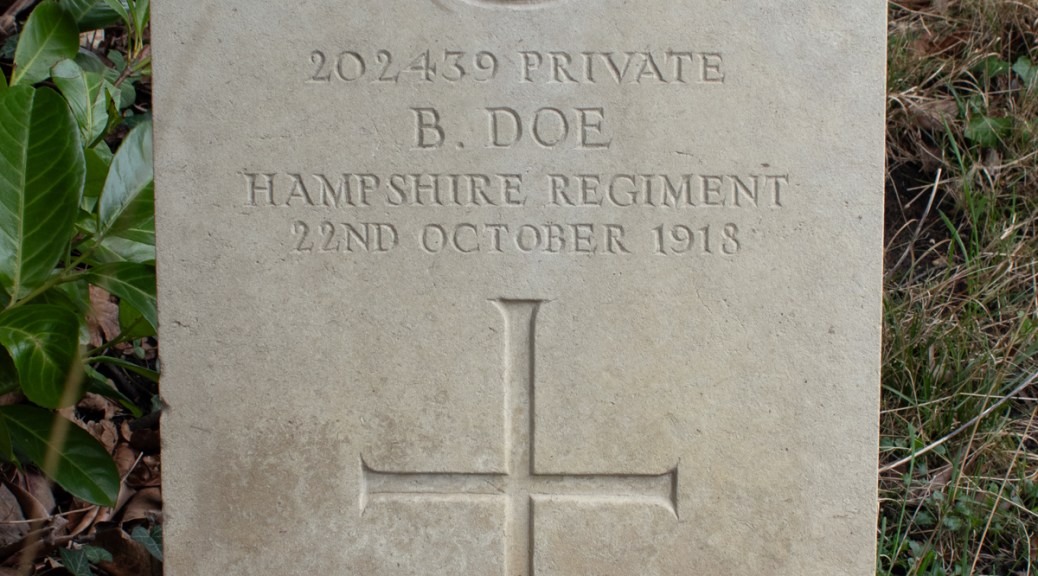
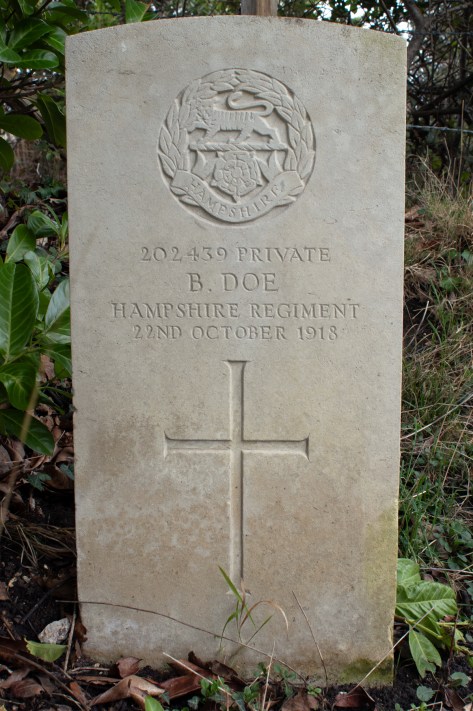
Bert Doe was born in Woking, Surrey, in 1881. One of twelve children, his parents were France and Louisa Doe. Francis – who went by his middle name, John – was a general labour and, over the years, his work took the family across the south of England. The 1891 census found the Does living in the village of Sopley, Hampshire, and this is where they seemed to settle.
There are large gaps in Bert’s early life, On 19th April 1916, he married Ellen Lackey. She was a broom maker’s daughter from Lyndhurst, Hampshire, and the couple had a son, Francis, who had been born a few weeks before they exchanged vows.
By the summer of 1918, Bert had enlisted in the army. He was attached to the Hampshire Regiment, but at some point had transferred over to the 441st Agricultural Company of the Labour Corps. Moves of this nature were often a way to rehabilitate injured or sick servicemen, and it is apparent that Private Doe fell into the latter category.
In October 1918, Bert had fallen ill with a combination of influenza and pneumonia. He was admitted to the Union Infirmary in Winchester, Hampshire, but the conditions were to prove too severe. He died on 22nd October 1918, at the age of 37 years old.
It would seem that Ellen was living in the East Boldre area of the New Forest by this point, and it was in the village’s St Paul’s Churchyard that her husband was laid to rest.
With a young son to raise, Ellen moved back in with her parents, Silas and Anna Lackey. The 1921 census found them living in Warsash Road, Sarisbury, Hampshire. Silas was employed as a labourer, while two of Ellen’s brothers were working as hawkers. Shockingly to today’s mindset, the census document records the family as ‘gipsies’.
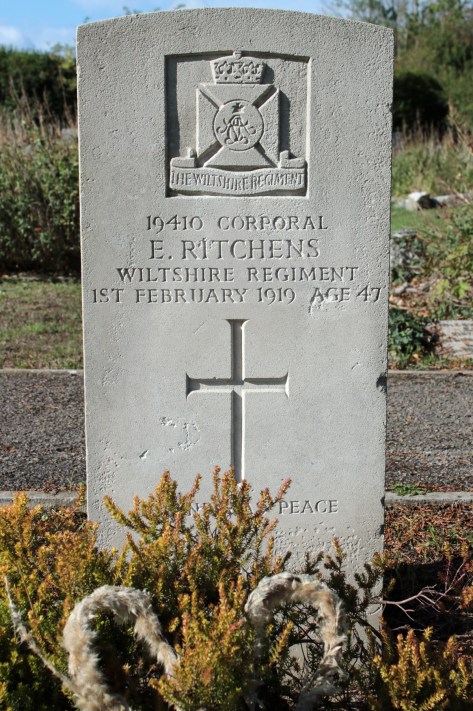
Ernest Ritchens was born in the summer of 1872 in the Wiltshire village of Semington. The youngest of nine children, he was one of seven boys to Isaac and Sarah Ritchens. Isaac was a farm labourer, and this is a job into which Ernest also followed when he completed his schooling.
Farming was not something Ernest wanted to be in for the long term, however, and, after the death of his parents – Isaac in 1895, and Sarah four years later – he joined the army. Details of his military career have been lost to time, but it seems that he joined the Wiltshire Regiment and, as a Private, spent time in South Africa. By the time he was stood down, he had risen to the rank of Lance Corporal.
Back home and, in the summer of 1907, Ernest married Sarah York, a wheelwright’s daughter from Hilperton near Trowbridge, Wiltshire. The newlyweds would set up home in the village, and go on to have four children. The 1911 census found the young family living on Devizes Road, Ernest back working as a farm labourer.
When war broke out, Ernest was again called upon to play his part . He was given the rank of Corporal, and attached to the Wiltshire Regiment (although other records he was assigned to the Hampshire Regiment). He did not appear to have spent any time overseas and, was soon transferred over to the 160th Company of the Labour Corps.
DEATHS
RITCHENS – On February 1st, at No. 1, Australian Hospital, Sutton Veny, Corporal Ernest Ritchens, of the Labour Corps, and formally of the Wilts Regiment, resident of Hilperton…
[Wiltshire News: Friday 7th February 1919]
Ernest Ritchens was 46 years of age when he passed away in 1919. While the cause us not reported, it is likely to have been an illness of some sort. His body was taken back to Hilperton, and he was laid to rest in the village cemetery.
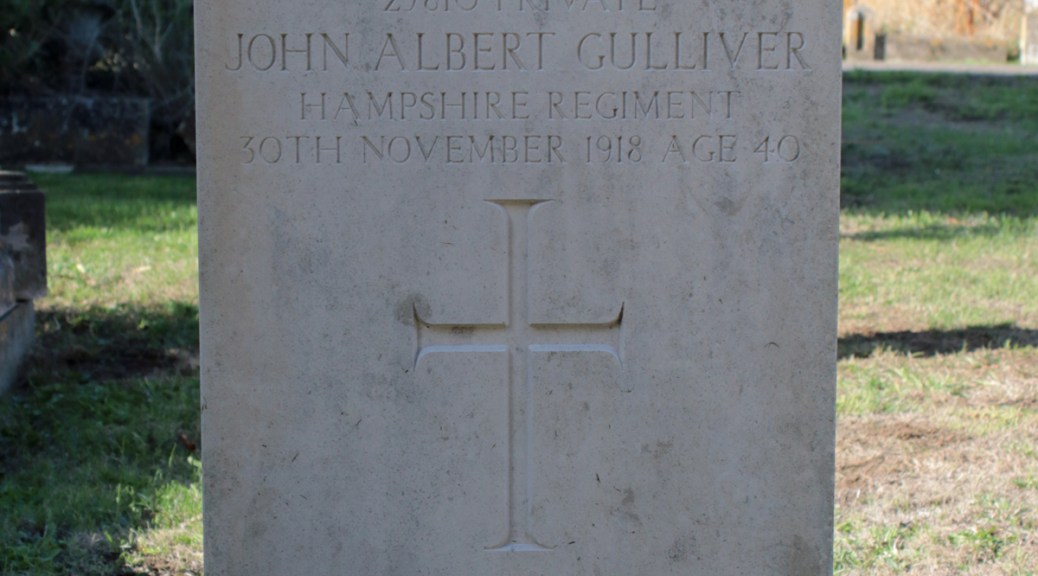
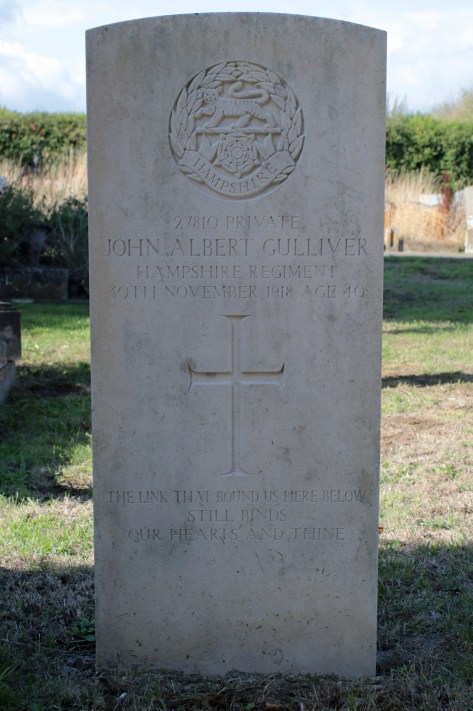
John Albert Gulliver was born in the summer of 1878. He was the second of six children – and the first boy – to farmers John and Ruth Gulliver. The family were raised in the Wiltshire village of Steeple Ashton, but had moved to Hilperton, on the outskirts of Trowbridge, by the time their eldest son had turned ten years old.
John Jr found work as a builder’s labourer when he finished his schooling. The 1911 census recorded him as living with his parents and sister on Horse Road, Hilperton, although the document suggests he was working in Edington, six miles to the south of the village. The Gulliver family also had a visitor – Bristol-born Albert Davies, who was a Lance Corporal in the Coldstream Guards.
When war broke out, John Jr was called upon to play his part. His service records have been lost to time, but it is clear that he had joined up by 1917. There is some confusion over his military service, however.
The Commonwealth War Graves Commission records give Private Gulliver’s initial unit as the 3rd Battalion of the Hampshire Regiment, and he was awarded a ‘wounded stripe’ following an injury on 10th September 1917. However, John’s Medal Roll Index Card suggests he joined the Duke of Cornwall’s Light Infantry. Either way, Private Gulliver did not appear to spend any time overseas and, by the autumn of 1918, he had transferred to the 442nd Agricultural Company of the Labour Corps.
Private Gulliver survived the war, but his health had been impacted. He had contracted pneumonia, and passed away at home on 30th November 1918. He was 40 years of age.
The body of John Albert Gulliver was laid to rest in the tranquil grounds of Hilperton Cemetery, not far from where his grieving parents still lived.
Inquests have been held by Mr PB Ingoldby, County Coroner, on the bodies of Sergt. S Pickett, aged 36, and Sergt. A Martin, aged 29, whose deaths occurred recently as the result of an explosion in the New Forest.
The evidence showed that Sergt. Martin was killed. Sergt. Pickett was found insensible from shock, and died five hours later in hospital. In both cases the verdict was that death took place accidentally, and that no blame was attached to anybody.
[Hampshire Independent: Saturday 3rd March 1917]
The life of Sergeant A Martin is a challenge to piece together. While no service papers remain, the few documents that are available don’t provide enough information to unpick the his details.
His entry in the Army Register of Soldiers’ Effects confirms his name as Alfred Albert Martin, and that he served in the 3rd Battalion of the Hampshire Regiment. The document also gives his beneficiary as his mother, Philaidah.
Sergeant Martin’s pension ledger card gives his mother’s name as Louisa Martin, of 64 Bedford Street, Kingstone Road, Portsmouth. It also provides details of a brother, Sergeant Arthur Theodore of the Devonshire Regiment, who also died during the conflict.
The newspaper report suggests Alfred would have been born in around 1888, but there is no definite evidence of him, Philaidah/Louisa or Arthur in census records from 1891 to 1911.
Alfred’s Medal Roll Index Card confirms that he served in the Balkans, and arrived there on 25th April 1915. It gives his rank only as Sergeant, which would suggest that he may have had some military background before the First World War.
Sadly, there are too many pieces to the jigsaw of Sergeant Martin’s life missing to be able to build a better picture. Killed by an accident, he was laid to rest in Lyndhurst Cemetery, not far from where he died.
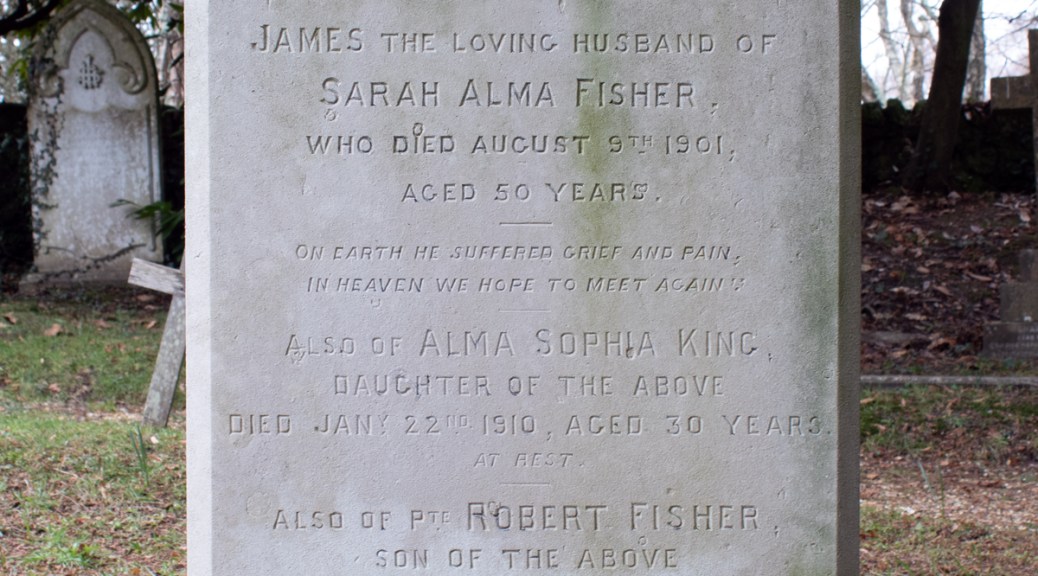
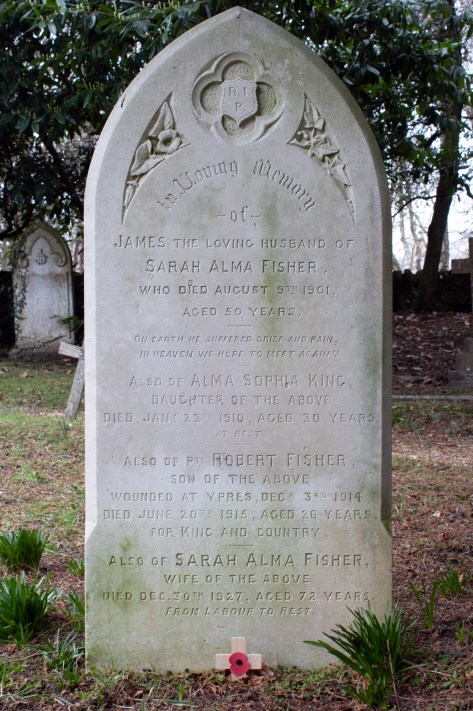
Robert Fisher was born on 12th September 1888 in Lyndhurst, Hampshire. He was the sixth of eight children to James and Sarah Fisher. James was a coachman, and the family lived on Pike’s Hill, to the north of the town centre.
James died in 1901, and Robert remained at home to support his mother and two younger sisters. The 1911 census found the family living in the same four-roomed cottage on Pike’s Hill: Robert was employed as a mail driver, while his sister Kathleen worked as a domestic servant. The family also had a lodger, William Penny, to help bring in some extra money.
When war broke out, Robert stepped up to play his part. His service documentation has been lost, but it is clear that he enlisted in the opening weeks of the conflict, and was assigned to the 1st Battalion of the Hampshire Regiment. As proof of a quick turnaround for these new recruits, Private Fisher found himself in France by mid-November 1914.
Fighting on the Western Front near Armentières, Private Fisher was wounded on 3rd December 1914. He was medically evacuated to Britain for treatment, and admitted to Netley Hospital near Southampton, Hampshire. He had been “struck in no less than seven places by shrapnel.” [Hampshire Independent: Saturday 3rd July 1915]
Eventually well enough to return home, by June 1915, Robert’s health had deteriorated. He contracted meningitis, and was admitted to the Isolation Hospital back in Southampton. The condition would ultimately prove fatal and Private Fisher passed away on 20th June 1915: he was 26 years of age.
Robert Fisher was laid to rest in the family plot in Lyndhurst Cemetery, alongside his father, and not far from where his grieving mother still lived.
Joseph Walls was born in Tortington, near Arundel, in West Sussex, on 13th November 1880. The youngest of four children, his parents were gamekeeper James Walls and his wife Annie. James moved the family to where his work took him and, by the time of the 1891 census, they had settled in the New Forest village of Sway, Hampshire.
When Joseph finished his schooling, he found work as a horseman and groom. The 1901 census found him living with his parents and older sister in a house in Brockenhurst. He seems to have taken his work seriously, and soon found himself a position as a chauffeur. The next census, taken in 1911, recorded him as working for Ann Libbey and her family in the village of Boldre.
On 18th February 1914, Joseph married Edith Perry. A carpenter’s daughter, she was working as a domestic servant when the couple exchanged vows. Their wedding certificate confirms that Joseph was ten years his new wife’s senior, and that they ceremony was witnessed by his older brother Frederick and her younger sister, Esther.
Joseph and Edith would go on to have two children: Vera was born in 1915, while Daphne came along three years later. During this time, however, war was raging across Europe, and Joseph had stepped up to play his part.
Private Walls enlisted within weeks of war being declared, on 10th December 1914. His service papers show that he was living at Hospital Cottage in Lyndhurst when he joined up. He was 5ft 8ins (1.72m) tall, with black hair, grey eyes and a dark complexion. He was also noted as being asthmatic since he was a child.
Assigned to the 1st/4th Battalion of the Hampshire Regiment, over the next few years, Private Wallis would see the world. Within days of enlisting, he was shipped out to India, where he would spend nearly three years (apart from the in the summer of 1917, when he served as part of the Mediterranean Expeditionary Force). During this time, Joseph was promoted to Lance Corporal, although by the time he left the army, he had returned to the tank of Private.
By the beginning of September 1917, Joseph was back on home soil. A spell of malaria that spring had impacted his asthma, and at the end of November, he was deemed no longer fit for war service. Private Walls was medically discharged from the army on 29th November 1917.
At this point, Joseph’s trail goes cold. He definitely returned home – Daphne was born just a few days after the Armistice – but it is unclear whether he was it enough to work.
Joseph Walls died on 14th February 1919: he was 38 years of age. He was laid to rest in Lyndhurst Cemetery, not far from where Edith and their children lived.
Joseph Tyler was born in the spring of 1882, and was the youngest of three children to Joseph and Sarah. Joseph Sr was a carter from Staffordshire, and the family were born and raised in Wordsley.
The 1901 census found the Tylers living in Brierley Hill, with Joseph Jr having found employment as a glass worker. His father passed away in 1907, and so he remained at home to support his now widowed mother.
By the 1911 census, Sarah and Joseph had moved to Birmingham, and were living at 32 Wiggin Street, a terraced house in the Ladywood area. Joseph listed his employment as a glassblower, while his mother gave no employment, presumably looking after the home.
When war came to Europe, Joseph stepped up to play his part. Full details of his service have been lost, but it is clear that he enlisted early on in the conflict. He joined the Hampshire Regiment, and was sent to Wiltshire for training.
Tragically, Private Tyler’s time in the army was not to be a lengthy one. Barracked near the village of Boyton, he was quickly admitted to the local military hospital. Suffering from heart failure, this would take his life: Joseph died on 13th October 1914, at the age of 32.
The body of Joseph Tyler was laid to rest in Boyton Cemetery, not far from the camp that had, so briefly, been his home.
Thomas Fidler was born on 15th May 1881 in Newbury, Berkshire and was the fourth of eight children to Charles and Sarah. Charles was a groom, who travelled where the work was, and, by the time of the 1901, the family has relocated to Whitchurch in Hampshire.
When he finished his schooling, Thomas found work as a dairyman. However, he had always had his sights on bigger and better things, and, having been a volunteer for the local militia, he was keen to become a full soldier. Things did not go immediately to plan though, and he was initially turned down because he was under height – he was just 5ft 3ins (1.6m) tall when he turned 18.
But Thomas was persistent, and, on 27th June 1898, he was formally enrolled in the Hampshire Regiment. Along with his height, his service records confirm other details about the young man he had become. The document show that he weighed 124lbs (56.2kg), and that he had brown hair, brown eyes and a fresh complexion. The records advise that he was considered fit for duty, but also note that he was given special authority to enlist, presumably to bypass the concerns about his height.
Private Thomas Fidler would go on to build up quite a military career for himself. He spent nearly two years on home soil, before his unit was shipped out to South Africa. During his time in the colony, he served in a number of the campaigns, and was awarded with the Queen’s South Africa medal, including clasps for Cape Colony, Orange Free State and Transvaal, and the King’s South Africa Medal 1901-1902.
After more than two years spent overseas, Thomas’ unit returned to Britain. He would remain on home soil until 1903, extending his service beyond the five compulsory years, and choosing to remain on active duty, rather than being stepped down to reserve status. In September of that year, his unit was on the move again, and he was transferred to Malta.
It would not be until September 1905 that Private Fidler saw home soil again. He was formally stood down from duty the following June and assigned to the Army Reserve. Interestingly, his transfer papers recorded that his conduct was indifferent, disobedient… inclined to drink.
Thomas’ attitude over the years was evidenced by his entries in the Regimental Defaulter Book. He was disciplined no fewer than twelve times during his military career. His offences included being absent from parade and using insubordinate language. While stationed in Malta, he was punished for being drunk four times. Over the years, Private Fidler spent 125 days confined to barracks, and was fined a total of £1 2s 6d for his crimes.
When he was not confined to barracks, Private Fidler would likely be found in a sick bay. Between January 1901 and September 1905, he spent 342 days in hospital with conditions ranging from fevers, psoriasis, scabies and gonorrhoea.
On 22nd March 1905, while serving in Malta, Thomas was admitted to hospital having suffered a fractured jaw following a scuffle. The cause of the injury is recorded in detail in an eleven-page report, which outlined that Private Fidler had been out in Valetta, and ended up quite drunk. He was approached by a couple of military police officers, and became abusive towards them. While trying to take off his boots, a private from another regiment, who was also drunk, came along and punched him in the face, fracturing his jaw. Both men were arrested and taken back to barracks. The investigation in to the incident found that, while Private Fidler was off duty at the time, he was to blame for the altercation.
In June 1906, Thomas returned to civvy street, and to his former job as a dairyman. On 5th February 1907, he married Tryphena Snook, who was the daughter of his employer. The couple had had a son the previous year, and would go on to have three more children in the next few years.
The 1911 census found the young family living in Sparsholt, Hampshire, the household being made up of Thomas, Tryphena and their older two children, Tryphena’s parents, William and Emma, and a boarder, William Clark, who was a carter on the farm.
By the summer of 1914, Thomas had been formally stood down from the army, his contract coming to an end on 26th June. A storm was brewing over the Channel, however, and he would soon be called upon to play his part once more.
Details of Thomas’ re-enlistment into the army have been lost to time. It is likely that he was called upon quite quickly. He was assigned to the South Wales Borderers, and, with the experience he had under his belt, was given the rank of Lance Corporal.
Thomas’ unit – the 4th (Service) Battalion – was initially sent to France, and he arrived there early in July 1915. Within a matter of weeks, however, the battalion moved on to the Eastern Mediterranean, ending up at Gallipoli.
Lance Corporal Fidler’s time in on the peninsula would have been fraught with danger. In the autumn of 1915, he was badly injured and was medically evacuated to Britain for treatment. Admitted to hospital in Devon, his wounds were to prove too severe, and he passed away on 5th November, at the age of 34.
The funeral rook place at Paignton… of Lance-Corpl. Thos. Fidler, of the 4th South Wales Borderers, who died at Oldway Hospital on Friday as a result of wounds sustained at Gallipoli. The widow and other mourners followed, and the Matron of the Hospital (Miss Blackmore) was among those present. Wounded convalescents from Oldway and a Company of the 7th Devons, under Capt. Brearley, attended, and the Devons provided a firing party.
[Exeter and Plymouth Gazette – Tuesday 09 November 1915]
Thomas Fidler was laid to rest in Paignton Cemetery.
Alfred Pollard was born in the spring of 1869 in Hinton Charterhouse, Somerset. His early life seems to have been a little disjointed. The son of Harriett Pollard, who had him out of wedlock, his baptism record gives no details of his father.
The 1871 census found him living with his mother and her widowed father, Thomas Pollard. Ten years later, Harriett is living with her husband, Walter Hayden, and four children, including Alfred – who has also taken the name of Hayden. Thomas is also recorded as living with the family.
Alfred is missing from the 1891 census return. Harriett, however, is now listed as married and the head of the household. She and Walter had a further three children – their youngest, Percy, being just three months old. Times must have been tough for her: the same census recorded Walter as being an inmate of the Somerset and Bath Asylum, where he is listed as being a lunatic.
Harriett died at the start of 1892, aged just 46 years old: Walter died three years later, at the age of 55. Both are buried in the graveyard of St John the Baptist Church, Hinton Charterhouse.
The passing of his mother and the diminishing health of his stepfather seems to have spurred Alfred into building a career to support his siblings. Having been working as an engine driver, on 7th December 1892, he enlisted in the Somerset Light Infantry.
Alfred’s service records give his height as 5ft 7ins (1.7m) and his weight as 137lbs (62kg). He was noted as having black hair, bark eyes and a coarse complexion. He also had a number of tattoos, including a cross on his right forearm; a circle of dots on his right wrist; crossed flags, an anchor and Jubilee 1887 VR and crown on his left forearm; and a bracelet on his left wrist. The records also noted the loss part of the middle finger on his right hand.
Private Pollard quickly became a career soldier. Over 21 years, he rose through the ranks to Lance Corporal (July 1902), Corporal (April 1906), Lance Sergeant (November 1907) and Serjeant (June 1911). He spent more than 14 years in India, and was involved in the Mohmand Campaign of 1897. He was formally discharged on 6th December 1913, having served as a signaller for eleven years, and a Provost Sergeant for three. His discharge papers confirmed his exemplary character, and that he was “thoroughly hardworking, sober and reliable.“
Back on civvy street, Alfred found work as a labourer in an iron foundry. This was not to last long, however, as he stepped up once more when war was declared in the summer of 1914. Joining the Somerset Light Infantry on 12th October, he retook his previous rank of Serjeant.
Alfred served on home soil during this second period in the army. Initially attached to the 3rd (Reserve) Battalion, his unit was based in Devonport, Devon. In September 1916, Sergeant Pollard was transferred to the 2nd Garrison Battalion of the Devonshire Regiment, which was based in nearby Plymouth. In January 1917, he moved again, to the Hampshire Regiment. He spent most of the year with 18th (Home Service) Battalion in Aldershot, Hampshire, and by December had moved to the 3rd (Reserve) Battalion, which was based in Gosport.
Sergeant Pollard remained on active service until the end of February 1919, when he was formally demobbed. At this point, his trail goes cold, although he seems to have settled in Bath, Somerset. He went on to marry, although details of his wife are limited to the name Mrs AE Pollard and her date of birth, 15th March 1879.
Alfred Pollard died of cardiac failure on 7th March 1921: he was 52 years of age. He was laid to rest in the army section of Bath’s Locksbrook Cemetery.
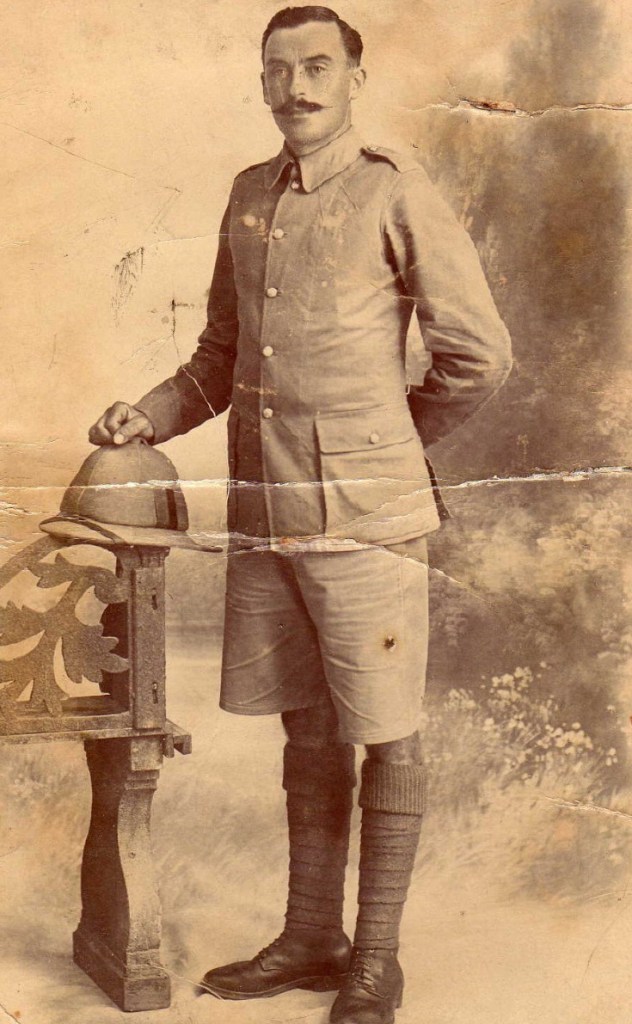
James Henry Savory was born in Gloucester in the spring of 1872. An only child, his parents were Frederick and Sophia Savory. Frederick was innkeeper of the town’s Bell Inn, but things seemed to go wrong for the family as time passed.
Both Frederick and James disappear from the 1891 census return, while Sophia is recorded as being an inmate in the Bristol City Workhouse. She was still there ten years later, although whether she had been there for the full decade is unclear.
James, by this point, had found employment as a travelling labourer. By the autumn of 1891, he had met Edith Morgan, a butcher’s daughter from Bristol. The couple married on 16th May 1892, four days before Edith gave birth to their first child, a daughter they called Eleanor. The couple set up home in Bedminster, James finding work as a foreman at the local marble works. He and Edith went on to have four children in all.
James was drawn to piecemeal work: by the time of the 1911 census, the family had moved to Portishead, Somerset, and he was employed as an ironmonger. His son, James Jr, was apprenticed in the same line of work, and the family had a relative, 71-year-old printer William Badger, boarding with them to bring in a little extra money.
What war came to Europe, James stepped up to play his part. Full records are not available for him, but he certainly enlisted in the army. Based on his age – he was 42 years old when the conflict began – it seems likely that he either volunteered for service, or that he was called up later in the war.
Private Savory was attached to the 19th Battalion of the Hampshire Regiment. Whether he service on home soil or overseas is unclear, but he survived through to the end of the war, and had returned home by the start of 1919.
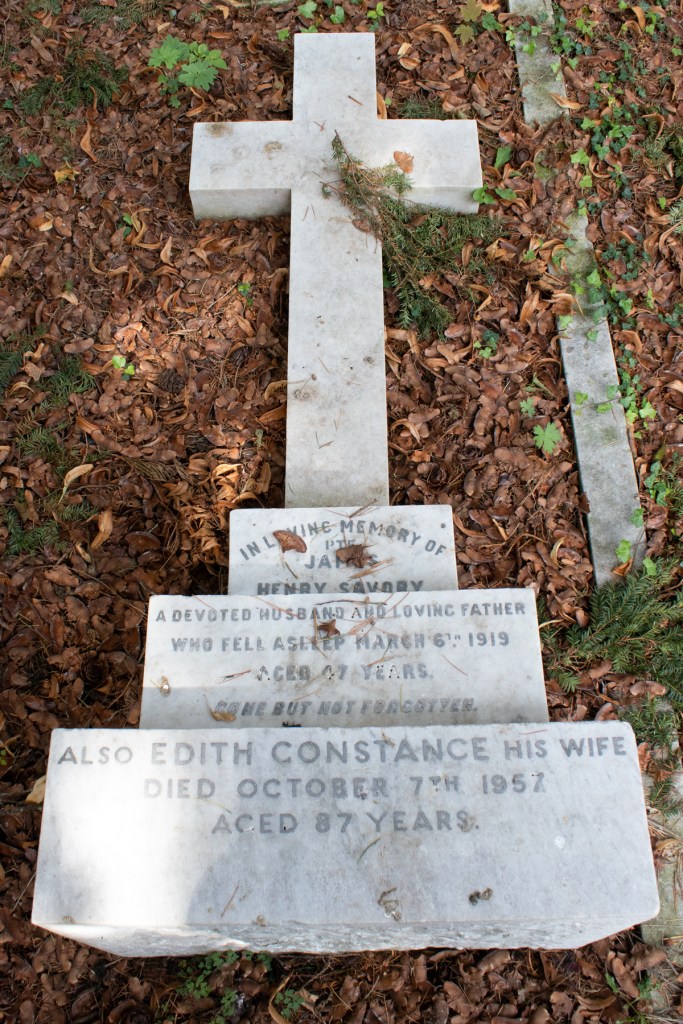
James Henry Savory died on 6th March 1919: he was 46 years of age. He was laid to rest in Portishead Cemetery, not far from where his widow still lived. Edith lived on until October 1957: she was laid to rest with her late husband, reunited after nearly forty years.







 Death and Service