Carmelo Ellul was born in Valetta, Malta, on 26th May 1889. There is little information about his early life, other than the fact that he worked as a baker.
He came to England at some point in the early 1900s, and was living in Portsmouth. It was here that he met Selina Southcott, who had been born on the Isle of Wight, and the couple married in 1904. The couple would go on to have three children, all boys: Maurice, who was born in 1911; Alva, who was born in 1912, but who died as a toddler; and Edwin, who was born in 1916.
Carmelo seemed to want a life of adventure: in the summer of 1912, he enlisted in the Royal Navy. Over the next eight years, Officer’s Cook Ellul served on a number of naval vessels, including HMS Bacchante, which toured the North Sea, and was involved in the Battle of Heligoland in August 1914.
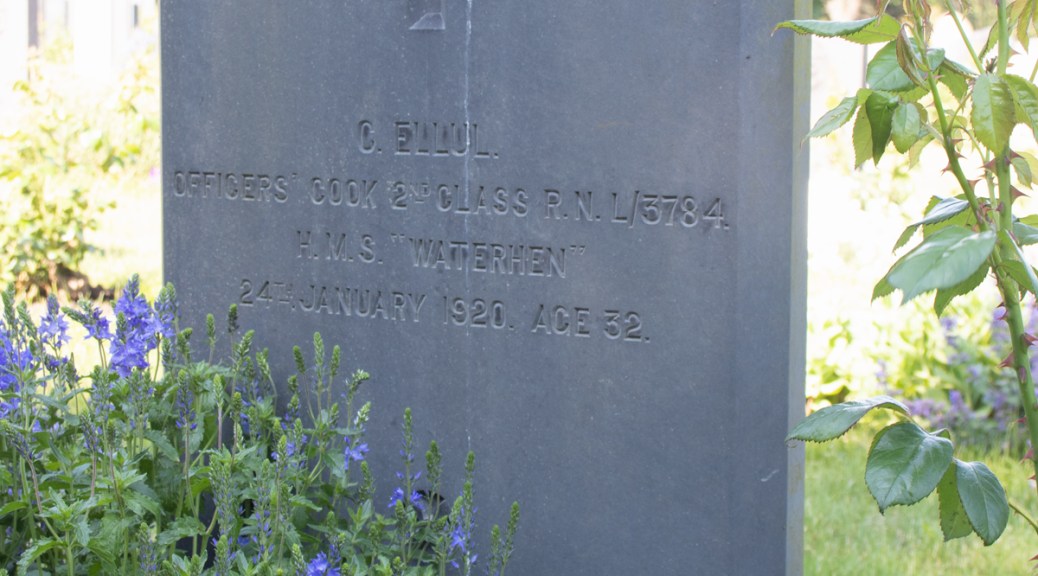
Carmelo’s naval life continued after the war ended, although he seems to have been more shore-based than before. He was serving on HMS Waterhen on 24th January 1920, when he collapsed with an epileptic fit, and died of heart failure. He was just 32 years old.
Carmelo Ellul was laid to rest in the Woodlands Cemetery in Gillingham, Kent, presumably as his ship was moored in the nearby Naval Dockyard in Chatham.
Percy Harry Hawkins was born in Waltham Green, London, in 1886. One of five children, all boys, his parents were Frederick and Elizabeth Hawkins. Frederick initially worked as a brewer’s collector – collecting rent from tenant pub managers on behalf of the brewery – before working as a tobacconist.
In July 1908, Percy married Gladys Parnell. Sadly, tragedy was to strike and, over the next couple of years both Elizabeth and Frederick passed away in 1909 and 1910 respectively.
By the time of the following year’s census, Percy and Gladys were boarding with a dispensing doctor (or GP), and his wife. Percy listed his occupation as a ‘traveller’, was probably employed as some kind of salesman.
Tragedy was to strike Percy again. Months after the couple had their first child in July 1911, Gladys also passed away, leaving him as a widower and single parent at just 26 years old.
From his later military documentation, it seems that Percy married again in August 1915, this time to a woman called Mildred, and, by September 1919, he had gone on to have three children in total; one boy and two girls.
When war broke out, Percy was quick to enlist. He joined up in Birmingham on 10th August 1914, and gave his profession as a commercial traveller. His records show that he was 28 years and 120 days old, stood 5ft 6ins (1.69m) tall and weighed 131lbs (59.5kg).
After initially joining the Royal Warwickshire Regiment, Private Hawkins was transferred to the Royal Army Service Corps, and was assigned to one of the supply companies.
Over the four years of the war, Percy served on home soil, and was promoted a number of times, rising from Private to Lance Corporal, Staff Sergeant to Quartermaster Staff Sergeant. In September 1917, he was again promoted, this time to Staff Sergeant Major, a position he held for the remainder of the conflict, and on into 1919, when he volunteered for an extra year’s service, rather than being demobbed.
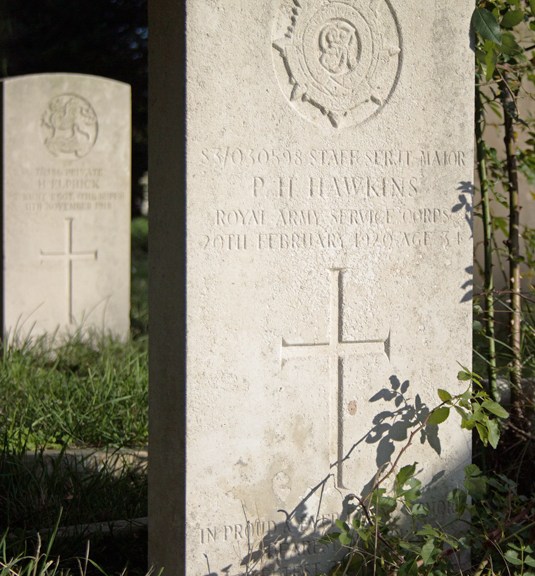
In February 1920, Staff Serjeant Major Hawkins fell ill; he was admitted to the military hospital that had been set up in Brighton Pavilion, Sussex. The diagnosis was heart failure, and, sadly, it was to this that he was to succumb. He passed away on 20th February 1920, aged just 34 years old.
Percy’s family was, by this time, living down the coast in Worthing; his body was brought there for burial and he lies at rest in the Broadwater Cemetery in the town.
Frederick John Slaughter was born in around 1878, one of eight children to Stephen and Frances (who was better known as Fanny) Slaughter. Stephen was a brewer’s drayman, who had gotten himself in trouble with the law the year before Frederick was born.
Stephen Slaughter charged with feloniously embezzling five several sums of 10s each, which he had received for and on account of his masters, Octavius Coope and others, at Worthing, on the 7th September 1876, was sentenced to six calendar months’ hard labour.
Sussex Advertiser: Saturday 14th April 1877
Stephen was imprisoned in Petworth Jail, but took ill there. Two months later, a further newspaper report shed further light on him:
ANOTHER DEATH IN THE GAOL
On Thursday another inquest – the second within a week – was held at Petworth Gaol… on the body of Stephen Slaughter.
Mr Linton, the governor, said the deceased was about 36 years of age, was a brewer’s drayman and was sentenced at the April Quarter Sessions to six months’ imprisonment with hard labour for embezzlement. He was a very quiet, industrious, and well-conducted prisoner.
On admission he was put to a labour machine, which consists of turning a handle, weighted to 10lbs, and making 14,000 revolutions daily as a maximum. About a fortnight after he was reported to the surgeon. He was looking pale, and was put in the open air to work at the pumps.
About the middle of June he was put to spinning wool, a very light description of work, and on the 18th June witness again reported him to the surgeon. He continued wool spinning until taken ill on Sunday morning last. Warder Daughtery then reported his illness and witness at once sent for Dr Wilmot, and at that gentleman’s request Dr Hope was also called in consultation.
From that time till his death, early on Wednesday, he was under the care of the surgeons, in his cell, which was a roomy, airy one. The Infirmary was occupied by another case.
On Sunday witness wrote to deceased’s brother, and two of them visited him on Monday. (Witness produced a letter, since received from one of deceased’s brothers, in which he said “In conclusion I beg to thank you and all the officials connected with the prison for your kindness to my brother during his illness, as he told me on Monday when I saw him he was treated with the greatest kindness.”)
The evidence of Mr Wilmot and Mr Hope, surgeon, showed that the nature of deceased’s illness necessitated an operation, which was performed with his consent, but that after it he gradually sank and died of exhaustion.
Horsham, Petworth, Midhurst and Steyning Express: 24th July 1877
Stephen died before Frederick was born, leaving Fanny, to bring him and the youngest of his siblings up alone. Fanny found work as a dressmaker and, according to the 1881 census, she lived in a small cottage just off Worthing seafront with her 15 year old daughter, Emily, and her three youngest boys, Walter (who was 8), Arthur (5) and Frederick (3).
When he left school, Frederick found work as a errand boy for the local fishermen; his two older brothers we employed by a local dairy, and the three of them were living with their mother, a paternal uncle and lodger in a cottage in the centre of the town.
Fanny died in 1902, at the age of 62. Seven years later Frederick, now working as a carman for a grocer, married Gertrude Lawrence, who had been born in Kent. The couple went on to have a son – also called Frederick – the following year.
When war came to European shores, Frederick was quick to enlist. He joined the Royal Sussex Regiment on 9th October 1914, and was assigned to the 7th (Service) Battalion as a Private. Full service details are not readily available, but he certainly served in France, having been posted there in June 1915.
While Private Slaughter’s military records are scarce, his medical ones are very detailed. In June 1916 he was treated in the field for scabies, in December that year, he received treatment for pediculosis, an infestation of lice. Eight months later, he was admitted to a hospital in Camiens with an inflamed knee, something which subsequently recurred two months later, when he was admitted for treatment in Etaples. Frederick was received treatment for a fifth time in January 1918, this time for a deformed toe, but after this, his overall health seemed to stabilise.
Private Slaughter was demobbed in March 1919, and returned to England. Sadly, it seemed that his health wasn’t as good as it might have seemed; on 17th July 1919, he died at home from heart failure, which was subsequently attributed to his was service. He was 41 years old.
Frederick Slaughter was laid to rest in the Broadwater Cemetery in his home town of Worthing, West Sussex.
The war years were particularly tragic for Stephen and Fanny’s children. Along with Frederick’s passing in 1919, his oldest brother Harry had died in 1914, two other brothers – Henry and William – had died in 1916, while a fourth brother, Walter, passed away in 1920.
Tom Harvey was born in the spring of 1871, one of four children to John and Caroline. John was a fly driver, hiring out a pony and trap for a fee, while his wife brought in extra money working as a laundress. The family lived in Weston-super-Mare, on the Somerset coast, in a town house they shared with another family, the Painters.
Details of Tom’s early life is a bit sketchy. The 1891 census lists him as a Private in the Royal Marine Light Infantry, with his address as the Royal Naval Hospital in East Stonehouse, Plymouth, where he was ‘receiving treatment’. Sadly, none of his military records survive, so there is nothing to confirm his dates of service.
In 1894, demobbed and working as a cab driver in his home town, Tom married a woman called Sarah. Little other information exists about her, but what is known is that she worked as a dressmaker to supplement her husband’s income, and the couple did not go on to have any children. The couple lived in Hopkins Street, near the centre of Weston-super-Mare, and initially took in boarders to help finances.
By the time war broke out in 1914, Tom was in his forties. Eventually called back into service, he joined the 261st Company of the Royal Defence Corps and, with the role of Serjeant, he would have had men under his command. The 261st was part of Southern Command, which provided a territorial defence force, or Home Guard, and a lot of his time was spent in Birmingham.
It was while he was home on leave that Tom fell ill. The local media picked up the story:
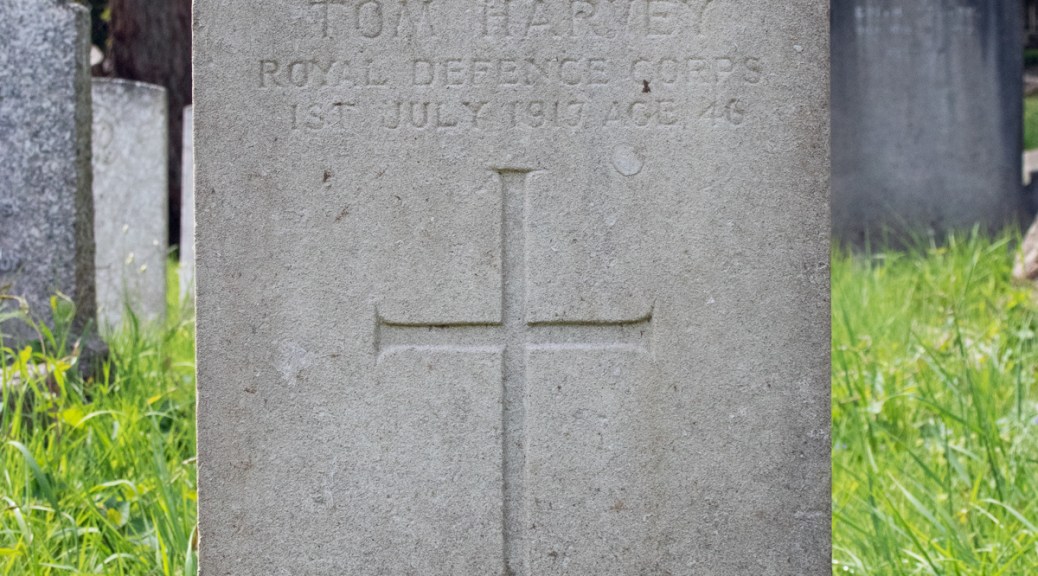
The death occurred on Sunday under sudden circumstances of Sergeant Tom Harvey, Royal Defence Corps… The deceased was proceeding to his residence… when he fell, and was only able to give his address and to state that he was suffering from chronic indigestion before he expired. Prior to joining up as a National Volunteer, the deceased has been engaged as an omnibus driver.
Western Daily Press: Tuesday 3rd July 1917
Tom Harvey was 46 years old when he died. He was laid to rest in the Milton Cemetery in his home town of Weston-super-Mare.
Harry Stephens was born in Banwell, near Weston-super-Mare on 4th January 1873. He was one of six children to Frederick Stephens and his wife, Emma. Frederick was a butcher, and this was a trade that both Harry and his older brother, Fred, would go into when they left school.
It appears that being a butcher was not the full-time career that Harry was looking for, and so, in the 1890s, he found other employment as a farmer, and moved to Lynton, on the north coast of Devon.
It was here that he met Norah Watts, another farmer’s daughter and, in 1898, the couple married. They set up home at Furzehill Farm, and went on to have four children, Frederick, Alice, Albert and Herbert.
By the time of the 1911 census, Harry had moved his family back to Banwell, where they lived in a four-roomed house on the High Street. Harry was now a cattle dealer, and was presumably supplying meat to his mother who, having been widowed in 1902, was now running the butcher’s shop with three of Harry’s siblings.
War was coming, though, and on 21st July 1915, Harry enlisted. Given his farming background, he was assigned to the Army Veterinary Corps and, while remaining on the Home Front, over the next few years he gained promotion.
Towards the end of 1917, when Serjeant Stephens was serving in Romsey, Hampshire, he fell ill, complaining of chest pains and breathlessness. He was taken to Hursley Hospital near Winchester for cardiac checks, and it became apparent that he was no longer fit for active duty.
Discharged from military service on 5th July 1918, he returned home. Admitted to the Military Hospital in Taunton, it was only a matter of weeks later than Serjeant Stephens passed away. He was 45 years of age.
Harry Stephens was laid to rest in the St James’ Cemetery in Taunton.
Charles Cassidy’s early life is a bit of a challenge to uncover. He was born in County Antrim, Ireland in around 1856, but there is little concrete information to identify his parentage or his movements before the late 1870s.
A newspaper report of his passing confirms that his military career began early. He joined the Somerset Light Infantry, and “saw active service in the Zulu campaign in 1879, and in Burmah 1885-1887.” [Western Times: Tuesday 15th February 1916]
In around 1890, he married a woman called Annie; she came from Wareham in Dorset, and the couple went on to have three children – Daisy, Charles and Margaret.
After completing his military service, Charles continued to work as a messenger for the regiment. However, when war came, he was called up again, acting as Company Serjeant Major in the Taunton Barracks.
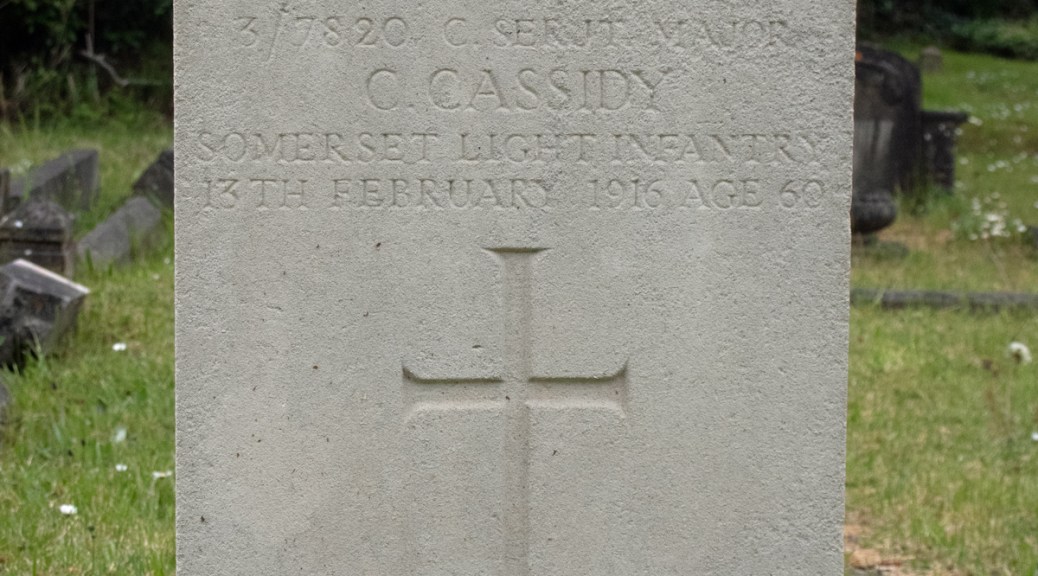
Charles’ military service was not to be prolonged, however. On 13th February 1916, he was in the Sergeants’ Mess in the barracks, when he suddenly collapsed with heart failure, dying almost instantaneously. He was 60 years old.
Charles Cassidy lies at rest in St Mary’s Cemetery in Taunton, next to the barracks where he so readily did his duty.
William Gulliford was born on 8th November 1877 in the village of Thurloxton, just to the north of Taunton, Somerset. William’s father – also called William – was an agricultural labourer who, with his wife Charlotte, had nine children in total.
William Jr found work as a labourer for a brewery and, by 1899, had moved to Staffordshire, met and married a local woman called Elsie Sutton. The couple settled down in Burton-on-Trent, and went on to have a daughter, also called Elsie.
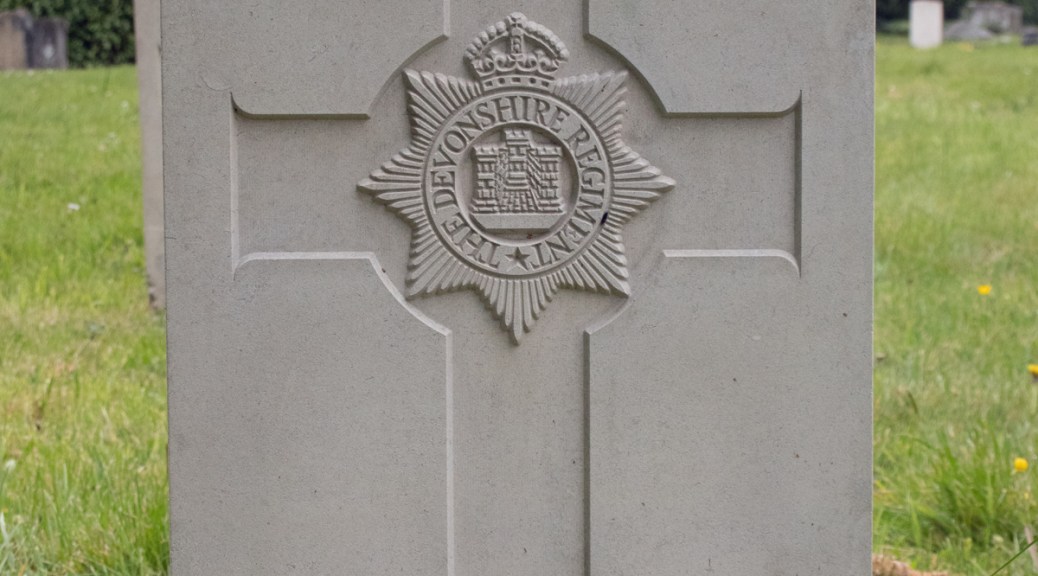
War was coming, however, and, in August 1916, William enlisted. Initially assigned as a Private in the 14th Devonshire Regiment, he was soon moved to the Labour Corps, and within a couple of months was on the Western Front as part of the British Expeditionary Force.
In November 1917, Private Gulliford was shipped back to England, suffering from ill health. He was admitted to the Military Hospital in Taunton with heart failure, and sadly passed away from this a month later. He had just turned 40 years old.
William Gulliford lies at rest in St Mary’s Cemetery in Taunton, Somerset.
Henry Thomas Underhill is one of those people whose lives are lost to time. Details of his early life were difficult to track down, but snippets helped unlock some of the mystery.
In late October 1914, a number of Somerset newspapers gave the following report:
Soldier’s Sudden Death
The West Somerset Coroner held an enquiry at Taunton Barracks on Saturday afternoon relative to the death of Private Henry Thomas Underhill, aged 44, of Street, which took place on Wednesday [14th October 1914].
Deceased was talking to Private TF Davis on a landing in the barracks, when he reeled and, throwing up his arms, fell heavily to the ground, his head striking the floor.
Major Stalkartt, RAMC, was at once summoned, but he found that life was extinct. He afterwards made a post mortem examination, which revealed fatty degeneration of the heart, with a fracture of the bae of the skull. The doctor considered that death was due to heart failure, and that the skull was fractured in falling to the ground.
The deceased was accorded a military funeral at St Mary’s Cemetery the same afternoon. He was an old member of the Somerset Light Infantry, which he recently re-joined on account of the war.
Wells Journal: Friday 23rd October 1914
Private Underhill’s pension record confirms that he was married to a woman called Mary Ann and that the couple had had a daughter, Beatrice Kate Lavinia Underhill, who had been born in December 1906. While searching for Henry directly drew too many variables to provide any certainty, his daughter proved the key to unlock his story.
Henry Thomas Underhill was born in the summer of 1860. One of nine children, his parents were William Underhill and his wife Elizabeth, who was also known as Betsy. William worked as a clerk for a button maker, and the family lived in Birmingham, which, at the time, was in Warwickshire.
When he left school, Henry found work as a ‘brass tube drawer’, making the metal tubes, using a die. He found love too, and, on 13th March 1881, aged just 20, he married Emma Howner. The couple went on to have a son, Ernest, in 1889 although, from the documentation about him, it seems likely that he passed away when only a toddler. Further tragedy was to strike Henry, when Emma also died in 1890, aged just 30 years old.
It may have been around this time that Henry found a focus in military service; he does not appear in the 1891 census and the next set of documentation for him dates from 1900.
It’s at this point that Henry married for a second time. Mary Ann Kelly was seventeen years younger than her new husband, and was the daughter of a carpenter from Solihull. Her father, Michael, had died when she was only a teenager, and she lived with her mother, Lavinia, helping to support her.
Henry’s previous experience with metalwork – and probably his time in the military – found him employment making gun components. The 1901 census finds him and Mary living in Yardley, to the east of Birmingham, with Lavinia and Mary’s younger brother William.
This was obviously a suitable and convenient arrangement; the next census, in 1911, shows the family still living together. By this time, Lavinia was still the head of the household, and shared her home with daughter Mary, Henry and four-year-old Beatrice; son William, his wife Ada and their new-born son, William. Making up the household on Census Day was a visitor, Amy.
War was on the horizon, and this is where we return to the initial news report about Private Underhill. It is likely that Henry had re-enlisted – or at least been called back up – as soon as hostilities broke out. Sadly, his service was not to be a long one, as he suffered the fatal heart attack within a couple of months of the start of the war. Private Underhill was 54 years old at the time of his death.
Henry Thomas Underhill’s body was buried in St Mary’s Cemetery in Taunton, Somerset.
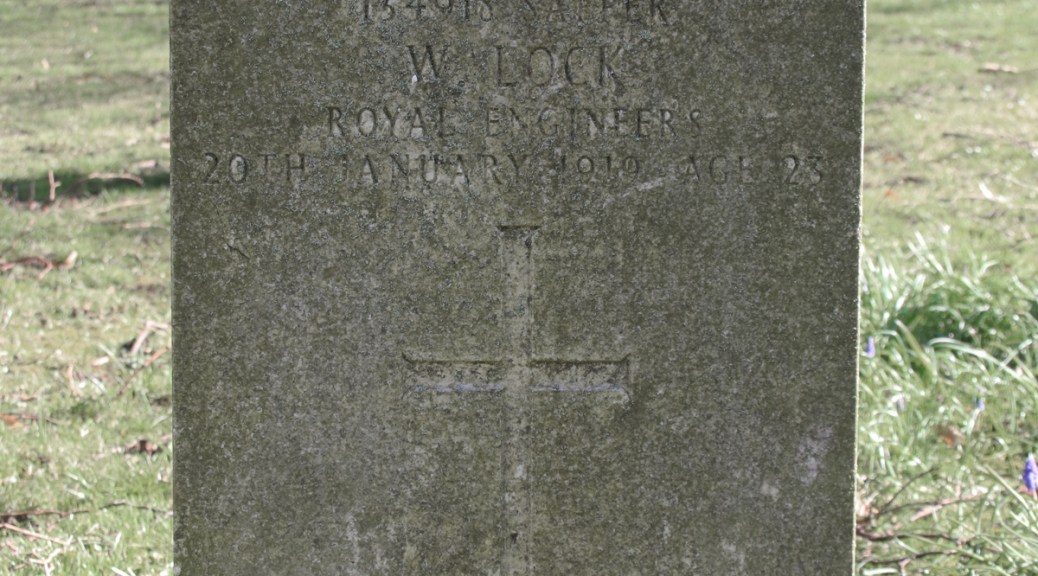
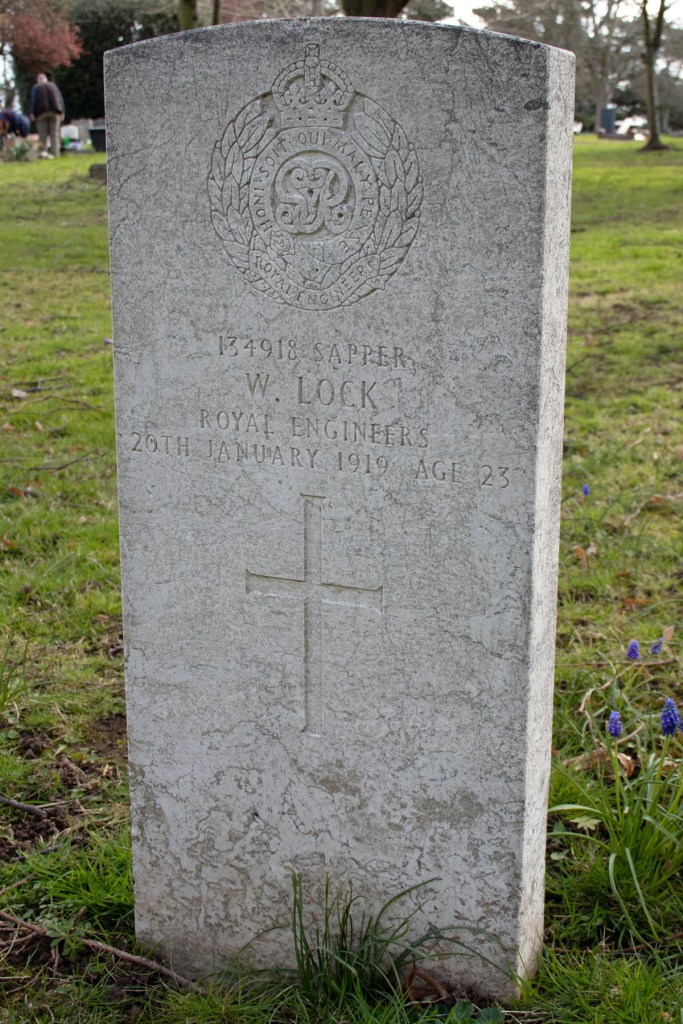
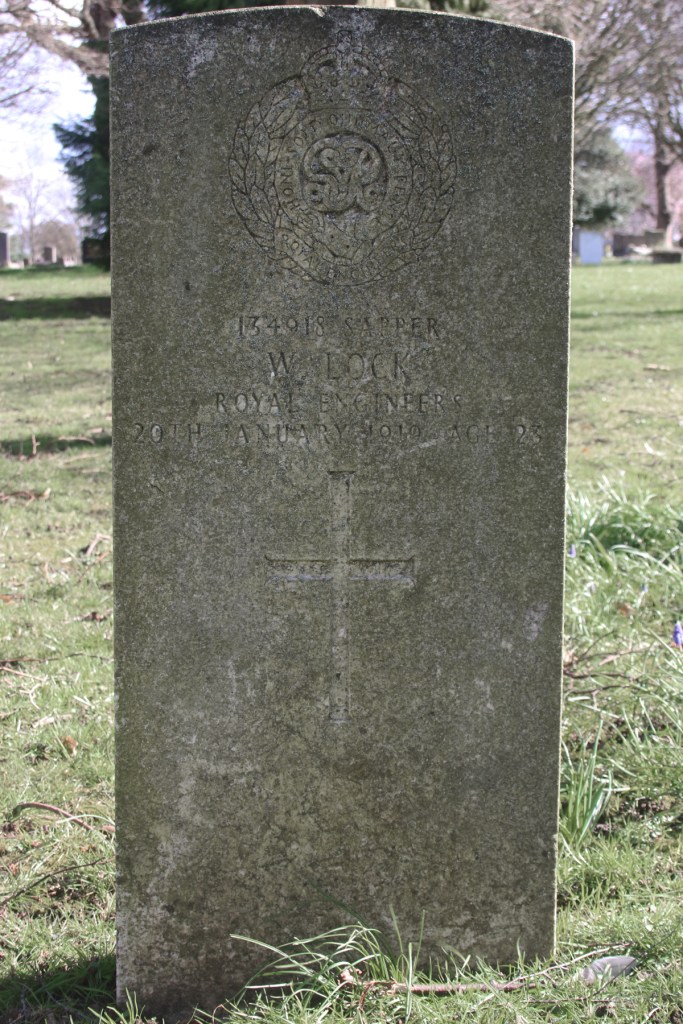
William Lock was born in Devon in 1896, one of three children to Tom and Mary Lock, although sadly only William survived childhood. Tom was a shipwright in on the Devon coast, but brought his young family to Kent, where he found work in the Naval Dockyard in Chatham.
When William left school, he set about finding a trade. By the time of the 1911 census, aged 15, he was listed as “learning house joinery”, presumably a trade for which his father’s work would have stood him in good stead.
War was looming, however, and William enlisted. He joined the Royal Engineers at a time where they were being inundated with volunteers. Sapper Lock was assigned to G Company, a provisional troop that formed part of the Depot Battalion.
Documentation relating to Sapper Lock’s military service are no longer available; he was awarded the Victory and British Medals, which suggests that he saw some kind of service overseas, but there is nothing on file to confirm this.
The next document relating to William is his war pension, which confirms that he died on 20th January 1919 from ulcerated endocarditis, or heart disease. He was just 23 years old.
Tom and Mary had lost the third of their three children.
William Lock was laid to rest in the Woodlands Cemetery in Gillingham, Kent.
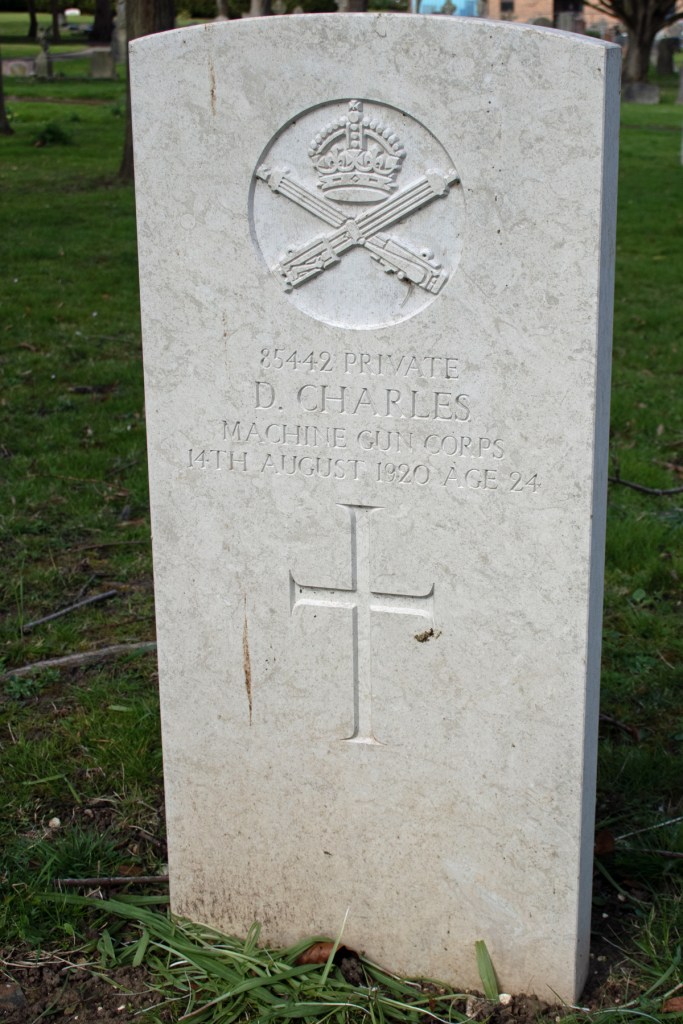
David Charles was born towards the end of 1893 and was one of eight children. His parents – David Sr and Elizabeth Charles – both came from Wales, and moved their young family to Kent in 1891. David Sr worked at a torpedo factory, and the move may have been determined by employment at the Naval Dockyard in Chatham, Kent.
When he left school, David Jr found work at an ironmonger’s, but storm clouds were forming over Europe, and he was soon called up on to do his duty for King and country.
David Jr enlisted in July 1915, joining the 23rd Reserve Battalion. He transferred to the Machine Gun Corps in February 1917 and was posted to the Western Front a month later.
Private Charles was wounded in action on 7th October 1917, although the injury did not prevent him from returning to duty after three weeks’ rest. He was readmitted to hospital on 23rd November, eventually being transferred home on a hospital ship before Christmas.
On 11th January 1918, Private Charles was transferred to No. 5 Battalion in Grantham, where he was promoted to Acting Lance Corporal within a couple of months. Sickness dogged him, however, and he was eventually discharged from military service for medical reasons on 7th August 1920.
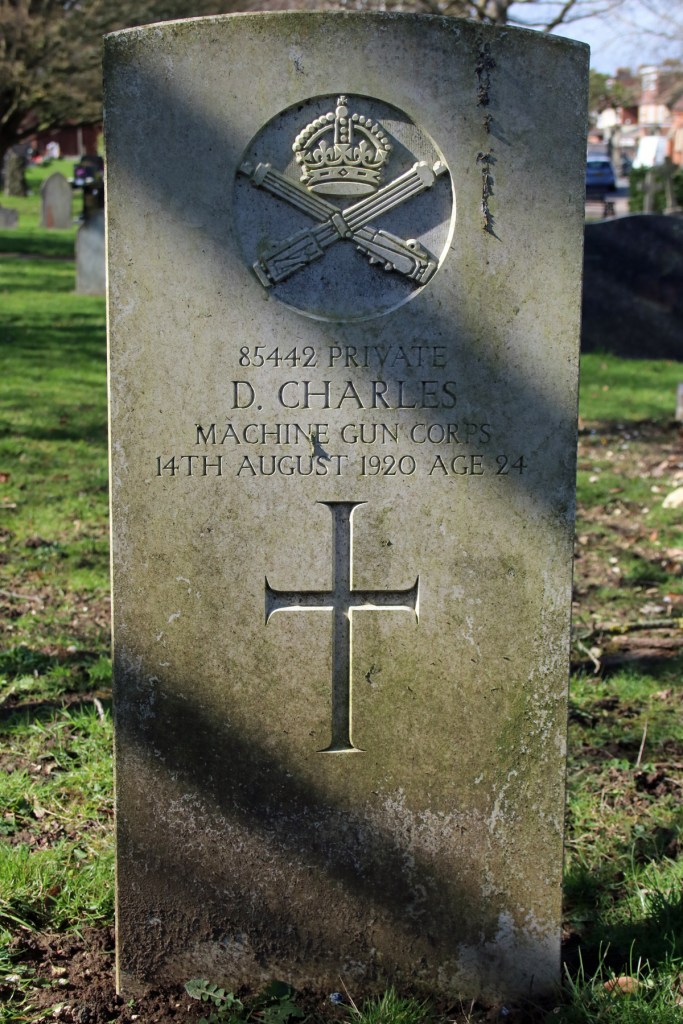
By this time, David had been admitted to Fort Pitt Hospital in Chatham with endocarditis – enlarged heart – and this is where he sadly passed away from the condition just a week after being discharged from the army. He died on 14th August 1920, at the age of 27 years old.
David Charles lies at rest in the Woodlands Cemetery in Gillingham, Kant.
David seems not to have been originally commemorated by the Commonwealth War Graves Commission. I can find no record of why this might have been the case, but this was eventually rectified 10th February 2016, and his name was immediately added to the United Kingdom Book of Remembrance.
The United Kingdom Book of Remembrance commemorates United Kingdom casualties of the two World Wars who were not formerly recorded by the Commonwealth War Graves Commission. The men and women remembered on it are recent additions to the list of war dead and are presently commemorated solely by their database record and register entry.
The register is maintained at the Commonwealth War Graves Commission’s Head Office, Maidenhead, and the names remain recorded there until such time as The Commission has investigated the grave location details.
David’s grave was identified and a headstone now placed in its rightful position.










 Death and Service