Clarence Southwood Emmett was born in September 1899 in the Devon village of Ipplepen. The middle of five children, his parents were village butcher Thomas Emmett and his wife, Annie.
There is little information about Clarence’s early life, but when war broke out in 1914, he is evident that he wanted to play his part. He enlisted in the army as soon as he turned 18, and joined the 4th Battalion of the Wiltshire Regiment.
Sadly, full details of his time in the army, although a local contemporary newspaper sheds a little more light onto his health:
He soon contracted measles, and took a chill before he recovered. Since then he has been dangerously ill at different times, and has undergone various operations. He was recently removed to a hospital at Devonport where, until a few weeks ago, it was hoped he might recover.
Western Times: Friday 14th February 1919
Private Clarence Southwood Emmett died in the hospital on 8th February 1919. He was just 19 years of age. His body was brought back to Ipplepen, and he was laid to rest in the graveyard of St Andrew’s Church there.
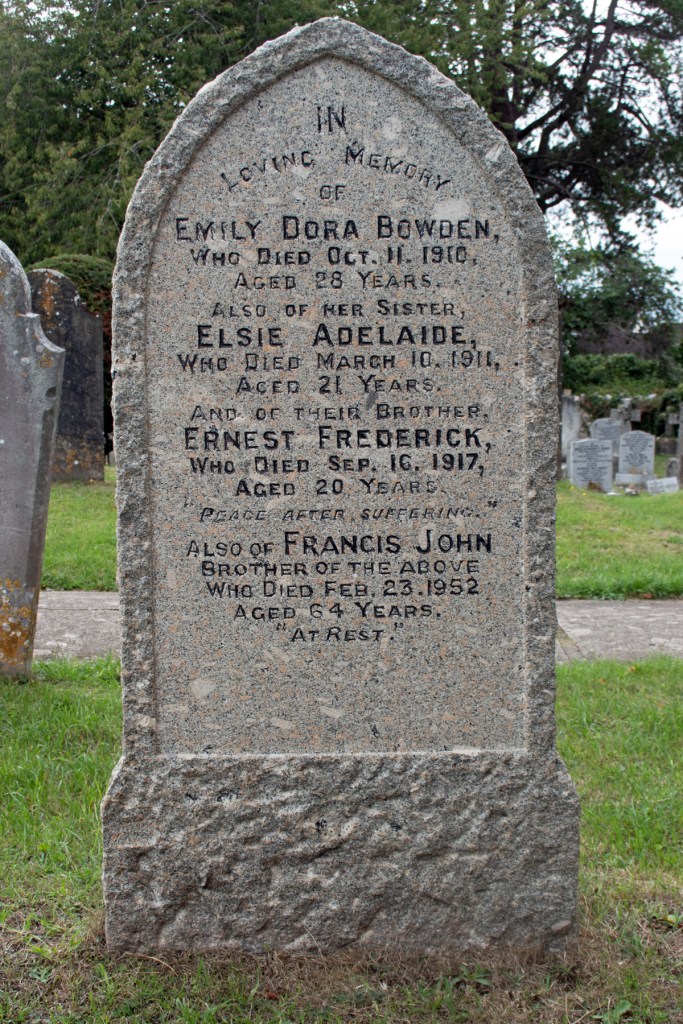
Ernest Frederick Bowden was born on 2nd November 1896 in Ipplepen, Devon. He was one of eleven children – and one of twins – to Frederick and Dora Bowden. Tragically, Dora died when Ernest was just over a year old, leaving Frederick and his older sisters to raise the family as best they could.
When he left school, Ernest found work as a page for a surgeon living in Paignton, before finding other employment as a chauffeur in Bovey Tracey. In his spare time, he was an avid bellringer at his local church.
War was coming to Europe, however, and in November 1915, he enlisted in the Gloucestershire Regiment. His service records noted that he was 19 years of age, and stood just 5ft 1.5ins (1.56m) tall. Assigned to the 14th Battalion, Private Bowden soon found himself on the front line. Arriving in France in July 1916, he spent four months there, during which he contracted tuberculosis and trench foot.
Medically evacuated to Britain for treatment, his conditions proved too severe for him to continue in the army. He was discharged from active service in December 1916.
For some months he had been at the Ivybank Dispensary, Exeter. Complications set in, and he rapidly sank just before reaching his 21st year.
Western Times: Friday 28th September 1917
Ernest Frederick Bowden had passed away on 16th September 1917, aged just 20 years old. He was laid to rest in the family grave at St Andrew’s Church, Ipplepen.
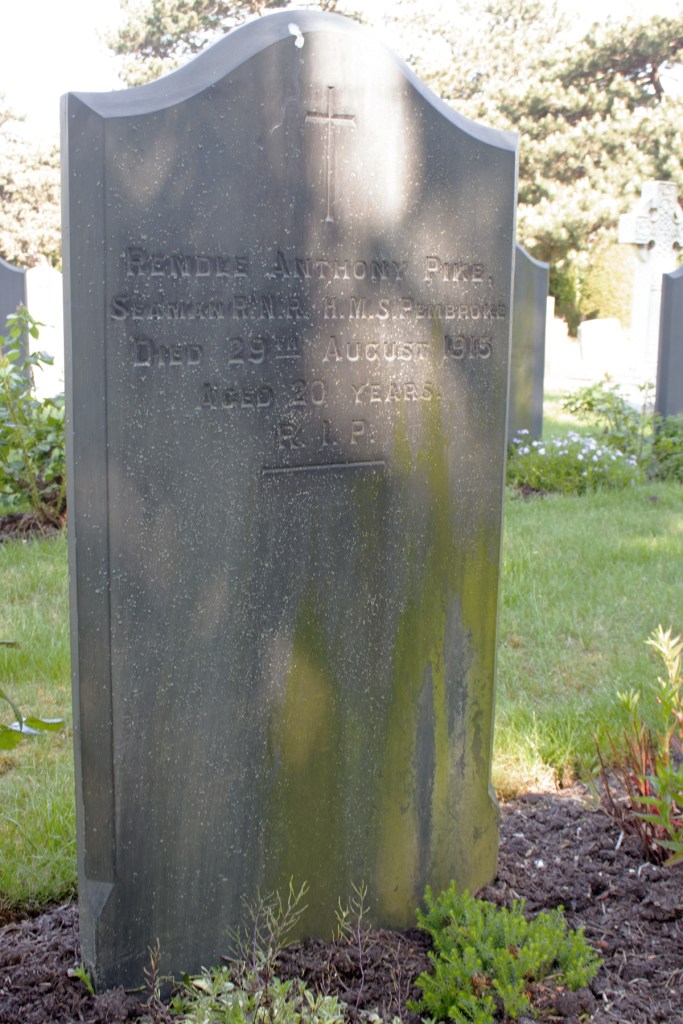
Rendle Anthony Pike was born on 9th May 1895 in Newfoundland. He was one of nine children to Lewis and Mary Pike, but there is little additional information about his early life.
Lewis was a fisherman, and it seems likely that Rendle would have had experience of seafaring when he was growing up. When war broke out, therefore, it made sense that he enlisted in the Royal Naval Reserve.
Again, full details of his service was unavailable, but Seaman Pike joined up within the first year of the war and, by the summer of 1915, he was based at HMS Pembroke, the Royal Naval Dockyard in Chatham, Kent.
Tragically, Rendle’s time in the navy was to be a short one. The next record available for him is that of his passing. According to his service documents, he died ‘of disease‘ on 29th August 1915. He was just 20 years of age.
Rendle Anthony Pike was laid to rest in Woodlands Cemetery in Gillingham, Kent, not far from the dockyard at which he had been based.
Alexander Maguire was born on 28th March 1880 in Glenarm, County Antrim, Northern Ireland. Little is known about his early life, apart from his parents’ names – James and Ellen.
Glenarm is a coastal village, and it is likely that Alexander would have had experience of seafaring from an early age. This seems to have spurred him into building a career and, on 16th December 1903, he enlisted in the Royal Naval Reserve as a Stoker.
With war getting closer, Stoker Maguire was called into formal service, and was assigned to the steamer SS Rathlin Head. He sailed the Atlantic in March 1914, and disembarked an New Orleans. It seems, however, that he missed his passage back home, although at this point, his whereabouts become a bit hazy.
Alexander was back in Britain by 13th January 1915, as his service papers record him in Liverpool. He then travelled to HMS Pembroke, the Royal Naval Dockyard in Chatham, Kent. This looks to have been his last move, however, as he passed away just two days later. The cause of death is simply recorded as ‘disease’: he was 34 years of age.
Alexander Maguire was laid to rest in the Roman Catholic section of Woodlands Cemetery in Gillingham, Kent, not far from the dockyard to which he had been assigned.
James Kirby’s life is one of intrigue and speculation. Born in Laytown, Ireland on 30th August 1867, the earliest documents relating to him are his Royal Naval Service Records.
He enlisted on 1st March 1883, while just fifteen years old, and was assigned the rank of Boy 2nd Class. Over the next couple of years, he served on two ships – HMS Lion and HMS Briton – and was promoted to Boy 1st Class.
On 30th August 1885, James came of age, and was formally enrolled in the Royal Navy. He enlisted for ten years’ service, and his records show that he stood 5ft 3ins (1.60m) tall, had brown hair, blue eyes and a fresh complexion. He was also noted as having a tattoo of an anchor on the back of his left hand.
Over the next ten years, Ordinary Seaman Kirby served on nine different vessels, and was obviously committed to his work. He rose through the ranks, making Able Seaman in January 1886, Leading Seaman (1889), Petty Officer (also 1889) and Chief Petty Officer (1895).
When his initial contract ended, he voluntarily continued with the Royal Navy, although his service record ends on 14th June 1896, at the point that he was promoted to Acting Boatswain.
A second service record picks up James’ details from 5th December 1902. Still serving as a Boatswain, he was assigned to the cruiser HMS Lancaster. His health, by this point, was beginning to suffer, and, it seems, his life was beginning to unravel.
In August 1904, he was injured in an accident involving a “hook rope” and “slightly amoral judgement”. Over the next couple of years his behaviour became increasingly erratic.
In December 1910, he was admitted to Shotley Hospital near Durham, suffering from acute mania and gonorrhoea, and was not be be fit for duty for a few weeks.
Just before Christmas that year, Boatswain Kirby was again admitted to hospital, this time in Chatham, Kent, remaining there for a number of months. He was deemed unfit for further service in March 1911, and was medically discharged with neurasthenia.
However, when war broke three years later, James volunteered his services once more, and was again employed by the Royal Navy. Tragically, this was a decision that would prove to be fatal.
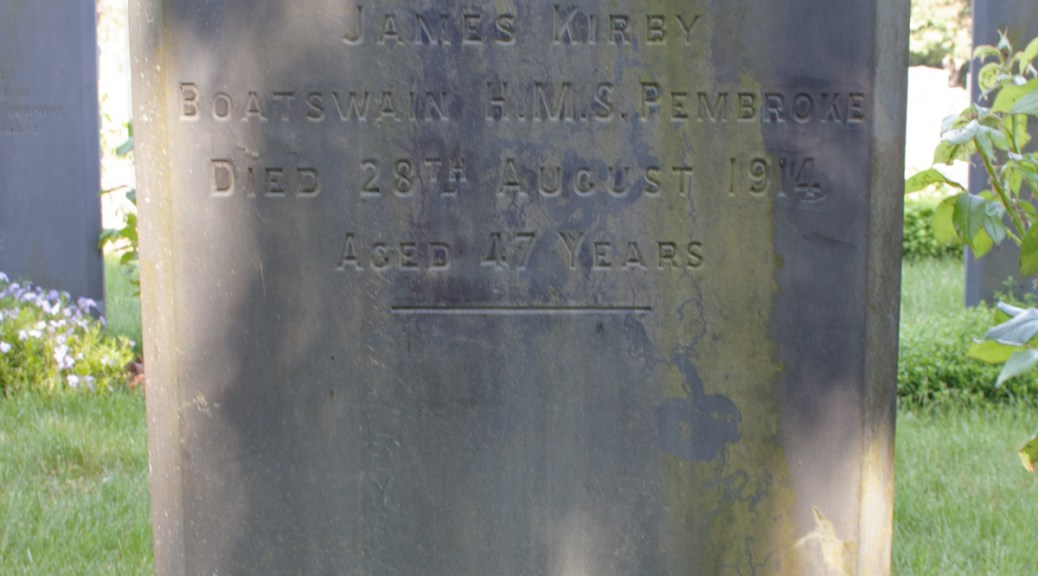
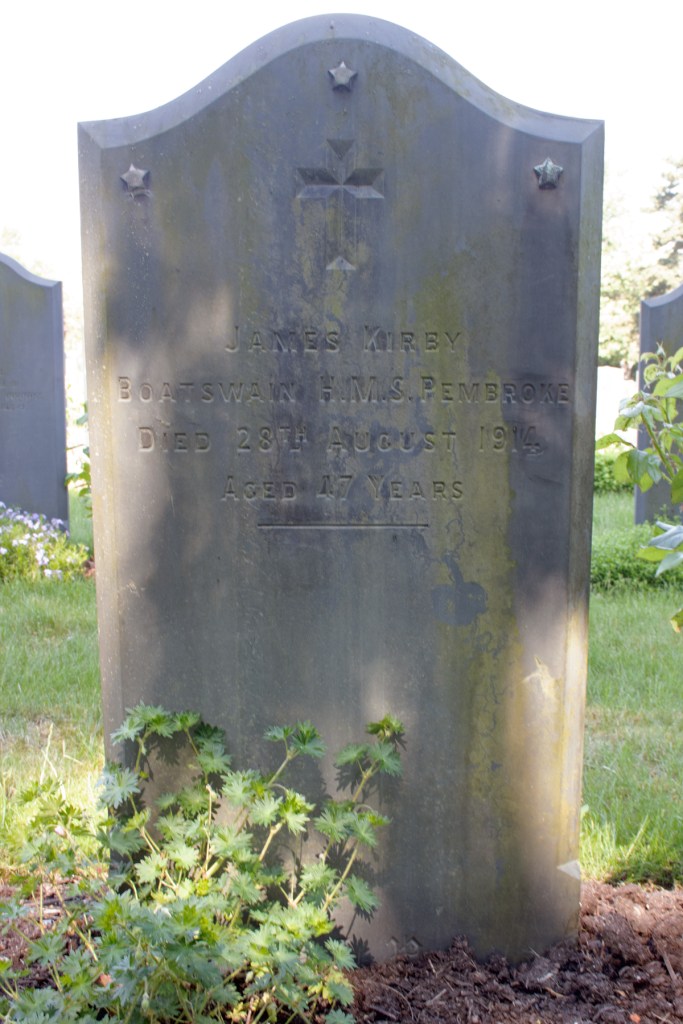
The extraordinary death of a naval boatswain names James Kirby, aged 47, was the subject of an inquest at the Royal Naval Hospital, Chatham… Deceased, whose home was at Dublin, had retired, but had volunteered for service and was anxious to go to sea. On Friday evening [28th August 1914] he was watching a game of billiards in the warrant officers’ mess at the Royal Naval Barracks, Chatham, and appeared perfectly rational and sober. Suddenly he was observed to disappear through an open window beneath which he had been sitting. He went down, as one witness stated “with a smile on his face,” and called out “Good-bye.” A crash of glass below indicated that he struck the dining room window as he fell.
Kent Messenger & Gravesend Telegraph: Saturday 5th September 1914
The article gave further information about the injury James sustained previously: “It transpired that deceased fell out of a window at the Hospital eight years ago through walking in his sleep. He was then suffering from neurasthenia and had delusions.“
The inquest concluded that Boatswain James Kirby had committed suicide during temporary insanity. He was laid to rest in the Woodlands Cemetery, Gillingham, not far from the dockyard at which he was based.
James Kirby’s grave is maintained by the Commonwealth War Graves Commission on behalf of the Royal Navy Admiralty. However, as the naval authorities did not confirm Boatswain Kirby was a war casualty – possibly because of the nature of his death – he was never formally commemorated with a Commonwealth War Grave. However, I have included his story as it remains as pertinent as those of his contemporaries.
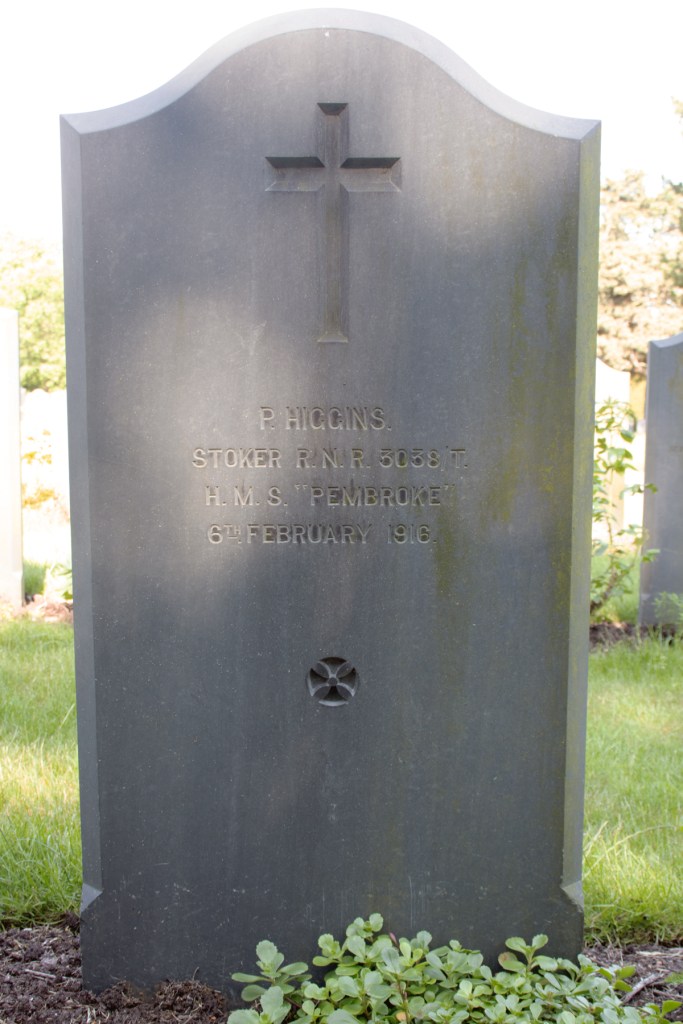
Peter Higgins was born in Thornaby, North Yorkshire, on 23rd January 1887. His parents were William and Catherine (Kate) Higgins, but of them there is very little information.
What seems likely that Peter would have had some experience with boats as, on 26th May 1909, he enlisted in the Royal Naval Reserve. His service records show that he was 5ft 7ins (1.70m) tall and was described as having blue eyes and a pale complexion. He was also noted as having a scar over his left eye and another on his left thigh.
When war broke out, Peter was officially called for duty and, over the next couple of years, he served as a Stoker on the battleship HMS St Vincent. The ship patrolled the North Sea, and would later be involved in the Battle of Jutland.
Stoker Higgins, however, was back on dry land by that point, having been assigned to HMS Pembroke, the Royal Naval Dockyard in Chatham, Kent. Peter had fallen ill with a gastric ulcer, and tragically, this was to prove fatal. He passed away on 16th February 1916, at the age of just 29 years old.
Peter Higgins was laid to rest in the naval section of Woodlands Cemetery in Gillingham, Kent, not far from the dockyard that was to prove his last posting.
Little concrete documentation remains about the life of William Henry Jackson. He was born in Bedford, Bedfordshire, on 6th February 1872, although it is not possible to identify who his parents were.
He married a woman called Edith in 1903, and the couple settled in her home town of Beeston, Nottinghamshire. By the time of the 1911 census, he was recorded working as an electrician’s labourer at the local telephone works, while Edith, who was five years his senior, earned extra money as a blouse finisher.
Information about William’s wartime efforts are also limited. He enlisted in the Royal Marine Light Infantry, and was assigned to the Chatham Division. He was given the rank of Private and based at the Royal Naval Dockyard in the Kent town.
The only other information available for Private Jackson is that he died on 16th September 1916, having contracted a combination of pneumonia and tuberculosis. He was 44 years of age.
William Henry Jackson was laid to rest in Woodlands Cemetery, Gillingham, not far from the dockyard in which he had served. His headstone gives the initial H, rather than W, although no documents suggest he went by any name other than William.
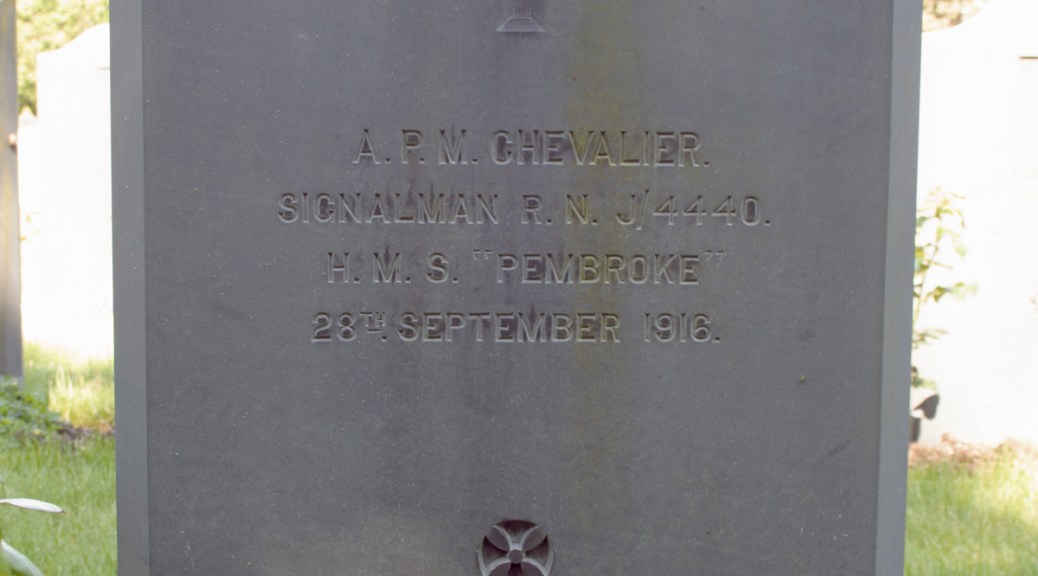
Albert Patrick Michael Chevalier was born in India on 16th June 1893. There is little definitive information about his early life, although his mother was called Georgina, and the family may have moved back to England when Albert was just a child.
When he left school, Albert found work as an errand boy in an office. But he wanted bigger and better things and, on 4th May 1909, aged just fifteen years old, he enlisted in the Royal Navy. Because of his age, he was given the rank of Boy 2nd Class, and for the first eighteen months, he was assigned to training bases – HMS Ganges and HMS Impregnable.
After only a few months, Albert was promoted to Boy 1st Class and, after a month at HMS Pembroke – the Royal Naval Dockyard in Chatham, Kent – he was given his first sea-going appointment on board the cruiser HMS Minerva.
Albert spent eighteen months on Minerva, during which time he came of age. He seems to have had an understanding of basic technology, as he was given the rank of Ordinary Signalman. After some more time in Chatham, Albert went to sea again, this time on board another cruiser, HMS Cressy. At the start of 1913 he was promoted again, and given the rank of full Signalman.
Signalman Chevalier went on to serve on a number of different vessels, primarily the battleship HMS Swiftsure, where he served for nearly three years, plying the waters between Britain and India. By the spring of 1916 he was back in Chatham, however, and it was here that things took a turn for the worse.
Albert was admitted to the Royal Naval Hospital in the town, suffering from pleurisy. Sadly, the condition was to get the better of him and he passed away the hospital on 28th September 1916, at the age of just 23 years of age.
Albert Patrick Michael Chevalier’s body was laid to rest in Woodlands Cemetery, Gillingham, not far from the dockyard from which he had made so many of his voyages.
Albert’s mother Georgina had not settled in England for long. The army pension record gives her as Albert’s beneficiary, but notes her address as Victoria Street, Daylesford, Victoria, Australia.
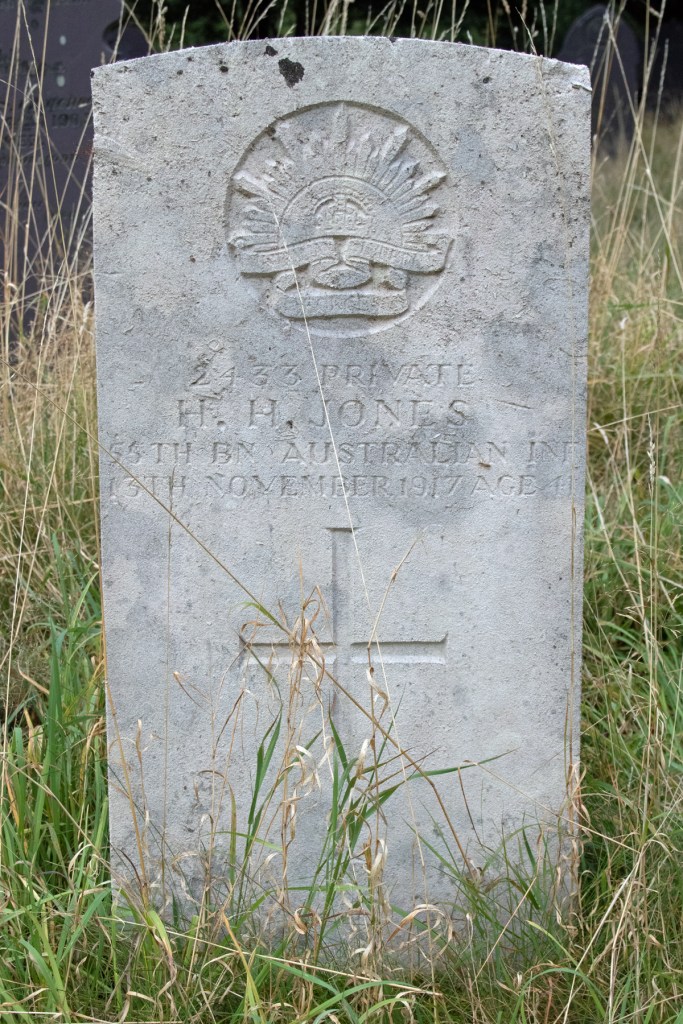
Hugh Henry Jones was born in around 1876 in the Welsh village of Llanberis, Gwynedd. He was one of seven children to quarryman John Jones and his wife Mary.
Slate was the big industry in Snowdonia, and Hugh and his brothers all followed his father into the quarries. Labour was plentiful and wages would not have been high, so when the opportunity arose for employment overseas, he seems to have taken it.
Exact details are sketchy, but Hugh emigrated to Australia at some point in the early 1900s. He settled in the city of Goulburn, New South Wales and the experience he had built up back home stood him good stead, as he continued working as a quarryman.
When war broke out in Europe, those in the British colonies were called upon to play their part, and Hugh was among those to serve King and Country. He enlisted on 29th December 1915, joining the 55th Battalion of the Australian Infantry.
Private Jones’ service records show that he was 40 years and six months old, stood 5ft 4ins (1.63m) tall and weighed 130lbs (59kg). He had a dark complexion, blue eyes and black hair. He also appears to have had a denture in his lower jaw.
After initial training, Private Jones set off for Europe at the end of September 1916, arriving in Plymouth six weeks later. Within a matter of weeks he was on the move again, sailing for France, and arriving at Etaples at the start of 1917.
Private Jones was ensconced on the Western Front for the next few months but, as spring came, he was starting to have some health issues. In April he was admitted to a field hospital suffering from dyspepsia (indigestion), which was subsequently diagnosed as gastritis.
Medically evacuated to Britain for treatment, Hugh spent the next few months being treated in hospitals in Kent, and Dorset, before being admitted to the Royal Infirmary in Liverpool. Sadly, by this point, his condition had been identified as stomach cancer and, while in Liverpool, he passed away. Private Jones breathed his last on 13th November 1917, at the age of 41 years old.
Hugh Henry Jones was brought back to Wales for burial. He was laid to rest in the graveyard of St Peris Church in his home village of Llanberis.
William Pierce Rowlands was born the summer of 1891 and was the oldest of three children to Thomas and Ellen Rowlands. Thomas was a slate dresser and quarryman from North Wales, and William was born in Ffestiniog, Gwynedd. By the time his sister Margaret was born, the young family had moved to Llanberis, settling in a small cottage on the outskirts of the village.
When he left school, William found work as a clerk, and this was the work he was carrying out when was broke out. He enlisted on 10th April 1915, joining the 14th (Service) Battalion of the Royal Welch Fusiliers. His service records show that he was 5ft 8ins (1.73m) tall.
Private Rowlands served on home soil for just over seven months, before being sent to France on 30th November 1915. He had been suffering from a cough for a couple of weeks, and this came to a head while he was overseas. He reported sick on 16th December, and was sent back to Britain for treatment a month later.
His condition was identified as pulmonary tuberculosis, aggravated by military service. Private Rowlands was medically discharged from the army on 8th February 1916, and returned home.
At this point, William’s trail goes cold. His condition appears to have worsened, however, and it was from tuberculosis that he was to die. He passed away at home on 18th February 1917, at the age of 25 years old.
William Pierce Rowlands was laid to rest in the quiet graveyard of St Peris Church, in the family home village of Llanberis.
Thomas and Ellen lived until 1932, when the passed away within a couple of months of each other (Thomas in August, Ellen in November). They were reunited with the son, and lie together in the family grave, along with Ellen’s brother, also called William, who had passed away in 1930.













 Death and Service