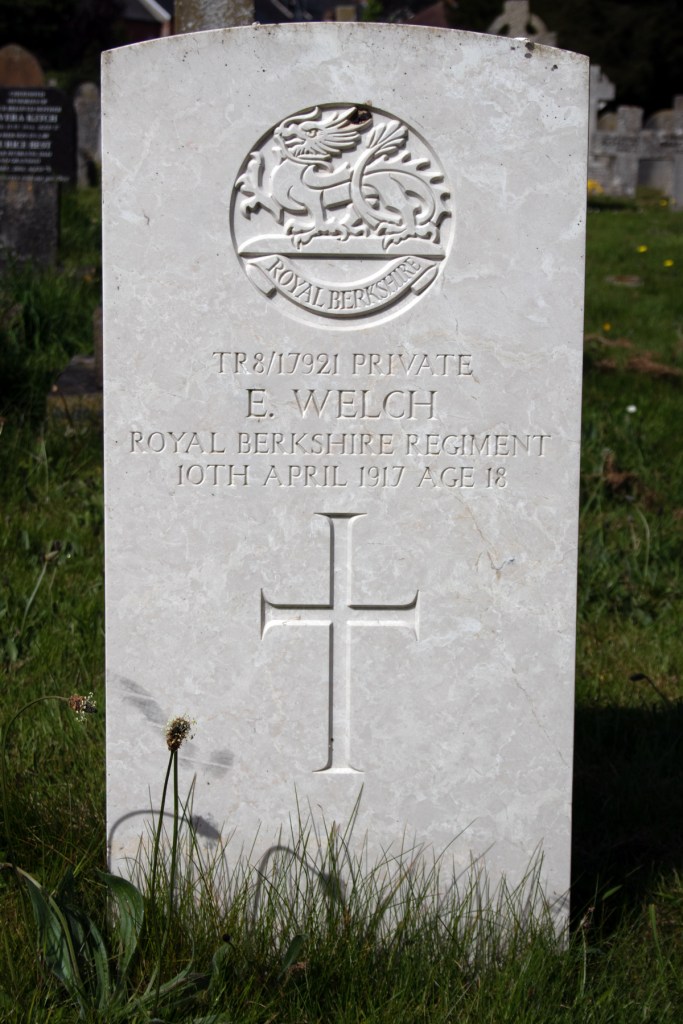
Edward Welch was born in Chard, Somerset, at the start of 1899. His parents were Edward and Sarah and he was one of five children, although he also had three half-siblings from Sarah’s previous marriage.
Edward Sr was a gardener who passed away in 1910, leaving Sarah a widow for a second time. She was already working as a lace maker, and this was a trade that Edward Jr’s older siblings also followed.
War was coming to Europe and, while he was too young to enlist when it was first declared, Edward was keen to play his part when he could. He enlisted in the Royal Berkshire Regiment at some point after October 1916, and was assigned to the 9th (Reserve) Battalion. Private Welch was part of the territorial force, and so did not see any action overseas.
There is little additional information about Private Welch’s life: all that can be confirmed is that he passed away “of disease” in hospital on 10th April 1917. He was just 18 years of age.
Edward Welch’s body was brought back to Somerset for burial. He was laid to rest in Chard Cemetery, not far from his family home.
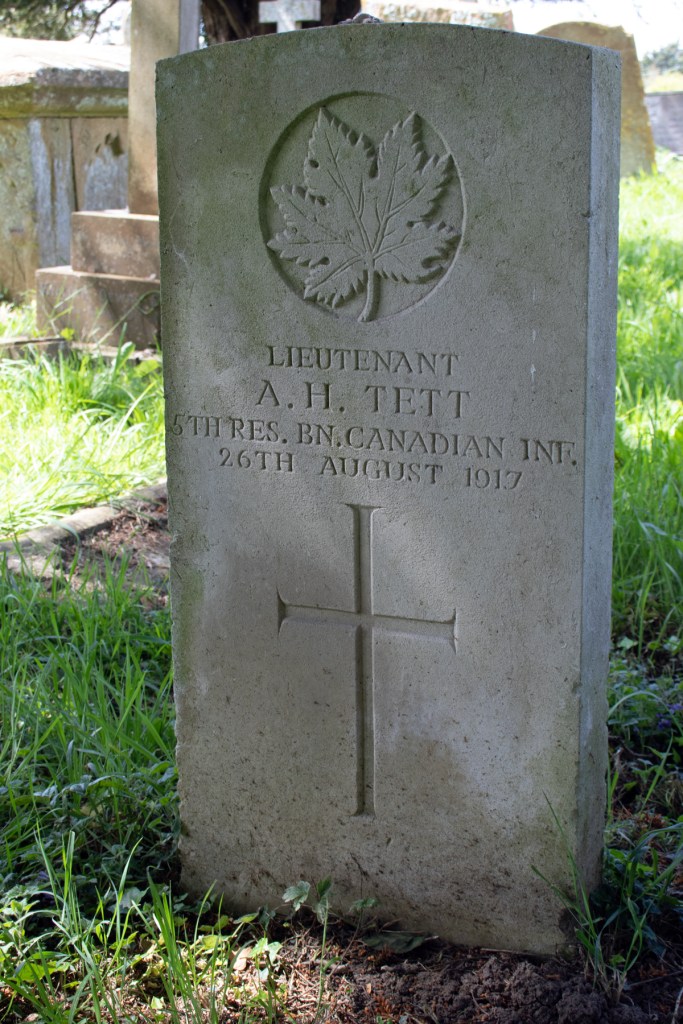
Arthur Hopkins Tett was born on 22nd August 1881 in Bedford Mills, Ontario, Canada. He was one of six children to lumberjack John Tett and his wife, Harriet. Both sets of Arthur’s grandparents had moved to Canada in the 1830s – John’s from Somerset, Harriet’s from Ireland – and his paternal grandfather had gone on to represent the county of Leeds in Ontario’s first parliament.
Arthur wanted to see the world, and viewed the army a a way to do that. After leaving school, he attended the Royal Military College, and was subsequently appointed a Signaller in the 3rd Canadian Mounted Rifles. He spent time in South Africa and, on returning to his home country, he took work as a bank clerk with the Union Bank, where he worked his way up to Head Office in Winnipeg.
He soon sought another challenge, and set up business in Outlook, Saskatchewan. In January 1913, Arthur married Bessie Kearns, an artist from back in Westport, Ontario. The couple settled in a detached property on Bagot Street, Kingston, Ontario and went on to have a son, John, who was born in 1917.
Arthur was still active in military circles at this point, playing a part in the local 14th Regiment. When war was declared, he again stepped forward to play his part, taking up a role of Lieutenant in the 253rd Battalion of the Canadian Expeditionary Force: this was a regiment made up mainly of students from the Kingston area, and it is likely that Arthur’s expertise would have been welcomed.
Having initially enlisted on 1st November 1916, Lieutenant Tett was declared fit a few months later and sent to Europe in May 1917. Based in Somerset, Arthur was not far from where his paternal grandparents had come from, nor where his cousins still lived. Sadly, however, his time in England was not to be a long one.
Lieutenant Tett was admitted to the Military Hospital attached to Taunton Barracks, suffering from pneumococcal meningitis. Sadly, this was to get the better of him, and he passed away on 26th August 1917, days after his 36th birthday.
Arthur Hopkins Tett was brought to the village of Kingstone in Somerset for burial. He was laid to rest in the graveyard of his second cousin George’s local church, St John and All Saints.
Bessie Tett did not marry again after her husband’s passing. She remained in Ontario for the rest of her life, passing away in October 1974, at the age of 89.
Arthur and Bessie’s son, John, was a babe-in-arms when his father died. He also remained in Ontario for much of his life, although he served in Europe during the Second World War. He married Sylvia Bird in September 1941; the couple went on to have two children. They returned to Canada when the war was over, and remained in Ontario until August 1974, when he passed away.
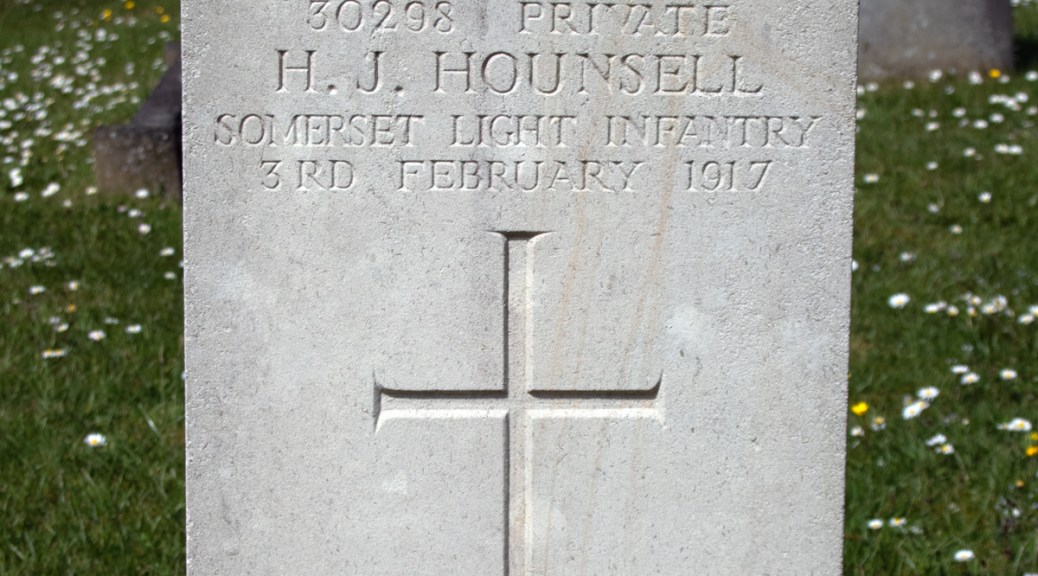
Henry James Hounsell was born in the spring of 1891, one of ten children to George and Emma Hounsell. George was a farm labourer and carter, and the family were raised in Tatworth, on the outskirts of Chard, Somerset.
Henry may have followed his father in farm work, but he wanted bigger and better things from life. The 1911 census recorded him as boarding with the Burt family in Corscombe, Dorset, where he was working as a baker’s van man.
Henry’s two older brothers, George and Alfred, died in 1913 and 1914 respectively; this left him as the oldest male of the siblings. In the summer of 1915, he married Lydia Lentell, the daughter of a shirt starcher and collar maker from East Coker, Somerset.
By this point, however, war was raging across Europe, and Henry was called upon to play his part. Full details of his service are lost to time, but it is clear that he enlisted in the Somerset Light Infantry as a Private in the 4th (Reserve) Battalion. By the time he joined up – at some point after August 1916 – his troop had already been sent out to Mesopotamia; it is unclear whether Henry also went overseas, but it appears unlikely.
The only other documents relating to Private Hounsell are those concerning his passing. His pension record confirms that he died on 3rd February 1917, having been suffering from a tumour in the back of his head, which had been aggravated by his military service. He was just 25 years old.
Henry James Hounsell was brought back to Somerset for burial. He was laid to rest in Tatworth Cemetery in Chard.
Lydia and Henry had had no children; she remained a widow for a number of years, before marrying for a second time in the autumn of 1939. Tragically, this was also destined to be a short-lived marriage – her new husband, Frederic Hodge, died just three years later.
Samuel Mattocks was born in Combe St Nicholas, Somerset, in 1885, one of six children to farm labourer George Mattocks and his wife, Anna. Sam sought a trade when he left school and soon found work as a butcher.
Documentation relating to Sam’s life is pretty scarce. When war broke out, he stepped forward to play his part, enlisting in the Army Service Corps (presumably because of his profession) by the start of 1916.
Private Mattocks was sent to Hampshire to work at one of the supply depots there. Sadly, this appears not to have been for long as, on 1st April 1916, he passed away at his base in Aldershot. No specific cause of death is evident – his records just note that he died ‘of disease’. He was 31 years old.
The body of Samuel Mattocks was brought back to Somerset for burial. He was laid to rest in the family plot in the graveyard of St Nicholas’ Church in his home village.
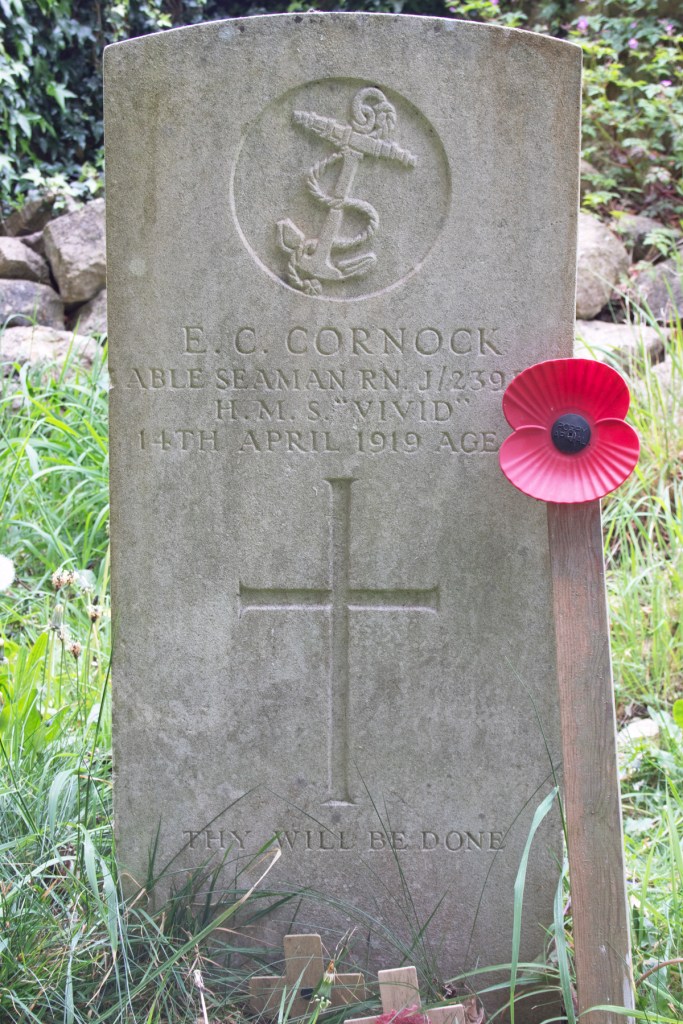
Ernest Charles Cornock was born on 16th June 1896, in the Gloucestershire town of Wotton-under-Edge. His parents were carter Charles Cornock and his wife, Millicent, both born and bred in the town, and he was one of eight children.
When he left school, Ernest found work as a rubber winder in the local mill. However, he wanted bigger and better things and so, on 8th April 1913, he enlisted in the Royal Navy. His service records show that he stood just 5ft 3ins (1.60m) tall, had brown hair grey eyes and a fresh complexion. He was also noted as having a scar on his right cheek.
As Ernest was under age when he joined up, he was initially given the rank of Boy 2nd Class. He was sent to HMS Vivid, the Naval Dockyard in Devonport and, after four months’ training, during which he was promoted to Boy 1st Class, he was given his first posting on board the battleship HMS Queen.
After five months on board, Boy Cornock was given another assignment, and was transferred to HMS Lion. While on board, a number of things happened: the First World War broke out, and the battle cruiser fought at Heligoland Bight and Dogger Bank; Ernest came of age, and was given the rank of Ordinary Seaman on his 18th birthday; with ongoing good conduct, in September 1915, he was then given a promotion to Able Seaman.
After a short spell back in Devonport, Ernest served on a further five ships, taking him through to the end of the war. By the start of 1919, however, Able Seaman Cornock’s health was beginning to suffer. Having contracted tuberculosis, he was medically discharged from service on 19th February, and was admitted to a sanatorium back in Gloucestershire. Sadly the condition was to get the better of him, and he passed away on 14th April 1919, at the age of just 22 years old.
Ernest Charles Cornock was brought back to Wotton-under-Edge for burial. He was laid to rest in the graveyard of St Mary the Virgin Church in the town, not far from his second cousin, Albert Cornock, who had been buried just the week before.
As an aside to Ernest’s tale, the newspaper that reported on his funeral also noted that his grandmother, Ruth Cornock, had not long received a message from the King, congratulating her on the fact that nine of her sons had served in the conflict
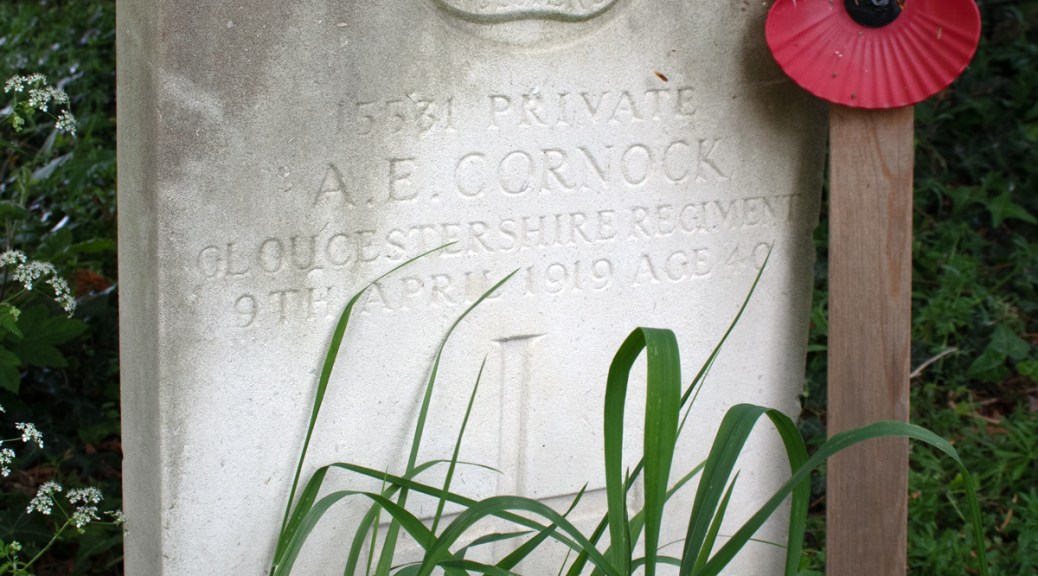
Albert Edward Cornock was born in 1878, and was one of eight children. His parents, John and Hannah Cornock, were both born in Wotton-under-Edge, Gloucestershire, ant this is where the family were brought up.
John was a labourer, and this was the trade than Albert also fell into. On 2nd August 1903, he married local woman Bessie Carter. The couple settled in their home town and went on to have eight children.
War came to Europe in 1914, and Albert was amongst those to enlist early on. He joined the 10th (Service) Battalion of the Gloucestershire Regiment in Bristol on 13th November. Albert’s service records show that he was 5ft 4ins (1.62m) tall and weighed 119lbs (54kg). He had a fresh complexion, brown eyes and black hair.
Private Cornock’s initial training was split between Cheltenham and Salisbury Plain, but he was eventually sent out to France as part of the British Expeditionary Force in August 1915. He spent nearly eighteen months overseas, but, towards the end of the following year, he contracted tuberculosis, and was sent back to England for treatment.
Albert’s lung condition was to ultimately lead to his discharge from the army on medical grounds. His last day of service was 8th February 1917.
At this point, Albert’s trail goes cold. He returned home to Gloucestershire, and lived on another couple of years. He passed away at home on 9th April 1919, aged 40 years old: while the cause of his passing is not clear, it seems likely to have been as a result of the illness that saw him discharged from the army.
Albert Edward Cornock was laid to rest in the graveyard of St Mary the Virgin Church in his home town of Wotton-under-Edge. He lies not far from his cousin, Ernest Cornock, another victim of the First World War, who was buried just a week later.
William Cecil Rowell was born on 29th November 1892 in Wolborough, Newton Abbot, Devon. He was the youngest of three children to architectural surveyor Spencer Rowell and his wife, Annie.
The 1911 census recorded that William had left the family home to study to be a civil servant, and was boarding with a family in Fulham, London. His studies complete, he was driven by a need to serve his country and, on 22nd January 1913, aged just 20 years old, he enlisted in the Loyal North Lancashire Regiment.
Full details of his service are not available, but it is clear that he was committed to his purpose. He was promoted to Second Lieutenant soon after enlisting, rose to full Lieutenant in November 1914, and Captain a year later. It’s not possible to pinpoint where he served, he was wounded twice and, after his second recovery, he made a transfer to the Royal Flying Corps (later moving to the new Royal Air Force when it was founded in 1918).
Captain Rowell was based at Bekesbourne Airfield in Kent. He qualified as a pilot with 50 Squadron in October 1918, but was injured when, on the 12th November, his Sopwith Camel collided with the hanger. William was admitted to the Military Hospital in nearby Canterbury, but the injuries to his leg proved too severe for it to be saved, and he underwent an amputation in January 1919.
Tragically, while the initial prognosis was good, within a few weeks sepsis set in; Captain Rowell passed away on 22nd May 1919, aged just 26 years old.
William Cecil Rowell’s body was brought back to Devon for burial. He was laid to rest in the family plot in the graveyard of St Mary’s Church in Wolborough.
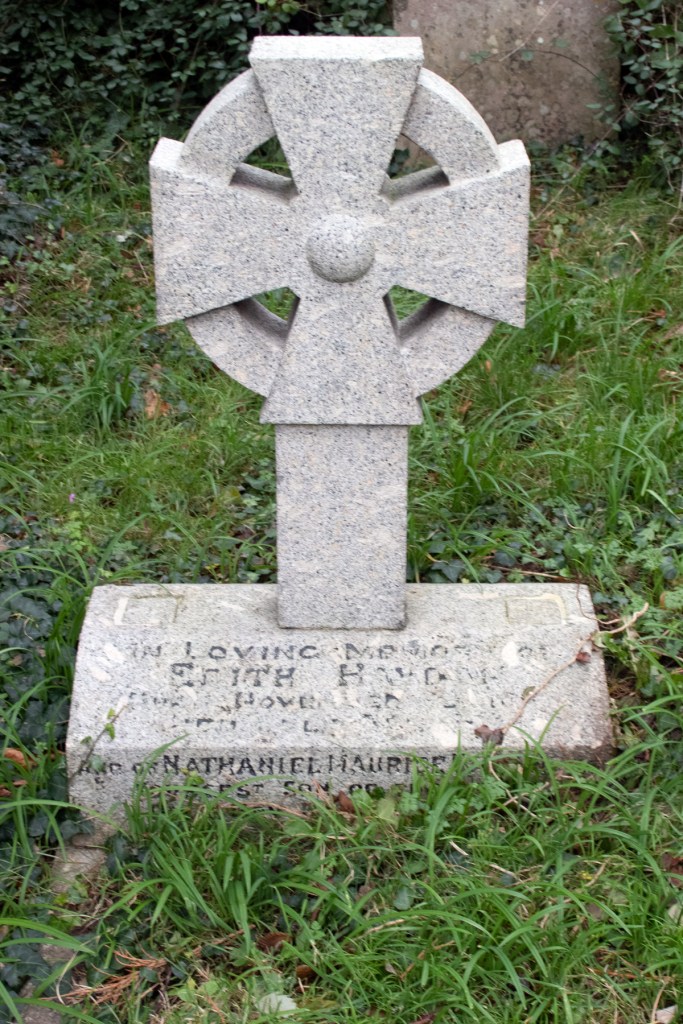
Nathaniel Maurice Haydon was born on 26th May 1900, and was the youngest of four children to Edgar and Edith Haydon. Edgar was a surgeon from Bovey Tracey, Devon, but the family were born and raised in Newton Abbot.
Edgar’s work gave them a comfortable lifestyle: the 1901 census shows the family had four live-in servants. Edith passed away from cancer in July 1903, when her youngest was only a toddler. Edgar married again – to a Gertrude Godwin, fourteen years his junior – four years later; given his role in the community, this is likely to have provided the family with a level of stability.
By the time of the 1911 census, Nathaniel and his older brother Frank were recorded as boarders in a private school in the town, while Edgar and Gertrude were listed at the family home with two domestics.
War was coming to Europe, but Nathaniel was initially young to become involved. Spurred on when his oldest brother, Edgar, was killed at the Somme in July 1916, he applied to join the Inns of Court Officer Training Corps in the summer of 1918. He was accepted, and sent off to Hemel Hempstead, Hertfordshire, for training that September.
Sadly, it was Private Haydon’s eagerness to emulate his brother that led to his undoing. While at the camp, he contracted pneumonia, and passed away on 1st November 1918, aged just 18 years old.
Nathaniel Maurice Haydon’s body was brought back to Devon for burial. He was laid to rest in the family plot in the graveyard of St Mary’s Church, Wolborough, Newton Abbot.
William Charles Fuller was born on 31st January 1876 in Newton Abbot, Devon. He was the older of two children to Francis and Mary Fuller. Francis was a nurseryman, and gardening was a trade that both William and his brother followed him in.
Mary died in 1895 and Francis married a second time the following year, to a Mary Rogers. In July 1905, William married Ellen Bland, the daughter of the landlord of the Swan Inn in nearby Highweek. The couple went on to have a son, William, who was born the following year. William Sr continued his nursery trade through until the outbreak of war, while volunteering for the local defence corps.
When war came to Europe, William stood up to play his part. Full details of his service are not readily available, but it is clear that he had enlisted in the 13th (Works) Battalion of the Devonshire Regiment by the summer of 1916.
Private Fuller was based on home soil, serving in both Devon and Cornwall. However, he was billeted on Salisbury Plain by the start of 1917, and it was here that he fell ill. Having contracted influenza, William was admitted to the Fargo Hospital in Larkhill, Wiltshire; this was where he passed away on 25th January 1917. He was days short of his 42nd birthday.
William Charles Fuller’s body was brought back to Devon for burial. He was laid to rest in the family plot in the graveyard of St Mary’s Church in Wolborough, near Newton Abbot.
Bert Burridge was born in the spring of 1893, one of nine children to Charles and Elizabeth. Charles was a journeyman shoemaker from Crediton in Devon, and this is where Bert was born. By the time of the 1901 census, however, the family had moved south to Newton Abbot.
When Bert left school, he found work as a carriage cleaner for the railways; he soon moved out, and boarded with a family in Kingsbridge, in the south of the county.
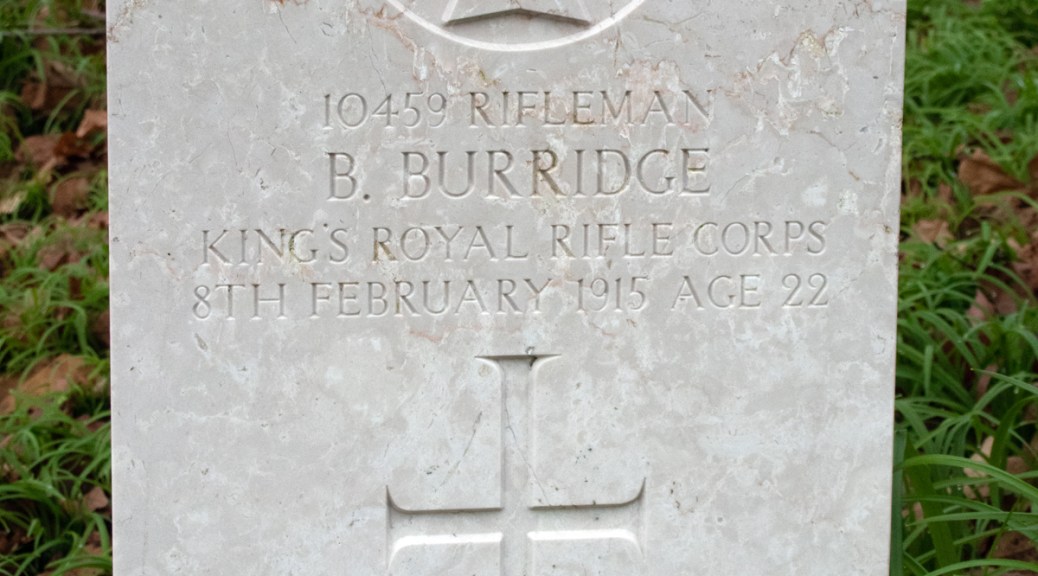
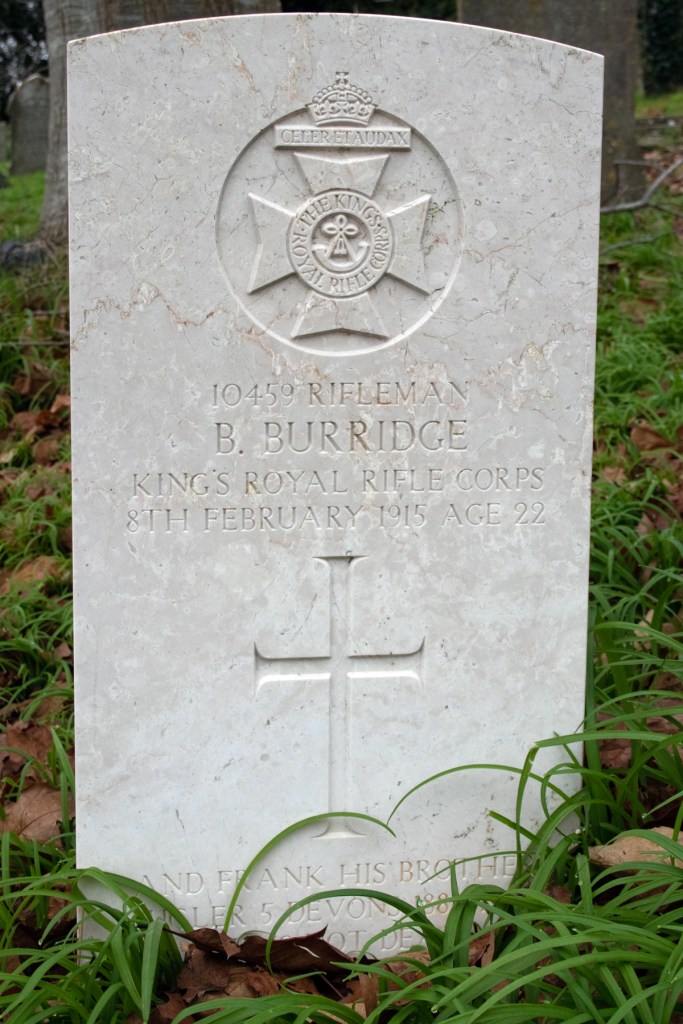
War was coming to England’s shores, however, and Bert was keen to play his part. He enlisted in the 4th Battalion of the King’s Royal Rifle Corps as a Rifleman on 16th January 1912. His service records show that he stood 5ft 4ins (1.63m) tall, and weighed 121lbs (55kg). He had a fresh complexion, grey eyes, dark brown hair, and a tattoo on right wrist of two crossed hands.
When war broke out, Rifleman Burridge was sent to France and was caught up in the fighting early on. After three months at the front, during the winter of 1914, he contracted frostbite, and was medically evacuated back to England. He was admitted to the 2nd Eastern General Hospital in Brighton, but died of injuries on 9th February 1915. He was just 22 years of age.
Bert Burridge’s body was brought back to Devon for burial. He was laid to rest in the graveyard of St Mary’s Church in Wolborough, on the outskirts of Newton Abbot.
Bert’s headstone also includes a commemoration to his older brother, Frank. Seven years older than Bert, he had enlisted in the Devonshire Regiment as a Bugler when quite young. He passed away in the autumn of 1906, aged just 20, but further details are unclear.









 Death and Service