Tag Archives: India

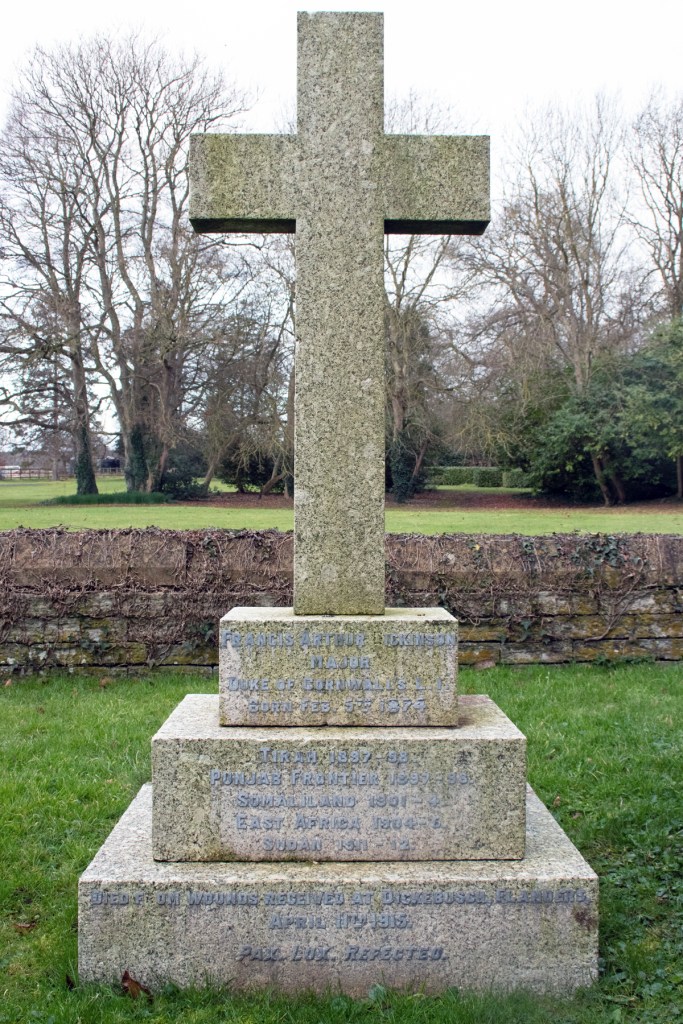
Major Francis Dickinson

Major Francis Dickinson

Francis Arthur Dickinson was born on 5th February 1874 in Lufton, near Yeovil, Somerset. The elder of two children, his parents were banker Arthur Dickinson, and his wife, Alice.

Francis was drawn to a military life. The 1891 census lists him as an army student at a boarding school in Cornwall, and by the end of the decade, he had enlisted in the Duke of Cornwall’s Light Infantry.

Over the next fifteen years, Francis served around the world, fighting in India, South and East Africa and in the Middle East. By the end of his term of service, he had risen to the rank of Major. During this time, he had been awarded a number of decorations, and had been mentioned in dispatches twice for his gallantry.

On 23rd July 1914, Francis married Clare Phipps, the daughter of a man of private means from Dilton Marsh, near Westbury, Wiltshire. The couple married in Clare’s home village, but set up residence in the Dickinson family home in Kingweston, Somerset.

When war was declared in 1914, the newlyweds were on their honeymoon. Francis returned to the army and was offered the rank of Colonel, but turned it down, in order to return to the Duke of Cornwall’s Light Infantry. He soon found himself in the thick of things again, and was caught up in the fighting at Mons, Marne, Aisne and Messines.

In April the following year, Major Dickinson was wounded. Evacuated to a camp hospital in Boulogne, he was not to survive his injuries this time round. He passed away at the hospital on 11th April 1915, at the age of 41 years old.

Due to the masses of servicemen being killed, a decision had been taken by the government of the time to not repatriate the dead to Britain, but to bury them in cemeteries close to where they fell. However, whether because of his family’s connections, or because he passed on the Channel coast, Major Dickinson’s body was, in fact, brought back to Somerset.

Francis Arthur Dickinson was laid to rest with full military honours in the graveyard of All Saints’ Church. He was buried alongside other family members, and in the shadow of the family manor.


Major Francis Dickinson
(from findagrave.com)

Private Alfred Luke

Private Alfred Luke

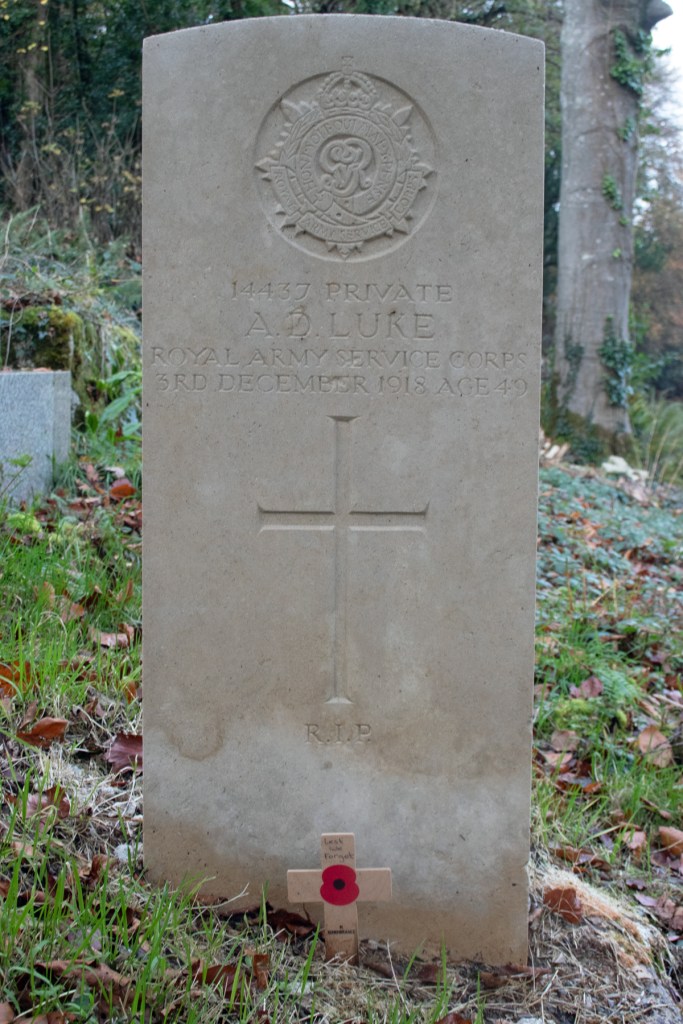
Alfred Docking Luke was born in 1869 in the village of St Breock, near Wadebridge, Cornwall. One of thirteen children, his parents were William and Selina Luke. William was a general labourer, and this is a trade into which Alfred followed.

Alfred wanted bigger and better things, however, and, on 27th September 1893, he enlisted in the Royal Garrison Artillery. Gunner Luke’s service records show that he was 5ft 9ins (1.75m) tall, and weighed 146lbs (66kg). He was noted as having blue eyes, brown hair and a fresh complexion. The record also noted a number of tattoos: a cross and a square and compass on his left forearm, the letters AL on the back of his left hand and rings on his middle and little fingers of the same hand.

Initially enlisting for seven years’ service, Alfred soon found himself sent to India. He served his whole time there, and it appears not to have been without incident. He was noted as having sustained a fractured skull on 2nd October 1896, although there is no further detail on the injury.

When Gunner Luke’s initial term of service came to an end, he elected to remain on active duty and, in the end, remained in India until December 1905, before returning home to be demobbed.

Back in Cornwall, Alfred built his life again. He found more labouring work, this time in a manure store in Wadebridge, and married the recently widowed Bessie Williams. She had two children, and the family set up home together.

A sense of duty, or a love of the army life, remained in Alfred’s heart, however and, when war was declared, he was keen to play his part again. He enlisted in the Royal Army Service Corps in July 1915, and, despite being 45 years old by this point, he soon found himself in Northern France.

Private Luke spent the next three years supporting the lines on the Western Front, but by the autumn of 1918, life was taking its toll on him. On 8th November 1918 he was admitted to a camp hospital, having contracted influenza. Tests for tuberculosis proved negative, although his breathing was laboured, and he was medically evacuated back to Britain for further treatment.

Admitted to St John’s Hospital in Cheltenham, the medical report makes for some grim reading:

Patient on admission had paralysis of soft palate lulateral and ptosis rt. eye. Tongue slightly pointing to the left. Difficulty in articulation due not only to palatal paralysis but also to apparently labial and dysphagia for fluids and solids. Fluids returned through nose. The symptoms, in short, of bulbar paralysis.

Private Luke’s condition worsened. He passed away the day after being admitted, on 3rd December 1918. He was 49 years of age.

Alfred Docking Luke’s body was brought back to Cornwall for burial. He was laid to rest in the peaceful, wooded graveyard of St Breoke’s Church in his home village.


St Breoke’s was the family church, and the Luke family were to be reunited again. Alfred’s mother Selina passed away a month after her son, at the age of 68; his father William followed in May 1919, at the age of 78.


Signalman Albert Chevalier

Signalman Albert Chevalier

Albert Patrick Michael Chevalier was born in India on 16th June 1893. There is little definitive information about his early life, although his mother was called Georgina, and the family may have moved back to England when Albert was just a child.

When he left school, Albert found work as an errand boy in an office. But he wanted bigger and better things and, on 4th May 1909, aged just fifteen years old, he enlisted in the Royal Navy. Because of his age, he was given the rank of Boy 2nd Class, and for the first eighteen months, he was assigned to training bases – HMS Ganges and HMS Impregnable.

After only a few months, Albert was promoted to Boy 1st Class and, after a month at HMS Pembroke – the Royal Naval Dockyard in Chatham, Kent – he was given his first sea-going appointment on board the cruiser HMS Minerva.

Albert spent eighteen months on Minerva, during which time he came of age. He seems to have had an understanding of basic technology, as he was given the rank of Ordinary Signalman. After some more time in Chatham, Albert went to sea again, this time on board another cruiser, HMS Cressy. At the start of 1913 he was promoted again, and given the rank of full Signalman.

Signalman Chevalier went on to serve on a number of different vessels, primarily the battleship HMS Swiftsure, where he served for nearly three years, plying the waters between Britain and India. By the spring of 1916 he was back in Chatham, however, and it was here that things took a turn for the worse.

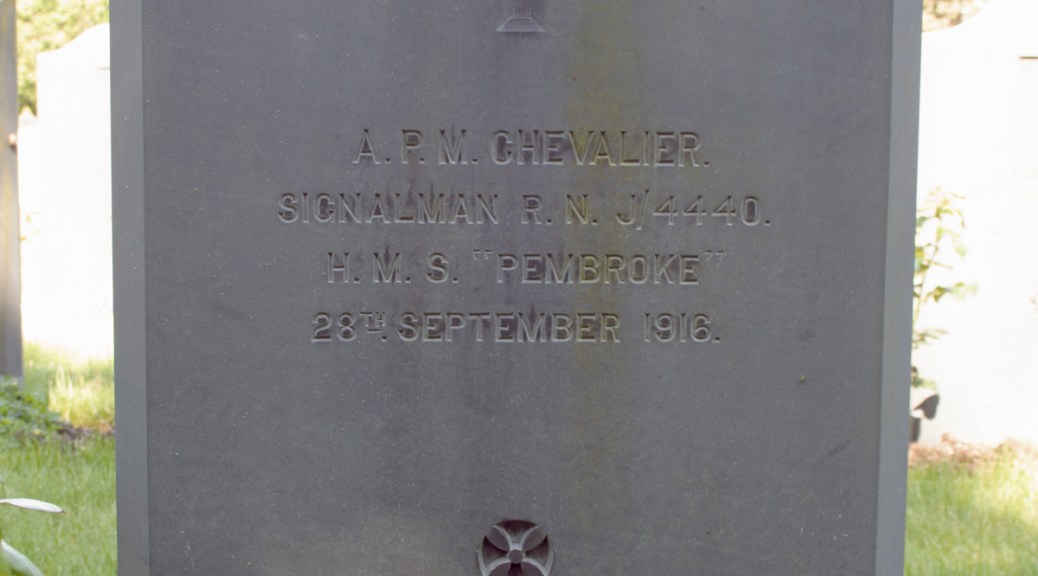
Albert was admitted to the Royal Naval Hospital in the town, suffering from pleurisy. Sadly, the condition was to get the better of him and he passed away the hospital on 28th September 1916, at the age of just 23 years of age.

Albert Patrick Michael Chevalier’s body was laid to rest in Woodlands Cemetery, Gillingham, not far from the dockyard from which he had made so many of his voyages.


Albert’s mother Georgina had not settled in England for long. The army pension record gives her as Albert’s beneficiary, but notes her address as Victoria Street, Daylesford, Victoria, Australia.


Serjeant-Trumpeter Alexander de Vere

Serjeant-Trumpeter Alexander de Vere

Alexander Johnstone de Vere was born on 10th August 1889 in Murree, India (now Pakistan). He was one of five children to Norfolk-born Alexander Johnstone (also known as John Ralph de Vere), and his wife Dorothea who had been born in Sangor, India. Alexander Sr was a Sergeant Major in the 12th Lancers, and the family returned to England not long after his son was born, settling first in Aldershot, then in Sandhurst.

Alexander’s youngest sibling, George, was born in Cairo, Egypt, so the family was on the move again. Sadly, Alexander Sr died in a nursing home in the city just two years later and, after returning to England, Dorothea passed away in a Holborn infirmary just two years later.

Documents for the de Vere children – Ellen, Alexander, Dorothea, William and George – are few and far between. The 1911 census places Dorothea boarding with a family in Kingston-upon-Thames, where she was employed as a dress maker. The same document records William as a Bandsman in the 1st Battalion of the Seaforth Highlanders, based at Chanpatia, in Northern India. George, meanwhile, was a schoolboy at the Duke of York’s Royal Military School on the outskirts of Dover. Of the two eldest siblings, however, there is no record.

In the autumn of 1912, Alexander married Emily Louise Collins. Born in Norfolk in 1884, she was working as a servant in a house in Surrey when she and Alexander met. The couple married in Faversham, Kent, and settle down there, their daughter, Dora, being born in the town in January 1915.

Given his family’s military background, it is not unsurprising that Alexander enlisted in the army almost as soon as war was declared. He may have already seen military service, as he enlisted in the 11th Hussars as a Lance Corporal. By 15th August 1914, Alexander was in France.

Lance Corporal de Vere was quickly caught up in the fighting. He saw action at Mons and Nery in 1914, and at Ypres the following year. By this point, he had been promoted to the rank of Sergeant Trumpeter, reflecting the musical connection he shared with his younger brother, William.

Alexander remained in France until January 1916, when he was invalided home. He was admitted to Dorchester County Hospital in Dorset, suffering from a cerebral abscess. Despite treatment, he succumbed to the condition, passing away on 17th March 1916, at the age of just 26 years old.

Alexander Johnstone de Vere was brought back to Kent for burial. He was laid to rest in Faversham Borough Cemetery.


Captain Roden Chatterton

Captain Roden Chatterton

Roden Latham Chatterton was born on 13th July 1895, in Budin, Bengal, India. He was the only child to George and Ella Chatterton. George was a Lieutenant Colonel in the army, and had married Ella in India, where he was based.

The family had returned to England by the time of the 1911 census, but then moved permanently to Ireland. When war broke out, Roden joined up, enlisting in the 1st Battalion of the Leinster Regiment with the rank of Lieutenant. Full details of Roden’s military service are not available, but he arrived in France in January 1915 and, stayed there for the best part of two years.

In December 1917, the now Captain Chatterton transferred to the Royal Flying Corps. Based in Kent, he learnt to fly, and was close to gaining his wings, when an accident befell him in March 1918.

About 5:30pm on March 27th, [Captain Chatterton] was about 1.500 feet up, was trying to land near an aerodrome, and the wind was very rough. He shut off the engine and tried a left hand turn when the machine stalled and came down in a spin nose down and crashed to the ground. Several [people] went to his assistance. He was in great pain and made no remarks. He had been strapped in, but the belt had broken. The wind was from the south south-west. He came own into the wind and was trying to turn head into it when the machine got into a spin. It was not an ideal day for flying. Another machine… was flying with the deceased, and that landed all right. There was no collision in the air. When [he] turned he had not got the nose down far enough to keep up the engine speed and, in the witness’ opinion it was through an error of judgment on his part that the machine crashed. Had there been more space he would have got out of the spin. There was nothing wrong with the machine, but it was a type that was very difficult to handle in rough weather.

Whitstable Times and Herne Bay Herald: Saturday 6th April 1918

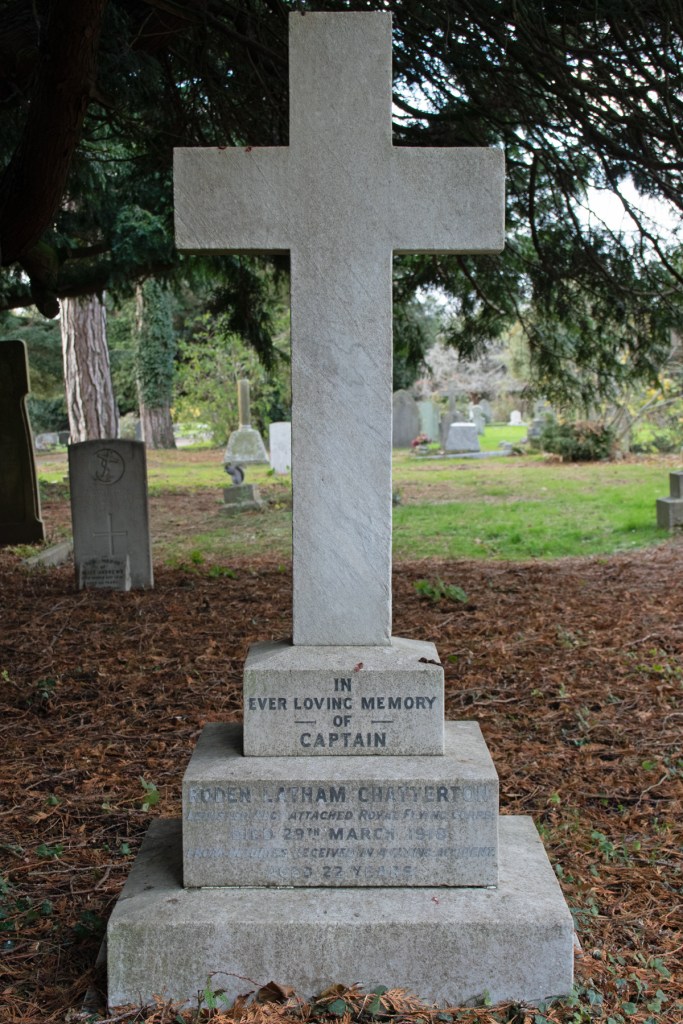
Captain Chatterton was taken to the Lees Court Military Hospital south of Faversham for treatment, but died of his injuries on 29th March 1918. He was 22 years of age.

Roden Latham Chatterton was laid to rest in a quiet corner of the Borough Cemetery in Faversham.


Rifleman Frederick Burstow

Rifleman Frederick Burstow

Frederick William Burstow was born in the summer of 1893, and was one of thirteen children. His parents were plasterer Alfred Burstow and his wife, Lydia. Both came from Sussex, and it was in Bexhill-on-Sea where they raised their family.

There is little documented about Frederick’s early life, but he sought a life outside of Sussex and, in around 1900, he enlisted in the 2nd Battalion of the Rifle Brigade, serving in India for a time.

Rifleman Burstow was still serving when, in August 1914, war was declared. His battalion was sent to France that November, and he ended up serving two terms on the Western Front.

In the summer of 1915, Frederick married Priscilla Epps. She was from Faversham, Kent, and this is where the couple set up home together.

It was while on his second term in France that Rifleman Burstow became ill. He had contracted enteric fever – also known as typhoid – and, at the beginning of 1916, he was sent home to recuperate. While here, Priscilla gave birth to a child, Alice.

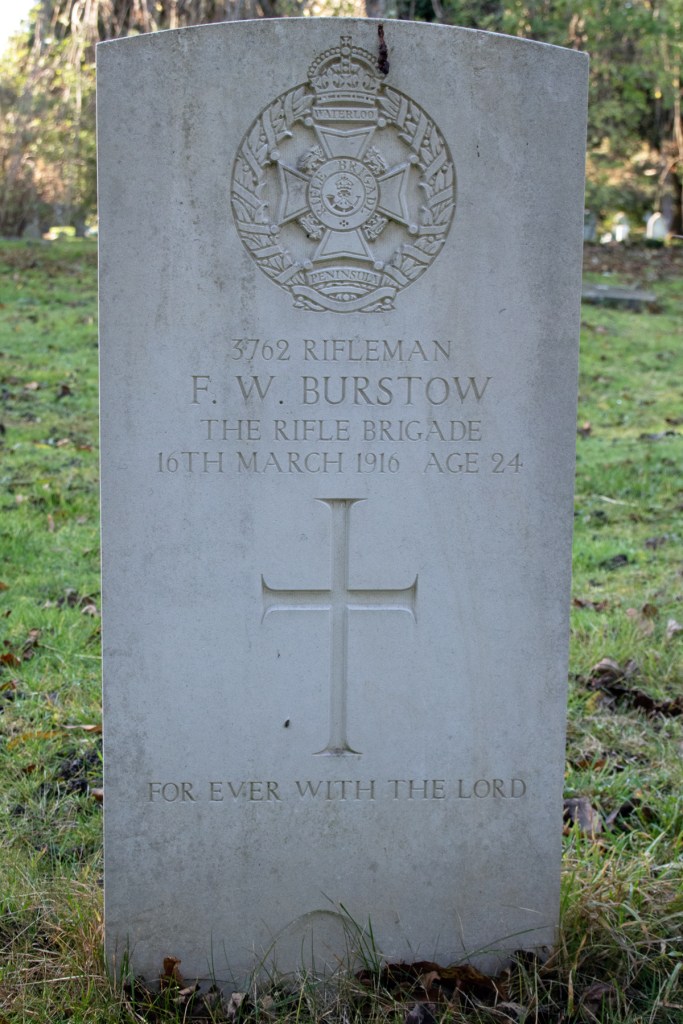
Sadly, however, Frederick’s condition was to get the better of him: he passed away at home on 16th March 1916, at the age of just 24 years old.

Frederick William Burstow was laid to rest in the Borough Cemetery in his adopted home town of Faversham.


Rifleman Frederick Burstow
(from ancestry.co.uk)

Frederick was not the only Burstow family member to die during the war. His older brother, Arthur Edward James Burstow, fought on the Western Front with the 2nd Battalion of the London Regiment.

Private Burstow was caught up in the fighting in Arras in the spring of 1918, and was killed in action on 13th April. He was 38 years of age, and left behind a widow and six children.

Arthur Edward James Burstow is commemorated on the Ploegsteert Memorial in Belgium.


Serjeant Albert Woolcott

Serjeant Albert Woolcott

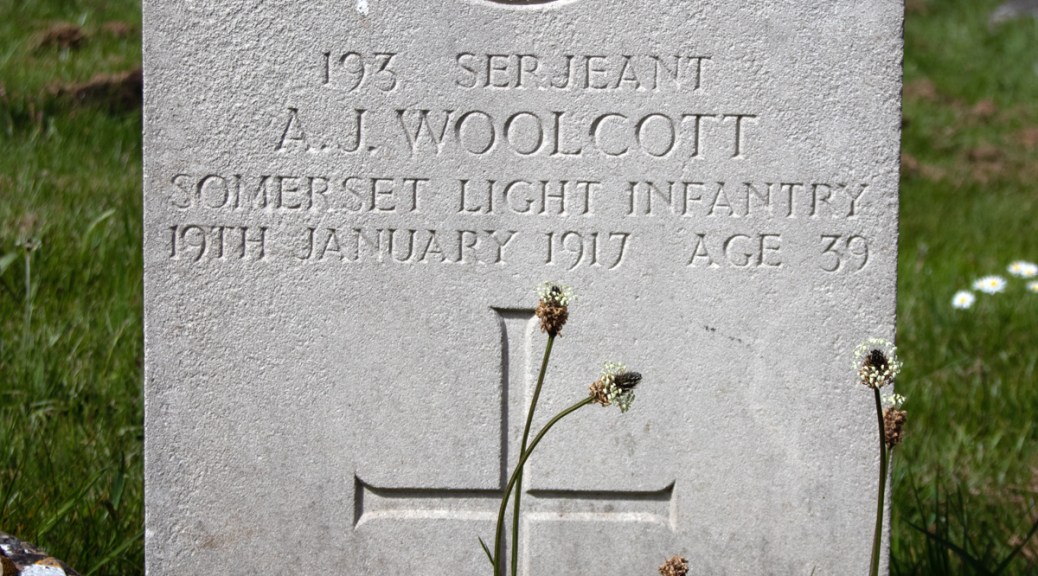
Albert John Woolcott was born in the spring of 1877 and was one of three children to Thomas and Mary. Thomas was a labourer for a spirit company, and both he and his wife came from Chard in Somerset, which is where Albert and his siblings were born.

When he finished school, Albert was apprenticed to a local iron foundry and, by the time of the 1901 census, he was recorded as being a blacksmith in his own right.

By this point, Albert had met local woman Mary Pattimore: the couple married in the local church on Boxing Day 1901, and went on to have four children, all of them boys. Albert continued with his ironwork: the 1911 census records him as being the blacksmith at Chard’s Gifford Fox & Co.’s lace factory.

Albert played a keen role in the local volunteer movement for the Somerset Light Infantry. Through the town’s Constitutional Club he took an active role in its rifle range and was known to be a particularly skilled marksman. He also played in both the Volunteer Band and Chard’s Municipal Band.

When war came to Europe in August 1914, Albert was already billeted on Salisbury Plain as part of the volunteers, and was promoted to the rank of Serjeant. He was sent to India with his troop – the 5th Battalion of the Somerset Light Infantry – and remained there until April 1916.

By this point, Serjeant Woolcott was suffering from dorsal abscesses on his hands, and was evacuated back to England for treatment. Over the next nine months he was in and out of Netley Hospital on the outskirts of Southampton, where he had a number of operations to try and fix the problem.

Sadly, his treatment proved unsuccessful: Serjeant Woolcott passed away in the hospital on 19th January 1917, at the age of 39 years old.

Albert John Woolcott’s body was taken back to Somerset for burial. He was laid to rest in his home town’s cemetery.


Serjeant Tom Harris

Serjeant Tom Harris

Thomas Harris – known as Tom – was born on 13th October 1876, the only son of Edmund and Mary Harris. Edmund was an agricultural labourer from the Somerset village of Seavington St Mary, and this is where Tom was born and raised.

Mary had married Edmund in the spring of 1876, but had been married before; she was widowed when her previous husband, Alfred Vickery, died ten years before. They had had seven children of their own, half-siblings to Tom.

Edmund died in the Wells Lunatic Asylum when Tom was only six years old. When he left school, he found work as a farm labourer, but sought bigger and better things, even though he was now the only one of Mary’s children still living at home.

Tom enlisted in the Somerset Light Infantry in January 1893, and soon found himself overseas. During his sixteen years’ service, he spent seven years in India and six months fighting in the Second Boer War. Corporal Harris seems to have had a sickly time of it, and while in India, was admitted to hospital a number of times for fever, ague and diarrhoea, as well as a bout of conjunctivitis.

When Tom’s contract came to an end in 1909, he returned to Britain, setting up home in Newport, South Wales, where he found work as a sheet weigher at the local steel works.

Mary died of senile decay and cardiac failure in May 1910. She was 74 years old, and sadly passed away in the Chard Workhouse, in similar circumstances to her late husband.

In October 1913, Tom married Ada Long in Chard. She was the daughter of a shopkeeper, and the couple set up home in South Wales, where Tom was still working.

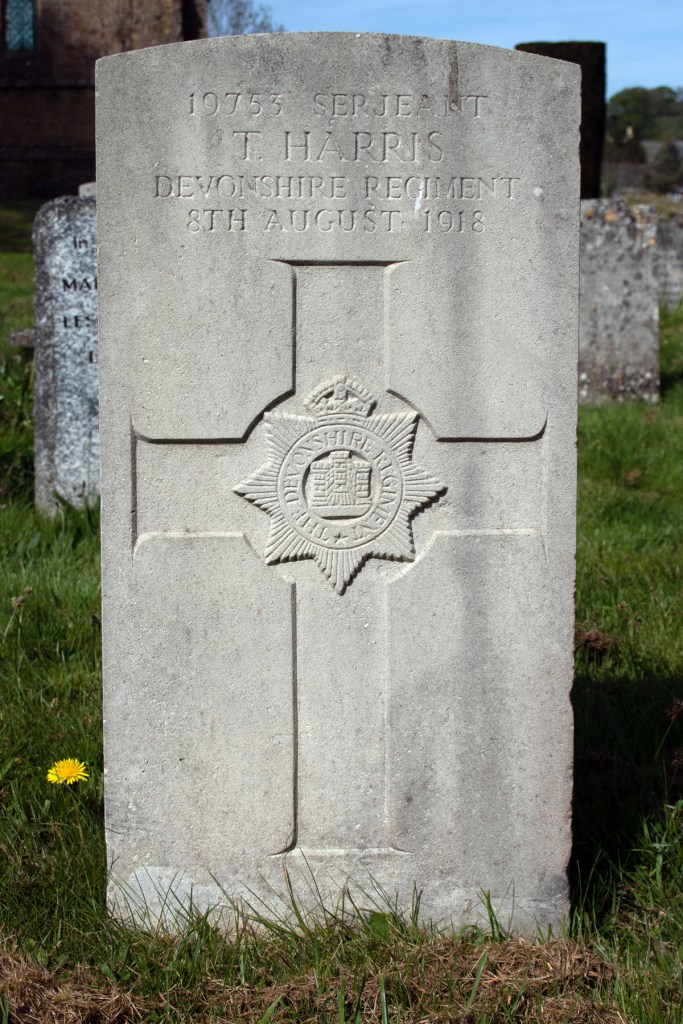
War, by now, was closing in on Europe, and Tom wanted to use his previous experience to serve his country once again. He enlisted on 20th August 1914 in Newport, joining the Devonshire Regiment as a Private, although he was quickly promoted first to Corporal and then to Serjeant. His service records show that he was 5ft 8ins (1.73m) tall, had blue eyes, brown hair and a tattoo of a Spanish girl on his right forearm.

After a year on the Home Front, Serjeant Harris was sent to Egypt in September 1915. On the way out, he contracted a severe cold, which left him deaf in his left ear. He was also suffering from varicose veins, which left him in pain in his right leg. He was treated for both conditions, and put on light duties for three months.

In November 1916, Serjeant Harris was supporting a food convoy when it came under attack. Buried in sand and wounded, he was laid up in a hole for two days and nights before help came. He was initially treated for shell shock in the camp hospital, but was eventually evacuated to Britain for treatment.

The incident had put too much of a strain on Tom, and he was medically discharged from the army in April 1917. While his medical report confirmed that the general paralysis he was suffering from was a result of the attack, it also noted on six separate occasions that he had previously suffered from syphilis, suggesting this may also have been a contributing factor to his mental state.

Tom was discharged initially to an asylum in South Wales, before returning home to Ada. The couple were soon expecting a child, and a boy, Sidney, was born in February 1918. By that summer, however, Tom’s condition had worsened enough for him to be admitted back to the Whitchurch Military Hospital in Cardiff.

It was here that Tom passed away, dying from a combination of chronic phlebitis – an extension of the varicose veins he had previously complained of – and general paralysis on 8th August 1918. He was, by this point, 41 years of age.

Tom Harris was brought back to Somerset for burial. He was laid to rest – finally at peace – in Chard Cemetery.


Serjeant Tom Harris
(from ancestry.co.uk)

Private Arthur King

Private Arthur King

Arthur Thomas Rendell King was born early in 1896, the oldest of six children to Thomas and Bessie King. Engine driver Thomas had been born in London, but, after marrying his wife the year before Arthur was born, he settled in Highweek near Newton Abbot, Devon.

When he left school, Arthur followed his father in working for Great Western Railways, working as a carriage cleaner at the town’s depot. War was on the horizon, however, and he enlisted in the Devonshire Regiment shortly after conflict was declared.

Private King was assigned to the 1st/5th Battalion and sailed for India in October 1914, arriving in Karachi a month later. After nearly three years, his regiment moved again, this time to Egypt, in advance of action in the Middle East.

Involved in the Battle of Nebi Samwil in November 1917, Arthur was badly wounded – and initially recorded as missing, presumed dead. However, he was found, and evacuated to England. Tragically, within hours of being admitted to a hospital on home soil on 31st January 1918, Private King died of his injuries. He had just turned 22 years of age.

Arthur Thomas Rendell King’s body was brought back to Devon for burial. He was laid to rest in the family grave in the graveyard of All Saints Church, Highweek.


Private Arthur King
(from findagrave.com)

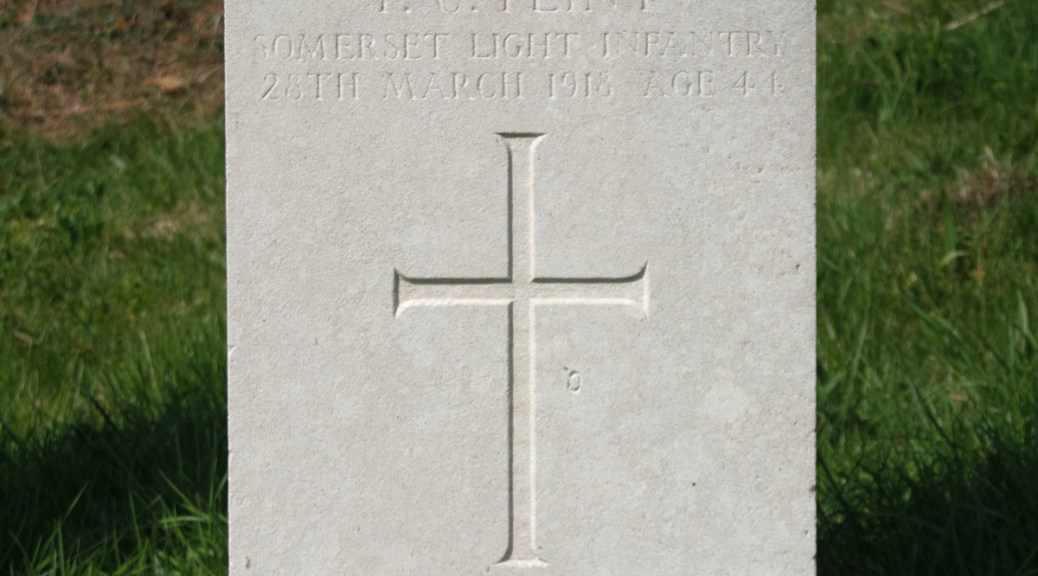
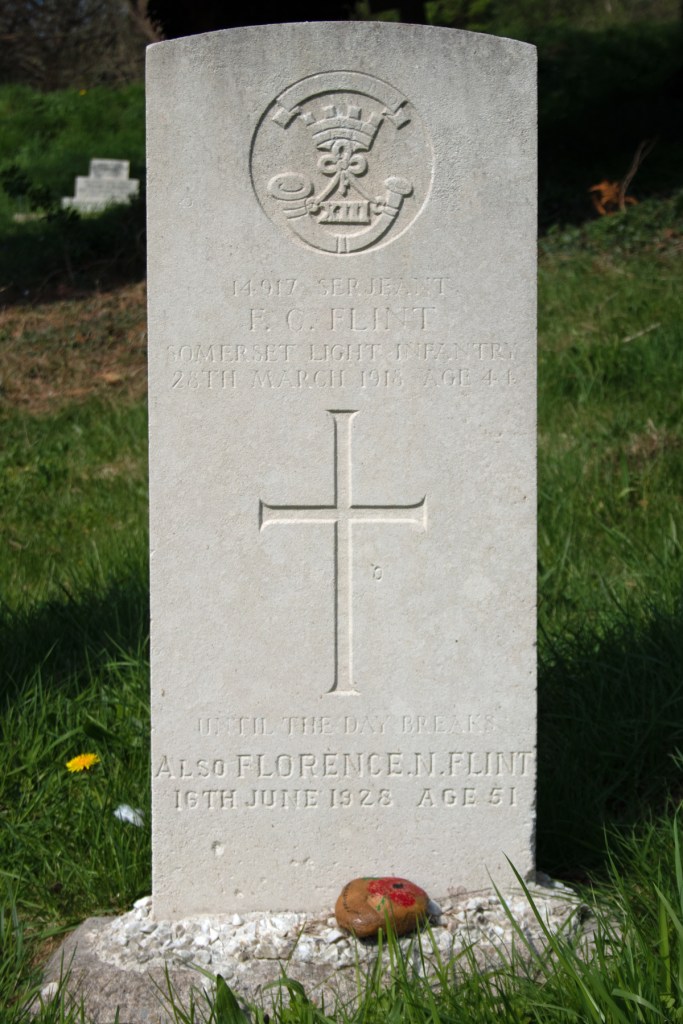
Serjeant Frederick Flint

Serjeant Frederick Flint

Frederick Charles Flint was born in the summer of 1872 in Bath, Somerset. He was the oldest of seven children to tailor Frederick Flint and his wife, Mary Ann.

Tailoring, however, was not a career that Frederick Jr wanted to follow and, in November 1890, he enlisted in the 7th Battalion of the Somerset Light Infantry. Over his twelve years’ service, he was posted to India and South Africa, gaining clasps for the Punjab Frontier 1897-1898, Relief of Ladysmith, Tugela Heights, Orange Free State, Cape Colony, Transvaal, South Africa 1901 and 1902 and the King’s South Africa Medal.

He returned to England in 1902, when he found employment as a postman back in Bath. He met Florence Novena Fishlock and the couple married at St Michael’s Church in Bath on 5th February 1905, before moving to nearby Radstock.

Frederick remained with the Post Office until the outbreak of war, when he again enlisted for duty, re-joining the Somerset Light Infantry. While he did not serve overseas, Serjeant Flint took on a training and mentoring role on Salisbury Plain. Suffering from tuberculosis, he was formally discharged from the army on medical ground in August 1915, and returned home.

The next few years proved challenging for Frederick, as his illness left him incapacitated. He was nursed through by Florence, but eventually his body could take no more. He succumbed to the condition on 28th March 1918, at the age of 45 years old.

Frederick Charles Flint was laid to rest in the graveyard of St Nicholas’ Church in Radstock. Florence passed away ten years after her husband; she was laid to rest in the same plot in the summer of 1928.


Serjeant Frederick Flint (from findagrave.com)