Tag Archives: influenza

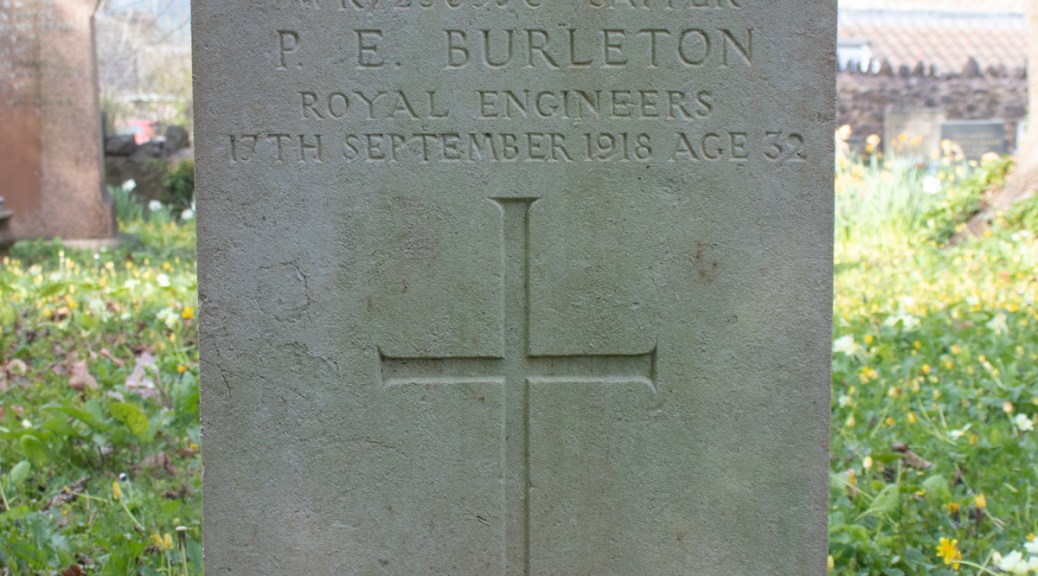
Sapper Percy Burleton

Sapper Percy Burleton

Percy Edward Burleton was born on 24th July 1885, the youngest of seven children to George and Lucy Burleton. George was a quarryman, and the family lived in the village of Draycott, near Wells in Somerset.

Percy’s older brother Lewis worked for the railways, and this is a trade that his younger sibling followed. By the time of the 1911 census he was living with his brother in Glastonbury and worked as a carman, delivering goods to and from the local station.

In February 1914, Percy appeared as a witness in an inquest about the death of a colleague, George Gillett. George had gone missing one night after the two had met for a drink in a local pub. The alert was raised when George’s coat was found hanging on a branch on the banks of the River Brue, to the south of the town; the waters were dredged and George’s body found.

At the inquest, Percy confirmed that the two men had had a drink in a local pub, and that George had seemed a little strange, but not the worse for drink. He reported that the deceased man had been quieter than usual at the railway stables for a week or so. George had left the pub at 10:55 that evening, and that was the last time that Percy had seen him.

Part of a carman’s duty was to collect money for the goods they had delivered; this was then paid to the station clerk on a daily basis. In the week leading up to his death, the stationmaster had been advised of some financial discrepancies, and on the day he drowned, he had been spoken to and advised the matter would be reported to the police if the missing amount was not paid back.

The place where George’s coat was found was not on his way home from the pub, and he would have had to have gone out of his way to get there. When considering their findings, the jury returned a verdict of suicide during temporary insanity, citing that the financial situation George had apparently gotten himself into.

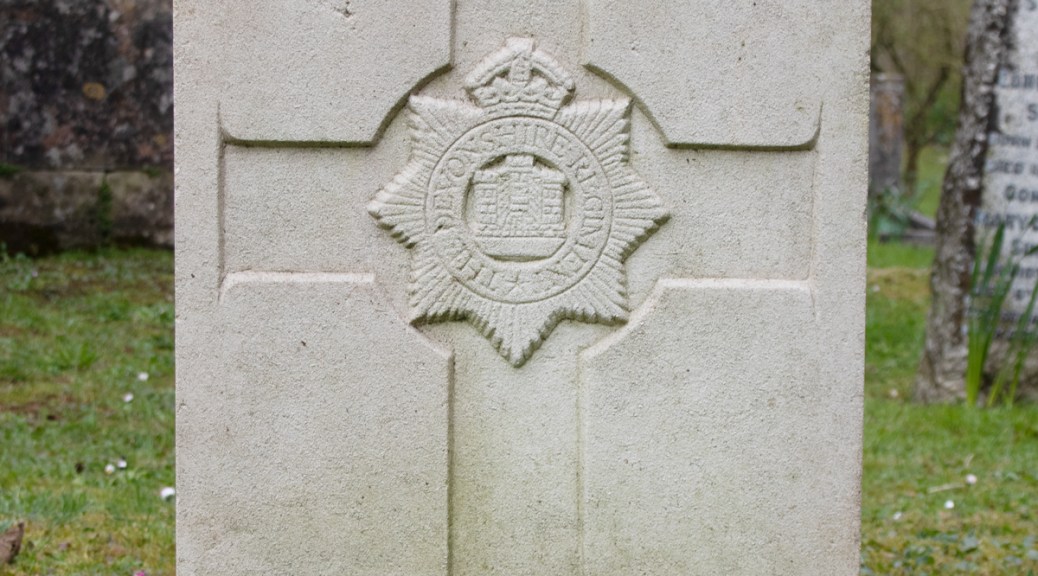
When war broke out, Percy seemed to have been keen to get involved. Initially joining the Devonshire Regiment in September 1914, his experience with his job saw him transferred to the Railway Operating Division of the Royal Engineers.

Shipped to France on 22nd September 1915, his service saw him awarded the Victory and British Medals and the 1915 Star. Sapper Burleton was moved to the Eastern Front and served in the Balkans for three years. According to the Central Somerset Gazette, which reported his passing, he contracted ‘a chill’ on the boat back to England and was admitted to Frensham Hill Hospital in Surrey.

Sadly, the chill seems to have been more severe than the report suggested, and Sapper Burleton passed away on 17th September 1918. He was 32 years old.

Percy Edward Burleton lies at rest in the graveyard of St Peter’s Church in his home village of Draycott, Somerset.


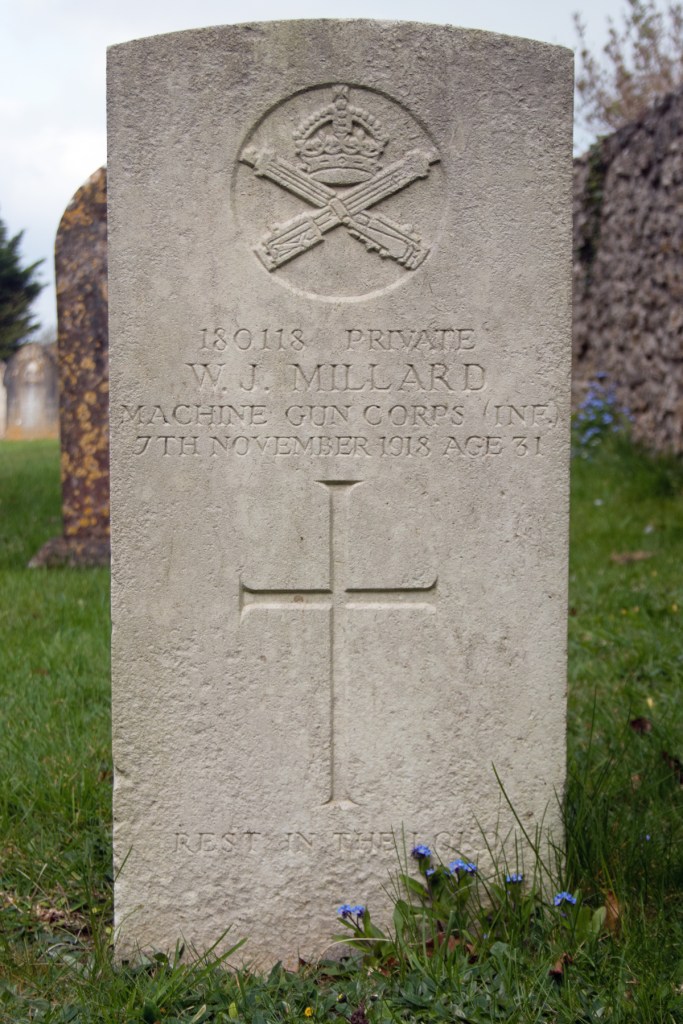
Private Walter Millard

Private Walter Millard

Walter John Millard was born in the summer of 1887, the youngest of nine children to Robert and Elizabeth. Robert was a farmer, and brought his family up in the village of Wedmore, Somerset. Walter followed in his father’s footsteps, and by the time of the 1911 census, was listed as a farm labourer in Wedmore, working for a William Millard, who presumably was a cousin of the family.

In March 1915, Walter married Jessy Masters, daughter of a grocer in nearby Wells. The couple set up home in the neighbouring village of Wookey, but would later make their home in Westbury-sub-Mendip.

In December 1915, aged 28, Walter was called up, and assigned to the Reserve Machine Gun Corps. He was not formally mobilised for almost three years when, in October 1918, he was shipped to Rugeley, Staffordshire, for training.

During this time, Private Millard was taken ill, and was admitted to the Military Hospital at Cannock Chase within weeks with influenza. His health deteriorated and, on 7th November 1918, he died from pneumonia. He was 31 years of age.

Had it not been for the quirk of fate of having been mobilised a month before the war ended, tragically, this would likely not be a story that needed to be told.

Walter John Millard was brought back to Somerset, and lies at rest in the graveyard of St Lawrence Church in Westbury-sub-Mendip.


Corporal Walter Tottle

Corporal Walter Tottle

Walter James Tottle was born in September 1892, one of fourteen children to Charles and Ellen Tottle from Somerset. Charles was a boatman, and they family lived in Salmon Parade along the riverfront in Bridgwater.

When Walter left school, he became an assistant at a market garden; by the 1911 census, he was living with his parents and eight of his siblings, whose jobs included carpentry and laundering. Walter’s younger brother Henry was listed as a ‘rink boy’, helping with skating at the local ice rink.

Walter’s life beyond this is a bit of a mystery. He enjoyed sports and, before the war had been a regular player for Bridgwater Rugby Football Club. He married a woman called Ruth, although I have been unable to track down who she was or when they couple wed.

When war came, Walter enlisted in the Somerset Light Infantry and, according to contemporary newspaper reports, Corporal Tottle had served on both the Eastern and Western Fronts. He was discharged from the army on 13th February 1919, following a severe attack of influenza, but it appeared to get the better of him. He passed away on 5th May 1919, aged just 26 years old.

Walter James Tottle lies at rest in St John’s Cemetery in his home town of Bridgwater, Somerset.


Walter’s ‘rink boy’ brother Henry also served in the First World War. He had also enrolled in the Somerset Light Infantry and, as a Corporal in the 1/5th Battalion, he was involved in some of the fierce fighting in the Middle East. He was injured, either in Gaza or Jerusalem, but sadly Henry died of his wounds on 22nd November 1917; he was buried in the War Cemetery in Jerusalem.


Company Quartermaster Sergeant Robert Roberts

Company Quartermaster Sergeant Robert Roberts

Robert Roberts was born in Liverpool in November 1887 the youngest of two children to Robert and Alice Roberts.

The New World beckoned for the Roberts family, and they set sail for Canada when Robert Jr was just 4 years old. The family settled in the city of Regina, Saskatchewan.

Little is recorded about Robert Jr until October 1911, when he married a Quebecois woman called Edna Webber. The young couple went on to have two children, a daughter, One, and a son, George.

In April 1916, he enlisted in the Canadian Expeditionary Force. His trade was noted as a Lumberman, and his record notes that Robert had already served as part of the 95th Saskatchewan Rifles.

Joining the 224th Battalion, Robert was shipped to England in May 1916. He transferred to the Canadian Forestry Corps in November, reaching the rank of Staff Sergeant, and was assigned to the company’s Base Depot in Sunningdale, near Windsor.

When the war ended, demobilisation was still a way off for a lot of soldiers, particularly those from the Commonwealth. Robert was transferred to Stirling, and was appointed Quartermaster Sergeant (responsible for supplies and stores) for 121st Company.

On 28th January 1919, Robert was admitted to the Royal Infirmary in Stirling with influenza and double pneumonia. Sadly, he passed away just over a week later, breathing his last on 6th February 1919. He was 33 years old.

Robert Roberts lies at peace in the Wembdon Road Cemetery in Bridgwater, Somerset.


There is no evident connection between Robert and Bridgwater, so why this was chosen as his place of rest is a mystery. It is likely that there was some sort of family connection, but that cannot be definitely established.


Able Seaman Alfred Walters

Able Seaman Alfred Walters

Alfred Charles Walters was born in March 1900, one of six children to Alfred and Sarah Walters from Bridgwater, Somerset. Alfred Sr was a labourer in a brickyard, and the family lived in the centre of the town.

When war broke out, Alfred seemed very eager to be involved. Lying about his age (giving his date of birth as 26th August 1898), he enlisted in the Royal Naval Reserve. Training in Portsmouth – on HMS Victory II, HMS Excellent and HMS President III – he was assigned to the SS Tanfield.

The steamer was heading out of London en route for Bombay and Karachi in April 1918, and was making its way west through the English Channel. On 15th April, it was located and tracked by the German U-Boat UB74, under the command of Ernst Steindorff. The German fired a torpedo, which hit and crippled Able Seaman Walters’ ship. Thankfully, there was no loss of life, and the Tanfield managed to limp back to port.

Little else remains of Able Seaman Walters’ military life. In February 1919, he was admitted to the Dreadnought Seaman’s Hospital in Greenwich, suffering from influenza and bronchial pneumonia. Sadly, he succumbed to the disease, passing away on 20th February 1919. He was just 18 years old (although his military record and gravestone give him as 19).

Alfred Charles Walters lies at peace in the Wembdon Road Cemetery in his home town of Bridgwater, Somerset.


Private Roland Roberts

Private Roland Roberts

Roland Roberts was born in September 1896, one of three children – all boys – to Albert and Minnie Roberts.

Minnie, who was originally from Yeovil, had married Walter Shury, a Londoner, in 1874, and the couple had six children together. Walter then went on to have four children with Alice Norwood, and the couple married in 1898. Minnie, meanwhile, had met Albert Roberts, who was from Dundalk in Ireland, and, while no marriage seems to be confirmed, the couple had three boys, including Roland. (It is pure speculation, but as Minnie’s maiden was also Roberts, this might have provided a good enough cover for any divorce or re-marriage.)

Albert had been a Band Sergeant in the 4th Hussars, and continued that passion by becoming a music teacher Travel was also definitely in his blood: the couple’s first child, Willie, was born in South London, Roland was born in Somerset, and his younger sibling, Glencoe, was born in Penzance, Cornwall. Albert’s musical success led him to become bandmaster for the Penzance Town Band. Sadly, it was not all positive for him; in 1901, Minnie passed away, and in the same year, Willie also died, at the tender age of six.

It was the military that drew Roland in, and, in 1910, aged just 14 years old, he enlisted in the Coldstream Guards. According to the following year’s census, he was stationed at the Ramillies Barracks in Aldershot, and held the rank of Boy.

Differing from the naval rank of the same name, lads of 14 or over could serve in any regiment as musicians, drummers, tailors, shoemakers, artificers or clerks, and all were ranked as boys. It seems likely, therefore, that his father’s enthusiasm for music served him well.

When war broke out, he was of fighting age, and, as part of the “Old Contemptibles”, he was involved in the Battle of Mons, the first major confrontation for the British Expeditionary Force.

During the war, Private Roberts took part in some of the most severe fighting on the Western Front, was wounded three times, as well as being gassed. He was also recommended for the DCM for gallantry in action.

He transferred to the Labour Corps, and spent time doing land work in Somerset. It was here that Roland met and married Gladys Pyne, whose family was from Bridgwater, and the couple tied the knot in March 1918.

Sadly, it was during this war service that Private Roberts contracted influenza and pneumonia and he passed away as his in-laws’ home on 10th November 1918, the day before the Armistice was signed. He was just 22 years old.

The local newspaper reported on Roland’s continued gallantry in its article on his funeral:

[Roland] held the medal of the Royal Humane Society for saving a woman’s life.

He was also the hero of an incident that occurred in Bridgwater a few weeks ago, when he succeeded in checking the career of an infuriated bull through pluckily catching the animal by its horns.

His disposition was always most cheerful, and although suffering from his [war] wounds a good deal, he never complained.

The Cornishman: Wednesday 27th November 1918

Roland Roberts lies at rest in the Wembdon Road Cemetery in his adopted home town of Bridgwater, Somerset.


Driver Stanley Pearce

Driver Stanley Pearce

Stanley Arthur Robert Pearce was born in September 1895, the fourth of five children to Edwin and Rosetta Pearce from Bridgwater, Somerset. Edwin was a painter and sign-writer, and it was in the creative trades that his children followed.

Stanley’s eldest brother Clifford became a gardener; his next oldest Edwin Jr was a mason’s labourer; while his older sister Dorothy became a cardboard box maker. By the time of the 1911 census, when Stanley was 16, he was listed as a painter’s errand boy, presumably helping out his father.

War was on the horizon, and Stanley was keen to do his bit. In October 1914, he enlisted, becoming a Driver in the Royal Army Service Corps. Assigned to the 662nd Heavy Transport Company, he was based in London. There was still time for visits home, however, and the local Bridgwater newspaper reported on an ASC football match in which Driver Pearce was involved in October 1915.

By this time, Stanley had met Flossie Vickery, from nearby North Petherton. The couple married the following year, and had two children, Ada and Geoffrey.

In 1916, Driver Pearce’s battalion was shipped off to Salonica in Greece, as part of the British Expeditionary Force in the Balkans. While there, he contracted malaria and dysentery, and was evacuated back to England for treatment in September 1918.

Driver Pearce recovered well enough to enjoy a month’s recuperation, but fell ill again, with a recurrence of malaria, combined with influenza and pneumonia. He was admitted to the Brook War Hospital in South East London, but sadly not recover, and passed away on 10th November 1918, a day before the Armistice was signed. He was just 23 years old.

Stanley Arthur Robert Pearce lies at rest in the Wembdon Road Cemetery in his home town of Bridgwater.


Stanley’s older sister Dorothy – the cardboard box maker – contracted influenza around the same time as her brother and, tragically, died just five days after him. The siblings were buried in a joint funeral at the cemetery.


Private Edward Gane

Private Edward Gane

Edward Lionel Gane was born in 1899 and was one of eight children. Known as Lionel, he was the son of Edwin and Joanna Gane, and lived in the quiet Somerset village of Ditcheat. Edwin began life as a pig dealer, but by the time of the 1911 census, had changed direction and become an insurance agent.

Joanna passed away in 1915, and this may have been the impetus Lionel needed to find his way in the world. He enlisted in the Wiltshire Regiment, joining the 3rd (Reserve) Battalion of the Duke of Edinburgh’s brigade.

The battalion – a depot and training unit – were initially based in Devizes, before moving to Dorset and then Kent. While there is no confirmation of when Private Gane enlisted, it would have been by September 1917, which is when the battalion became part of the Thames & Medway Garrison.

The end of the war marked another ending for the Gane family. Edwin passed away on Armistice Day – 11th November – and further tragedy was to follow, as Private Gane contracted influenza and died less than two weeks later.

Edward Lionel Gane died in a military hospital in Malling, Kent, on 24th November 1918. He was just 19 years old. He lies at rest in the graveyard of St Mary’s Church in his home village of Ditcheat.


Private Henry Mees

Private Henry Mees

Henry Edward Mees was born in Shepton Mallet, in June 1888. Henry was one of six children, and lived in Somerset with his father – Frederick and his mother Emma. Frederick was a gardener who worked as a groundsman for the local cemetery.

After leaving school, Henry found work as a clerk for a local auctioneer. Of his two brothers, the elder has found a trade in carpentry, while his younger sibling helped his father.

Henry’s service records are scant; he enlisted in the Labour Corps, although there is no confirmation of when this happened. Private Mees joined the 615th Home Service Employment Company and was based in England.

The HSE Companies categorised the employment of the men serving with them, whether they were cooks, caretakers, clerks, policemen, butchers or telephone operators, and used the men to the best of their skills. It is likely, therefore, that Private Mees continued in his clerk role, albeit in a different line of work from auctioneering.

Sadly, few further details of Henry’s life remain documented. He is listed as having been admitted to the War Hospital in Bath, and he died from influenza on 10th November 1918. He was 30 years old.

Henry Edward Mees lies at rest in the cemetery of his home town, Shepton Mallet, sadly tended by his father as part of his day-to-day job.


Private Hubert Labdon

Ashcott

Hubert Wilfred Labdon was born in the spring of 1896, to Alfred and Elizabeth Labdon, bakers in Ashcott, Somerset. One of five children, with two older brothers and two older sisters, he lost is mother at a very early age; Elizabeth died in 1901.

Hubert had left home by the time he was fifteen, but had not gone far – the 1911 census found him learning a trade from Edgar and Betsy Vining, farmers in the village.

When war came, Hubert enlisted – he joined up in February 1916, aged 19 years and five months. Private Labdon was initially assigned to the Somerset Light Infantry, but he must have quickly shown aptitude, because he was soon transferred to the Machine Gun Corps. After initial training, he found himself on a ship to France, arriving in Camiers, to the south of Boulonge, on 25th September 1916.

Private Labdon’s military records survive and are quite detailed – after an early mishap, where he was docked two days’ pay for losing part of his kit ‘by neglect’, he also spent time in hospital in June 1917.

By August of that year, he was based permanently at Camiers, where he was acting as a stretcher bearer. This was a role he continued to execute until he was demobbed at the end of the war.

His records show Hubert was granted two periods of leave; it was on the second of these, in November 1918, that he married Eva May Acreman. She was two years his senior, a farmer’s daughter from Ashcott as well, although the couple married in Ealing, London.

By mid-December, Private Labden was back in France, and here he stayed until February 1919, when his unit was finally demobilised. On returning to England, the young couple moved back to Ashcott, to be close to his family.

Sadly, Hubert seems to have succumbed to illness as many of his returning colleagues did. The local newspaper gave details of his passing:

The deceased, who was only 23, was recently married. He had served his country during the late war, part time as stretcher bearer. He had suffered from trench fever, which considerably injured his constitution and left him with a weak heart, which, no doubt, was the cause of death.

He had left his home for a short walk, and having been away rather longer than usual [a] search was made for him, and he was found sitting in an unconscious state. He died in a short time after reaching his home.

Deceased was of a very quiet and inoffensive disposition, and was much respected.

Central Somerset Gazette: Friday 2nd January 1920

While the end result was the same, Private Labdon’s military records adds the cause of death as ‘heart failure following influenza and acute diarrhoea’.

Hubert Wilfred Labdon lies at peace in the graveyard of All Saints’ Church, in his home village of Ashcott in Somerset.


Eva remained in Somerset after her husband’s death. In 1930, she married William Langford, a baker, and the couple went on to have a daughter.