William Samuel King was born in the summer of 1880, and was one of four children to Richard and Elizabeth King. Richard was a railway worker from Totnes, Devon, and this is where the family were born and raised.
When he left school, William found work as a house painter, and this is a job he continued to do through to the outbreak of the Great War. On 8th June 1908 he married Minnie Edmunds: the couple went on to have a son, Leslie, who was born in 1912. William and Minnie had, by this point, moved to Swansea, West Glamorgan, presumably as work was more plentiful here than in their Devon home. His work as a decorator seems to have been recognised, and he was admitted to the National Association Partnership, Swansea South.
On 1st December 1915, William enlisted and his service records show that he was 5ft 2ins (1.57m) tall. While it is clear that he spent his time on home soil, his service seems a bit disjointed.
Private King wasn’t formally mobilised until September 1916, when he was assigned to the 2nd/2nd Battalion of the Monmouthshire Regiment. In December he was transferred to the Royal West Kent Regiment before returned to his original battalion in February 1917. A month later, he moved to the Bedfordshire Regiment, before moving to the Middlesex Regiment a few weeks later. This also seems to have been a temporary move as, three weeks later, he was assigned to the 337th Works Company of the Labour Corps (although this was still part of the Middlesex Regiment).
The potential reason behind Private King’s haphazard service seemed to become a little clearer when, in September 1917, he was referred to Fort Pitt Hospital in Rochester, Kent. He was noted as being “very talkative, noisy [and] in a state of mental disease… he has… exalted and grandiose ideas and is difficult to restrain.” His mental health was obviously suffering, and he was discharged from military service in December 1917.
William returned home, although it was not to be for long. He passed away on 13th April 1918, at the age of 37 years old. While no cause of death is evident, it seems likely to have been connected to his ‘mania’, which had been exacerbated by his army service.
William Samuel King was laid to rest in Totnes Cemetery, not far from his parental home.
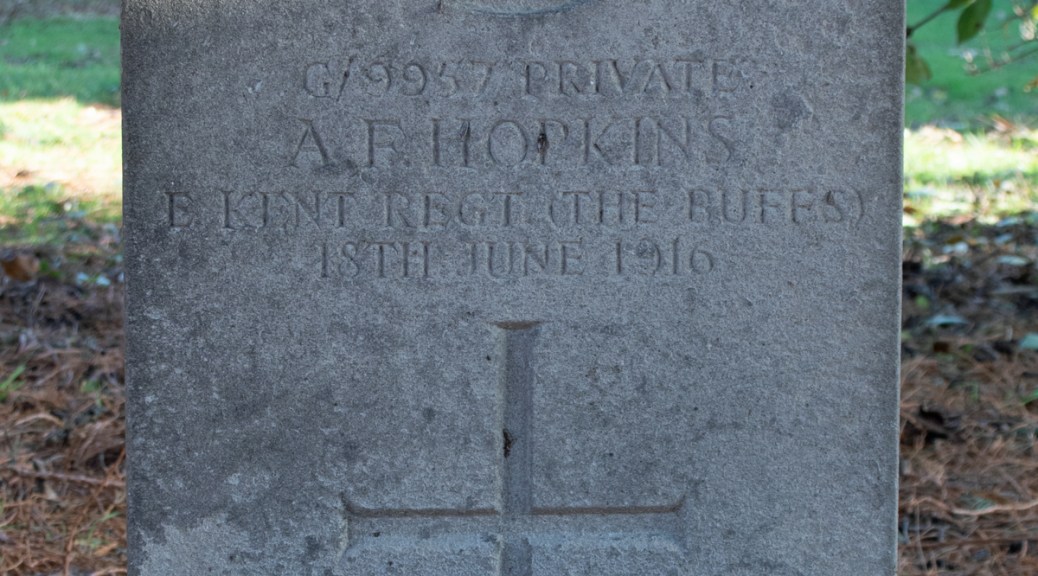
Ambrose Frank Hopkins was born in the autumn of 1886, in the Kent village of Ospringe. He was one of four children to shopkeeper-turned-farmer William Hopkins and his wife Julia.
When he finished school, Ambrose found employment in a brickyard in nearby Faversham. In August 1901, however, things took a turn for the worse for the Hopkins family.
Mr WJ Harris, Coroner, had a painful task on Monday evening, when he held an inquest on the body of William Hopkins, a farmer, who was found hanging in the cellar of his house that morning, having ended his life in consequence, it would appear, of business troubles.
Julie Hopkins, wife of the deceased, stated that her husband was 59 years of age… He went to bed on Sunday evening apparently in his usual health and at four o’clock that morning to light the fire which he usually did. Deceased had lately been troubled by business worries.
Blanche Sophia Hopkins, deceased’s daughter, stated that on going down the cellar about seven o’clock that morning (Monday) she saw her father hanging from a beam in the ceiling. She was too much frightened either to touch him or to notice if he was dead, but run up and sent to PC Ward and a doctor. The constable saw deceased just as she found him.
Faversham News: Saturday 31st August 1901.
The tragedy rocked the family and, within eighteen months, Julia too had died. By the summer of 1903, Blanche had auctioned off her once family home for the sum of £270, in order to support her and Ambrose, who was nine years her junior.
In 1906, Ambrose married Florence Harris, a widow thirteen years his senior, who had three children. The couple settled down in Faversham, and went on to have three children themselves – Elsie, Harold and William.
By now Ambrose was working as a labourer in Harty Ferry, just the other side of the Swale River on the Isle of Sheppey. But again, things were going to change as, in May 1916, he was called up for military service.
Private Hopkins was assigned to the 3rd Battalion of the The Buffs (East Kent Regiment). He was sent to Dover for training, before returning to home on leave in advance of further action.
An inquest was held at the Guildhall, Faversham, on Tuesday by the County Coroner… touching the death of Ambrose Frank Hopkins, aged 29… a Private in the 3rd Buffs, stationed at Dover, who hung himself on Sunday last.
Florence Amy Hopkins, the widow, stated that deceased has been… called to the colours three weeks that day. He had leave on Friday last until Sunday night. When he returned he seemed in very good health, but he told her he could not get on in the Army as he could not do his drill, etc.
He was a very quiet man of sober habits. They got on well together except for occasional tiffs. On the Sunday he said what a good breakfast and dinner she had got. All Sunday morning he was cleaning his buttons. He sat talking till after 3pm and then went out the back.
She went out for about twenty minutes, and when she returned she could not find him. Thinking he had gone to bed she went upstairs, but he was not there. Just about five she looked down the cellar stairs, thinking he might be at work there, and saw him hanging by a rope.
On the Saturday night she found the following note on the living room table in her husband’s handwriting. “Good night, my dear Flo, the last night here. My dear little wife, think of me and be good to the children.” She went upstairs, woke him up, and asked him what he had done it for, and he said it was only a joke. There had not been any words between them.
His one trouble was about going back. She told him to make the best of it, and that it would all be the better for him. He replied “Flo, I cannot and I never shall.” They owed a little, but nothing to worry about.
He complained of the food very much, and said that all he had on Thursday night was a piece of bread as hard as a brick. He had fallen away very much since he had been in the Army.
Alfred Willett, a munition worker.. stated that he was called by [Julia] about 5:30pm on Sunday and found deceased in the cellar hanging by a rope fastened to the rafters. The knees were about six inches from the ground, and the feet were touching the ground. Witness cut him down, but he was quite dead. His tunic and cap were off.
Lieutenant Hillier Hughes, of The Buffs, said that deceased had a clean conduct sheet, and he was quite up to average at drill. The food at dinner consisted of meat, two vegetables and pudding. An officer always went round to enquire if there were any complaints. The bread was fresh every day.
The Coroner, in summing up, said that apparently the deceased was not well balanced, and no doubt felt that he was not doing as well as he ought to.
The jury returned a verdict of “Suicide whilst temporarily insane.”
Faversham Time and Mercury and North East Kent Journal: Saturday 24th June 1916.
In very similar circumstances to his father, Private Ambrose Frank Hopkins had died on 18th June 1916. He was just 29 years of age. He was laid to rest in Faversham Borough Cemetery, finally finding some peace.
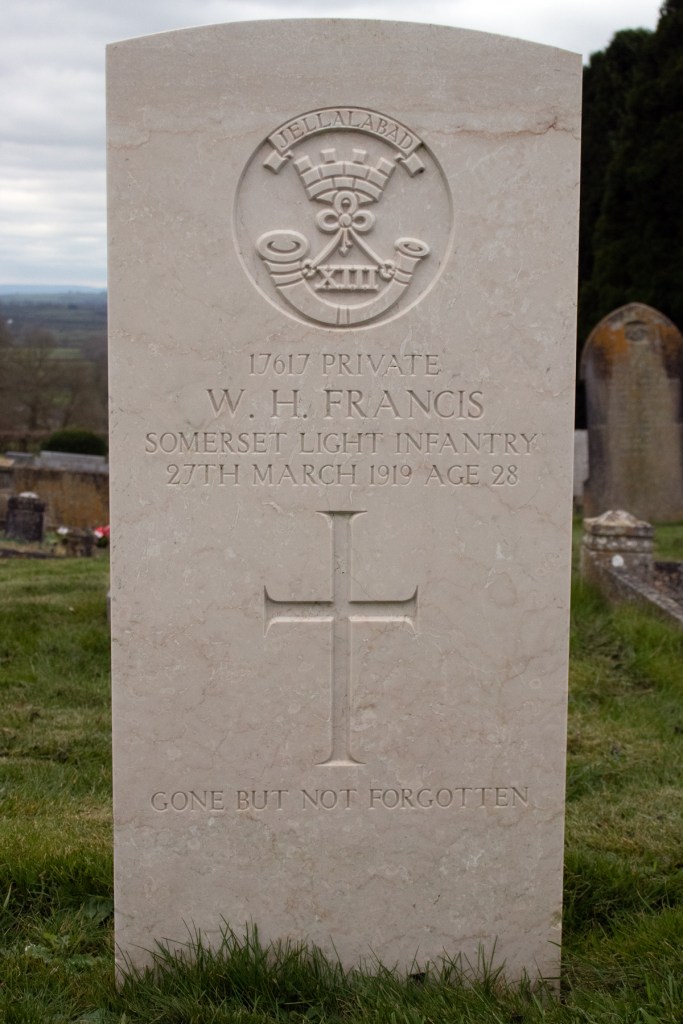
Wilfred Harry Francis was born in October 1890 in Castle Cary. He was the oldest of eight children to Edward and Rosina Francis, both of whom had also been born in the Somerset Town. Edward was a baker in his younger days, but, by the 1911 census he was employed as a builder’s labourer. Wilfred was recorded in the same document as a tailor.
War was coming to Europe, and Wilfred enlisted. He had been a volunteer in the Somerset Light Infantry, but on 6th April 1915, he made this a formal role. His service records show that he stood 5ft 6ins (1.68m) tall had light blue eyes and light brown hair.
Private Francis was assigned to the 6th Battalion and sent to France in the summer of 1915. His battalion was immediately thrown into the thick of the fighting at Ypres. The intensity of the battles of Hooge and Bellewaarde seemed to impact Wilfred as, on 7th October, he was admitted to the 4th London General Hospital, suffering from shell shock.
Wilfred was discharged after two weeks, and signed off as fit for light duties. It seems that he didn’t return to the Western Front, but instead was transferred to the 3rd (Reserve) Battalion of the regiment, based in Devonport.
The memories still seemed to haunt Private Francis, however. He was admitted to hospital again – this time the County of Middlesex Hospital in Napsbury, near St Albans – with mania. This time his ‘mental deficiency’ proved to much for the army, and he was discharged from military service on 18th July 1916. His discharge papers show that he gave the hospital as his address and recommended that he be admitted to a civil asylum.
Wilfred’s trail goes cold for the next few years. He seems to have been brought back to Somerset for ongoing treatment, but passed away in Wells on 27th March 1919; the cause of his passing is not known. He was 28 years of age.
Wilfred Harry Francis was laid to rest in the Castle Cary Cemetery, hopefully finding peace at last.
Robert Voisey was born towards the end of 1891, one of six children to Richard and Sophia. Richard was a tailor and, while both he and Sophia had been born in Cullompton, Devon, by the time Robert was born, they had moved to the Somerset town of Taunton.
When he left school, Robert followed his father’s trade and, by the time of the 1911 census, he was living with his parents and two of his sisters in a terraced house not far from the town’s station.
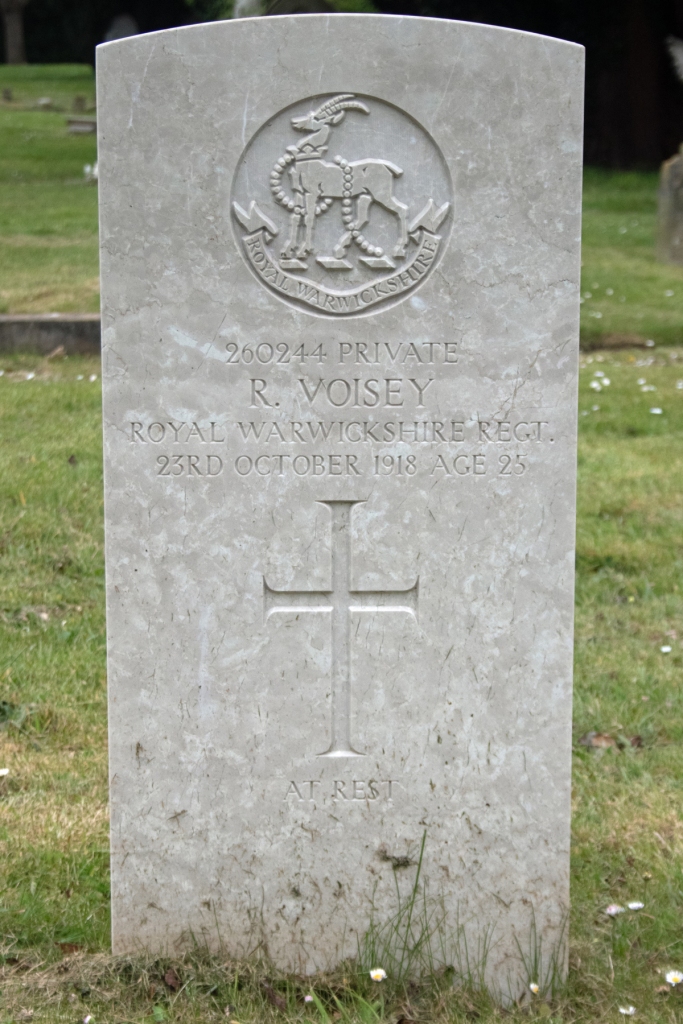
With the outbreak of the Great War, Robert was keen to do his bit. While full details of his military service are not available, it seems that he initially enlisted in the Somerset Light Infantry, but was subsequently transferred to the Royal Warwickshire Regiment. Joining the 6th Battalion as a Private, he saw action on the Western Front, and was wounded in April 1918.
Evacuated to England for treatment, Private Voisey was admitted to the 5th Northern General Hospital in Leicester. He seemed to be recovering well from his injuries, but then contracted influenza.
Sadly, this developed into pneumonia and Private Voisey subsequently died on 23rd October 1918, at the tender age of 25 years old.
Robert Voisey’s body was brought back to Somerset and he was laid to rest in the St James’ Cemetery in the town.
Robert’s funeral was written up in the local newspaper, and the report sheds more of a light on the Edwardian attitude towards some medical and mental health conditions than it does on the actual service.
The very fact of [Robert] ever having been a soldier, considering the great disability he was afflicted with through an incurable impediment in his speech, testifies abundantly to his high and noble interpretation of duty and patriotism.
Had he insisted he could at any time have evaded military service, but so eager was he to serve his country that it was not until he had actually been four times rejected as “physically unfit for military service” was he eventually accepted.
To the writer o this brief notice, who was his friend and fellow shop-mate for a long while, but who was at the time doing duty at Castle Green Recruiting Office, he often time used to express his indignation at not being accepted, and on the last occasion he spoke to the writer, it was to emphatically declare himself “as fit to be a soldier as anyone who had yet left Taunton.”
He dreaded the thought of being considered a shirker, and his opinion of many who have, even up till now, successfully evaded service, though far more physically fit than he was, was contemptuous to the bitterest extreme.
He was a true Britisher, a faithful friend and shop-mate, and a courageous soldier of whom no fitter epitaph could be written than “he gave himself in defence of home, country and liberty.”
Taunton Courier and Western Advertiser: Wednesday 6th November 1918
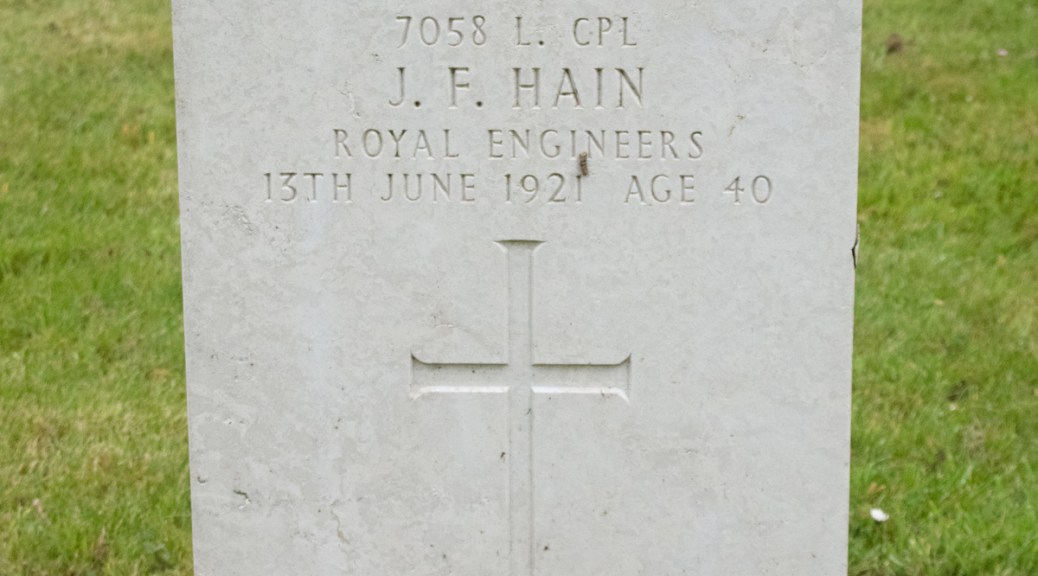
James Frederick Hain was born on 5th November 1881 in the village of Holmer in Herefordshire. He was one of seven children to James and Catherine Hain, and was more commonly known as Fred. On James Jr’s birth certificate, his father was listed as a manure agent, although by the time of the 1891 census, the family had moved to London, where James Sr was now running a coffee house.
When he left school, James Jr started work as a French polisher, but he had a taste for adventure and joined the army. He served in South Africa during the Boer War campaign of 1899-1900, attaining the Cape Colony, Orange Free State and Transvaal Clasps.
In 1900 James returned home, finding work as a French polisher. The military life was in his blood by now, though, and in September, he re-enlisted. Initially joining the Royal Berkshire Regiment, he was soon transferred over to the Royal Engineers as a Sapper.
James had signed up for a period of eight years and, as part of his role as a wireman (maintaining and fitting telegraph cables), he was stationed abroad. On one particular trip, when his battalion was travelling from Plymouth to Limerick early in 1908, he was injured. According to the accident report: “owing to bad weather on boat between Fishguard and Waterford he was thrown violently forward, striking his head against a girder.” Treated in Limerick, “the disability is of a slight nature, and in all probability will not interfere with his future efficiency as a soldier.”
Sapper Hain’s time with the service was nearly up, and he was put on reserve status in November 1908. By 1911, he was working as a linesman, and boarding in a house in Hayle, Cornwall.
War was on the horizon by now, and on 5th August 1914, James was called back into service. He saw action on the Western Front, adding the Victory and British Medals and the 1915 Star to his count. In October 1915, he was treated for shell shock, and evacuated back to England.
At the beginning of 1917, Lance Corporal Hain was transferred back to the Army Reserve, suffering from neuritis. His health was to suffer for the rest of his life.
In September 1917, having settled in Cornwall, James married Beatrice Opie, an innkeeper’s daughter from the village of Wendron, Cornwall. The couple would go on to have a son, who they called Frederick, two years later.
Discharged from the Army, James put his engineering experience to good use, joining the General Post Office to work with telegraphs.
By this time, James’ medical condition had been formally diagnosed as General Paralysis of the Insane. A degenerative disease, similar to Alzheimer’s disease, it was associated with brisk reflexes and tremors (usually most obvious of the lips, tongue, and outstretched hands) and characterised by failing memory and general deterioration.
By August 1920, James was admitted to the Somerset and Bath Asylum in Cotford, because of his worsening condition. He was not to come out again, and passed away ten months later, on 13th June 1921. He was just 39 years old.
James Frederick Hain was buried in the St James’ Cemetery in Taunton, Somerset.
Albert George Bellringer was born in April 1889, the youngest of three children to Charles and Sarah. Charles was a sawyer in a local timber yard, and his son followed suit.
Little detail of Albert’s early life remains, but he married Elizabeth Burge in December 1909, and the couple went on to have three children – Albert Jr, Cecil and Charles.
Albert enlisted when war appeared inevitable, joining the Somerset Light Infantry in June 1914. When his training was complete, his troop – the 2nd Battalion – were shipped off to India, and this is where Private Bellringer spent the majority of the war.
Distance from home and family made some soldiers act in ways they otherwise wouldn’t. On 15th August 1917, Albert was admitted to hospital with a venereal sore. He was then admitted to the Dinapore (now Danapur) Station Hospital on 2nd December 1917, “in a very excited condition. He was childish, silly and had grandiose delusions”.
Things were not going well for Private Bellringer’s health. He was transferred back to England for treatment on the Hospital Ship Wandilla – this was torpedoed on the journey home, although the device failed to explode. While on board, he was seen to be “exalted in his ideas, and to have physical signs of GPI [General Paresis (or Paralysis) of the Insane]”.
The ship arrived back in England on 25th April, and Albert was admitted to the Royal Victoria Hospital in Netley, Hampshire. The medical report again showed that “he was foolish, demented and [that] the physical signs of GPI were marked.”
Moved to Dykebar Hospital in Paisley – a mental health institution – for specialist attention, Private Bellringer was eventually discharged from the army. Medical grounds were the reason for his dismissal, and his last day of service was 5th July 1918.
Sadly, however, Albert’s health faltered; he was transferred again, this time to the Somerset and Bath Asylum in Somerset, and it was there that he passed away. Albert George Bellringer died on 5th December 1918; he was 30 years old.
Albert lies at rest in the Wembdon Road Cemetery in his home town of Bridgwater.
So, what was the cause of Albert’s illness and death? His initial hospital admission identified a venereal sore, and, based on his subsequent decline, it is likely that this was syphilis. One of the last symptoms of the disease is mental illness – insanity – and so this underlines the probably diagnosis.
However, mental illness only usually appears on average 10 to 30 years after the STI is first contracted, and then only if it is not treated (which, given that this would have been Victorian England, is it likely not to have been).
What this suggests, therefore, is that Albert contracted syphilis before the war, probably before his marriage to Elizabeth, and he may not have been unfaithful while serving in India.
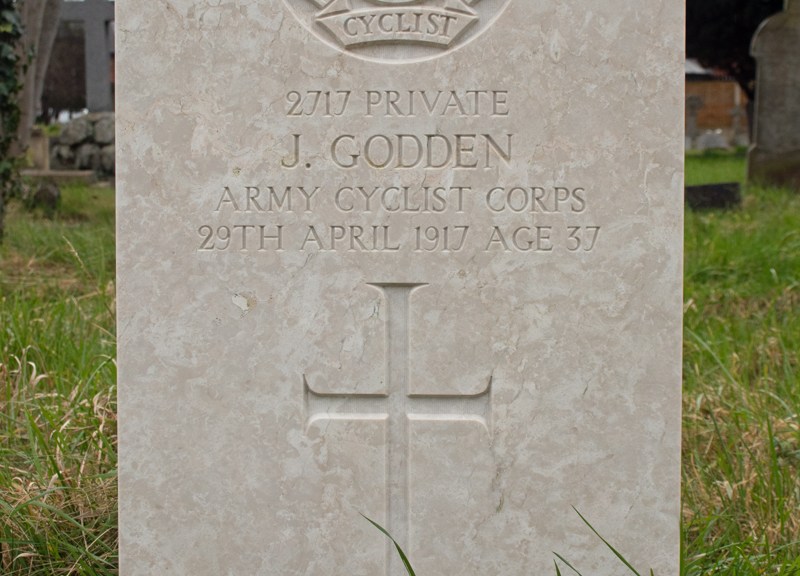
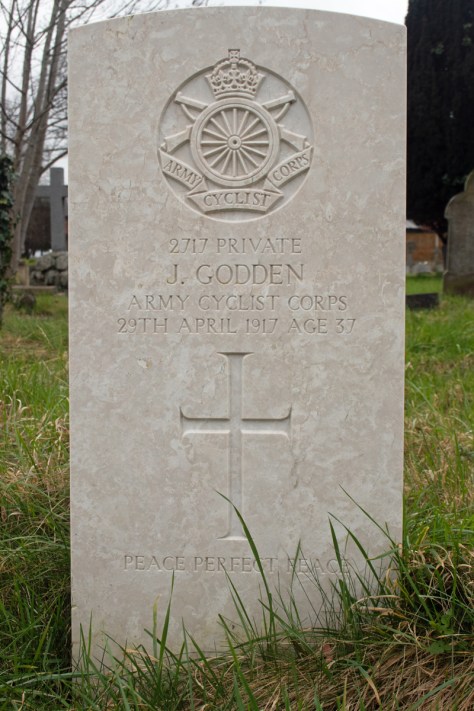
James Godden was born in the autumn of 1879. The youngest of six children to Charles and Mary Ann Godden, the family lived in Bridgwater, Somerset. Charles was a labourer and, while his older brothers followed in a similar vein, by the time of the 1901 census, aged 21, was listed as a hairdresser.
James married Hester Addicott in 1906, and the couple had three children – Ruby, Leslie and Freda. Hairdressing may not have been that well paid; according the to 1911 census, the young family had four boarders, ranging from 17 to 60 in age.
War was on its way, and James enlisted at the end of 1914. Initially joining the Somerset Light Infantry, he was soon transferred to the Army Cyclist Corps. Sadly, full details of his military service are not readily available, but it seems likely that he was part of the company’s First Line, who saw service overseas.
Private Godden served three years before being medically discharged from the army. His discharge records give a startling insight into his health.
Originated at Chiseldon Camp: April 12th 1917.
He is in a condition of violent excitement, talks without ceasing and suffers from insomnia. Refuses solid food, but will take a little milk. Not result of, but aggravated by, strain of ordinary military service.
Permanent total incapacity. Treatment in an asylum required.
Cause of discharge: Medically Unfit – Acute Mania
James Godden: WW1 Pension Records
James was admitted to the Somerset & Bath Asylum in the village of Codford, near Taunton. For good or bad, his time there was brief. Within a couple of weeks, he contracted bronchitis. Sadly, James was to succumb to this, and passed away on 29th April 1917. He was 27 years of age.
An additional twist in the tail came from the local newspaper report on his passing:
Somerset Athlete Killed
The death is reported of a former well-known athlete in the person of Mr James Godden, who before joining the Army carried on business as a hairdresser at Bridgwater. The deceased, who was 37 years of age, enlisted in December 1914, and was subsequently transferred to a cycle corps. He death occurred at a Somerset institution after a short illness. The deceased was well known throughout the West of England as a crack cyclist, and competed at big athletic meetings at Exeter, Plymouth, Bath and Bristol, in addition to local sports. He had won altogether over 400 prizes. He leaves a widow and three children.
Wells Journal: Friday 4th May 1917
James Godden lies at rest in the Wembden Road Cemetery in his home town of Bridgwater, Somerset.
James Godden, celebrated on an Ogden’s Cigarettes card (with thanks to John Boyland)
William Gardner was born in Cirencester, Gloucestershire, in around 1877. While I have been unable to totally confirm this, his parents seem to have been William and Sarah Carpenter; William Sr was an agricultural labourer, and both he and his wife were from Cirencester.
It has been difficult to track down William’s early life, because of the potential variations of his surname and the number of William Gardner’s in the Gloucestershire area.
The first time I can definitively identify him is on the 1911 census; he was living in Cheltenham and working as gardener. While the census shows that he had been married for 16 years and had one child. However, William’s wife is not recorded on the census; instead a Lily Marie Denley is boarding with him, as is her daughter, Irina May Gardner Denley.
William’s military life also needs a little piecing together. His gravestone confirms that he was a Serjeant in the Gloucestershire Regiment, and it seems that he enlisted towards the end of the 1800s, as he is recorded as having served in South Africa.
Serjeant Gardner re-enlisted (or was called back up) when the Great War broke out; at the age of 39, he was sent to France, collecting the Victory Medal, the British Medal and the 1915 Star for his service. At some point, however, he transferred back to England, joining the 440th Agricultural Coy. Labour Corps.
While there is no evidence of why William transferred, his later records certainly seem to suggest there were some issues going on in his life. When he was demobbed in February 1919, this seems to have been for medical reasons; his pension records show that he was suffering from neurasthenia (or shell shock), and that this was directly attributable to his war service.
William’s suffering evidently continued: a further record shows that he was admitted to an asylum in March 1921 and the 1921 census corroborates this. William was noted as being one of nearly 900 patients at the Somerset and Bath Pauper Lunatic Asylum in Wells and this is where he died, just a month later. While there is no cause of death, he passed away on 14th July 1921, at the age of 45 years old.
William Gardner lies at peace in the Cemetery in Wells, Somerset.
One additional point for William’s story. Another part of his was pension records give Miss Lily Denley as his dependent, and that she was guardian of his child. No eyebrows raised now, but how must their relationship have been viewed in 1911?










 Death and Service