Tag Archives: Private

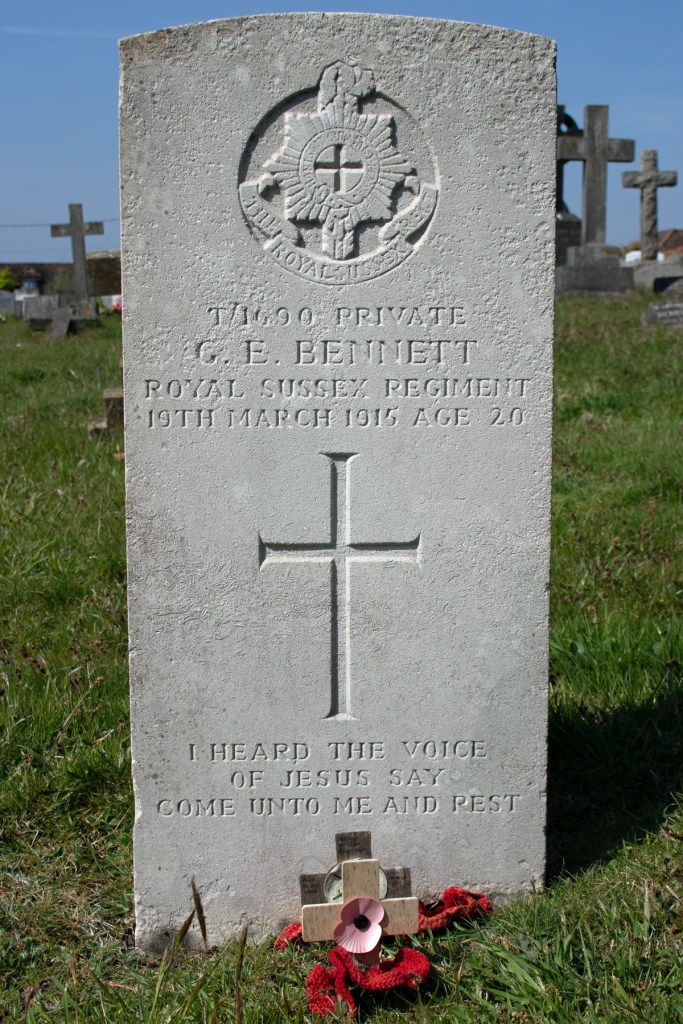
Private George Bennett

Private George Bennett

George Ernest Bennett was born in 1895 in Cuckfield, West Sussex, the oldest of four children to Alfred and Annie Bennett. Much of his early life is a mystery – within eighteen months, his parents had moved to Kent, leaving George with his widowed paternal grandmother.

By the time of the 1911 census, both Alfred and Annie were dead, along with their only daughter. George’s two younger brothers were in a poor school back in Sussex, while George was living with one of his father’s sisters and her family, and working as an errand boy.

By the time war broke out, it seems that George had plans for an army career. He had certainly enlisted by September 1914, and joined the 1st/4th Battalion of the Royal Sussex Regiment. This was a primarily territorial force, and Private Bennett initially received his training on the East Sussex coast.

Full details of George’s military service aren’t available, but what is clear is that he was admitted to the Military Hospital in Newhaven in the spring of 1915, and this is where he died on 19th March. The cause of his passing is not known, but he was just 20 years old.

Brought back to Cuckfield, where his father’s family still lived, George Ernest Bennett was laid to rest in the village’s cemetery, within sight of Holy Trinity Church.

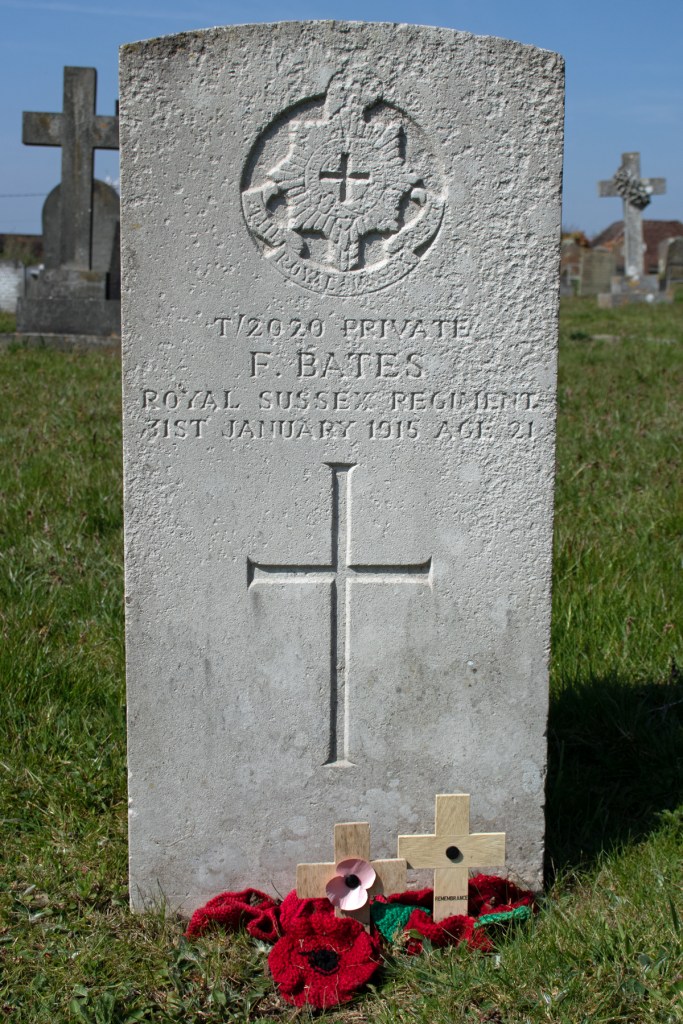
Private Frank Bates

Private Frank Bates

Frank Bates was born on 29th June 1893, in Cuckfield, West Sussex and was the fourth of five children. His parents were tailor William Bates and his wife, Sarah.

Tragedy was to be a constant companion to the Bates family. Frank’s older brother, William, died in November 1907 after a protracted illness, at the tender age of just 19 years old. Four years later, his younger sister, Maggie, also passed away after an illness. She was just 21 years of age.

When he left school, Frank went into the service of the Messel family, who owned the Nyman’s estate close to where Frank and his family lived. When war was declared, however, he was keen to play his part, enlisting soon after hostilities were announced in August 1914.

Private Bates joined the 4th (Home Service) Battalion of the Royal Sussex Regiment and was sent to Newhaven for training. It was while he was here that he fell ill, and, having caught a chill, he returned to Cuckfield to recuperate. Sadly, his condition worsened, and he passed away at his family home on 31st January 1915. He was just 21 years old.

Frank Bates was laid to rest in Cuckfield cemetery, resting not far from his siblings.


Tragedy was to strike one more time for William and Sarah. Frank’s older brother Jack served as a Private in the 2nd/4th Battalion of the London Regiment. In the spring of 1918, he was caught up in that year’s Battles of the Somme, including fighting at St Quentin and Avre.

In May 1918, Private Bates was officially reported as missing, but it was later confirmed that he had died of injuries sustained in the fighting. He passed away on 16th April 1918, at the age of 29 years old.

Jack was laid to rest at the Chauny Communal Cemetery in Picardie, France, and is also commemorated in Cuckfield Cemetery.


Private Charles Tucker

Private Charles Tucker

Charles Wilfred Tucker was born in the summer of 1898 in Penarth, Glamorgan. He was the oldest of four children to Wilfred and Elizabeth Tucker, restaurant owners on Windsor Terrace in the centre of the town.

Little information is available about Charles’ early life. When war broke out, he enlisted in the Welch Regiment, before transferring to the Machine Gun Corps at some point during the conflict. In the autumn of 1919, Private Tucker was put on furlough while waiting to be demobbed, and he returned home.

Sadly, it was while here that Charles contracted pneumonia, and it was from the lung condition that he was to pass away. He breathed his last on 30th October 1919, at the age of just 21 years old.

Charles Wilfred Tucker was laid to rest in the family grave in St Augustine’s Churchyard in his home town of Penarth.


Private Edward Savage

Private Edward Savage

In the graveyard of St Augustine of Hippo Church in Penarth, Glamorgan, lies the Commonwealth War Grave for Private Edward Savage. The headstone confirms that he had died on 25th December 1915 and that he was in the Loyal North Lancashire Regiment.

The Commonwealth War Grave Commission website suggests that he was the son of Edward and Rachel Savage and that he was born in Beccles, Suffolk. Sadly, there are no available census documents to shed any further light on that early life.

The same website suggests that he served in Burma, and in the South African campaign, which would have placed him there in the late 1890s and early 1900s.

It is also noted that Edward was the husband of Emily Savage and that they were living in Fleetwood, Lancashire. Edward’s later pension ledger suggests this was an Emily Shannon, who is, in fact, noted as the guardian of his illegitimate child. Further information, however, is not available.

From a military perspective, it is likely that Private Savage was either still service at the point that the First World War broke out, or that he was called into service – or volunteered his services – shortly after its declaration. He was assigned to No. 5 Supply Company of the 3rd/4th Loyal North Lancashire Regiment and, by the autumn of 1915, he found himself based at Penarth Head Fort near Cardiff.

Edward’s death seems to have been a less than auspicious one, as a local newspaper reported at the time.

The district coroner held an inquest at Penarth on Tuesday touching the death of Private Edward Savage, who was found dead at the billets of the A Company of the Loyal North Lancashire Regiment on Sunday morning. Surgeon-Major Charles Parsons, the local medical officer, stated that the deceased had apparently fallen down some stone steps, causing a fracture of the base of the skull. The jury returned a verdict of “Accidental Death.”

Western Mail: Wednesday 29th December 1915

Private Edward Savage had died on Christmas Day, 25th December 1915. He was 54 years of age. He was laid to rest in the graveyard of St Augustine of Hippo Church in Penarth.


Edwards shares his grave with another member of the Loyal North Lancashire Regiment, Serjeant Frank Carter. Read his story here.

Lance Corporal Colin Clarke

Lance Corporal Colin Clarke

Colin Lewis Clarke was born in the spring of 1879 in Cardiff, South Wales. He was one of seven children to Bernard and Elizabeth Clarke. Bernard was a carpenter, but after Elizabeth died in 1886, he took over the running of the Windsor Hotel in Penarth.

When he left school, Colin found work as a clerk. Bernard also died in 1908, and the 1911 census records Colin and his brother Thomas living with his sister, Beatrice. They were sharing the house with Beatrice’s second husband, Charles, and her six children from her first marriage in the Cheshire village of Poulton.

Colin’s trail goes tantalisingly cold at this point. When war broke out, he enlisted to play his part, joining the 16th (Transport Workers) Battalion of the York and Lancaster Regiment by the summer of 1916. This troop was a territorial force, and Private – and then Lance Corporal – Clarke was based in the Yorkshire Dales.

At some point during the autumn Colin fell ill, and was admitted to the Military Hospital in Middlesbrough. His condition is unclear, but he was to succumb to it, passing away on 5th November 1916, the age of 37 years old.

Colin Lewis Clarke’s body was brought back to Wales for burial. He was laid to rest in the graveyard of St Augustine’s Church in Penarth, Glamorganshire.


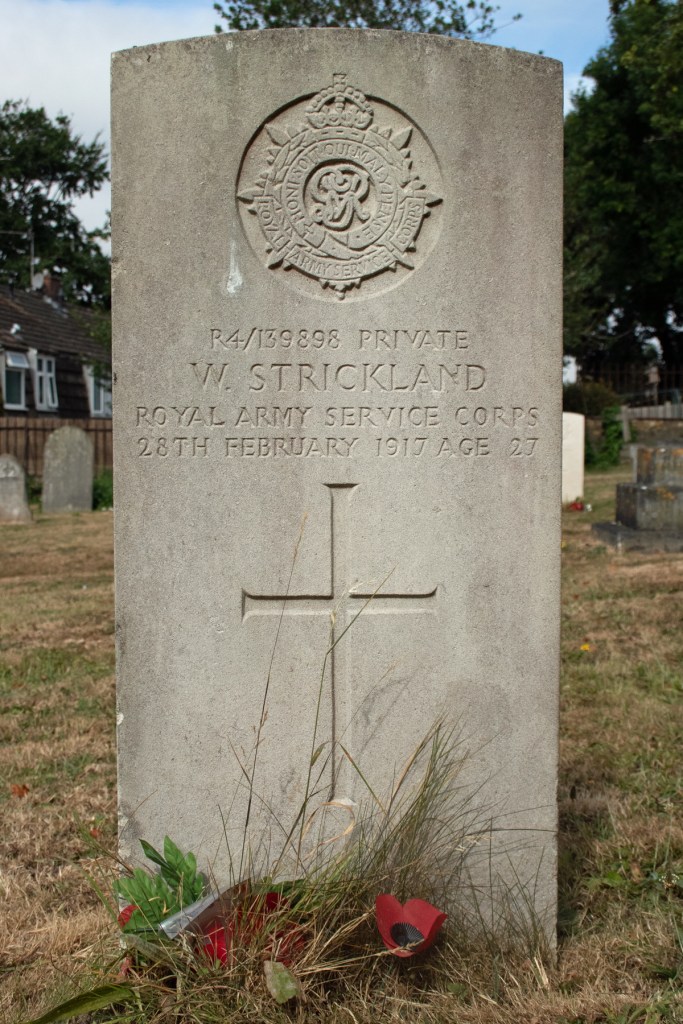
rivate Walter Strickland

Private Walter Strickland

Walter Strickland was born in 1890 in Pitminster, Somerset, the youngest of eight children to William and Sarah Strickland. William was a farm labourer, but his son found employment in the local coal mines on leaving school.

In December 1910, Walter married local woman Eliza Burton. The couple moved with Eliza’s brother and sister-in-law to Monmouthshire, where mining was the primary industry. After a couple of years, the young couple moved back to Somerset and went on to have a son, Wilfred, who was born in 1913. Walter had found other work, by this time, and was employed as a groom.

Storm clouds were brewing over Europe, and Walter enlisted in September 1915. He was assigned to the Royal Army Service Corps and given the rank of Private. His service records show that he was 5ft 6ins (1.67m) in height, and had a 35in (89cm) chest measurement.

Details of Private Strickland’s military service are limited. It seems likely that he was sent overseas, but that cannot be confirmed. By the start of 1917, however, he was back in England, and had been admitted to the Royal Victoria Hospital in Netley, near Southampton. He was suffering from an exophthalmic goitre – also known as Grave’s Disease – which results in heart palpitations, and an enlargement of the thyroid gland.

Sadly, this was an illness to which Private Strickland was to succumb: he passed away in the hospital on 28th February 1917, Eliza by his side. He was just 27 years of age.

Walter Strickland’s body was brought back to Somerset for burial. He was laid to rest in the graveyard of All Saints’ Church in his now home town of Norton Fitzwarren.


Private William Pole

Private William Pole

William James Pole was born on 22nd July 1892 in the Somerset village of Halse. He was the third of six children to shepherd and farm labourer William Pole and his wife, Harriet. When he left school, William Jr also found work on a relative’s farm in Herefordshire.

William Jr was still working on the farm when war broke out. He enlisted in the spring of 1915, joining the Royal Army Service Corps as a Private. There is no evidence of whether he served overseas, although it seems likely that he would have done, if only for a short while.

By September 1915, however, he was back on English soil, having been admitted to Netley Hospital in Southampton, suffering from enteric fever, also known as typhoid. Sadly, his illness was to get the better of him, and he passed away in the medical facility on 12th September 1915. He was just 23 years of age.

William James Pole’s body was brought back to Somerset for burial. He lies in the graveyard of St James’ Church, Halse. His parents would also be buried there: William Sr in 1935, and Harriet in 1949.


Private Cyril Pratt

Private Cyril Pratt

Cyril Robert Pratt was born on 31st October 1899 in the Somerset village of Halse. The younger of two children, his parents were local baker Robert Pratt and his wife, Elizabeth.

Little information about Cyril’s early life remains. He enlisted in the army not long after his eighteenth birthday, joining the Royal Warwickshire Regiment as a Private in November 1917. He was sent to Salisbury Plain for training, and was barracked in Larkhill, just north of Stonehenge.

Sadly, this seems to have been Private Pratt’s undoing. As with numerous other soldiers at the time, being billeted in cramped quarters with other men from across the country meant that disease was quick to spread. During his first winter at the camp, Cyril contracted pneumonia, and was admitted to the local Fargo Hospital. The lung condition was to get the better of him, and he passed away on 28th February 1918, at the age of just 18 years old.

Cyril Robert Pratt was brought back to Somerset for burial. He was laid to rest in the graveyard of St James’ Church in his home village, Halse.


Corporal William Dunster

Corporal William Dunster

William John Dunster was born in Uffculme, Devon, at the beginning of 1894. The older of two children, his parents were Robert and Mary Dunster. Robert was a carter and farm labourer, but when William left school, he found work on the railways. By the time of the 1911 census, the family had moved to Milverton in Somerset, and William was employed as an engine cleaner at the station in Taunton.

William had always had a keen interest in the army, and joined the Somerset Light Infantry early in 1914. His full service records are not available, but he was assigned to the 1st Battalion and, when hostilities were declared, he was dispatched to France.

On 26th August 1914, with the heroic men of his Regiment, he leaped over the trench amid a hail of bullets: a terrible gunshot wound laid him low, and he was taken prisoner by the Germans. For two years he remained in the hands of his captors, and endured all those sufferings and privations which our brave men have to bear in Germany.

[In 1916] he was removed to Switzerland Then all was done that could be done to save a young soldier’s life – the skill of the doctor, the comfort of the hospital, the care of the nurse – but unfortunately his constitution had been undermined.

In December 1916, by the kindness of [the secretary of the Prisoners of War Society] Mrs Walsh, he was enabled to see his mother, who paid him a visit, and this for a time revived him wonderfully.

Taunton Courier and Western Advertiser: Wednesday 26th June 1918

By the spring of 1918, Corporal Dunster had been medically evacuated to England, and was admitted to a military hospital in Southampton. This gave Robert and Mary the chance to see their son again, and Mary remained at her son’s side until he passed away on 19th June 1918. He was 23 years of age.

William John Dunster was brought back to Somerset for burial. He was laid to rest in the graveyard of St Bartholomew’s Church in the village of Oake, where his family were living.


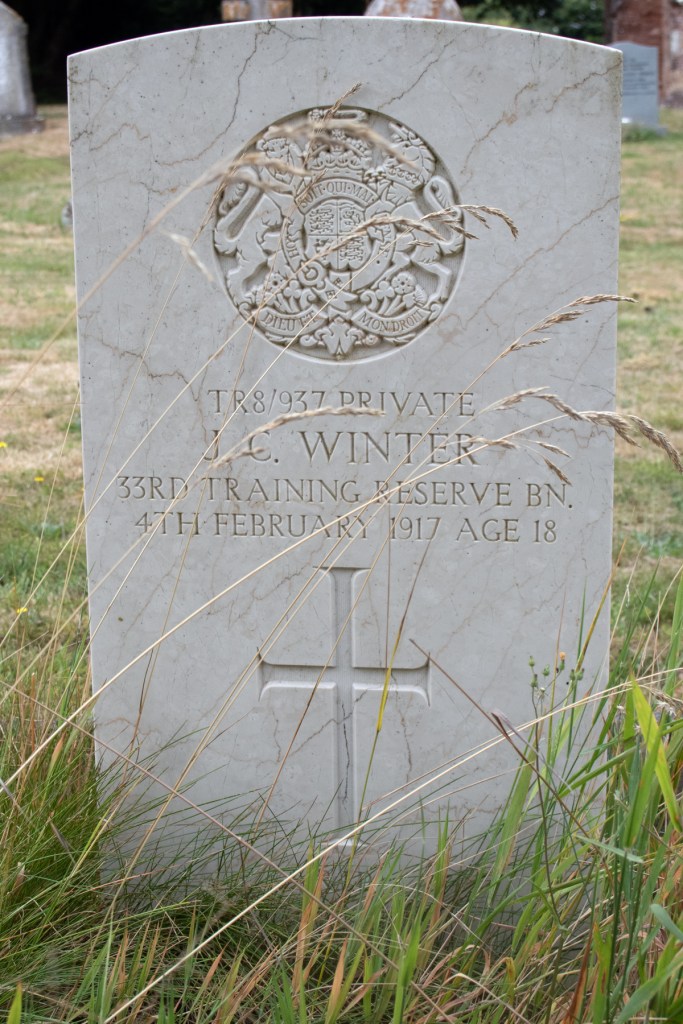
Private John Winter

Private John Winter

John Charles Winter was born in the summer of 1898, the younger of two children to James and Henrietta Winter. James was an agricultural labourer and carter from the village of Oake in Somerset. Henrietta had been born in Ontario in the USA, and was the daughter of English immigrants.

Little is documented about John’s early life. The 1911 census shows him living with his parents and his mother’s widowed brother, an army pensioner. At 12 years old, John was still at school.

War was coming to Europe by this point, and, as soon as he was able to (and probably encouraged by his uncle), John enlisted. He joined the 33rd Training Reserve Battalion, which was connected to the Warwickshire Regiment, at some point after August 1916.

Again, the details of his military service are scarce, but it seems that he soon fell ill, presumably from one of the medical conditions that tend to run rife in barracks crowded with men from across the country. The illness was to get the better of him and, on 4th February 1917, Private Winter passed away. He was just 18 years of age.

John Charles Winter was laid to rest in the graveyard of St Bartholomew’s Church in his home village of Oake.


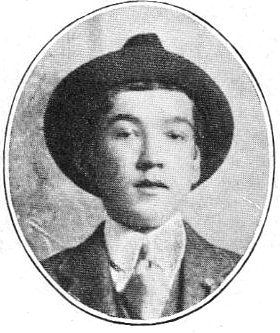
Private John Winter
(from findagrave.com)