Tag Archives: Royal Engineers

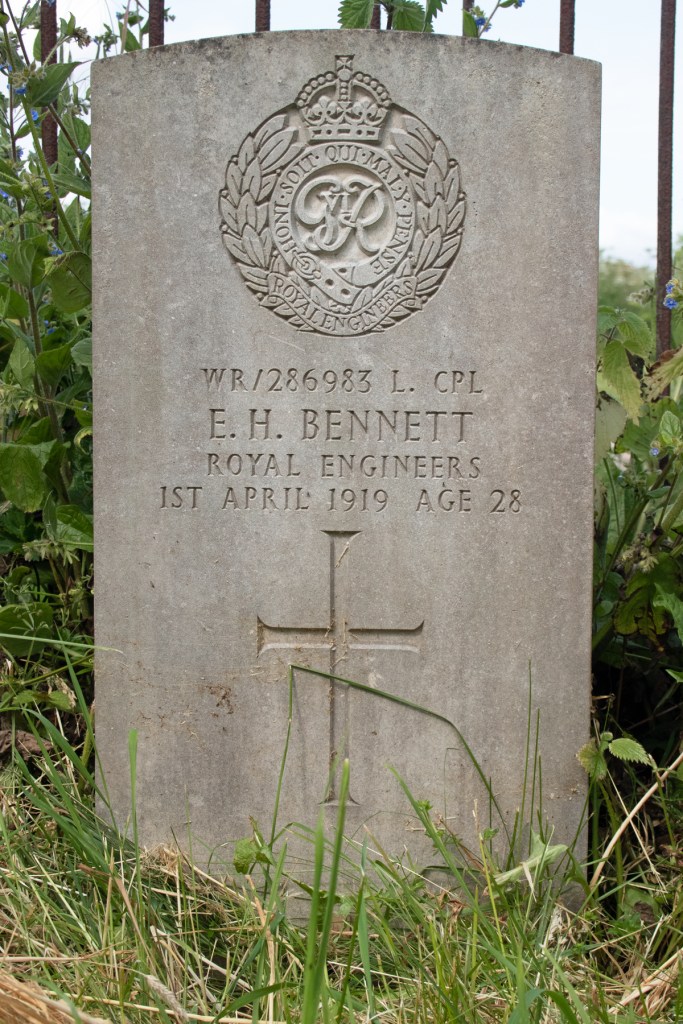
Lance Corporal Ernest Bennett

Lance Corporal Ernest Bennett

Ernest Harry Bennett was born in the summer of 1890, he third of ten children to Harry and Caroline – or Carrie – Bennett. Harry was a journeyman mason from the Devon village of Chagford, and this is where the Bennett family were raised.

When he finished his education, Ernest found work as a general labourer, and it this work that likely took him across the border to Somerset. He found work as a platelayer for the Great Western Railway in Taunton, and settled in Rowbarton, to the north west of the town.

On 28th September 1912, Ernest married Gertrude Alice Bennett in her local parish church, St George’s in Ruishton. A few months later, the couple had a son, Frederick, and almost exactly two years later, a daughter, Gladys, was born.

By this point, war was raging across Europe, and in July 1915, Ernest received the notice to enlist. Assigned to the Royal Engineers, he was attached to the 53rd Railway Company, probably to make use of his civilian trade. By the end of 1915, Ernest found himself in Egypt, and remained there for the rest of the war.

In July 1918, the now Lance Corporal Bennett was posted to the Railway Operating Division, but continued his service in North Africa. On 8th March 1919, he sailed from Port Said, heading back to Britain to be demobbed.

Returning to Somerset, Ernest fell ill, contracting pneumonia, probably on the journey home. He was admitted to the Taunton Military Hospital, but passed away from the condition just ten days after reaching England’s shores, on 1st April 1919. He was just 28 years of age.

The body of Ernest Harry Bennett was laid to rest in the graveyard extension to St George’s Church in Ruishton, not far from where his widow and children lived.
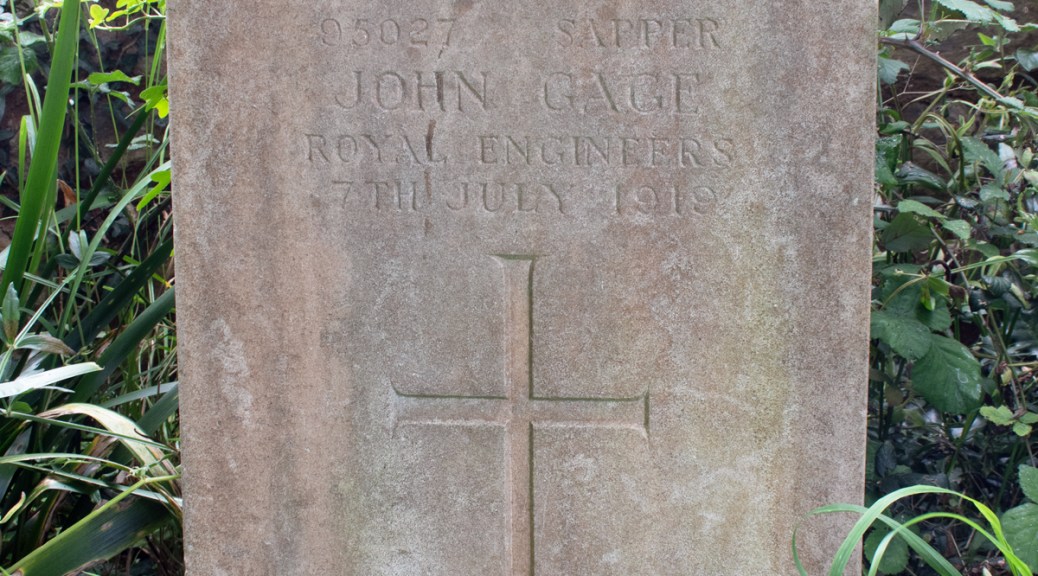

Sapper John Gage

Sapper John Gage

The life of John Gage seems destined to remain a mystery. His grave lies in a quiet corner of St Andrew’s Churchyard in West Hatch, Somerset. The Commonwealth War Graves Commission registration reads:

GAGE, Spr. John, 95027. “G” Depot Coy. Royal Engineers. 7th July 1919. Son of John Gage; husband of Lucy Gage, of Canal Cottage, Wrantage, Taunton. Born at Axminster, Devon.

There is no date of birth for John, and, while there is a possible census return for 1891, with a John Gage Sr and Jr living in the Axminster area, in isolation it is not concrete enough to connect to the man lying in St Andrew’s Churchyard.

The Army Register of Soldiers’ Effects confirms Lucy as John’s widow, but again no marriage documents remain to give a date for the nuptials or ages for the bride and groom. The document does confirm that Sapper Gage had been serving in the Royal Engineers for more than six months at the time of his passing, and that he died in a military hospital in Taunton.

There are no contemporary newspapers that report on John’s passing, which would indicate that is was nothing out of the ordinary, or connected directly to the war – through injury, for example. This might suggest, therefore, that John passed away though illness, although this cannot be confirmed either way.

Sapper John Gage’s life is set to be lost to time, therefore. He lies in the graveyard of St Andrew’s Church in West Hatch. Nearby is another grave, that of Lucy Gage, who died in 1942.


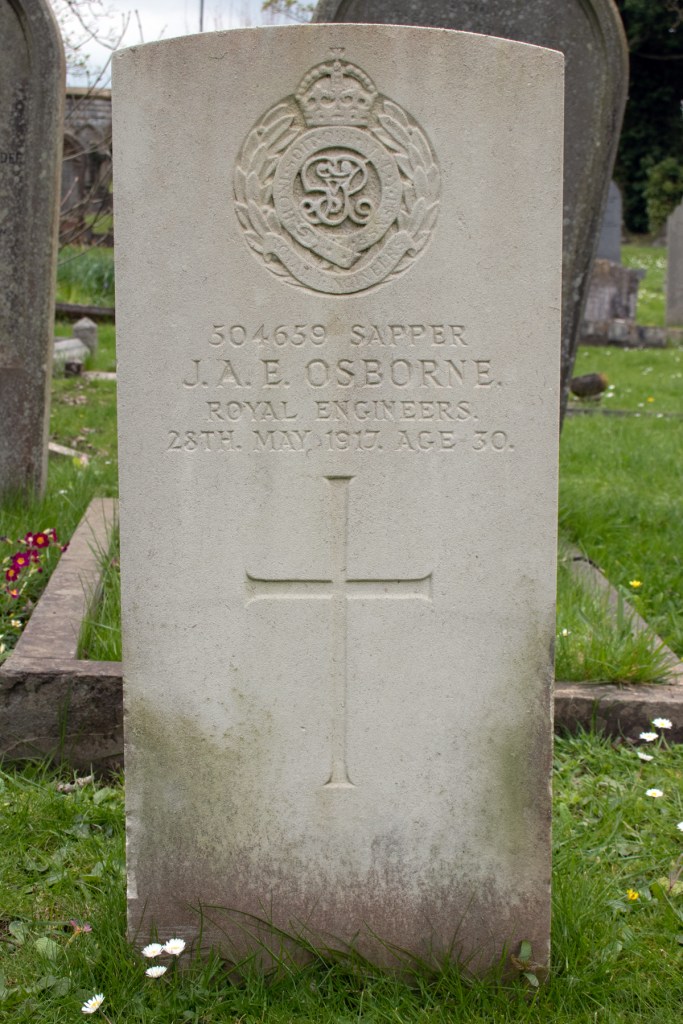
Sapper James Osborne

Sapper James Osborne

James Albert Edward Osborne was born early in 1887, in Weston, on the northern outskirts of Bath, Somerset. One of eight siblings, his parents were road labourer James and launderess Emily Osborne.

When he completed his schooling, James Jr found work as an ‘under brewer’, but soon took up woodwork. By the time of the 1911 census, he was employed as a jobbing carpenter, bringing in one of four wages into the family home.

On 25th May 1915, James married Frances Kettlety. Born in Twerton, near Bath, she was the daughter of a nurseryman. At the time of the wedding, she was working as a tailor’s machinist. The couple set up home in a terraced house in Locksbrook Road, Bath, and had a daughter, Joyce, who was born in May 1916.

War was closing in on Europe and, in December 1915, James enlisted. His trade made him ideal to join the Royal Engineers, and he signed up as a Sapper. His service records show that he was 5ft 4.5ins (1.64m) tall, weighed 144lbs (65.3kg) and note that his lower molars were absent.

Initially placed on Reserve, Sapper Osborne was mobilised on 8th May 1916, and sent to a camp near Whitchurch, Hampshire. Over the next year he served in the area and was billeted with a Mr and Mrs Carpenter. While details of the work he did are lost to time, there is nothing in his records to suggest that he was anything other than committed to what he was doing.

In the spring of 1917, Sapper Osborne began to suffer from headaches. He visited the camp doctor a couple of times for them, but, again, there is no detail about the outcome of these appointments. By the end of May, the pains were becoming severe, and James took drastic action.

On Sunday 27th May, he spent the morning with colleagues Sapper Trott and Private Sutcliffe, both of whom said he was in good form, and was talking as normal. They saw him again the following morning, but only in passing. James’ landlord said that he had not seen him on the Monday, and so set out to look for him.

[Mr Carpenter] found Osborne in a field about two miles away from his home; he was in the middle of a big double hedge and must have crawled through. [He] thought at first he was asleep, but when he went round to the other side of the hedge he could see that Osborne’s throat had been cut, but he did not touch him; he could see that he was dead… His hands, coat and trousers were covered with blood… Near his right hand was a blood-stained razor, this throat was cut and his windpipe severed He searched the deceased and in his tunic pocket found a letter… addressed to his wife, his mother, Lance-Corpl. Macey, two other mates and Mr and Mrs Carpenter…

Andover Advertiser: 1st June 1917

The inquest into Sapper Osborne’s dead returned a verdict of suicide while temporarily insane: he was 30 years of age.

James Albert Edward Osborne was brought back to Somerset for burial. He was laid to rest in Twerton Cemetery, not far from where his widow and daughter lived.


Corporal John Parker

Corporal John Parker

John Burge Parker was born in the spring of 1887, the second of eight children to George and Ann Parker. The family were raised in Huntspill, Somerset, where George was employed as a labourer in the local railway works.

When he finished his schooling, John found work on a farm and this is how he was employed when, on 30th April 1907, he married Alice Jane Grove in the parish church in Pawlett. The sleepiness of the area is underlined by the fact that this was both the only wedding to take part in the church that year, and for more than a year. John and Alice went on to have three children, Audrey, who was born in 1907, Elsie, who came along two years later, and Clifford, born in 1915.

With a growing family to support, John sought out more of a career. Indeed, by the time of the 1911 census, he was employed as a police constable, and the Parkers had moved to Bristol. When war came to Europe, however, John stepped up to play his part.

John enlisted on 17th November 1915, joining the Railway Troops Depot of the Royal Engineers. His service records show the kind of figure he must have cut in the police, and he was noted as being 6ft 1in (1.85m) tall, weighing 176lbs (79.8kg). Initially give the rank of Private, he was promoted to Lance Corporal in May 1916, just four months after being officially mobilised.

In October 1916, Lance Corporal Parker’s troop set sail from Southampton, their final destination being Alexandria in Egypt. He spent more than two years in North Africa, wand was promoted to full Corporal during this time.

John returned to Britain early in 1919. In February, John was visiting his brother in Highbridge, Somerset, and, on the evening of the 6th, he left to visit his father in Huntspill. He set off to Highbridge Station first, with the intention of checking the train times to return to Bristol, but that was the last time he was seen alive.

A painful sensation was created in Highbridge and neighbourhood… when it became known than on the previous evening.. the mutilated body of a soldier was found on the Great Western Railway metals, about a quarter of a mile below the Highbridge Station… The body was subsequently identified as that of John Parker… a corporal in the Royal Engineers, whose home it at Bristol and who leaves a wife and three children.

Central Somerset Gazette: Friday 14th February 1919

Nothing untoward was confirmed in the accident that killed John on the night of the 6th February 1919, and at the inquest the jury reached the conclusion that he had died through a tragic accident. He was 32 years of age.

The newspaper report gave more insight into the character of Corporal Parker: “He was a splendid specimen of manhood, standing over 6ft, and of proportionately fine physique… [He] was of a most genial temperament [and] was held in the highest respect both in the Highbridge district and at Bristol.”

The body of John Burge Parker was laid to rest in the quiet graveyard of St Peter’s Church in his home village of Huntspill.


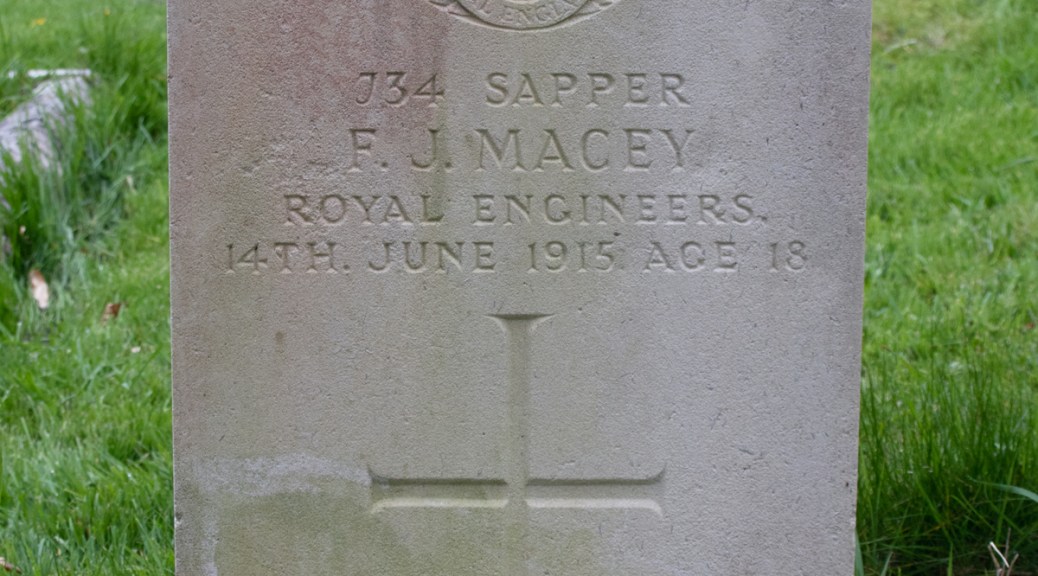
Sapper Frederick Macey

Sapper Frederick Macey

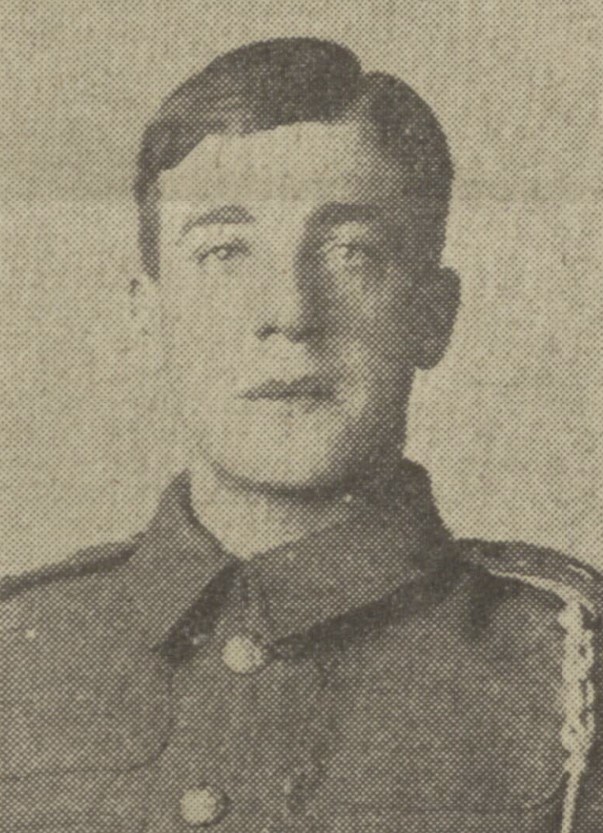
Frederick John Macey was born in the spring of 1897, the fourth of five children to James and Rose. James was a labourer from Hampshire, Rose was born in Ireland, but the children were born and raised in Monkton Combe, Somerset.

When war broke out, Fred stepped up to play his part. He enlisted in the Royal Engineers, and was assigned to the 503rd Field Company. Full details of his military service are lost to time, so it is not possible to identify whether Sapper Macey served overseas – Malta, where part of the regiment were based – or on home soil – in and around Ipswich, Suffolk.

Wherever he was based, Fred was injured, and he was sent to a military hospital in Guildford, Surrey, for treatment. Sadly, his wounds were to prove too severe, and he passed away on 14th June 1915, aged just 18 years old.

Frederick John Macey’s body was brought back to Somerset for burial. He was laid to rest in the peaceful graveyard of St Michael’s Church, in his home village of Monkton Combe.


Sapper John Macey
(from britishnewpaperarchive.co.uk)

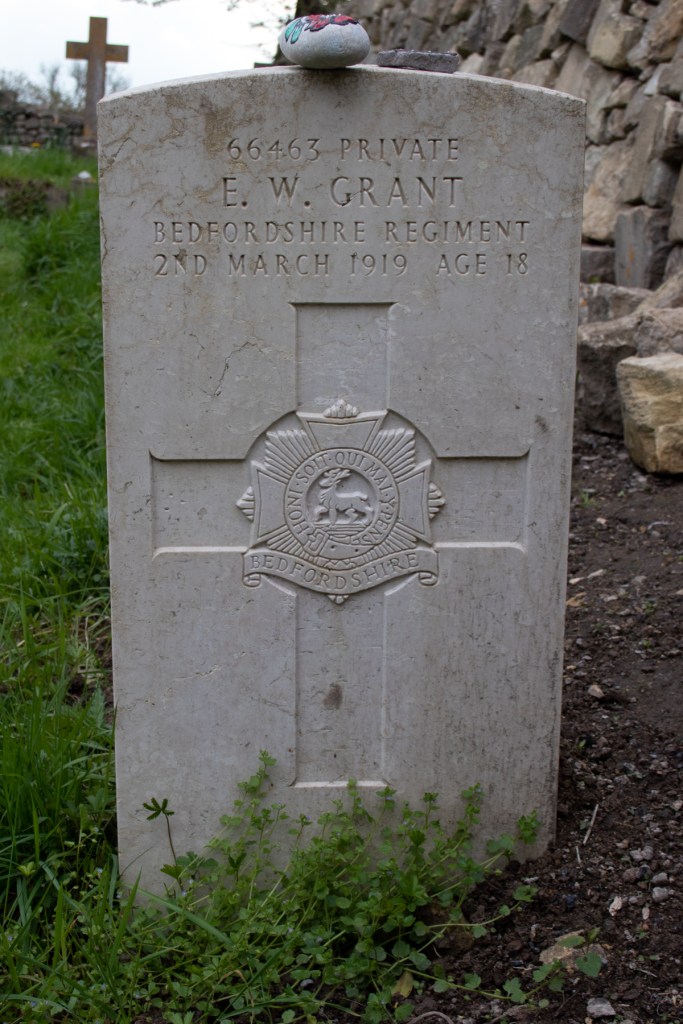
Private Eric Grant

Private Eric Grant

Eric William Grant was born at the start of 1901, the middle of three children to Ernest and Annie Grant. Ernest was a carpenter from Bath, Somerset, and it was here they he and Annie raised their young family.

Little information is available about Eric’s young life. When war came to Europe, his father joined up, enlisting in the Royal Engineers as a Sapper. Keen not to miss out, Eric also signed up, lying about his age to ensure he was accepted.

When he joined in February 1916, Private Grant was assigned to the 52nd (Graduated) Battalion of the Bedfordshire Regiment. Full details of his service are lost to time, but towards the end of the war, Eric was based in East Anglia.

It was here, in early 1919, that Private Grant fell ill. He was admitted to the Norfolk War Hospital, but whatever his condition, it proved fatal. He passed away on 2nd March, aged just 18 years old.

Eric William Grant’s body was brought back to Somerset for burial. He was laid to rest in the peaceful graveyard of St Michael’s Church, Monkton Combe, where the family now living.


Despite her understandable concern at seeing her husband and son go off to war, and for Eric to die because of it, Annie was to be reunited with Ernest. Again, full details of his service are lost, but the 1939 Register found him and Annie living with their daughter and Ernest’s brother in Bathavon, Somerset.

Annie passed away in 1947, at the age of 73. Ernest lived on until 1952, having lived to 76 years old. Both were buried in St Michael’s Churchyard, reunited with their son at last.


Major Cyril Wilson

Major Cyril Wilson

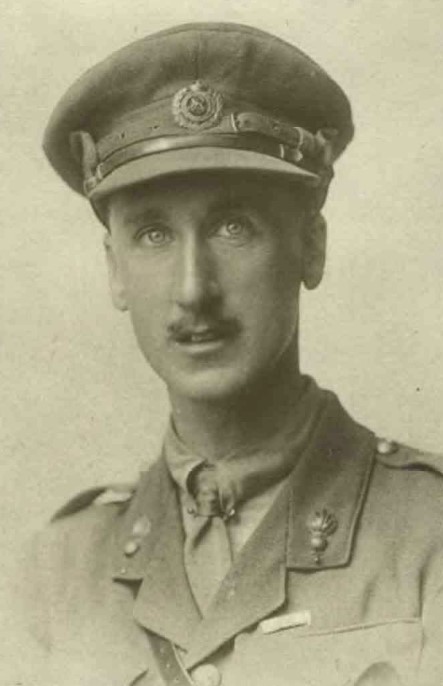
Cyril Spencer Wilson was born on 12th July 1883 in Charlcombe, Somerset. The youngest of three children, his parents were John and Edith Wilson. John was a solicitor who went on to become President of the Bath Law Society and, because of his standing, Cyril and his siblings had a comfortable upbringing: all three censuses covering his life – in 1891, 1901 and 1911 – all show the family living in a large villa in Charlcombe, with a cook and a housemaid to support them.

[Cyril] was educated at Bath College and Lancing College, and then studied engineering at Bristol University. He then became an articled pupil at the Great Western Railway Works at Swindon. Very interested in, and a keen supporter of, the Territorial movement, he was a Captain of the [Royal Engineers] Wilts Fortress Engineers when war broke out.

Bath Chronicle and Weekly Gazette: Saturday 2nd November 1918

Cyril had begun work for the Great Western Railway in July 1902, and became attached to the Institute of Civil Engineers the following January.

Captain Wilson formally enlisted when war was declared, and was soon sent to France. “He was awarded the Military Cross early in the summer of 1917, after being twice mentioned in despatches for excellent work.[Bath Chronicle and Weekly Gazette: Saturday 2nd November 1918]

Cyril was promoted to Major soon after this, and would go on to serve in France for more than a year more. In February 1918 he married Amy Pounds, the daughter of a bank clerk from East London and the couple exchanged vows in the city.

Major Wilson returned to France, but contracted dysentery that summer. He returned to Britain to recuperate, but came down with pneumonia, and this was to take his life. He died on 27th October 1918, aged 35 years old.

Cyril Spencer Wilson’s body was brought back to Somerset for burial. He was laid to rest in the family plot in St Mary’s Churchyard, Charlcombe.


Major Cyril Wilson
(from ancestry.co.uk)

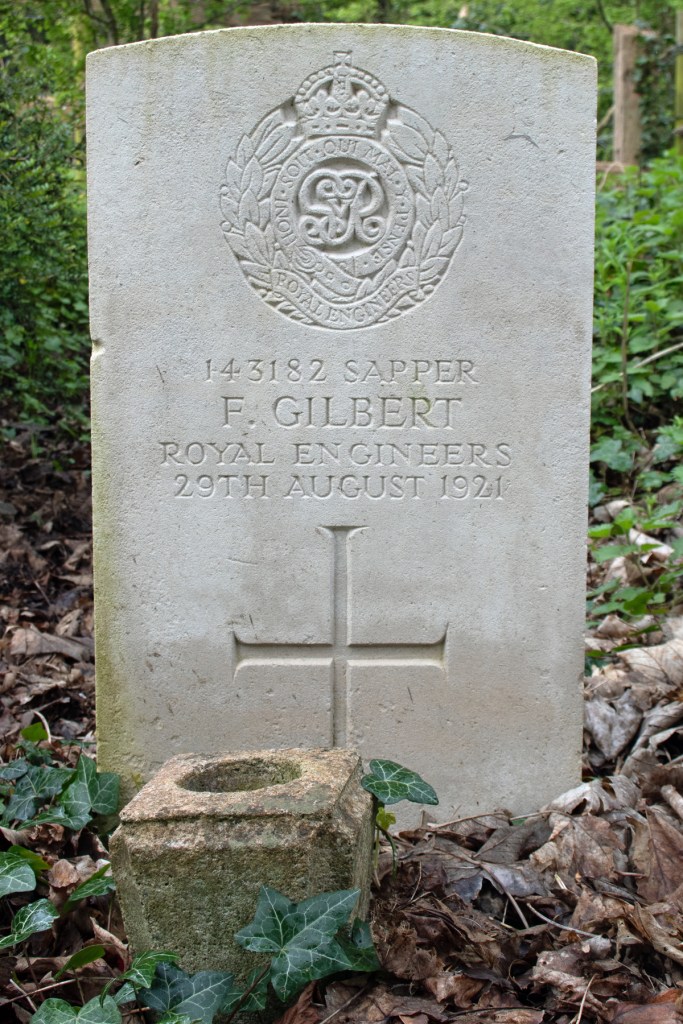
Sapper Frank Gilbert

Sapper Frank Gilbert

On Monday the body of a man was found.. neat Newton Bridge, commonly known as the “Skew” Bridge, having been killed by a passing train… The deceased was Frank Gilbert…

The inquest was held at the Globe Inn, Newton… by the Coroner for North Somerset (Dr S Craddock), who sat without a jury.

The first witness… said the previous morning he was walking along the railway when he saw the body of a man lying on the down side. The head was separated from the body…

PC Cornish said he found four cards in the pockets of the deceased’s coat. Two were National Insurance cards, and there was an unemployment book, the last payment being dated 15-8-21.

Written on the blotting paper of the book was the following:

“It is quite dark. You still take you neck oil, and my children outside waiting. Marry the man who gave you the watch. Don’t forget to have an extra one (Guinness) over my parting. It would be murder if I ever lived with you again.”

The man’s name, “Frank Gilbert, 44 Jubilee Road, Aberdare,” was on some of the cards. Deceased was wearing a discharged soldier’s badge.

Sarah Kate Gilbert, wife of the deceased, who lives at Bristol, said she had not known her husband’s address at Aberdare. They had been living apart since he went into the Army in 1915. She had, however, met him since that date.

Witness added that she saw him on Sunday night, and went on to say that she took out a summons for a maintenance order against him last February at Gloucester. He was then working as a carpenter in Cheltenham.

The Coroner: ‘Have you ever heard him threaten to commit suicide?’

‘Yes, sir.’ She added that he did so on Sunday night when she was with him at the bottom of Park Lane, Bath. “He was always threatening me when we lived together,” she stated, and also said she had a separation order in Bath in 1913. She had a letter from him on Saturday morning in which he said that when she got the letter he would be gone. In the letter was enclosed the ticket for his suit-case, and the key.

[The letter read] “I would never dream of making a home for you as you are worth only the Gloucester man. You have ruined my life, and you will be able to sleep with… for always now. I shall be gone.”

Witness said there was no reason for him to have made any such statements, as she had had nothing to do with any man except him. He was always using threats. When she left him on Sunday night she told him to try and get on and pull himself together.

The Coroner recorded a verdict that deceased committed suicide by placing himself in front of a passing train on the Midland Railway.

Somerset Guardian and Radstock Observer: Friday 2nd September 1921

Little additional concrete information is available for Frank Gilbert’s life. No marriage certificate remains for his wedding to Sarah, nor is there any evidence for the couple in the 1911 census.

Frank’s service records no longer exist in their entirety, although his pension record give hints as to his service. He enlisted in the Royal Engineers as a Sapper on 20th November 1915, although he never saw any action overseas. He was medically discharged because of rheumatism on 11th November 1917. The document confirm he was born in 1883, and lived in Cheltenham after his discharge.

An additional newspaper report of the inquest confirmed that Sarah had two children, and that they lived with her parents in Bath. When asked by the Coroner if she intended to bury her husband’s remains, she replied that “she had no money to do it with.” [Bath Chronicle and Weekly Gazette: Saturday 3rd September 1921]

And so Frank Gilbert was laid to rest in the quiet graveyard of Holy Trinity Church in Newton St Loe, near Bath in Somerset. He was around 38 years of age when he took his life.


Sapper Arthur Coward

Sapper Arthur Coward

Arthur Coward was born in the village of Faulkland, near Radstock, Somerset, on 6th November 1888. One of twelve siblings, of which only five survived childhood, his parents were Henry and Mercy Coward.

Henry was an agricultural labourer, who was 62 years of age when Arthur was born. By the time Arthur had finished his schooling, the family had moved west, to Writhlington, and he took up work in the local colliery.

Arthur was a keen motorcyclist, and when war came to Europe, he enlisted in the Royal Engineers. Working as a dispatch rider, Sapper Coward was assigned to the 34th Division Signal Company, and soon found himself in France.

Arthur returned home for a fortnight’s leave on 22nd October 1918. “He should have returned to France again on the 4th [November] but had a few days previously contracted influenza and this was followed by double pneumonia. Everything possible was done for him, but despite a robust constitution he gradually sank and died peaceful a few hours before the public learnt that the war in which he had taken part was ended.” [Somerset Guardian and Radstock Observer: Friday 15th November 1918]

Sapper Coward had died on 11th November 1918, having celebrated his thirtieth birthday just five days previously. His father, Henry, had lost another child, at the age of 91.

Arthur Coward was laid to rest in the tranquil Writhlington Cemetery.


Sapper Albert Colston

Sapper Albert Colston

Albert Edward Colston was born in the spring of 1887 in Bath, Somerset. The oldest of seven children, his parents were Thomas and Elizabeth Colston. Thomas was a carpenter and the family were raised in Lyncombe, to the south of the city centre.

Elizabeth died in 1905, by which time Albert had left school. He worked with Thomas and, by the time of the 1911 census, the family – father and four children at home – had moved to a terraced house in the suburbs of Twerton.

During this time, Albert volunteered with the Somerset Light Infantry. When war came to Europe, however, he was enlisted into the Royal Engineers. He joined on 28th February 1916, and was assigned to the Wessex Field Company. His service record show that he was 5ft 8ins (1.73m) tall, of normal physical development and with good vision.

A few months after enlisting, Albert married Alice Selway. She was a groom’s daughter from Bath who, at the time of their marriage, was working as a housemaid in a boarding house in the centre of the city.

Sapper Colston spent the next year on home soil. In March 1917, however, he was discharged from the army as he was deemed no longer medically fit for active duty. Sadly, the records do not confirm the complaint that led to his dismissal.

It is likely that he returned home when he was discharged. He died in Bath just weeks later, on 4th April 1917. He was thirty years of age.

Albert Edward Colston was laid to rest in St James’ Cemetery in his home city, the same location as Elizabeth, mother and son reunited again.


Alice married for a second time in May 1919. He husband was William Keepen, and the couple went on to have a son, Reginald, who was born in 1920. Reginald died in 1937, while Alice lived until 1918. The couple were buried in Haycombe Cemetery on the outskirts of Bath.