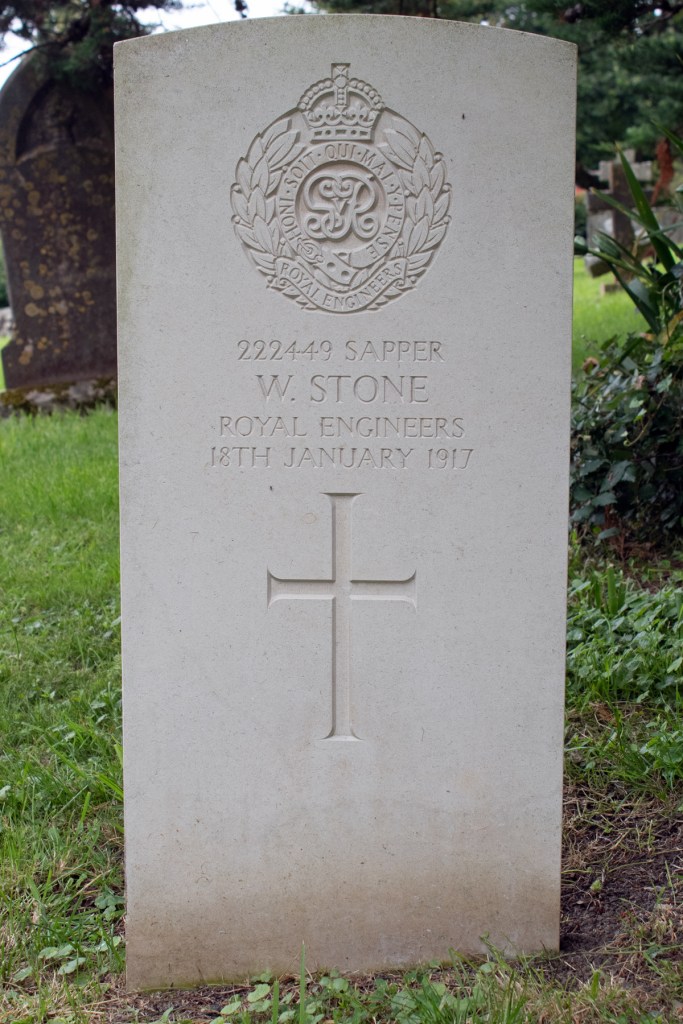
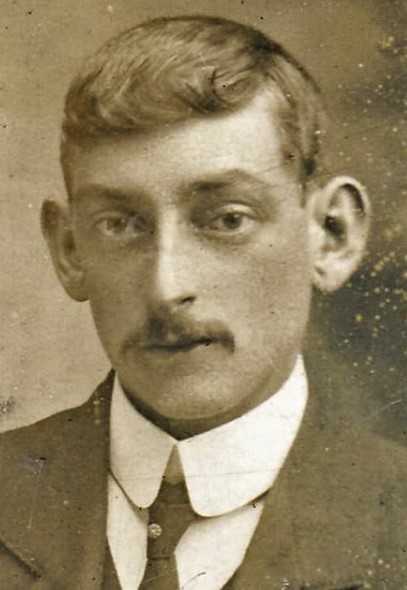
Walter Stone was born at the start of 1880 in Lympsham, Somerset. The middle of three children, his parents were coal merchant George Stone and his wife, Ellen.
When he finished his schooling, Walter found work as a painter and plumber. In January 1902 he married Alice Charman. Eighteen years older than Walter, she was the widow of a milkman from Bristol, and had raised her son, Edgar, since her husband had passed away a few months before. The couple settled in the village of Brent Knoll, and went on to have three children of their own: Albert, Florence and Alice.
When war came to Europe, Walter was called upon to play his part. He enlisted after June 1916, and joined the Royal Engineers as a Sapper. He was attached to the Inland Waterways and Docks division, but, as no documentation remains to confirm his service, it is not possible to confirm whether he saw any action overseas
Sapper Stone’s time in the army was not to be a long one. The next record for him is that of his admission to a military hospital in Herne Bay, Kent. He was suffering from pneumonia, and this would take his life on 18th January 1917. He was 36 years of age.
Walter Stone’s body was brought back to Somerset for burial. He was laid to rest in the tranquil graveyard of St Michael’s Church in Brent Knoll.
Further tragedy was to strike Walter’s widow, Alice. Edgar, her son from her first marriage, enlisted in the Somerset Light Infantry when war broke out. Attached to the 7th (Service) Battalion, he found himself on the Front Line by the end of July 1915.
Private Stone is reported to have been accidentally killed on 1st May 1917. No other detail is given, but he was just 24 years of age when he passed. He was buried at the Thiepval Memorial at the Somme.
Alice had lost her husband and her oldest child within a matter of months.
Walter John Greedy was born in the spring of 1889, the eighth of nine children to Theophilus and Mary Greedy. Theophilus was an agricultural labourer from Wiveliscombe in Somerset, and it was here that the Greedy family were born and raised.
When he finished his schooling, Walter found work as a carter for a brewery. In 1906 his oldest sister, Charlotte, was widowed, and he moved in with her and her children to help provide some additional support. He soon found alternative employment, however, and within a couple of years was employed by Great Western Railways as a plate-layer.
On 26th December 1913, Walter married Irene Hobbs. She was a blacksmith’s daughter from nearby Fitzhead, who was working as a domestic servant when the couple wed. They went on to have three children: Frederick, Winifred and Dorothy.
When war was declared, Walter stepped up to play his part. Full details of his military service no longer remain, but he had certainly enlisted by the summer of 1918. Walter joined the Royal Engineers, and, based on his previous employment, was assigned to the 278th Railway Company.
Sapper Greedy served in Northern France, and was based in and around Boulogne. He survived the war, and was back on home soil by December 1918. This may have been because of illness: Walter was admitted to Exeter War Hospital in Devon, having contracted influenza and pneumonia. Sadly, the combination of conditions was to prove a fatal one: he passed away on 22nd December 1918, at the age of 29 years old.
Walter John Greedy was brought back to Somerset for burial: he was laid to rest in the peaceful graveyard extension of St Nicholas’ Church in Brushford, where Irene and their children were now living.
Reginald Cuthbert Langford was born in Frome, Somerset, in the spring of 1899, the youngest of thirteen children to Albert and Charlotte Langford. Albert was a chalk seller turned jobbing gardener, who, by the time of the 1911 census, had moved the family to Bath.
Reginald appears to have helped his father with his work when he finished his schooling, but, during the First World War, he enlisted in the Royal Engineers as a Driver. His service records no longer remain, but a later newspaper report shed some light onto his time in the army: “[He] enlisted when he was just over 16, and went to the Wessex Engineers to Salonica. He returned to England and then went to France with the Glamorgan Engineers.” [Bath Chronicle and Weekly Gazette: Saturday 16th October 1920]
All did not fare well for Driver Langford: he contracted malaria and dysentery, and a combination of the conditions led to his ultimate discharge from the army. He left the Royal Engineers on 24th June 1919, and returned home to Somerset.
When he had recovered his health, Reginald took up employment as a gardener once more. On September 1920, he was in the employ of a Mr J Milburn, in Bath, when he felt a nail drive through his boot, scratching his foot. The following Tuesday, he visited his doctor – a Mr John Jarvis – complaining that his malaria had returned. According to a later inquest:
[He] did not make any mention of a wound in the foot. On Thursday, at about 10 o’clock, [Jarvis] was asked to go and see Langford, who was in bed. He was covered with a cold sweat, he could speak only with difficulty, and complained that he could not swallow anything, especially the medicine… His limbs were rigid, but he had not all the symptoms of tetanus. [Jarvis] decided to send Langford to the hospital at once, suspecting that he was suffering from tetanus. He did not know till later that there was an injury to [Reginald’s] foot.
Bath Chronicle and Weekly Gazette: Saturday 16th October 1920
Reginald’s landlady, Amelia Baily, also gave evidence at the inquest:
Langford had lodged with her for about nine months. His inly complaint was of his head when he had malaria… He came home saying his foot was sore and that he had thought it was gathering. He had hot water to soak it, and he did the same the next night, an afterwards sad it was alright… he went to work, but returned at dinner time again complaining of his head and perspiring terribly. He was ill and witness looked after him during the night. He complained of pains in the stomach and aid they were going up to the throat. Next morning [Amelia] sent for the doctor.
Questioned as to the injury to Langford’s foot, [she] said he told her he had a nail enter the toe while he was in the army, and that it was festering again. He wad worn the army boots up to just before he became ill, when he bought new ones.
Bath Chronicle and Weekly Gazette: Saturday 16th October 1920
Admitted to the Pensions Hospital, Bath, Reginald was to be there only one day. He passed away on 8th October 1920, aged just 21 years old. Medical evidence at the inquest diagnosed tetanus as the cause of his death, but Reginald’s older brother, George, contested this.
George’s challenge was that, having some medical background, he felt that his brother’s death was caused not by tetanus, but by malaria. He was a sufferer himself, and he knew the symptoms. He had examined Reginald’s body, and could not see how the small scratch on his foot could have induced tetanus to the extent of causing his brother’s passing.
The Coroner at the inquest, a Mr F Shum, declined George’s assertion, on the basis that separate medics had determined tetanus as the cause:
“It may not have been from the foot, but the evidence is clear. Dr Jarvis said he formed the opinion before any suggestion was made to him, that the man was suffering from tetanus. He saw the symptoms, and the man was brought here [to the Pensioner’s Hospital]. Two doctors saw him here and came to the same conclusion, and a medical specialist confirmed the diagnosis. Therefore, it is quite clear to me, and my verdict will be that he died from tetanus. It is a very unfortunate thing, and I am sorry for you.
Bath Chronicle and Weekly Gazette: Saturday 16th October 1920
George’s challenge was as much about the financial aspect as it was his late brother’s wellbeing. Had Reginald’s death been the result of malaria, it could have been attributable to his military service, and therefore any funeral costs – or at least a proportion of them – would have been paid for by the army. As the inquest had identified tetanus as the cause of his passing, however, the family would have to pay for the burial themselves.
Following the inquest, Reginald’s funeral was held: he was laid to rest in the sweeping Locksbrook Cemetery, Bath, not far from where his bereaved family still lived.
There are two other intriguing aspects of Reginald’s case.
The first is that of his being awarded a war grave. Amongst other criteria, which can be seen here, the Commonwealth War Graves Commission (CWGC) are responsible for the commemoration of personal who died after they were discharged from a Commonwealth military force, if their death was caused by their wartime service.
Based on the inquest, Reginald’s passing was clearly not – the tetanus having come on after his medical discharge for malaria and dysentery. Technically, therefore, his should not be designated a war grave.
The second confusing thing is that of the date on Reginald’s headstone. The CWGC headstone gives the date of his death as 13th October 1920, as do his grave registration documents. While newspaper reports are not always a reliable source of information, the first media report of the inquest came on Tuesday 12th October.
The Bath Chronicle and Weekly Gazette article confirms that Dr Jarvis’ visit to Reginald was on Thursday 7th October. He was admitted to hospital straight away, “where he died the following day” [Bath Chronicle and Weekly Gazette: Saturday 16th October 1920]. This would suggest that Reginald died on Friday 8th October.
While the newspapers do not confirm the date of the inquest, it is likely to have been held soon after Reginald’s passing. The date provided by the CWGC, therefore, looks to be either that of the conclusion of the inquest, or of Reginald’s burial.
Godfrey George Beames was born in the spring of 1891, in Henbury, Gloucestershire. One of eleven children, his mother was Minnie Beames. Her husband was Thomas Beames, and he served in the navy, which meant that Minnie was left to her own devices a lot of the time. The 1891 and 1901 censuses record Minnie and the children living with her farm labourer brother-in-law, George Watkins.
The 1911 census gives the same information for Minnie and the children – living with George in Redwick, Gloucestershire. Minnie is, however, noted as a widow, although this seems to be out of convenience, as the now naval pensioner Thomas was living with his wife of eight years, Louisa, in Arundel, West Sussex. Minnie went on to marry George the following year, and it seems possible that only the first of her eleven children was Thomas’.
Godfrey, now 21 years old, was working as a farm labourer. In the autumn of 1913, he married a woman called Lily Ball, although little information about her remains today. War was coming to Europe, and things were to change for the young couple.
Godfrey stepped up to play his part. While his full service records no longer exist, what remains paints a picture of his time in the army. He had enlisted by the spring of 1917, joining the Royal Engineers. At some point, however, he moved to the Worcestershire Regiment, and was assigned to the 10th (Service) Battalion.
While it’s not possible to determine exactly where Private Beames fought, he was definitely caught up in the fighting on the Western Front and, by October 1917, was entrenched at Passchendaele. It was here that he was wounded, and he was medically evacuated to Britain for treatment.
Private Beames was admitted to the General Hospital in Nottingham, but his injuries were to prove too severe. He died on 15th November 1917, at the age of just 26 years old.
Godfrey George Beames’ body was brought back to Somerset for burial. He was laid to rest in the graveyard of Ss Mary and Peter’s Church in Winford, where Lily was now living.
Private Godfrey Beames (from ancestry.co.uk)
Thank you to Rob Clarke for helping to unpick a convoluted family background for Godfrey.
Frederick Reginald Channing was born in the autumn of 1869, in Bath, Somerset. He was one of five children to carpenter Allen Channing and his dressmaker wife, Sarah. When Frederick was just a toddler, Allen moved the family south to Chard, and this is where his younger siblings were born.
When Frederick left school, he found work as a lace machine operator and, in fact, all of Allen’s children found work with their hands: Frederick worked alongside one of his brothers, while his two other brothers built on their father’s woodworking skills, one as a coachbuilder, another as a cabinet maker.
By the autumn of 1905, Frederick had moved back to Bath. This is where he met Elizabeth Scammell, a farm labourer’s daughter from Wiltshire. The 1901 census appears to record her as being a servant to a surgeon’s family in Wincanton, and this may have prompted a further move to the larger city where the couple met.
The couple married in Bath towards the end of 1905, and had a son, Frederick Jr, who was born in November the following year. Frederick Sr was doing general labouring work by this point, and the family had moved to Wedmore by the time a second boy, William, was born in 1910. Frederick and Elizabeth had a daughter, Eva, in 1911, and another, Gwendoline, in 1913, tragically, the same year that Eva died.
When war came to Europe, Frederick stepped up to play his part. He enlisted in September 1914, joining the Somerset Light Infantry as a Private. His service records confirm that he was 5ft 6ins (1.67m) tall, and weighed 154lbs (69.9kg). The document also gives his age as 35, although he was actually ten years older than that by this point.
Private Channing spent a year on home soil, during which time Elizabeth gave birth to their fifth child, Percival, who was born in May 1915. Based at a camp in Aylesbury, Buckinghamshire, he was hospitalised twice in this time, suffering from a contusion of his left shoulder.
By September 1915, Frederick was in France, and he remained on the Western Front, apart from when on leave, for the next three-and-a-half years. At some point during this time, he was promoted to the rank of Lance Corporal, and transferred across to the Royal Engineers.
Back at home, Elizabeth was doing her best to raise the family. She didn’t always do the right thing, though, and this resulted in her being taken to court.
Elizabeth Mary Rose Channing, 30… was indicted for having been delivered of a certain female child, did unlawfully by a secret disposition of the deceased child, endeavour to conceal the birth thereof at Wedmore the same day in the month of September 1916.
Mr Wethered prosecuted, and said that the prisoner was a married woman. Her husband was a soldier now on active service. He was last home on leave in April or May, 1917. Previously to that he had not been home for 18 months or two years, so the child could not have been his. Some boys found a parcel in the well, and they discovered the body of the child. The boys communicated with the police, who searched the well and found some pieces of carpet which agreed with a similar carpet in the possession of the prisoner. When arrested she confessed to the crime.
Frederick Channing, husband of the prisoner, said he was home on leave five months ago – May 27th. He went back on June 4th. Previously he had not been home for twenty months. He pleaded for the prisoner in the interests of their four children. He was very sorry for her to think she had thrown herself away like that.
His Lordship, addressing the prisoner, said that while her husband was away doing his duty for her any everybody, she was not faithful to him, and the result was the birth of the child which had been concealed and not revealed till a year afterwards. His Lordship understood that prisoner was already legitimately in a certain condition, and he did not wish her child to be born in prison. She would be sent to prison therefore for three months.
Wells Journal: Friday 26th October 1917
Elizabeth was released in February 1918, and the couple’s last child, Kathleen, was born the following month.
Frederick, meanwhile, returned to the Western Front. He remained in France through to the end of the conflict and beyond, only returning to Britain in February 1919, having fallen ill. Admitted to the North Evington War Hospital in Leicester with influenza, he remained there for two months.
In April 1919, Lance Corporal Channing was transferred to the Bath War Hospital, back in Somerset. This was presumably so that he could be closer to his family, although there is no evidence of whether he was fully reconciled with Elizabeth. His condition did not improve, however, and by this point he was also suffering from myalgia.
Frederick remained in hospital for eighteen months. As time passed, carcinoma of the liver was identified, and this, eventually, was the condition that would take his life. Lance Corporal Canning passed away on 5th September 1920. He was 49 years of age.
Sarah and the children were still living in Wedmore, by this point. Frederick Reginald Channing’s last journey was not to be that far, however. He was moved only a short distance from the hospital, and was laid to rest in the sweeping grounds of the Locksbrook Cemetery in Bath.
Abraham James Scott was born in Bathford, Somerset, in the spring of 1893. He was one of fourteen children to Abraham and Lucy Scott, and became known as James, to avoid any confusion with his father. Abraham was a shepherd, who travelled where work took him: both he and Lucy were from Wiltshire, but had moved to Somerset by the end of the 1880s. When James was just a babe-in-arms, the family had relocated to Gloucestershire, but by the time of the 1901 census, they were back in Wiltshire once more.
Abraham Sr died in 1910, at the age of just 41 years old. The following year’s census found the now widowed Lucy living in North Wraxhall, Wiltshire, with eight of her children. Abraham Jr is absent, and, indeed, does not appear on any of the 1911 censuses.
Lucy needed options and, on Christmas Day 1912, she married carter William Amblin in the village church. Abraham was, by this time, living in Bath and working as a carter.
When war came to Europe, Abraham felt the need to step up and play his part and, on 15th December 1915, he enlisted in the army. His service records show that he was 5ft 5ins (1.65m) tall and weighed 132lbs (59.9kg). He had a vaccination mark on his left arm which, according to the document’s section on ‘distinctive marks’, has a tendency to rupture.
Private Scott was mobilised in March 1916, and was assigned to the 1st/5th Gloucestershire Regiment. He soon found himself on the Western Front, and, having transferred to the 1st/4th Battalion, served at the Somme.
Abraham was in for a chequered time in Northern France. On 26th August 1916, he was injured when he received a gunshot wound to his scalp. He was admitted to the 1st Canadian General Hospital in Etaples, the moved to Rouen to recuperate. Private Scott rejoined his unit on 21st October 1916.
Just weeks later, however, Abraham was back in a hospital in Rouen, having fractured his ankle. After a couple of weeks in the 1st Australian General Hospital, the injury was deemed severe enough for him to be evacuated back to Britain for recuperation, and he was posted to Ballyvonare Camp in County Cork. Abraham returned to his unit in France in September 1917, nine months after his ankle injury.
On 1st March 1918, Abraham transferred to the Royal Engineers where, as a Sapper, he was attached to the Depot in Rouen. He remained there for more than a year, during which time he was admitted to hospital once more, this time with trench fever. Little additional information is available about this spell in hospital, other than that Lucy had written to the regiment thanking them for informing her of her son’s illness, and confirming a new address for her.
Sapper Scott’s health continued to suffer, however. In May 1919, he was admitted to a camp hospital, suffering from appendicitis. He was operated on, and medically evacuated to Britain for further treatment and recuperation. Abraham was admitted to the Bath War Hospital on 25th July 1919, and remained there for four months.
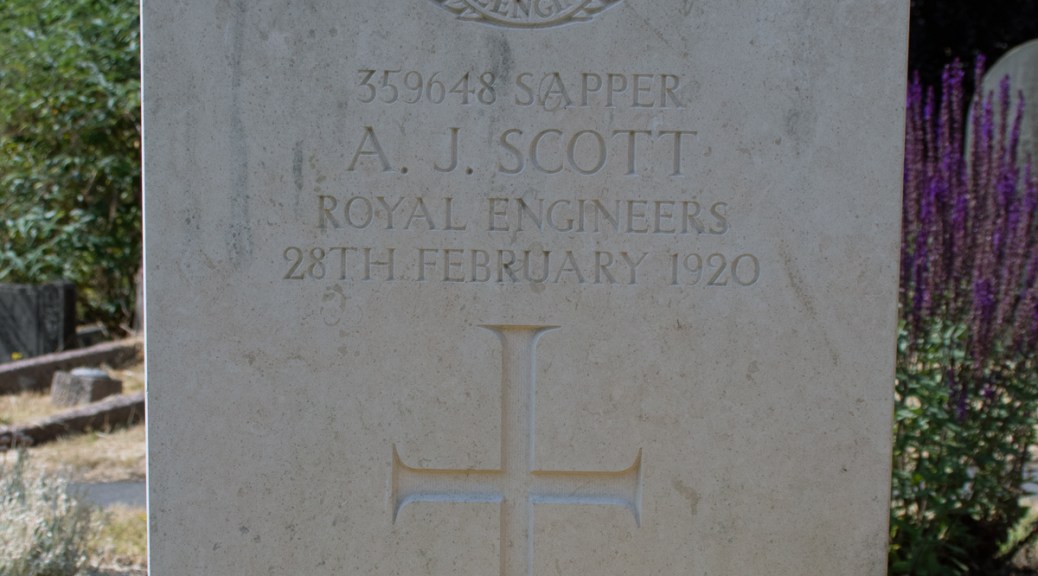
Abraham’s health seemed to improve, albeit slowly, and he was moved to the Pension’s Hospital in Bath on 27th November. The head wound, broken ankle and bout of trench fever appear to have taken their toll on his body which, by this point, seems to have been too weak to recover. On 28th February 1920, two months after being transferred to the Pension’s Hospital, he passed away there from a combination of appendicitis and pelvic cellulitis. He was just 26 years of age.
Abraham James Scott’s body did not have to travel far after this point. He was laid to rest in the sprawling Locksbrook Cemetery in his adopted home city of Bath.
John Renouf was born in Bedminster, Bristol, on 26th June 1875. Hiss parents, Charles and Emily Renouf, had been born in St Helier, Jersey, and had moved to the mainland with their older children in around 1874. Charles was a blacksmith, initially working on naval vessels in Jersey, he continued his smithing when the family had settled in Bedminster.
John was one of seven children and became apprenticed to his father when he finished his schooling. Charles’ trade offered him an opportunity for a career, however, and, on 23rd September 1893, he enlisted in the Royal Navy as a Blacksmith’s Mate. His service records show that he was 5ft 7.5ins (1.71m) tall, with black hair, grey eyes and a fresh complexion.
John signed up for a 12-year contract, and was primarily based out of HMS Vivid, the Royal Naval Dockyard in Devonport. His records confirm that he was not shore-bound, however, and he spent time on eleven ships up to 1905. At this point, his contract came to an end, and he chose not to re-enlist.
At this point, John’s trail becomes a little hazy. He returned to Bristol, and seems to have continued working as a blacksmith. The 1911 census recorded him as being one of a number of residents at the city’s Salvation Army Hostel on Tower Hill. According to the same census, Charles, now 71 and a widower of three years, was living with his youngest son, Ernest, and family.
When war came to European shores, John’s skills as a blacksmith were to be called upon once again. His service records are no longer available, but it is clear that he chose not to re-join the navy, instead enlisting in the Royal Engineers as a Sapper.
Sapper Renouf’s trail goes cold again: he was assigned to one of the Waterways and Railway Troops, but it is unclear whether he spent his time on home soil or overseas. Either way, he survived the conflict, and was back in Britain soon after the Armistice.
The next record for John Renouf is that of his passing. He died in Bath, Somerset, on 30th December 1919, at the age of 44 years old. John was laid to rest in the sweeping grounds of the city’s Locksbrook Cemetery.
Albert Sharp was born in Rugeley, Staffordshire, in the summer of 1894. One of six children, his parents were George, who was a house painter, and Janet Sharp. When he left school, Albert found work as a bricklayer’s labourer, but, when war was declared, he sought a new adventure.
Albert enlisted in the army on 21st February 1916. Assigned to the North Staffordshire Regiment, he was initially attached to the 5th Battalion. His medical records show that Private Sharp was 5ft 6ins (1.6m) tall, and weighed 122lbs (553kg).
By November 1916, Albert found himself in France. Unusually, his life over the next couple of years is pretty well documented. His battalion saw action at the Hindenburg Line, the Third Battles of Ypres, Cambrai and the Third Battles of the Somme, but Private Sharp’s service records shed more light onto his life than simply where he fought.
Albert seems to have been a bit of a character, and this got him into trouble on more than one occasion. On 9th November 1916, he was confined to barracks for two days, for having untidy bedding and no towel on his bed. The following day, he was punished with another two days’ confinement for not attending his battalion’s role call.
On 18th December 1916, Private Sharp found himself in trouble again. This time, he was confined to barracks for five days for appearing dirty on parade, and committing a nuisance. Four days later, Albert was admitted to the camp hospital for reasons that are unclear. He returned to his unit just under a week later.
At the end of February 1917, Private Sharp transferred to the 31st Light Railway Operating Company of the Royal Engineers. He remained with the battalion for just under a year, although again his time there was not without incident. On 31st August 1917, Albert was confined to barracks for seven days for being absent from parade. The same punishment was meted out for the same offence on 8th January 1918.
Later that month, Private Sharp re-joined the North Staffordshire Regiment, and was this time attached to the 9th Battalion. He remained on the Western Front and was caught up in some of the fiercest fighting of the closing months of the conflict.
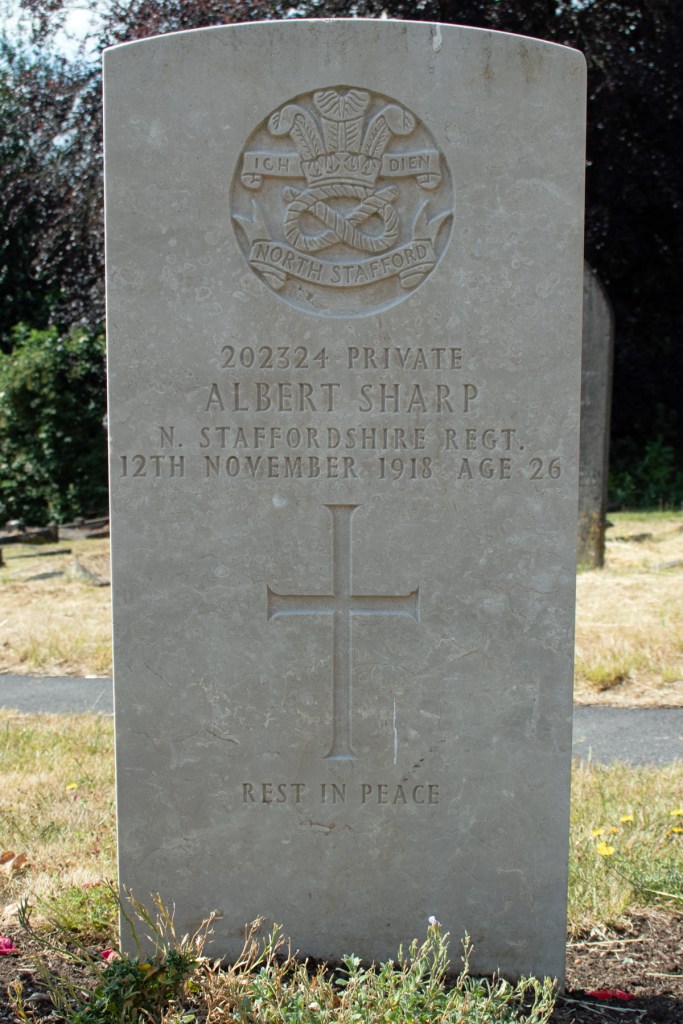
On 12th May 1918, Albert was caught up in a gas attack. Seriously injured, he was medically evacuated to Britain for treatment and admitted to the Bath War Hospital on 29th May. The next six months saw a slow and steady decline in his health. He passed away at 5:45am on 12th November 1918, the day after the Armistice was signed, from a combination of pneumonia and emphysema that was directly attributable to his injuries in France. Albert was 24 years of age.
It seems likely that Albert’s family were unable to pay for his body to be taken back to Staffordshire for burial. His service records give only his mother, Janet, as a next of kin, so it would seem that George had passed away by the time Albert enlisted. For some reason, however, while the British Register of Army Effects note that Private Sharp has effects to the value of £39 10s (£2250 in today’s money), this amount does not appear to have been paid. Janet passed away in the early 1920s, and Albert’s brother continued to try and obtain this gratuity on her behalf, but seems to have been unsuccessful.
Albert’s family did get his belongings when he died, however, which came to a postal order for 2s (around £3 today), 50 French centimes, a leather purse, two combs, two jack knives, a razor, a shaving brush, a toothbrush, two briar pipes and a pouch of tobacco, a nickel cigarette case, a text book, a wallet containing his pay book, his cap badge and six letters.
Unable to afford to bring Albert Sharp’s body back to his home town, he was, instead, laid to rest in the sweeping vista of Bath’s Locksbrook Cemetery, not far from the hospital in which he had breathed his last.
Francis Frederick Herbert Rich was born in Sherborne, Dorset, in the spring of 1896. The youngest of three children, his parents were Frederick and Alice Rich. Frederick was a grocer’s assistant, who had left Sherborne by the time of the 1901 census for Weston-super-Mare, Somerset, to find work. Alice remained with their children, but, by 1911, the family were back together and living in Bridgwater.
Frederick was now working as a grocer, and his two daughters were employed as pressers in a local blouse factory. Frederick, meanwhile, was apprenticed to an outfitter’s in the town.
War came to Europe, and Francis stepped up to service his King and Country. Full details of his time in the army are lost to time, but it is clear that he joined the Royal Engineers, and was attached to the 20th Territorial Force Depot. This was based in Pier Road, Gillingham, Kent, but it seems likely that he spent at least some time overseas.
A contemporary newspaper suggested that he worked as a dispatch rider for his battalion. The location of his passing – the Royal Victoria Hospital in Netley, near Southampton – would intimate that he had been brought there from the Western Front, having been wounded there.
Corporal Rich had been awarded the Military Medal before he passed, although again, the reason for this award is lost to the ages. He died, through causes unknown, on 16th May 1918, at the age of just 22 years old.
The body of Francis Frederick Herbert Rich was brought back to Somerset for burial. He was laid to rest in North Petherton Cemetery, not far from where his family still lived, on Taunton Road, Bridgwater.
Charles Herbert Dyer was born in the Somerset village of West Monkton in the spring of 1890. One of eight children, his parents were farm labourer Charles Dyer and his wife Mary.
By the time of the 1911 census, Charles Jr had set out on his own, settling in Briton Ferry, near Port Talbot, Glamorganshire. He found work as a gardener and, from this point on, he went by his middle name, Herbert.
Over the next few years, Herbert continued his employment in Wales, although he did make a move to Newport, Monmouthshire. When war came to Britain, Herbert stepped up to serve King and Country, enlisting in the South Wales Borderers on 10th January 1916. Less than two weeks later, he married Ethel May Andrews, in All Saints’ Church, Newport.
Private Dyer was formally mobilised on 2nd March 1916. His service records show that he was 5ft 10ins (1.78m) tall and weighed 141lbs (64kg). Details of his service are a little scrambled, but it appears that Herbert was initially assigned to the 3rd (Reserve) Battalion, and remained on home soil throughout the conflict.
Herbert was based in Bottesford, Leicestershire, in December 1916, where he was put on report and docked 14 days’ pay for being absent from his post, and refusing to obey a superior’s order. Six months later, he had moved camp, and was confined to barracks for two weeks, and docked two days’ pay for being absent without leave for a day and ten hours.
By the summer of 1918, Herbert had transferred across to the Royal Engineers where, with the rank of Pioneer, he was assigned to the 15th Anti-Aircraft Company. Full details of his time in his new regiment have been lost, but he was certainly based in Essex as the war came to a close.
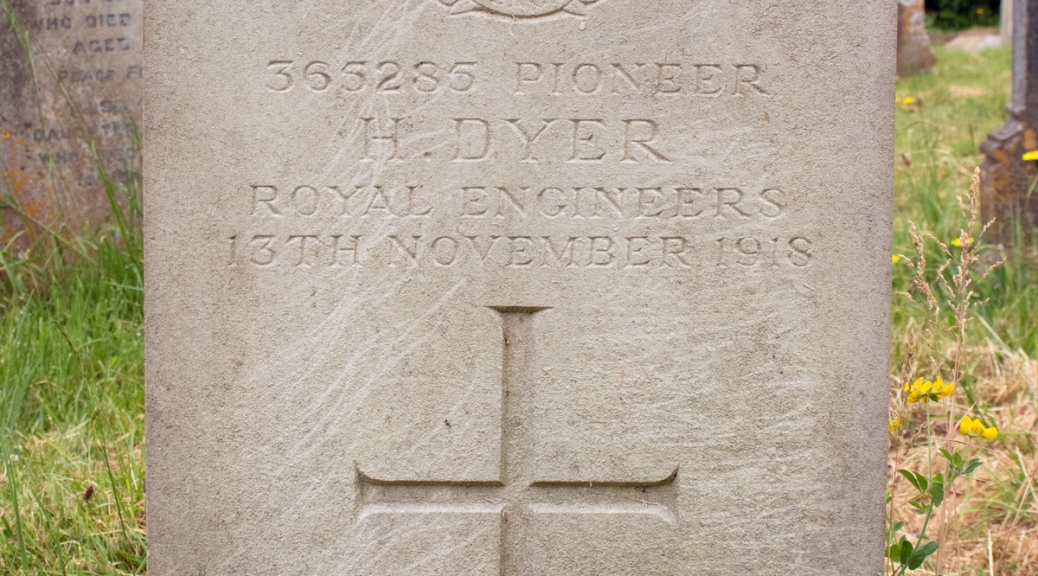
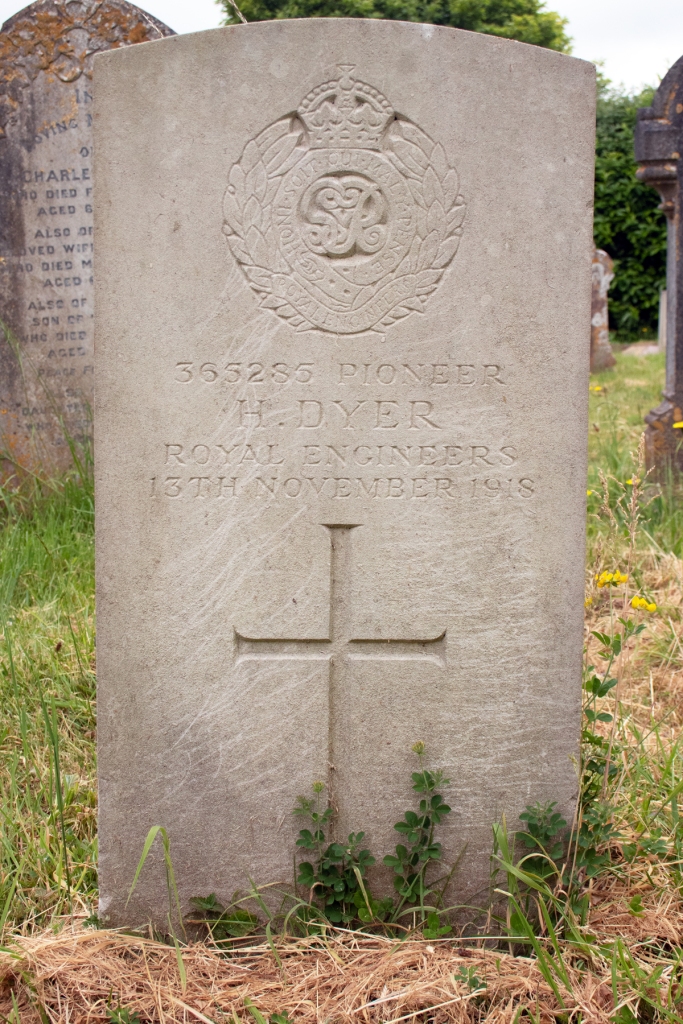
Pioneer Dyer’s health was, however, beginning to suffer by this point. He had a bout of influenza, which developed into pneumonia. He was admitted to the Warley Military Hospital in Brentwood, on 10th November 1918, but, by this point, his body had seemingly had enough. He passed away at 11:20am on 13th November 1918, at the age of 28 years old.
The body of Herbert Dyer was brought back to Somerset for burial. Ethel had moved in with her in-laws in West Monkton by this point, and was a couple of months’ pregnant. Herbert was laid to rest in the peaceful graveyard of St Augustine’s Church. His son – who Ethel named Herbert – was born on 6th June 1919, never to know his father.