Tag Archives: Royal Navy

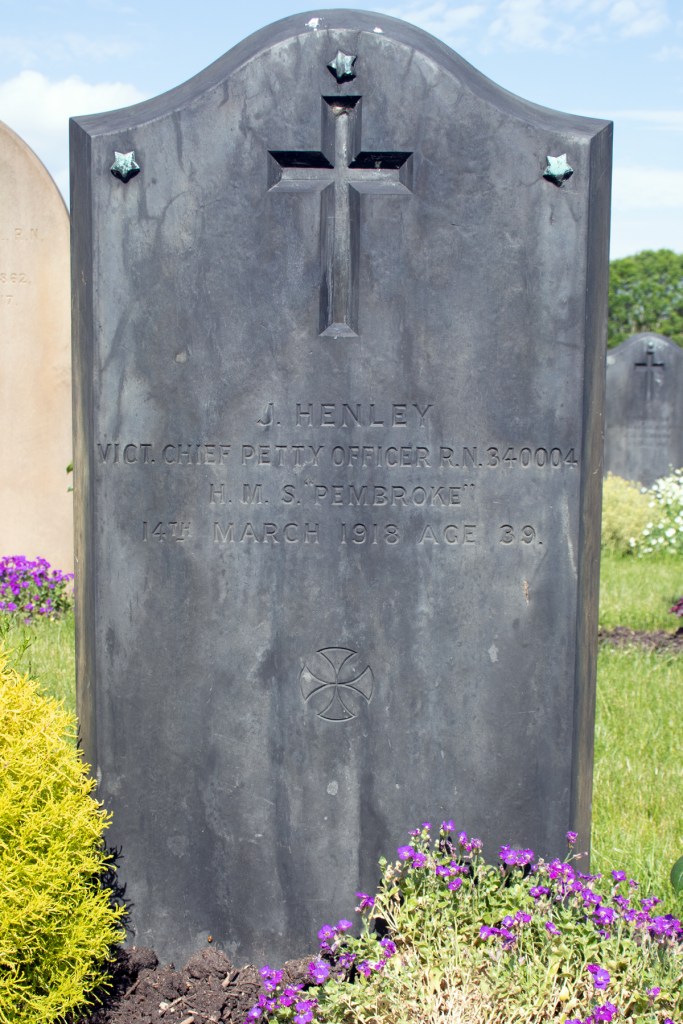
Chief Petty Officer John Henley

Chief Petty Officer John Henley

John Henley was born on 4th September 1878, and was the second of five children to William and Frances. William was a navy pensioner from Maidstone, Kent, but it was in the nearby village of Loose that John was born and the family raised.

Given his father’s background, it was inevitable that John would go to sea as well. The 1891 census recorded him as being one of nearly 1000 pupils of the Royal Hospital School in Greenwich, and just three years later he formally enlisted in the Royal Navy. Just sixteen years of age, he was given the rank of Ship’s Steward Boy. His service records confirm that he was 5ft 4ins (1.63m) tall, with dark brown hair, light blue eyes and a fresh complexion.

Initially based at HMS Pembroke, the Royal Naval Dockyard in Chatham, Kent, over the next eighteen months, John spent time on five ships. This gave him enough grounding so that when he came of age in September 1896, he could be formally inducted into the navy, with the rank of Ship’s Steward Assistant.

Over the next decade, John’s career flourished. He was promoted to Acting Ship’s Steward in January 1901, and full Ship’s Steward fifteen months later. He had spent time on a further ten ship by this point, returning to HMS Pembroke in between postings.

In July 1905, John married Maud Norton, a carpenter’s daughter from his home village. While her husband was away at sea, she set up home at 88 Kingswood Road, Gillingham, Kent, and the couple went on to have three children: John, William and Lionel.

Back at sea, and by the time war broke out, Ship’s Steward Henley had completed more than twelve years in the role. In February 1918, he received a further promotion, this time to Victualling Chief Petty Officer, but this new role was to be cut tragically short. The following month, he was admitted to the Royal Naval Hospital in Chatham, Kent, suffering from a gastric ulcer. This haemorrhaged, and he passed away while still admitted. John died on 14th March 1918: he was 39 years of age.

We regret to announce the death of Mr John Henley, Victualling Chief Petty Officer (Ship Steward)… Deceased was a native of Loose and… had served 25 years in the Royal Navy, having commenced his career in the Royal Hospital School, Greenwich, at the age of eleven years. He took part in the battle off the Falkland Islands, and also in the operations in the Dardanelles whilst serving on HMS Inflexible. He leaves a widow and three sons.

[Kent Messenger & Gravesend Telegraph: Saturday 30th March 1918]

John Henley was laid to rest in the naval section of Woodlands Cemetery, Gillingham, walking distance from where his widow still lived.


Chief Petty Officer John Henley
(from britishnewspaperarchive.co.uk)

Stoker 1st Class Joseph Ward

Stoker 1st Class Joseph Ward

Joseph Ward was born in Wednesbury, Staffordshire, on 13th January 1890. The four of five children – all boys – his parents were William and Caroline. William was a coal miner-turned-weighman, but Joseph found work as a riveter when he completed his schooling.

It seems that Joseph sought any employment to avoid going down the mines, and, on 26th August 1910, he enlisted in the Royal Navy. His service records show that he was 5ft 3ins (1,6m) tall, with brown hair, grey eyes and a sallow complexion. He was also noted as having a dot or mole on the back of this left forearm and another on the back of his left hand.

Joseph was given the rank of Stoker 2nd Class, and was sent to HMS Vivid, the Royal Naval Dockyard in Devonport, Devon, for training. This would be his base of operations, and he would return there a number of times in the coming years.

On 4th January 1911, Stoker Ward was given his first posting, on board the armoured cruiser HMS Cumberland. he remained on board for more than two-and-a-half years, and gained a promotion to Stoker 1st Class during this time.

In October 1913, Joseph returned to Devonport, remaining on shore for more than three months. His service record notes he was confined to the Dockyard Sick Quarters for three days, although the cause is not given. In January 1914, he returned to sea again, on board another cruiser, HMS Highflyer. This would prove another lengthy assignment, and Stoker Ward would not return to HMS Vivid for more than three years.

During his short spell ashore, Joseph returned to Staffordshire. He married Lily Wright, a tailoress from Wednesbury. Their honeymoon was brief, however, and he was given a new assignment.

Stoker Ward was attached to HMS Valkyrie, a newly commissioned destroyer attached to the Harwich Force. On 22nd December 1917, she was escorting a convoy to the Netherlands when she struck a mine. Twelve of the crew – including Joseph – were killed, while a further seven subsequently succumbed to their injuries. The Valkyrie was towed to the Royal Naval Dockyard in Chatham, Kent, for repairs.

Joseph Ward was 27 years of age when he was killed. He was laid to rest in the naval section of Woodlands Cemetery in Gillingham, not far from the Kent naval base.


Tragically, Lily was pregnant when her husband was killed. On 25th February 1918, she gave birth to their child, Flora, the daughter Joseph would never know.


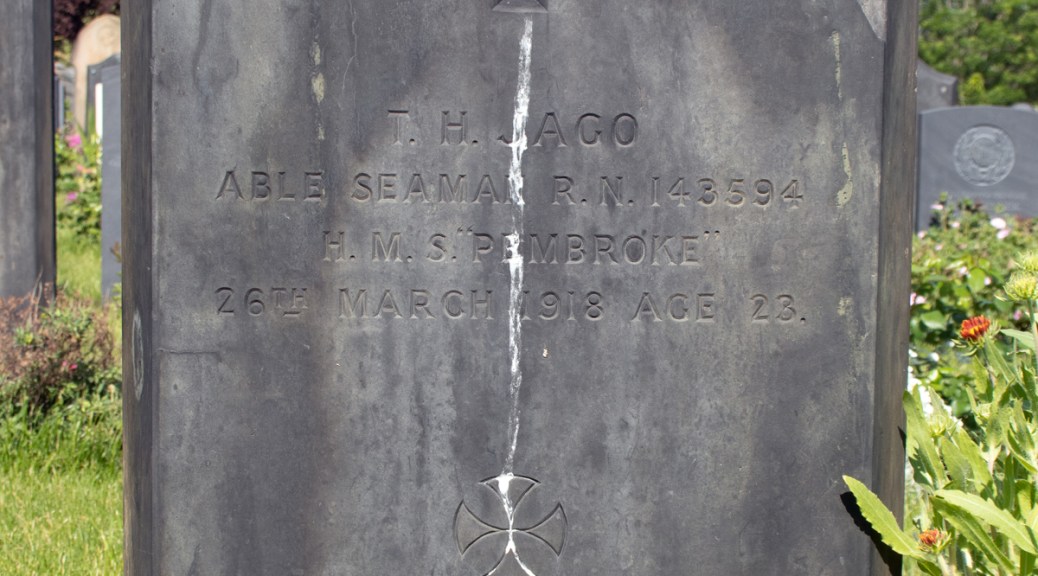
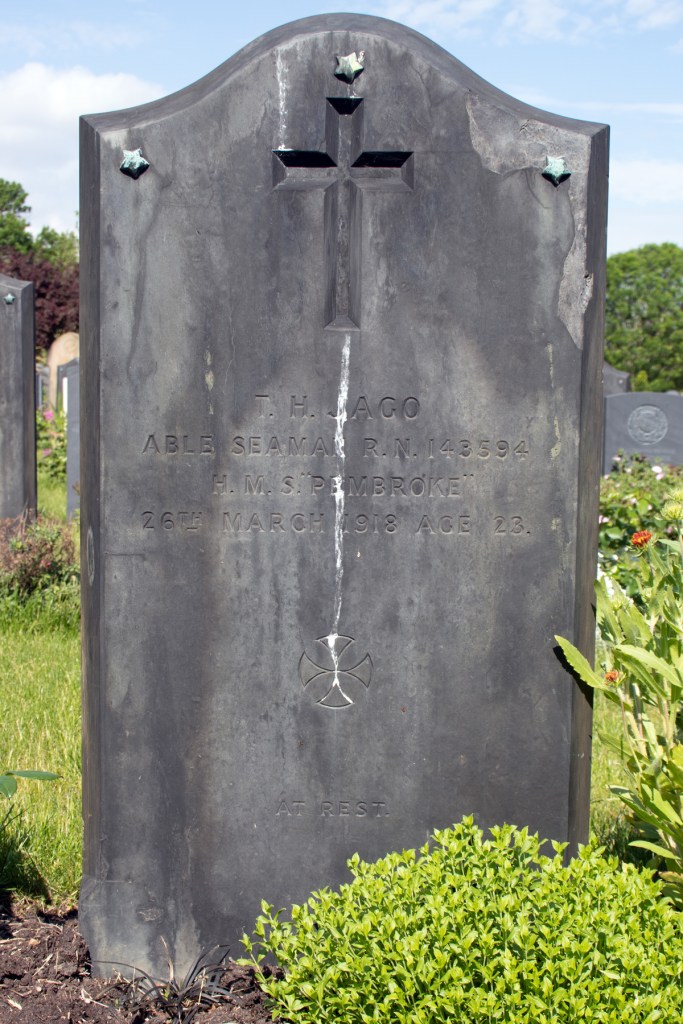
Able Seaman Thomas Jago

Able Seaman Thomas Jago

Thomas Henry Jago was born on 3rd June 1872 in Romney Marsh, Kent. The second of ten children, his parents were James and Elizabeth. James was a coastguardman, and his son was destined to be connected to the sea.

Thomas joined the Royal Navy on 19th December 1887. Given the rank of Boy 2nd Class, his records show that he was just 5ft (1.52m) tall, with dark brown hair, grey eyes and a fresh complexion. He was sent to HMS St Vincent, the training ship based in Haslar, Hampshire, and would remain there until June 1889. During this time, he was promoted and given the new rank of Boy 1st Class.

Thomas’ first ocean assignment was on board the corvette HMS Active. She would be his home for the next three years. In June 1890 he came of age, and was formally inducted into the Royal Navy as an Ordinary Seaman. By November 1890, he had proved his worth again, and was promoted to Able Seaman.

Over the next seventeen years, Thomas would serve on 21 ships. Frustratingly, the dates on his service records become a little muddled as time goes on, but it was while he was on board the RMS Empress of India in the late 1890s that he was promoted to Leading Seaman, then Petty Officer 2nd Class and Petty Officer 1st Class, all within a matter of three years.

In March 1903 he was demoted to Petty Officer 2nd Class, but the higher rank was reinstated eighteen months later. In September 1907, while serving on HMS Magnificent, Thomas seems to have been in some sort of trouble. This resulted in the removal of his ranking, and he was downgraded to Able Seaman once more, a rank that he would then hold until the end of his naval career.

In between voyages, Able Seaman Jago would have a shore base to return back to. His most common port seems to have been Chatham, and HMS Pembroke, the town’s Royal Naval Dockyard, features on his records more and more as time goes by.

In June 1912, after 22 years of service, Thomas was stood down to reserve status. Over the next few years his trail goes cold, although a later document suggests that he had moved to Sandgate, Kent, where he was renting rooms at 18 High Street.

War was soon raging across the world, and Able Seaman Jago was called upon to serve again. Assigned to London’s HMS President in December 1915, he quickly returned to Chatham Dockyard again. Over the next couple of years, Thomas serves on two further ships – HMS Diligence and HMS Mars – but HMS Pembroke definitely became a home from home.

In February 1918, Able Seaman Jago returned to the Royal Naval Dockyard in Chatham one last time. He was unwell by this point, and was admitted to the the town’s Royal Naval Hospital for an operation on his mouth. Thomas was suffering from carcinoma of the tongue, and the condition was to prove fatal. He passed away on 26th March 1918, at the age of 45 years old.

Thomas Henry Jago was laid to rest in the naval section of Woodlands Cemetery in Gillingham, Kent, not far from the base he had called home for so many years.


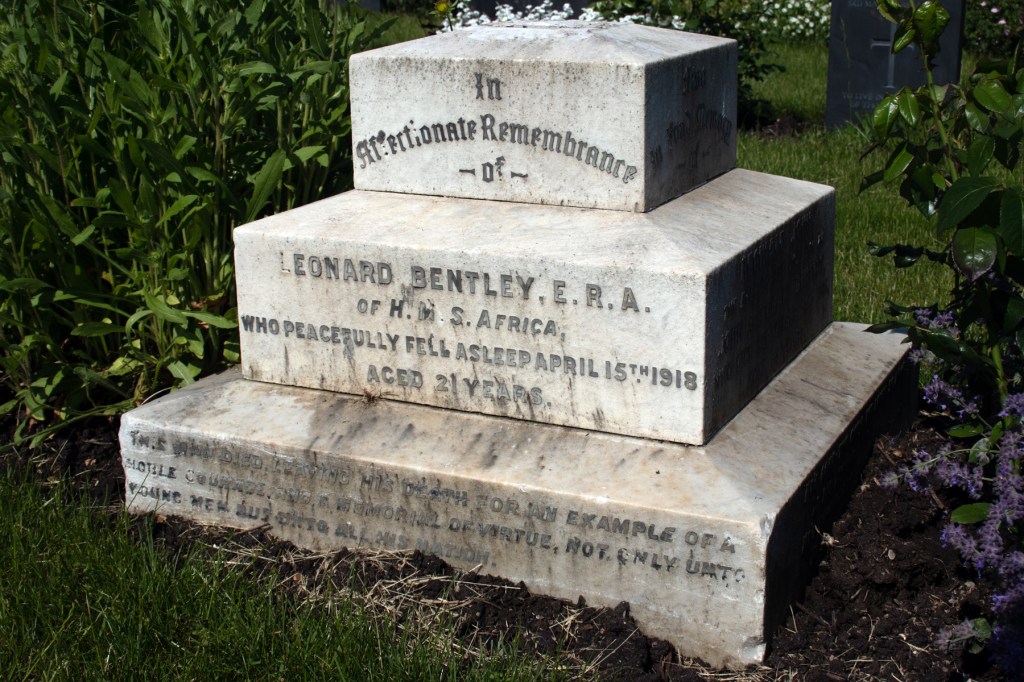
Engine Room Artificer 4th Class Leonard Bentley

Engine Room Artificer 4th Class Leonard Bentley

Leonard Bentley was born in Strood, Kent, on 6th December 1896. One of six children, his parents were John and Emma Bentley. John was a barge captain, transporting ship-loads of cement from the local works to where it was needed.

The 1911 census found an extended Bentley family living at 85 Cliffe Road in Strood. John and Emma shared their home with Leonard, his older brother Arthur, and Arthur’s wife and son. Eleven years younger than Arthur, who was his next oldest sibling, Leonard was still at school by this point.

Education was obviously important to Leonard, and by the end of the year, he had enrolled in the Royal Navy as a Boy Artificer. He would spend the next few years at HMS Fisgard, the training establishment in Woolwich, Kent, learning his trade.

When he came of age in December 1914, Leonard was officially inducted into the Royal Navy, taking on the rank of Engine Room Artificer 5th Class. He remained at Fisgard until January 1916, when he transferred to HMS Victory, the Royal Naval Dockyard in Portsmouth.

This was a temporary move, however, and on 11th April Leonard was assigned to HMS Africa, and a few weeks later, he was promoted to Engine Room Artificer 4th Class. A battleship, the Africa would become his home for the next eighteen months and he would travel with to the Mediterranean and Adriatic Seas.

In January 1918, Engine Room Artificer Bentley would return to solid ground. He transferred to HMS Pembroke, the Royal Navy’s base in Chatham, Kent. The reason for his move appears to have been health related, and he was soon moved the the town’s Naval Hospital, suffering from pulmonary tuberculosis. The condition was to prove fatal. Leonard died on 15th April 1918: he was 21 years of age.

Leonard Bentley was laid to rest in the naval section of Woodlands Cemetery, Gillingham, Kent, not far from his family home, or his final naval base.


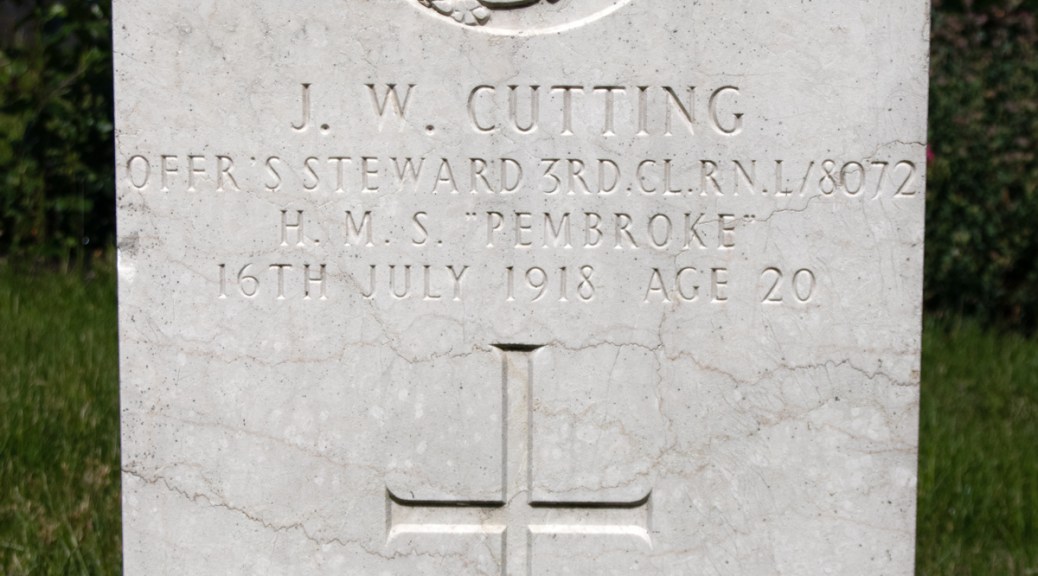
Officer’s Steward 3rd Class Joseph Cutting

Officer’s Steward 3rd Class Joseph Cutting

Joseph William Cutting was born on 10th September 1897 in Stratford, Essex. The middle of three children, his parents were Alfred and Clara. Alfred was a stoker in a carpenter’s workshop, but when he completed his schooling, his son found work as a clerk.

When war broke out, Joseph stepped up to play his part. He enlisted in the Royal Navy on 22nd September 1915, joining as an Officer’s Steward 3rd Class. His service records show that he was 5ft 8ins (1.72m) tall, with dark brown hair, blue eyes and a fresh complexion. He was also noted as having a scar in the middle of his forehead.

Officer’s Steward Cutting was based at HMS Pembroke, the Royal Naval Dockyard in Chatham, Kent, and would continue in his role for the next two and a half years. His annual review recorded a very good character, and moderate to satisfactory ability, which may be why he did not rise above his junior rank.

In the summer of 1918, Joseph was admitted to the Royal Naval Hospital in Chatham, suffering from tuberculosis. The lung condition was to prove his undoing, and he succumbed to it on 16th July 1918. He was just 20 years of age.

Joseph William Cutting was laid to rest in the naval section of Woodlands Cemetery in Gillingham, Kent, not far from the base he had called home for so long.


Stoker 1st Class Thomas Ellis

Stoker 1st Class Thomas Ellis

Thomas Ellis was born in 1896 in St Leonard’s, Sussex. The third of twelve children, his parents were George and Ellen Ellis. George was a general labourer, but when he finished his schooling, Thomas found work as a golf caddy. The 1911 census recorded the Ellis family living in four rooms at 7 Caves Road to the east of the town centre.

There is little additional information about Thomas, sadly. He joined the Royal Navy when war broke out, and was working as a Stoker 1st Class by the closing months of the conflict. He passed away, through causes unknown, on 7th July 1918, at the age of just 23 years old.

Thomas Ellis was laid to rest in the naval section of the Woodlands Cemetery in Gillingham, Kent, not far from the Royal Naval Dockyard in Chatham – HMS Pembroke – at which he was based.


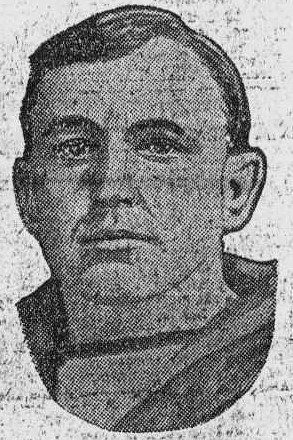
Able Seaman William Comley

Able Seaman William Comley

Charles William Comley was born on 10th May 1882 in the Somerset city of Bath. One of sixteen siblings – only seven of whom survived childhood – his parents were Charles and Mary. Charles Sr was a stonemason, and to avoid any confusions with their names, his son quickly became known by his middle name, William.

When he completed his schooling, young William found work with a baker. However he had his sights on bigger and better things, and on 1st August 1899 he enlisted in the Royal Navy. Being too young to formally enlist, he was given the rank of Boy 2nd Class, and was sent to HMS Northampton, a training ship, to start learning the skills he would later rely on.

After jut a couple of months Boy Comley was given his first assignment, on board HMS Curacoa, a cruiser which served as a training ship. He would spend the next six months on board, visiting the Atlantic coastal ports in Madeira, Las Palmas and Cape Verde. By the time William completed his time on Curacoa, he had been promoted to Boy 1st Class.

Returning to Britain, William was sent to HMS Vivid, the Royal Naval Dockyard in Devonport, Devon. He would only be based there for a matter of weeks, but during that time he turned 18, and was now of an age to be inducted into the navy proper. Now given the rank of Ordinary Seaman, his service records show that he was 5ft 3ins (1.6m) tall, with light brown hair, hazel eyes and a dark complexion. He was also noted as having a scar on the first finger of his left hand.

In June 1900, Ordinary Seaman Comley was assigned to the battleship HMS Magnificent, and from this point on, his naval career was set. Over the next sixteen years, he would serve on a total of seven ships, with HMS Vivid remaining his home base in between voyages. His service records continually note his very good character, and, from September 1903, he held the rank of Able Seaman.

When William’s initial twelve-year contract came to an end in the spring of 1912, he immediately re-enlisted. He had grown to 5ft 7.5ins (1.71cm) in height, and his records show that, while retaining his light brown hair and eyes, he now had a light complexion.

War broke out in the summer of 1914, and Able Seaman Comley was assigned to the newly launched HMS Tiger. He would remain part of the battleship’s crew for close to two years, and was involved in the Battle of Dogger Bank in January 1915.

On 3rd April 1916, William was medically disembarked in Scotland, suffering from pneumonia. He was admitted to the Royal Naval Hospital in Queensferry, but his condition turned septic. He passed away on 12th April 1916, a month short of this 34th birthday.

The body of William Charles Comley was taken back to Somerset for burial. He was laid to rest in the city’s majestic Locksbrook Cemetery.


Able Seaman William Comley
(from ancestry.co.uk)

Stoker 1st Class Albert Willingham

Stoker 1st Class Albert Willingham

Albert Willingham was born in Upchurch, Kent, on 4th January 1888. One of eleven children, his parents were George and Annie Willingham. George was a brickmaker and labourer, who moved his family to where the work was. By the time of the 1891 census, they had relocated to the nearby town of Gillingham, and were living on the waterfront at 5 Danes Hill.

As the family grew, so they kept moving. The census of 1901 found the ten Willinghams – George, Annie and eight children including 13-year-old Albert and his youngest sibling, 11-day-old Ada – residing at 5 Court Lodge Road. The small terraced house would still be crowded, however, and this may have been one of the factors pushing Albert to bigger and better things.

Having followed his older brothers into labouring work, Albert decided enough was enough. On 13th July 1908, he enlisted in the Royal Navy, joining up as a Stoker 2nd Class. His service records show that he had brown eyes, dark brown hair and a ruddy complexion. He was 5ft 8.5ins (1.73m) tall.

Stoker Willingham was first sent to HMS Acheron, the training frigate, for his induction. He remained on board for six months, before moving to the cruiser HMS Dido in January 1909. Over the next six years, Albert served on seven further ships, returning to what became his home base, HMS Pembroke in Kent, in between voyages.

Albert quickly became well-travelled, and he served in the Somaliland Expedition, and in the operations in the Persian Gulf between 1909 and 1914. The 1911 census recorded him as being a stoker on board HMS Hyacinth, which was then moored in Bombay (now Mumbai), India.

While on board Hyacinth, Albert was promoted to Stoker 1st Class, and in April 1915, with the war raging around him, he was promoted again, to Acting Leading Stoker. At the end of that month, he was transferred to what would be his final ship, HMS Princess Irene.

She was an ocean liner that had been requisitioned at the outbreak of war, and converted to a minelayer. On 27th May 1915, while moored off Sheerness, Kent, a series of explosions ripped through the ship, killing more than 350 crew. Acting Leading Stoker Willingham was among those who perished: he was 27 years of age.

The body of Albert Willingham was buried in Woodlands Cemetery, Gillingham, Kent, just a short walk from his family’s home.


Albert’s headstone records the permanent rank he held at the time of his passing, rather than acting one he had been temporarily given. He is therefore noted as Stoker 1st Class, instead of Acting Leading Stoker.


Stoker 1st Class Albert Knieriem

Stoker 1st Class Albert Knieriem

Albert George Knieriem was born in Bromley-by-Bow, Middlesex, on 1st January 1892. The eighth of nine children, his parents were German-born Gottliept (anglicised to George) Knieriem, and his London-born wife, Caroline.

George was a labourer at the local gas works, and the family had rooms at 3 Hancock Road. Their home has long since gone, but the Knieriems shared the property with the Richard and Eliza Bone and their four children.

George passed away in March 1906, with Caroline dying less than eighteen months later. Albert found himself an orphan at just 15 years of age. It seems that his oldest brother, also called George, found him employment as a local iron foundry. By the time of the 1911 census, he was boarding with the Fryatt family, at 29 Hancock Road, not far from the old family home.

Albert sought bigger and better things for himself, however, and was drawn to a life at sea. On 14th July 1911 he enlisted in the Royal Navy as a Stoker 2nd Class. His service records confirm that he was 5ft 5.5ins (1.66m) tall, and that he has light brown hair, grey eyes and a fresh complexion.

Stoker Knieriem was initially sent to HMS Pembroke, the Royal Naval Dockyard in Chatham, Kent, for his training. He remained there for four months, before being given his first posting, on board the cruiser HMS Intrepid. She would be his home for the best part of a year, during which time Albert was promoted to Stoker 1st Class.

In September 1912, Albert transferred to HMS Acteon. A former hulk, she was based at Sheerness, Kent, as was used as a torpedo school. Albert would remain there for more than two years, attached to the school’s tender, HMS Kestrel.

On 18th January 1915, Stoker 1st Class Knieriem’s service records note one word: “Run”. Albert had absconded, remaining at large for two months. He was apprehended on 23rd March, and sentenced to 28 days’ detention for going AWOL. Put back on duty on 28th April, he was reassigned, to the former cruise liner, HMS Princess Irene.

The Princess Irene had been requisitioned by the Royal Navy on the outbreak of war and converted into a minelayer. On the morning of 27th May 1915, she was moored in the Medway Estuary and was being loaded with mines. A faulty primer set off a series of explosions, destroying the ship and killing more than 250 crew, Stoker 1st Class Knieriem among them. He was 23 years of age.

Albert’s name comes up in a newspaper article about one of the subsequent enquiries. The Coroner’s inquest on 18th June focused on the bodies in coffins 29 to 34.

No. 32 body was very much shattered. It was dressed as a stoker. The name “A. G Knieriem” was no the band of the trousers.

The body was identified as that of Albert George Knieriem, aged 23, stoker, 1st class, of Bromley-by-Bow.

[Sheerness Guardian and East Kent Advertiser: Saturday 19th June 1915]

Albert’s body was laid to rest in the naval section of Woodlands Cemetery in Gillingham, Kent. He was buried alongside some of the other crew whose bodies had been rescued and identified.


Stoker 1st Class William James

Stoker 1st Class William James

William Charles James was born on 12th September 1893, the ninth of ten children to John and Isabella James. John was a sawyer from Shoreditch, Middlesex, and this is where he and his Surrey-born wife raised their family.

By the time of the 1911 census, John and Isabella were living in four rooms at 36 Falkirk Street, Hoxton, Middlesex with three of their children – including William – and Isabella’s brother, Charles. The building was inhabited by 17 people in total, four families renting out the nine rooms of the house.

The James family had three wages coming in. In addition to John’s work at the wood mill, his brother-in-law was employed as a casual winder cleaner. William was also in work, serving as an office boy a a draper’s warehouse. Isabella would have been running the household and looking after her youngest, schoolboy Thomas. William’s 27-year-old sister, Rachel, completed the household: she was not working, but was noted as having been suffering from a chest disease for at least four years.

Whether seeking a life away from London’s East End, or to bring in a more permanent wage for his family, William sought a more stable and financially lucrative career. On 8th January 1913, he enlisted in the Royal Navy for the standard twelve-year contract. His service records show that he had progressed from an office boy to a clerk, and confirm his physical features: he was 5ft 5.5ins (1.66m) tall, with dark brown hair, grey eyes and a fresh complexion. His records also highlight a scar on his left forearm and another above his right eye.

William was given the rank of Stoker 2nd Class, and sent off to HMS Pembroke, the Royal Naval Dockyard in Chatham, Kent, to be trained. After six months he was given his first assignment, on board the cruiser HMS Forward, which would remain his home for the next two years.

During his time on Forward, William, rising to Stoker 1st Class in January 1914. The ship was assigned to patrol the eastern coast of England, and, in December that year, bore witness – but was not directly involved in – the German bombardment of Hartlepool.

In April 1915 Stoker James was moved to HMS Princess Irene, an ocean liner requisitioned on the outbreak of war and converted to a minelayer. On the morning of 27th May 1915, she was moored in the Medway Estuary and was being loaded with mines in preparation for a mission. At 11:14am, a faulty primer on board set off a series of explosions, and she blew apart and sank. More than 250 crew – including Stoker 1st Class James – were killed. He was just 21 years of age.

The body of William Charles James was brought ashore and laid to rest in the Woodlands Cemetery in Gillingham, Kent. He was buried alongside some of the other crew whose bodies had been rescued and identified.