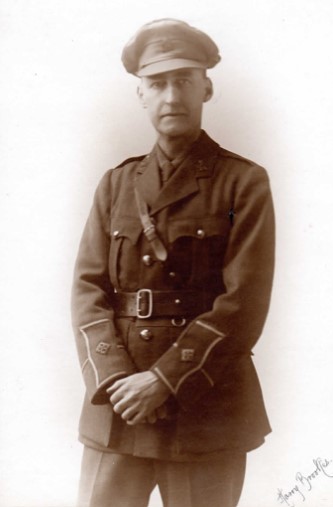
Cecil St John Harris was the son of Reverend Percy and Constance Harris. Born in Kilver, Staffordshire, on 13th July 1891, he was one of nine children, although, by the time of the 1911 census, four of them had passed away. The Harris family had, by this point, moved from Staffordshire, to Devon, to Cornwall, and had settled in Staplegrove, Somerset, where Percy had become the rector at St John’s Church.
According to the census record, Cecil was studying engineering. He was keen at sports, being a keen member of the village’s cricket club. When war broke out, he enlisted in the West Somerset Yeomanry, but soon took a commission as a Second Lieutenant in the Somerset Light Infantry.
Cecil’s troop, the 3rd/5th Battalion remained on home soil, and he was based in Somerset for the duration of his time in the army. This was not to be for a long time, however, as, in the summer of 1915, he fell ill with appendicitis. He underwent an operation, and made a slow recovery, before relapsing. He passed away on 10th September 1915, aged just 24 years old.
Cecil St John Harris was laid to rest in the north east corner of St John’s Churchyard, Staplegrove, where his father was still the vicar. His grave is now lost to time, but Second Lieutenant Harris is commemorated on a special memorial, close to the entrance of the building.
Gilbert Harold Earle Rippon was born in Paddington, London, in the spring of 1887. The third of seven children, his parents were coal merchant Frederick Rippon and his wife, Eugenie.
When Gilbert left school, he found work as a clerk for a building firm. He was an ambitious young man, however, and, after his mother died in 1903 and his father a few years later, he took on work at a rubber plantation in Jementah, Malaysia.
When war broke out, “he came home on six months’ leave in order to enlist, having an exciting voyage owing to the activities of submarines. He was refused at first owing to a slight physical defect, but after an operation learnt to fly and was given a commission in the Royal Flying Corps.” [Somerset Guardian and Radstock Observer: Friday 9th June 1916]
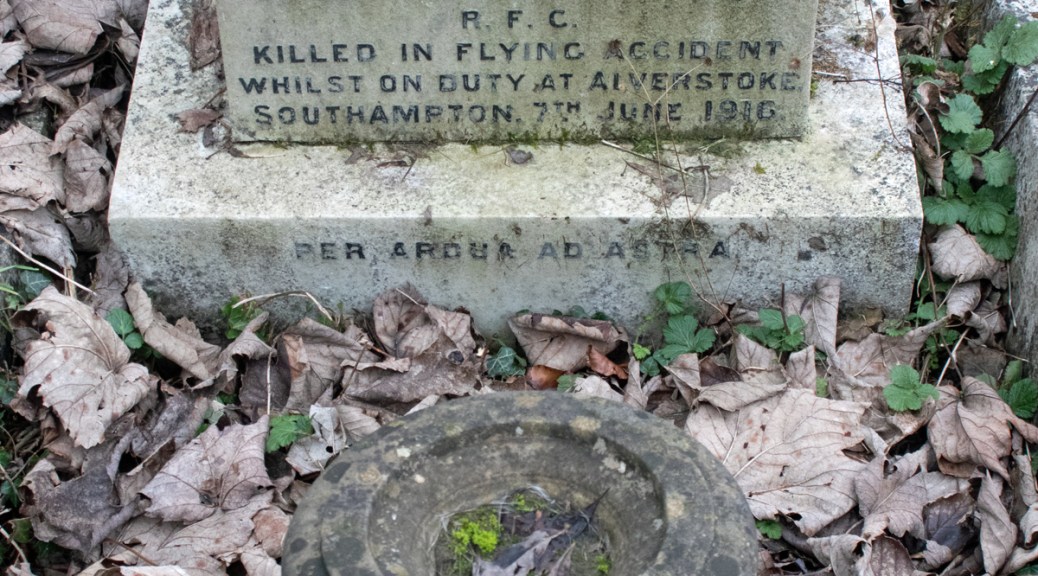
Second Lieutenant Rippon gained his wings at Brooklands in Surrey on 16th January 1916. By the summer he was attached to a flying school in Gosport, Hampshire, and this is where he was based by the early summer of 1916.
On 7th June, Gilbert was flying a de Havilland DH2 aircraft, when an accident occurred. According to a newspaper report: “Evidence showed that the machine, when 300 feet [91m] up, made a double turn, as though the aviator was trying to return. It then slipped and made a nose-dive to the ground, killing the pilot instantaneously. He had only been in the air three minutes. The previous evening the same monoplane had ascended 14,000 ft [4267m].” [Somerset Guardian and Radstock Observer: Friday 9th June 1916]
Second Lieutenant Rippon was 29 years of age. The same report confirmed that he was the older brother of two Bath and Somerset cricketers – twins Dudley and Sydney Rippon – and that his oldest brother, New York-based Secretary of the Board of Correction Frank Rippon, “had the unhappy experience of being in the aerodrome when the accident occurred, and saw his brother fall to the ground.”
Gilbert Harold Earle Rippon was laid to rest in the family plot St James Cemetery, Bath, Somerset. There seems to have been a family connection with the city: this is where both Frederick and Eugenie were buried, and where, after their parents’ deaths, the twins and the youngest Rippon son, Percy, were taken to live.
Cedric William Pepper was born in 1895 in South Kirkby, Yorkshire. He was the middle of three children to William and Harriette Pepper. William was a colliery owner from Leeds, and the family lived in some comfort in Rawdon Hill in Wharfdale. The 1901 census records show that they employed a governess, cook, two housemaids, a kitchen maid and a page.
By the time of the next census, in 1911, the Pepper family had moved to Shipton in Oxfordshire, where they lived in the 27-room Shipton Court. Cedric, by this time, was still studying, having been taught at Winchester College, where he lasted only a year, Tonbridge School, and then Worcester College in Oxford.
When war broke out, he had taken time away from his studies, and was working on a ranch in Rhodesia (present-day Zimbabwe). He returned to Britain at the start of the conflict and enlisted in the King’s Royal Rifle Corps. Assigned to the 2nd Battalion, Private Pepper arrived in France in November 1914, and was wounded in his thigh the summer of 1915.
Private Pepper returned to Britain to recuperate and, when he had recovered, he was given a commission in the 3rd Battalion of the Somerset Light Infantry. It was while he was training in Oxfordshire that the now Second Lieutenant Pepper met his end.
The evidence at the inquest… suggested that the death from a bullet wound… was accidental.
Second-Lieutenant William Eric Warburton… stated that early last week Lieutenant Pepper told him he was in some difficulty with a woman, but he did not explain it. Lieutenant Warburton did not think that this caused him to take his life. In his opinion Lieutenant Pepper knew nothing of the working of an automatic pistol he possessed.
The medical evidence was that a bullet entered the centre of the forehead. The doctor said that if the wound was self-inflicted it was quite possible that it was accidental.
The jury returned a verdict of Death from a bullet from an automatic pistol, but that there was no evidence to show how the wound was inflicted.
Central Somerset Gazette: Friday 29th October 1915
Second Lieutenant Pepper died from the bullet wound on 21st October 1915. He was just 20 years of age.
Pepper Family Memorial
Cedric William Pepper’s family were, by this time, living in Redlynch House, near Bruton, Somerset. He was cremated, and his ashes immured in the wall of St Peter’s Church in the hamlet.
Second Lieutenant Cedric Pepper (from findagrave.com)
In researching Cedric’s life, there is a definite sense of a young man desperately looking to please his father. A successful Yorkshire colliery owner, he may have expected more from his oldest son, a drop out from Winchester College, possibly sent to Southern Africa to find himself. While an immediate return to Britain to serve his country would have been commonplace, the suggestion of difficulty with a woman and the subsequent accident with his gun just adds to the sense of a need for Cedric to not disappoint his father.
Charles Edward Hoare Hales was born in Bournemouth, Dorset, in the summer of 1886. The fourth of five children, his parents were Arthur Hales – a Major General in the Royal Inniskilling Fusiliers – and his wife, Maria.
Arthur’s career stood the family in good stead: the 1891 census records the Hales living in a house in Crystal Palace Park, South London, with five servants supporting their – and their two visitors’ – every need. Arthur also believed in education for this two sons: Charles was dispatched to Hartwood House School in Hartley Wintney, Hampshire.
Arthur died in 1904 and at this point the Hales family disappears – there is no record for Maria or her five children in any of the 1911 census returns.
When war came to Europe, Charles and his older brother Arthur, stepped up to play their part. Both joined the Wiltshire Regiment, both being attached to the 1st Battalion. Sadly, neither of the brothers’ service records remain, so it is difficult to piece together their military careers.
Arthur achieved the rank of Captain, gained a Military Cross for his dedication and service. He was caught up in the Battle of Albert – one of the phases of the fighting at The Somme – in 1916. He was initially reported killed in action, then, to the elation of Maria, this was changed to missing. Tragically, he was subsequently confirmed as dead, having passed away on 6th July 1916, aged 34 years of age. He is commemorated on the Thiepval memorial in Northern France.
A further tragedy was to strike the Hales family the following year, when Charles, who had risen to the rank of Second Lieutenant, also passed away.
The internment took place in Bathwick Cemetery on Monday, of Mr Chas. Edward Hoare Hales, 2nd-Lieutenant Wiltshire Regiment, who died on Thursday, after a long illness contracted on active service. He was the last surviving son of the late Major-General A Hales, Royal Inniskilling Fusiliers, Commandant of the Straits Settlements, and of Mrs Hales… The young officer, whose body was brought from Buxton, was buried in the same grave where rest the remains of his father, who died in April 1904.
Bath Chronicle and Weekly Gazette: Saturday 1st December 1917
Details of Charles’ illness, from which he passed on 22nd November 1917, are unclear. He was 31 years old when he died. He left his estate – which amounted to £6524 18s 1d (the equivalent of £579,000 in today’s money) to his youngest sister, Sophia.
Maria Hales passed away in 1924, at the age of 74. She was buried in the family ploy, reunited with husband and younger son once more.
Second Lieutenant Charles Hales (from findagrave.com)
The death occurred on Thursday of Mr Eric Cyril Guillebaud. Deceased was the youngest son of the late Rev. ED Guillebaud, Rector of Yatesbury, near Calne. On the outbreak of war he joined the Army, and was given a commission in the 11th (Service) Battalion of the Worcestershire Regiment. His physical strength not being equal to his patriotic zeal, he broke down under the strain of military duty. He came to rest at Combe Royal, Bathwick Hill, where his brother, Mr H Guillebaud, resides, but on medical advice entered a nursing home. Mr Guillebaud was 22 years of age. He was officially invalided from the Army six weeks ago. Deceased was a nephew of the late Mr Charles Marshall, of The Sycamores, Bathford, and the interment will take place in the churchyard there on Tuesday next.
Bath Chronicle and Weekly Gazette: Saturday 5th June 1915
Little further information is available on the life of Eric Guillebaud. The 1901 census confirms that he was living at The Rectory in Yatesbury, with an extended family: his parents, Reverend Erneste and Mabel Guillebaud; his maternal grandfather, William Marshall; his maternal uncle, Charles; and his cousin, William. The family also employed four servants: a nurse, cook and two housemaids.
There is no information relating to Eric’s military service, although it is clear from his headstone that he reached the rank of Second Lieutenant. His troop – the 11th Battalion of the Worcestershire Regiment – was based on Salisbury Plain and, from subsequent reports, uniforms and equipment were not provided until the spring of 1915: everything up to then was improvised.
The 11th Battalion did not leave for France until September 1915, three months after Eric’s passing: he would not, therefore, have seen any action overseas.
The only other document relating to Second Lieutenant Guillebaud is his probate record. This confirms that he died on 3rd June 1915 at 15 Somerset Place, Bath. His effects – totalling £5041 18s 10d – were left to his brother, Harold, who was listed as a gentleman.
Eric Cyril Guillebaud was 32 years old when he died. He was laid to rest in the graveyard of St Swithun’s Church, Bathford.
William John Lydston Poulett was born on 11th September 1883, in Belsize Park, London. The oldest child to William Poulett, 6th Earl Poulett, and his third wife, Rosa, William Jr was known by the title Viscount Hinton.
When William’s father died in January 1899, a battle ensued for the title of the 7th Earl Poulett. The 6th Earl had married his first wife, Elizabeth, in 1849, separating from her within a couple of months, when he learnt that she was pregnant. The alleged father was Captain William Turnour Granville, and when the 6th Earl died, Elizabeth’s son, another William Poulett, claimed the right to take the title. In July 1903, the judge decreed that William and Rosa’s son held the valid claim, and William John Lydston Poulett succeeded him, becoming the 7th Earl. At this point, he was living in Ayston, Rutland, expanding his education and boarding with a Clerk in Holy Orders.
In 1908, William married Sylvia Storey. She was the daughter of actor and dancer Fred Storey, and was herself an actress and Gaiety girl. Given Earl Poulett’s status, it seems this might not have been the most appropriate of matches, as a contemporary newspaper reported:
Another marriage alliance of the stage with the aristocracy, and one of the most remarkable of them all, was brought about yesterday by a quiet ceremony at St James’ Church, Piccadilly, uniting Earl Poulett and Miss Sylvia Lilian Storey, the well-known comedienne.
Besides contracting parties, there were only one or two persons present, including the family solicitor and Lady Violet Wingfield, sister of the bridegroom [who was also a Gaiety girl]. There were no bridesmaids.
Before the ceremony, some consternation was caused by an untoward event. The wedding ring was dropped, and there were some perturbing moments while a scrambling hunt was made for it on the floor. Finally it was discovered and pounced upon by the verger.
The time and place of the ceremony had been kept quite a secret, and the bride and bridegroom were on their way from London before the news of their marriage became known. The sudden announcement which was then made greatly enhanced the romance of the affair.
The Earl is just twenty-five years of age, and the new Countess is eighteen…
Shields Daily News: Thursday 3rd September 1908
The secret nuptials couple went on to have two children – George and Bridget – and, by the time of the 1911 census, the family were living in some luxury at Hinton House in Hinton St George, Somerset.
William had also had a distinguished military career by this point. In 1903 he received a commission as Second Lieutenant in the 4th Battalion of the Royal Welch Fusiliers, before being transferred to the 4th Highland Light Infantry.
On 26th February 1913, he was recommissioned, as a Second Lieutenant in the Warwickshire Royal Horse Artillery and, when war broke out, he was sent to France. By November 1915, he had been promoted to Captain, but after three years on the Western Front, his health was beginning to suffer.
Captain Poulett was transferred back to Britain, and assigned to the Royal Warwickshire Regiment. By 1918, he was serving as part of the Anti-Aircraft Corps in Middlesbrough, when he contracted pneumonia. This was to take his life, and he breathed his last on 11th July 1918, at the age of just 34 years old.
William John Lydston Poulett, 7th Earl Poulett, was brought back to Somerset for burial. He was laid to rest in the graveyard of St George’s Church in Hinton St George.
Captain William Poulett (from ancestry.co.uk)
William’s death meant that his nine-year-old son, George, inherited his title and his £187,200 estate (worth £8.2m today). The 8th Earl served during the Second World War, working as an engineer at Woolwich Arsenal and becoming an Associate of the Institute of Railway Signal Engineers and the Institute of British Engineers.
George married three times: he divorced his first wife, Oriel, in 1941; outlived his second wife, Olga, who died in 1961; and was survived by his third wife, Margaret, when he passed away in 1973. When he died, with no children, all of his titles became extinct.
Cyril Talbot Burney Croft was born on 28th January 1891 in Streetsville, Ontario, Canada. He was the only child of Dorset clergyman Otho Croft and his Canadian-born wife, Lucy.
Otho brought his young family back to England when Cyril was a boy. The 1901 census found him and Lucy living in South Cadbury, Somerset, where he had taken the role of the local rector. Their young son, meanwhile, was boarding at a school in St Leonard’s in East Sussex.
Education was key to Cyril’s development. He was sent to King’s College in Taunton and St Boniface College in Warminster, and enlisted in the Officer’s Training Corps for three years.
During this time, he and Lucy had travelled back to Canada, and there was an obvious draw for the young man as, in 1913, he made a move to Quebec, becoming the Assistant to the Commissioner of Harbour Works in the city.
When war broke out, Cyril was quick to step up and play his part. Joining the Canadian Expeditionary Force on 23rd September 1914, his service records show that he was 6ft 1in (1.85m) tall, with black hair, grey eyes and a dark complexion.
Cyril was initially assigned to the 12th Battalion of the Canadian Infantry, where he held the rank of Lance Corporal. On arriving in England, however, he took his leave of the Canadian force, and accepted a role in the King’s Royal Rifles. Within a few months, he transferred again, gaining the rank of Second Lieutenant in the 8th (Service) Battalion of the Somerset Light Infantry.
Details of Cyril’s actual service are vague, however, as his British Army service records are no longer available. It appears that he did not serve any time overseas, as his battalion was raised in Taunton, Somerset, and did not move to France until the end of 1915.
Second Lieutenant Croft had made a further transfer by this point, joining the Royal Flying Corps in the summer. He gained his wings on 27th October 1915 at a Military School in Birmingham.
On 8th December 1915, he was a passenger in an aircraft being piloted by a Lieutenant McDonald at Castle Bromwich.
The weather was “bumpy” but not bad… They went towards Birmingham, and then made a turn to the left. [McDonald] noticed that the engine was missing fire when he was at a height of 1,500ft [460m], and decided to land. He turned off the petrol, but did not switch off the electric ignition. He made a right-hand turn, so as to reduce the height, the machine then being at a normal angle, when, owing to the wind, the aeroplane banked. To put the machine back again he put the control lever over to the left, but finding that the machine did not answer to the control, he put on the right rudder, and Lieutenant C Black, of the Royal Flying Corps, who had instructions to watch the aeroplane, stated that shortly after eleven o’clock in the morning it ascended to a height of 1,500ft. Shortly afterwards he saw the machine coming down: it made a short spiral, then a complete circle, and while turning to make another at a height of 500ft [150m], fell straight to the ground, nose downwards. The aeroplane was in proper working order, and the witness was of the opinion that the accident was due to wind disturbances.
De Ruvigny’s Roll of Honour
Croft and McDonald were both killed. Cyril was just 24 years of age. His Colonel wrote to Otho and Lucy, noting that Cyril “did so well that it makes one feel the loss all the more of such a promising young officer. He is, indeed, a great loss to our country, especially in these times.” Cyril’s Major noted “he had a most charming, lovable character, and was thoroughly popular with all his brother officers. He was exceedingly keen at his work, and in him the service has lost a most promising and capable officer.”
Cyril Talbot Burney Croft was brought back to Somerset for burial. He was laid to rest in the graveyard of his father’s church: St Thomas a Becket’s in South Cadbury.
Second Lieutenant Cyril Croft (from ancestry.co.uk)
Joseph Leonard Roe was born on 16th February 1892 in Totnes, Devon. The older of two children, his parents were Francis and Mary Roe. Mary died in 1898, when Joseph was only six years old, leaving Francis, who was a traveller for a wholesale grocer, to raise his sons. Tragically, he also passed away in 1902, and it seems that Joseph and his brother were left in the care of their paternal grandmother.
Hope was to come out of adversity – the 1911 census recorded Joseph as boarding in a school in Tiverton, while his brother, who was called Francis, found work as a clerk at a chartered accountant. He was living with his grandmother Mary and aunt Marian in Weston-super-Mare, Somerset.
Joseph followed in his father’s footsteps, finding work as a chemist’s merchant, and this took him travelling across the country. When war broke out, he was living in Wallasey, Merseyside, and it was from here that, on 28th August 1914, he was to enlist.
Joseph’s service records show that he was 5ft 11ins (1.80m) tall, was of good physical development and had good vision. He was accepted for enlistment into The King’s (Liverpool Regiment), and was assigned to the 10th (Scottish) Battalion.
After a coupe of months’ training, Private Roe set sail for France, arriving in Le Havre on 1st November 1914. His time overseas, however, was to be cut short, however, when he contracted a combination of myalgia, bronchitis and diarrhoea. He was medically evacuated back to Britain on 30th November, and given time to recover.
Private Roe remained on home soil for the remainder of his time in the army. However, he continued to suffer with his health. In the spring of 1916, he contracted tuberculosis and was at his grandmother’s home when he passed away on 4th April. He was just 24 years of age.
Joseph Leonard Roe was laid to rest in Totnes Cemetery, buried in the family grave, and reunited with his parents at last.
Francis, meanwhile, had also played an active part on the First World War. He joined the 2nd Battalion of the South Lancashire Regiment and fought on the Western Front.
While at Etaples, he was wounded, and succumbed to his injuries on 7th January 1916, aged just 21 years old. Second Lieutenant Francis Roe was buried at Etaples Military Cemetery in Northern France.
His sacrifice is also commemorated on the family monument in Totnes Cemetery.
Thomas David William Denny was born on 26th December 1890 in Glasgow, Lanarkshire. There is little information on his early life, other than that his parents were Thomas and Annie Denny.
By the time of the 1911 census, Thomas Jr was serving as a Lance Corporal in the 2nd Battalion of the Gloucestershire Regiment, and was based at the Verdola Barracks in Malta.
When war broke out, the battalion was called back to mainland Europe. By 19th December 1914, Thomas found himself in France; two years later, he was in Salonika, Greece.
Thomas’ bravery was not in doubt. While serving in France, he received the Military Medal for conspicuous gallantry. This went hand in hand with a promotion to Sergeant. In 1917, he received a commission as Second Lieutenant and was moved to the regiment’s 3rd Battalion.
In the spring of 1918, Second Lieutenant Denny married Elsie, a woman from Bearsted, near Maidstone in Kent. Sadly, little else is known of her, and even a later newspaper report only referred to her as “a Bearsted lady” [East Kent Gazette: Saturday 15th March 1919].
By early 1919, Thomas was back in Britain. Whether he had been demobbed is unclear, but is seems more likely that he had returned home for medical treatment. On 6th March, he passed away in Maidstone. He was just 28 years of age.
Thomas David William Denny was laid to rest in the graveyard of Holy Cross Church in Bearsted close to where the now-widowed Elsie must have lived.
Francis Reginald Steele Wakeford was born in the summer of 1893 in Penarth, Glamorgan. The middle of five children, his parents were Herbert – who was a master printer – and Mary Wakeford. When he left school, Francis became a stockbroking clerk, but when war broke out, he was quick to ensure he played his part.
Initially enlisting in the Royal Engineers, he was attached to the Glamorgan Yeomanry. By the time he was sent to France, however, he had been assigned to the Lancashire Fusiliers.
After eighteen months of fighting, in the spring of 1918, Second Lieutenant Wakeford transferred to the Royal Air Force and gained his wings. “During six months’ flying he had many encounters with enemy airmen, many of whom he brought down, and was also in several bombing raids over Germany.” [Western Mail: Monday 30th December 1918]
When the Armistice was declared, Francis returned to Wales. He has been suffering from an ongoing illness, and this was to be to what he was to succumb. Second Lieutenant Wakeford passed away in Cardiff on Christmas Day, 25th December 1918. He was just 25 years of age.
Francis Reginald Steele Wakeford was laid to rest in the graveyard of St Augustine’s Church in his home town of Penarth.
Second Lieutenant Wakeford (from findagrave.com)
Francis’ grave also commemorates the passing of his only brother, Charles Herbert Stanley Wakeford.
Four years Francis’ senior, Charles had enlisted in the 24th (Pembroke and Glamorgan Yeomanry) Battalion of the Welch Regiment. As the war moved through its final year, Lieutenant Wakeford found himself caught up in the fierce fighting of the Second Battles of the Somme.
Charles was killed on 7th September 1918, aged 28 years old. He was laid to rest in Tincourt British Cemetery, in Picardie, France. He is also commemorated on the family grave in St Augustine’s Church, Penarth.